
What Is an ETF-Based PMS? Passive Building Blocks, Active Allocation
What an ETF-based PMS is, its two cost layers, ETF liquidity and tax on every switch, PRIM from April 2027, and how it compares with DIY ETFs.

An ETF-based PMS is a portfolio management service that builds your portfolio out of exchange-traded funds, covering equity indices, sectors and factors, gold, debt and sometimes global markets, and lets the manager's allocation model decide how much goes where. You pay two layers of cost: the PMS fee plus GST, and the expense ratios of the ETFs underneath. Because the ETFs sit in your own demat account, every switch the manager makes is a taxable sale for you. Indian ETF liquidity is regulated but uneven, and international ETFs have recently traded far above their NAV. From 1 April 2027, the new PRIM route will let managers run ETF and index-fund portfolios from a ₹25 lakh minimum.
Why an ETF-Based PMS Appeals to Cost-Aware Index Investors
Many wealthy investors in India have concluded that broad index exposure is cheap, transparent and hard to beat after costs. Yet sitting in one index forever is also a decision. How much should go into equity versus gold or bonds? When should a portfolio tilt toward mid-caps, banks, low-volatility stocks or the US market? Those allocation questions drive most of what an investor actually experiences.
An ETF-based PMS tries to answer both needs at once. The building blocks are passive. Each holding is an exchange-traded fund that tracks an index or a commodity. The decisions are active. A SEBI-registered portfolio manager runs an allocation model that decides the weights and changes them over time.
This article covers what you pay, how liquid Indian ETFs are, how each switch is taxed under the Income-tax Act, 2025, and what changes when the SEBI (Portfolio Managers) Regulations, 2026 take effect on 1 April 2027.
Whether any active manager is worth a fee at all is covered in our guide Active vs Passive: Does a PMS Fee Even Make Sense in 2026?, and the wider universe of cheap PMS options in Low-Cost PMS in India, so the passive PMS fee debate is not repeated here. Multi-asset PMS, which holds stocks, bonds and gold directly rather than through ETFs, is a separate product with its own explainer.
What an ETF-Based PMS Is and How the Allocation Engine Works
A portfolio management service in India is a SEBI-regulated arrangement in which a portfolio manager invests your money in your own name, under an agreement and an investment approach set out in a disclosure document. Under the rules in force today, the SEBI (Portfolio Managers) Regulations, 2020 and SEBI's July 2025 master circular, the minimum investment is ₹50 lakh per client.
An ETF-based PMS is simply an investment approach whose permitted universe is mostly or entirely ETFs. Instead of buying 25 stocks, the manager buys a handful of funds, each of which already holds an entire index. The value the manager adds is the mix and the timing of changes to that mix, not the selection of individual companies.
How Many ETF-Based PMS Strategies Exist in India
Be clear about one thing first: ETF-based PMS strategies are rare. SEBI does not have a separate "ETF PMS" category, so these approaches sit inside the ordinary equity or multi-asset labels, and you find them only by reading each strategy's stated purpose. On the APMI IA Insight Report, checked on 27 October 2026, three examples stand out:
- ICICI Prudential PMS ETF Strategy (inception 18 March 2015) aims at capital appreciation by "investing in a basket of ETFs available in the market." It shows assets of about ₹12.95 crore and a ₹50 lakh minimum; fees are shown as "NA".
- Capitalmind's ETF strategy (inception 5 March 2019) invests in "a combination of Indian and/or US indices via ETFs." It shows assets of about ₹193 crore and a 0.25% management fee.
- Tata PMS Enterprising India Plus is a hybrid rather than a pure ETF portfolio: it splits money between a gold ETF and an equity sleeve that mirrors another Tata strategy. Its listed assets are under ₹1 crore.
That is a thin shelf beside the long list of stock-picking approaches on the same report. Small assets also mean short or patchy public records, which matters when you try to judge the allocation skill you are paying for.
The Building Blocks: Equity, Sector, Factor, Gold, Debt and Global ETFs
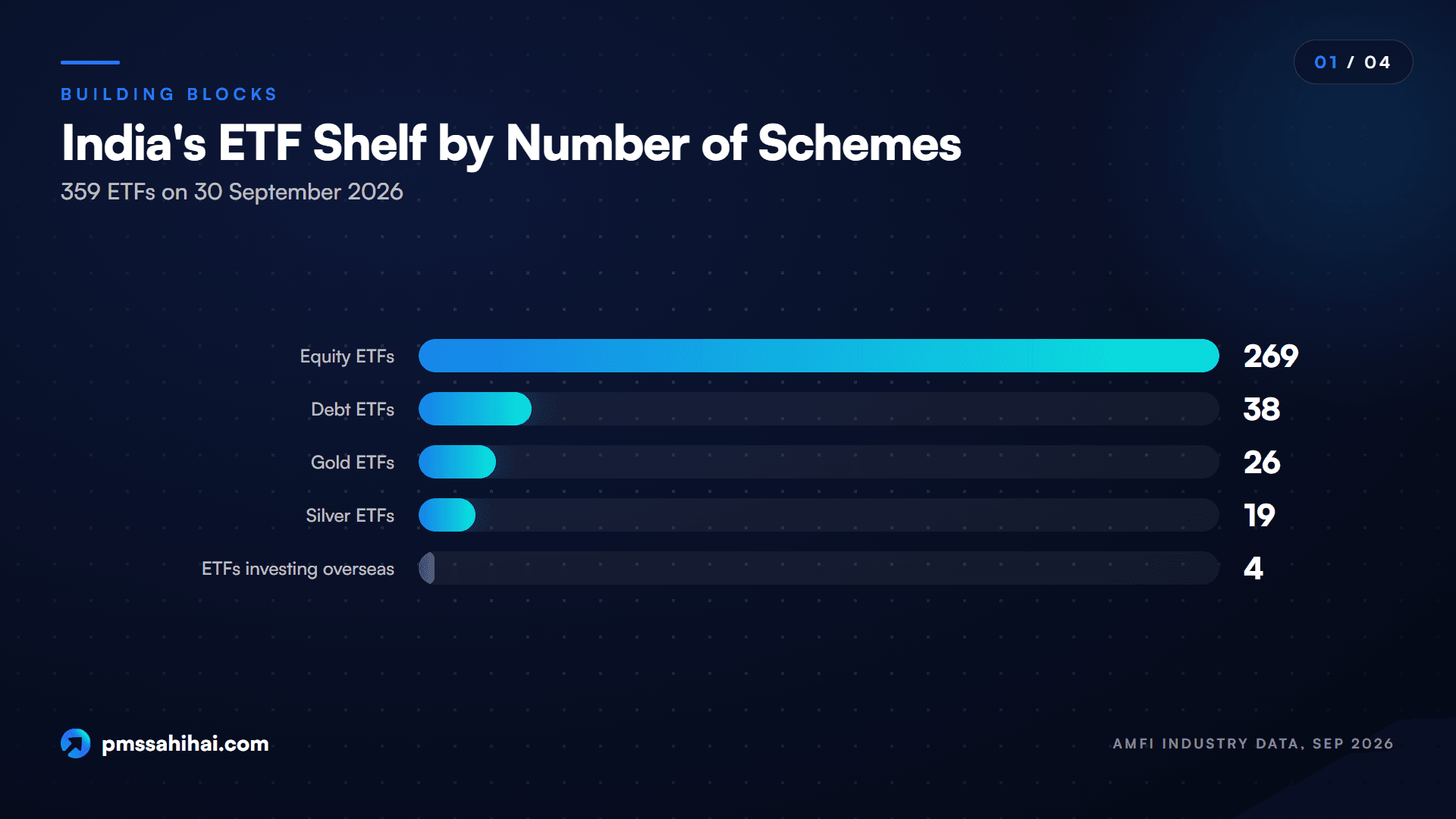
India's ETF shelf is now wide enough to build a full portfolio. According to AMFI's September 2026 industry data, there were 359 ETFs with net assets of about ₹11.5 lakh crore on 30 September 2026. The menu includes:
- Equity ETFs (269 schemes, about ₹7.81 lakh crore): broad indices such as the Nifty 50 and Sensex, mid-cap and small-cap indices, sector indices such as banks or IT, and factor or smart-beta indices such as momentum, quality, value and low volatility.
- Gold ETFs (26 schemes, about ₹1.86 lakh crore) and silver ETFs (19 schemes, about ₹81,600 crore).
- Debt ETFs (38 schemes, about ₹93,800 crore): government securities, state development loans, target-maturity bond ETFs and liquid or overnight ETFs.
- ETFs investing overseas (only 4 schemes, about ₹7,000 crore), plus Indian-listed ETFs that track foreign indices.
The Allocation Model: Who Decides the Weights
The allocation model is the product you are paying for. Managers describe these models in their disclosure documents, and they usually fall into three styles:
- Strategic, low-churn allocation. The manager sets long-run weights and rebalances when they drift. Capitalmind's ETF strategy shows a one-year turnover of only 0.18 as on 30 September 2026 on the APMI IA Insight Report, which suggests a largely buy-and-hold approach.
- Rules-based rotation. A quantitative model shifts weights between asset classes or factors using signals such as valuation, trend or momentum.
- Discretionary tactical calls. The manager overweights or underweights sectors, gold or duration based on a macro view.
Ask which of these you are buying: a rotation model behaves very differently from a low-churn one, especially at tax time.
What Actually Sits in Your Demat Account
In a PMS investing in ETFs, the units are bought on the exchange and credited to your own demat account, unlike a mutual fund or fund of funds, where you hold units of a pooled scheme. Direct ownership brings transparency, but it also means the tax consequences of every trade land on you, which we cover below and in our guide to how PMS gains are taxed in your own hands.
How ETF Portfolios Grew From Index Trackers Into PMS Strategies
ETFs reached India well before the idea of an all-ETF PMS did. A short timeline shows how the building blocks were assembled:
- 28 December 2001: Nifty BeES, India's first ETF, was incepted, as its Business Today fund page records. It was launched by Benchmark AMC and now belongs to Nippon India Mutual Fund.
- 2007: the first gold ETFs followed, giving investors a listed, demat-held route to gold.
- 18 March 2015: ICICI Prudential's PMS ETF Strategy was incepted, aiming at capital appreciation through "a basket of ETFs available in the market."
- March 2019: Capitalmind launched its ETF-only strategy, which invests in Indian and US index ETFs.
- 4 December 2019: the Union Cabinet approved Bharat Bond ETF, described as India's first corporate bond ETF.
- 23 May 2022: SEBI's passive funds circular created today's market-maker framework for ETFs. The circular is now consolidated in SEBI's Master Circular for Mutual Funds dated 20 March 2026.
- 15 June 2026: SEBI issued new norms for ETF base prices and price bands, which NSE says took effect on 7 September 2026.
- 7 October 2026: the SEBI (Portfolio Managers) Regulations, 2026 were notified. They take effect on 1 April 2027 and create PRIM, a mutual-fund-only route that explicitly includes ETFs.
ETF-Based PMS vs Stock-Picking PMS vs Doing It Yourself
The easiest way to understand an ETF-based PMS is to put it beside the two choices it most often competes with.
| Feature | ETF-based PMS | Stock-picking PMS | DIY ETF basket |
|---|---|---|---|
| What you own | ETF units in your demat | 15–30 individual stocks in your demat | ETF units in your demat |
| Source of return | Index returns plus allocation decisions | Stock selection plus allocation | Index returns plus your own allocation |
| Manager's job | Choosing and resizing asset-class and factor weights | Picking companies and sizing positions | None; you decide |
| Concentration risk | Low within each ETF | Often high | Low within each ETF |
| Minimum today | ₹50 lakh | ₹50 lakh | One ETF unit |
| Cost layers | PMS fee + GST + ETF expense ratios | PMS fee + GST (no fund-level fee) | ETF expense ratios only |
| Who triggers taxable sales | The manager | The manager | You |
Against a stock-picking PMS, you give up stock-specific upside for lower concentration and usually lower fees. Against DIY ETF portfolio management, you pay a second fee layer to hand over allocation, rebalancing discipline and paperwork.
The Two Cost Layers Every ETF PMS Investor Pays
Cost is the reason most investors look at this structure, so it deserves careful arithmetic. ETF PMS fees are only half of the bill.
Layer One: The Portfolio Manager's Fee Plus GST
The portfolio manager charges a management fee, sometimes with a performance fee, and GST at 18% applies on top. Published fee data for ETF-only strategies is thin, but two public cards are instructive:
- The APMI IA Insight Report for Capitalmind's ETF strategy, viewed in October 2026, shows a 0.25% management fee, nil exit load and assets of about ₹193 crore.
- Business Today's PMS card for the Wizemarkets Market Fund, whose description refers to the "Capitalmind Market portfolio" and which appears to be the same strategy, also shows a 0.25% fixed fee with no profit share, but its data is dated May 2025.
For comparison, a typical stock-picking PMS fixed fee is often quoted at about 1% to 2.5% a year, sometimes with a profit share, according to industry fee explainers such as Dezerv's. Always check the current fee schedule in the disclosure document.
Layer Two: ETF Expense Ratios and Trading Frictions
Every ETF deducts its own total expense ratio (TER) from its NAV. These costs vary widely by asset class:
- A large Nifty 50 ETF such as Nippon India ETF Nifty 50 BeES lists an expense ratio of 0.04%.
- A large gold ETF such as Nippon India ETF Gold BeES lists 0.79%.
Then come trading frictions: brokerage, levies, the bid-ask spread and any premium or discount to NAV, paid at every rebalance.
A Worked All-In Cost Example
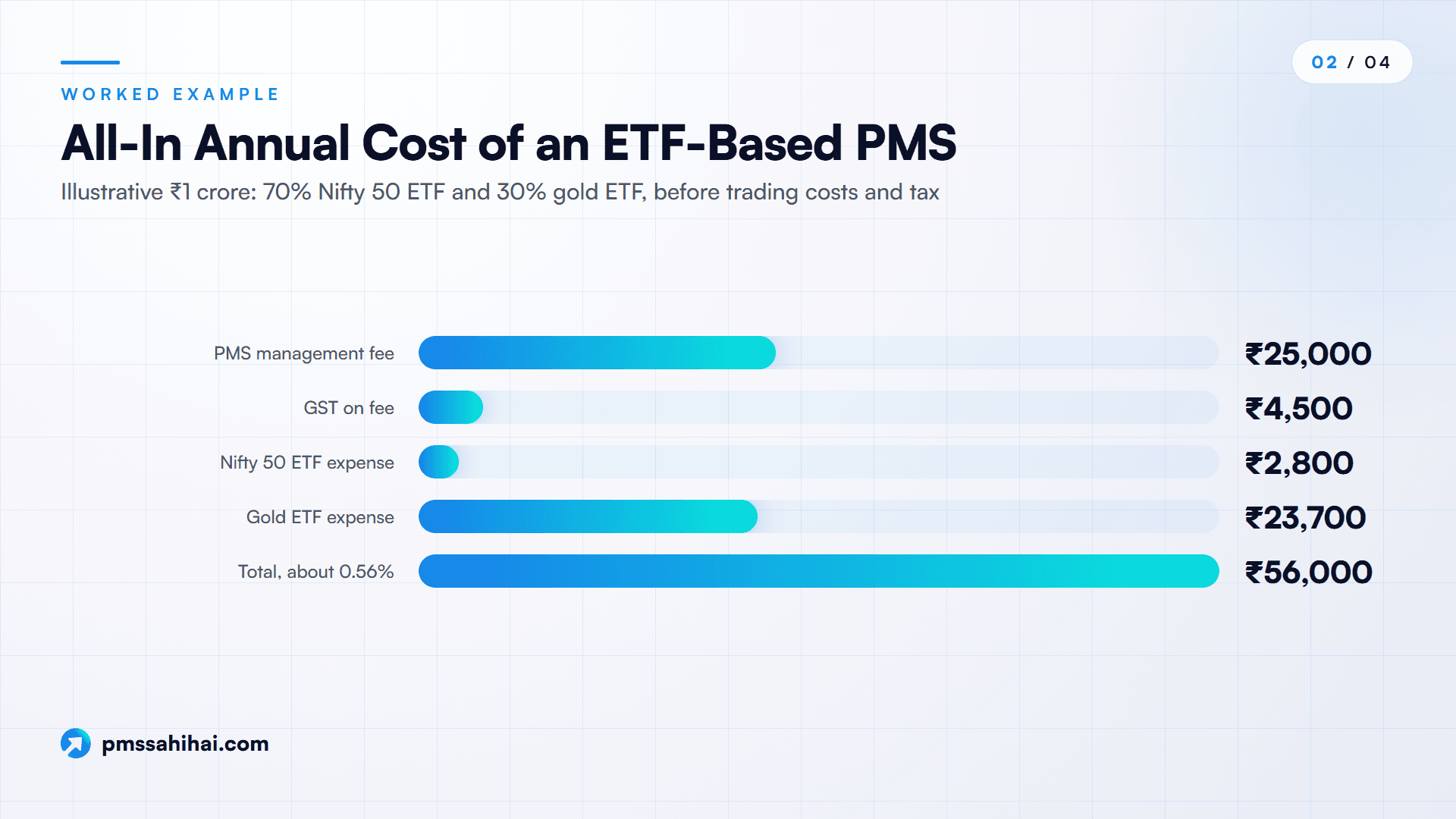
Take an illustrative ₹1 crore ETF-based PMS with a 70% Nifty 50 ETF and 30% gold ETF mix. The weights are hypothetical; the fee figures are the published ones above.
| Cost item | Calculation | Annual cost |
|---|---|---|
| PMS management fee | 0.25% of ₹1 crore | ₹25,000 |
| GST on fee | 18% of ₹25,000 | ₹4,500 |
| Nifty 50 ETF expense | 0.04% × ₹70 lakh | ₹2,800 |
| Gold ETF expense | 0.79% × ₹30 lakh | ₹23,700 |
| Total before trading costs and tax | ₹56,000 (about 0.56%) |
A DIY investor holding the same two ETFs would pay about ₹26,500 a year in expense ratios. So the manager's layer adds about ₹29,500 a year, or roughly 0.3% of assets. That is the price of allocation and rebalancing. Notice also that the gold sleeve's expense ratio is almost as large as the whole PMS fee. Product selection within each asset class matters as much as the headline fee.
For a stock-picking PMS at a 2% fixed fee, the same ₹1 crore would cost ₹2.36 lakh a year including GST, before any performance fee.
ETF Liquidity in India: iNAV, Market Makers and Spreads
An ETF portfolio is only as good as the prices at which it trades, and ETF liquidity in India remains uneven across products.
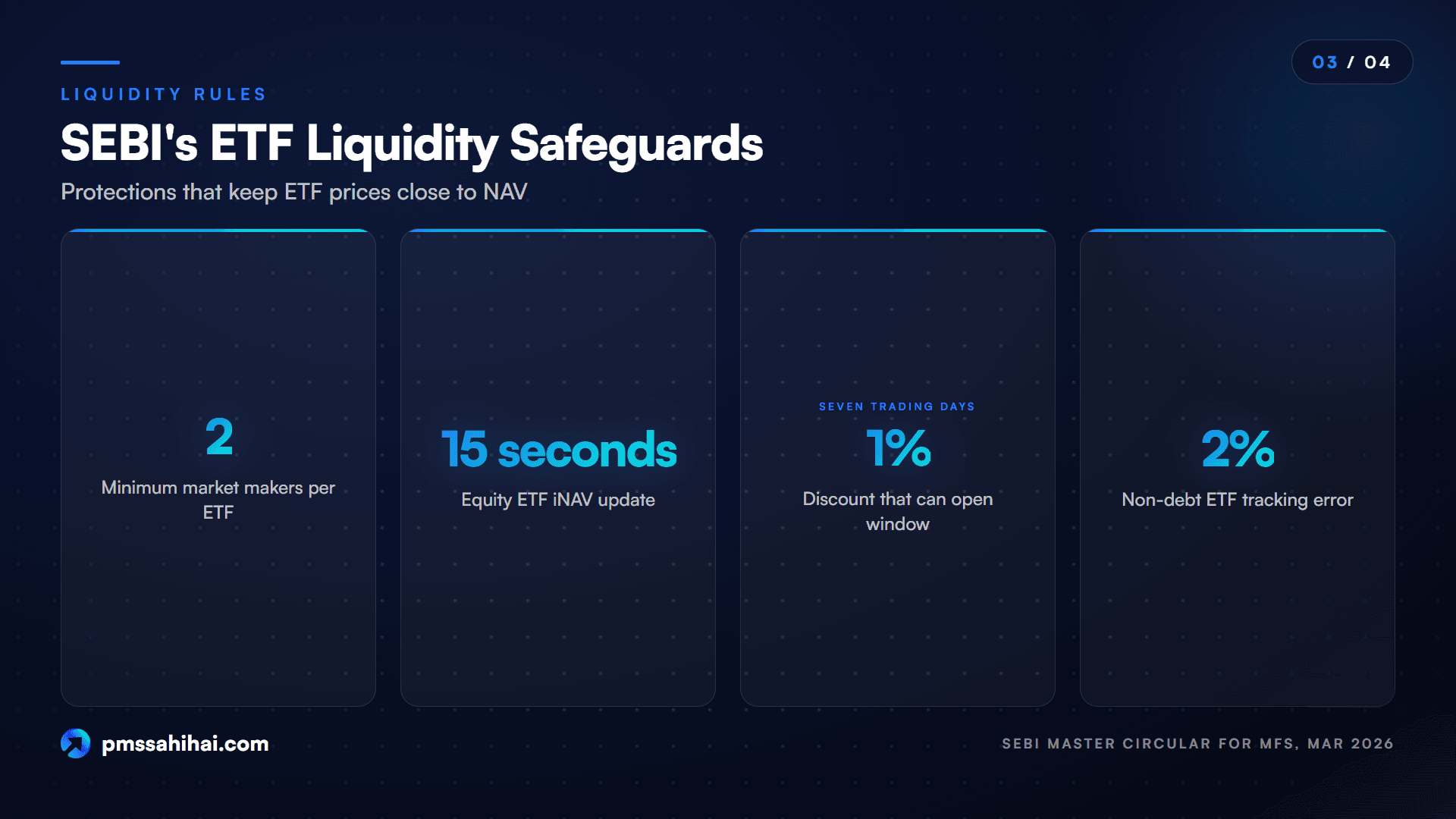
SEBI's Master Circular for Mutual Funds (20 March 2026) sets the main protections:
- Market makers: each AMC must appoint at least two market makers per ETF, with incentives linked to trading volume and bid-ask spreads.
- iNAV: the indicative NAV must update within 15 seconds for equity ETFs and at least four times a day for debt ETFs; for gold, silver and international ETFs it may be static or dynamic.
- Direct dealing with the AMC is allowed only above ₹25 crore, except for market makers.
- Liquidity window: if an ETF trades at more than a 1% discount to NAV for seven consecutive trading days, has no quotes for three days, or has thin bids for seven days, investors can redeem up to ₹25 crore directly with the AMC without an exit load.
- Tracking error for non-debt ETFs must not exceed 2%. For debt ETFs, the average annual tracking difference must stay within 1.25%.
In practice, large ETFs on liquid indices usually trade close to iNAV, while smaller ones can show wide spreads. A 2021 Business Standard explainer illustrated the risk with an ETF whose NAV was ₹100 but which could be bought at ₹102 and sold at ₹98, a 4% round trip. A good ETF PMS should explain how it checks volumes, spreads and impact cost before trading.
Why International ETFs Have Been Trading Far Above NAV
The international sleeve is the weak link today. SEBI caps mutual funds' overseas investments at US$7 billion industry-wide, with a separate US$1 billion limit for investing in overseas ETFs. When those limits are used up, AMCs cannot create fresh units, so market makers lose the mechanism that normally pushes the price back to NAV.
On 25 September 2026, NSE warned in a press release that units of certain international ETFs were trading at a substantial premium to NAV even though their NAVs had stayed broadly stable. It cautioned that buyers at steep premiums risk an abrupt price fall unrelated to the underlying markets. That could happen if overseas limits are raised, or when the base price for ETF price bands moves to the previous day's NAV from 1 April 2027 under SEBI's 15 June 2026 circular. Value Research reported a week in September 2026 in which one Nasdaq-linked ETF rose 41% while the 50 companies it holds fell 2.6%.
If an ETF-based PMS has a global sleeve, ask whether it buys Indian-listed international ETFs at premiums, and what its exit plan is.
How ETF Taxation Works When the Manager Switches Funds
ETF taxation inside a PMS follows the rules for each ETF you hold, applied every time the manager sells. Because the units are in your name, each sale is your capital gain in the year it happens. In contrast, when an index ETF rebalances its own constituents, the fund pays no tax: a SEBI-registered mutual fund is exempt under Schedule VII (Sl. No. 20) of the Income-tax Act, 2025, corresponding to old section 10(23D). Rotation by the PMS manager is therefore the main tax cost of active allocation.
Under the Income-tax Act, 2025, which applies from 1 April 2026, the main rules are:
| ETF type | Held 12 months or less | Held more than 12 months |
|---|---|---|
| Equity ETF (at least 65% in listed Indian equity) | 20% (s.196; old s.111A) | 12.5% on gains above ₹1.25 lakh a year (s.198; old s.112A) |
| Gold, silver and international equity ETFs (listed in India) | Slab rate | 12.5% (s.197; old s.112) |
| Debt ETF (more than 65% in debt and money-market instruments), bought on or after 1 April 2023 | Slab rate | Slab rate; always short-term (s.76; old s.50AA) |
A few points matter for portfolio design:
- The 12-month line applies to every listed ETF. Section 2(101) treats a security listed on a recognised Indian exchange as long-term after 12 months, so the line applies to gold and international ETFs too.
- International equity ETFs are not "equity-oriented". They do not hold 65% in Indian listed equity, so they miss the ₹1.25 lakh exemption and the 20% short-term rate. Short-term gains on them are taxed at your slab.
- Debt ETFs lose the long-term benefit entirely, so a manager rotating into and out of bonds creates slab-rate income for a top-bracket investor.
- Surcharge and cess apply on top of these rates.
A rotation model that switches every few months can turn would-be 12.5% long-term gains into 20% or slab-rate short-term gains. Ask any manager for its historical turnover and its tax-aware rules, such as holding positions past 12 months where the signal allows. Tax rules change, and individual situations differ, so consult a qualified tax adviser before acting on this summary.
PRIM Route and ETFs Under the Portfolio Managers Regulations 2026
The biggest change ahead is PRIM, the Portfolio Management Service Route for Investment in Mutual Fund units. It was created by the SEBI (Portfolio Managers) Regulations, 2026, notified on 7 October 2026 and effective from 1 April 2027. Until that date, the 2020 regulations and the July 2025 master circular continue to apply.
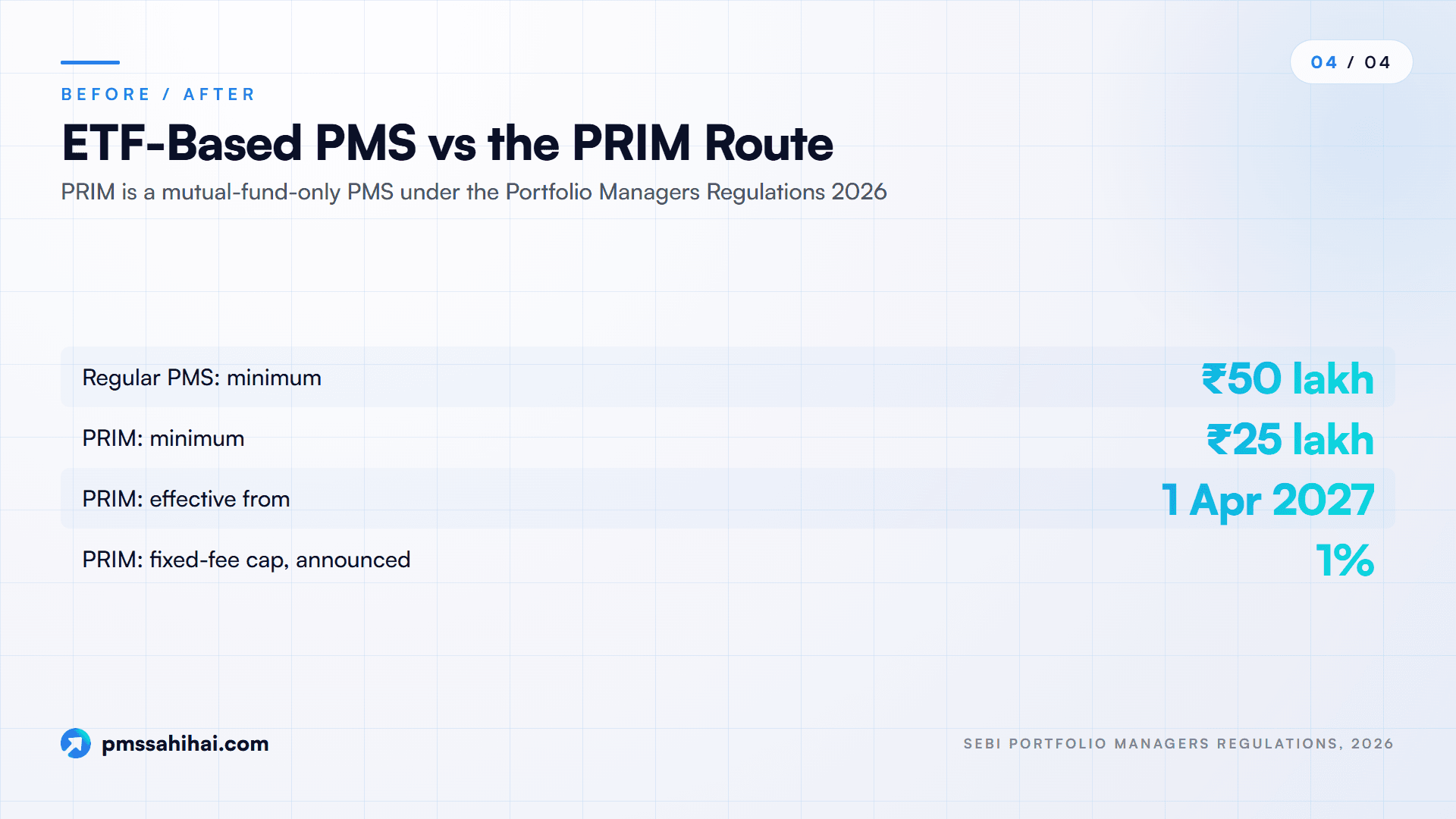
Does PRIM include ETFs? Yes. Regulation 32 of the notified text says the portfolio manager "shall invest funds of the client only in direct plans of mutual funds in India including index funds, exchange traded funds and specialized investment funds." In practice:
- Lower minimum. Regulation 33 sets a minimum of ₹25 lakh per client for PRIM, half the ₹50 lakh for a regular PMS.
- Indian schemes only. PRIM can hold ETFs issued by Indian mutual funds, including gold, debt and Indian-listed international ETFs. It cannot hold foreign-listed ETFs or individual stocks.
- Existing managers can join through segregated investment approaches (regulation 30(2)).
SEBI's board press release of 24 September 2026 also announced a fixed management fee cap of 1% of assets, with performance-based fees permitted, a waiver of exit-load provisions, and a 25% cap on schemes of affiliated AMCs. These conditions do not appear in the notified regulations. Regulation 34 leaves fees and similar conditions to SEBI, so treat them as announced and awaiting a circular.
ETF-Based PMS vs the PRIM Route: Not the Same Thing
PRIM and an ETF-based PMS overlap but are not interchangeable. PRIM is a mutual-fund-only PMS; an ETF-based PMS is an ordinary PMS that happens to choose ETFs.
| Feature | ETF-based PMS (regular PMS) | PRIM portfolio (from 1 April 2027) |
|---|---|---|
| Permitted universe | Listed securities, mutual fund units and other permitted instruments, so ETFs can be mixed with stocks or bonds | Only direct plans of Indian mutual funds, including ETFs, index funds and SIFs |
| Minimum per client | ₹50 lakh | ₹25 lakh |
| Fee limits | Usual PMS fee rules | 1% fixed-fee cap announced, awaiting a circular |
| Foreign-listed ETFs | Announced for discretionary and non-discretionary PMS, awaiting a circular | Not permitted |
| Index funds as building blocks | Possible, but unusual | Explicitly permitted |
Index funds matter here: a PRIM manager can use them instead of ETFs, which removes bid-ask spreads and exchange premiums. Switches still realise gains in your name, because the units are yours.
The PRIM route could become the natural home for low-cost ETF allocation strategies. The same press release announced that regular discretionary and non-discretionary PMS will be able to buy foreign securities, including ETFs, under FEMA and the LRS; the notified text leaves details to SEBI, so watch for the circular.
What an ETF-Based PMS Does Well for Cost-Aware HNIs
For the right investor, the structure solves real problems:
- Low headline fees are achievable. At least one ETF-only strategy charges 0.25%, a fraction of typical stock-picking PMS fees.
- Cheap building blocks. Broad equity ETFs can cost as little as 0.04% a year, so most of your money compounds almost at index cost.
- Diversification by default. Each ETF holds an entire index, so a single company's failure barely registers.
- Professional allocation and discipline. The manager handles rebalancing, drift control and execution.
- Full transparency. Every unit sits in your demat account, and the ETFs' tracking error and iNAV are public.
- A cheaper entry route from April 2027. PRIM will allow ETF and index-fund portfolios from ₹25 lakh.
How PMS Sahi Hai Helps You Read the Inner Clause of an ETF-Based PMS
An ETF-based PMS is easy to describe and hard to compare: the headline fee is one of two cost layers, and the strategy may sit under an equity label that says nothing about the ETFs inside. Here is how PMS Sahi Hai helps, and where its help ends.
Shortlist on one screen. The PMS listing on PMS Sahi Hai can be filtered by category label and by benchmark, and each strategy page shows trailing returns beside the stated benchmark, from one month to five years and since inception. For an ETF strategy benchmarked to the Nifty 50 TRI, that comparison tells you whether the allocation calls have added anything over simply holding the index.
Ask Nyra the structural questions. Nyra is PMS Sahi Hai's AI-powered research tool. Use it to frame the questions this article raises: what to ask a manager about the ETFs it uses, how a rotation between equity, gold and debt ETFs would be taxed, and what to ask about international sleeves trading above NAV. Its published scoring methodology gives 30% of the Nyra Score to excess return over the stated benchmark across one, three and five years, and a strategy needs at least 12 months of record to be rated. Several ETF strategies are small, so check whether a score exists before leaning on it; the score is described as not a recommendation.
Do the cost arithmetic yourself. Strategy pages do not show holdings tables, so the expense ratios of the ETFs underneath come from the disclosure document and the AMCs' own scheme pages. Take the worked example above, plug in the fee from the disclosure document and the TERs of the ETFs the manager names, and add 18% GST on the fee. Our guide to portfolio turnover explains how to read the churn figure that drives your tax bill.
PMS Sahi Hai is an APMI-registered distributor of PMS and AIF products, and Nyra is an analytical tool, not a SEBI-registered investment adviser. The disclosure document and your tax adviser have the final word.
Where an ETF-Based PMS Falls Short
The honest limitations are just as important:
- Two fee layers can erase the cost advantage, especially if the manager favours expensive ETFs.
- Every switch is taxable for you. Active rotation realises gains in your name, while a buy-and-hold index investor defers tax for years.
- High entry ticket. Outside PRIM, you still need ₹50 lakh, while a DIY ETF portfolio needs only a demat account.
- Liquidity is uneven. Thin ETFs carry wide spreads, and international ETFs have recently traded at large premiums to NAV.
- Few products. Only a handful of ETF-only PMS strategies are publicly listed.
- Allocation skill is hard to prove. Tactical asset allocation needs a long track record to separate skill from luck, and most of these strategies are young.
Comparing an ETF PMS With Index Funds, ETF Baskets, Smallcases and Stock-Picking PMS
Here is how the main routes to passive building blocks compare for an HNI:
| Feature | Index funds | DIY ETF basket | Smallcase-style model portfolio | ETF-based PMS | Stock-picking PMS |
|---|---|---|---|---|---|
| Minimum | Very low (SIP) | One unit | Price of the basket | ₹50 lakh (₹25 lakh via PRIM from April 2027) | ₹50 lakh |
| Who allocates | You | You | Model provider suggests; you execute | Manager, with discretion | Manager, with discretion |
| What you own | Fund units | ETF units | ETF units or stocks | ETF units | Stocks |
| Typical cost layers | Fund expense ratio | ETF expense ratio + trading costs | ETF expense ratio + subscription or fee | PMS fee + GST + ETF expense ratios | PMS fee + GST |
| Trade execution | At NAV | On exchange | On exchange, by you | On exchange, by manager | On exchange, by manager |
| Tax on rebalancing | None inside the fund; tax on your redemption | On each sale you make | On each sale you make | On each sale the manager makes | On each sale the manager makes |
| Regulatory oversight | SEBI MF rules | Exchange and MF rules | Depends on provider's registration | SEBI PM Regulations | SEBI PM Regulations |
Index funds win on simplicity and tax deferral for a static mix; a DIY basket or model portfolio wins on cost if you stay disciplined. An ETF-based PMS earns its place only when you value delegated, discretionary allocation and consolidated reporting enough to pay for them. The difference between a model portfolio you execute and a mandate someone else executes is covered in PMS vs Smallcase: Direct Ownership, Two Different Ways.
Deciding Whether Passive Building Blocks Need an Active Manager
An ETF-based PMS is not a passive product. It is an active allocation service built from passive parts.
It tends to suit investors who:
- already accept index investing and do not want to pay for stock picking;
- want exposure across equity, gold, bonds and possibly global markets without running the rebalancing themselves;
- have ₹50 lakh or more today, or ₹25 lakh once PRIM begins on 1 April 2027;
- are comfortable that each switch is a realised gain in their own name.
It is probably not right for investors who:
- want a static mix they will rarely change, since index funds or a DIY basket do that more cheaply;
- are in the top tax bracket and would face a high-turnover rotation model;
- need a large international sleeve right now, given the premiums on Indian-listed global ETFs.
Before signing, ask five questions. What is the all-in cost, including ETF expense ratios? What has portfolio turnover been? Which ETFs does the manager use, and how liquid are they? How is performance measured against a simple static mix of the same ETFs? And will the strategy move to the PRIM route after April 2027? Line up the answers for two or three strategies on PMS Sahi Hai and put the open points to Nyra before you meet any manager.
Take the Next Step Before Choosing an ETF PMS
An ETF-based PMS can give you index-like building blocks with a professional allocation process. Compare the all-in cost, the manager's turnover and the liquidity of the ETFs used before you commit. Use the PMS Sahi Hai comparison tool to shortlist strategies by benchmark and record, ask Nyra to help frame your questions on cost, tax and liquidity, or book a 15-minute conversation with the team. Then read each disclosure document and compare every candidate side by side with a static ETF mix before you sign.
PMS Sahi Hai is a distributor of Portfolio Management Services and Alternative Investment Funds, APMI-registered (Registration No. APRN08358). This article is for education only and is not investment advice, a recommendation, or an offer to buy or sell any security. Investments in securities markets are subject to market risks; read all scheme-related documents carefully. Past performance is not indicative of future results. Consult your advisor before investing.
Ishaan founded PMS Sahi Hai to make India's PMS, AIF and GIFT City markets legible to serious investors, comparing every SEBI-registered manager on the same comparative basis, with no shelf products and no commission bias.
Frequently asked
What is an ETF-based PMS?
It is a SEBI-registered portfolio management service that invests mainly or entirely in exchange-traded funds covering equity indices, factors, gold, debt and sometimes global markets. The manager's allocation model sets the weights, the units sit in your own demat account, and the minimum today is ₹50 lakh.
How is an ETF PMS different from a stock-picking PMS?
A stock-picking PMS tries to beat the market by choosing companies. An ETF PMS buys whole indices and adds value, if at all, through allocation across asset classes, sectors and factors. It is more diversified and can charge lower fees, but you also pay the ETFs' expense ratios.
What does an ETF PMS cost in total?
Add the PMS fee, 18% GST on it, the weighted expense ratio of the ETFs and trading costs. On an illustrative ₹1 crore, 70:30 Nifty 50 and gold ETF portfolio with a 0.25% fee, that is about ₹56,000 a year before trading costs and tax.
Is every rebalance in an ETF PMS taxable?
Yes, every sale is taxable, because the ETF units are held in your name. Each sale by the manager is a transfer that creates a capital gain or loss for you in that year. Equity ETFs held up to 12 months are taxed at 20%, and longer holdings at 12.5% above ₹1.25 lakh. Gold and international ETFs follow different rules, and debt ETFs are taxed at slab rates. Consult a tax adviser.
Are Indian ETFs liquid enough for a PMS?
Large ETFs on liquid indices usually trade close to iNAV, helped by SEBI's rule of at least two market makers per ETF. Smaller ETFs can show wide spreads, and Indian-listed international ETFs have recently traded at steep premiums because overseas limits stopped new unit creation.
Can the PRIM route invest in ETFs?
Yes. Regulation 32 of the SEBI (Portfolio Managers) Regulations, 2026 allows PRIM portfolios to invest only in direct plans of Indian mutual funds, "including index funds, exchange traded funds and specialized investment funds." PRIM starts on 1 April 2027 with a ₹25 lakh minimum. The announced 1% fixed-fee cap still awaits a SEBI circular.
Is an ETF-based PMS the same as a PRIM portfolio?
No. An ETF-based PMS is a regular PMS that chooses ETFs, needs ₹50 lakh today and may also hold stocks or bonds. PRIM, from 1 April 2027, is a separate mutual-fund-only route with a ₹25 lakh minimum that may use ETFs, index funds and SIFs of Indian AMCs, but no individual stocks or foreign-listed ETFs.
Are ETF-based PMS strategies common in India?
No, they are rare. The APMI IA Insight Report lists only a handful of approaches whose stated purpose is investing through ETFs, such as ICICI Prudential's ETF Strategy and Capitalmind's ETF strategy, and most carry modest assets. Expect to read disclosure documents closely, because SEBI has no separate ETF PMS category.
Should I choose an ETF PMS or build my own ETF basket?
Build your own if you can choose a mix and rebalance on schedule; you avoid the PMS fee layer entirely. Choose an ETF PMS if delegated allocation and consolidated reporting are worth the extra cost to you.
Keep reading
All articles
What Happens to Your GIFT City Investment When You Return to India
Returning NRI? What happens to GIFT City funds, deposits and PMS when FEMA and tax residency change: RNOR rules, the 3-month exit and a dated checklist.
DTAA Benefits for NRIs: How to Claim the Treaty Rate on Indian Income
How NRIs claim DTAA benefits in 2026: tax residency certificate, Form 41, who gets the papers, the treaty rate at source and TDS refunds.
AIF Taxation for NRIs: Rates by Category and Repatriation
AIF taxation for NRIs: Category I, II and III rates by income type, TDS and treaty relief, NRE vs NRO routes and the USD 1 million limit.
Read it. Now pressure-test it.
Ask Nyra how this applies to your portfolio, or talk to our team, no pitch, no pressure.