
UHNI Wealth Management Strategies: Structure, Allocation, Liquidity
Eight UHNI wealth management strategies: family balance sheet, structures, PMS/AIF/GIFT City allocation, liquidity tiers and estate planning.


UHNI wealth management is less about finding a better fund and more about making decisions in the right order: map the family balance sheet, choose how assets are held, spread money across PMS, AIF, GIFT City and direct deals, keep liquidity for capital calls, reduce the risk in the family business and write succession into every account. SEBI rules that matter at this level changed in 2025 and 2026, including a Rs 25 crore large value fund minimum, co-investment alongside AIFs and, on 5 November 2026, manager-led accreditation. Legal and tax points here are general: check them with a lawyer and a tax adviser.
Why UHNI Wealth Management Needs Its Own Playbook
India has no legal definition of an ultra HNI. Global wealth reports use a net worth of US$30 million or more; Knight Frank's Wealth Report 2026 counted 19,877 such people in India, sixth in the world, and expects about 25,217 by 2031. Business Today converted the threshold to roughly Rs 282 crore. Indian wealth firms usually draw the UHNI line far lower, at around Rs 25 crore of investable assets. Which line applies matters less than what changes once a family crosses it.
Below that line, most investors solve one problem: build a corpus and avoid mistakes. Above it, the problems multiply. Wealth sits in several names, several entities and often several countries. A large share is locked inside an operating business. The family has to fund capital calls, support three generations, handle a sale or listing of the business and pass assets on without disputes. Products that look attractive on their own can clash once they sit in the same balance sheet.
That is why UHNI wealth management works best as a sequence of decisions rather than a product list. This guide covers eight UHNI investment strategies in the order most families should take them. If you are still working out which tier you sit in, our explainer on what separates retail, HNI and UHNI investors covers the thresholds. This post assumes you are already there and asks what to do next.
How UHNI Wealth Management Evolved in India
For most of the twentieth century, Indian family wealth was run by the family itself, with a trusted accountant and a bank manager. The legal tools came early: the Indian Trusts Act, 1882 still governs private trusts. India levied estate duty from 1953 and abolished it in 1985, so Indian trusts have been used mainly for control and succession rather than to avoid death taxes.
The modern UHNI toolkit arrived in layers:
- 1990s–2000s: portfolio management services and private banking desks offered separately managed equity portfolios.
- 2012: the SEBI (Alternative Investment Funds) Regulations created a regulated route into private equity, venture capital, private credit and hedge-fund style strategies.
- 2015 onward: GIFT City's International Financial Services Centre opened, later regulated by the IFSCA.
- 2018–2025: EY and Julius Baer counted more than 300 family offices in India by 2025, up from 45 in 2018.
- 2021: the accredited investor framework entered the AIF Regulations.
- September 2025: AIFs could offer co-investment schemes to their accredited investors.
- November 2025: the large value fund minimum fell to Rs 25 crore, and an "Accredited Investors only fund" category was created.
- October 2026: the SEBI (Portfolio Managers) Regulations, 2026 were notified on 7 October, effective 1 April 2027. On 15 October, a Rs 5 crore securities-market exposure test was added for accreditation.
- 5 November 2026: fund managers and portfolio managers could determine accredited status themselves.
Regulation has moved from treating all wealthy investors alike to giving larger, tested investors more choice, with fewer default protections. That choice helps only if the family has a plan for using it.
Strategy 1: Map the Whole Family Balance Sheet First
Most ultra HNI families cannot quickly answer a simple question: what do we own, in whose name, and how fast can it become cash? Wealth sits in the founder's name, a spouse's, an HUF, private companies, an LLP, a trust and foreign accounts, and each manager reports only on its own slice.
Start with one statement listing every asset and liability across every person and entity. For each line, record:
- Owner (individual, HUF, company, LLP, trust) and beneficial owner.
- Asset type, current value and how the value was measured.
- Liquidity: days to cash, lock-in end date, exit load and any pledge.
- Concentration: exposure to the family business, its sector and its promoters.
- Tax position: unrealised gains and how a sale would be taxed.
- Succession status: nominee, will, trust or none.
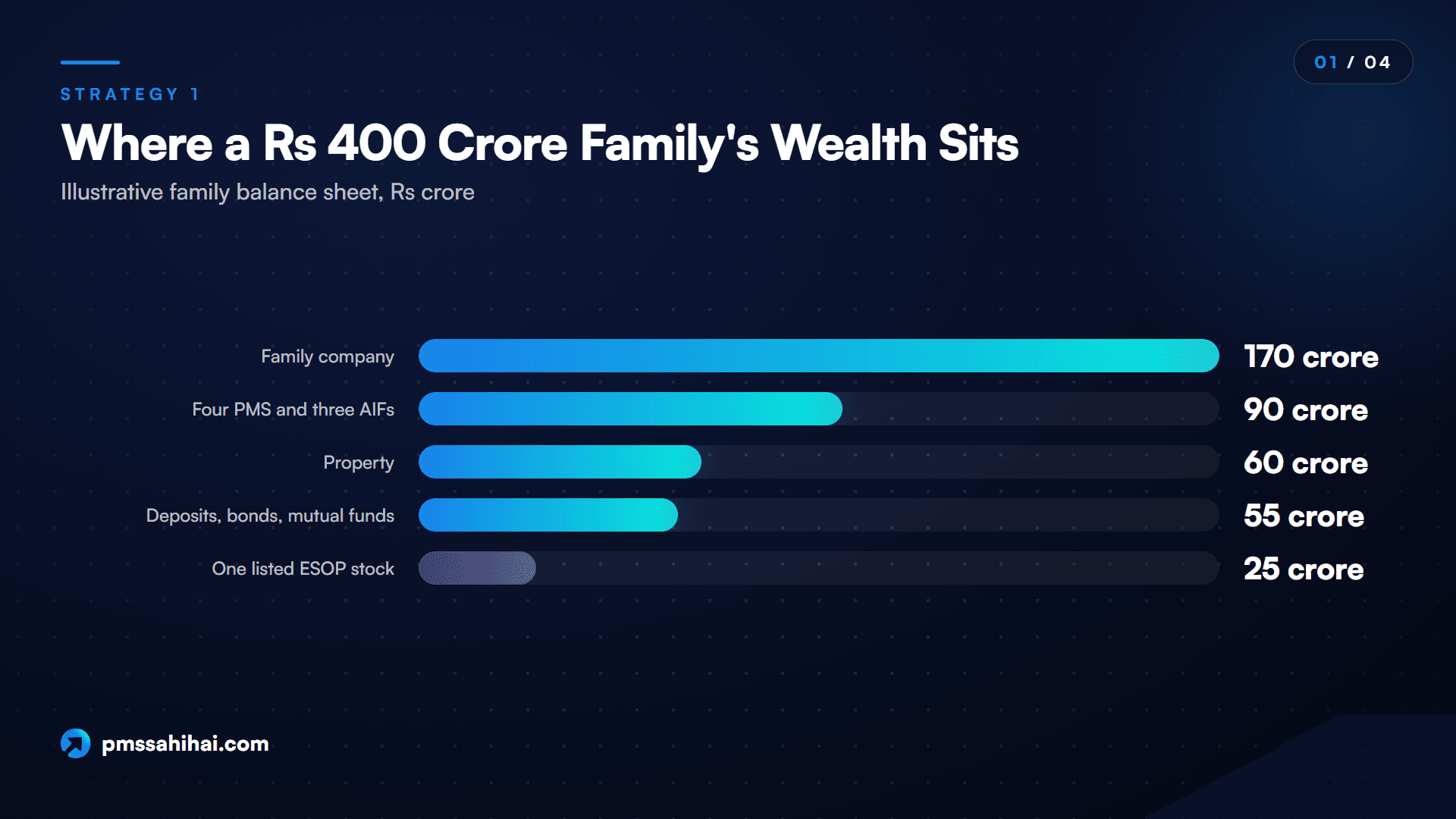
An illustrative Rs 400 crore family might hold Rs 170 crore in the family company, Rs 60 crore in property, Rs 25 crore in one listed ESOP stock, Rs 90 crore across four PMS accounts and three AIFs and Rs 55 crore in deposits, bonds and mutual funds. It looks diversified, yet more than half the net worth rides on one business and its sector, and the PMS accounts may own the same large banks.
Write a Family Investment Policy Statement
Once the map exists, write down the rules. A family investment policy statement usually covers return goals, the maximum drawdown the family can live with, five-year liquidity needs, the target UHNI asset allocation and its ranges, allowed vehicles, who approves new investments and how often the portfolio is reviewed. Setting the policy mix and choosing a rebalancing method are subjects of their own; our guide to asset allocation strategies for PMS investors is a starting point. The key point here: the people who will decide after the founder should sign it too.
Strategy 2: Choose the Holding Structure Before the Product
At this level, how an asset is held matters as much as what it is. The same PMS mandate can sit with an individual, an HUF, a family company or a trust, and each choice changes control, tax, what happens on death or divorce and whether business creditors can reach it.
Family Office, Trusts, HUFs and LLPs in Brief
A family office is a privately held company that handles investment and wealth management for a wealthy family. A single family office suits families with enough wealth to pay for an in-house team; others use a multi-family office or a private bank. SEBI does not regulate family offices as a category, so the investments they make are regulated through the products they buy.
A private trust separates legal ownership (the trustee) from benefit (the beneficiaries). Families use them to keep assets together across generations, set rules for distributions and shield assets from claims against individual members. Trust income is taxed under the trust provisions of the Income-tax Act, 2025 (sections 303 to 307, formerly 160 to 164), and the rate can depend on whether beneficiaries and their shares are fixed.
An HUF gives a Hindu joint family its own tax identity. An LLP or a private company can hold investments and give partners or shareholders a clear governance framework.
Each structure has costs, filings and trade-offs, and several of them interact with the accredited investor rules covered later. Choosing among them is legal and tax work, not investment work. Consult a lawyer and a tax adviser before you set up or move assets into any of them.
Strategy 3: Spread the UHNI Portfolio Across PMS and AIF Managers
Next comes the investment mix, the part of UHNI asset allocation families often tackle first, though it works better after Strategies 1 and 2. A common pattern is a low-cost core of index funds, bonds and large-cap exposure with PMS and AIF mandates around it; the core-satellite framework has its own guide. Here the focus is how an ultra HNI family uses each satellite vehicle.
How Many PMS Managers a Family Actually Needs
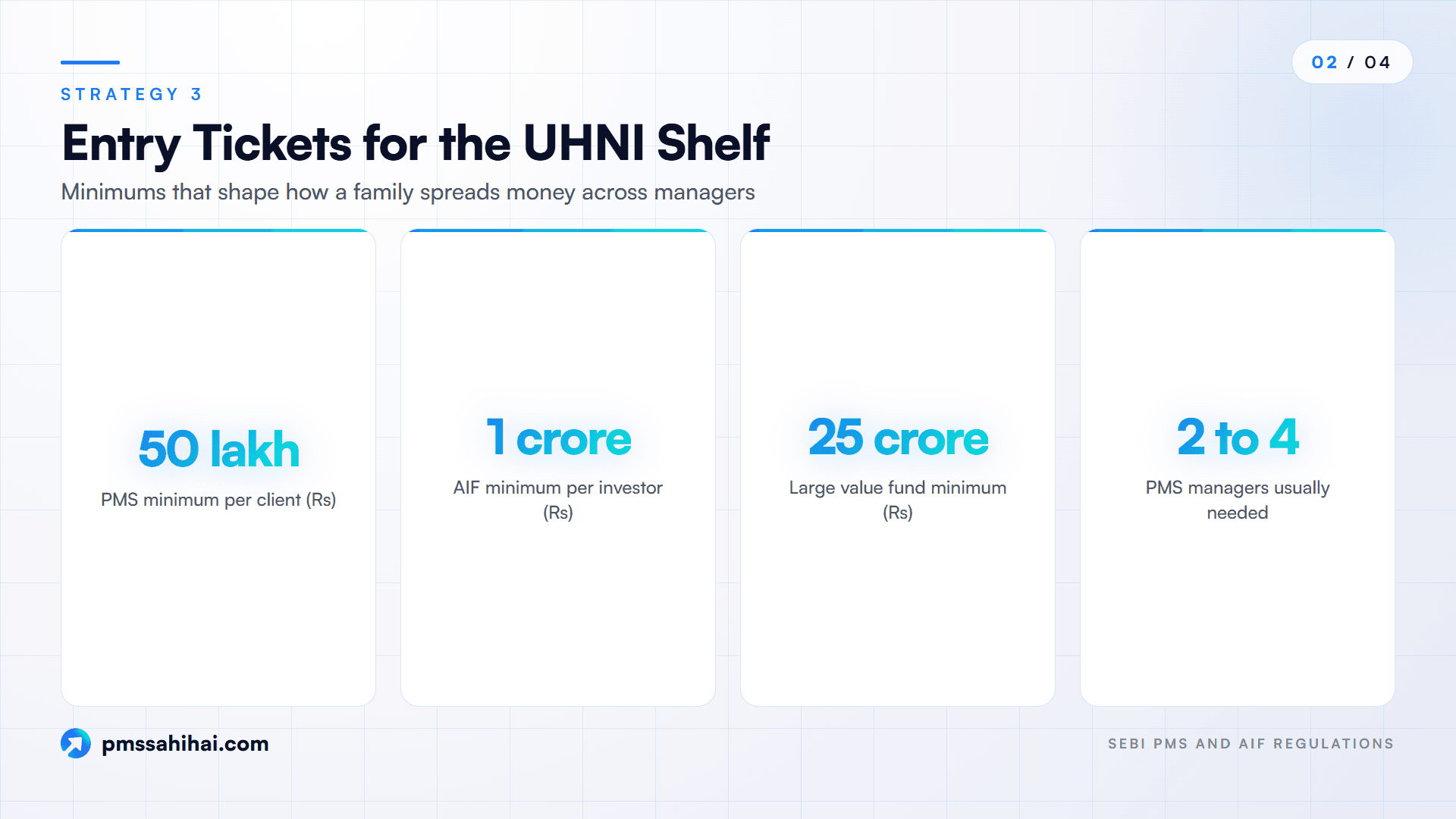
A PMS holds stocks directly in the investor's own demat account, which gives full visibility and lets the family see every holding. The SEBI minimum is Rs 50 lakh per client, and accredited investors are exempt from it. PMS gains are taxed in the investor's own hands each time the manager sells, so high-turnover strategies create tax bills every year.
With Rs 50 crore or more in listed equity, the temptation is to hire six or eight managers who then own the same 30 large companies, so the family pays several fee layers for something close to an index. Two to four managers with clearly different styles (say, large-cap quality, mid-cap and value) usually cover the opportunity set. Check stock-level overlap across PMS accounts before adding another. At this size fees are often negotiable; remember the 18% GST on fees.
Where Category I, II and III AIFs Fit
An AIF is a pooled fund with a Rs 1 crore minimum per investor. The three categories do different jobs in a UHNI portfolio:
| AIF category | Typical strategies | Role in a UHNI portfolio | Liquidity |
|---|---|---|---|
| Category I | Venture capital, angel, infrastructure, SME, social impact | Long-term growth; exposure to new businesses | Closed-ended, often 7–10 years |
| Category II | Private equity, private credit, real estate, pre-IPO | Growth and income outside listed markets | Closed-ended, capital called over time |
| Category III | Long-short, hedge-fund style, listed-equity strategies | Return streams different from long-only equity | Often open-ended or with shorter lock-ins |
Category I and II AIFs are tax pass-through vehicles for most income: the investor pays tax as if they had earned it directly. Onshore Category III AIFs are taxed at the fund level, and the effective rates and whether investors are taxed again on redemption are disputed. Our comparison of AIF vs PMS taxation sets out the basics, but a tax adviser should run the numbers before the family commits.
Private-market AIFs draw money in stages through capital calls: a Rs 10 crore commitment may be called over three or four years and returned over seven to ten. Strategy 6 has to fund these calls; our guide to how capital calls work explains the drawdown schedule.
Large Value Funds and Co-Investment for Accredited Investors
Two routes are open only to accredited investors.
A large value fund for accredited investors (LVF) requires each investor to put in at least Rs 25 crore. In exchange, a Category I or II LVF may invest up to 50% of its investable funds in one company, and a Category III LVF up to 20%, double the ordinary limits of 25% and 10%. That allows high-conviction portfolios, and lets one bad investment do far more damage.
Co-investment lets an accredited investor in a Category I or II AIF invest directly in one of the fund's portfolio companies through a separate scheme. Since SEBI's September 2025 co-investment framework, the rules cap it at three times the investor's contribution to that company through the main fund, bar leverage and require exit at the same time and on the same terms as the AIF. It can cut fee layers. The risk is adverse selection: the deals offered may be the hardest ones to fill.
Strategy 4: Add GIFT City and Direct Deals With Clear Limits
Many ultra HNI families also add dollar assets and direct stakes in private companies. Both need limits set in advance.
GIFT City Funds for Resident Families
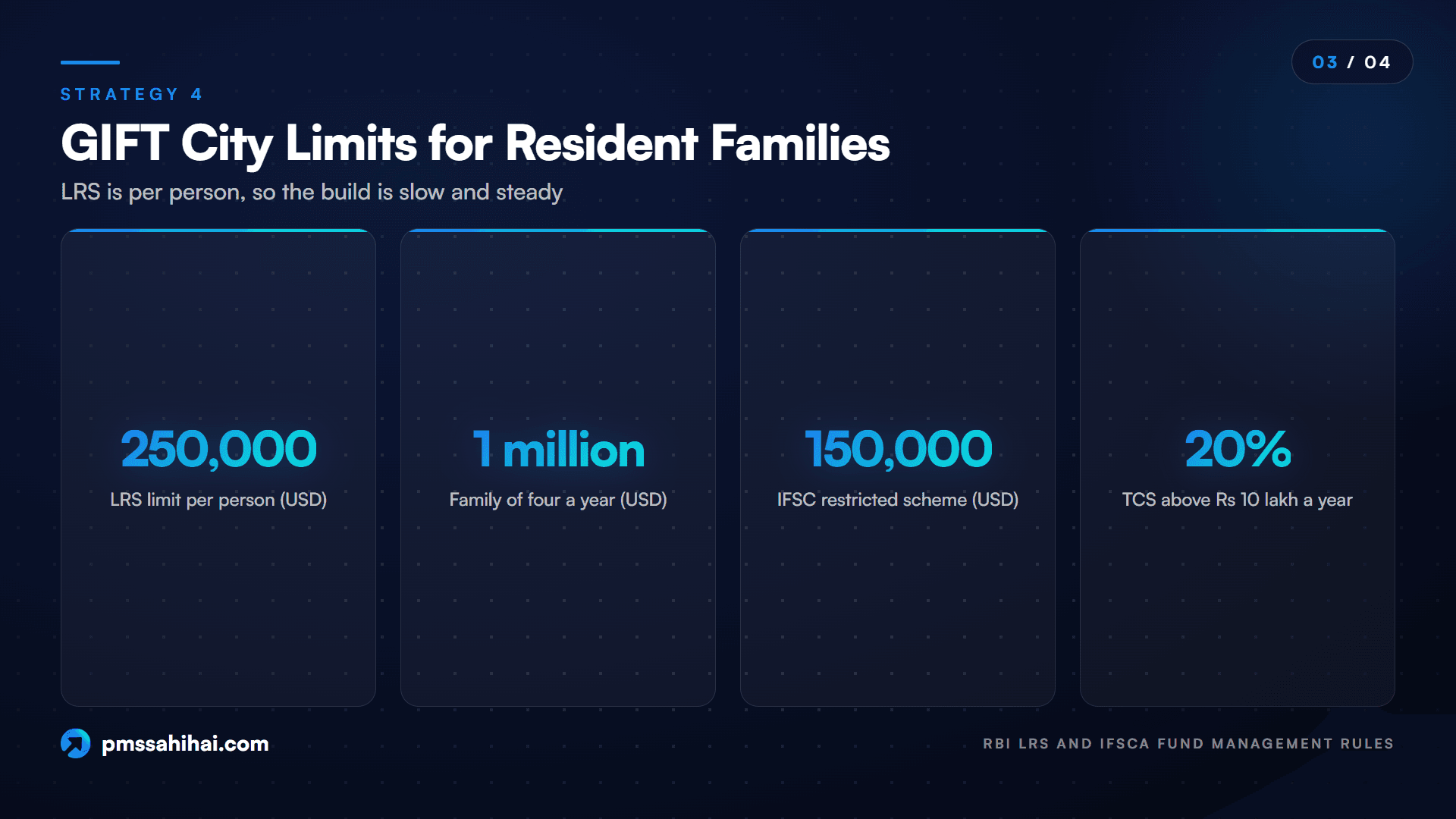
Resident individuals can send up to USD 250,000 per financial year abroad under the Liberalised Remittance Scheme, and RBI allows LRS money to go to IFSC funds in GIFT City. The limit is per person, so a family of four adults can remit up to USD 1 million a year in total, provided each person uses their own money. Tax collected at source applies to LRS remittances for investment above Rs 10 lakh a year at 20%, which can be claimed back against tax due, but ties up cash in the meantime.
IFSCA's fund management rules set a USD 150,000 minimum for restricted schemes and USD 75,000 for portfolio management in the IFSC, so a single person's LRS limit covers one or two such commitments a year. That makes GIFT City a slow, steady build rather than a one-time switch.
The tax breaks commonly advertised for GIFT City funds apply mainly to non-residents. A fund that takes resident LRS money falls outside the "specified fund" regime, and whether residents must report IFSC units as foreign assets is disputed. Resident families should not assume the NRI tax treatment; our guide to GIFT City funds for resident Indians covers what residents can and cannot buy, and a tax adviser should confirm the treatment.
Direct Deals and Unlisted Shares
Business families often back companies directly: a friend's start-up, a pre-IPO round, a supplier. Direct deals can pay off, but the family takes on what a fund manager would absorb: diligence, valuation, documents, minority rights and exit.
Set a hard cap on direct deals as a share of the UHNI portfolio (for example, a single-digit percentage) and a per-deal cap. Our guide to pre-IPO investing in India compares fund and direct routes. Use the angel fund or co-investment routes where possible, since they come with a registered manager and standard documents. Be careful with websites that sell unlisted shares: in June 2026 SEBI warned again that platforms trading unlisted securities of public companies are not authorised or recognised by SEBI, and that investors using them have no access to exchange investor-protection or dispute-resolution mechanisms.
Strategy 5: Use Accredited Investor Status Deliberately
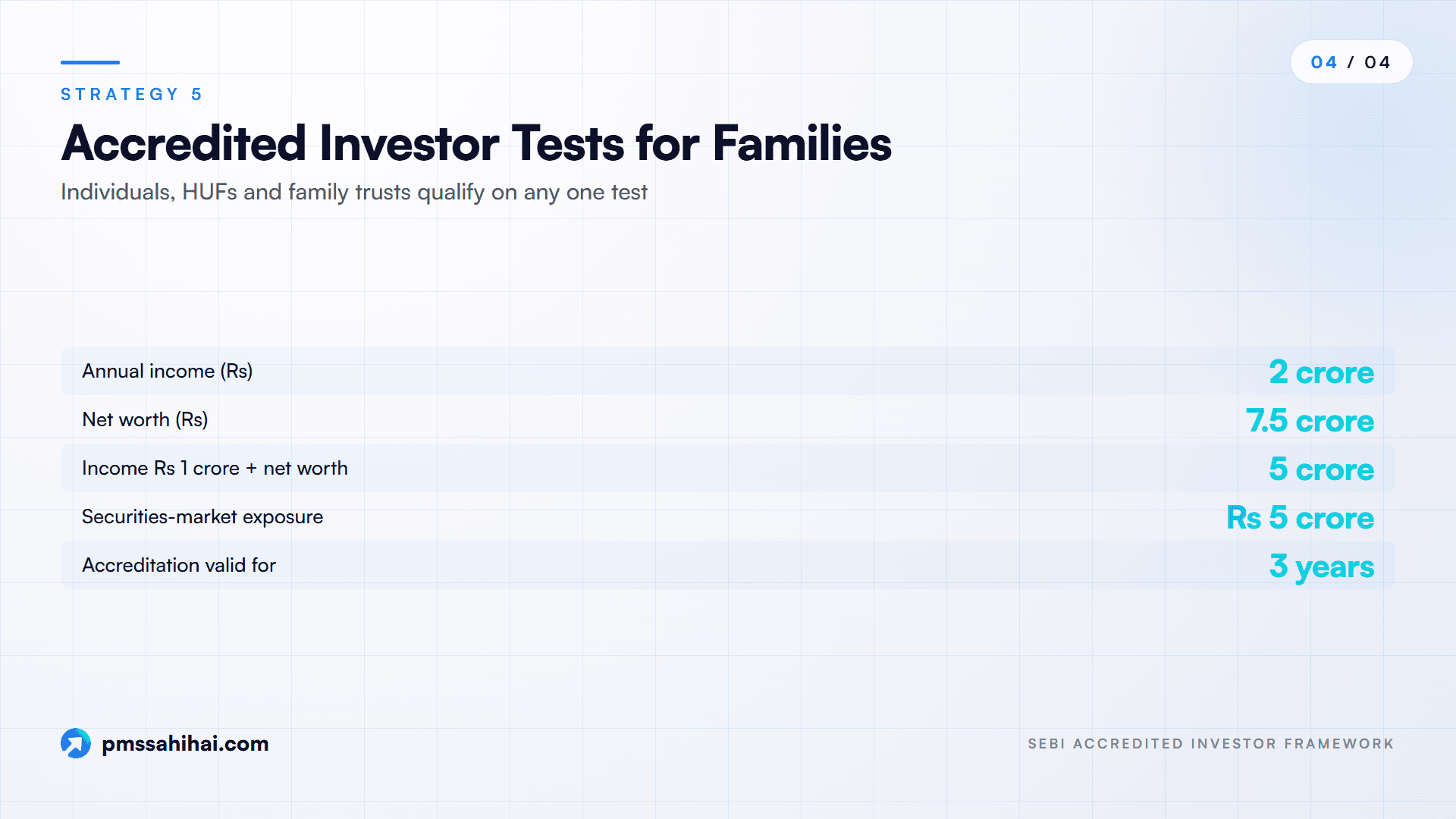
Accreditation is a certificate that says the investor can judge risk without some default protections. An individual, HUF, family trust or sole proprietorship qualifies with any one of:
- Annual income of at least Rs 2 crore.
- Net worth of at least Rs 7.5 crore, with at least Rs 3.75 crore in financial assets.
- Annual income of at least Rs 1 crore and net worth of at least Rs 5 crore, with at least Rs 2.5 crore in financial assets.
- Securities-market exposure of at least Rs 5 crore (Rs 20 crore for companies and non-family trusts), added from 15 October 2026.
SEBI's circular of 5 November 2026 made accreditation easier. An AIF manager, an SIF asset manager or a portfolio manager can now determine an investor's status at onboarding, and other managers in the same group recognise it. Accreditation lasts three years, and an investor accredited on joining a scheme stays accredited for that scheme's life. Securities-market exposure counts demat holdings, mutual fund folios, unlisted shares in demat form, overseas securities and NPS investments. An LLP qualifies only if each partner qualifies, and persons resident outside India are deemed accredited.
Accreditation opens LVFs, Accredited Investors only funds, co-investment schemes and room to negotiate terms. The cost is giving up some protections, such as standard diversification limits. Decide in advance which family members and entities should be accredited, and why, rather than ticking the box whenever a salesperson asks.
Strategy 6: Plan UHNI Liquidity in Tiers
UHNI liquidity problems rarely come from a lack of wealth. They come from wealth in the wrong place at the wrong time: a capital call during a market fall, a tax bill after a stake sale, or a family need while assets are locked in private funds. Selling good assets at bad prices to meet these needs is a common, avoidable loss. The fix is to split the balance sheet into tiers sized against known and likely needs.
Illustrative Liquidity Tiers for a Rs 400 Crore Family| Tier | Purpose | Typical holdings | Illustrative size |
|---|---|---|---|
| Tier 1: Cash within days | Two years of family spending, taxes, emergencies | Savings, liquid funds, short-term deposits | Rs 15–20 crore |
| Tier 2: Cash within months | Next 24–36 months of capital calls and planned purchases | Bonds, arbitrage or short-duration funds, listed equity in the core | Rs 30–50 crore |
| Tier 3: Long-term growth | Compounding over 5+ years | PMS, Category III AIFs, global equity | Rs 80–120 crore |
| Tier 4: Locked capital | Private equity, venture, real estate, direct deals | Category I and II AIFs, LVFs, co-investments, unlisted stakes | Set by policy, not by opportunity |
| Operating business | Family company and promoter stock | Not counted as liquidity | Rs 170 crore or more |
The figures are illustrative, not a recommendation for any UHNI portfolio. The rule matters more: Tiers 1 and 2 together should cover every undrawn capital call plus a stress buffer, and Tier 4 grows only when earlier tiers are full. Track undrawn commitments as a liability, not a footnote.
Strategy 7: Hedge the Operating Business and Concentrated Stock
For most first- and second-generation ultra HNI families, the biggest single risk is the family business. Even after a listing, promoters may hold a stake they cannot or will not sell; executives with ESOPs face the same problem on a smaller scale. Start with four questions:
- What share of total net worth sits in the business and its listed stock?
- What happens to family spending and commitments if that value halves, or cannot be sold for five years?
- Is the share rising or falling over time?
- What is the family willing to pay, in tax and lost upside, to reduce it?
Then build the portfolio to offset the business, not repeat it. A family that owns a bank should not hold banks across four PMS accounts; a real estate family should be wary of real estate AIFs.
Ways to reduce concentration include staged sales over several years, gifts of shares to family members or trusts as part of the succession plan, and using sale proceeds to fill the liquidity tiers. Pledging promoter shares to borrow adds risk: in a sharp fall, lenders can demand more security or sell. Listed-company promoters also face insider-trading rules under the SEBI (Prohibition of Insider Trading) Regulations, 2015, which restrict when and how they can trade. Consult a lawyer and a tax adviser before any sale, gift or hedge of promoter shares.
Strategy 8: Write UHNI Succession Planning Into the Portfolio
UHNI succession planning often stops at a will. In practice, the portfolio has to carry the plan, because nominations, account titles and trust holdings decide who can act on the day something happens.
Three points have changed or been clarified recently:
- Nomination: from 1 September 2026, SEBI allows up to three nominees on demat accounts and mutual fund folios. If percentages are not specified, assets are split equally.
- Transmission: SEBI's July 2026 transmission framework says nominees receive securities as trustees on behalf of the legal heirs, simplifies documents and removes the mandatory need for probate in line with changes to succession law.
- Ownership: the Supreme Court held in Shakti Yezdani (December 2023) that a nominee is not the owner. The will or the law of succession still decides who inherits.
Nomination moves assets quickly but does not settle ownership. The usual layers for an ultra HNI family are a registered will, a private trust under the Indian Trusts Act, 1882 for assets meant to stay together, nominations aligned with the will and a family constitution for the business and investments. EY and Julius Baer found in 2025 that 59% of families surveyed had wills or family constitutions and only 19% used trusts or LLPs.
Review nominations and account titles whenever the family changes: births, marriages, divorces, deaths, moves abroad. A child who becomes non-resident changes how accounts must be held. India has had no estate duty since 1985, but transfers into trusts, cross-border heirs and foreign assets bring their own tax rules. Succession planning is legal work; consult a lawyer and a tax adviser before you sign anything.
How Technology Is Changing UHNI Wealth Management
Technology is cutting the paperwork that used to make UHNI wealth management slow and opaque.
- Consolidated statements: depository statements pull demat holdings and mutual fund folios into one view. SEBI's November 2026 accreditation circular accepts that statement as evidence of securities-market exposure.
- Digital accreditation: managers that determine accredited status must keep records, run audits and protect investor data.
- Comparison tools: families can compare hundreds of PMS and AIF strategies on fees, drawdowns and track records side by side, and check overlap before adding a manager.
- Monitoring: regular holdings feeds let a family office spot drift, rising concentration or a liquidity shortfall early.
Technology does not replace judgement. It makes the balance-sheet map, the liquidity tiers and the overlap check cheaper to maintain.
Advantages of a Structured UHNI Wealth Management Approach
A structured approach changes outcomes, not just paperwork:
- Access that matches the ticket size: LVFs, Accredited Investors only funds and co-investment schemes open concentrated strategies ordinary investors cannot reach.
- Less paperwork: manager-led accreditation and three-year validity mean fewer repeated checks.
- Fewer forced sales: liquidity tiers sized against capital calls and taxes protect good assets from bad-price sales.
- Real diversification: the balance-sheet map exposes hidden concentration in the business, its sector and stocks shared across managers.
- Clear control and succession: structures, nominations and a family constitution set out who decides and who inherits.
- Better terms: larger tickets and a written policy give the family leverage on fees.
- Regulated global exposure: LRS and GIFT City allow dollar diversification within known limits.
How PMS Sahi Hai Helps UHNI Families Compare the Shelf
Several of the strategies above come down to one practical task: comparing a large number of PMS and AIF options on the same basis and checking how they fit what the family already owns. That is the job PMS Sahi Hai is built for. It describes itself as a platform that tracks 900+ offerings across PMS, AIF and GIFT City, and it is an APMI-registered distributor, not a family office, a law firm or a tax adviser.
What the platform's pages show it can do for an ultra HNI family:
- Shortlist PMS managers with different styles. The PMS comparison tool lists 657 strategies with filters for category, minimum ticket, vintage, risk and AUM, and shows 1-, 3- and 5-year returns side by side. You can pin up to four strategies to compare three-year CAGR, maximum drawdown, fee structure and Sharpe ratio, which helps when choosing two to four managers that do not duplicate each other.
- Screen AIFs by category and lock-in. The AIF comparison tool covers 269 Category I, II and III funds with strategy, vintage, AUM and lock-in fields, useful when matching private-market commitments to the Tier 4 budget in your liquidity plan.
- Score managers on one published method. Nyra's methodology rates strategies from 0 to 10 across five weighted pillars: return performance, risk-adjusted return, downside protection, consistency, and structure and stewardship. Strategies with less than 12 months of track record are shown as Not Rated.
- Check overlap, drift and fee drag. Nyra reviews holdings for overlap, drift and fee drag, which is the stock-level check Strategy 3 and Strategy 7 call for. Nyra describes itself as an analytical tool, not a SEBI-registered investment adviser, and its output is informational rather than personalised advice.
Be clear about the limits. The site does not describe a consolidated, multi-entity family reporting service, and it does not handle trusts, wills or tax structuring. Use it to compare and screen the products; keep your lawyer, tax adviser and, if you have one, your family office in charge of structure and succession.
Limitations and Risks No UHNI Strategy Removes
No strategy makes these risks disappear:
- Illiquidity: private-market AIFs, LVFs and direct deals lock money for seven to ten years or more. Early exits, where possible, usually come at a discount.
- Fewer protections: accreditation and LVFs remove some default safeguards. The family has to do more of its own diligence.
- Complexity and cost: trusts, companies, LLPs and foreign accounts bring filings, audit fees and governance work, and badly set-up structures cause problems later.
- Disputed tax treatment: onshore Category III AIF taxation and GIFT City funds held by residents are areas where the law is unsettled. Positions taken today may be challenged.
- Manager risk: a concentrated LVF or co-investment depends heavily on one manager's judgement.
- Concentration in the business: for many families, no portfolio can fully offset a business that makes up half or more of net worth.
- Family risk: disagreements between generations or branches can undo a sound plan. Governance is as important as asset allocation.
Putting UHNI Wealth Management Strategies Together
The eight strategies work best in order: map the balance sheet, choose structures before products, use a few distinct PMS and AIF managers, cap GIFT City and direct deals in advance, accredit for specific purposes, size liquidity tiers against every commitment, offset the family business and write succession into every account.
The 2026 rules give ultra HNI families more choice than ever: a Rs 25 crore LVF route, co-investment, a Rs 5 crore securities-market accreditation test and manager-led accreditation. More choice raises the cost of picking badly. The families who benefit have a written policy and a full view of their holdings before the next commitment. Tools such as PMS Sahi Hai's comparison pages and Nyra can make the product side of that work faster, while structure and succession stay with your advisers.
Next Step: Review Your Family Portfolio With Nyra
Before the next commitment, put every account, entity and undrawn capital call on one page. Check how much rides on the family business, which managers overlap and whether the liquidity tiers cover what is already committed. Then use Nyra to review your PMS holdings for overlap and fee drag, compare managers side by side on PMS Sahi Hai and screen AIFs by category and lock-in before you sign. For structures, wills and tax, bring your lawyer and tax adviser in early. If you want to talk it through, contact the PMS Sahi Hai team.
PMS Sahi Hai is a distributor of Portfolio Management Services and Alternative Investment Funds, APMI-registered (Registration No. APRN08358). This article is for education only and is not investment advice, a recommendation, or an offer to buy or sell any security. Investments in securities markets are subject to market risks; read all scheme-related documents carefully. Past performance is not indicative of future results. Consult your advisor before investing.
Ishaan founded PMS Sahi Hai to make India's PMS, AIF and GIFT City markets legible to serious investors, comparing every SEBI-registered manager on the same comparative basis, with no shelf products and no commission bias.
Frequently asked
What is UHNI wealth management?
UHNI wealth management is the planning and oversight of a very wealthy family's whole balance sheet, not just its investments. It covers holding structures, allocation across listed equity, PMS, AIFs, GIFT City funds and direct deals, liquidity for capital calls and taxes, family-business risk and succession, with the aim of growing and protecting wealth across generations.
Who counts as an ultra HNI in India?
There is no legal definition. Global reports such as Knight Frank's use a net worth of US$30 million or more; Knight Frank counted 19,877 Indians above that line in 2026. Indian wealth firms often use a much lower line of about Rs 25 crore in investable assets. SEBI does not use the term; it sets product minimums and accredited investor tests instead, as our guide to what an HNI investor is explains.
How should an ultra HNI family split its portfolio?
There is no single split. A common pattern is a low-cost core of index funds, bonds and large-cap equity, with PMS, AIFs, GIFT City funds and direct deals around it. The right mix depends on how much wealth sits in the family business, upcoming capital calls and spending, the family's tolerance for drawdowns and its time horizon. Write the target ranges into a family investment policy statement.
Can a resident UHNI invest in GIFT City funds?
Yes. Resident individuals can invest in IFSC funds using the Liberalised Remittance Scheme, which allows up to USD 250,000 per person per financial year. Restricted schemes in GIFT City have a USD 150,000 minimum. The tax advantages often advertised apply mainly to non-residents, so resident families should check their own treatment with a tax adviser before investing.
What does accredited investor status unlock for a UHNI?
Accreditation opens large value funds (Rs 25 crore minimum per investor), Accredited Investors only funds, co-investment schemes alongside Category I and II AIFs and more freedom to negotiate terms. Since 5 November 2026, a fund manager or portfolio manager can determine accredited status, valid for three years. In return, the investor gives up some default protections, such as diversification limits.
Do UHNIs need a family office?
Not always. A single family office makes sense when wealth is large and complex enough to pay for an in-house team. Many families use a multi-family office, a private bank or a set of advisers instead. More important than the label is that someone keeps a complete balance-sheet map, a written investment policy and a liquidity plan.
Is there inheritance tax in India?
No. India abolished estate duty in 1985 and has no inheritance tax today. That does not make succession tax-free: income from inherited assets is taxed, trusts are taxed under specific rules, and heirs living abroad may face tax in their own country. Consult a tax adviser and a lawyer for your family's situation.
Does a nominee become the owner of shares?
No. The Supreme Court held in December 2023 that a nominee is not the owner. SEBI's July 2026 transmission framework says nominees receive securities as trustees on behalf of the legal heirs. The will or the law of succession decides who inherits, so nominations should match the will.
Keep reading
All articles
Strategic Asset Allocation: How to Build a Policy Mix That Lasts
What strategic asset allocation is, what the research shows, and how to set a policy mix by goals, risk and horizon, with PMS and AIF in place.

Types of Rebalancing Strategies: Rules, Trade-offs and Indian Costs
Calendar, threshold, hybrid, cash-flow, constant-mix and CPPI rebalancing explained, with the tax and exit-load cost of rebalancing in India.

Tracking Error in PMS: How Far Your Strategy Strays From Its Benchmark
Tracking error in PMS explained: the formula, a worked 12-month example, ex-ante vs ex-post, SEBI's 2% index-fund rule and ranges by PMS style.
Read it. Now pressure-test it.
Ask Nyra how this applies to your portfolio, or talk to our team, no pitch, no pressure.