
What Is Diworsification? How Too Many Funds Quietly Cost HNIs
Diworsification is owning so many similar funds or PMS strategies that you pay active fees for index-like returns. Learn the signs and the cost.


Diworsification is what happens when you keep adding investments that look different but behave the same, so the portfolio gets more complicated without getting safer. Peter Lynch coined the word in 1989 to mock companies that bought businesses they did not understand; investors later borrowed it for portfolios stuffed with overlapping funds. In Indian HNI portfolios it usually shows up as 15 or more mutual funds, several PMS strategies with the same mandate, and a different adviser behind each one. The cost is real: layered active fees for an index-like result, winners too small to matter, more paperwork, and a tax bill when you finally clean up.
Diworsification Explained: When More Investments Make a Portfolio Worse
Ask a wealthy investor how diversified they are and the answer often comes as a number. Eighteen mutual funds. Four PMS strategies. Two AIFs. A handful of direct stocks from an old broking account. The number feels reassuring, because everyone has heard that you should not put all your eggs in one basket.
The trouble is that baskets can be counted, but eggs cannot be seen from the outside. If most of those funds and strategies own the same large banks, the same IT majors and the same consumer names, the investor does not own twenty baskets. They own one basket with twenty labels, and they pay twenty sets of fees for it.
So, what is diworsification? In plain terms, it is adding investments past the point where they reduce risk, so that each new holding brings more cost and complexity than protection. Investopedia's definition of diworsification puts it as adding similar investments that increase risk without improving potential returns. The word is a blend of "diversification" and "worse". Diversification spreads money across holdings that respond differently to the same event. Diworsification adds holdings that respond the same way, so the spread is only on paper.
Three features separate diworsification from sensible diversification:
- Duplication. The new holding repeats an exposure you already have.
- Dilution. Each position becomes too small for a good idea to move the total.
- Drag. Fees, taxes, paperwork and attention rise with every addition.
This article explains the term, where it came from, how it shows up in Indian HNI portfolios, and what it costs. It does not try to define the ideal portfolio; that depends on your goals, horizon and tax position.
Where the Word Came From: Peter Lynch and the Conglomerate Era
The 1989 Quote That Started It
The word belongs to Peter Lynch, who ran Fidelity's Magellan Fund from 1977 to 1990 and averaged a 29.2% annual return over that period. In 1989 he published One Up on Wall Street, written with John Rothchild, and the same year he was quoted in the Los Angeles Times (11 March 1989) saying: "A lot of companies have gotten into other businesses that were away from their basic businesses, something I call 'diworsification.'"
Notice who the target was. In its original form, the Peter Lynch diworsification idea was not about mutual fund investors. It was about companies that spent shareholders' money buying unrelated businesses: a profitable firm that, instead of returning surplus cash or reinvesting in what it knew, bought into an industry it did not understand. The result was usually a weaker company.
Why Conglomerates Were the Original Target
Lynch's audience would have recognised the pattern immediately. In the United States, conglomerates became popular in the 1960s, helped by cheap money and leveraged deals. Many of them collapsed or were broken up in the 1980s after poor performance, accounting scandals and antitrust action. By the time Lynch wrote, "diversifying" into unrelated industries had a track record, and much of it was bad.
That corporate meaning still matters: when a listed company you own moves into an unrelated sector with no clear edge, Lynch's warning applies directly. But the word did not stay in the boardroom.
How Diworsification Moved From Boardrooms to Portfolios
Over the following decades, writers and advisers began applying the term to investors rather than companies. The idea translated neatly. A company that buys too many unrelated businesses loses focus. An investor who buys too many similar funds loses the benefit of each one. Today most investing glossaries define the diworsification meaning as adding too many similar investments, so that risk does not fall and returns suffer.
Modern Portfolio Theory and the Limits of Adding More
The intellectual roots of diversification go back to 1952, when Harry Markowitz published "Portfolio Selection" and laid the base of modern portfolio theory. The key insight is that what matters is not how many assets you hold, but how they move together. Two assets that rise and fall at the same time do little to protect each other. Two that move differently do.
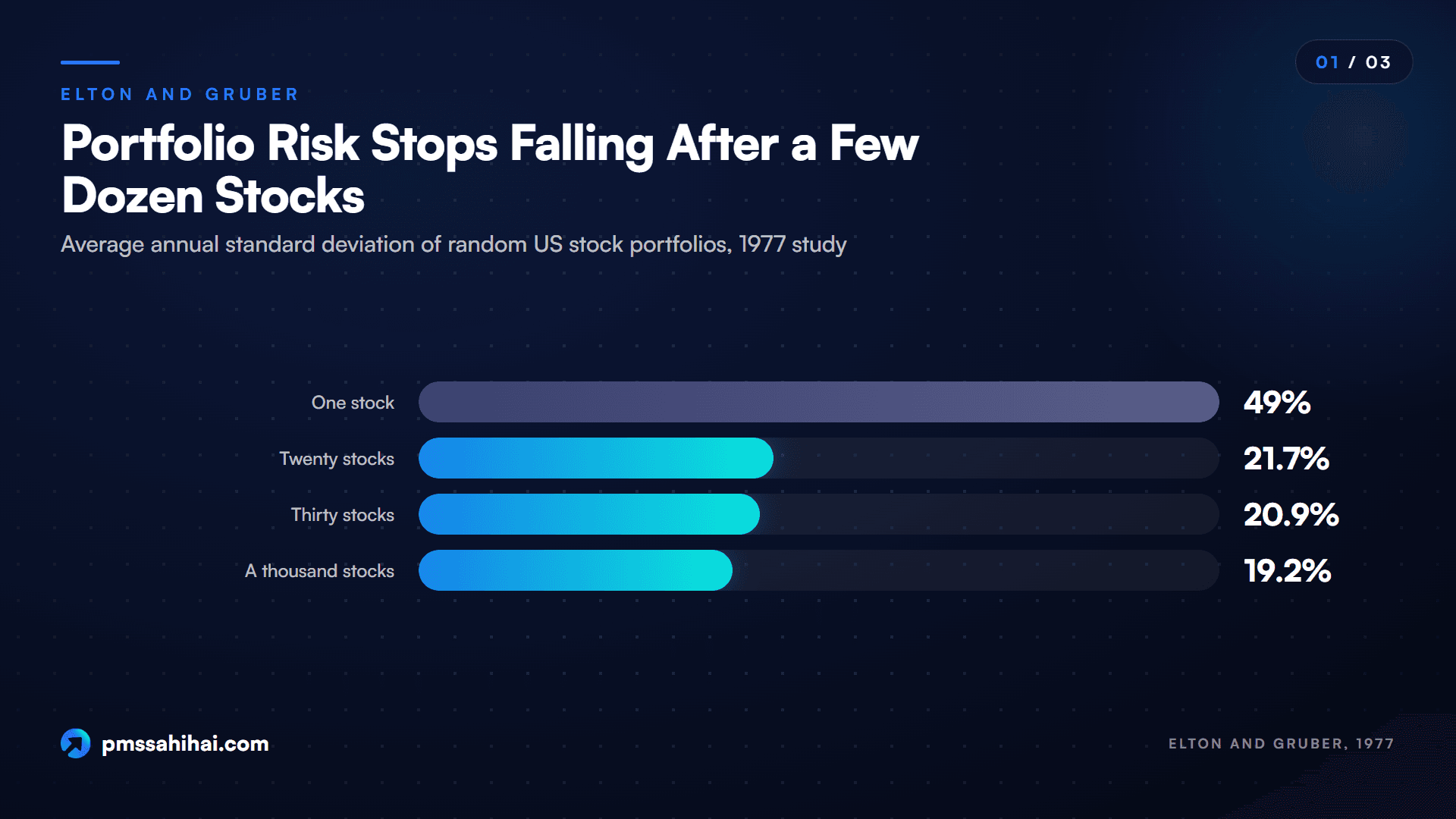
Empirical work soon showed how quickly the benefit runs out. In a well-known 1977 study, Edwin Elton and Martin Gruber measured the average risk of randomly chosen equal-weighted US stock portfolios. A one-stock portfolio had an annual standard deviation of about 49%. Twenty stocks brought it to about 21.7%, thirty stocks to about 20.9%, and a thousand stocks only to about 19.2%. Past a few dozen stocks, adding more names barely changed the risk. What remained was market risk, which no amount of stock-counting can remove.
That is the mathematical heart of diworsification. A single diversified equity fund already holds dozens of stocks. Holding a second, third and tenth fund of the same type adds very little extra risk reduction, because the first fund already captured most of it. Indian data points the same way: wealth manager Avendus compared the Sensex, Nifty 50, BSE 100, BSE 200 and BSE 500 over five- to twenty-year periods and found they delivered nearly identical returns with nearly identical risk. Going from 30 stocks to 500 changed little.
How Indian Regulation Has Pushed Back Against Fund Clutter
Indian regulators have acted on fund clutter twice in a decade, which shows how real the problem is.
On 6 October 2017, SEBI issued its circular on categorisation and rationalisation of mutual fund schemes. It defined large caps as the 1st to 100th company by full market capitalisation, mid caps as the 101st to 250th and small caps as the 251st onward, and it said that only one scheme per category would be permitted for each fund house, with exceptions for index funds and ETFs on different indices, funds of funds with different underlying schemes, and sectoral or thematic funds on different sectors. Fund houses had to merge or recast lookalike schemes.
On 26 February 2026, SEBI went further. Its revised categorisation circular lets a fund house offer both a value fund and a contra fund only if the portfolio overlap between the two is no more than 50%. Sectoral and thematic schemes must keep overlap with the fund house's other equity schemes (other than large cap) within 50%, measured as a quarterly average of daily overlap. Existing sectoral and thematic schemes have three years to comply, or they must be merged. Fund houses must also publish category-wise overlap levels on their websites every month.
These rules are useful, but notice their limit. They police overlap inside one fund house. Nothing stops an investor from buying a flexi-cap fund from five different fund houses, or four PMS strategies from four managers, that all hold the same twenty stocks. Regulation can reduce lookalike products on the shelf. It cannot stop you from filling your trolley with them.
Seven Signs of Diworsification in Indian HNI Portfolios
These signs of diworsification come up again and again in large Indian portfolios. None of them proves the problem on its own. Three or more together usually do.
1. You Hold More Funds Than You Can Name From Memory
The simplest test is recall. If you cannot list your funds and say why you own each one, you probably own too many. Value Research described investors who "flaunt a collection of 12-15 funds" thinking more means better diversification, while in practice paying different active fees for portfolios with high stock overlap. Broker guides suggest anything from four or five core funds to five to seven, which tells you there is no magic number. The warning sign is not the count itself. It is a count that has grown without a plan.
2. Several Funds Sit in the Same Category
Owning a large-cap fund, a second large-cap fund and a third from different fund houses is the textbook case. Each fund house is different; the stocks are largely the same, because a large-cap fund must put at least 80% of its assets in the top 100 companies. Three such funds give you three expense ratios and roughly one large-cap portfolio. The same applies to stacking flexi-cap funds, or a flexi-cap fund next to a large and mid cap fund with similar top holdings.
3. Your Portfolio Reads Like a List of Past New Fund Offers
Every bull market brings a wave of new thematic and sector launches. If your statement shows a manufacturing fund from one year, a consumption fund from the next, a defence or PSU theme after that and a "special opportunities" fund on top, you have probably been buying stories rather than building exposure. Many of these themes end up holding the same leading companies as your core funds.
4. You Own Several PMS Strategies With the Same Mandate
This is where HNI diworsification gets expensive. A PMS needs a minimum of Rs 50 lakh per client under SEBI's rules, a floor the SEBI (Portfolio Managers) Regulations, 2026 keep when they take effect on 1 April 2027, so four strategies with four managers mean at least Rs 2 crore committed. If all four are multi-cap or mid-cap "quality growth" books benchmarked to similar indices, they may own many of the same names. The published PMS Sahi Hai guide to PMS portfolio overlap explains how to measure this with a common-holdings method; the point here is simpler. Four managers with the same style rarely add four sources of return. They usually add four fee schedules.
5. A Different Adviser Stands Behind Each Product
Many families have a private banker, a mutual fund distributor, a broker's relationship manager and a friend who runs a PMS. Each recommends products in good faith, and none sees the whole picture. Diworsification is often the sum of several sensible suggestions that nobody added up.
6. Legacy Holdings That Nobody Reviews
Old ELSS units, a fund bought for a child's education years ago, inherited shares, an insurance-linked plan. Each sits untouched, adding another line to the statement and more holdings to the overlap.
7. Positions Too Small to Matter
A fund that doubles while being 1.5% of the portfolio adds just 1.5% to the total. Tiny positions usually signal buying to avoid missing out, rather than because the holding has a job to do.
Why Wealthy Investors Diworsify in the First Place
Diworsification is rarely a deliberate choice. It builds up for understandable reasons.
Fear of regret. Missing a theme that later soars feels worse than owning a little of everything. Buying a small amount of each new idea is a way to avoid that regret, at the cost of diluting the whole.
Distribution incentives. New products are where sales effort concentrates. Value Research noted that fund houses launch a frenzy of thematic and sector funds whenever markets rise, and distributors push them. Each sale may be reasonable; the collection rarely is.
Comfort in numbers. A long statement looks like prudence. It is easy to confuse activity with protection.
Manager-side incentives. Some critics argue that managers over-diversify to protect their own business: a portfolio that hugs its benchmark rarely underperforms badly, so the manager keeps the mandate while the client pays active fees.
No single owner of the portfolio. When five advisers each manage a slice, nobody is accountable for the total. That is the structural cause behind most HNI diworsification.
The Real Cost of Diworsification, Rupee by Rupee
The cost of diworsification is easy to underestimate because no single statement shows it. It arrives in four ways.
Layered Fees for an Index-Like Result
Every active fund charges an expense ratio, and every PMS charges a fixed fee, often a performance fee, plus 18% GST on fees, as our explainer on GST on PMS and AIF fees sets out. That is fair if each manager delivers something different. When the combined portfolio behaves like a broad index, the investor ends up paying active fees on what is, in effect, a passive portfolio.
Research on institutional investors shows how this plays out at scale. In a 2020 analysis for the CFA Institute, Richard Ennis looked at 46 large US public pension funds. Their composite return tracked a passive stock-bond benchmark with an R-squared of 0.993, and it underperformed that benchmark by about 1% a year in the decade to June 2018, roughly equal to its estimated cost. His conclusion: "Extreme diversification combined with high cost is a recipe for failure." Those funds had thousands of managers and portfolios. An Indian HNI with twenty products faces the same arithmetic on a smaller scale.
Diluted Winners and Closet Indexing
When a portfolio holds hundreds of stocks across overlapping funds, the good decisions of any one manager are averaged away by the rest. One manager's outperformer is another manager's underweight. The net result tends toward the market return minus costs.
A fund that claims to be active but closely mirrors its benchmark is practising closet indexing, and is often called a closet indexer. Diworsification can turn a portfolio of genuinely active funds into a closet index fund at the household level, even if no single manager is a closet indexer. You can see this when your total portfolio return sits within a point or so of a broad index, year after year, after paying active fees.
Time, Paperwork and Decision Fatigue
Each PMS sends its own statements and capital gains report, and every trade inside it is taxed in your name. Twenty products mean twenty sets of documents, more lines on your tax return, more nominations to update and more decisions at every review. For an HNI with a business to run, attention is a cost too.
A Worked Example: Rs 5 Crore Spread Across 22 Products
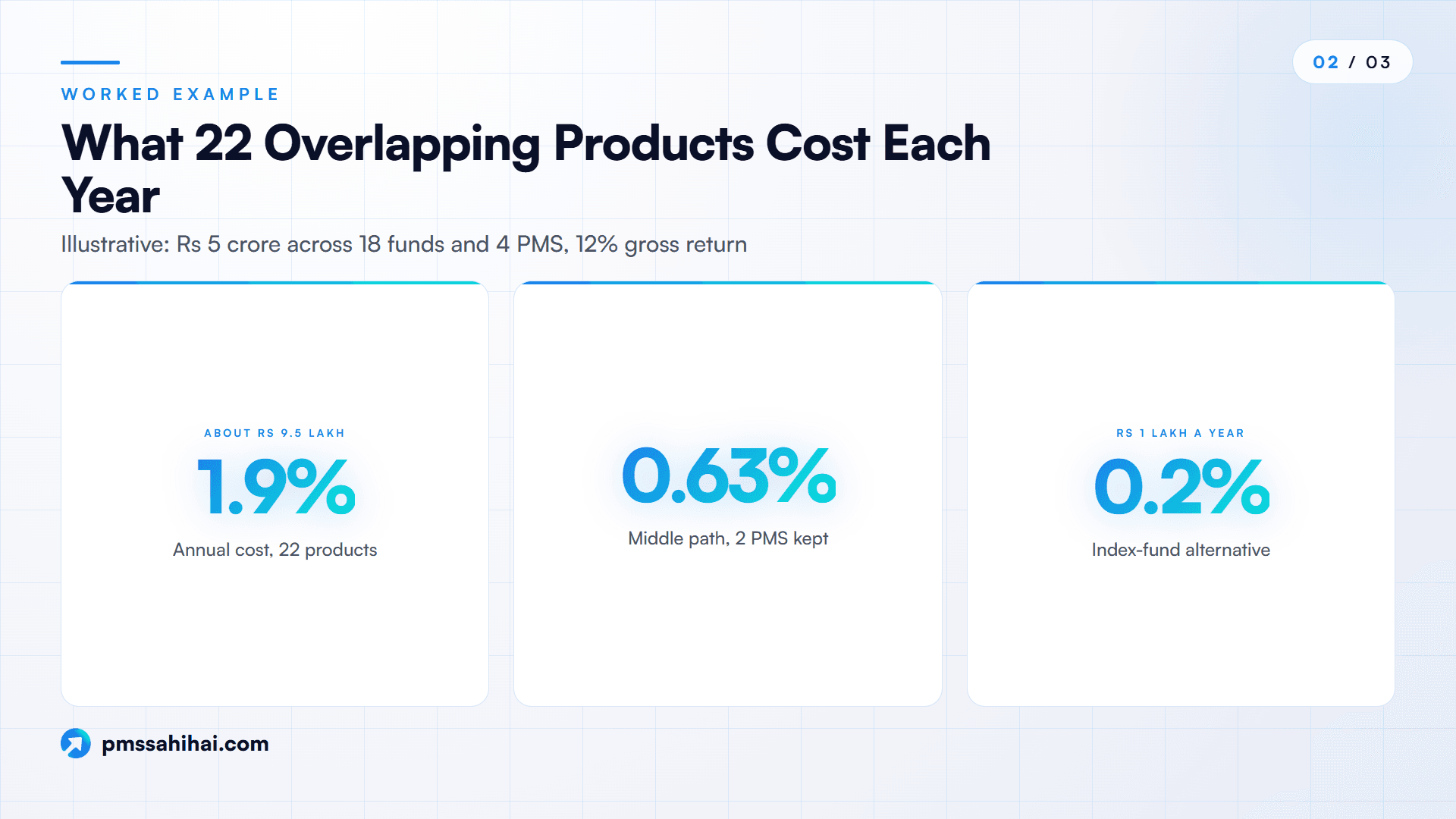
Consider a hypothetical investor with Rs 5 crore in equity, held across 18 actively managed mutual funds and four PMS strategies. The figures below are illustrative assumptions, not market averages.
| Item | Assumption |
|---|---|
| Mutual funds | Rs 3 crore across 18 schemes, average expense ratio 1.6% a year |
| PMS strategies | Rs 2 crore across four strategies (Rs 50 lakh each), fixed fee 2% a year plus 18% GST |
| Look-through portfolio | About 350 distinct stocks, behaving much like a broad market index |
| Gross market return | 12% a year, the same for every option |
| Alternative compared | The same equity exposure through low-cost index funds at 0.2% a year |
The annual cost works out like this:
- Mutual funds: Rs 3 crore × 1.6% = Rs 4.8 lakh
- PMS: Rs 2 crore × 2% × 1.18 = Rs 4.72 lakh
- Total: about Rs 9.5 lakh a year, or roughly 1.9% of the portfolio
- Index-fund alternative: Rs 5 crore × 0.2% = Rs 1 lakh a year
The gap is about Rs 8.5 lakh in the first year alone. Compounded over ten years at a 12% gross return, Rs 5 crore grows to about Rs 13.1 crore at a 1.9% annual cost, against about Rs 15.3 crore at 0.2%. The difference is roughly Rs 2.2 crore, paid for diversification the investor already had.
Two caveats keep this honest. First, if the active managers genuinely beat the market after fees, the comparison changes; the example assumes that, combined, they deliver the market return. Second, a middle path exists. Keeping two distinctive PMS strategies (Rs 1 crore) and moving the rest to index funds would cut the annual cost to about 0.63%, leaving a ten-year gap of about Rs 0.6 crore against the all-index option, while keeping room for real active bets.
The Bill for Fixing It
Unwinding diworsification is not free either, and this is the cost most guides skip. Under the Income-tax Act, 2025, in force from 1 April 2026, gains on listed equity and equity-oriented fund units held for up to twelve months are short-term and taxed at 20% (section 196, old section 111A). Long-term gains are taxed at 12.5% on the amount above Rs 1.25 lakh a year (section 198, old section 112A), before surcharge and cess. Selling Rs 1 crore of fund units with Rs 40 lakh of long-term gains could cost about Rs 4.8 lakh in tax at the base rate.
PMS exits carry an extra cost in the early years. SEBI's Master Circular for Portfolio Managers caps the exit load at 3% of the amount redeemed in the first year, 2% in the second and 1% in the third, with no exit load after three years. Many investors therefore consolidate in stages, using the annual Rs 1.25 lakh exemption, selling short-term units only after they turn long-term, and redirecting fresh money rather than selling. Tax treatment depends on your full situation, so consult a qualified tax adviser before you sell.
How Today's Data Tools Expose Diworsification
Finding your true exposure once meant downloading factsheets one by one. Today the job is far easier.
Consolidated statements. A consolidated account statement lists your mutual fund holdings across fund houses in one document, which is the natural starting list for a review.
Monthly overlap disclosure. Under SEBI's February 2026 circular, fund houses publish category-wise portfolio overlap levels every month. That tells you how similar a fund house's own schemes are to one another.
Look-through analytics. Portfolio tools combine the holdings of every fund and strategy into one look-through portfolio, showing your real exposure to each stock and sector. That is where duplication becomes visible: the same bank appearing in eleven of your holdings, for example.
Statistical fingerprints. As Investopedia's guide to closet indexing notes, R-squared, tracking error and active share reveal whether a fund, or your whole portfolio, behaves like an index. A household portfolio with an R-squared close to 1 against a broad index is behaving like an index fund, whatever the labels say.
AI research tools. Newer tools read factsheets and statements and flag overlap, fee drag and style drift. They do not replace judgement, but they turn a weekend of spreadsheet work into minutes.
Why Spotting Diworsification Makes Investing Easier
Recognising diworsification is not about owning as few things as possible. It is about making every holding earn its place, which brings six benefits.
- Lower total fees. Dropping duplicate active products cuts costs without changing your market exposure.
- Winners that matter. A strong manager with 15% of your portfolio moves the total; the same manager with 1.5% does not.
- Simpler tax and paperwork. Fewer products mean fewer statements, fewer capital gains reports and fewer nominations to manage.
- Clear accountability. When each holding has a single job, such as core equity, a mid-cap satellite or a specific alternative, you can judge whether it is doing that job.
- Better decisions on new launches. Once you know your exposures, a new fund offer has to show what it adds before it gets money.
- Honest benchmarking. With a focused portfolio you can see whether your active fees are buying anything, instead of hiding the answer in a crowd.
How PMS Sahi Hai Helps You Read the Inner Clause of Diworsification
Every sign in this article has the same root: nobody is looking at the whole portfolio at once. That is the problem PMS Sahi Hai's tools are built around, so it is worth being precise about what they do and do not do.
Start with what you already own. The PMS Sahi Hai portfolio health check takes your PMS, AIF, mutual fund or direct equity holdings, as a statement, a list or just the names, and grades each holding on the same comparative basis that Nyra applies across the market. The readout is meant to show the drag you are paying and what to fix first. For a diworsified portfolio, that order matters: see the duplication before you add anything new.
Ask Nyra to look through the labels. Nyra, the platform's AI research analyst, is described as offering overlap detection, hidden-fee surfacing, sector-drift flags and post-tax drag on what you own, grounded in SEBI, AMC and IFSCA primary sources. Its "Review my portfolio" prompt covers overlap, drift and fee drag across holdings, which are the three symptoms that turn diversification into diworsification. Nyra states plainly that it is an analytical tool, not a SEBI-registered investment adviser, and that it will not state a number it cannot source.
Test a new strategy before it joins the pile. Before adding a fifth PMS, you can line up to four strategies side by side on the compare page, filtered by category, fund house, benchmark and style. The Nyra Score methodology scores every rated strategy from 0 to 10 on five pillars with fixed weights, so two candidates with similar mandates can be read on the same basis. If the new strategy looks like one you already hold, that is the moment to ask what it adds.
Price the stack, not the line item. The PMS fees explainer breaks a PMS bill into fixed fee, performance share, exit load and operating costs, with 18% GST on top. Adding those layers across every product you own is the quickest way to see the cost of diworsification in rupees.
None of this replaces your own judgement or a qualified adviser. What it does is make the whole portfolio visible in one place, which is where diworsification is spotted and where it is fixed.
Where the Diworsification Label Gets Misused
The word is useful, but it is also misused. Five limits are worth keeping in mind.
Lynch himself held hundreds of stocks. At its largest, Magellan held hundreds of stocks; a former colleague later said Lynch kept many lower-conviction names in very small amounts. Lynch's coinage was aimed at corporate empire-building, not at broad portfolios. Using "diworsification" to justify a five-stock portfolio twists the original meaning and can expose an investor to serious single-stock risk.
Concentration risk is real. Cutting from twenty funds to two can swap one problem for another. If both remaining products are small-cap strategies, you are now concentrated in one segment, a risk covered in our guide to concentration risk in PMS. The cure for diworsification is purpose, not a lower count.
There is no correct number. Guides that recommend four, five or seven funds are offering rules of thumb. A family with Rs 50 crore across equity, debt, AIFs and global assets may reasonably hold more products than a salaried investor with Rs 50 lakh.
Index investors are a special case. Some writers argue that an investor who owns the whole market through low-cost index funds cannot really be too diversified, because they are not trying to beat the market. Owning two index funds that track similar indices adds cost and admin, but it does not dilute any active decision.
Overlap is a proxy, not a verdict. Two funds can share many names but weight them differently, or hold different stocks that move together. Fund count and overlap percentages are starting points for a review, not final answers.
Turning a Diworsified Portfolio Into a Deliberate One
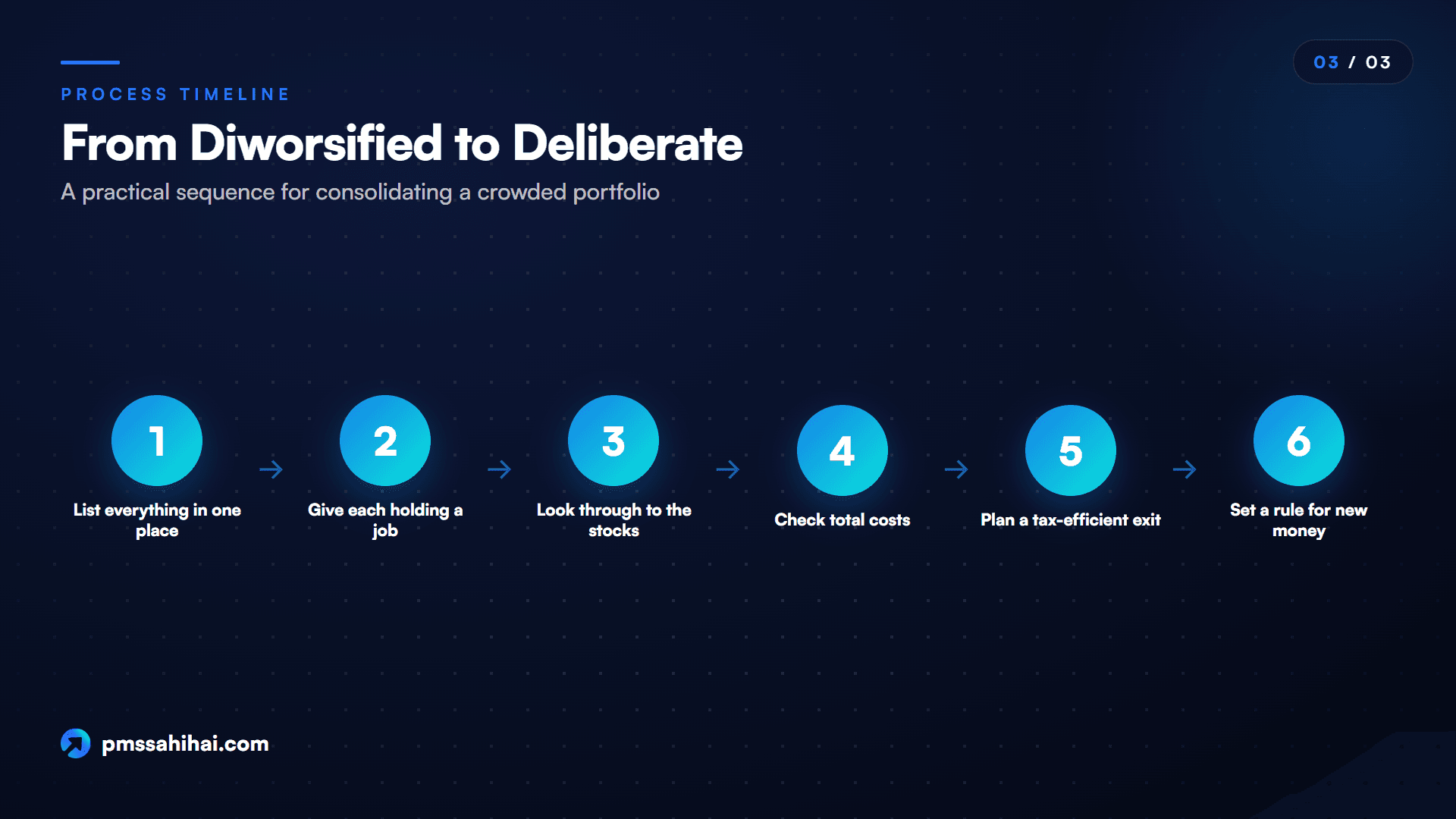
The goal is not a smaller portfolio. It is a deliberate one, where every holding has a reason to be there. A practical sequence:
- List everything in one place. Mutual funds, PMS, AIFs, direct stocks, old policies. Include the adviser behind each.
- Give each holding a job. Core equity, a mid-cap or small-cap satellite, debt for stability, an alternative for a specific purpose. Anything without a job is a candidate to exit.
- Look through to the stocks. Combine holdings and see where the same names repeat. Several products sharing one job and one set of stocks is the clearest sign of over-diversification.
- Check the costs. Add up expense ratios, PMS fees and GST on the whole portfolio, not product by product.
- Plan the exit tax-efficiently. Stage sales around the long-term holding date, the Rs 1.25 lakh annual exemption and PMS exit-load windows, and speak to a tax adviser first.
- Set a rule for new money. A new product must show what it adds that you do not already own.
If steps 1 to 4 feel like a weekend of spreadsheets, PMS Sahi Hai's health check and Nyra's portfolio review are built to do the look-through and fee tally for you, so your time goes into the decisions rather than the data.
The answer to what is diworsification, in the end, is a habit rather than a number: adding without subtracting, and counting products instead of exposures. Break the habit, and the portfolio becomes easier to understand, cheaper to hold and more likely to reward the good decisions inside it.
Ready to Find Out Whether Your Portfolio Has Diworsified?
If your statement runs to several pages, if more than one adviser recommended what you own, or if you have added a new fund or PMS every year without removing anything, look through to the stocks before you invest another rupee. You can score your current portfolio with PMS Sahi Hai or ask Nyra to review it for overlap, drift and fee drag, and then decide what stays. The fix is rarely dramatic. Often it is three or four products quietly retired, and the next new idea asked one question before it gets your money: what does this add that I do not already own?
PMS Sahi Hai is a distributor of Portfolio Management Services and Alternative Investment Funds, APMI-registered (Registration No. APRN08358). This article is for education only and is not investment advice, a recommendation, or an offer to buy or sell any security. Investments in securities markets are subject to market risks; read all scheme-related documents carefully. Past performance is not indicative of future results. Consult your advisor before investing.
Ishaan founded PMS Sahi Hai to make India's PMS, AIF and GIFT City markets legible to serious investors, comparing every SEBI-registered manager on the same comparative basis, with no shelf products and no commission bias.
Frequently asked
What is diworsification in simple terms?
Diworsification is adding investments that look different but behave alike, so the portfolio becomes more complex and costly without becoming safer. The word blends "diversification" and "worse". A common example is owning several large-cap funds from different fund houses that hold mostly the same stocks. You pay several sets of fees and get roughly one large-cap portfolio.
Who coined the term diworsification?
Peter Lynch, who managed Fidelity's Magellan Fund from 1977 to 1990, coined it. In 1989, the year his book One Up on Wall Street was published, he was quoted using it for companies that moved into businesses away from their core. Investors later applied the word to portfolios with too many overlapping holdings.
What did Peter Lynch mean by diworsification?
Peter Lynch's diworsification referred to companies spending profits on unrelated acquisitions they did not understand, which usually made them weaker. It was a criticism of conglomerate-style empire-building, not of broad portfolios. Lynch himself held hundreds of stocks in Magellan, so using his word to argue for an extremely concentrated portfolio misreads him.
How many mutual funds are too many?
There is no regulatory or agreed number. Indian guides suggest anything from four or five core funds to five to seven. A better test is purpose: if two funds share a category, a job and most of their top holdings, one is probably redundant. Too many mutual funds is less about the count and more about duplication without a reason.
Can you diworsify with PMS strategies?
Yes. A PMS needs at least Rs 50 lakh per client, and several strategies with the same style, such as multi-cap quality growth, often hold many of the same stocks. You then pay several fixed fees, performance fees and 18% GST for overlapping exposure. Checking the look-through holdings before adding a second or third PMS helps avoid this.
What does diworsification cost an investor?
The cost of diworsification comes from layered active fees for an index-like result, diluted winners, extra paperwork and the tax and exit loads paid when you consolidate. In an illustrative Rs 5 crore portfolio paying about 1.9% a year in fees versus 0.2% for index funds, the ten-year gap at a 12% gross return is roughly Rs 2.2 crore.
Is owning many index funds diworsification?
Mostly not. Index funds do not try to beat the market, so there is no active decision to dilute. Owning two or three index funds on very similar indices adds a little cost and paperwork, but the bigger diworsification risk is paying active fees across many overlapping active funds and PMS strategies.
Does fixing diworsification trigger tax?
Usually, yes. Selling listed equity or equity fund units held up to twelve months attracts 20% short-term capital gains tax; long-term gains are taxed at 12.5% above Rs 1.25 lakh a year under the Income-tax Act, 2025. PMS exits within three years may also carry exit loads. Stage sales carefully and consult a tax adviser.
Keep reading
All articles
How Standard Deviation Is Calculated in PMS: A Worked Example
Calculate a PMS's standard deviation from monthly TWRR returns: worked example, sample vs population, square root of 12, Excel formulas.

What Is Survivorship Bias? Why PMS Performance Tables Flatter the Industry
Survivorship bias explained for PMS investors: how closed strategies vanish from tables, what SEBI and APMI data cover, and how to correct for it.

What Is True Diversification? Correlation, Assets, Factors and Geography
True diversification is about correlation, not count. Test your PMS, mutual fund and stock portfolio on assets, factors, geography and holdings.
Read it. Now pressure-test it.
Ask Nyra how this applies to your portfolio, or talk to our team, no pitch, no pressure.