
What Is Core-Satellite Investing? A Framework for HNI Portfolios
Core-satellite investing for Indian HNIs: what goes in the core, which PMS and AIFs suit satellites, typical splits and a Rs 10 crore example.


Core-satellite investing splits a portfolio into a large, low-cost, diversified core that captures market returns and a smaller set of satellites that try to earn something the core cannot. Most published guides put 60–80% in the core and 20–40% in satellites. For Indian HNIs, the framework answers a practical question: where do PMS strategies (Rs 50 lakh minimum) and AIFs (Rs 1 crore minimum) belong? Usually in the satellite sleeve, each with a defined job, a size limit and a benchmark it must beat after fees. This guide covers what goes in each part, typical splits, a minimum-ticket test, a worked Rs 10 crore example and the mistakes that break the framework.
Why HNI Portfolios Need a Core-Satellite Framework
Wealthy Indian families rarely suffer from a shortage of products, but from an excess of them. A typical HNI with Rs 5–20 crore of investable money hears a steady stream of pitches: a new small-cap PMS, a long-short AIF, a pre-IPO deal, a thematic fund, a private credit scheme. Each pitch sounds sensible on its own. The trouble is that nobody asks how the new product fits with everything already held.
Over a few years, the portfolio becomes a collection of decisions rather than a plan: three PMS strategies holding the same mid caps, an AIF sold as "diversifying" that moves with the Nifty, and fees piling up across layers.
Core-satellite investing is a simple fix for that drift. It gives every rupee a job. Most of the money goes into a core designed to deliver market returns cheaply and reliably. A smaller, capped portion goes into satellites, where you pay for active management, concentration or alternative strategies because you expect them to add something the core cannot.
A core-satellite strategy does not tell you which fund to buy. It tells you which sleeve a product belongs in, how large it can be and what it must beat to stay. That is why it suits HNI portfolio construction so well: the products are expensive and lumpy, and the cost of a poor fit is high.
This post explains the core-satellite approach itself. If you want the broader menu of allocation styles (strategic, tactical, dynamic, constant-weight and more), our published guide to asset allocation strategies for PMS investors covers them, and we will not repeat it here.
What Core-Satellite Investing Means in Plain Terms
At its simplest, a core and satellite portfolio has two parts.
The Core Captures the Market
The core is the foundation. It is large, broadly diversified and cheap to hold. In most descriptions it is built from passively managed securities that track a benchmark, such as index funds and ETFs. Its job is to capture beta, the return of the market itself, at the lowest possible cost and with the least manager risk.
The core is meant to be boring: held through full cycles, topped up with new money and rarely traded. If every satellite disappoints, the core should still carry the family's long-term goals.
Satellites Seek Something Different
Satellites are smaller positions placed around the core. Each one is there to do something the core cannot: earn alpha through stock selection, take a concentrated view on a segment such as small caps, reduce dependence on the equity market through a long-short strategy, or add an asset the core does not hold.
Satellites may be volatile, concentrated and expensive because their size is capped. A poor one hurts but cannot sink the plan. That containment is the whole point of the core-satellite approach.
Put simply, the core decides how much risk the portfolio takes in total; the satellites decide where you take active risk and pay active fees.
Where the Core-Satellite Approach Came From
In 1952, Harry Markowitz published "Portfolio Selection", the paper that became modern portfolio theory. Its central insight is that an asset's risk should be judged by what it does to the whole portfolio, and that holding assets that do not move in lockstep lowers risk without necessarily lowering return. Core-satellite thinking is built on that whole-portfolio view.
In January 1973, Jack Treynor and Fischer Black published "How to Use Security Analysis to Improve Portfolio Selection" in the Journal of Business, the basis of the Treynor–Black model. Their model assumes most securities are fairly priced, but that an investor may have a genuine edge on a few. The best portfolio, they showed, combines a passive index fund holding the market with an active portfolio of those few securities. That is core plus satellites in mathematical form. The model also showed that the active weight can grow to unrealistic levels if left unchecked, which is why practitioners cap it. The satellite size limit in today's framework is the practical version of that cap.
The same year, Burton Malkiel's A Random Walk Down Wall Street argued for a low-fee fund that bought the market. On 31 December 1975, John Bogle launched the First Index Investment Trust, later the Vanguard 500 Index Fund, one of the first and best-known index funds. Cheap index funds made a low-cost core practical.
The "core and satellite" label then spread through pension funds, advisers and platforms. Vanguard's adviser education describes the indexed core as capturing long-term market returns and the active satellites as seeking outperformance.
In India, SEBI's circular of 6 October 2017 on categorising mutual fund schemes defined large caps as the 1st to 100th company by full market capitalisation, mid caps as the 101st to 250th and small caps as the 251st onwards. That shared vocabulary makes it easier to say what sits in the core (broad, large-cap exposure) and what sits in a satellite (a mid- or small-cap tilt).
How Core-Satellite Investing Works in Today's Market
Today, core-satellite investing is a default way many advisers organise client money, and three developments make it easier to run than a decade ago.
Cheap broad-market building blocks. Indian investors can now buy index funds and ETFs on the Nifty 50, Nifty Next 50, Nifty 500 and many other indices. SEBI's 2017 categorisation rules allow fund houses to run multiple index funds and ETFs tracking different indices, outside the one-scheme-per-category limit that applies to active funds. That has widened the choice of core products.
Evidence that the core is hard to beat in efficient segments. S&P Dow Jones Indices' SPIVA India scorecard, as reported in October 2025, found that 73% of Indian large-cap funds and 82% of mid- and small-cap funds had underperformed their benchmarks over ten years. Critics question the benchmarks, but the message supports a passive large-cap core and deliberate spending on active fees.
Better data on satellites. PMS managers must report performance in standardised ways, and platforms now compare strategies on one basis and look through holdings for overlap, so it is easier to check whether a satellite is doing its job.
Vanguard's educational material describes two ways to decide what goes into satellites:
| View | What goes in the core | What goes in satellites | What decides success |
|---|---|---|---|
| Conventional | Efficient segments (large caps) via index funds | Less efficient segments (small caps, emerging markets) via active funds | Picking the right segments for active management |
| Alternative | Indexing across all segments | Active managers chosen for skill and low cost, whatever the segment | Finding talented, reasonably priced managers |
For Indian HNIs building a core-satellite portfolio, the conventional view usually fits better. Large caps are heavily researched and cheap to index, while small caps, special situations and long-short strategies are where PMS and AIF managers claim most of their edge.
What Belongs in the Core of an HNI Portfolio
In a core-satellite portfolio, the core is not "the equity part". It is the policy portfolio: the mix of equity, debt, gold and cash that reflects your goals and how much of a fall you can sit through. Setting that mix is the subject of strategic asset allocation, which we cover separately; here we focus on the building blocks.
Equity Building Blocks for the Core
Good core equity holdings share four traits: broad diversification, low cost, low turnover and a clear benchmark. In India the usual choices are:
- Nifty 50 or Sensex index funds and ETFs for the 50 or 30 largest companies.
- Nifty Next 50 or Nifty 100 funds to extend coverage to the full large-cap universe.
- Nifty 500 or total-market index funds for one-fund exposure across large, mid and small caps.
- Low-cost diversified large-cap or flexi-cap funds, for investors who prefer some active management in the core. Morningstar's guidance notes that a core can include active funds, as long as they are broad and reasonably priced.
The test for every core holding: would you hold it for ten years without checking it monthly? If not, it is probably a satellite.
Debt, Gold and Liquidity in the Core
For most HNIs, the core also holds the defensive assets:
- High-quality debt, such as government securities, target-maturity funds and short-duration funds, to cushion equity falls and fund near-term goals.
- Gold, usually through gold ETFs, as a diversifier that has often behaved differently from equities.
- A liquidity reserve in liquid or overnight funds, so that a market fall never forces you to sell equity or break a PMS early.
This matters because satellites are often illiquid: an AIF with a multi-year tenure cannot be sold to meet a family expense, so the core carries the liquidity for the whole portfolio.
What Belongs in the Satellite Sleeve
The satellite sleeve is where a core-satellite portfolio pays for active decisions. Typical Indian satellites named by ranking guides include mid- and small-cap funds, sector and thematic funds, international funds, direct stocks and alternatives. For HNIs, the list widens to PMS strategies and AIFs.
Three Jobs a Satellite Can Do
A satellite earns its place by doing one of three jobs. Naming the job before you invest is what separates a satellite from a punt.
- Return enhancement. A concentrated or segment-focused strategy aims to beat its benchmark through stock selection. Examples: a 15–25 stock mid- and small-cap PMS, a value or special-situations PMS, a sector fund on a theme you understand.
- Diversification of the core's risk. A strategy whose returns do not depend mainly on the equity market. One Indian glossary suggests that HNIs using PMS or AIFs can hold market-neutral or long-short strategies as satellites to add returns that are less tied to the core's equity exposure. Category III long-short AIFs and some debt or private credit strategies can play this role.
- Access to something the core cannot hold. Unlisted or private-market exposure through Category I or II AIFs, or specific opportunities a mutual fund cannot easily own.
Every satellite needs three things written down before money goes in: its job, its maximum weight and the benchmark it must beat after all fees. Judge a small-cap PMS against a small-cap index, not the Nifty 50, and a long-short fund on whether it actually reduced the portfolio's dependence on the market.
Typical Core-Satellite Splits for Different Investors
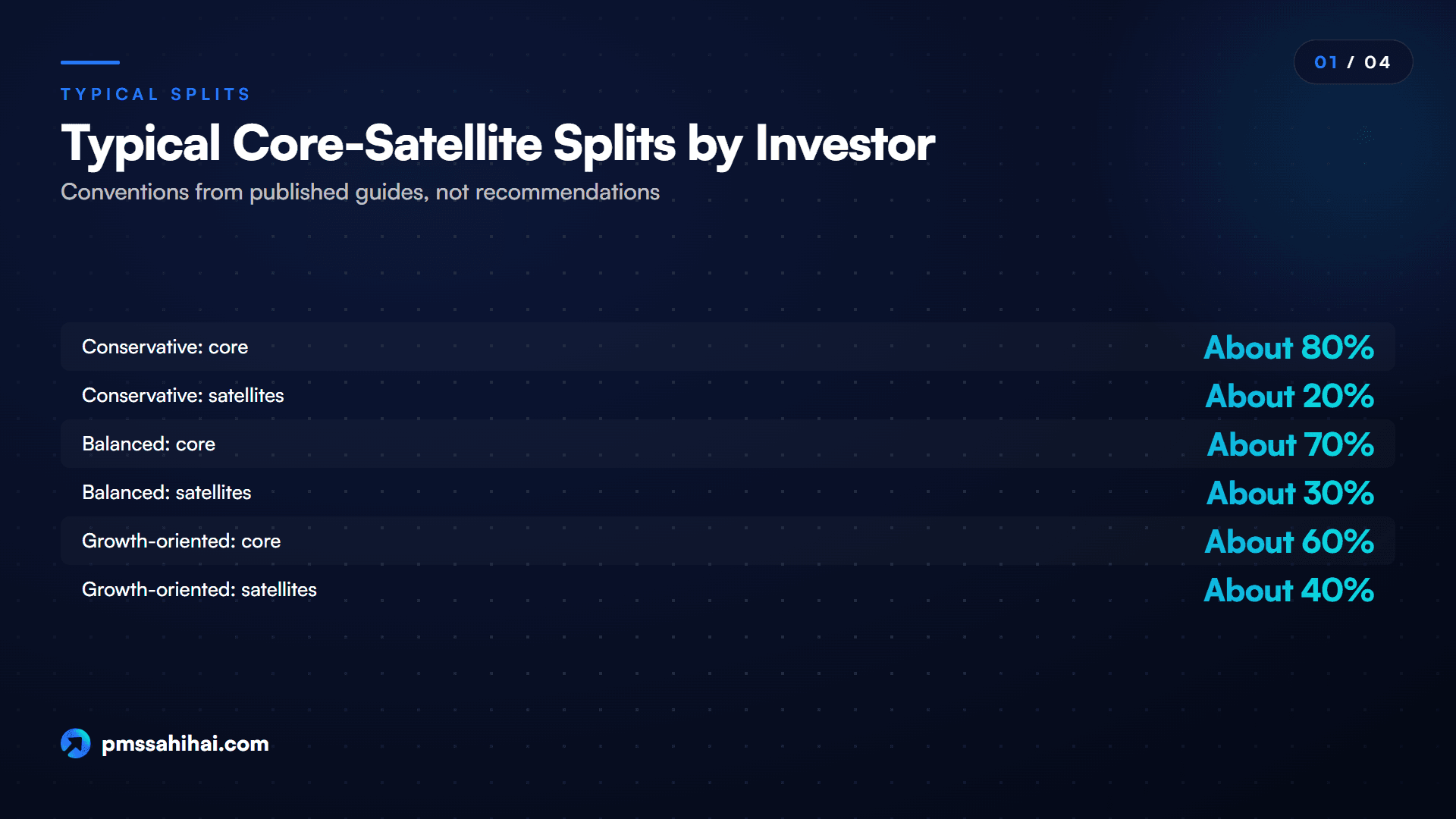
There is no regulatory or academic rule for the core-satellite split or the satellite allocation. The ranges below are conventions drawn from published guides, not recommendations.
| Source type | Core | Satellites |
|---|---|---|
| Indian broker and fintech guides (general) | 60–80% | 20–40% |
| UK investment platform guidance | 70% or more | Up to 30% |
| UK broker guide | 70–90% (80/20 called common) | 10–30% |
Most guides then shift the split by investor profile:
| Profile | Core | Satellites | Why |
|---|---|---|---|
| Conservative or near a large withdrawal | About 80% | About 20% | Stability and liquidity come first |
| Balanced, long horizon | About 70% | About 30% | Room for two or three meaningful satellites |
| Growth-oriented, experienced | About 60% | About 40% | Higher tolerance for active risk; guides warn against going further |
One broker guide lists letting satellites grow beyond roughly 40–50% as a common mistake, because at that point the satellites become the portfolio and the core stops doing its job.
Two points matter more than the exact number. Some guides apply the split to the whole investable portfolio and others only to equity, so be clear which you use. And the split should follow from your goals and drawdown tolerance, not from how exciting this year's satellite pipeline looks.
Where PMS and AIF Fit as Satellites
This is where core-satellite investing becomes specific to Indian HNIs, and where most explainers stop short.
A portfolio management service under the SEBI Master Circular for Portfolio Managers requires a minimum investment of Rs 50 lakh per client. The SEBI (Portfolio Managers) Regulations, 2026, notified in October 2026 and taking effect on 1 April 2027, keep that minimum. Until then the 2020 Regulations and the July 2025 Master Circular apply. An AIF requires at least Rs 1 crore per investor under the AIF Regulations and the SEBI Master Circular for AIFs, last updated 5 November 2026.
Most PMS strategies are concentrated, actively managed portfolios with management and often performance fees. Most AIFs are private-market funds (Category I and II) or complex listed strategies (Category III). Both match the satellite profile: active, concentrated, expensive and expected to add something the core cannot. That is why using a PMS as a satellite, rather than as the core, is the default in core-satellite investing for HNIs.
The Minimum-Ticket Test
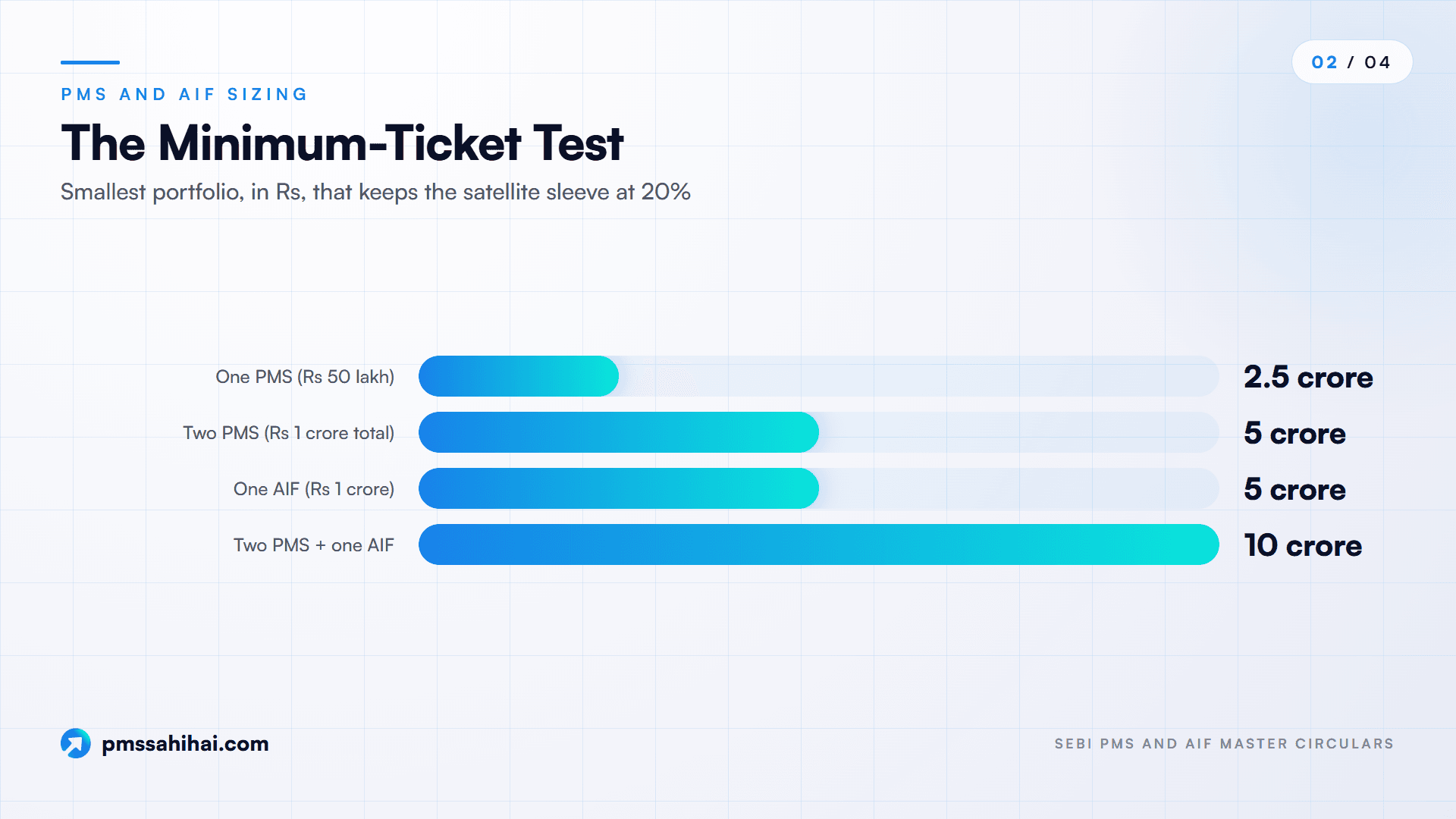
Because PMS and AIF tickets are large and fixed, they shape HNI portfolio construction by putting a floor under the portfolio size at which a sensible satellite allocation is possible. The arithmetic is simple:
Minimum portfolio size = (number of satellites × minimum ticket) ÷ satellite weight
| Satellite plan | 20% satellite weight | 25% satellite weight | 30% satellite weight |
|---|---|---|---|
| One PMS (Rs 50 lakh) | Rs 2.5 crore | Rs 2 crore | Rs 1.67 crore |
| Two PMS (Rs 1 crore total) | Rs 5 crore | Rs 4 crore | Rs 3.33 crore |
| One AIF (Rs 1 crore) | Rs 5 crore | Rs 4 crore | Rs 3.33 crore |
| Two PMS + one AIF (Rs 2 crore total) | Rs 10 crore | Rs 8 crore | Rs 6.67 crore |
Below these sizes, either the satellite sleeve grows too large or you need fewer satellites. An investor with Rs 1.5 crore who puts Rs 50 lakh into one PMS already has a third of the portfolio in one satellite. That may suit a growth-oriented investor, but it should be a choice, not an accident of the minimum ticket.
This is why many families graduate in stages: mutual fund satellites first, one PMS once the portfolio clears Rs 2–3 crore, and AIFs only when a Rs 1 crore commitment fits inside the satellite limit.
Can a PMS Ever Be the Core?
Sometimes. Our published guide to asset allocation for PMS investors takes a different view, treating long-term, high-conviction PMS equity as the core and funds as satellites. That can work for a family that has chosen a diversified, low-turnover PMS it intends to hold for a decade.
The trade-off: a PMS core costs more than an index core, depends on one manager's judgement and is often more concentrated (see concentrated vs diversified PMS). If you go this way, prefer a diversified, large-cap-heavy strategy with a record through full cycles, and keep concentrated, high-fee strategies in the satellites. The question to ask is not "is this a PMS?" but "does this holding behave like a core or like a satellite?"
Worked Example of a Rs 10 Crore Core-Satellite Portfolio
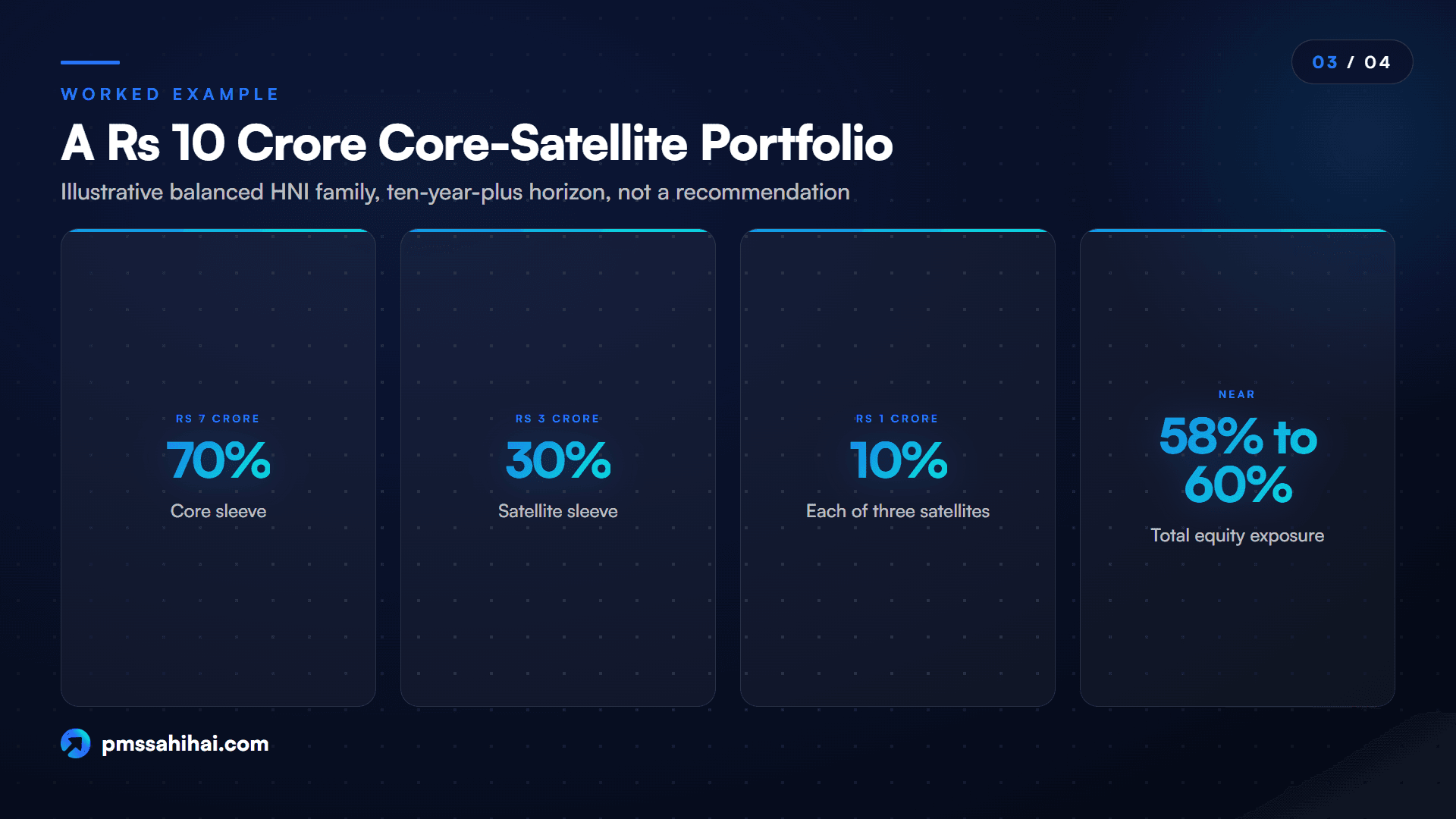
Here is a hypothetical core-satellite portfolio for a balanced Indian HNI family with Rs 10 crore of investable money, a ten-year-plus horizon and an emergency reserve held separately. It is an example of the framework, not a recommendation for any reader.
Target split: 70% core (Rs 7 crore), 30% satellites (Rs 3 crore).
| Sleeve | Holding (illustrative) | Amount | Weight | Job |
|---|---|---|---|---|
| Core | Broad Indian equity index funds (Nifty 50 plus Nifty Next 50, or one Nifty 500 fund) | Rs 3.5 crore | 35% | Capture market return cheaply |
| Core | High-quality debt (government securities, target-maturity and short-duration funds) | Rs 2.5 crore | 25% | Stability, goal funding |
| Core | Gold ETFs | Rs 0.5 crore | 5% | Diversifier |
| Core | Liquid or overnight funds | Rs 0.5 crore | 5% | Liquidity for the whole portfolio |
| Satellite | Concentrated mid- and small-cap PMS | Rs 1 crore | 10% | Return enhancement vs a small-cap index |
| Satellite | Value or special-situations PMS | Rs 1 crore | 10% | Return enhancement with a different style |
| Satellite | Category III long-short AIF | Rs 1 crore | 10% | Diversify away from core equity beta |
Three checks turn this core and satellite portfolio from a list into a working plan:
- Total equity exposure. Core equity is 35%. The two PMS add 20%. A long-short AIF's net equity exposure varies, but if it runs, say, 30–50% net long, it adds another 3–5%. Total equity therefore sits near 58–60%, which should match the family's agreed policy mix. If it does not, adjust the core, not the satellites.
- Overlap. The index core already owns India's largest companies. If either PMS holds mostly large caps, it overlaps with the core and you are paying active fees for index exposure. Choosing a mid- and small-cap PMS and a style-different PMS reduces that risk. A look-through check across all holdings, of the kind described in our guide to PMS portfolio overlap, should confirm it.
- Ticket fit. Each satellite meets its minimum (Rs 50 lakh for each PMS, Rs 1 crore for the AIF) and the sleeve stays at 30%, consistent with the minimum-ticket test above.
If the same family had Rs 4 crore instead of Rs 10 crore, the core-satellite strategy would suggest one or two PMS satellites and no AIF, since a Rs 1 crore AIF alone would be a quarter of the portfolio.
How Core-Satellite Investing Makes Portfolio Decisions Easier
The biggest benefit of core-satellite investing is not a higher return. It is better decisions. Here is what it changes in practice.
- Every new product gets the same three questions. Which sleeve does it fill? How much room is left in that sleeve? What must it beat? Many pitches fail the first question.
- Fees become a choice. Most of the portfolio sits in low-cost vehicles, so active and performance fees are paid only on the satellite slice, where you expect them to earn their keep.
- Risk is contained. Because satellites are capped, one disappointing manager hurts without derailing the family's goals. Ranking guides make the same point: the core must stay larger than the satellites so one poor bet cannot undo the plan.
- Accountability is clear. Each satellite has a named job and benchmark, so it is easier to spot one that is not working and replace it, without touching the core.
- Behaviour improves. One Indian glossary flags performance-chasing in the satellite as the main risk and recommends fixing satellite rules in advance.
- Family conversations get simpler. "70% stays in the core and we have room for one more satellite" is easier to explain than a list of 14 products.
For an HNI with several advisers, that is the real value: a product shelf becomes a plan.
How PMS Sahi Hai Helps You Build and Check Your Satellite Sleeve
PMS Sahi Hai is built around the question this framework keeps asking: does a product fit you, and what job would it do? Its who-should-invest guide describes the role of a PMS or AIF in a plan in one word: satellite, placed "around a low-cost core". It also says plainly that if you lack a genuine surplus of Rs 50 lakh or more, a five-year horizon or the temperament to sit through drawdowns, "a low-cost fund is usually the wiser starting point". That is the core-first logic of the core-satellite strategy, stated by a platform that distributes PMS and AIFs.
Here is how its tools map to each step of core-satellite investing.
- Mapping what you already hold. The portfolio score lets you share your PMS, AIF, mutual fund or direct equity holdings. Nyra, the platform's AI research assistant, reads each one against the same published standards and reports on returns against the right benchmark net of costs, maximum drawdown and recovery, manager tenure and fees. That is the satellite review this post recommends, done holding by holding.
- Spotting overlap and drift. One of Nyra's starting points is a review of "overlap, drift and fee drag" across your holdings. Use it to check whether a satellite PMS is quietly duplicating your index core.
- Shortlisting satellites by job. The PMS and AIF comparison tool filters strategies by category (large, mid, small, flexi, thematic), benchmark and style, and lines up to four side by side. If your satellite's job is "beat a small-cap index", you can shortlist only small-cap strategies against that benchmark.
- Comparing on one basis. Every rated strategy gets a 0–10 Nyra Score built on five pillars with fixed weights, and the methodology page is open about its limits: the score is "not a prediction" and "not a recommendation", and a high score "can be completely wrong for your risk profile". Suitability, in other words, is still decided by your core-satellite plan.
One nuance is worth knowing. A few strategies listed on the site, such as Axis Core & Satellite PMS and Spark Core & Satellite, use core-satellite construction inside a single portfolio. That is a manager's stock-selection approach, not your family's allocation plan. Holding one of them is still one satellite in your core and satellite portfolio.
Nyra is an analytical tool, not a SEBI-registered investment adviser, so treat its output as research to discuss, not as advice.
Keeping the Framework on Track with Rebalancing
Markets move the satellite allocation. A strong year for small caps can push a 30% satellite sleeve to 38%; a sharp fall can shrink it to 22%. Rebalancing returns the portfolio to its targets. Rebalancing methods are a topic of their own, so this section covers only what a core-satellite portfolio needs.
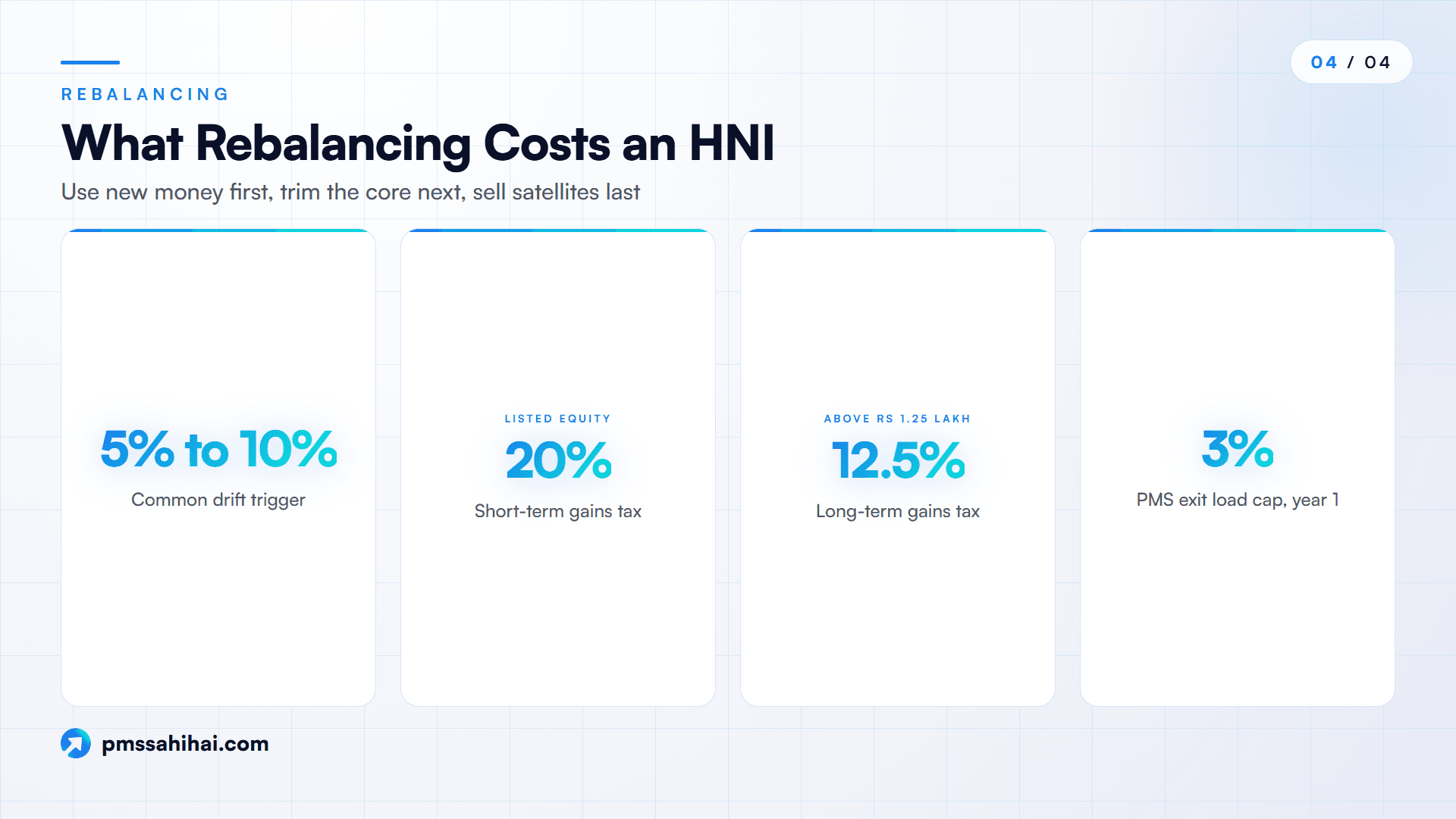
Guides commonly suggest an annual review, or action when weights drift about 5–10% from target. For Indian HNIs, the cost of acting matters as much as the rule:
- Tax on sales. Since 23 July 2024, short-term gains on listed equity are taxed at 20% and long-term gains at 12.5% above an annual exemption of Rs 1.25 lakh. From 1 April 2026 these rules sit in the Income-tax Act, 2025 (sections 196 and 198, previously 111A and 112A).
- Gains inside a PMS are yours. In a PMS, the securities are held in your own account, so the manager's trades create capital gains in your hands each year, whether or not you rebalance between sleeves.
- Exit loads. PMS exit loads are capped at 3%, 2% and 1% in years one to three, nil after. AIFs often have lock-ins.
So the practical sequence is: use new money and income first, directing them to the underweight sleeve; trim within the core, where low-cost funds are easiest to adjust; and only then sell satellites. Tax rules can change and individual situations differ, so consult a tax adviser before acting on a rebalancing plan.
Limitations and Mistakes That Undermine the Framework
Core-satellite investing is a structure, not a guarantee. Its limits are real.
- Satellites may not beat the core. As one broker guide puts it, there is no guarantee the satellite portion will perform better than the core. Vanguard adds that a combined approach is not guaranteed to be less risky or to deliver comparable returns.
- It takes work. Satellites need research, monitoring and periodic decisions, which ranking guides consistently list as a drawback.
- Ticket sizes and friction. Below roughly Rs 2–3 crore, one Rs 50 lakh PMS can push the satellite allocation past sensible limits, and tax, exit loads and AIF lock-ins mean you cannot always trim satellites on schedule.
The common mistakes are behavioural:
- Satellite creep. Adding one more "small" satellite each year until satellites are half the portfolio.
- Hidden overlap. Several PMS strategies holding the same stocks, or a "satellite" PMS that is really a large-cap portfolio duplicating the index core.
- Judging satellites against the wrong benchmark. A small-cap PMS compared with the Nifty 50 can look brilliant in a small-cap rally and terrible after it.
- An expensive core. High-cost, high-turnover funds in the core defeat its purpose.
- Chasing themes. Buying a satellite after a strong run rather than because it does a needed job.
- No exit rule. Keeping a failing satellite for years to avoid admitting the mistake.
Making Core-Satellite Investing Work for Your Family Wealth
Core-satellite investing is not new or complicated. Its strength for Indian HNIs is that it imposes order on an expensive, crowded product market.
Start with the core: set your policy mix of equity, debt, gold and liquidity, and fill it with broad, low-cost holdings you will hold for a decade. Then size the satellite sleeve, usually 20–40% of the portfolio, and run the minimum-ticket test before adding any PMS or AIF. Give every satellite a job, a weight limit and a benchmark it must beat after fees. Review the core-satellite portfolio at least once a year, rebalance with new money first and keep the tax cost in view.
If you want a second pair of eyes, PMS Sahi Hai's Nyra can score what you already hold and flag overlap and fee drag before you add the next satellite.
Done well, this approach to HNI portfolio construction promises not higher returns but something more useful: a portfolio where you know why every holding is there.
Start Building Your Core-Satellite Portfolio Today
If your portfolio has grown product by product, the first step towards core-satellite investing is to map it. List every holding, mark it core or satellite, and check three things: the total split, the overlap between satellites and the core, and whether each satellite has beaten its own benchmark after fees. Then decide how much room your satellite allocation really has before you look at the next PMS or AIF.
PMS Sahi Hai can help with both steps. Get your portfolio scored by Nyra to see each holding's returns, drawdown, manager tenure and fees on one basis, then use the comparison tool to shortlist satellites that match the job you have defined. Keep the core simple, make every satellite earn its place, and talk to a qualified adviser and a tax adviser before you commit.
PMS Sahi Hai is a distributor of Portfolio Management Services and Alternative Investment Funds, APMI-registered (Registration No. APRN08358). This article is for education only and is not investment advice, a recommendation, or an offer to buy or sell any security. Investments in securities markets are subject to market risks; read all scheme-related documents carefully. Past performance is not indicative of future results. Consult your advisor before investing.
Ishaan founded PMS Sahi Hai to make India's PMS, AIF and GIFT City markets legible to serious investors, comparing every SEBI-registered manager on the same comparative basis, with no shelf products and no commission bias.
Frequently asked
What is core-satellite investing in simple words?
Core-satellite investing divides a portfolio into two parts. The core, usually 60–80% of the money, holds broad, low-cost, diversified investments such as index funds and high-quality debt that aim to capture market returns. The satellites, usually 20–40%, hold smaller, more active or specialised positions that aim to add returns or diversification. Capping satellites keeps active risk and fees under control.
What is a good core-satellite split for an Indian HNI?
Published guides commonly suggest 60–80% in the core and 20–40% in satellites, with conservative investors near 80/20 and growth-oriented investors near 60/40. For HNIs, the split should also pass a minimum-ticket test: Rs 50 lakh per PMS and Rs 1 crore per AIF must fit inside the satellite weight. Your goals and drawdown tolerance should set the final number.
Can a PMS be used as a satellite investment?
Yes, and for most HNIs that is its natural role. PMS strategies are usually concentrated, actively managed and charge higher fees than index funds, which matches the satellite profile. Each PMS satellite should have a defined job, a weight limit and a matching benchmark. A broadly diversified, low-turnover PMS can sometimes sit near the core, but concentrated strategies belong in satellites.
Should an AIF be part of the core or the satellite sleeve?
Usually the satellite sleeve. AIFs need at least Rs 1 crore, often have lock-ins or limited redemption windows and run specialised strategies such as private equity, private credit or long-short equity. Those features make them poor core holdings, since the core must stay liquid and cheap. A Category III long-short AIF can be a useful satellite if it genuinely reduces dependence on the equity market.
How much money do I need before core-satellite investing with PMS makes sense?
Divide the total satellite tickets by your satellite weight. One PMS at a 25% satellite weight needs about Rs 2 crore; two PMS need about Rs 4 crore; two PMS plus one AIF need about Rs 8 crore. Below those levels the framework still works, but satellites should come from mutual funds or you must accept a larger satellite share.
How often should a core-satellite portfolio be rebalanced?
Many guides suggest a review once a year, or when the split drifts by about 5–10% from target. In India, rebalancing can trigger capital gains tax and PMS exit loads in the first three years, so direct new money to the underweight sleeve first and trim the low-cost core before selling satellites. Consult a tax adviser for your situation.
Who invented the core-satellite strategy?
No single person invented the label, but its theory traces to Jack Treynor and Fischer Black, whose 1973 paper showed that an optimal portfolio combines a passive index fund with an active portfolio of a few securities where the investor has an edge. Harry Markowitz's 1952 work on diversification and the rise of low-cost index funds from 1975 made the approach practical.
Keep reading
All articles
Why PMS and Mutual Fund Benchmarks Use TRI: The Rules Explained
SEBI's 2018 TRI mandate, the PMS benchmark rules from APMI, and why comparing a fund with a price index flatters its returns.
What Is NAV? Net Asset Value in Mutual Funds, AIFs and PMS
Net asset value explained: the NAV formula, SEBI's 2026 cut-off and disclosure rules, why AIF NAV lags, and why a PMS has no NAV per unit.

Active Share in PMS: Formula, Worked Example and Good Values
What active share in PMS measures, the formula, a worked example on Nifty 50 weights, what a good value is, and the metric's real limits.
Read it. Now pressure-test it.
Ask Nyra how this applies to your portfolio, or talk to our team, no pitch, no pressure.