
What Is NAV? Net Asset Value in Mutual Funds, AIFs and PMS
Net asset value explained: the NAV formula, SEBI's 2026 cut-off and disclosure rules, why AIF NAV lags, and why a PMS has no NAV per unit.


Net asset value (NAV) is what one unit of a pooled fund is worth: the market value of everything the scheme owns, minus what it owes, divided by the units in issue. Under SEBI's Mutual Funds Regulations 2026, every mutual fund computes it daily, and SEBI's March 2026 master circular fixes the formula, the rounding, the cut-off times that decide which NAV you get, and the deadlines for publishing it. AIFs use the same arithmetic on slower, model-based inputs, so their NAV can be months old. A PMS has no NAV per unit at all, because you own the securities directly: what you get is the value of your own portfolio, with performance reported as TWRR and XIRR. Read NAV as a price, never as a sign that a fund is cheap or good.
Why the Price of a Fund Unit Needs a Rulebook
When you buy a share on the exchange, the price is whatever the last buyer and seller agreed. When you buy a unit of an open-ended mutual fund, nobody bargains. You put in money, the fund issues new units, and the price of each unit is set by a calculation done after the market closes. That calculated price is the net asset value.
Because thousands of investors deal at that one number every day, small errors matter. Set it too high and leavers are overpaid by those who stay; too low and newcomers get a bargain at existing investors' expense. So NAV in mutual fund schemes is written into regulation: how it is computed, which day's figure applies to your order, how many decimals it carries and when it is published.
This guide explains those rules as they stand on 6 November 2026, then follows the idea into alternative investment funds (AIFs), where NAV exists but moves slowly, and into portfolio management services (PMS), where there is no NAV per unit at all. That last part is where most confusion starts for investors moving up from mutual funds.
What Net Asset Value Means in Plain Terms
Net asset value is the value of a fund's assets after its liabilities are paid, expressed per unit. If the fund sold everything at today's prices, paid every bill and shared what was left equally, the net asset value is what each unit would get.
So what is NAV in one line? It is the price of one unit, recalculated from the fund's holdings. SEBI's own investor FAQ calls NAV "the unit price of a mutual fund scheme" and the price at which investors buy or redeem units. Its worked example is a scheme with total assets of Rs 200 lakh, liabilities of Rs 10 lakh and 10 lakh units outstanding. Net assets are Rs 190 lakh, so the NAV is Rs 19 per unit.
Three features follow from that definition:
- NAV is mechanical. It moves only when the value of the holdings, accrued income or expenses owed change. Demand for the fund does not push it up the way demand pushes a share price.
- NAV is per unit. A Rs 10,000 crore fund and a Rs 50 crore fund can have the same NAV per unit.
- NAV is a pooled-fund idea. It only makes sense when many investors own slices of one portfolio. Where each investor owns a separate portfolio, as in a PMS, there is nothing to divide.
NAV is a price, AUM is a size
People often place NAV next to assets under management (AUM). NAV per unit is the price of a slice; AUM is the size of the whole pie. A high NAV does not mean a big fund, and a big fund does not mean a high NAV.
How NAV Is Calculated: The Formula Step by Step
The legal starting point is regulation 43 of the SEBI (Mutual Funds) Regulations, 2026, in force since 1 April 2026. Every asset management company must compute the net asset value of each scheme daily, dividing net assets (valued under SEBI's norms) by the units outstanding on the valuation date.
SEBI's Master Circular for Mutual Funds dated 20 March 2026 spells out the NAV formula (paragraph 9.1.2):
NAV = (Market or fair value of the scheme's investments + Current assets − Current liabilities and provisions) ÷ Number of units outstanding on the valuation date
That is the whole of how NAV is calculated. The work lies in getting each input right.
What sits on the assets side
- Investments at market or fair value. The Eighth Schedule to the 2026 Regulations requires mutual funds to mark all investments to market. Listed shares are valued at their closing prices; bonds at prices set under SEBI's valuation norms; investments that do not trade are valued in good faith under those norms.
- Accrued income. Interest on bonds must be accrued day by day as it is earned, not when the coupon arrives. A dividend is recognised on the date the share goes ex-dividend, not when the cash is paid.
- Cash and other current assets. Bank balances, short-term money market holdings and money receivable for securities the fund has sold but not yet settled.
Transactions are recorded on the trade date, not the settlement date, so a share bought this afternoon is already in this evening's NAV.
What counts as a liability
- Payables for securities bought but not yet paid for.
- Accrued expenses: the management fee and other scheme costs, kept within the total expense ratio limits, are provided for as they build up, so the cost of running the fund comes out of NAV rather than being billed to you.
- Redemptions payable to investors who have already exited, and any other amounts owed.
Some popular explainers get this wrong: NAV is not "assets minus the expense ratio". The expense ratio is an annual rate; what enters the NAV formula is the expense accrued to date, one liability among several.
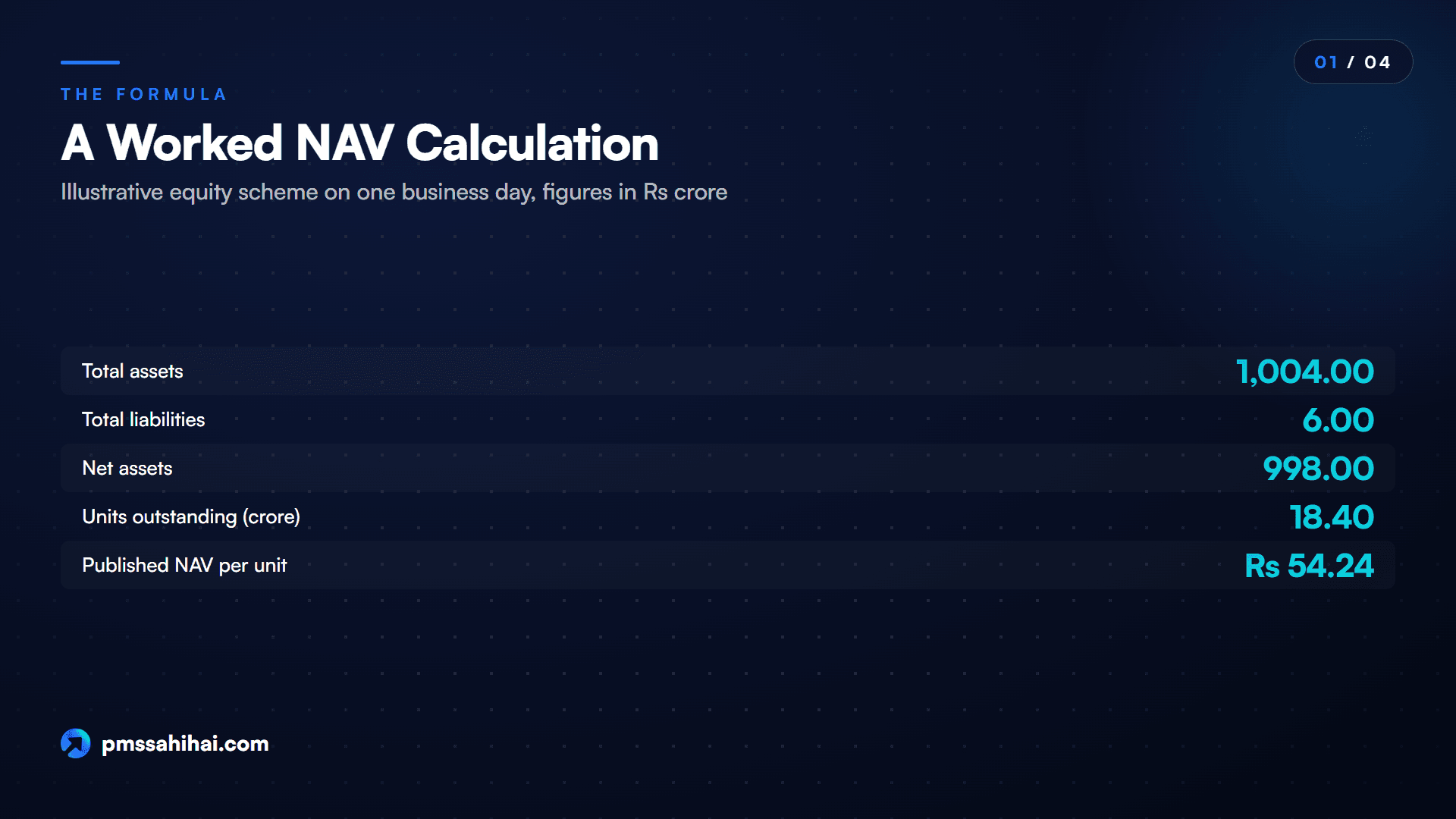
A worked NAV calculation
Take an invented equity scheme on one business day (all figures illustrative):
| Item | Rs crore |
|---|---|
| Shares at closing prices | 920.00 |
| Government securities and bonds at market value | 60.00 |
| Cash and money market | 18.50 |
| Interest and dividends receivable | 1.20 |
| Receivable for shares sold | 4.30 |
| Total assets | 1,004.00 |
| Payable for shares bought | 3.10 |
| Accrued management fee and other expenses | 0.65 |
| Redemptions payable | 2.25 |
| Total liabilities | 6.00 |
| Net assets | 998.00 |
| Units outstanding | 18.40 crore units |
Applying the NAV formula: Rs 998.00 crore ÷ 18.40 crore units = Rs 54.2391, published as Rs 54.24 for an equity scheme.
If you invest Rs 5 lakh at that NAV per unit, you get about 9,218 units. The next day the fund's shares fall 1% overall and nothing else changes: the shares are now worth Rs 910.80 crore, net assets fall to Rs 988.80 crore and NAV drops to about Rs 53.74. Your units have not changed. Their value has.
Rounding rules for published NAVs
The master circular also fixes the decimals (paragraph 9.1.3). Index funds and all debt-oriented schemes must round NAV to four decimal places, because their daily moves are small and two decimals would hide them. Other schemes round to two decimals, though a fund may use more if it says so in its scheme documents. That is why a liquid fund shows a NAV such as 3,214.5678 while an equity fund shows 54.24.
From Fixed Prices to Daily NAV: How the Idea Evolved
India's first mutual fund, the Unit Trust of India, was set up by an Act of Parliament in 1963. Its flagship Unit Scheme 1964 (US-64) sold and bought back units at prices fixed by its management rather than on the basis of the actual value of the underlying assets. After political pressure, instability in the 1990s and a market downturn left the scheme in serious trouble, the government stepped in in 2002 with a rescue package and a law that split UTI in two. The schemes that were not priced on NAV went to a government-controlled entity (the Specified Undertaking of UTI), and the rest became UTI Mutual Fund under SEBI's regulation. The lesson stuck: a pooled fund should price its units off its net asset value.
Meanwhile, in 1987 public sector banks and financial institutions were allowed to sponsor mutual funds, ending UTI's monopoly, and SEBI's Mutual Funds Regulations of 1996 set the rulebook for the next three decades.
The timing rules came from the same concern. In the United States, the SEC adopted forward pricing in 1968 (Rule 22c-1): a fund must sell and redeem at the NAV next computed after it receives the order, so nobody can buy at a stale price after good news breaks. India built its own version through SEBI circulars on uniform cut-off timings from March 2004 onward, and tightened it on 1 February 2021, when the NAV for every purchase became tied to the day the money actually reaches the scheme.
On 1 April 2026 the SEBI (Mutual Funds) Regulations, 2026 replaced the 1996 Regulations; the NAV rules now sit in regulation 43 and Chapter 9 of the March 2026 master circular.
When NAV Is Struck and Which NAV You Get
Cut-off times and the applicable NAV
The applicable NAV is the NAV at which your purchase or redemption is processed. The rules pick it from when your order arrives and, for purchases, when your money arrives.
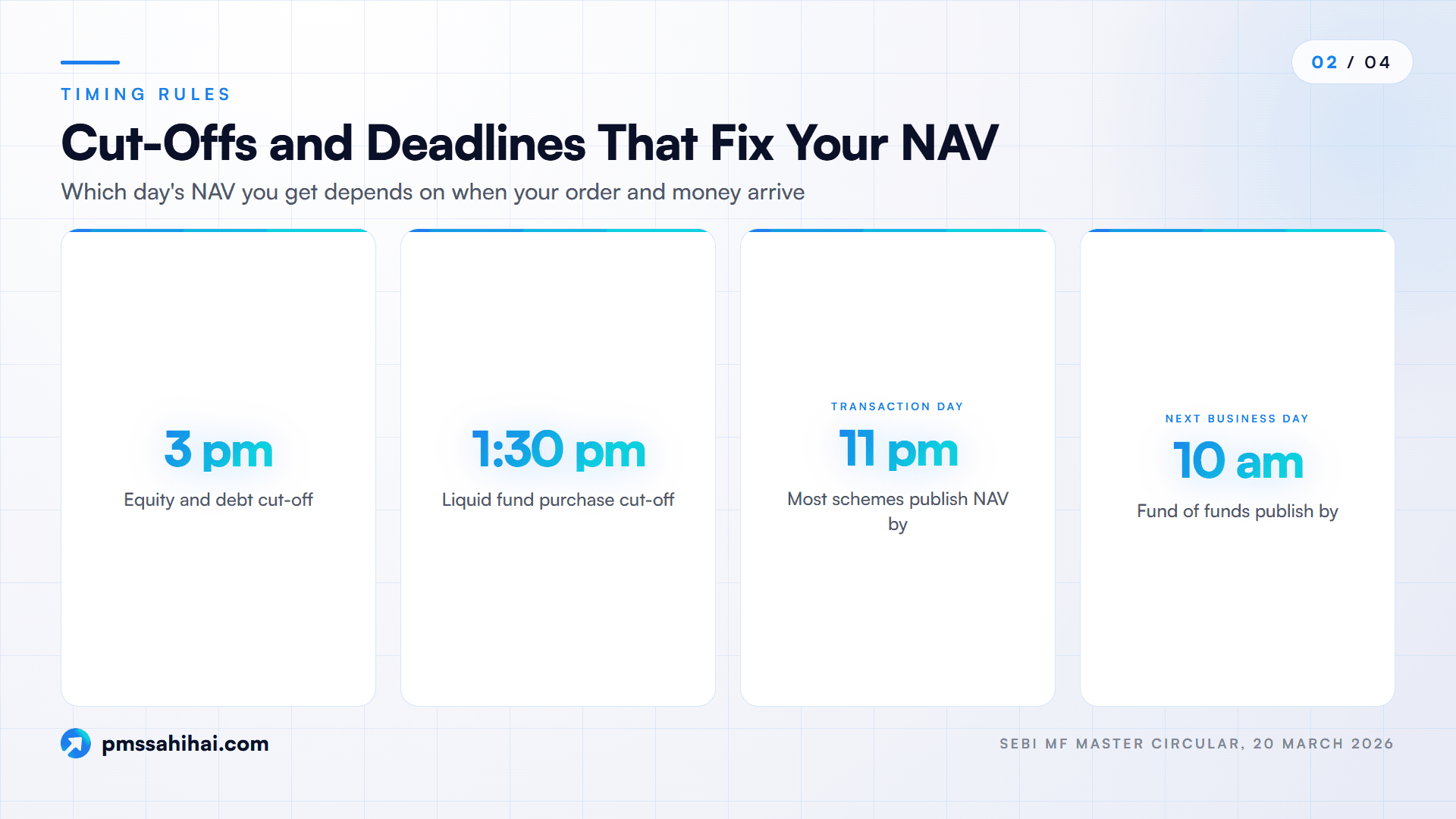
For equity and debt schemes (other than liquid and overnight funds), the cut-off is 3 pm on a business day:
- Purchases: if your application is received and the full amount is credited to the scheme's bank account and available for use before 3 pm, you get that day's closing NAV. If the money arrives later, you get the NAV of the business day on which it is available before the cut-off. This has applied to every purchase regardless of amount since 1 February 2021, under SEBI circulars of 17 September and 31 December 2020. It covers SIP instalments and switch-ins too.
- Redemptions: an application received before 3 pm gets that day's closing NAV; after 3 pm, the next business day's.
Liquid and overnight funds work differently because they hold very short-term instruments. Purchases have a 1:30 pm cut-off, and if the money is in by then you get the closing NAV of the day immediately preceding the day of receipt. Redemptions use the 3 pm cut-off.
Two principles sit behind this. Money must be available to the scheme without any credit facility, intraday or otherwise. And outside liquid and overnight funds, AMCs may use only a prospective NAV, one not yet known when you place the order.
SEBI's investor FAQ gives a useful example. Suppose Monday, Wednesday and Thursday are business days and Tuesday is not. You apply on Monday to buy an equity scheme, but the money is realised on Wednesday by 2 pm: you get Wednesday's NAV. If it is realised only by 5 pm on Wednesday, you get Thursday's.
When each scheme type must publish
The master circular sets a deadline for declaring NAV, measured in business days:
| Scheme type | NAV must be published by |
|---|---|
| All schemes other than those below | 11 pm on the transaction day |
| Schemes with exposure to exchange-traded commodity derivatives | 9 am the next business day |
| Fund of funds | 10 am the next business day |
| Schemes, including index funds and ETFs, with at least 80% in overseas investments | 10 am the next business day |
| Schemes that cannot capture same-day valuation | The time disclosed in the scheme document, with reasons |
NAVs go on the AMC's website and on AMFI's daily NAV page. Some explainers say 9 pm; the master circular says 11 pm for most schemes.
Why One Scheme Can Show Several NAVs
Look up a fund and you may find four or more NAVs on the same day. That is not an error.
Direct and regular plans
Every scheme must offer a direct plan for investors who do not go through a distributor. The master circular says that plan shall have a lower expense ratio, because no distribution commission is paid, and a separate NAV. Both plans hold the same portfolio. The direct plan's NAV is higher, and the gap widens over time by the difference in expenses. Over many years that gap is a clear picture of what distribution costs.
Growth and IDCW options
Under the growth option, income stays in the scheme and NAV keeps compounding. Under the Income Distribution cum Capital Withdrawal (IDCW) option, the scheme pays some money out, and NAV is adjusted on the record date by the amount distributed plus any statutory levy. SEBI requires the notice to say, in bold, that NAV will fall to the extent of the payout. So an IDCW option's NAV history shows step drops that are not losses. Compare growth options with growth options.
ETFs, market price and iNAV
An exchange-traded fund has a net asset value, but you usually buy and sell its units on the exchange at a market price, which can sit above or below NAV. To help you judge that gap, AMCs and exchanges publish an indicative NAV (iNAV) during trading hours. For equity ETFs it must be updated within a maximum lag of 15 seconds from the underlying market; for debt and hybrid ETFs, at least four times a day. If an ETF trades well above its iNAV, you are paying a premium for the units.
Swing pricing in debt funds
Under SEBI's swing pricing framework (circulars of 2021 and 2022, now in the master circular), open-ended debt schemes other than overnight and gilt funds can adjust NAV when net outflows are large, with a mandatory full swing for high-risk schemes in a market dislocation. The cost of selling bonds in a rush then falls on those leaving, not those staying.
AIF NAV: The Same Formula With Slower Inputs
An alternative investment fund also issues units, so it also has a net asset value: portfolio value plus cash, minus liabilities, divided by units. AIF NAV differs in its inputs and in how often it is produced.
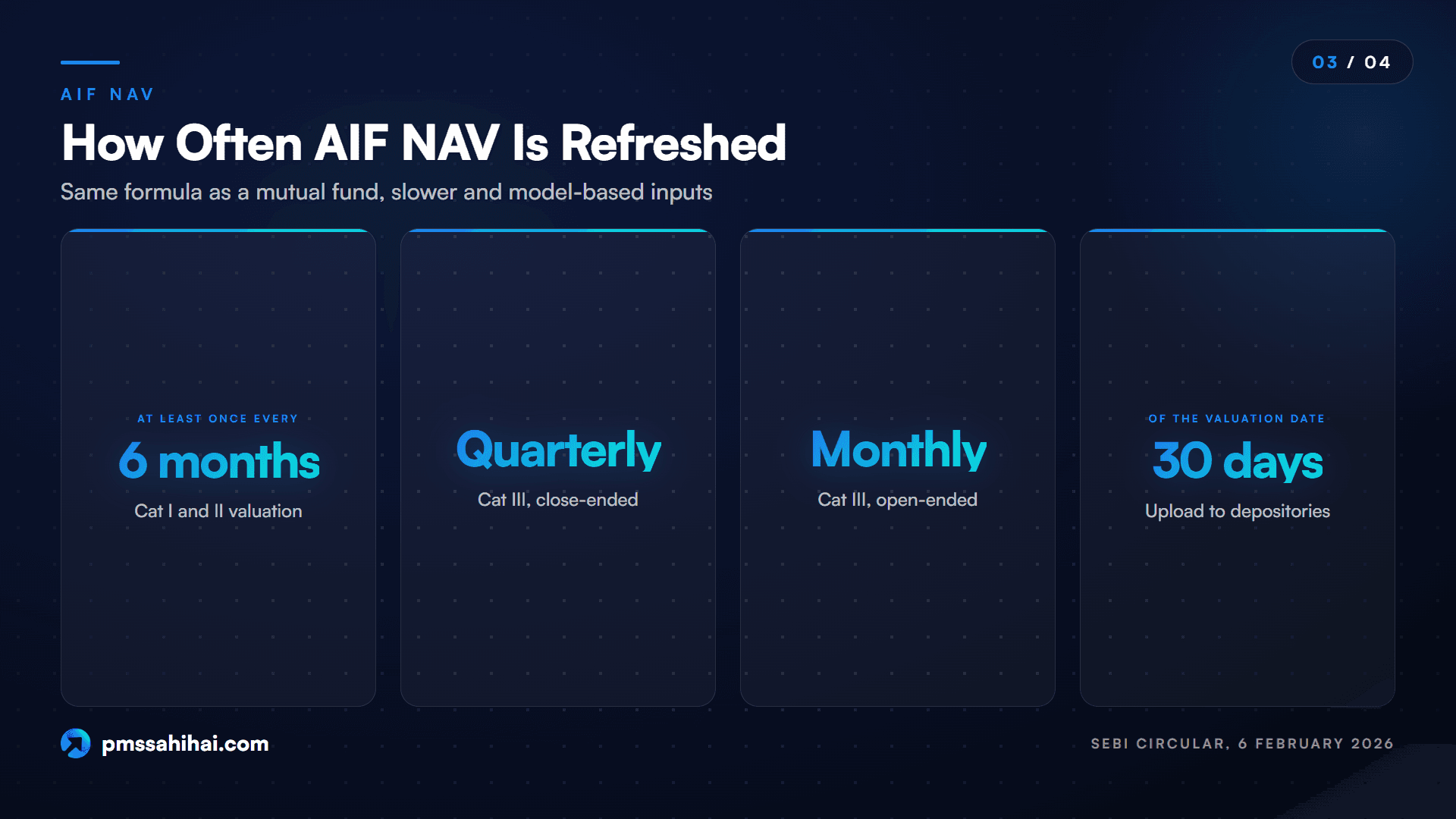
As SEBI's circular of 6 February 2026 summarises the AIF Regulations, Category I and II AIFs must have their investments valued by an independent valuer at least once every six months (extendable to a year with the approval of 75% of investors by value). Category III AIFs must calculate NAV independently of the fund management team and disclose it at least quarterly if close-ended and monthly if open-ended. The same circular requires AIFs to upload the latest NAV for each unit ISIN to the depositories within 30 days of the valuation date, with a disclaimer that it reflects the fund's own valuation method and accounting practice.
So an AIF NAV can be months old and built on models rather than trades. Our explainer on how AIFs work in India covers the valuation cycle, the early-years dip and the depository NAV in your statement.
Why a PMS Has No NAV Per Unit
A portfolio management service is not a pooled fund. It issues no units, so there is no PMS NAV in the mutual fund sense.
SEBI's rules make the structure clear. Regulation 24(14) of the Portfolio Managers Regulations 2020, quoted in SEBI's Master Circular for Portfolio Managers of 16 July 2025, requires the manager to segregate each client's funds and portfolio of securities and keep them separate from its own. The shares sit in a demat account in your name, mapped to a custodian. Another client in the same strategy may hold different weights, bought at different prices, depending on when each of you joined.
With no common pool, there is nothing to divide. Tellingly, the PMS master circular's text never uses the term "NAV"; it talks about portfolio value. (The SEBI Portfolio Managers Regulations 2026, notified on 7 October 2026, take effect on 1 April 2027; until then the 2020 Regulations and the July 2025 master circular apply, including the Rs 50 lakh minimum.)
What replaces NAV in a PMS statement
Your statement shows the portfolio value of your account: each security you hold at its market price, plus cash in the account, plus income receivable, less fees and charges accrued but not yet paid. The master circular requires managers to keep client-wise accounts and send statements at least monthly, and its quarterly report format starts with "Portfolio Value at the beginning of quarter" and "Portfolio Value at the end of quarter".
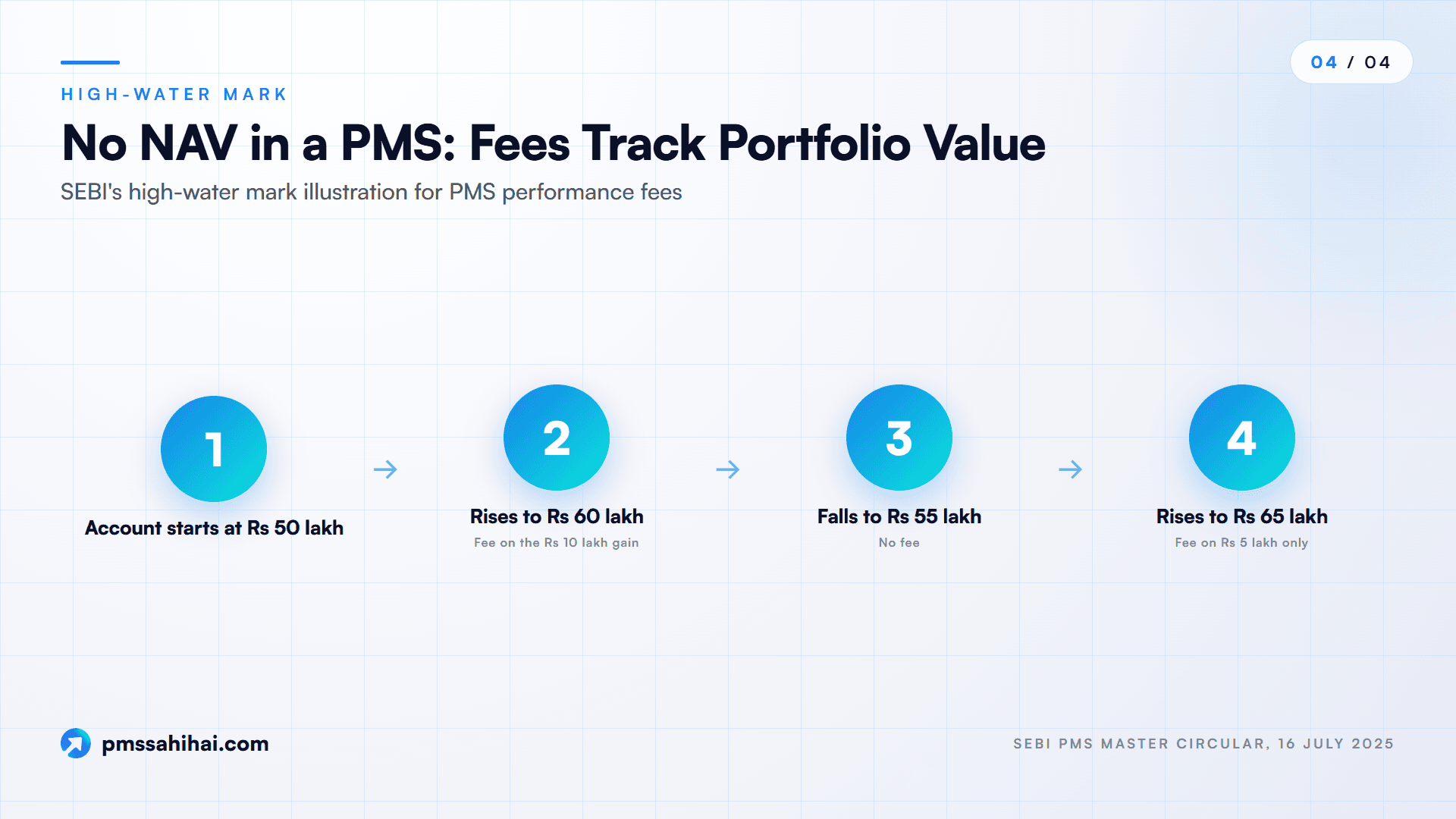
Portfolio value also does the job NAV does for fees. Performance fees in a PMS must follow the high-water-mark principle, defined on the highest value the portfolio has reached. SEBI's own illustration: a Rs 50 lakh account rises to Rs 60 lakh (fee payable on the Rs 10 lakh gain), falls to Rs 55 lakh (no fee), then rises to Rs 65 lakh (fee only on the Rs 5 lakh above the Rs 60 lakh mark).
A worked PMS valuation
Take an invented PMS account at a month-end (illustrative):
| Item | Rs |
|---|---|
| 22 stocks at closing prices | 71,40,000 |
| Cash in the client's account | 1,85,000 |
| Dividends receivable | 15,000 |
| Less: fixed fee and GST accrued, not yet debited | (43,070) |
| Portfolio value | 72,96,930 |
There is no per-unit line, because there are no units. If you invested Rs 60 lakh and added Rs 10 lakh fourteen months later, dividing Rs 72.97 lakh by Rs 70 lakh does not give your return, because the top-up was invested for less time. You need a method that copes with cash flows.
How PMS returns are reported without units
SEBI's answer is two numbers. When a manager advertises or reports the performance of an investment approach, it must show the time-weighted rate of return (TWRR) of that approach with the trailing return of its benchmark. When it reports to you, it must show the XIRR of your own account, with the minimum, maximum and median XIRR across all investors in that approach. TWRR strips out the effect of when money came in and out, so it measures the manager; XIRR includes it, so it measures your experience. Our TWRR explainer walks through the calculation.
The PMS NAV you may still see on a websiteYou may still see a figure labelled NAV on some PMS websites, often starting from 10 or 100. Treat it as a performance index, not a price. One way to compute a time-weighted return is to "unitise" a portfolio internally, creating or cancelling notional units at each cash flow so the value per notional unit tracks performance. You cannot deal at it, and your account can differ from it. SEBI also bars managers from mentioning model portfolio returns in performance reporting.
What NAV Does Well for Investors
For all its limits, net asset value is one of the reasons mutual funds work for millions of people:
- One fair price for everyone. Every investor who transacts in a scheme on a given day, on either side, gets the same price. Nobody negotiates.
- Daily transparency. NAV is computed every business day and published by a fixed deadline on the AMC and AMFI websites. You can check your holding's value without asking anyone.
- Protection against stale-price trading. Cut-offs and prospective pricing stop late investors from buying on yesterday's price after today's news.
- Current values, not book values. Mark-to-market valuation and day-to-day accrual of interest mean NAV reflects what the fund is worth now, not what it paid.
- A clean basis for returns. Because units do not change when money flows in or out, the change in NAV over a period is the scheme's return, before your own taxes and loads.
- Visible costs. Separate NAVs for direct and regular plans let you see the cost of distribution in the numbers themselves.
How PMS Sahi Hai Helps You Read NAV and Portfolio Value
PMS Sahi Hai does not publish its own NAV calculator, and it does not pretend a PMS has a unit price. What it does is help with the harder step: comparing products that report value in different ways.
- Compare PMS strategies on returns, not prices. The PMS comparison tool lines up strategies on normalised returns, fees and AUM "with the same calendar", so you compare like-for-like periods rather than any PMS NAV figure a manager's website may show.
- Read the labels honestly. Each strategy page states that its growth chart and risk figures are modelled to the disclosed since-inception CAGR, "illustrative, not the actual NAV series", and that returns are net of fees where stated. That is the right way to read any PMS chart.
- See AIF NAV history in one place. The AIF comparison page shows side-by-side IRR, NAV history and structure across Category I, II and III funds, which helps when each fund values its units on a different cycle.
- Get the return maths right. The TWRR vs XIRR guide explains why the strategy's reported TWRR and your own XIRR differ, which is the PMS answer to "what has my NAV done?"
- Ask Nyra. Nyra, the platform's AI research assistant, answers questions on PMS, AIF and mutual fund trade-offs, and the Nyra methodology publishes how its 0–10 score is built from disclosed data across five pillars with fixed weights. Strategies with under 12 months of track record are shown as Not Rated. Nyra is an analytical tool, not a SEBI-registered investment adviser, and its score is not a prediction or a recommendation.
If you are moving from mutual funds, where net asset value does most of the work, to a PMS, where your own portfolio value does, this is where the habits change.
Common NAV Myths and Real Limitations
- "A low NAV is cheaper." It is not. New schemes typically start at Rs 10 a unit, but if a Rs 10 NAV fund and a Rs 100 NAV fund both rise 10%, Rs 1 lakh becomes Rs 1.1 lakh in either. More units at a lower price buy you nothing extra. The level of NAV reflects history (when the scheme started, what it has earned, whether it pays IDCW), not value.
- "A rising NAV means a good fund." A rising NAV in a rising market may still trail the benchmark. Judge the change in NAV against the scheme's benchmark and peers, over the same dates.
- NAV history can mislead. IDCW payouts create step drops. A direct and a regular plan of the same scheme show different NAVs. Compare like with like.
- Model-based NAVs can be stale. For unlisted shares, private credit or real estate, NAV is an estimate (and mismarked valuations have led to lawsuits against fund administrators abroad), refreshed every few months in an AIF. It is not a price anyone has paid.
- The ETF price is not the NAV. On the exchange you pay the market price. Check it against the iNAV before you buy.
- NAV does not exist for a PMS. Comparing a PMS "NAV" chart with a mutual fund's mixes an index with a dealing price. Compare TWRR with TWRR.
- NAV is before your taxes and loads. Exit loads (capped at 3% of NAV for open-ended schemes under the 2026 Regulations) and your own tax come out after.
Using NAV Well Across Your Portfolio
Treat net asset value as a price tag. For NAV in mutual fund holdings, it tells you what each unit is worth today, which day's price your order gets and, over time, how the scheme has done. Check the plan and option before comparing NAVs, the time your money arrived before disputing an applicable NAV, and the iNAV before buying an ETF.
AIF NAV is an estimate with a date on it. Read the valuation date first, and judge the fund on distributions over its life rather than any one print.
In a PMS, stop looking for a NAV. Look at your portfolio value, your XIRR and the strategy's TWRR against its benchmark: the same questions, answered for a portfolio that belongs to you alone. PMS Sahi Hai's comparison pages and Nyra are built around exactly those numbers, so you can line up mutual funds, AIFs and PMS strategies without mixing a unit price with a portfolio value.
Compare Strategies on Value, Not Unit Price
Pick one fund or strategy you hold. If it is a mutual fund, check which plan and option you are in and compare its NAV change with its benchmark over the same dates. If it is an AIF, find the date of the last valuation. If it is a PMS, find your account's XIRR and the strategy's TWRR on your latest statement and set them side by side. Then compare PMS strategies on PMS Sahi Hai, check AIF NAV history and IRR, ask Nyra to explain anything on your statement, use our guide on how to read a PMS factsheet, or talk to the team about a shortlist. Past performance does not guarantee future results, and this article is general information, not investment advice.
PMS Sahi Hai is a distributor of Portfolio Management Services and Alternative Investment Funds, APMI-registered (Registration No. APRN08358). This article is for education only and is not investment advice, a recommendation, or an offer to buy or sell any security. Investments in securities markets are subject to market risks; read all scheme-related documents carefully. Past performance is not indicative of future results. Consult your advisor before investing.
Ishaan founded PMS Sahi Hai to make India's PMS, AIF and GIFT City markets legible to serious investors, comparing every SEBI-registered manager on the same comparative basis, with no shelf products and no commission bias.
Frequently asked
What is NAV in simple words?
NAV, or net asset value, is the price of one unit of a fund. It is worked out by taking the market value of everything the scheme owns, adding cash and income due, subtracting what it owes, and dividing by the number of units in issue. NAV in mutual fund schemes is computed every business day after markets close.
How is NAV calculated for a mutual fund?
SEBI's NAV formula is: market or fair value of the scheme's investments, plus current assets, minus current liabilities and provisions, divided by units outstanding on the valuation date. For example, Rs 190 lakh of net assets over 10 lakh units gives a NAV of Rs 19. Equity scheme NAVs are rounded to two decimals; index and debt schemes to four.
Which NAV applies if I invest after 3 pm?
For equity and debt schemes, the applicable NAV is the closing NAV of the business day on which both your application and your money reach the scheme before 3 pm. If either arrives after 3 pm, the next business day's NAV applies. Liquid and overnight funds use a 1:30 pm cut-off for purchases. Redemptions received before 3 pm get that day's NAV.
When is mutual fund NAV published?
Most schemes must publish NAV by 11 pm on the same business day, on the AMC's website and AMFI's website. Fund of funds and schemes with at least 80% in overseas investments have until 10 am the next business day. Schemes with exposure to exchange-traded commodity derivatives have until 9 am the next business day.
Is a fund with a low NAV better than one with a high NAV?
No. The level of NAV does not tell you whether a fund is cheap or good. If two funds each gain 10%, the same investment grows by the same amount, whatever their NAVs. A low NAV usually means a newer scheme or an IDCW option. Compare returns, risk and costs against the benchmark instead.
Why do direct and regular plans of the same fund have different NAVs?
Both plans hold the same portfolio, but the direct plan pays no distributor commission, so SEBI requires it to have a lower expense ratio and a separate NAV. Because its expenses are lower, the direct plan's NAV pulls ahead over time. The gap over time shows what distribution has cost regular-plan investors.
Does a PMS have a NAV?
Not in the mutual fund sense. There is no PMS NAV because a PMS issues no units: each client owns the securities directly in their own demat account, segregated from other clients. What you get instead is your portfolio value, plus returns reported as the strategy's TWRR and your account's XIRR. Any "NAV" on a PMS website is a performance index, not a price you can deal at.
How often do AIFs declare NAV?
AIF NAV depends on the category. Category I and II AIFs must be valued by an independent valuer at least every six months, or yearly if 75% of investors by value agree. Category III AIFs must disclose NAV at least quarterly if close-ended and monthly if open-ended. AIFs upload the latest NAV to the depositories within 30 days of each valuation.
Keep reading
All articles
Why PMS and Mutual Fund Benchmarks Use TRI: The Rules Explained
SEBI's 2018 TRI mandate, the PMS benchmark rules from APMI, and why comparing a fund with a price index flatters its returns.

Active Share in PMS: Formula, Worked Example and Good Values
What active share in PMS measures, the formula, a worked example on Nifty 50 weights, what a good value is, and the metric's real limits.

What Is Core-Satellite Investing? A Framework for HNI Portfolios
Core-satellite investing for Indian HNIs: what goes in the core, which PMS and AIFs suit satellites, typical splits and a Rs 10 crore example.
Read it. Now pressure-test it.
Ask Nyra how this applies to your portfolio, or talk to our team, no pitch, no pressure.