
In-Kind Transfer of Shares in PMS Redemption: Rules, Tax, Process
Take PMS shares, not cash, at exit: what SEBI rules allow, how custodians move them, exit load, and how the Income-tax Act 2025 treats cost and dates.

An in-kind transfer of shares in PMS redemption means you leave a portfolio management service and take the shares themselves into your own demat account, instead of having the manager sell them and send you cash. SEBI's rules say that on termination your securities and funds go to your verified demat and bank accounts, and the PMS Regulations 2026 (in force from 1 April 2027) state a right to withdraw "funds and securities". Moving shares between demat accounts you own is widely treated as no sale under the Income-tax Act 2025, so your original cost and dates carry over, but exit load and fees can still apply. A few points are unsettled, including how FIFO works once lots merge with shares you already hold, so check your agreement and consult a tax adviser before you exit.
What an In-Kind Transfer of Shares Means When You Exit a PMS
Most people picture a PMS exit as a cash event. You write to the portfolio manager, the manager sells everything on the exchange, and the proceeds land in your bank account a few days later. That is how most redemption requests in a PMS are settled.
There is a second route. In an in-kind transfer of shares, nothing is sold. The custodian moves the shares themselves out of the PMS demat account and into a demat account you nominate, usually your own. You walk away holding the same companies, in the same quantities. "In kind" simply means settled in the asset rather than in money. The same thing is called an in-kind redemption or an in-specie redemption, and here the terms mean the same thing.
Why does it matter? A cash PMS exit sells every holding on one date. It crystallises capital gains, pays securities transaction tax and brokerage, and leaves you in cash until you reinvest. An in-kind redemption avoids the sale. Whether that helps depends on your tax position, your stocks, your agreement and whether you actually want to keep the shares.
This guide is deliberately narrow. PMS Sahi Hai's guide to the PMS exit process covers notice periods, timelines and cash settlement, and its in-specie transfer explainer covers the general concept. Here we answer one question in depth: what happens when you take your PMS shares back in kind? We cover the SEBI rules, the custodian's steps, the costs and the Income-tax Act 2025 treatment.
How Settling a PMS Exit in Shares Became Possible
An in-kind PMS exit works because of how a PMS is built. A mutual fund pools money and issues units, so redemption can only pay cash: you never owned the fund's shares. A PMS holds each client's portfolio in a demat account in the client's own name, with a custodian, and the manager trades it under a power of attorney. The shares were always yours, so an in-kind transfer of shares at exit just ends the manager's authority and moves your own property.
Three layers of Indian law built that structure.
Depository law came first. Under the Depositories Act, 1996, a depository such as NSDL or CDSL is the registered owner of dematerialised securities and the investor is the beneficial owner. Shares became electronic balances that move by instruction. The Income-tax Act 2025 still borrows that framework: section 67(8) takes its definitions of "beneficial owner", "depository" and "security" from the Depositories Act.
PMS regulation then hard-wired client ownership. The SEBI (Portfolio Managers) Regulations, 2020 require a manager to "segregate each client's holding in securities in separate accounts" (regulation 23(4)). They bar it from holding client securities "in its own name" (regulation 24(15)). In an informal guidance letter of 17 August 2026, a SEBI department wrote that a discretionary PMS client "is the beneficial owner of the securities in the portfolio". Informal guidance binds only on its facts, but it confirms the principle.
SEBI then wrote the exit route into investor-facing rules. The Investor Charter in SEBI's Master Circular for Portfolio Managers of 16 July 2025 says that upon termination, "the securities and the funds lying in the account of the investor shall be transferred to the verified bank account/ demat account of the investor." The SEBI (Portfolio Managers) Regulations, 2026 were notified on 7 October 2026 and take effect on 1 April 2027. They add an explicit right to "withdraw funds and securities".
What SEBI's Portfolio Manager Rules Say About Returning Securities
Two sets of rules matter in November 2026. The 2020 Regulations and the July 2025 Master Circular apply today. The 2026 Regulations replace the 2020 Regulations from 1 April 2027.
The 2020 Regulations and the July 2025 Master Circular
The rules in force today give you the right to take securities out and leave the details to your agreement.
| Rule (in force until 31 March 2027) | What it says | What it means for an in-kind exit |
|---|---|---|
| Regulation 24(2)(a), 2020 Regulations | Funds or securities can be withdrawn before maturity on voluntary or compulsory termination | Withdrawal can be in securities, not only cash |
| Regulation 31(3) | On termination, a detailed statement of accounts and settlement "as agreed in the contract" | Mechanics, timing and charges sit in your agreement |
| Schedule IV, para 9 | The agreement must state when the client "may withdraw cash or securities from the portfolio account" | Your agreement should already describe a securities withdrawal |
| Investor Charter C(vi), Master Circular | On termination, securities and funds go to the investor's verified demat or bank account | The default destination is your own verified demat |
| Investor Charter, item 25 | "Settlement of funds and securities is done by the Custodian" | The custodian executes the move |
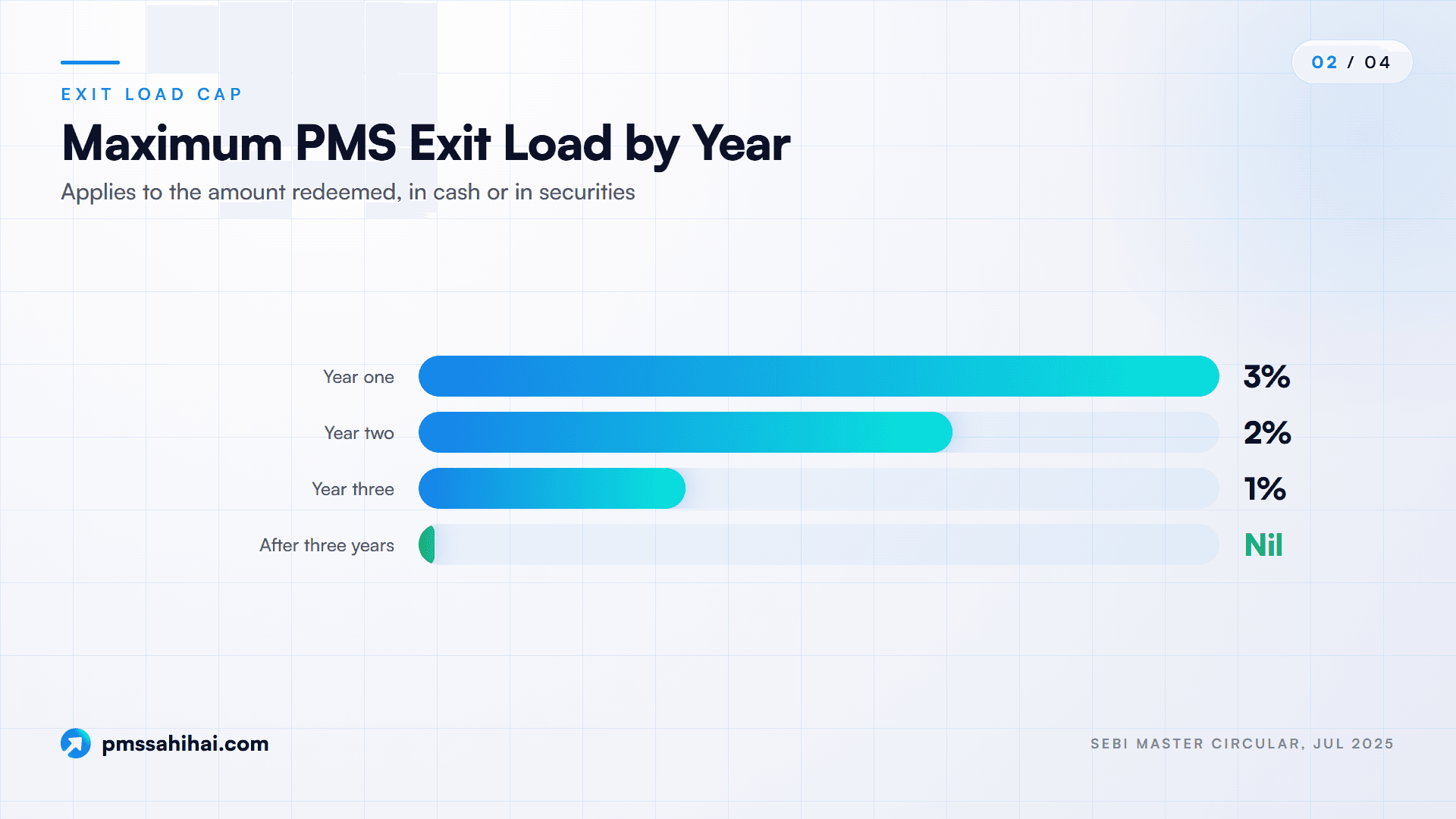
| Master Circular para 6.1.4 | Exit load where the portfolio "is redeemed in part or full": maximum 3%, 2% and 1% of the amount redeemed in years one to three; nil after | A load can apply even when no cash is paid out |
No rule sets a timeline for an in-kind PMS redemption, a valuation method for securities withdrawn, or a duty to allow partial in-kind withdrawals of chosen stocks. Those are contractual. Co-investment portfolio managers fall outside regulation 24(2)(a). Large value accredited investors fall outside the exit-load cap.
What Changes Under the 2026 Regulations From April 2027
The 2026 Regulations sharpen the client's right. Regulation 17(4)(a) says the client "has the right to withdraw funds and securities before the maturity of the contract, irrespective of the terms of the agreement". The right applies on termination by either side, suspension or cancellation of the manager's registration, or the manager's bankruptcy or liquidation. Regulation 24(3) keeps the duty to "settle the account with the client as agreed in the contract". Item 11 of the Third Schedule again requires the agreement to say when you may "withdraw cash or securities".
"Irrespective of the terms of the agreement" is the notable change: an agreement cannot block the right to take securities in those situations. Charges such as exit load are still set by SEBI circulars and your agreement. Until 1 April 2027 rely on the 2020 Regulations and the July 2025 Master Circular, and re-check sebi.gov.in for implementing circulars before you act.
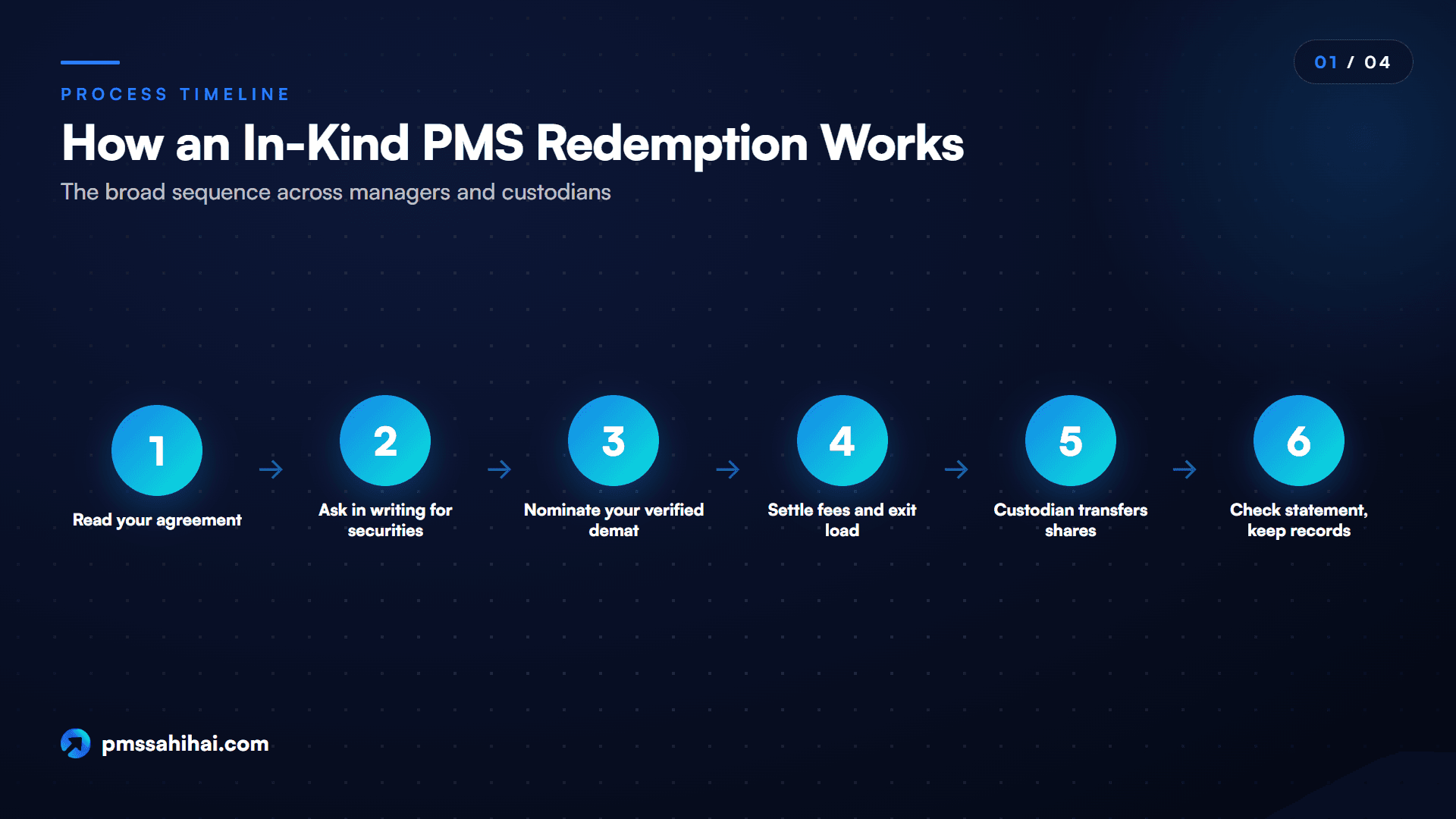
How an In-Kind PMS Redemption Works Step by Step
Forms differ by manager and custodian, but the sequence is broadly the same. A cash PMS exit ends with the manager selling, shares debited on T+1 and proceeds credited within a few business days. An in-kind PMS exit swaps the selling step for a transfer.
- Read your agreement and disclosure document. Find the termination clause, notice period, exit-load schedule, fee settlement at exit and the securities-withdrawal clause.
- Give written notice asking for securities, not cash. Say whether it covers all holdings or named stocks. Otherwise many managers default to selling.
- Nominate the receiving demat. The Investor Charter refers to your "verified" demat, the one recorded at onboarding. Another account, especially someone else's, means more paperwork and different tax treatment.
- Settle fees and exit load. With no sale proceeds, you may pay these from cash in the PMS bank account, pay separately, or let the manager sell some holdings.
- The custodian executes the transfer through the depository system.
- Check the closing statement that regulation 31(3) requires against the shares that arrive.
- Keep the cost and date records. Ask for a lot-wise statement of purchase dates and costs. You need it for every future sale.
Choosing a Full or Partial In-Kind Exit
A full in-kind redemption moves every share and closes the mandate. A partial in-kind withdrawal moves selected shares and keeps the account running, which raises the ₹50 lakh question. Regulation 23(2) of the 2020 Regulations bars a manager from accepting "funds or securities worth less than fifty lakh rupees", and it applies to new clients and fresh investments. It says nothing direct about an existing account that falls below ₹50 lakh after a withdrawal. Managers handle that through their agreements, so ask first.
You can mix the routes: take long-held winners in kind and let the manager sell stocks you do not want. A blended PMS exit is often the most sensible outcome.
How the Custodian Moves the Shares
Mechanically, an in-kind PMS redemption is an off-market transfer. Securities pass from one demat account to another through NSDL or CDSL without touching a stock exchange. Retail investors start an off-market transfer with a delivery instruction slip or the depositories' online channels (NSDL SPEED-e, CDSL Easiest, with OTP authentication). In a PMS, the custodian runs the instruction because it operates the PMS demat.
Three practical points follow. First, there is no exchange trade, so no securities transaction tax or brokerage is due on the move. You pay those when you later sell. Second, depository participants charge transfer fees, so ask for the custodian's schedule. Third, NSDL's stamp duty page says duty on an off-market transfer is computed on the consideration declared in the instruction and paid by the transferor. A move between your own accounts with no consideration should normally attract none, but confirm the reason code and any duty with the custodian first.
Exit Load, Fees and Charges When No Cash Changes Hands
A common mistake is assuming an in-kind redemption escapes the exit load. The Master Circular points the other way. Paragraph 6.1.4 applies the load "in case client portfolio is redeemed in part or full", as a percentage "of the amount redeemed". It does not limit the load to cash. Taking securities out is still a redemption of that value.
What the circular does not settle is how the securities are valued for the load. The price could be taken on the notice date, the transfer date or another date, and each gives a different figure. This is contractual. The cap is a ceiling: as PMS Sahi Hai's house-by-house exit load comparison shows, many houses charge less or nothing, and the load falls to nil three years after the date of investment.
Fees work the same way. Management fees accrue to termination, and a performance fee may crystallise at exit. Paragraph 6.1.3.9 of the Master Circular says that on interim contributions or withdrawals, performance fees are charged after adjusting the high-water mark proportionately. GST applies on top. All of this needs cash. If the PMS bank account cannot cover it, you pay separately or authorise a partial sale. That sale is taxable in your hands.
There is a tax question too. Under the old Act, tribunal rulings on whether PMS fees reduce capital gains went both ways. Whether an exit load paid on an in-kind PMS redemption can be set against a later sale of those shares is not settled, so do not assume it. PMS Sahi Hai's guide to whether PMS fees are deductible covers the wider debate. Ask a tax adviser.
How the Income-tax Act 2025 Treats Shares Returned In Kind
The Income-tax Act 2025 has applied since 1 April 2026, replacing the 1961 Act. Section numbers below are from the 2025 Act, with old numbers where useful. This explains the rules; it is not tax advice, and a tax adviser should confirm your treatment.
Why Moving Shares to Your Own Demat Is Not Treated as a Sale
Capital gains are charged on the "transfer" of a capital asset (section 67, old section 45). Section 2(109) defines transfer to include "the sale, exchange or relinquishment of the asset", the extinguishment of rights in it, and similar events. When the custodian moves shares from a PMS demat in your name to another demat in your name, you sell nothing, receive nothing, exchange nothing and give up no rights. You are the beneficial owner before and after. That is why an in-kind transfer of shares to your own demat is widely treated as no transfer, so no capital gain arises at the exit.
Be clear about the basis. The 2025 Act has no section that says a same-owner demat move "is not a transfer". The conclusion comes from the definition and from ownership not changing. It is the standard view, not an express exemption.
Cost of Acquisition and Holding Period After the Move
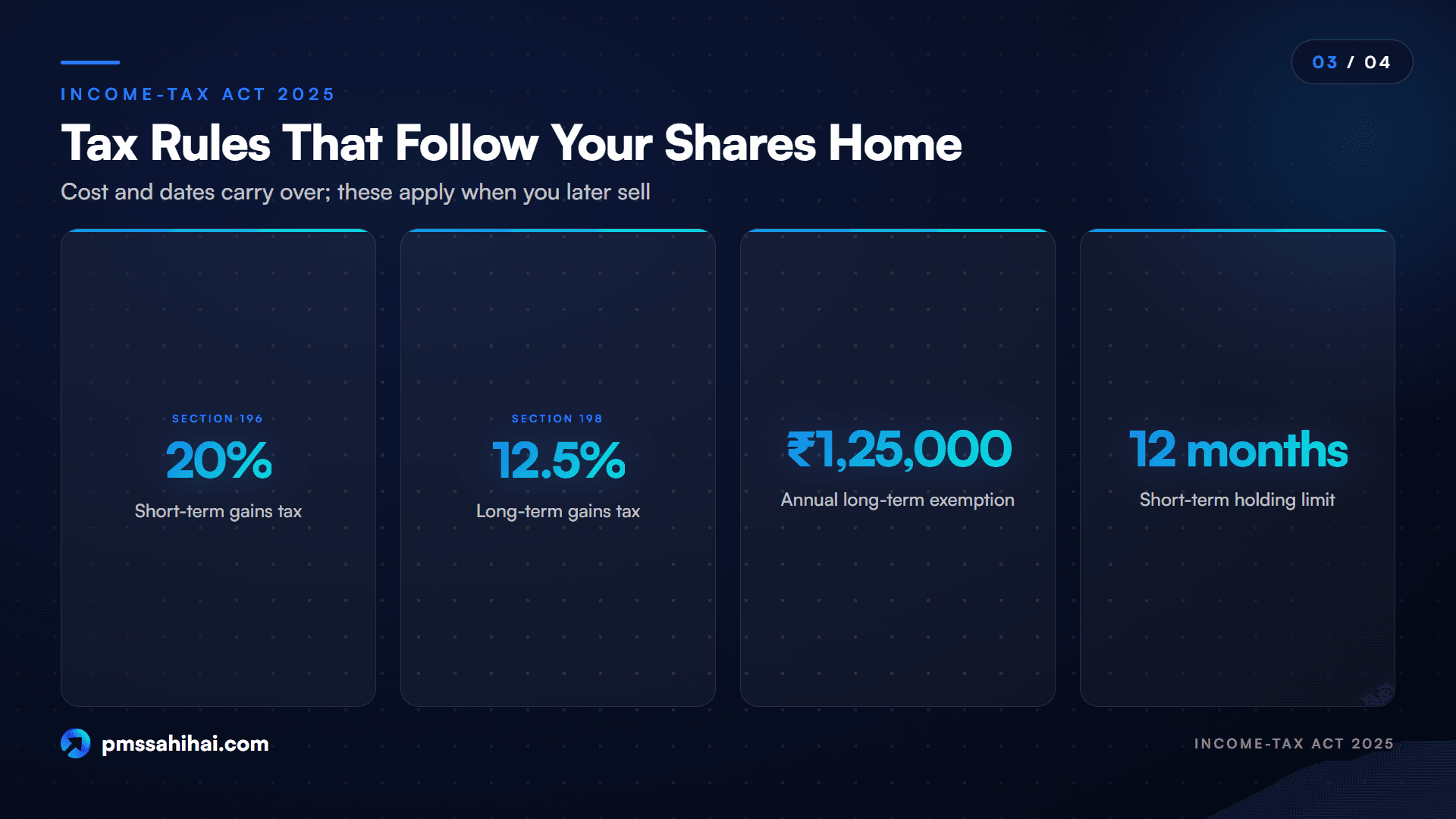
Because the move is not a transfer, nothing resets, and the usual rule that PMS gains are taxed in your own hands simply carries on. Your cost of acquisition (your cost basis) for each share is still the price the manager paid for you, and the holding period still runs from the original purchase date. Under section 2(101)(b), listed shares are short-term if held for not more than 12 months.
When you later sell on the exchange, STT is paid and the normal rates apply:
- Short-term gains on STT-paid listed equity: 20% under section 196 (old section 111A).
- Long-term gains: 12.5% on gains above ₹1,25,000 a year under section 198 (old section 112A). This needs STT on acquisition and transfer, which exchange purchases by the manager usually meet.
Here is the point most guides miss. Section 67(7)(c) says that for securities held through a depository, "the cost of acquisition and the period of holding of any securities shall be determined on the basis of the first-in-first-out method." Suppose you already hold 500 shares of a company in your personal demat, bought years ago, and the PMS returns 300 more bought last year. When you sell 300, FIFO may treat the old shares as sold first. That gives a different gain, and perhaps a different short-term or long-term split. The Act does not spell out how FIFO applies when PMS lots merge into a demat already holding the same share. This is unsettled. If it matters, receive the shares into a separate demat or keep careful lot records, and take advice before selling.
Your new broker will not know the PMS cost of acquisition unless you supply it, so keep the custodian's records.
When the Receiving Demat Belongs to Someone Else
Delivering the shares into a spouse's, child's or parent's demat is not a move between your own accounts. It is a gift by you. Section 70(1)(b) says section 67 does not apply to a transfer "under a will or a gift" by an individual or HUF, and the table in section 73(1) gives the recipient the previous owner's cost. Other rules can still bite, such as those on gifts from non-relatives and income clubbing for a spouse or minor child. Treat it as a separate tax decision and consult a tax adviser.
Non-resident clients should also confirm with the custodian and their authorised dealer bank that the receiving demat is the right type (repatriable or non-repatriable) for the shares.
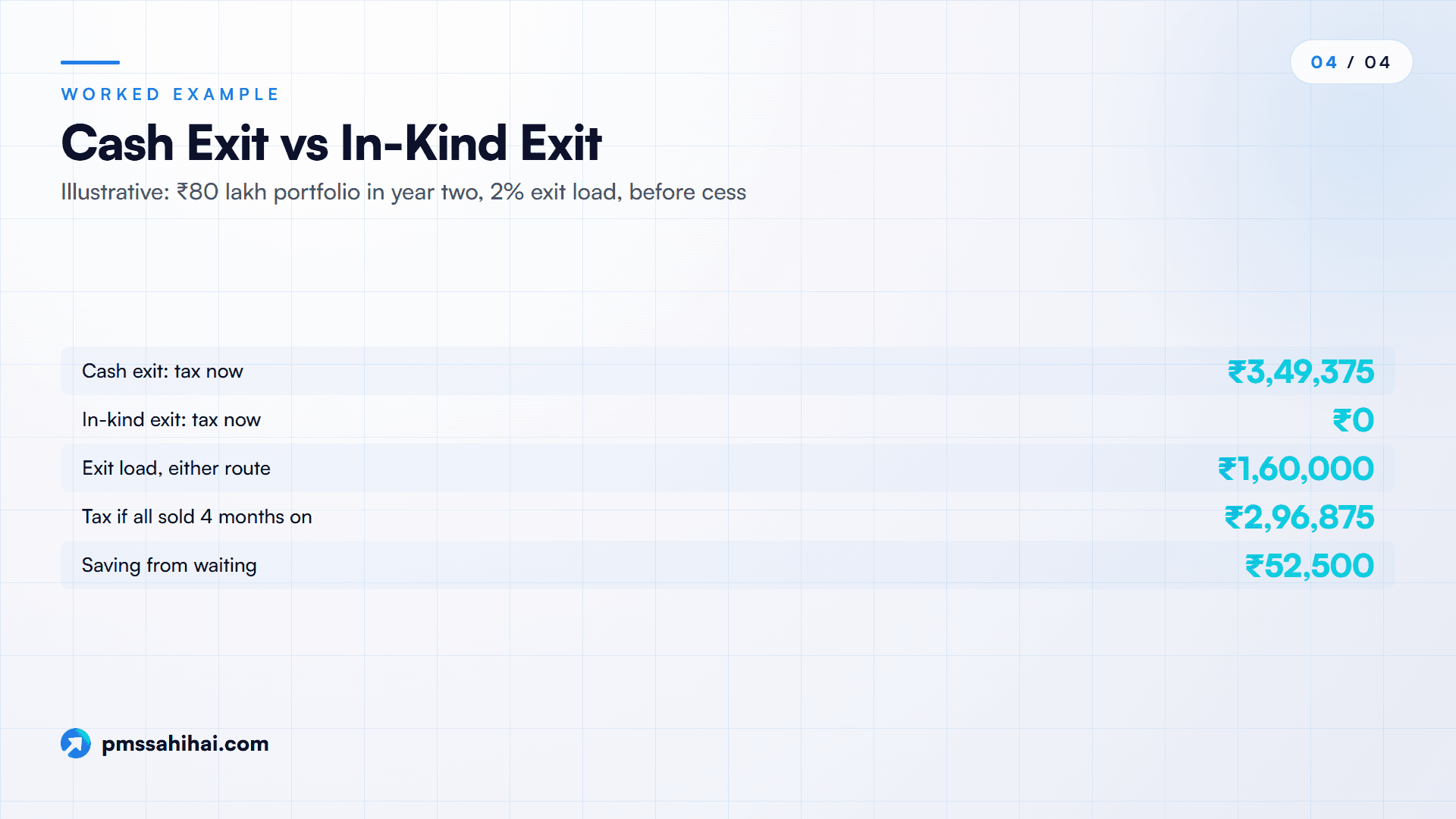
Worked Example: Cash Exit vs In-Kind Exit on ₹80 Lakh
An illustration with simple numbers, not a recommendation; surcharge, cess and personal circumstances change the figures.
Priya invested in a discretionary PMS 20 months ago. Her portfolio is worth ₹80 lakh:
- Lots bought at the start (held 20 months): value ₹50 lakh, cost ₹32 lakh, gain ₹18 lakh (long-term).
- Lots bought eight months ago: value ₹30 lakh, cost ₹23 lakh, gain ₹7 lakh (short-term).
She is in year two, and her agreement charges the maximum 2% exit load. She has not used her ₹1,25,000 long-term exemption elsewhere this year.
| Item | Cash exit (manager sells all) | In-kind redemption (shares to her demat) |
|---|---|---|
| Long-term gain crystallised now | ₹18,00,000 | ₹0 |
| Short-term gain crystallised now | ₹7,00,000 | ₹0 |
| Tax on long-term gain: (₹18,00,000 − ₹1,25,000) × 12.5% | ₹2,09,375 | ₹0 now |
| Tax on short-term gain: ₹7,00,000 × 20% | ₹1,40,000 | ₹0 now |
| Exit load at 2% of ₹80 lakh (if applied to securities) | ₹1,60,000 | ₹1,60,000, payable in cash |
| STT and brokerage on exit | On every sale | None on the transfer |
| What she holds afterwards | About ₹74.9 lakh in cash before cess, STT and fees | ₹80 lakh of the same shares, original costs and dates intact |
Now suppose Priya holds four more months, until the short-term lots pass 12 months from their original purchase date. She then sells everything in the same tax year at unchanged prices. Her whole ₹25 lakh gain is long-term: (₹25,00,000 − ₹1,25,000) × 12.5% = ₹2,96,875, against ₹3,49,375 on the cash exit. That saves ₹52,500 before cess, and she stayed invested throughout. Any lot she never sells defers its tax indefinitely.
The limits show too. The exit load does not disappear: ₹1.6 lakh still needs cash. Prices will not stand still for four months, so a fall can wipe out the saving. And if she already holds some of these stocks personally, FIFO could change which lots count as sold.
Bringing Shares Into a PMS In Kind at Onboarding
The reverse move gets a short mention, because PMS Sahi Hai's in-specie transfer explainer already works through it with a ₹1 crore example. SEBI's Investor Charter says an investor can give a portfolio "in any form i.e. in stocks or cash or a combination of both". Regulation 23(2) counts "funds or securities" towards the ₹50 lakh minimum, and regulation 16(3) of the 2026 Regulations says "funds or securities or a combination thereof".
Managers accept shares selectively. One large manager's support page says it accepts "only listed and liquid securities". It asks for the sending demat's client master record and a complete purchase history, so the cost data travels with the shares. Shares that do not fit the strategy are usually sold, and that sale is taxable in your hands. Ask how in-kind contributions are valued for fees, the minimum and performance before you move them.
Advantages of Taking Your PMS Shares Back In Kind
Where it fits, an in-kind PMS exit has concrete benefits:
- No forced crystallisation of gains. A move to your own demat is not a sale, so no capital gain arises at the exit. You choose when, or whether, to sell.
- Original cost and dates survive. Short-term lots can mature into long-term lots, taxed at 12.5% above the annual exemption instead of 20%.
- No time out of the market. You never sit in cash between the exit and your next decision.
- No STT or brokerage on the move. These arise only when you actually sell.
- A cleaner exit for hard-to-sell holdings. Non-discretionary PMS clients can hold up to 25% in unlisted securities under regulation 24(4), and some small caps trade thinly. Taking them in kind avoids a rushed sale at a poor price.
- You keep the stocks you believe in. If you are leaving over fees or service, you can keep the holdings and drop the mandate.
- The right is written into SEBI's rules. The Investor Charter names your verified demat as the destination, and from April 2027 regulation 17(4) protects the right to withdraw securities.
This is how an in-kind transfer of shares makes life easier. A cash PMS redemption forces tax, timing and reinvestment decisions onto one day. Taking the shares lets you spread those decisions out and make each on its merits.
How PMS Sahi Hai Helps You Read the In-Kind Exit Clause
The hard part of an in-kind transfer of shares is rarely the custodian's paperwork. It is knowing, before you sign, what your agreement will let you do when you leave, and whether the strategy is worth joining at all. That is the part PMS Sahi Hai is built for.
PMS Sahi Hai describes itself as an APMI-registered platform for comparing PMS, AIF and GIFT City strategies, and its research assistant is Nyra. Its exit guide, How you exit a PMS or AIF, says Nyra "has already read the exit clauses": notice periods, load schedules, tenure and wind-down terms for every SEBI-registered strategy. Every answer cites its source. That is the information an in-kind redemption turns on. You need to know how long the notice period is, whether the load runs the full 3-2-1 schedule or ends sooner, and when the load falls to nil.
In practice you can use it in three ways:
- Before you invest, ask Nyra about a strategy's exit terms and compare up to four strategies side by side on the compare page. A strategy with a short or nil exit-load schedule leaves you more freedom to take shares in kind later without paying for the privilege.
- Before you switch, use Nyra's portfolio review, which the site says looks at "overlap, drift & fee drag across your holdings". If the new strategy overlaps heavily with what you would take in kind, you may not need to move those shares at all. If it does not, you will know which holdings a new manager is likely to sell.
- When you weigh the strategy itself, the Nyra Score methodology rates strategies from 0 to 10 on five fixed pillars. The site is explicit that the score is "Not a prediction" and "Not a recommendation".
Be clear about the limits. PMS Sahi Hai does not publish a calculator for exit load or tax on an in-kind redemption. It has no list of which managers allow in-kind redemptions, and it does not say how each house values securities for exit load. Those answers sit in your agreement, with your custodian and with your tax adviser. Nyra itself is described as "an analytical tool, not a SEBI-registered Investment Adviser". Use it to read the fine print faster, then confirm the numbers with the people who will sign off your return.
Limitations and Risks of an In-Kind PMS Exit
An in-kind redemption solves some problems and creates others:
- Exit load still applies. The capped load is a percentage of the amount redeemed, and taking securities is a redemption. You may need cash for it.
- Fees still need cash. Management fees, any performance fee and GST must be paid; a partial sale to fund them is taxable.
- You become the portfolio manager. Nobody rebalances, monitors or exits the shares for you any more.
- FIFO can surprise you. Shares merged with existing holdings of the same company may produce an unexpected cost and holding period on a later sale. This is unsettled.
- Record-keeping gets harder. You need lot-wise cost and date data, and your broker will not have it automatically.
- Terms vary by manager. Valuation, timelines and partial in-kind withdrawals are contractual, and a new manager may refuse some of your shares.
- Transfers to other people change the tax picture. Delivery into a family member's demat is a gift.
- It is not a manager takeover. SEBI's circular of 24 October 2025 lets one portfolio manager transfer its PMS business to another, with prior SEBI approval. That moves the manager's business, not your shares to your own demat. If your manager is being taken over, ask how your agreement and holdings move.
Choosing Between Cash and Shares at Your PMS Exit
The choice comes down to a few questions. Do you want to keep these shares? Would selling now crystallise large gains, or short-term gains close to turning long-term? Can you pay the exit load and fees in cash? Will you, or a new manager, actually look after the shares? Do you hold any of the same stocks elsewhere, which raises the FIFO issue?
If the answers favour keeping the shares, an in-kind PMS redemption is a rule-backed way to leave a mandate without a tax-driven fire sale. If you want cash, or would not manage the stocks yourself, a cash exit may be simpler even if it costs more tax today. Many investors land in between, taking long-held winners in kind and letting the manager sell the rest. Either way, put the instruction in writing, get the lot-wise cost statement, and have a tax adviser review the plan before any share moves. If you are still choosing a strategy, PMS Sahi Hai's Nyra can show you its exit terms before you commit, so an in-kind redemption is planned rather than improvised.
Check Your Exit Clause Before You Redeem
Before you send a PMS redemption request, pull out your PMS agreement, the disclosure document and your latest holding statement. Find the termination clause, the exit-load schedule, how fees are settled at exit and whether securities can be withdrawn. Then decide which holdings to take in kind and which to sell, and take that plan to your tax adviser.
If you have not yet picked a strategy, or you are planning a switch, ask Nyra about exit terms and compare strategies on PMS Sahi Hai before you sign. An exit you plan before you sign is easier than one you work out on the way out.
PMS Sahi Hai is a distributor of Portfolio Management Services and Alternative Investment Funds, APMI-registered (Registration No. APRN08358). This article is for education only and is not investment advice, a recommendation, or an offer to buy or sell any security. Investments in securities markets are subject to market risks; read all scheme-related documents carefully. Past performance is not indicative of future results. Consult your advisor before investing.
Ishaan founded PMS Sahi Hai to make India's PMS, AIF and GIFT City markets legible to serious investors, comparing every SEBI-registered manager on the same comparative basis, with no shelf products and no commission bias.
Frequently asked
What is in-kind transfer of shares in PMS redemption?
It is a PMS exit in which the custodian moves your shares from the PMS demat to a demat you nominate, instead of the manager selling them and paying you cash. You keep the same stocks and quantities. SEBI's Investor Charter says that on termination your securities and funds go to your verified demat and bank accounts, and the PMS Regulations 2026 state a right to withdraw securities.
Can I take shares instead of cash when I exit a PMS?
Usually yes, because a PMS holds shares in a demat in your name. The 2020 Regulations allow withdrawal of funds or securities on termination, and your agreement must state the conditions for withdrawing securities. Give written notice asking for an in-kind exit and name the receiving demat. Valuation, timing and partial withdrawals depend on your agreement.
Is an in-kind PMS redemption taxable?
Moving shares from your PMS demat to another demat in your own name is widely treated as no transfer under section 2(109) of the Income-tax Act 2025, because nothing is sold and ownership does not change. So no capital gain arises at the exit itself. Tax arises when you later sell. The Act has no express exemption for this move, so confirm your case with a tax adviser.
What cost and holding period apply to shares I receive from a PMS?
The original ones. Your cost of acquisition is the price the manager paid for each lot, and the holding period runs from that purchase date. Listed shares become long-term after 12 months under section 2(101)(b). If the shares merge with existing holdings of the same stock, the FIFO rule in section 67(7)(c) may change which lots count as sold, which is unsettled.
Does exit load apply if I take shares instead of cash?
It can. SEBI's Master Circular applies the capped exit load (maximum 3%, 2% and 1% in years one to three, nil after) when a portfolio "is redeemed in part or full", measured on the amount redeemed. It does not exempt in-kind redemptions. How the securities are valued for the load is set by your agreement, so read that clause before you instruct the exit.
How are PMS fees paid if I redeem in shares?
Fees, any crystallised performance fee and GST still need cash. The manager deducts them from cash in your PMS bank account if there is enough. Otherwise you pay separately or authorise the manager to sell some holdings, and any such sale is a taxable event for you. Ask for the final fee computation before the shares move.
Can I transfer my PMS shares straight into a family member's demat?
The custodian can deliver to another person's demat, but that is a gift by you, not a move between your own accounts. Section 70(1)(b) of the Income-tax Act 2025 excludes gifts by individuals from the capital gains charge, and the recipient takes your cost. Rules on gifts from non-relatives and income clubbing can still apply, so consult a tax adviser first.
Can I move my PMS shares to a new portfolio manager without selling them?
Often, if the new manager agrees. You take the shares in kind from the old PMS and contribute them in kind to the new one. Many managers accept only listed, liquid stocks that fit their strategy and ask for purchase history. Shares they reject are usually sold, and that sale is taxable.
Keep reading
All articles
Tracking Error in PMS: How Far Your Strategy Strays From Its Benchmark
Tracking error in PMS explained: the formula, a worked 12-month example, ex-ante vs ex-post, SEBI's 2% index-fund rule and ranges by PMS style.

What Is Alpha Decay? Why Winning PMS Strategies Stop Winning
Alpha decay is when a strategy's excess return fades. Learn the five causes, from AUM growth and crowding to manager change, with a PMS example.
Tactical Asset Allocation (TAA): Signals, Evidence and Risks
What tactical asset allocation is, how TAA tilts are built, the signals managers use, what fund data shows, and what each switch costs in tax in India.
Read it. Now pressure-test it.
Ask Nyra how this applies to your portfolio, or talk to our team, no pitch, no pressure.