
Small Cap vs Multi Cap PMS: Which Suits a ₹1 Crore+ Portfolio?

Small cap PMS and multi cap PMS solve different problems for a ₹1 crore+ portfolio. Small cap PMS concentrates in 15–30 stocks ranked 251st or lower by market capitalization — higher potential upside, higher volatility, and slower exits when markets turn. Multi cap PMS blends large, mid and small cap holdings at the manager's own discretion, since — unlike a mutual fund's "Multi Cap Fund" category — SEBI does not mandate any fixed allocation for a PMS labeled multi-cap. Both require the same ₹50 lakh SEBI minimum investment, sit below the ₹1 crore AIF Category III floor, and are taxed differently from each other once you factor in the 2024 capital gains changes. The right choice depends on your time horizon, drawdown tolerance, and how much of your total net worth this ₹1 crore actually represents — not on category labels alone.
What "Small Cap PMS" and "Multi Cap PMS" Actually Mean in India Today
A small cap PMS is a discretionary equity strategy that concentrates in companies SEBI and AMFI classify as "small cap" — the 251st-largest listed company by full market capitalization and every one smaller. This is a rank-based classification, periodically refreshed using average market-cap data, not a fixed rupee band, which matters because a company that was "small cap" five years ago may have grown out of that bracket entirely. Small cap PMS managers typically run concentrated books of 15–30 stocks, betting that lighter analyst coverage in this part of the market creates genuine mispricing a skilled, hands-on manager can exploit.
Multi cap PMS, defined — and the point almost every comparison gets wrongA multi cap PMS invests across large, mid and small cap stocks at the fund manager's own discretion. Here's the detail worth sitting with: SEBI's rule that a "Multi Cap Fund" must hold at least 25% each in large-cap, mid-cap and small-cap stocks was written for mutual funds — introduced via a SEBI circular dated September 11, 2020, and reaffirmed without change in SEBI's February 2026 mutual fund categorization circular. No equivalent rule exists for PMS. A portfolio manager can call a strategy "multi-cap" while running anywhere from a mostly-large-cap book to a genuinely blended one — the only place that's actually defined is the manager's own Disclosure Document, and that allocation can shift over time entirely at the manager's discretion. Even AMFI's own investor-education page on multi cap funds frames the 25/25/25 rule strictly as a mutual-fund construct.
This distinction is the single most important thing to understand before comparing the two categories — a "multi cap PMS" is not a PMS-flavored version of a multi cap mutual fund. It's a discretionary label, and due diligence has to look past the name to the fund's actual, current, disclosed holdings.
The Origin Story: How PMS Became India's Vehicle for Serious Equity Investors
Portfolio Management Services were first regulated in India under the SEBI (Portfolio Managers) Regulations, 1993, when the minimum investment was as little as ₹5 lakh. The idea was straightforward: instead of pooling money into mutual fund units, an investor could have a manager make direct, discretionary decisions on a portfolio of stocks the investor actually owned in their own name. Over the following two decades, as PMS grew and SEBI grew more concerned about retail investors taking on concentrated single-stock risk without adequate loss-absorption capacity, the minimum ticket size was raised in stages, eventually reaching ₹25 lakh.
The bigger overhaul came with the SEBI (Portfolio Managers) Regulations, 2020, effective January 16, 2020, which lifted the minimum investment to the ₹50 lakh figure still in force today, and simultaneously raised a portfolio manager's own required net worth from ₹2 crore to ₹5 crore — reported at the time by Deccan Herald. "Small cap" and "multi cap" emerged within this framework simply as descriptive labels — a shorthand for where on the market-cap spectrum a given manager's Investment Approach concentrates — rather than as SEBI-defined categories the way mutual fund categories are. Alternative Investment Funds (AIFs) grew up alongside PMS on a parallel, separate regulatory track — the SEBI (AIF) Regulations, 2012 — built for pooled, trust-structured strategies (including the hedge-fund-like Category III) with their own, higher ₹1 crore minimum.
| Vehicle | Minimum investment | In force since |
|---|---|---|
| Mutual funds | As low as ₹500 (SIP) | Long-standing |
| Specialized Investment Funds (SIF) | ₹10 lakh | April 1, 2025 |
| Portfolio Management Services (PMS) | ₹50 lakh | January 2020 |
| Alternative Investment Funds (AIF), Cat I/II/III | ₹1 crore (₹25 lakh for eligible employees/directors) | 2012, unchanged |
The Specialized Investment Fund (SIF) category is the newest rung — SEBI created it explicitly to sit "between traditional portfolio management services and mutual funds," with a ₹10 lakh minimum effective from April 1, 2025, as Business Today reported at launch. For readers exactly at the ₹1 crore mark, the practical question usually isn't "can I afford PMS" — it's how much of that ₹1 crore should sit in a single PMS mandate at all, given that SEBI's own investor-education page on PMS and the AIF framework both exist specifically because concentrated, discretionary strategies carry more single-manager and single-stock risk than a diversified mutual fund.
Two developments are worth watching without over-reading them. First, the PMS industry body (APMI) has asked SEBI to lower the ₹50 lakh threshold, citing competition from the new lower-minimum SIF category — as of this writing, that remains an industry request, not a rule change. Second, SEBI flagged a broader review of PMS governance (risk profiling, suitability, mis-selling safeguards) in early 2026, reported by Business Standard — but this is about governance standards, not the ₹50 lakh ticket size itself.
Inside a Small Cap PMS: Concentration, Liquidity and Real Volatility
The appeal of small cap investing is straightforward: less analyst coverage means more room for a skilled manager's research to actually find something the market has mispriced. The trade-off is equally straightforward. A typical small cap PMS runs a concentrated book — often 15–30 stocks — which means each position carries real weight in the outcome, for better and worse.
The less-discussed risk is liquidity. Small cap stocks trade in lower daily volumes than large caps, so a manager holding a meaningful position can find it slower and costlier to exit cleanly, especially in a falling market where everyone is trying to sell the same illiquid names at once. This is exactly the dynamic PMS Sahi Hai's own guide to PMS liquidity walks through: large-cap books can typically unwind in days, while concentrated small-cap positions can take meaningfully longer to exit at a fair price. It's a real, structural feature of the category — not a flaw specific to any one manager — and it matters most exactly when you'd want to exit quickly, in a downturn.
Inside a Multi Cap PMS: Manager Discretion Without a Fixed Formula
If small cap PMS is a bet on one part of the market, multi cap PMS is a bet on a manager's ability to rotate across the whole market-cap spectrum as conditions change — leaning into large caps when valuations elsewhere look stretched, or into mid and small caps when the manager sees an opportunity there. Because — as established above — there's no SEBI-mandated floor forcing a fixed split, this flexibility is real, not cosmetic. A multi cap PMS can look meaningfully different from one provider to the next, and can look meaningfully different from itself two years ago.
That flexibility is the whole point, but it's also exactly why the label alone tells you less than it would for a mutual fund. Two managers can both call their strategy "multi-cap" while running very different books — one holding 70% in large caps with a small-cap satellite, another running a genuinely even three-way blend. The only way to know which you're actually buying is to check the manager's current disclosed portfolio, not the marketing copy.
Risk, Drawdowns and What a ₹1 Crore Bet Can Actually Feel Like
Category labels aside, the risk profiles here are genuinely different, and worth translating into real rupee terms. Small cap portfolios carry higher volatility and typically deeper drawdowns in a market correction than large-cap-heavy ones — the sharp 2020 pandemic crash and the mid-2022 correction are both well remembered by Indian equity investors as periods where concentrated, small-cap-heavy portfolios tended to fall further and take longer to recover than the broader index. A well-run multi cap PMS, by blending in large-cap exposure, has historically offered a somewhat smoother ride — at the cost of some upside during a strong small-cap-led rally.
Translate that into your own numbers: a 25–30% drawdown on a ₹1 crore small-cap-heavy PMS is ₹25–30 lakh of paper loss — real money, even if the strategy eventually recovers. This is why the honest first question isn't "which category has performed better historically" (return data in this space changes fast and is easy to cherry-pick — see the fees and taxes section below for why we've deliberately avoided quoting specific trailing return numbers here). The better first question is how much of a drawdown you can sit through without needing to sell, and how much of your total net worth — not just this ₹1 crore — this allocation actually represents. PMS Sahi Hai's own explainer on reading PMS risk and returns honestly is a useful primer on why a single trailing-return number, without its matching drawdown, tells you very little.
Fees and Taxes: The Real Cost After the 2024 Capital Gains Reset
Most PMS providers charge one of three structures: a fixed management fee (typically 1–2.5% annually), a pure performance fee (commonly 10–20% of profits above an 8–12% hurdle rate), or a hybrid of both. Two rules matter more than most investors realize: SEBI's Master Circular for Portfolio Managers bans upfront or entry fees outright, and requires a high-water mark before any performance fee can be charged again — meaning you can't be charged a performance fee twice on the same gain. 18% GST applies on top of whatever fee structure you're on, and some providers still apply a tapering exit load in the first one to three years. Combined, fixed and performance fees can add up to a few percentage points a year, which compounds meaningfully over a five-to-ten-year hold — it's worth asking for the full fee stack in writing before you sign, not just the headline number.
What you owe in taxBecause PMS holdings sit directly in your own demat account, gains are taxed as your own capital gains — the same 20% short-term (holdings under 12 months) and 12.5% long-term (above a ₹1.25 lakh annual exemption) rates that have applied to listed equity since the July 2024 Union Budget, and which have stayed unchanged through Budget 2025 and Budget 2026, per Angel One's Budget 2026 coverage and confirmed in EY's Union Budget 2026 financial services summary. (The underlying law changed names, not numbers, in the process — the new Income-tax Act, 2025, in force from April 1, 2026, renumbers the old Section 111A/112A as Sections 196/198, but preserves the same rates.)
AIF taxation is where PMS and AIF genuinely diverge, and it's worth knowing if you're weighing a Category III AIF against a PMS for part of that ₹1 crore. Category I and II AIFs get statutory pass-through treatment under Section 115UB of the Income Tax Act — gains retain their character and are taxed at the investor level. Category III AIFs get no such statutory pass-through and have historically been taxed at the fund/trust level, often at the maximum marginal rate of roughly 42.7%. A 2025 Delhi High Court ruling — Equity Intelligence AIF Trust v. CBDT — opened a path for well-documented Category III AIFs to be treated as "determinate trusts" and taxed closer to investor-equivalent rates instead, a development covered in detail by Khaitan & Co. That's meaningful, but it's a case-law outcome that depends on how a specific fund is documented — not a blanket, industry-wide reform — so it's worth confirming directly with any Category III AIF you're considering rather than assuming it applies automatically.
How PMS Sahi Hai Helps You Understand the Inner Clause
Everything in the two sections above — the multi-cap label that means something different for PMS than for a mutual fund, the fee stack that's easy to understate, the AIF tax treatment that depends on fund-specific documentation — lives in the fine print, not the marketing brochure. Reading it properly, across the 400-plus PMS providers and 250-plus AIFs actually registered in India today, is genuinely tedious to do by hand. That's the specific, practical problem PMS Sahi Hai and its AI engine Nyra are built to solve.
Nyra is grounded only in primary sources — SEBI filings, AMC factsheets, AMFI disclosures — and cites the source behind every number it gives you, rather than estimating. It scores every strategy PMS Sahi Hai tracks across seven weighted factors: Returns, Risk, Fees, Manager tenure, Concentration, Transparency and AUM fit — the same dimensions this article has walked through, applied consistently across every provider rather than trusting each one's own marketing. It also runs an "Honest Mirror" check on a portfolio you already hold, surfacing hidden overlap between funds, sector concentration you may not have noticed, and fee drag you're currently paying — the kind of cross-checking that catches exactly the small-cap-labeled-strategy-that-isn't-really-small-cap problem described above. Across the platform, PMS Sahi Hai currently tracks 430-plus PMS strategies and 250-plus AIFs (1,200-plus strategies scored in total), all screened the same way.
One thing worth being direct about, in the same spirit as this whole article: Nyra is an analytical tool, not a substitute for a SEBI-registered Investment Adviser's personalised advice. It won't rank a strategy higher because a manager pays more to be listed, and it's explicitly built to refuse an answer rather than state a number it can't cite a source for. As PMS Sahi Hai puts it plainly on its own site: "don't buy the return — buy the evidence behind it." If you want to see how a specific small cap or multi cap strategy actually scores, or want your existing ₹1 crore portfolio checked for overlap and fee drag before you add another PMS mandate to it, that's exactly what the Nyra scoring methodology and the PMS due-diligence checklist on PMS Sahi Hai are built for.
How AI and Data Are Reshaping PMS and AIF Selection in 2026
PMS and AIF selection has historically been a relationship-driven decision — a distributor's recommendation, a glossy factsheet, word of mouth — because, unlike mutual fund NAVs (published daily via AMFI), PMS performance data has never been centrally standardized the way mutual fund data is. That's shifting. SEBI's own regulatory posture has pushed toward more standardized, comparable disclosure over the past several years, and a wave of AI-assisted analysis tools has emerged specifically to read hundreds of factsheets and filings at a speed and consistency no individual investor — or even a single human advisor — can match by hand.
That matters more, not less, as the market gets more crowded: over 400 SEBI-registered portfolio managers, 250-plus AIFs, and now a new SIF category sitting between mutual funds and PMS all compete for the same ₹1 crore-plus investor's attention. Tools like Nyra that normalize returns to consistent, fee- and tax-adjusted terms — and that flag exactly the kind of category-label ambiguity this article has focused on — are becoming less of a novelty and more of a baseline due-diligence step, the same way mutual fund research tools became standard a decade earlier.
| Comparison Parameter | Small Cap PMS | Multi Cap PMS |
|---|---|---|
| Market-cap exposure | Concentrated in stocks ranked 251st+ | Large, mid and small cap, at manager's discretion |
| Regulatory allocation floor | None (SEBI classification is by rank, not a PMS mandate) | None — unlike the mutual fund "Multi Cap Fund" category |
| Typical concentration | 15–30 stocks | Varies by manager; often similarly concentrated |
| Volatility & drawdowns | Higher | Generally lower, due to large-cap ballast |
| Liquidity / exit speed | Slower, costlier in stressed markets | Faster overall, aided by large-cap holdings |
| Best suited for | 5–7+ year horizon, high drawdown tolerance, allocation is one sleeve of a larger net worth | Investors wanting one flexible core equity mandate without timing market-cap exposure themselves |
Before choosing, it's worth asking yourself three practical questions. First, what's your actual time horizon for this money — small cap concentration needs years, not quarters, to play out. Second, could you genuinely sit through a 25–30% drawdown on this specific ₹1 crore without needing to withdraw it? Third, does this ₹1 crore represent your entire investable surplus, or one sleeve of a larger portfolio — concentration risk is a very different conversation in each case. Many investors reasonably conclude the answer isn't "either/or": a multi cap PMS as a core allocation, with a smaller, high-conviction small cap PMS as a satellite, sized to your total net worth rather than to this ₹1 crore in isolation.
Common Mistakes to Avoid When Choosing Between Small Cap and Multi Cap PMS
- Chasing last year's category-topping return without checking the drawdown that produced it — PMS return data moves fast, and a standout year is often followed by a sharp reversal.
- Assuming "multi-cap" means the same fixed 25/25/25 split as a mutual fund — as this article has covered, it doesn't, for PMS.
- Confusing headline PMS "industry AUM" figures with the actual HNI-relevant market — of the roughly ₹42 lakh crore in total reported PMS assets as of April 2026, a large share is provident-fund-type institutional money, not discretionary equity strategies like the ones this article discusses, as Angel One's reporting on the April 2026 AUM data breaks out — so treat any single industry-size statistic with caution.
- Putting the entire ₹1 crore into one concentrated small-cap PMS instead of treating it as one sleeve of a broader, diversified portfolio.
- Underestimating the combined drag of fixed fees, performance fees and GST over a five-to-ten-year hold — ask for the full fee stack in writing, not just the headline management fee.
- Not checking whether a strategy has simply grown too large to still trade the small- or micro-cap names that built its track record — a genuine, common due-diligence gap once a small cap strategy's AUM scales up.
Getting Started: Matching Your ₹1 Crore Portfolio to the Right PMS Strategy
Small cap and multi cap PMS aren't rival products competing for the same answer — they're different tools for different amounts of risk, and the honest starting point is your own time horizon and drawdown tolerance, not a category's marketing. Once you know roughly where you sit on that spectrum, the harder, more useful work is checking whether a specific strategy's actual holdings, fees and track record match what its label promises.
That's the exact gap PMS Sahi Hai was built to close. Rather than reading through dozens of Disclosure Documents by hand, you can compare small cap and multi cap PMS strategies side by side using the same seven-factor scoring behind every listing, or get your existing ₹1 crore-plus portfolio scored by Nyra for overlap, concentration and fee drag before you commit fresh capital to either category. Hard-earned wealth deserves a decision built on your own numbers — not on which brochure looked more convincing.
PMS Sahi Hai is a distributor of Portfolio Management Services and Alternative Investment Funds, APMI-registered (Registration No. APRN08358). This article is for education only and is not investment advice, a recommendation, or an offer to buy or sell any security. Investments in securities markets are subject to market risks; read all scheme-related documents carefully. Past performance is not indicative of future results. Consult your advisor before investing.
Ishaan founded PMS Sahi Hai to make India's PMS, AIF and GIFT City markets legible to serious investors — comparing every SEBI-registered manager on the same comparative basis, with no shelf products and no commission bias.
Frequently asked
What is the minimum investment required for small cap or multi cap PMS in India?
Ans: Both small cap and multi cap PMS carry the same SEBI-mandated floor: ₹50 lakh as a first lump-sum investment, a threshold that has applied since January 2020 (raised from ₹25 lakh). The category itself doesn't change this regulatory minimum, though individual providers sometimes set their own higher house minimums, especially for concentrated small-cap strategies.
Is small cap PMS riskier than multi cap PMS?
Ans: Generally, yes. Small cap PMS concentrates in 15–30 stocks ranked 251st or lower by market capitalization, which tend to carry higher volatility and slower, costlier exits during a market correction. Multi cap PMS blends large, mid and small cap exposure at the manager's discretion, which historically produces a shallower drawdown than a pure small-cap book, though it can also mean giving up some peak upside during a strong small-cap rally. The right amount of risk depends on your time horizon and how much of your total net worth this ₹1 crore represents.
Does SEBI require multi cap PMS to hold a fixed allocation across large, mid and small cap stocks?
Ans: No — and this is one of the most misunderstood points in PMS investing. SEBI's rule requiring a minimum 25% allocation each to large-cap, mid-cap and small-cap stocks applies only to mutual funds categorized as "Multi Cap Fund," under a circular first issued in September 2020. A PMS strategy labeled "multi-cap" is a discretionary product with no equivalent regulatory floor — the manager's own Disclosure Document defines the actual approach, and it can shift over time. Always check a strategy's actual disclosed holdings rather than assuming the label works the same way it does for a mutual fund.
How is PMS taxed compared to a Category III AIF?
Ans: PMS holdings sit directly in your own demat account, so gains are taxed as your own capital gains — 20% short-term (under 12 months) or 12.5% long-term (above a ₹1.25 lakh annual exemption), the rates in force since the July 2024 Union Budget. A Category III AIF is structured differently: it has historically been taxed at the fund level, often near the maximum marginal rate of roughly 42.7%, rather than passed through to investors the way Category I and II AIFs are. A 2025 Delhi High Court ruling has opened a path for well-documented Category III AIFs to get investor-equivalent tax treatment instead, but this depends on how each specific fund is structured — it isn't an automatic, industry-wide change.
Is a multi cap PMS better than a small cap PMS for a ₹1 crore portfolio?
Ans: Neither is universally better — the right fit depends on your time horizon, risk tolerance, and how the rest of your portfolio is built. A multi cap PMS generally suits an investor who wants one flexible, professionally-timed core equity allocation without picking market-cap exposure themselves. A small cap PMS generally suits an investor with a longer horizon (5–7+ years), a higher tolerance for sharp drawdowns, and a ₹1 crore allocation that represents one sleeve of a larger net worth rather than their entire investable surplus. Some investors reasonably hold both, using multi cap as the core and small cap as a smaller, higher-conviction satellite.
What fees do small cap and multi cap PMS strategies typically charge?
Ans: Most PMS providers charge either a fixed management fee (typically 1–2.5% annually), a pure performance fee (commonly 10–20% of profits above an 8–12% hurdle rate), or a hybrid of both. SEBI's Master Circular for Portfolio Managers bans upfront or entry fees outright and requires a high-water mark before any performance fee can be charged again, so investors aren't charged twice on the same gains. GST of 18% applies on top of these fees, and some providers apply a tapering exit load in the first one to three years.
Can I invest in both a small cap and a multi cap PMS at the same time?
Ans: Yes, and many advisors consider this a reasonable way to diversify manager and market-cap risk within a larger portfolio, provided you meet the ₹50 lakh minimum for each PMS mandate separately. The main things to check before doing this are whether the two strategies' actual holdings overlap more than their category labels suggest, and whether the combined fee drag across both mandates still makes sense for your total portfolio size — an overlap check like PMS Sahi Hai's portfolio scoring tool is built specifically for this.
How do I check whether a PMS strategy's actual holdings match its "small cap" or "multi cap" label?
Ans: Since neither label is strictly defined by SEBI for PMS the way it is for mutual funds, the only reliable check is the strategy's actual Disclosure Document and current portfolio factsheet — not its name. Look at the market-cap breakdown of current holdings, how much that breakdown has shifted over the past few years, and how concentrated the top 5–10 holdings are. AI-assisted comparison tools that ingest factsheets directly, such as PMS Sahi Hai's Nyra, can flag this kind of label-versus-holdings mismatch faster than manually cross-checking dozens of PDFs.
Keep reading
All articlesDiscretionary vs Non-Discretionary PMS: What You’re Signing Up For
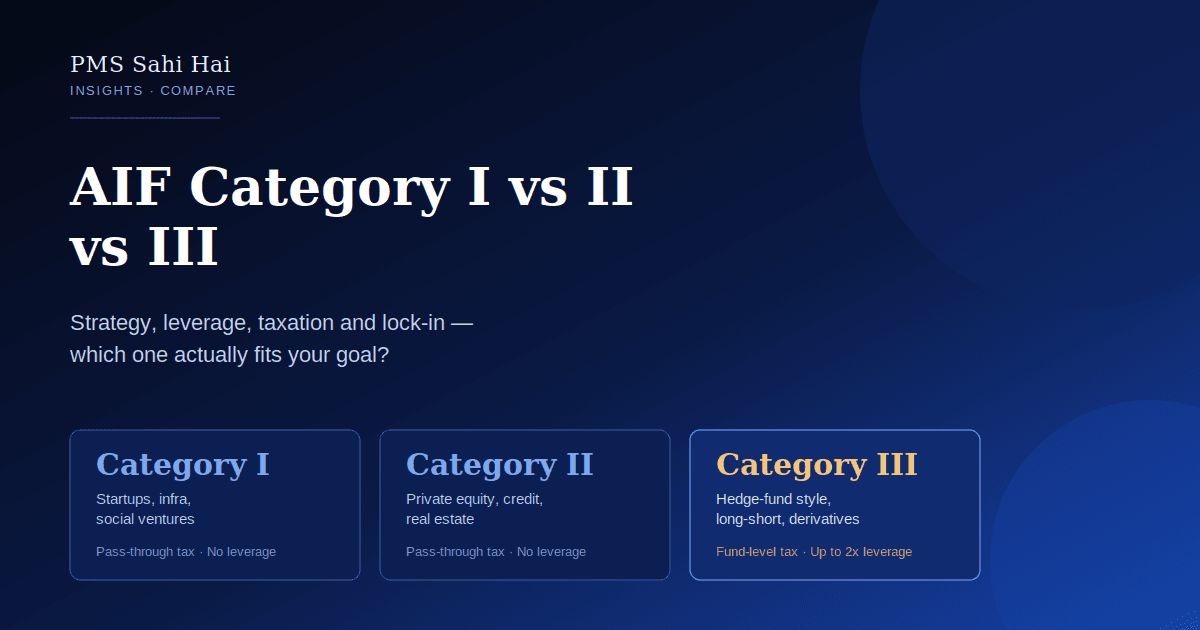
AIF Category I vs II vs III: Which One Actually Fits Your Goal

Should You Invest in PMS as well as Mutual Funds?
PMS and mutual funds are not rivals to choose between. For HNIs with Rs 50 lakh-plus, the smarter move is a hybrid portfolio that uses PMS as a high-conviction core and mutual funds as diversified, liquid stabilisers.
Read it. Now pressure-test it.
Ask Nyra how this applies to your portfolio, or talk to our team — no pitch, no pressure.