
Discretionary vs Non-Discretionary PMS: What You’re Signing Up For

Discretionary and non-discretionary are the two core structures a SEBI-registered portfolio manager can offer once you cross the ₹50 lakh minimum investment for Portfolio Management Services (PMS) in India. In discretionary PMS, the manager decides and executes every trade within an agreed mandate. In non-discretionary PMS, the manager recommends, but nothing happens until you personally approve it. A third, less-discussed structure advisory PMS hands execution entirely to you. This guide walks through where these rules actually come from, what each structure costs, how they show up in today's wealth-tech stack, and the honest trade-offs of each so you know precisely what you're agreeing to before you sign anything.
How India's PMS Rules Landed on "Discretionary vs Non-Discretionary"
Portfolio Management Services haven't always required ₹50 lakh to get in the door. The category was first formally regulated under the SEBI (Portfolio Managers) Regulations, 1993, which set the minimum client investment at just ₹5 lakh — a figure aimed at a much broader slice of affluent Indian investors than PMS serves today. That threshold was raised to ₹25 lakh in 2012, and then doubled again to ₹50 lakh under the SEBI (Portfolio Managers) Regulations, 2020, notified on January 16, 2020, with detailed guidelines following on February 13, 2020. According to contemporaneous reporting on the 2020 overhaul, SEBI's explicit goal was to restrict PMS to genuinely high-net-worth investors and clean up aggressive sales practices that had crept into the industry.
The same 2020 regulations are where the discretionary-versus-non-discretionary distinction gets its legal definition. Under Regulation 23(1) of the SEBI (Portfolio Managers) Regulations, 2020 (last amended September 2025), a discretionary portfolio manager "individually and independently" manages a client's funds within an agreed mandate, while a non-discretionary manager must act strictly "in accordance with the directions of the client." That single clause is the entire legal basis for a distinction that shapes everything else in this article — how fast trades happen, how much say you retain, and even what kinds of assets your portfolio can hold. Alongside raising the investment minimum, the 2020 rules also raised the portfolio manager's own required net worth, mandated an independent custodian for client assets, and shifted performance reporting to a standardized quarterly methodology — all changes we'll come back to. For a closer look at the most recent layer of changes, PMS Sahi Hai has a dedicated breakdown of SEBI's 2025 PMS regulation updates.
Discretionary PMS, Explained: Who's Really Making the Calls
Discretionary PMS is the default most people picture when they hear "portfolio management service." You agree to a mandate upfront — your risk profile, sector preferences, benchmark, any exclusions — and from that point forward, the manager buys, sells, and rebalances without calling you first. You'll see the trades after the fact, in your demat account and in periodic reports, not before.
This is the structure most PMS providers push first, largely because it's operationally simpler for them and faster for the market to reward. If a manager spots a genuine opportunity — a stock re-rating on a strong quarter, a sector rotation worth acting on quickly — a discretionary mandate lets them act the same day. There's no approval loop to slow things down.
A realistic example: imagine your portfolio manager identifies a mid-cap logistics company that just posted a strong quarterly beat and is trading below its historical valuation band. Under a discretionary mandate, the manager can initiate the position that afternoon. Under a non-discretionary mandate, the same idea has to be phoned or emailed to you first — and if you're in a meeting, traveling, or simply slow to respond, the price you'd have gotten a few hours earlier may no longer be available by the time you say yes. That gap — however small it looks in isolation — is the entire practical argument for discretionary PMS.
The trade-off, obviously, is control. You're trusting the manager's judgment inside the mandate's boundaries, and your only real lever if you're unhappy is to renegotiate the mandate or leave. For many investors, that's a reasonable exchange for professional attention they don't have the time or expertise to replicate themselves.
Non-Discretionary PMS, Explained: Why Your Approval Still Matters
Non-discretionary PMS flips the execution step. The manager still does the research, builds the recommendation, and tells you exactly what they'd do and why — but nothing is bought or sold until you say yes. Per SEBI's own investor-education guidance, the final transaction decision under this structure "rests with the investor," full stop.
This matters more than it sounds. It means every single trade — not just the big strategic calls, but the routine rebalancing ones too — needs your sign-off. That's a real time commitment, and it only works if you're genuinely reachable and reasonably fast to respond; otherwise you're paying for advice you can't act on in time. In exchange, you keep an absolute veto. If a recommended trade doesn't sit right with you — wrong sector, bad timing, a stock you have personal reasons to avoid — you can simply say no, something a discretionary client structurally cannot do once the mandate is signed. Independent breakdowns of non-discretionary PMS describe this same trade-off: more control, at the cost of speed.
Non-discretionary mandates also have one structural advantage that's easy to miss: per SEBI's own FAQ on portfolio managers, they're permitted to hold up to 25% of assets under management in unlisted securities such as AIFs, REITs, and InvITs, whereas discretionary portfolios are generally restricted to listed securities, money-market instruments, and direct mutual fund plans. If part of your strategy depends on that kind of access, the structure itself — not just your preference for control — may decide the question for you.
The 2026 Update: Pledging Your Non-Discretionary Holdings
One recent, genuinely useful clarification: in May 2026, SEBI issued informal guidance — in response to a query from a brokerage — confirming that non-discretionary PMS clients can pledge their demat holdings to a third-party lender for personal borrowing without breaching Regulation 23(8)'s restrictions on portfolio managers borrowing on a client's behalf. Because you retain beneficial ownership of the underlying securities under a non-discretionary mandate, the pledge arrangement sits strictly between you and your lender — your portfolio manager isn't a party to it, and the pledged securities continue to count toward your reported AUM until the pledge is actually invoked. It's a small but real bit of extra flexibility that discretionary structures, where the manager retains day-to-day control, don't offer in the same way.
And Then There's Advisory PMS: The Option Most Comparisons Skip
Most "discretionary vs non-discretionary" content — including, to be fair, this article's own title — leaves out a third structure that SEBI's framework explicitly recognizes: advisory PMS. Here, the manager's role stops at advice. You don't just approve trades; you execute them yourself, through your own broker and demat account. The manager researches and recommends; you do everything else.
Advisory PMS suits a narrower audience: investors who want institutional-grade research and a second opinion but aren't willing to give up operational control at all — not even the "approve or reject" veto of non-discretionary PMS. It's worth knowing this option exists mainly because most of the market conversation compresses PMS into a binary choice when it's really a three-way spectrum of control, from "hand it over" (discretionary) to "review and approve" (non-discretionary) to "advise only" (advisory).
Discretionary vs Non-Discretionary PMS: The Side-by-Side Comparison
| Dimension | Discretionary PMS | Non-Discretionary PMS |
|---|---|---|
| Who makes the final call | Portfolio manager, within the agreed mandate | You — the manager can only recommend |
| Trade execution | Immediate; no per-trade approval needed | Only after your explicit sign-off |
| Governing rule | Regulation 23(1), SEBI (Portfolio Managers) Regulations, 2020 | Regulation 23(1), SEBI (Portfolio Managers) Regulations, 2020 |
| Speed advantage | High — can act same-day on opportunities | Lower — bound by how fast you respond |
| Eligible investments | Listed securities, money-market instruments, direct MF plans | Can also hold up to 25% AUM in unlisted securities (AIFs, REITs, InvITs) |
| Time commitment from you | Low | High — you must stay reachable and responsive |
| Can pledge holdings for a personal loan | Less straightforward — manager retains day-to-day control | Yes, clarified by SEBI as of May 2026 |
| Best suited for | Investors who trust the process and don't want daily involvement | Investors with the time, market knowledge, and desire for final say |
That last row is worth sitting with. Per SEBI's own monthly statistics as of April 30, 2026, discretionary PMS clients outnumber non-discretionary clients by more than 27 to 1. That's not necessarily proof discretionary is "better" — it's at least partly a reflection of which structure is easier to sell and easier to live with day to day. Worth noting too: a large share of the ₹35.9 lakh crore reported under "discretionary" AUM is actually institutional debt money — EPFO and pension-fund mandates — not retail or HNI equity portfolios, so the headline number overstates how dominant discretionary PMS is among individual investors specifically.
What Each Structure Actually Costs You
The discretionary-versus-non-discretionary decision doesn't change what you pay in any fundamental way — both structures are governed by the same fee rules — but understanding the full cost stack matters regardless of which one you choose, because PMS fees are meaningfully higher than what most investors are used to paying for mutual funds.
The Fee Stack, Piece by Piece
Most providers charge a fixed management fee of 1–2.5% of AUM annually, charged quarterly rather than as a single upfront hit. This is your baseline cost of having a dedicated manager, independent of performance.
Performance Fee Above the Hurdle RateOn top of that, many PMS agreements include a performance fee — typically 10–20% of profits above a pre-agreed hurdle rate — calculated using a high-watermark principle, so you're not charged twice for recovering losses you've already paid a fee on once.
Entry Load, Exit Load, and GSTExpect entry and exit loads of roughly 1–3%, particularly for early withdrawals, plus 18% GST applied on top of the management fee itself. One rule genuinely in your favor: per SEBI's official FAQ on portfolio managers, upfront fees are not permitted at all — you can't be charged before the service is actually delivered. Independent fee breakdowns corroborate this same fee structure across providers.
Minimum Investment vs Manager Net Worth: Two Numbers People Mix Up
Two figures get placed near each other on almost every PMS explainer, and they get confused constantly: the ₹50 lakh minimum (Regulation 23(2)) is what you must invest as a client. The ₹5 crore minimum net worth (Regulation 9) is what the portfolio management firm itself must maintain to stay SEBI-registered — raised from ₹2 crore under the same 2020 overhaul. They're unrelated to each other beyond both appearing in the same set of regulations, and mixing them up can leave you with a wrong mental model of what "minimum investment" even means.
Where Discretionary and Non-Discretionary PMS Fit Into Today's Wealth-Tech Stack
PMS used to be a relationship business almost entirely — a relationship manager, a phone call, a PDF factsheet. That's changed substantially. Large fintech brokerages now run PMS product pages directly inside their trading apps; wealth-tech platforms blend robo-advisory-style interfaces with PMS access; and dedicated comparison marketplaces apply structured scoring frameworks across the full universe of registered strategies, which as of April 2026 stood at 498 SEBI-registered portfolio managers filing monthly reports with the regulator.
Two regulatory changes have quietly made this digital shift possible. First, the 2020 regulations mandated standardized quarterly reporting using a time-weighted rate of return (TWRR) methodology, which — unlike the inconsistent, self-reported performance figures common before 2020 — makes it possible to compare PMS strategies on something closer to an apples-to-apples basis. Second, and more recent, the May 2026 clarification on pledging non-discretionary holdings signals a regulator actively adapting older rules to how investors actually use their assets today, rather than leaving ambiguity for the market to guess at.
What PMS still lacks, though, is the daily public NAV disclosure that mutual funds have always had. That gap is exactly why independent comparison and scoring tools have become a meaningfully bigger part of the due-diligence process than they were a decade ago — because without them, you're often comparing one provider's self-reported numbers against another's, in different formats, with different assumptions baked in.
How PMS Sahi Hai Helps You Understand the Inner Clause
Everything covered so far — discretionary versus non-discretionary, the ₹50 lakh threshold, the fee stack, Regulation 23's fine print — actually lives inside the agreement you'll sign with a portfolio manager. Most investors never read that agreement clause by clause. They read a brochure and a return chart, and sign.
PMS Sahi Hai exists because of a simple observation: hard-earned wealth shouldn't rely on random advice. As India's 1st AI-powered PMS & AIF marketplace, it tracks 1,000+ PMS and AIF strategies across the country's SEBI-registered managers and scores them on a consistent framework — rather than asking you to take any single provider's word for how their product stacks up. You can browse the full landscape of asset managers, including AUM and quality scores for each one, instead of relying on whichever brochure happened to land in your inbox. If you're still building the basics, PMS Sahi Hai's own primer on what PMS actually is is a good companion to this guide, and its AIF explainer covers the adjacent category worth knowing about at this ticket size.
At the center of that effort is Nyra — PMS Sahi Hai's AI Wealth Compass. Where this article has explained the discretionary-versus-non-discretionary decision in general terms, Nyra takes the same question further for your specific situation. It profiles your risk appetite, time horizon, and — critically for everything this guide has covered — how much day-to-day involvement you actually want, then matches that against real strategy data rather than a marketing pitch. Two discretionary large-cap strategies can look nearly identical in a comparison table and still behave very differently in a downturn; Nyra's structural analysis, sourced from regulatory filings and factsheets rather than sales copy, is built to surface exactly that kind of difference before you commit ₹50 lakh, not after.
If you've read this far and are reasonably confident PMS is right for you but still torn between the hands-off pace of a discretionary mandate and the final say of a non-discretionary one, comparing real strategies through Nyra is a considerably faster way to see the actual difference than reading another ten factsheets.
Five Advantages of Getting Your PMS Structure Right
- Direct, personal ownership. Unlike a mutual fund, your PMS holdings sit in your own demat account as individual securities — not pooled units — giving you full visibility into every holding and trade-level tax treatment, sourced to your own capital gains obligations rather than a fund's blended NAV.
- Professional, dedicated management. A qualified, SEBI-registered manager is actively running a concentrated portfolio built specifically around your mandate — not a fund of thousands of anonymous unit-holders.
- A genuine choice of control level. The discretionary/non-discretionary/advisory spectrum means you're not forced into one operating model; you can pick how involved you want to be and change providers if that preference changes.
- Real customization. Sector exclusions, concentration limits, thematic tilts, tax-loss harvesting at the individual-stock level — all of this is available in a way a pooled mutual fund structurally cannot offer a single investor.
- Regulatory guardrails baked in, not optional. SEBI registration, a mandatory independent custodian, a mandatory compliance officer, and standardized quarterly TWRR reporting are requirements of the framework itself, not features an individual provider chose to offer.
Three Honest Limitations of Discretionary and Non-Discretionary PMS
- The entry barrier is real and by design. The ₹50 lakh minimum puts PMS out of reach for the overwhelming majority of Indian investors — this product is priced for HNIs on purpose, not by accident.
- The fee load is materially higher than a mutual fund. Between a 1–2.5% management fee, 18% GST on top of it, a 10–20% performance fee above the hurdle rate, and entry/exit loads of 1–3%, the total cost stack needs real scrutiny against expected outperformance — fees this size compound against you every single year, performance or not.
- Performance comparability is genuinely weaker than mutual funds. Without the daily public NAV disclosure mutual funds are required to publish, independent "top performer" comparisons compiled by different platforms can and do disagree — which means real diligence, not a single headline return figure, is required before you commit.
And a fourth, specific to the discretionary/non-discretionary choice itself: the control-versus-speed trade-off cuts both ways. Non-discretionary PMS only works if you're genuinely available and responsive; if you're not, you're paying for advice you can't act on before the opportunity moves. Discretionary PMS removes that friction but asks you to trust a mandate you can't veto trade-by-trade. Neither failure mode is hypothetical — both show up regularly in how investors actually experience these structures.
So, Which One Should You Actually Sign Up For?
There's no universal right answer, but there is a genuinely useful way to think about it. Ask yourself three questions honestly:
How much time can you actually give this?
Ans: If your honest answer is "very little," non-discretionary PMS will frustrate both you and your manager — approvals will lag, and you'll effectively be paying discretionary-adjacent fees for a slower, less-responsive version of the service.
How much market knowledge do you bring?
Ans: Non-discretionary PMS rewards investors who can evaluate a recommended trade quickly and meaningfully, not just rubber-stamp it. If you'd be approving trades on faith anyway, you're paying for the illusion of control rather than the substance of it.
How much do you need the final word?
Ans: Some investors have specific stocks, sectors, or personal exclusions they will not compromise on — inherited concentrated positions, ethical exclusions, tax considerations tied to other holdings. If that's you, the non-discretionary veto isn't a nice-to-have, it's the entire point.
If you're still unsure after answering those honestly, that's a reasonable place to be — it's also exactly the gap that PMS Sahi Hai's guidance on getting started with PMS and a structured tool like Nyra are meant to close, by matching your actual answers against real strategy data instead of asking you to guess.
Your Next Step Before You Sign Anything
By now, this shouldn't feel like a coin flip. If you want a manager to act fast within a mandate you trust, and you don't want your phone buzzing every time a trade is proposed, discretionary PMS is doing exactly what it's designed to do. If you want the final word on every transaction — and you can genuinely commit the time to give it — non-discretionary PMS is the more honest fit, and as of SEBI's May 2026 clarification, it now comes with the added flexibility of pledging your holdings without disrupting the mandate. If neither quite fits and you'd rather execute every trade yourself with expert research behind you, advisory PMS deserves a closer look too.
None of that, though, tells you which specific manager, mandate, or fee structure is right for your ₹50 lakh — or ₹5 crore, or more. That's a narrower, more personal question than any general guide can answer in the abstract, and it's exactly the question PMS Sahi Hai and Nyra were built to answer: compare, evaluate, and invest — smarter and faster, on a SEBI-registered platform that covers the full universe of registered strategies and explains why it's recommending something, not just that it is.
Compare Discretionary and Non-Discretionary PMS Strategies With Nyra
You've now read more about how discretionary and non-discretionary PMS actually work than most brochures will tell you. The part left to figure out is which specific manager, mandate, and fee structure actually fits your money — and that's a personal question, not a general one.
That's exactly what Nyra, PMS Sahi Hai's AI Wealth Compass, is built to help with: matching your risk profile, time availability, and control preferences against real, regulatory-sourced strategy data across the full universe of SEBI-registered PMS and AIF options — not just the one provider whose brochure you happened to read first.
Compare discretionary and non-discretionary PMS strategies with Nyra →
Still have questions? PMS Sahi Hai's PMS FAQ page covers more of the everyday basics.
PMS Sahi Hai is a distributor of Portfolio Management Services and Alternative Investment Funds, APMI-registered (Registration No. APRN08358). This article is for education only and is not investment advice, a recommendation, or an offer to buy or sell any security. Investments in securities markets are subject to market risks; read all scheme-related documents carefully. Past performance is not indicative of future results. Consult your advisor before investing.
Ishaan founded PMS Sahi Hai to make India's PMS, AIF and GIFT City markets legible to serious investors — comparing every SEBI-registered manager on the same seven pillars, with no shelf products and no commission bias.
Frequently asked
What is discretionary PMS?
In discretionary PMS, the portfolio manager has full authority to buy, sell, and rebalance your portfolio without asking for approval on individual trades, operating within the investment mandate you agreed to upfront. It's the more common structure in India and suits investors who want professional management without being involved in day-to-day decisions.
What is non-discretionary PMS?
In non-discretionary PMS, the portfolio manager recommends trades, but you must approve each one before it's executed — the manager cannot act without your explicit go-ahead. It suits investors who want professional research and ideas but insist on final say over every transaction.
What is advisory PMS, and how is it different from discretionary and non-discretionary PMS?
Advisory PMS is the third, less-discussed structure: the manager only advises, and you execute every trade yourself through your own broker and demat account — the manager never touches the transaction. That's different from non-discretionary PMS, where the manager still executes trades once you approve them; in advisory PMS, execution stays entirely in your hands. It suits highly involved investors who want expert research but full operational control, which is also why most SEBI-registered managers actually offer some combination of all three structures rather than just one.
Is discretionary PMS better than non-discretionary PMS?
Neither is objectively better — it depends on how much time you can give to markets and how much control you want to retain. Discretionary PMS suits investors who trust their manager's process and don't want approval calls interrupting their day; non-discretionary suits investors with the market knowledge and availability to sign off on every trade. SEBI's own client-count data shows discretionary PMS is far more common in practice, which reflects convenience winning out for most investors — not necessarily better outcomes.
What is the minimum investment required for PMS in India?
SEBI mandates a minimum client investment of ₹50 lakh for all PMS accounts, discretionary or non-discretionary, under Regulation 23(2) of the SEBI (Portfolio Managers) Regulations, 2020. This threshold has risen twice — from ₹5 lakh in 1993 to ₹25 lakh in 2012 to ₹50 lakh in 2020 — specifically to keep PMS reserved for high-net-worth investors.
Can non-discretionary PMS clients pledge their shares for a loan?
Yes. SEBI clarified in informal guidance issued in May 2026 that non-discretionary PMS clients retain beneficial ownership of their holdings and can pledge their demat securities to a third-party lender for personal borrowing, without this breaching Regulation 23(8)'s restrictions on portfolio managers borrowing on a client's behalf. The pledge is a matter between the client and the lender — the portfolio manager isn't a party to it.
Is PMS better than mutual funds if I want more control over my investments?
If control is your priority, PMS — especially non-discretionary or advisory PMS — gives you far more say than a mutual fund, where you have zero input into individual holdings. PMS also gives you direct ownership of securities in your own demat account rather than fund units, and lets you customize concentration, sector tilts, and tax treatment at the individual-stock level. The trade-off is cost, the ₹50 lakh minimum ticket size, and the fact that PMS performance isn't standardized or publicly disclosed the way mutual fund NAVs are — so comparing options properly takes real diligence, not just a headline return number.
Keep reading
All articles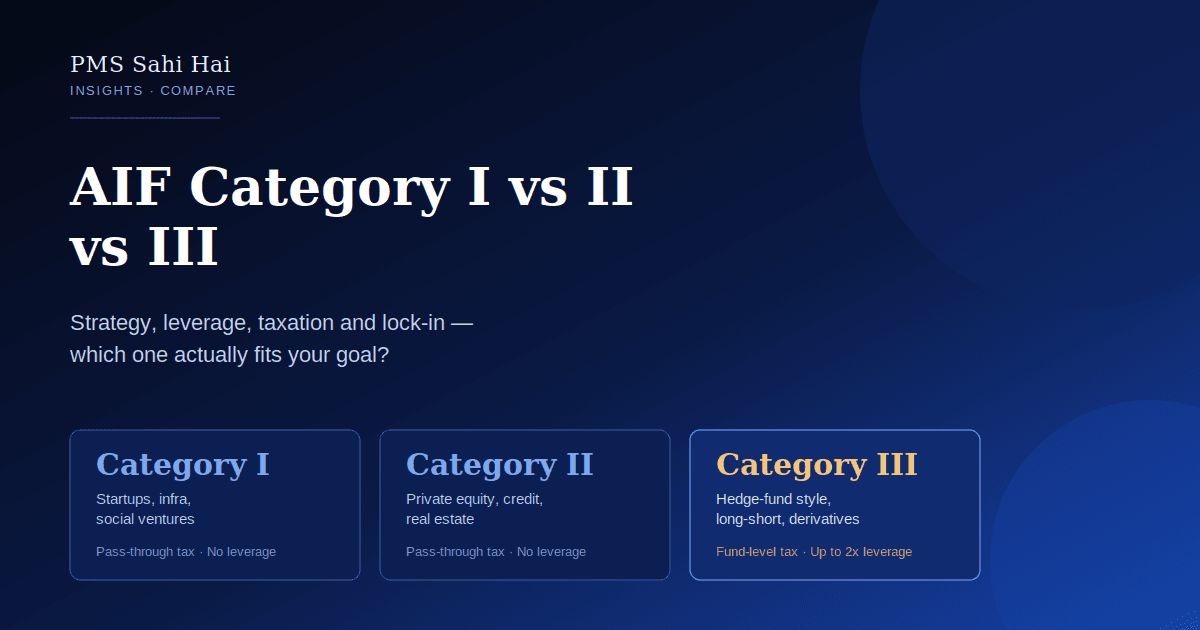
AIF Category I vs II vs III: Which One Actually Fits Your Goal

Should You Invest in PMS as well as Mutual Funds?
PMS and mutual funds are not rivals to choose between. For HNIs with Rs 50 lakh-plus, the smarter move is a hybrid portfolio that uses PMS as a high-conviction core and mutual funds as diversified, liquid stabilisers.
PMS vs VPF — Which Investment is Better?
PMS chases market-linked growth for high-net-worth and NRI investors. VPF builds a safe, government-backed retirement corpus for salaried savers. Here is how the two compare, and who each one actually suits.
Read it. Now pressure-test it.
Ask Nyra how this applies to your portfolio, or talk to a SEBI-registered advisor — no pitch, no pressure.