
Will vs Trust vs Nomination: Who Actually Gets Your PMS Portfolio
A nominee is not the owner. How SEBI's 2026 nomination and transmission rules, wills and trusts decide who gets your PMS portfolio.


In the nomination vs will debate, the nominee is the person your custodian hands the PMS portfolio to, but not necessarily the person who ends up owning it. The Supreme Court held in December 2023 that nomination is not a third mode of succession, so ownership follows your will, or succession law if there is no will. SEBI's revised rules allow up to three nominees on a demat account from 1 September 2026, and a July 2026 framework sets the papers heirs need when there is no nominee. A private trust takes the portfolio out of this chain altogether, at the cost of paperwork and tax trade-offs. This is general information, not legal advice: consult a lawyer before you sign a will or a trust deed.
Why Your PMS Portfolio Needs More Than a Nominee
A portfolio management service is unusual among investment products because you own every share in it directly. The portfolio manager takes decisions, but the securities sit in a demat account opened in your name with the manager's custodian. SEBI's own informal guidance in May 2026 described securities bought under a non-discretionary PMS as remaining in the client's beneficial ownership and held in the client's name in the demat account with the approved custodian.
That structure is good news while you are alive: your manager cannot walk off with your shares. It also means that when you die, your PMS portfolio is treated like any other demat holding. It is frozen, then moved by a process called transmission of securities to whoever has the right papers.
Three documents decide what happens next, and most investors mix them up:
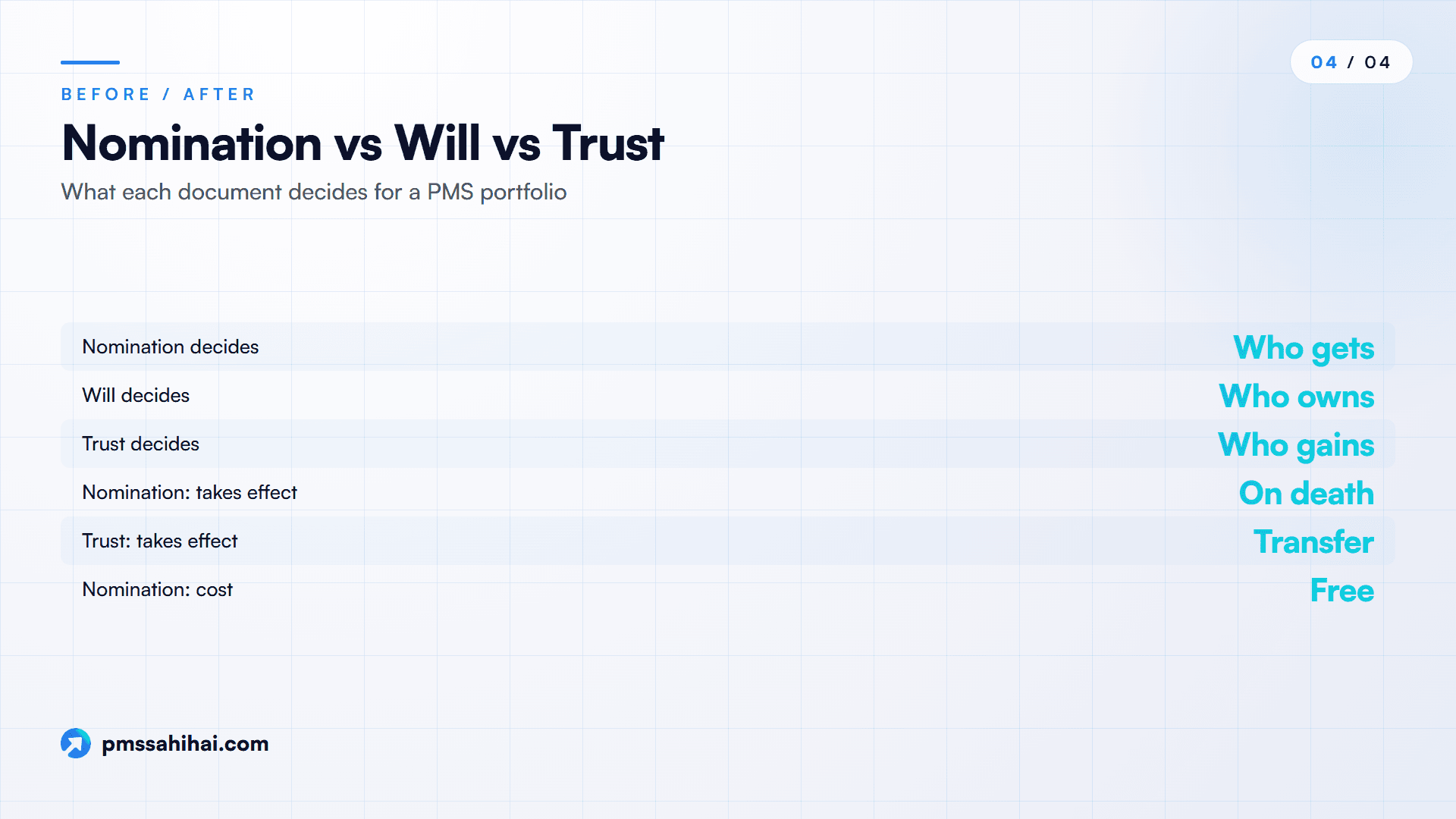
- Nomination tells the custodian and depository whom to release the securities to.
- A will (or, without one, succession law) decides who owns them.
- A private trust can own the securities before you die, so nothing needs to be released or inherited at all.
Getting the nomination vs will question wrong is how families end up with a sibling holding shares "in trust" for everyone else, or a widow waiting for court papers while a Rs 2 crore portfolio sits frozen. PMS succession planning is about lining these three documents up so the person who collects the portfolio is also the person meant to keep it.
This guide stays with PMS portfolios held in an individual's demat account. Family offices, HUFs and the general mechanics of private trusts are covered in separate guides. Nothing here is legal advice; succession law in India depends on your religion, residence and family, so please consult a lawyer before acting.
How Nomination, Wills and Trusts Took Shape in Indian Law
Nomination Was Built for Convenience, Not Inheritance
Wills and trusts are old instruments. The Indian Succession Act, 1925 governs how wills are made and proved, and the Indian Trusts Act, 1882 governs private trusts. Nomination is newer. For company shares, it arrived through sections 109A and 109B of the Companies Act, 1956, inserted in 1999. The Supreme Court later noted that the purpose was to "ease the cumbersome process of obtaining various letters of succession" after a shareholder's death.
Courts had already decided what a nomination means for other assets. In the 1984 Sarbati Devi case on life insurance, and later in a case on bank deposits, the Supreme Court held that a nominee collects money on behalf of the estate rather than inheriting it. Shares remained contested for years, with conflicting Bombay High Court rulings, until the Supreme Court settled the question in 2023.
The 2025–2026 Reset of Nomination, Probate and Transmission
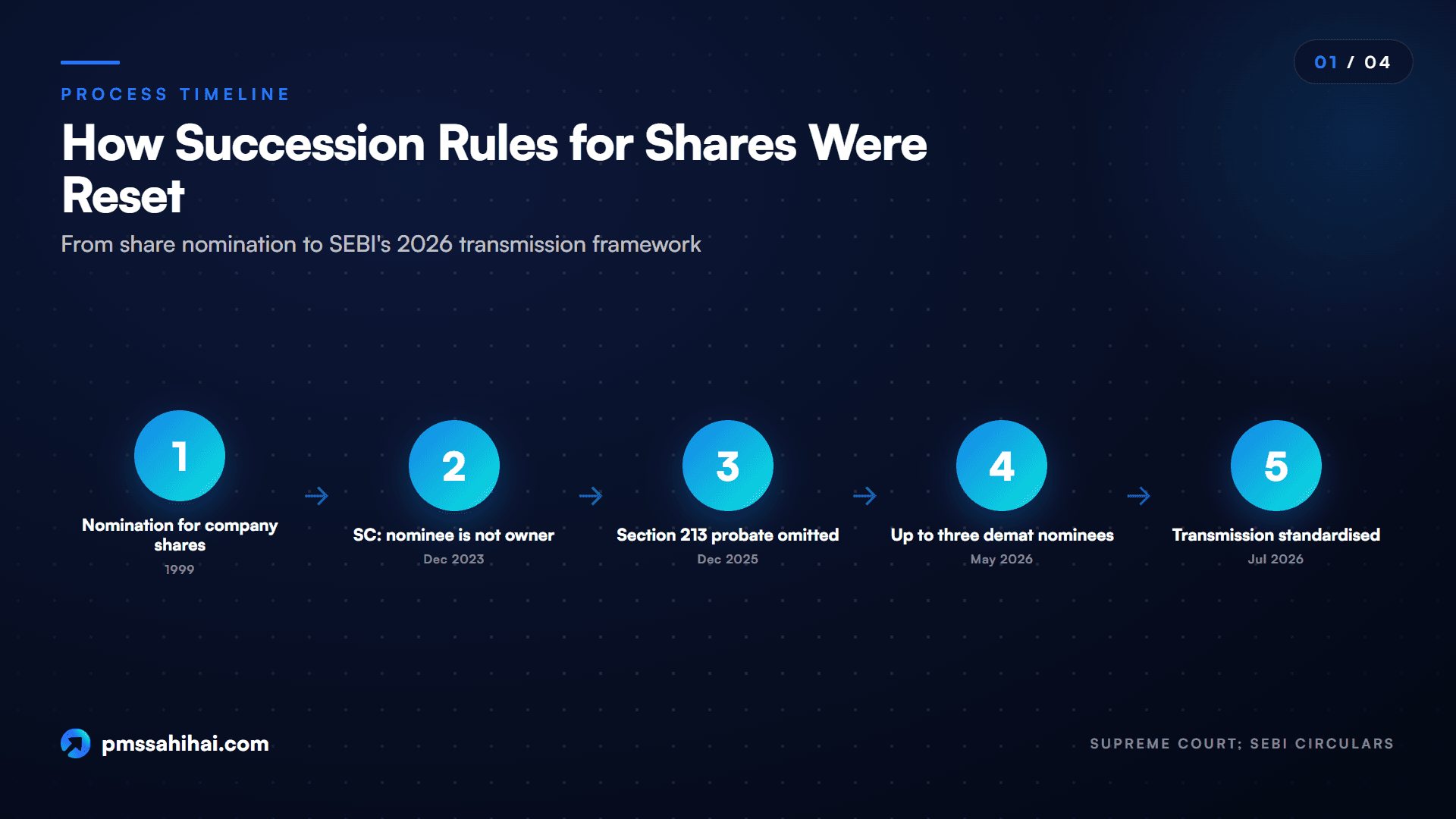
The last two years rewrote almost every practical rule:
| Date | Change |
|---|---|
| 3 Oct 2023 (in force 1 Jan 2024) | SEBI creates a centralised mechanism to report an investor's death through KYC registration agencies; portfolio managers are covered |
| 14 Dec 2023 | Supreme Court rules in Shakti Yezdani that nominees of shares do not become owners |
| 10 Jan 2025 | SEBI raises the demat nominee limit from 3 to 10; rollout is later phased and then deferred |
| 20 Dec 2025 | Repealing and Amending Act, 2025 omits section 213 of the Indian Succession Act, ending mandatory probate in the former presidency towns |
| 17 Mar 2026 | SEBI consultation paper proposes simpler nomination norms |
| 29 May 2026 | SEBI issues modified nomination norms: up to three nominees, effective 1 September 2026 |
| 23 Jul 2026 | SEBI standardises transmission of securities, with new value thresholds and no mandatory probate |
If your estate plan was written before 2025, at least one assumption in it is probably out of date.
Nominee vs Legal Heir: What the Supreme Court Settled in 2023
Discharge for the Institution Is Not Ownership for the Nominee
The nominee vs legal heir question for shares and demat holdings was answered on 14 December 2023 in Shakti Yezdani & Anr v Jayanand Jayant Salgaonkar & Ors (Civil Appeal No. 7107 of 2017). The deceased had left a will, but had also named nominees on fixed deposits and mutual fund investments. The nominees argued that the "vesting" language in the Companies Act and the depository bye-laws made them absolute owners.
The Supreme Court disagreed. Its key lines are worth reading in full:
- "offering a discharge to the entity once the nominee is in picture is quite distinct from granting ownership of securities to nominees instead of the legal heirs"
- "Nomination process therefore does not override the succession laws."
- there is "no third mode of succession" that the Companies Act, 1956, its 2013 counterpart, or the Depositories Act, 1996 intends to provide.
In plain terms, nomination protects the company, depository or custodian. Once it hands the securities to the nominee, it is off the hook. The nominee then holds them for whoever is entitled under the will or under the succession law that applies to the deceased. SEBI's July 2026 transmission framework uses the same idea: where there is a nomination, the nominees "shall receive the assets ... as trustee on behalf of legal heir(s)."
So, in the nomination vs will contest, the will wins on ownership. The nomination only wins on speed.
Where Insurance and Bank Nominations Differ
Bank deposits follow the Banking Regulation Act. After the Banking Laws (Amendment) Act, 2025, depositors can nominate up to four persons, either simultaneously with percentage shares or successively. Life insurance follows its own statute, which treats certain close-family nominees differently. Do not assume the rule for your term policy or savings account applies to your demat account. Ask a lawyer to check each asset's statute.
SEBI Nomination Rules for Demat Accounts From 1 September 2026
Three Nominees, Opt-Out and Joint Holdings
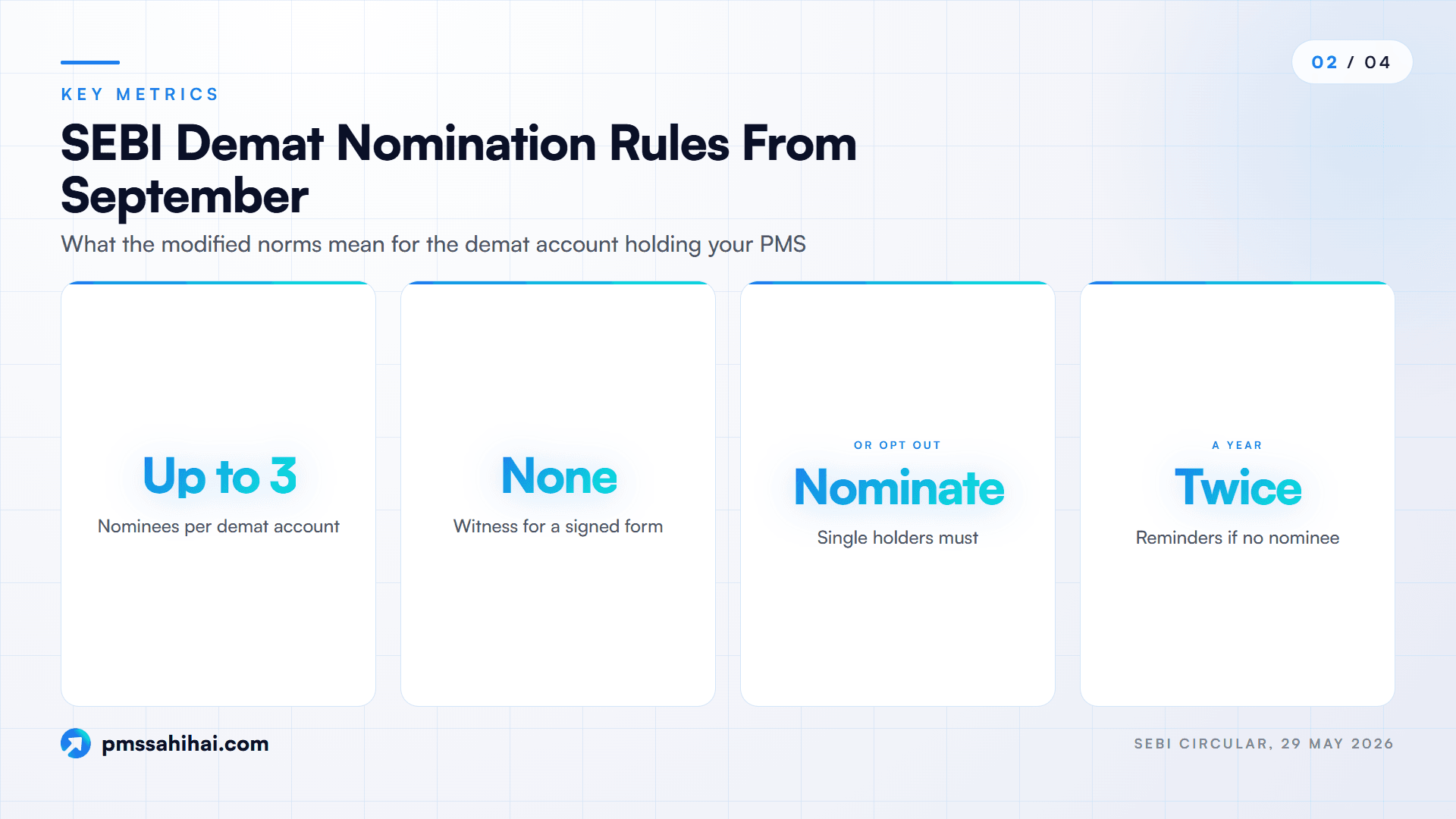
The current SEBI nomination rules come from a SEBI circular dated 29 May 2026, which replaced 18 earlier circulars, including the January 2025 framework that had allowed ten nominees. It applies to demat accounts and mutual fund folios, and so to the demat account that holds your PMS portfolio. The main rules, effective 1 September 2026:
- Single-holder accounts opened from that date must either name a nominee or file an opt-out declaration.
- Joint accounts can choose whether to nominate, but every joint holder must consent to add or change a nominee.
- Up to three nominees. If you do not state percentages, the holding is split equally and any odd lot goes to the first nominee.
- Only the nominee's name and relationship are mandatory, plus date of birth for a minor. Contact details, identity numbers and percentage shares are optional.
- No witness is needed for a signed form; a thumb impression needs two witnesses.
- Online nomination can be validated by digital signature, Aadhaar e-sign or OTP-based two-factor authentication.
- You can change or cancel a nomination any number of times. The rules apply to existing accounts too.
- Accounts without a nominee will receive SMS and email reminders twice a year and a pop-up at login.
Why the push? SEBI's March 2026 consultation paper showed that in 2025, between roughly 71% and 83% of newly opened demat accounts each month opted out of nomination. Fewer than one in a hundred named two or more nominees. Accounts without nominees are the ones that turn into unclaimed assets.
What the Final Circular Left Out
Two things in the earlier drafts did not survive. The January 2025 idea of letting a nominee operate the account if the investor became incapacitated was dropped; SEBI's paper pointed to the existing power of attorney route instead. The draft's line that nominees receive assets "as trustee" also does not appear in the final nomination circular. It turned up instead in the July 2026 transmission circular, where it now governs how securities move after death.
For PMS investors, the practical point is simple. Your PMS demat account is a demat account under these SEBI nomination rules. Check its statement: it must now print either your nominees' names or a Yes/No flag.
What Happens to a PMS Portfolio When the Investor Dies
Step One: The Death Is Reported and the Account Is Frozen
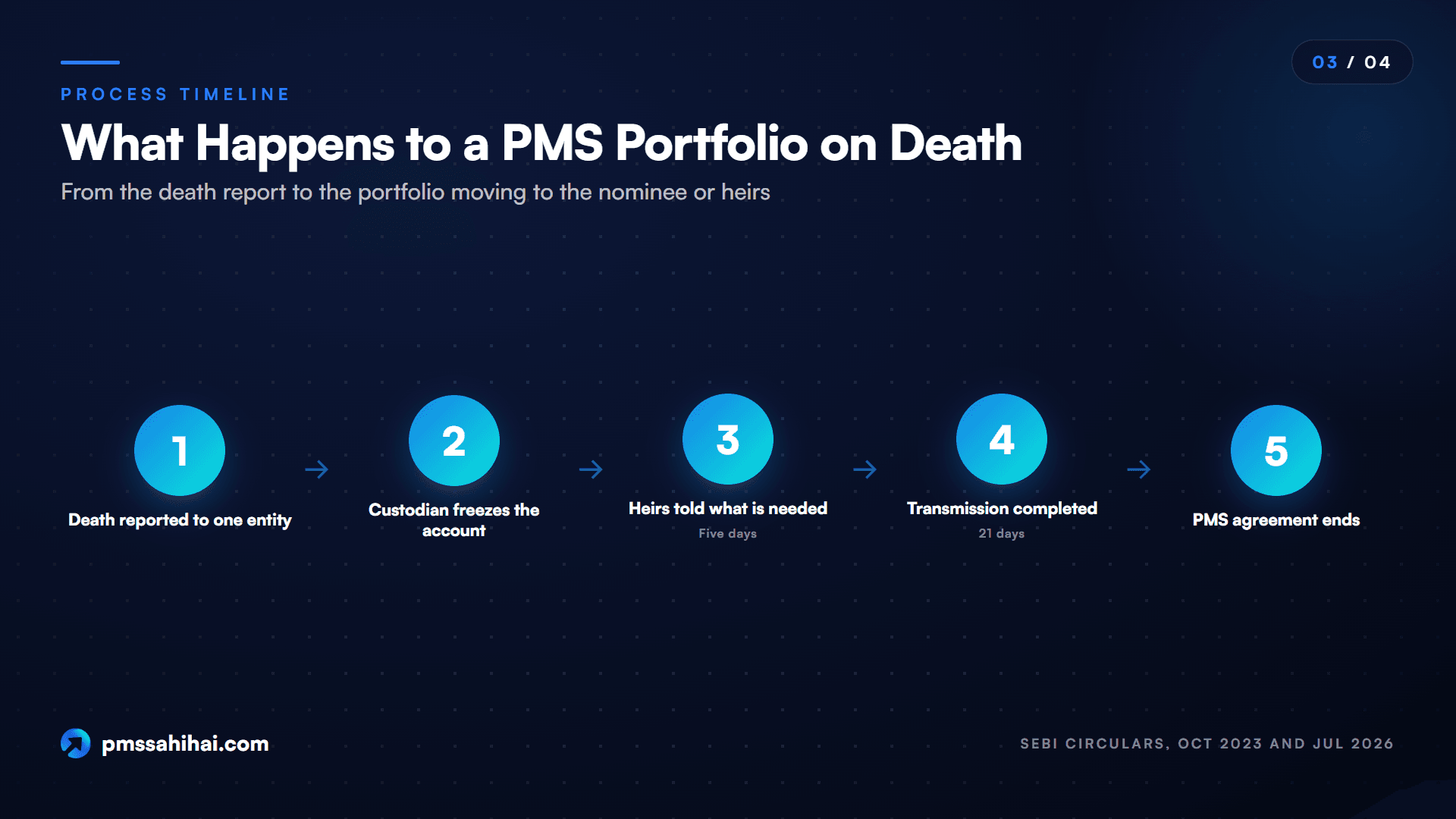
Under SEBI's October 2023 framework, a nominee, joint holder, legal representative or family member reports the death to any one regulated entity: the portfolio manager, the custodian, a broker or a mutual fund. That entity verifies the death certificate, usually by the next working day, and updates the KYC registration agency. The agency then alerts every other linked intermediary, which must block debit transactions. Within five days, the intermediaries must tell the nominee or notifier how transmission works and which documents are needed.
The industry's common operating procedure for this mechanism, updated in March 2026, adds PMS-specific steps. The portfolio manager reports the client's depository participant number along with the death intimation. The custodian stops debit transactions; trades already in progress settle by the end of that day, and then the account is frozen. The custodian tells the portfolio manager once it acts. In practice, your manager stops trading the portfolio.
Step Two: Transmission of Securities to the Nominee or Heirs
SEBI's 23 July 2026 circular standardised transmission of securities for listed shares and mutual fund units, in force from late August 2026 (30 days after issue). It sets three lanes:
| Situation | Who receives | Main documents |
|---|---|---|
| Nominee registered | Nominee(s), as trustee for legal heirs | Transmission form, nominee's client master list, verifiable death certificate, statement of holdings |
| No nominee, value up to Rs 30,000 (demat) | Immediate relatives only: parents, spouse, children, parents-in-law | Plain-paper request with undertaking, proof of relationship |
| No nominee, value up to Rs 30 lakh (demat) | Claimant(s) / legal heirs | Notarised indemnity bond, plus affidavit-cum-NOC from all legal heirs or a notarised family settlement deed |
| No nominee, value above Rs 30 lakh | Claimant(s) / legal heirs | Affidavit-cum-NOC from all heirs, plus a copy of the will or a legal heirship certificate (with indemnity), or a succession certificate, letter of administration or court decree |
The Rs 30 lakh limit for demat holdings is per beneficial owner. Here is the PMS-specific catch: SEBI's minimum PMS investment is Rs 50 lakh, so almost every PMS portfolio without a nominee will land in the heaviest documentation lane. The processing entity must complete transmission within 21 calendar days of receiving all documents. If a nominee dies before you and you never updated the form, that nominee's share goes pro rata to the surviving nominees.
Two caveats matter. First, the framework does not apply where claims are disputed; those go to court. Second, it covers listed securities and mutual fund units. Unlisted shares or other assets inside a PMS account may follow the issuer's own process, so ask your manager what the portfolio holds.
Step Three: The PMS Agreement Ends and the Portfolio Moves
SEBI's master circular for portfolio managers says that on termination of the PMS agreement, the securities and funds in the investor's account are transferred to the investor's verified demat and bank account. The agreement itself sets the termination conditions, including what happens on death, how fees accrued to that date are settled and whether an exit load applies. Read that clause now, not later.
The nominee or heir can then usually choose between receiving the shares in their own demat account and selling them. Receiving shares in kind keeps the holding invested and, as explained below, carries over the original cost.
How a Will Decides Who Finally Owns the Portfolio
Probate After the Omission of Section 213
A will is the document that settles ownership. Under the Indian Succession Act, a will is generally signed by the testator and attested by two witnesses; registration is optional. NRIs can also make wills covering Indian assets.
Probate is a court's certification that a will is genuine. Until December 2025, section 213 of the Indian Succession Act stopped an executor or beneficiary of certain communities from establishing rights under a will in court, in matters connected with the old presidency towns of Mumbai, Kolkata and Chennai, without probate or letters of administration. The Repealing and Amending Act, 2025 omitted section 213. The government's own factsheet on the Repealing and Amending Act describes this as eliminating "community-based disparities in probate requirements."
SEBI followed. Its July 2026 transmission circular removed the mandatory requirement of probate, "in line with recent amendments to succession laws." For a PMS portfolio above Rs 30 lakh, heirs can now submit a copy of the will with an affidavit-cum-NOC and an indemnity bond instead.
Probate has not disappeared. It is still available, and lawyers still recommend it where a will may be challenged, where the estate is large or complex, or where assets sit abroad. A probated will is also a court document, so it lets heirs skip the affidavit-cum-NOC from non-claimant heirs.
When the Nominee and the Will Disagree
Picture a hypothetical investor, Anil, with a Rs 1.8 crore PMS portfolio. Years ago he named his elder son as sole nominee. His later will leaves the portfolio equally to his wife and two children.
On Anil's death, the custodian transmits the shares to the son, and the custodian is discharged. The son, however, holds them for the three beneficiaries under the will, and he must transfer two-thirds to his mother and sister. If he refuses, the family is in court.
Had Anil named all three as nominees with one-third each, matching the will, the transmission would have done the work. That alignment is the cheapest piece of PMS succession planning you will ever do.
Personal law also matters. Muslim personal law, for example, limits what can be left by will. A lawyer should review any will covering a large PMS portfolio.
When a Private Trust Fits a PMS Portfolio
How Securities Move Into a Trust
A private trust is created under the Indian Trusts Act, 1882. You (the settlor) transfer assets to trustees, who hold them for beneficiaries under the terms of a trust deed. Because the trust owns the securities before your death, they are not part of the estate passing under your will. Nobody needs to be "transmitted" anything, and nominations on your personal account become irrelevant for those assets.
For a PMS portfolio, that usually means:
- Drafting a trust deed naming trustees, beneficiaries and the rules for income and capital.
- Opening a PAN, bank account and demat account for the trust.
- Transferring the shares off-market from your demat account to the trust's demat account.
- Either opening a PMS account in the trust's name or keeping the trust's portfolio under a new mandate.
Whether a given portfolio manager onboards private trusts, and what KYC it wants from trustees, is a question to ask before the deed is signed. Registration and stamp duty depend on the type of property and your state, so have a lawyer draft the deed.
Revocable vs Irrevocable Trusts and Tax
The tax treatment of a private trust holding a PMS portfolio depends on how it is set up. Under the Income-tax Act, 2025, in force from 1 April 2026:
- A transfer of a capital asset by an individual under a will or a gift or an irrevocable trust is not treated as a transfer for capital gains (section 70(1)(b), formerly section 47(iii)).
- Income from a revocable transfer stays taxable in the settlor's hands (section 97, formerly sections 61–63). A revocable trust keeps control with you but saves no tax.
- Where beneficiaries' shares are indeterminate, as in a discretionary trust, income can be taxed at the maximum marginal rate (section 307(1), formerly section 164). A trust created by will, if it is the only such trust, can be taxed at AOP rates instead (section 307(2)(b)).
- Property received by a trust created solely for the benefit of the individual's relatives is excluded from the gift-tax rule (section 92(3)(h)).
How a transfer into a revocable trust is treated for capital gains is not spelled out in section 70(1)(b), which names irrevocable trusts. Settle that point with a tax adviser before moving a large portfolio.
Nomination vs Will vs Trust Side by Side for PMS Investors
| Factor | Nomination | Will | Private trust |
|---|---|---|---|
| What it decides | Who receives securities from the custodian | Who owns them after death | Who benefits, while you are alive and after |
| Legal basis | SEBI circulars, Depositories Act | Indian Succession Act, 1925, plus personal law | Indian Trusts Act, 1882 |
| Takes effect | On death | On death | When assets are transferred to trustees |
| Can be challenged by heirs? | Yes, nominee holds for heirs | Yes, in court | Assets have already left your estate |
| Cost and effort | Free, online, minutes | Low; registration optional | Higher: deed, trustees, PAN, demat, filings |
| Control after death | None | Ends with distribution | Continues through trustees for years |
| Privacy | Statement shows name or Yes/No | Can become public if probated | Deed is not filed in court |
| Best for | Fast release of a PMS portfolio | Deciding final ownership | Staged distribution, minors, protection |
The will vs trust choice is really about control. A will hands over ownership on death. A trust can drip out income to a child until 25, protect a dependent with special needs, or keep a portfolio intact across generations.
Tax on an Inherited PMS Portfolio
India has no separate inheritance tax. Under the Income-tax Act, 2025:
- Shares received under a will or by inheritance are not taxed as income in the heir's hands (section 92(3)(c)).
- Transmission itself is not a sale, so no capital gains arise on the death.
- When the heir later sells, the cost is the original owner's cost (section 73(1), Table Sl. 1) and the original holding period counts (section 2(101)(c)).
So an heir who sells listed shares the deceased held for years generally pays long-term capital gains rates on the full gain since the original purchase, not just the gain since inheritance. Confirm the numbers with a tax adviser, especially for NRI heirs, who face TDS on sale.
Why a Layered Succession Plan Makes Life Easier for Families
Used together, the three tools solve different problems:
- Speed. A registered nominee needs four documents and the entity has 21 days, versus months of affidavits or court papers without one.
- Certainty. A will decides who owns the portfolio instead of leaving it to default succession law.
- Less court time. With section 213 gone and SEBI no longer demanding probate, an uncontested will plus nominee can move a PMS portfolio without litigation.
- Lower friction for heirs. Inherited cost and holding period carry over, so heirs are not forced to sell to pay tax.
- Control beyond death. A private trust lets you set conditions, appoint trustees and avoid fragmenting a portfolio among many heirs.
- Privacy. Assets already in a trust do not pass through probate files.
How PMS Sahi Hai Helps You Plan Who Gets Your PMS Portfolio
Let us be clear about what PMS Sahi Hai is not. It does not draft wills or trust deeds, it does not file transmission claims, and it is not a law firm. Nothing on the site is dedicated to nomination or succession, which is partly why this guide exists. What the platform does is make the PMS side of your succession plan legible, so the conversation with your lawyer starts from facts.
- Know where the portfolio actually sits. Transmission runs through your custodian and depository participant, not through the fund manager's brand. The guide on what a custodian does and why your manager can't touch your money explains that chain, which is exactly the chain your nominee will deal with.
- Understand what heirs can do with the shares. Heirs usually choose between keeping the shares in kind and selling. The explainer on in-specie transfers shows why moving shares without selling keeps the holding invested, and the guide to the PMS exit process covers what a full exit involves.
- Decide whether the inherited strategy still fits. An heir inherits a strategy picked for someone else's age and goals. The compare page lets them line up to four PMS, AIF or GIFT City strategies side by side before deciding to stay, switch or exit.
- Ask Nyra the awkward questions. Nyra, the platform's AI research tool, answers plain-English questions with cited sources. Use it to prepare for a meeting with your manager: what your agreement's termination clause covers, how a trust account would be onboarded, or how inherited gains are taxed. The site describes Nyra as an analytical tool, not a SEBI-registered investment adviser, so treat its answers as research, not legal advice.
The workflow is simple: understand the structure on PMS Sahi Hai, settle the legal documents with a lawyer, and keep both in the same family file.
Limits and Mistakes That Derail PMS Succession Planning
Each tool has real limits:
- Nominee mismatch. Naming one child while the will splits three ways guarantees friction. The nominee is legally bound to hand over, but enforcement can mean a lawsuit.
- Opting out. No nominee on a PMS demat account means the above-Rs-30-lakh route: affidavits from every legal heir, or court documents. One reluctant heir can stall everything.
- Disputes leave the simplified route. SEBI's framework does not apply to contested claims.
- Outdated forms. A nominee who died before you, a former spouse, or a minor without a guardian named can all complicate transmission.
- Discretionary trust tax. Maximum marginal rate on trust income can wipe out the convenience.
- Trust overheads. Trustees, accounts, returns and KYC add cost every year.
- Personal-law limits. A will cannot always override religious succession rules.
- Non-listed holdings. Unlisted shares or assets outside SEBI's transmission framework may need their own process.
Getting Nomination, Will and Trust to Work Together
The nomination vs will question has a clean answer. Nomination decides who collects your PMS portfolio. Your will, or succession law, decides who keeps it. A private trust lets you decide that before you die.
For most PMS investors, the sensible order is:
- Update the nomination on the PMS demat account under the September 2026 rules, with up to three nominees and percentages that match your will.
- Write or update a will with a lawyer, naming an executor and covering the PMS portfolio explicitly.
- Consider a private trust if you have minors, dependants who need protection, or a portfolio you want kept intact.
- Read the termination clause in your PMS agreement and keep a family file with your manager's and custodian's contacts.
If the portfolio itself needs a second look before you lock in heirs, PMS Sahi Hai and Nyra can help you understand what you hold and what your heirs would inherit.
Please consult a lawyer for the will and trust deed and a tax adviser for the tax points; the rules above are as of 27 October 2026.
Start Your PMS Succession Checklist With PMS Sahi Hai
Open your PMS demat statement this week and check whether it shows a nominee. If it says "No" or names someone your will does not, fix the nomination online in minutes. Then book time with a lawyer to align your will, and decide whether a private trust belongs in your plan.
When you want clarity on the portfolio itself, compare PMS strategies side by side on PMS Sahi Hai, ask Nyra to explain how your strategy or its tax works, or book a 15-minute conversation with the team. This article is general information as of 27 October 2026, not legal, tax or investment advice; consult a lawyer for your will or trust and a tax adviser for the tax points.
PMS Sahi Hai is a distributor of Portfolio Management Services and Alternative Investment Funds, APMI-registered (Registration No. APRN08358). This article is for education only and is not investment advice, a recommendation, or an offer to buy or sell any security. Investments in securities markets are subject to market risks; read all scheme-related documents carefully. Past performance is not indicative of future results. Consult your advisor before investing.
Ishaan founded PMS Sahi Hai to make India's PMS, AIF and GIFT City markets legible to serious investors, comparing every SEBI-registered manager on the same comparative basis, with no shelf products and no commission bias.
Frequently asked
Does a nominee become the owner of shares in a PMS account?
No. In Shakti Yezdani (December 2023), the Supreme Court held that nomination under the Companies Act and Depositories Act is not a third mode of succession. The custodian is discharged once it transmits the shares to the nominee, but the nominee holds them for the legal heirs under the will or succession law. SEBI's July 2026 transmission framework says nominees receive the assets as trustee for the legal heirs.
Does a will override a nomination?
On ownership, yes. A valid will decides who finally owns the securities; the nomination only decides who receives them first from the custodian or depository. If your nominee and your will name different people, the nominee must pass the shares to the beneficiaries under the will. To avoid disputes, name the same people, in the same proportions, in both documents.
How many nominees can I add to my PMS demat account?
Up to three, under SEBI's circular of 29 May 2026, effective 1 September 2026. The earlier ten-nominee limit from January 2025 was superseded. You can set percentage shares; if you do not, the holding is split equally and any odd lot goes to the first nominee. Only the nominee's name and relationship are mandatory, plus date of birth for a minor.
Who gets my PMS portfolio if there is no nominee?
Your legal heirs, under your will or under succession law if there is no will. Because PMS portfolios usually exceed SEBI's Rs 30 lakh simplified-documentation limit, heirs typically need an affidavit-cum-NOC from all legal heirs plus a copy of the will or a legal heirship certificate, or a court-issued succession certificate. Disputed claims fall outside the simplified process entirely.
Is probate still required to transfer shares in 2026?
Not as a mandatory step. The Repealing and Amending Act, 2025 omitted section 213 of the Indian Succession Act, and SEBI's July 2026 transmission circular removed the mandatory probate requirement for securities. Heirs can submit a copy of the will with other documents. Probate remains available and is still advisable where a will may be challenged.
Can a private trust hold a PMS portfolio?
A private trust can own securities in its own demat account, and those assets then pass outside your will. Whether a particular portfolio manager accepts a trust as a client, and what KYC it needs from trustees, varies by manager. Tax depends on the trust type: discretionary trust income can be taxed at the maximum marginal rate. Get the deed drafted by a lawyer.
Is there inheritance tax on shares in India?
There is no separate inheritance tax. Under the Income-tax Act, 2025, shares received under a will or by inheritance are not taxed as income in the heir's hands. When the heir sells, the cost and holding period of the original owner carry over, so capital gains are computed from the original purchase. NRI heirs should check TDS rules with a tax adviser.
What happens to my PMS fees and exit load if I die?
That depends on your PMS agreement. SEBI's master circular says that on termination of the agreement, securities and funds are transferred to the investor's verified demat and bank account, but the agreement sets termination conditions, fee settlement and any exit load. Read the termination clause now and keep a copy with your will.
Keep reading
All articles
Single Family Office vs Multi Family Office: Which Fits Your Wealth?
Single family office vs multi family office in India: wealth thresholds, cost break-even, SEBI and GIFT City rules, and which model fits your wealth.

REIT vs InvIT: Which Income Trust Fits Indian Investors in 2026?
REIT vs InvIT for Indian investors: assets, 90% payout rules, yield composition, tax on each distribution component, risks and portfolio fit.

GIFT City Investment Options for NRIs: Six IFSC Products Compared
GIFT City investment options for NRIs compared: deposits, funds, AIFs, PMS, NSE IX and insurance by minimum, tax, liquidity and fit.
Read it. Now pressure-test it.
Ask Nyra how this applies to your portfolio, or talk to our team, no pitch, no pressure.