
Single Family Office vs Multi Family Office: Which Fits Your Wealth?
Single family office vs multi family office in India: wealth thresholds, cost break-even, SEBI and GIFT City rules, and which model fits your wealth.


The single family office vs multi family office decision is mostly a question of scale. A single family office (SFO) gives one family full control and privacy, but Indian estimates put its running cost at roughly ₹2.5–5 crore a year, which only becomes cheap relative to assets somewhere between ₹250 crore and ₹2,000 crore. A multi family office (MFO) shares that cost across several families and usually charges about 0.25%–1% of assets or a retainer, which suits families from roughly ₹25 crore upward. India has no dedicated family office law: SEBI said in October 2025 it is not pursuing one, so what protects you is the licence your provider holds, and GIFT City offers a separate family investment fund route from USD 10 million.
Why the Single Family Office vs Multi Family Office Choice Matters Now
Every wealthy family eventually hits the same wall. The portfolio has outgrown a single relationship manager, the money sits across a holding company, a family trust, a few demat accounts, two PMS mandates, some AIF commitments and perhaps a GIFT City account, and nobody can answer a simple question: what do we own, what does it cost, and is it working?
That is the moment the family office conversation starts. And the first fork in the road is the single family office vs multi family office question: build your own team, or share a professional platform with other families?
The choice has become more pressing in India for a plain reason: there are far more families facing it. PwC counted more than 300 family offices in India in 2024, up from about 45 in 2018, and expected the number to keep rising as promoters build businesses beyond the metros. Most of the new offices are first-generation, set up by founders who sold a stake or took a company public.
Yet the advice is strangely inconsistent. One wealth firm says a single family office needs ₹100 crore; another says ₹2,000 crore. Each number hides an assumption about cost, complexity and control.
This guide lines up the published thresholds side by side, shows the break-even arithmetic that explains why they disagree, and covers what regulation applies to each family office in India and GIFT City as of October 2026. For the basics of what a family office does, see our companion explainer; here we focus on the choice between the two models.
How Family Offices Evolved Into Two Distinct Models
From In-House Wealth Teams to Shared Platforms
The family office began as an in-house team working for one wealthy family: accountants, lawyers and investment staff whose only job was to manage that family's fortune. That is still the definition of a single family office: a private business run by and for one family.
The multi family office came later, as a commercial response. Families that wanted institutional-grade advice, reporting and governance, but could not justify a dedicated team, began to share one. An MFO is simply a family office that serves several unrelated families on a shared platform, spreading fixed costs across all of them.
The family office in India followed a familiar path. Many first-generation fortunes were first managed by the company CFO, effectively an informal single family office. As wealth moved out of the operating company, families needed skills those teams lacked: multi-asset allocation, manager selection, succession structuring and consolidated reporting. Some built a formal SFO; many turned to MFOs.
The United States shows how regulators see the two models differently. Its 2011 SEC family office rule exempts an office from adviser registration only if it advises family clients alone, is family-owned and does not hold itself out to the public. A multi family office cannot fit that exclusion. India has no equivalent rule, but similar logic runs through its licensing framework.
The Indian Timeline in Dated Milestones
- 2018: India has roughly 45 family offices (PwC).
- 2022: IFSCA's first Fund Management Regulations introduce the GIFT City family investment fund.
- 2024: PwC counts more than 300 family offices in India.
- 19 February 2025: the IFSCA (Fund Management) Regulations, 2025 are notified, keeping the family investment fund and adding a route for managers to serve multi family offices.
- 3 October 2025: SEBI says it is not pursuing oversight of family offices.
- 10 September 2026: IFSCA lets a family investment fund be treated as a Category I, II or III AIF by strategy.
- 7 October 2026: SEBI notifies the Portfolio Managers Regulations, 2026, effective 1 April 2027.
SFO vs MFO Side by Side: Control, Cost and Services
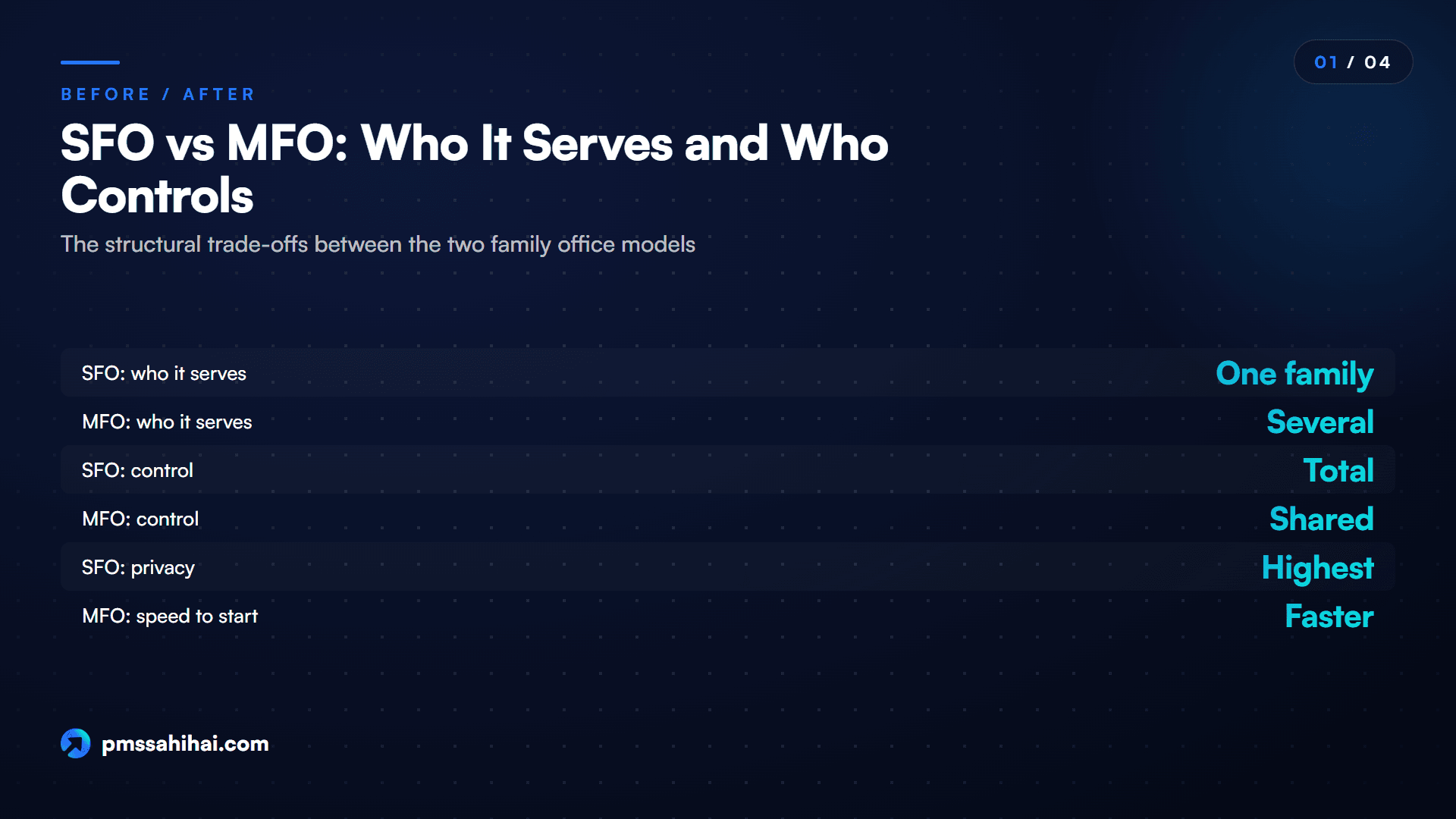
The SFO vs MFO comparison comes down to six dimensions. The table summarises them; the sections below explain the trade-offs.
| Dimension | Single family office | Multi family office |
|---|---|---|
| Who it serves | One family and its entities | Several unrelated families |
| Control | Total: the family sets strategy, hires and fires | Shared: the family directs its own mandate within the MFO's processes |
| Privacy | Highest: no outside clients | High, but data and attention are shared |
| Cost structure | High fixed cost (team, office, systems) | Fee per family: AUM-based, retainer or hybrid |
| Typical cost (Indian estimates) | About ₹2.5–5 crore a year | About 0.25%–1% of assets, or ₹25 lakh to ₹2 crore+ retainer |
| Talent | Must recruit and retain its own team | Access to a broader specialist bench |
| Speed to start | Slower: a team must be hired and systems built | Faster: the family joins an existing platform |
| Regulation in India | No dedicated framework; regulated through the entities and products it uses | No dedicated framework; the MFO's activities need SEBI licences (adviser or portfolio manager) |
What a Single Family Office Controls
A single family office is the family's own company. It decides the asset allocation, chooses which PMS and AIF managers to use, negotiates fees directly, sets its own reporting format and keeps every piece of information inside the family. For families with an operating business, the SFO often handles treasury, direct deals and promoter holdings alongside the liquid portfolio.
That control matters most when needs are unusual: large private deals, cross-border structures, philanthropy at scale, or family members who want a real say. Indian examples often cited include PremjiInvest, Catamaran Ventures and Burman Family Holdings. The cost of control is that the family becomes an employer, hiring and retaining a CIO, analysts, accountants and compliance staff.
What a Multi Family Office Shares
A multi family office spreads the same professional infrastructure across many families. A family buys access to investment research, manager due diligence, consolidated reporting across custodians, tax and estate coordination and, often, family-governance support, without building any of it.
The MFO also brings scale benefits that a mid-sized SFO cannot: negotiating power with custodians and managers, a wider view of deal flow, and specialists the family would never hire full-time. The trade-off is that your family is one client among many. Your reporting follows the MFO's templates, your mandate sits inside its processes, and the senior partner's attention is shared.
The fee model matters as much as the model itself. Industry commentators argue that an MFO should be paid only through a transparent fee charged to the client, not through commissions on products it recommends, precisely because a commission-paid MFO has an incentive that a family-owned SFO does not.
The Virtual and Hybrid Middle Ground
The two models are not the only options. A virtual family office uses outsourced specialists, coordinated remotely, instead of a physical office and permanent staff. It suits families who want family-office discipline at lower cost.
Hybrid set-ups are increasingly common. A family runs a lean SFO, perhaps a CIO and an accountant, for control and confidentiality, and buys specialist services such as tax structuring or global manager research from an MFO. Many families also start with an MFO and move to an SFO when wealth and complexity grow; nothing in the MFO relationship prevents that.
Wealth Thresholds: What the Published Estimates Say
There is no legal minimum wealth for either model in India. Every threshold you will read is an industry estimate. Here is how the most visible Indian sources compare.
| Source (date) | Single family office | Multi family office | Other |
|---|---|---|---|
| Equirus Wealth (Jul 2025) | Typically ₹100 crore+ | From ₹25–50 crore | Hybrid or SFO for large cross-border legacy businesses |
| 5paisa (undated blog) | ₹2,000 crore and above | ₹50 crore and above | SFO running cost ₹2.5–5 crore a year |
| Treelife (Jun 2026) | Viable above about ₹300 crore; cost-efficient above ₹500 crore | About ₹30–300 crore | SFO running cost ₹2.5–5 crore a year |
| ALTPORT fee guide (Jun 2026) | ₹200 crore+ (cost ₹1–3 crore+ a year) | ₹25–100 crore (cost ₹25–75 lakh a year) | Virtual office ₹10–25 crore (₹10–30 lakh a year) |
| Global rule of thumb (Wikipedia's family office entry) | Investable assets above about USD 50–100 million; cost can exceed USD 1 million a year | — | — |
Two things stand out. First, the MFO entry point is broadly agreed at ₹25–50 crore. Second, the single family office threshold ranges twentyfold, from ₹100 crore to ₹2,000 crore.
Why the Published Numbers Disagree
The disagreement is not sloppiness. The academic work on this question says that a single minimum is the wrong idea. A 2018 EDHEC paper by Bernd Scherer argued that the minimum assets for a single family office depend on the family's investment skill, its costs relative to a benchmark alternative, and its risk aversion, and that rules of thumb such as "you need 100 million" can be grossly misleading.
In practice, four things move the number:
- How lean the SFO is. A two-person office costs a fraction of a fifteen-person office with a CIO, a legal head and a direct-deals team.
- What the MFO would charge instead. A family paying 1% to an MFO reaches break-even with its own office far sooner than one paying 0.25%.
- Complexity, not just size. A ₹300 crore family with an operating business, three generations, overseas residents and private deals may need an SFO sooner than a ₹1,000 crore family holding listed equity and bonds.
- Who wrote the estimate. Several of the pages above are published by firms that sell MFO services. That does not make them wrong, but it is a reason to run the numbers yourself.
The Break-Even Arithmetic Behind Single Family Office Cost
The simplest way to cut through the thresholds is to convert single family office cost into a percentage of assets and compare it with typical multi family office fees.
Single Family Office Cost as a Share of Assets
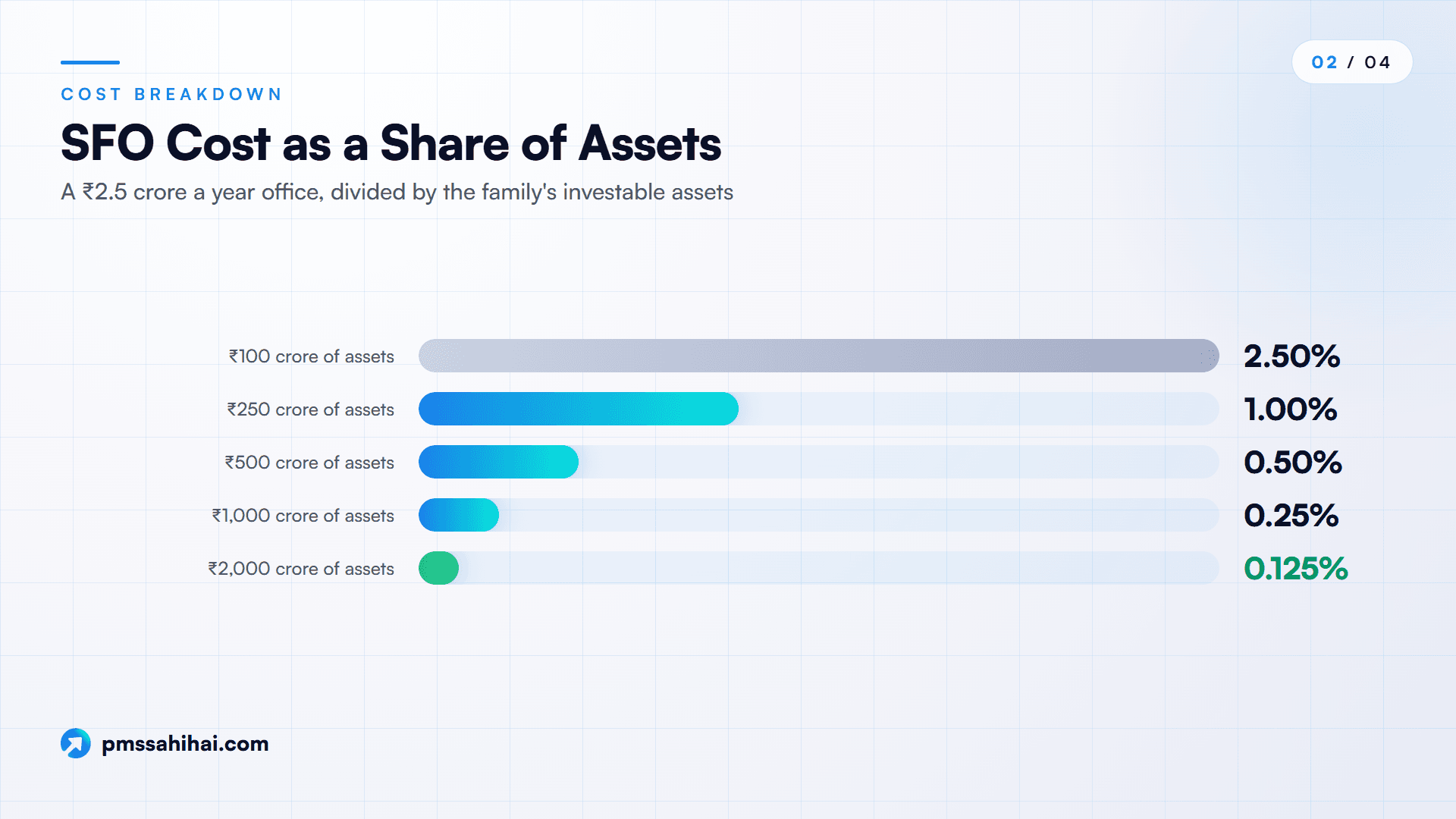
Take the commonly quoted Indian range of ₹2.5–5 crore a year to run a single family office, and divide it by the family's investable assets.
| Investable assets | SFO cost at ₹2.5 crore a year | SFO cost at ₹5 crore a year |
|---|---|---|
| ₹100 crore | 2.50% | 5.00% |
| ₹250 crore | 1.00% | 2.00% |
| ₹500 crore | 0.50% | 1.00% |
| ₹1,000 crore | 0.25% | 0.50% |
| ₹2,000 crore | 0.125% | 0.25% |
Now compare those with MFO fees of roughly 0.25%–1% of assets. A ₹2.5 crore office matches a 1% MFO fee at ₹250 crore. A ₹5 crore office matches a 0.25% fee only at ₹2,000 crore. That single calculation explains the whole spread of published thresholds: the cost crossover sits somewhere between ₹250 crore and ₹2,000 crore, depending on how expensive your office would be and how cheap your MFO alternative is.
Three caveats keep this honest. Both models still pay the underlying PMS and AIF fees, plus GST. An SFO may recover some cost by negotiating lower manager fees. And an MFO's fee may include services an SFO would buy separately, such as tax filing. Treat the table as a starting point, not a verdict.
How Multi Family Office Fees Are Structured
Indian multi family office fees generally follow one of four models, according to a June 2026 industry fee guide by ALTPORT:
- AUM-based fee: about 0.25%–1% a year, falling as assets rise. On ₹100 crore, 0.5% is ₹50 lakh a year.
- Fixed retainer: about ₹25 lakh to more than ₹2 crore a year, regardless of performance.
- Hybrid: a retainer plus a lower AUM fee of about 0.1%–0.3%, increasingly chosen by larger families.
- Performance fee: uncommon in pure family office work; more likely on specific investment mandates.
When you compare MFO proposals, ask for the fee in writing as an all-in annual rupee figure at your asset level, ask whether the MFO receives any commission or distribution income from products it recommends, and ask which SEBI registration covers the service you are buying.
Which Model Fits Which Wealth Level in India
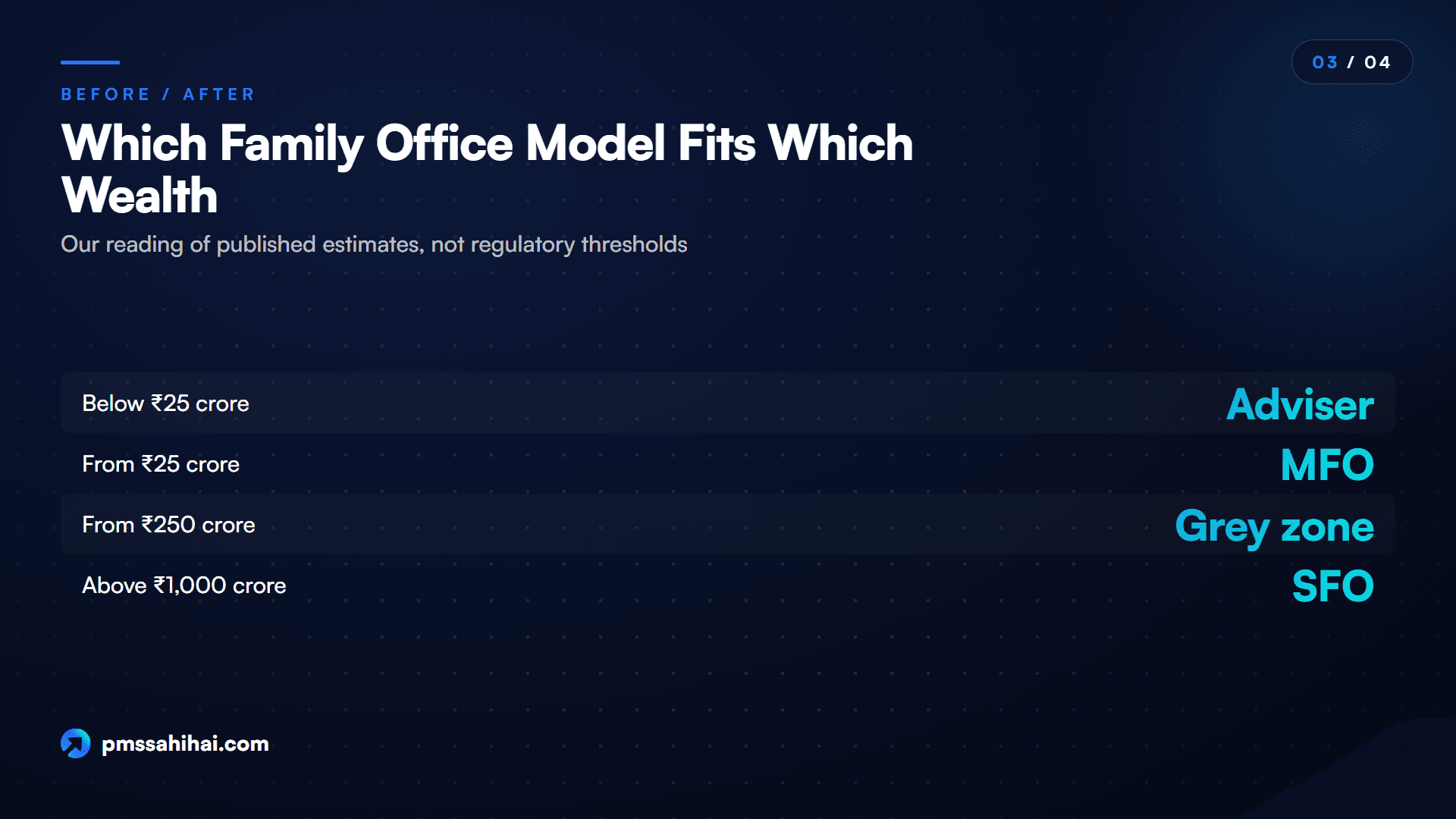
Pulling the estimates and arithmetic together gives four practical bands. These are our reading of published estimates, not regulatory thresholds, and complexity can move a family up or down a band.
Below ₹25 Crore: Advisers and Managers, Not a Family OfficeBelow about ₹25 crore, neither model is usually economic. A fee-only SEBI-registered investment adviser, a good wealth manager and a sensible mix of mutual funds, PMS (minimum ₹50 lakh per client) and perhaps an AIF (minimum ₹1 crore per investor) do most of what a family office would do. A virtual family office becomes an option toward the top of this band.
₹25–250 Crore: The Multi Family Office Sweet SpotFrom about ₹25 crore the multi family office starts to make sense, and below ₹250 crore even a lean SFO would cost more than 1% of assets a year. An MFO gives this family consolidated reporting, manager selection and succession support at a fraction of the fixed cost. The key task is choosing the right MFO: fee transparency, licences and conflicts matter more than brand.
₹250–1,000 Crore: The Grey Zone Where Complexity DecidesIn this band the arithmetic no longer settles the answer. A family with mostly listed assets and simple structures may stay with an MFO, perhaps on a negotiated hybrid fee. A family with an operating business, private deals, several branches and overseas members may justify a lean SFO, often buying specialist services from an MFO. Many families here run a hybrid.
Above ₹1,000 Crore: Where a Single Family Office Usually PaysAbove about ₹1,000 crore even a ₹5 crore office costs 0.5% of assets or less, and the value of control, privacy and direct deal access usually outweighs the cost. These families may also consider a GIFT City family investment fund for global investing, and many still use MFOs or private banks for specific services.
Regulation of Family Offices in India and GIFT City
Regulation is where most comparisons go quiet, and it is where the single family office vs multi family office difference is sharpest.
What SEBI Has Said About Family Offices
India has no statute or SEBI regulation that defines or licenses a "family office". On 3 October 2025, after a Bloomberg report that SEBI had begun discussions on bringing family offices under oversight, including disclosure of entities, assets and returns and a separate regulatory category, SEBI issued a clarification (press release 65/2025). It said the reports were "factually incorrect" and that "SEBI is not examining or pursuing this matter at present".
That does not mean family offices are unregulated. A family office is regulated through what it is and what it does: the company, LLP or trust it uses is subject to company, trust and tax law; its investments follow the rules of each product (PMS, AIF, listed securities); and its foreign investments follow FEMA.
When a Multi Family Office Needs a SEBI Licence
This is the practical heart of the regulatory difference. Two SEBI definitions do the work:
- Under the SEBI (Investment Advisers) Regulations, 2013 (amended up to 25 November 2025), an investment adviser is anyone who, for consideration, is in the business of giving investment advice to clients. The exemption list in regulation 4 contains no carve-out for advising relatives or families.
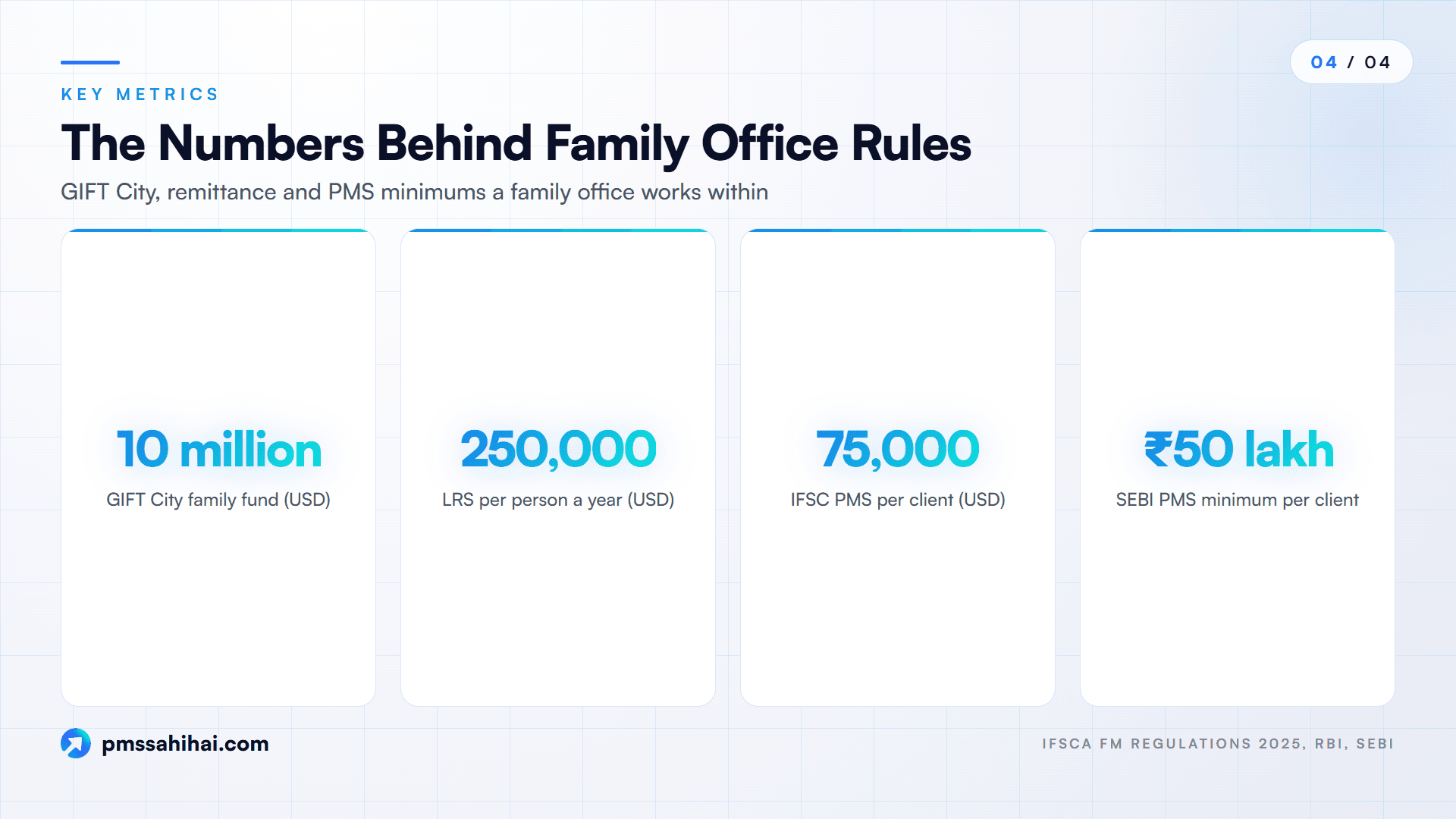
- Under the SEBI (Portfolio Managers) Regulations, a portfolio manager is a body corporate that, under a contract with a client, manages or advises on the client's portfolio. The Portfolio Managers Regulations, 2026, effective 1 April 2027, keep a ₹5 crore minimum net worth for the manager and ₹50 lakh minimum per client (accredited investors excepted); the 2020 Regulations apply until then.
A single family office that manages only its own family's money, through its own entities, is not selling advice to outside clients for a fee, so it usually falls outside both definitions. A multi family office that advises or manages money for unrelated families for a fee is squarely the kind of business these licences cover. In practice, an MFO should be able to show an investment-adviser registration, a portfolio-management registration, or both, held by itself or by the group entity that delivers the regulated part of the service.
The practical lesson: "multi family office" is a marketing label, not a licence. Before signing, check which SEBI registration the entity holds and which part of the service it covers. And if your SFO starts managing money for cousins' separate households or outside co-investors, take legal advice before it becomes an unlicensed MFO.
The IFSCA Family Investment Fund for Single Families
GIFT City has something the domestic market lacks: a vehicle designed specifically for a single family. Under the IFSCA (Fund Management) Regulations, 2025, as amended to 10 September 2026:
- A family investment fund pools money only from a single family.
- A "single family" covers lineal descendants of a common ancestor with their spouses and children, plus companies, LLPs, trusts and firms the family controls and holds a substantial economic interest in.
- The family's fund management entity registers as an Authorised FME; the usual legal-form and net-worth requirements for fund managers do not apply.
- The fund can be a company, an LLP or a contributory trust in which each beneficiary's share is fixed by the deed, not left to the trustee's discretion.
- It must reach a minimum investment of USD 10 million within three years of registration, and can be open-ended or close-ended.
- It may invest in listed and unlisted securities, debt, derivatives including commodity derivatives, units of other schemes, LLPs and even physical assets such as real estate, bullion and art, in the IFSC, India or abroad, and may borrow under its risk policy.
- Since 10 September 2026, it may be treated as a Category I, II or III AIF depending on strategy.
The funding constraint is real. Under the Liberalised Remittance Scheme, each resident individual can remit up to USD 250,000 a financial year, and RBI's FAQ states that the scheme is not available to corporates, partnership firms, HUFs or trusts. Reaching USD 10 million through individual LRS alone takes many family members or several years, which is why families often need entity routes under the overseas investment rules. Tax treatment depends on the vehicle chosen and is not settled in every respect; get FEMA and tax advice before setting one up.
Multi Family Office Services Under IFSCA Rules
The same IFSCA regulations treat MFOs differently. A Registered FME (Non-Retail) may provide portfolio management services "including for multi-family office", and regulation 81 lets an FME serve a multi family office under a portfolio management agreement, with IFSCA free to add conditions. The general IFSC portfolio-management minimum is USD 75,000 per client. In other words, GIFT City gives a single family its own self-managed vehicle but expects a multi family service to run through a registered manager: the same split between the two models that SEBI's definitions imply onshore.
Technology, Reporting and the Modern Family Office
Technology is narrowing some gaps between the two models. The most valued MFO services, according to industry practitioners, are account aggregation and consolidated reporting across custodians, chief-investment-office support for asset allocation, and better custody and execution pricing. Those are largely data services, which is why shared platforms deliver them cheaply. For a single family office, the same tools let a smaller team do more, one reason virtual and hybrid models are spreading.
Research platforms matter in both models. Whether an SFO's CIO or an MFO's research team is choosing PMS strategies or AIFs, the work starts with consistent data: returns against the right benchmark, fees, drawdowns and track record. A family that sees that data directly can question its office, whichever model it chooses.
Advantages Each Family Office Model Brings
A single family office offers:
- Full control over strategy, managers, reporting and hiring, with staff who work only for the family.
- Maximum privacy: no outside clients, no shared data.
- Cost efficiency at scale: at ₹1,000 crore and above, even a well-staffed office costs a fraction of a percent of assets.
- Direct deal capability for private companies, real estate and co-investments, plus a GIFT City vehicle built for one family.
A multi family office offers:
- Institutional expertise at shared cost, viable from about ₹25 crore.
- A broader specialist bench and bargaining power with custodians and managers.
- Speed and flexibility: joining an existing platform, with the option to graduate to an SFO later.
How PMS Sahi Hai Helps You Check What Your Family Office Picks
PMS Sahi Hai is not a family office, single or multi, and it does not run one. It is a PMS and AIF research and comparison platform. That matters for this decision because, whichever model you choose, much of what your office actually does is pick managers: which PMS strategies, which AIFs, at what fee. The platform gives the family an independent view of those choices.
- See the shortlist against its benchmark. The PMS compare page lists strategies with trailing returns beside their stated benchmark, so a family can check whether the managers its office recommends have actually beaten the index they claim to track.
- Check the AIF side too. The AIF comparison page lists funds across Category I, II and III so a ₹1 crore commitment proposed by an MFO or SFO can be weighed against peers. Our guide to the AIF minimum investment rules explains every exception.
- Ask Nyra in plain English. Nyra, the platform's AI research tool, answers questions such as how a strategy has done against its benchmark or what a fee structure means. Its published methodology scores strategies on five pillars and shows anything with under 12 months of track record as "Not Rated". A score is research, not a recommendation for your family.
- Test the conflict question. If an MFO is paid through distribution income, our breakdown of PMS direct vs regular plans shows what a distributor layer costs, and PMS vs wealth management vs RIA explains who is paid for what.
The platform has no content dedicated to family office set-up, licensing or GIFT City family investment funds; for those, use lawyers and tax advisers. Where it helps is the recurring question every family office faces: are the products in our portfolio worth what we pay for them?
Limitations and Risks of Each Family Office Model
Single family office risks:
- High fixed cost: about ₹2.5–5 crore a year by Indian estimates, regardless of returns.
- Key-person risk: losing a CIO can stall the office.
- Talent and culture: small offices struggle to recruit and keep strong investment staff.
- Governance gaps: with no outside clients, an SFO can drift into the founder's personal preferences.
- Regulatory creep: serving relatives beyond the core family or outside co-investors can trigger licence requirements.
Multi family office risks:
- Less privacy and exclusivity: your family shares attention and systems.
- Conflicts of interest: an MFO paid through product commissions has incentives that a transparent fee removes.
- Licence gaps: no dedicated framework means quality varies; protection depends on the SEBI registrations the MFO holds.
- Standardisation: your reporting and processes follow the MFO's templates.
Shared risks: neither model guarantees better returns. Fees on underlying PMS and AIF products remain, and an office that picks poor managers costs the family twice.
Choosing Your Family Office Model With Clear Eyes
The single family office vs multi family office decision is not about prestige. It is a cost-and-control trade-off you can largely calculate: advisers and managers below about ₹25 crore, a well-chosen MFO from ₹25 crore to ₹250 crore, complexity and hybrids between ₹250 crore and ₹1,000 crore, and usually an SFO above that.
Whatever you choose, check the licences, insist on a transparent fee, and keep independent visibility of the products your office selects, for instance by checking its PMS and AIF picks on PMS Sahi Hai or asking Nyra how they compare. The office manages the decisions; you still own the outcome. This article is general information, not legal, tax or investment advice; confirm current SEBI, IFSCA and FEMA rules with qualified advisers before you act.
Take the Next Step on Your Family Office Decision
Start with a clear picture of what you own and what it costs. List your investable assets by entity, add up every fee you pay today, and test the break-even table above against real proposals. Then shortlist MFOs or plan an SFO with a written fee quote and the licence details in hand.
Before your office commits to its next PMS or AIF, compare the shortlist on PMS Sahi Hai, ask Nyra to explain any fee or score you do not follow, or book a 15-minute conversation with the team. If your family is still in the UHNI transition, our guide to retail vs HNI vs UHNI investors shows how the service model changes with wealth.
PMS Sahi Hai is a distributor of Portfolio Management Services and Alternative Investment Funds, APMI-registered (Registration No. APRN08358). This article is for education only and is not investment advice, a recommendation, or an offer to buy or sell any security. Investments in securities markets are subject to market risks; read all scheme-related documents carefully. Past performance is not indicative of future results. Consult your advisor before investing.
Ishaan founded PMS Sahi Hai to make India's PMS, AIF and GIFT City markets legible to serious investors, comparing every SEBI-registered manager on the same comparative basis, with no shelf products and no commission bias.
Frequently asked
What is the main difference between a single family office and a multi family office?
A single family office serves one family only and is owned by it, giving full control and privacy at a high fixed cost. A multi family office serves several unrelated families on a shared platform, charging each a fee. The trade-off is control and confidentiality versus cost and access to a wider bench of specialists.
How much wealth do you need for a single family office in India?
There is no legal minimum. Indian estimates range from about ₹100 crore to ₹2,000 crore. With running costs of roughly ₹2.5–5 crore a year, an SFO costs 1% of assets or less only from about ₹250 crore, and 0.25%–0.5% at ₹1,000 crore. Complexity, not just size, should decide.
How much does a multi family office charge?
Industry estimates put Indian MFO fees at about 0.25%–1% of assets a year, a fixed retainer of about ₹25 lakh to over ₹2 crore, or a hybrid of a retainer plus 0.1%–0.3%. Underlying PMS and AIF fees are extra. Ask for an all-in rupee figure in writing and confirm the MFO earns no product commissions.
Are family offices regulated by SEBI?
No dedicated framework exists. On 3 October 2025 SEBI said in a statement that it is "not examining or pursuing" oversight of family offices. Family offices are regulated through the entities they use and the products they buy. An office that advises or manages money for other families for a fee needs a SEBI investment-adviser or portfolio-manager registration.
What is a family investment fund in GIFT City?
It is a self-managed fund under IFSCA's Fund Management Regulations, 2025 that pools money only from a single family. It can be a company, LLP or contributory trust, must reach USD 10 million within three years, and may invest in securities, derivatives and physical assets in India, the IFSC or abroad.
Can a family trust or HUF fund a GIFT City family investment fund under LRS?
Not through LRS. RBI's LRS FAQ states that the Liberalised Remittance Scheme, which allows resident individuals up to USD 250,000 a financial year, is not available to corporates, partnership firms, HUFs or trusts. Entities must use other routes under the overseas investment rules, so take FEMA advice first.
Can a family move from a multi family office to a single family office later?
Yes. Many families start with an MFO and build an SFO as wealth and complexity grow, sometimes keeping the MFO for specialist services. Make sure records, reporting history and manager relationships are portable, and check the exit terms in the MFO agreement.
Is a virtual family office a cheaper alternative?
It can be. A virtual family office coordinates outsourced specialists without a permanent team or physical office. Industry estimates put it at about ₹10–30 lakh a year for families with ₹10–25 crore, but quality depends heavily on who coordinates it.
Keep reading
All articles
Will vs Trust vs Nomination: Who Actually Gets Your PMS Portfolio
A nominee is not the owner. How SEBI's 2026 nomination and transmission rules, wills and trusts decide who gets your PMS portfolio.

REIT vs InvIT: Which Income Trust Fits Indian Investors in 2026?
REIT vs InvIT for Indian investors: assets, 90% payout rules, yield composition, tax on each distribution component, risks and portfolio fit.

GIFT City Investment Options for NRIs: Six IFSC Products Compared
GIFT City investment options for NRIs compared: deposits, funds, AIFs, PMS, NSE IX and insurance by minimum, tax, liquidity and fit.
Read it. Now pressure-test it.
Ask Nyra how this applies to your portfolio, or talk to our team, no pitch, no pressure.