
What Is an Accredited Investor? SEBI’s Rules and What They Unlock
SEBI's accredited investor rules after the October 2026 amendment: who qualifies, what it unlocks in AIFs and PMS, and what protection you give up.


An accredited investor is a person or entity that SEBI's rules treat as able to understand and bear the risk of products with lighter regulation. Since 15 October 2026, individuals can qualify on income, on net worth, or on Rs 5 crore of securities market exposure, and non-residents are deemed accredited. The status removes the Rs 1 crore AIF and Rs 50 lakh PMS regulatory minimums and opens co-investment schemes, angel funds and AI-only funds. The price is less regulatory oversight, and in some products no way to withdraw your consent. Parts of the new regime still depend on a SEBI circular we had not seen as of 30 October 2026.
Why the Accredited Investor Label Now Matters to HNIs
Being wealthy and being an accredited investor in India are two different things. "HNI" is a market label with no single legal test. An accredited investor is a defined legal category, written into SEBI's Alternative Investment Fund Regulations, and it changes which products you can buy and on what terms.
For years the label was a footnote. That has changed quickly. SEBI's Board memorandum counted 649 accredited investors on 29 May 2025 and 4,492 on 28 August 2026. Those investors held AIF units worth about Rs 2.31 lakh crore at par value on 31 July 2026, close to 33% of all AIF investments. A small group of investors already accounts for a third of the industry's holdings.
Three things drove the shift. Accreditation became compulsory for angel funds and co-investment schemes. SEBI created funds open only to accredited investors. And in October 2026 it widened the door with a new eligibility test and new ways to get accredited.
This guide explains the accredited investor framework, what it unlocks and what it costs. It is about the rules and whether they suit you. The step-by-step application process is a separate subject, so we cover it only in brief. Because this involves regulation and contracts, take advice from a lawyer on your own documents before relying on any concession.
How SEBI Built the Accredited Investor Framework
The idea is older than India's version of it. Regulators in many countries sort investors by their capacity to absorb loss. In the United States, Regulation D uses income of $200,000 (or $300,000 jointly) in the last two years, or net worth of $1 million excluding the primary residence. Accredited status there allows participation in private placements made without the usual public-offering disclosure.
The logic behind the SEBI accredited investor category was similar. Its February 2021 consultation paper reasoned that investors with financial capacity can hire expert managers and can absorb losses, so relatively higher-risk products may suit them. The paper noted that jurisdictions with such categories offer a regulation-light regime for these investors.
The Indian milestones run as follows:
- February 2021: SEBI consults on introducing the concept.
- 3 August 2021: The definition takes effect through amendments to the AIF and Portfolio Manager regulations, along with changes to the Investment Adviser regulations. The large value fund arrives with a Rs 70 crore ticket.
- 26 August 2021: A circular sets the modalities, including accreditation agencies.
- 21 December 2021: Exit loads for large value PMS clients become a matter for negotiation.
- 18 December 2023: SEBI eases the certificate process and lengthens validity.
- 9 September 2025: Angel funds are restricted to accredited investors under a revised framework.
- 19 November 2025: The Accredited Investors only fund is created and the large value fund ticket falls to Rs 25 crore.
- 24 September 2026: SEBI's Board approves a wider framework after a consultation that drew 486 responses from 58 respondents.
- 15 October 2026: The AIF Regulations amendment takes effect.
Older articles still quote Rs 70 crore for a large value fund. That figure has been out of date since November 2025.
The definition lives in the AIF Regulations, but its reach is wider. The PMS rules borrow the same meaning, and the concessions spread across AIFs, PMS and Specialized Investment Funds.
Who Qualifies Under the October 2026 Rules
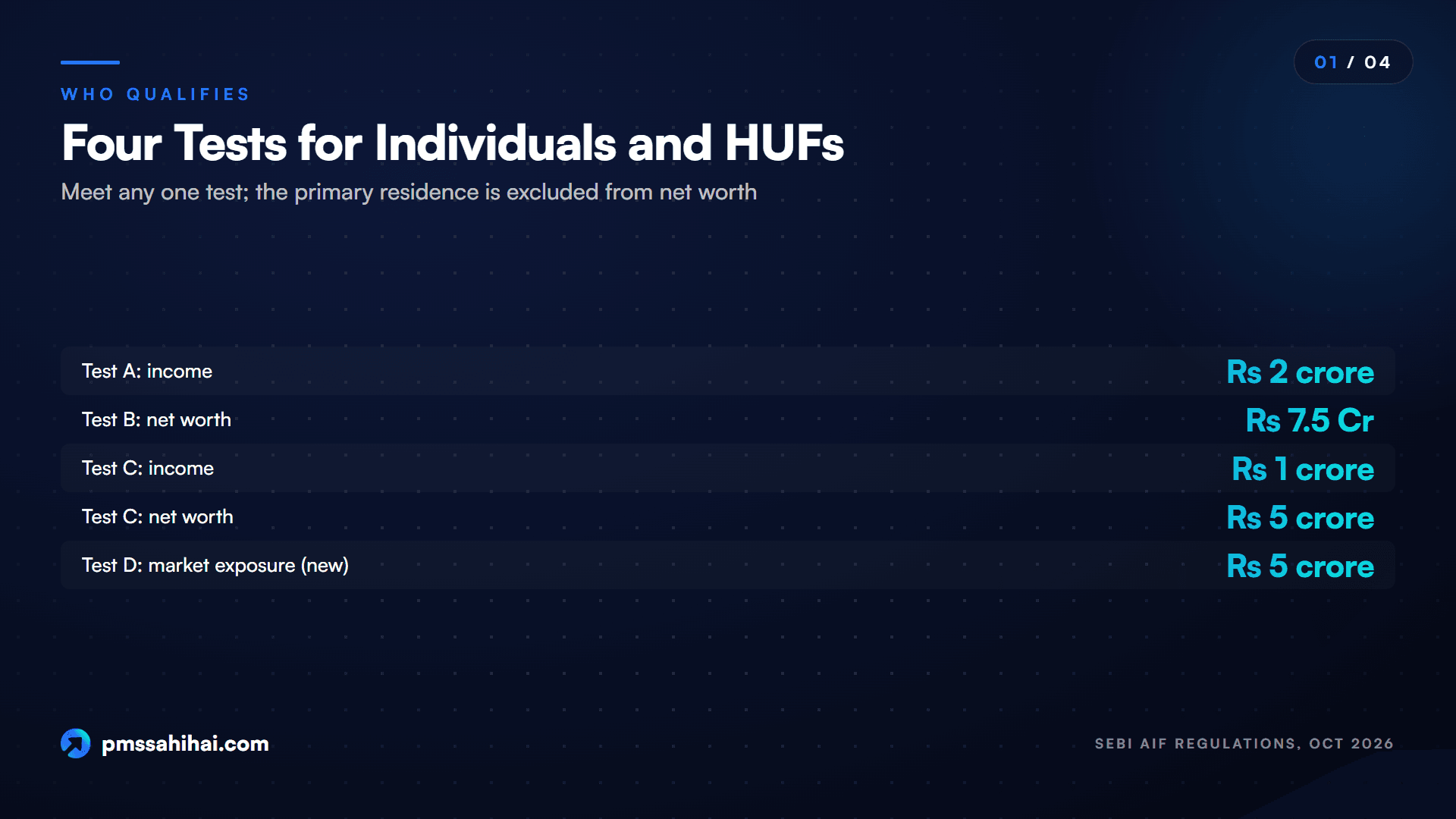
The current SEBI accredited investor definition is regulation 2(1)(ab) of the AIF Regulations. Individuals, Hindu Undivided Families, family trusts and sole proprietorships need to meet any one of four tests:
| Test | Annual income | Net worth | Of which financial assets | Market holdings |
|---|---|---|---|---|
| A | Rs 2 crore or more | Not needed | Not needed | Not needed |
| B | Not needed | Rs 7.5 crore or more | Rs 3.75 crore or more | Not needed |
| C | Rs 1 crore or more | Rs 5 crore or more | Rs 2.5 crore or more | Not needed |
| D (new) | Not needed | Not needed | Not needed | Rs 5 crore or more |
Entities have their own thresholds:
| Investor | Test |
|---|---|
| Body corporate other than an LLP | Net worth of Rs 50 crore, or securities market exposure of Rs 20 crore |
| Trust other than a family trust | Net worth of Rs 50 crore, or securities market exposure of Rs 20 crore |
| LLP | Net worth of Rs 50 crore, securities market exposure of Rs 20 crore, or each partner qualifies independently |
| Partnership firm | Each partner qualifies independently |
The Fine Print That Decides Borderline Cases
- Your home does not count. The primary residence of the individual, karta or sole proprietor is excluded from net worth.
- Joint holdings have their own rule. Where parents and children hold jointly, at least one must qualify alone. Spouses may combine income or net worth.
- Some investors are deemed accredited. These include central and state governments, government-established funds and development agencies, qualified institutional buyers, multilateral agencies and, new in 2026, persons resident outside India as defined under FEMA.
The non-resident change is broad. It replaced the earlier references to Category I foreign portfolio investors and sovereign wealth funds. It also means an NRI who is a person resident outside India no longer needs to pass an income or wealth test. It does not switch off KYC, FEMA or tax rules, and whether you count as resident depends on the FEMA definition, which is not the income-tax one.
There is one drafting detail to note. The amendment removed the words saying deemed investors "may not be required to obtain a certificate of accreditation". The deeming language remains, and SEBI's consultation had proposed no separate certificate. Until a circular settles it, ask your manager what evidence it wants.
What Is Live and What Awaits a SEBI Circular
Most articles on the accredited investor in India blur what was proposed, approved and notified. Here is the position as we read it on 30 October 2026, after checking SEBI's circular listing. We found no implementing circular on the new accreditation modalities.
| Change | Status on 30 Oct 2026 |
|---|---|
| Rs 5 crore and Rs 20 crore exposure tests | In the regulations, but "as specified by the Board"; the qualifying list is not yet specified |
| Accreditation by specified SEBI-regulated entities | In the regulations, "in a manner as may be specified" |
| Non-residents deemed accredited | In the regulations |
| LLP partner look-through | In the regulations; the Board memorandum also contemplates safeguards by circular |
| Three-year validity for both routes | Approved by the Board, to be set by circular |
| Certificate validity today | AIF Master Circular: two years, or three if you met the criteria in each of the two preceding financial years |
What will probably count as exposure? The consultation listed items such as demat equity and debt, REIT, InvIT and AIF units, mutual fund folios, futures open interest and overseas securities investments, according to Lakshmikumaran and Sridharan's review. SEBI's Board memorandum added that National Pension System holdings "may be considered" and that undeployed cash with a portfolio manager would not qualify. Treat all of this as a guide until the final list appears.
The memorandum also sets out proposed evidence: the latest income tax return or a chartered accountant's certificate for income, a CA net worth certificate no older than six months, and an eCAS or broker statement no older than six months, or a CA certificate, for exposure.
Under manager-led accreditation, a manager would assess you during onboarding. The status would be valid for three years and would extend to AIF, SIF and PMS managers in the same corporate group. A different group's manager would have to assess you afresh. The agency route, with its portable accreditation certificate, stays available. SEBI names two agencies today: CDSL Ventures and NSDL Database Management.
What Accredited Status Unlocks in AIFs and PMS
This is where the label earns its keep. The concessions fall into two groups: lower entry and access to different products.
Lower Regulatory Entry Tickets
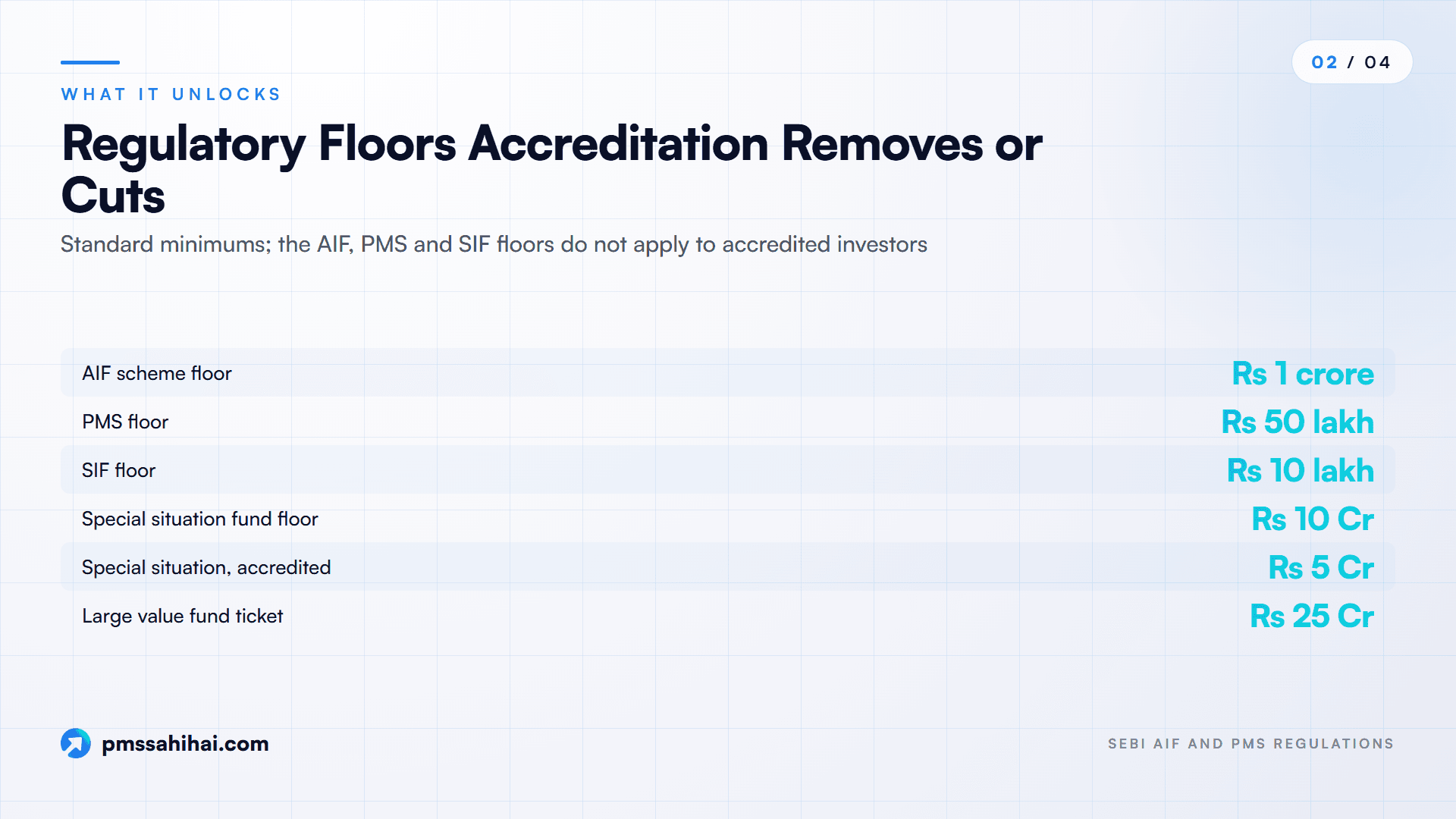
| Product | Normal minimum | For an accredited investor |
|---|---|---|
| AIF scheme | Rs 1 crore | Regulatory minimum does not apply |
| Special situation fund | Rs 10 crore | Rs 5 crore |
| PMS | Rs 50 lakh | Regulatory minimum does not apply, subject to disclosures and agreed terms |
| Specialized Investment Fund | Rs 10 lakh | Regulatory minimum does not apply |
A word of caution on "does not apply". This removes the regulatory floor. It does not oblige a manager to take a small cheque, and a manager can set its own commercial minimum. Some pages quote fixed accredited minimums, such as Rs 25 lakh for an AIF. We found no such figure in SEBI's rules.
The same PMS position continues under the Portfolio Managers Regulations 2026, which replace the 2020 Regulations from 1 April 2027.
Products Only an Accredited Investor Can Buy
- Co-investment schemes. Regulation 17A lets Category I and II AIFs run a separate scheme for one investee company, and only their accredited investors may invest.
- Angel funds. These may raise money only from accredited investors. Funds registered on or before 10 September 2025 have until 31 March 2027 to comply.
- AI only fund schemes. Every investor other than the manager, sponsor and their staff must be accredited. A scheme can launch on filing its placement memorandum, without the merchant banker route and SEBI comments, and may extend its tenure by up to five years with two-thirds approval by value. The usual pari passu requirement does not apply, and the manager carries out the duties otherwise held by a trustee.
- Large value fund schemes. A large value fund is an AI only fund in which each investor commits at least Rs 25 crore. Category I and II schemes may put up to 50% of investable funds in one company, against 25% normally. Category III schemes may go to 20%, against 10%.
The Rs 10 Crore Tier in PMS
A large value accredited investor is one who signs a PMS agreement with a minimum investment of Rs 10 crore. Three things change:
- The manager may invest up to 100% of assets under management in unlisted securities, against an ordinary 25% limit under non-discretionary PMS.
- The prescribed content of the client agreement does not apply, so the contract is more freely negotiated.
- The exit load is set by bilateral negotiation rather than the standard cap.
What does not change is just as useful to know. Accredited status gives you no separate tax treatment, because tax follows the product and your residence. It gives you no assurance of returns, and it is not a SEBI endorsement of your judgment. For the tax effects of any structure, consult a tax adviser.
How Accreditation Makes Investing Simpler for HNIs
Set the jargon aside and the practical benefits are fairly plain.
- You can spread capital. Without the Rs 1 crore floor, Rs 2 crore need not mean two AIFs. Subject to each manager's minimum, it can mean several. That is the most useful effect for investors near the threshold.
- You can follow a specific deal. A co-investment scheme lets you add to one company your AIF already backs, rather than asking the fund to size up.
- Contracts can fit you. Large value clients can negotiate terms that standard documents fix.
- Your paperwork can travel. An agency certificate is usable across products during its validity, which saves repeat assessments.
- Status does not lapse mid-investment. SEBI's December 2025 circular says that an investor who is accredited at onboarding into an AIF scheme is reckoned as accredited through the life of that scheme, even if the status is later lost.
How the Digital Market Is Reshaping Accreditation
The October 2026 test is as much about data as about wealth. SEBI describes the exposure route as digitally verifiable. The idea is that a depository's eCAS or a broker's statement can establish eligibility without a manually prepared certificate. Agencies that are also KYC Registration Agencies can already draw on KYC records for accreditation.
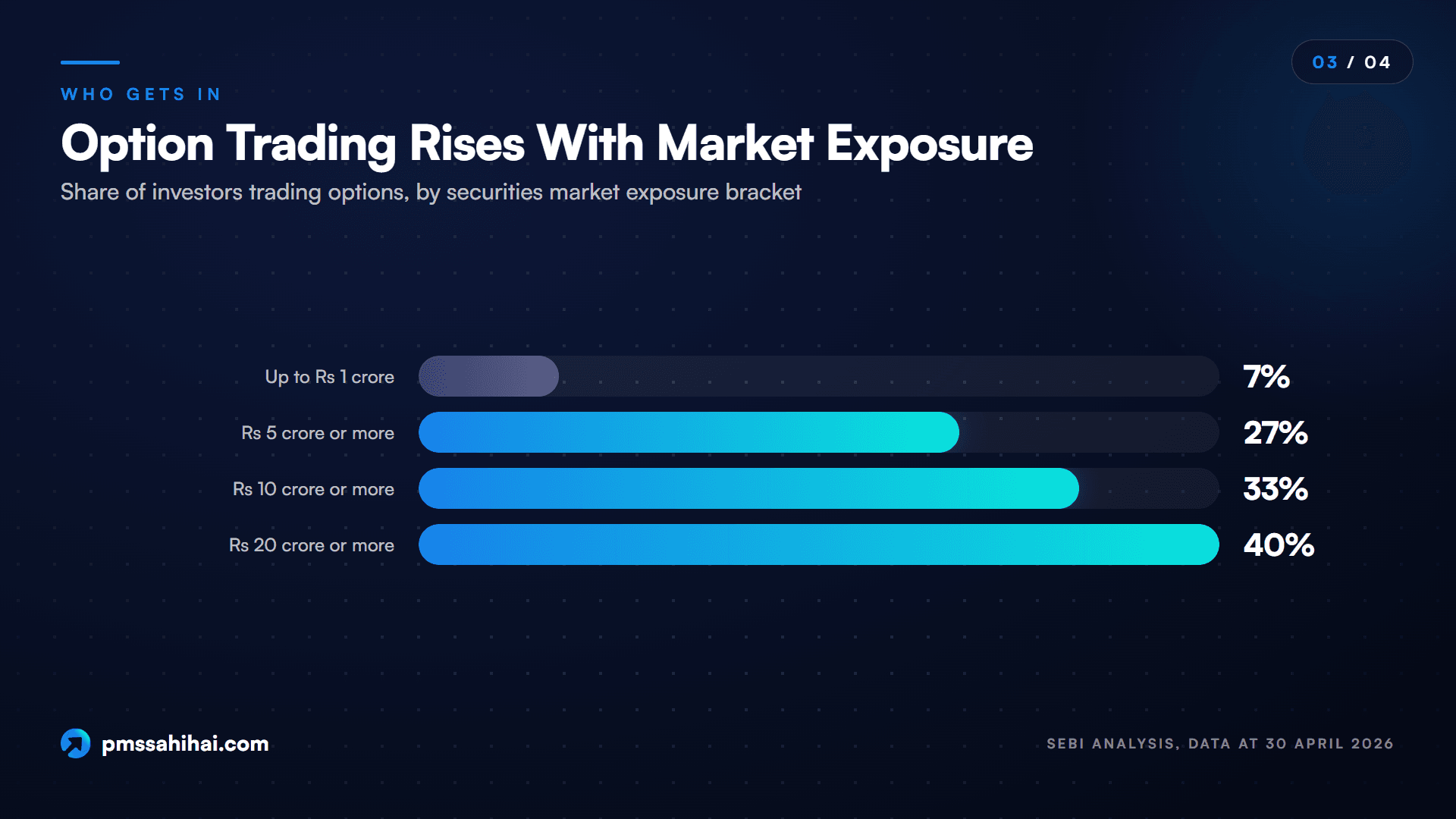
That choice shapes who gets in. SEBI's analysis of exchange and depository data at 30 April 2026 is the most revealing number set on this topic:
| Holdings bracket | Individuals (approx.) | Of which option traders |
|---|---|---|
| Up to Rs 1 crore | 12.50 crore | 7% |
| Rs 5 crore or more | 2.90 lakh | 27% |
| Rs 10 crore or more | 1.50 lakh | 33% |
| Rs 20 crore or more | 82,000 | 40% |
SEBI used option trading as a sign of willingness to take risk. It estimated about 3.7 lakh eligible investors at the proposed thresholds, against an AIF investor base of about 96,000. So the potential pool is roughly 80 times today's accredited count of 4,492, though many of those investors may never apply. The August press note, as reported by Business Today, used rounder figures of about 4 lakh and about 1 lakh.
Three HNI Profiles Tested Against the Rules
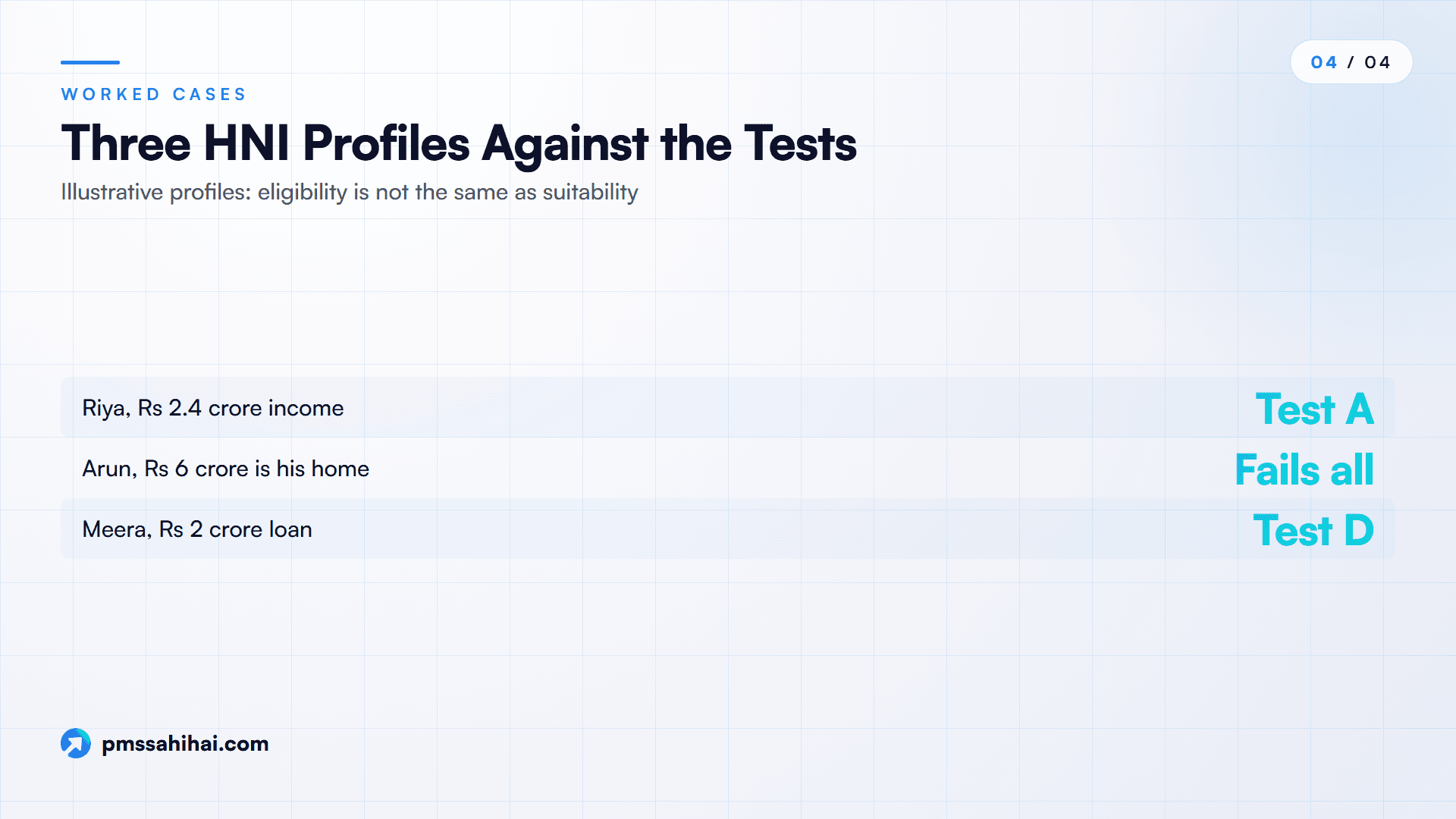
These profiles are hypothetical illustrations, not advice. They show how a test can give an answer you may not expect.
The Salaried Executive With Little Invested
Riya earns Rs 2.4 crore a year and holds Rs 80 lakh in mutual funds. She qualifies on Test A through income alone. The rules allow her to enter an AIF for less than Rs 1 crore. Her portfolio suggests she should think hard before doing so, because eligibility says nothing about how much illiquidity she can carry.
The Retired Owner Whose Wealth Sits in His Home
Arun's net worth is Rs 9 crore, of which Rs 6 crore is his primary residence, and his income is Rs 60 lakh. Excluding the home leaves Rs 3 crore, so he fails Tests B and C. He fails A on income and D on holdings. Many people in his position would assume they qualify, and he does not.
The Portfolio Investor With a Loan Against Shares
Meera holds Rs 5.5 crore of listed shares and funds, with a Rs 2 crore loan against them, and her income is Rs 70 lakh. Her net worth excluding her home is Rs 3.5 crore, so B and C fail. She passes Test D on gross holdings, subject to the final list of what counts. SEBI considered commenters' request to adjust for borrowings and pledges and declined, because liabilities cannot be established from a statement. On paper she is accredited with over a third of her book borrowed against. Whether pledged holdings count in practice should become clear in the circular.
Meera's case is the one to remember. The test measures market holdings, not capacity to absorb a loss.
How PMS Sahi Hai Helps You Test What Accreditation Unlocks
Accreditation tells you which products you may buy. It does not tell you whether a given one deserves your money. That second question is where PMS Sahi Hai fits, once you are clear on what the rules allow.
- Put an unlocked product in context. The AIF comparison page lists AIFs across Category I, II and III with strategy, vintage, AUM, one-year return, lock-in and a Nyra score. If accreditation lets you take a smaller ticket, this is a way to see what else competes for that money.
- Line up routes side by side. The compare directory covers PMS, AIF and GIFT City strategies and lets you shortlist up to four, which helps when one idea is offered through more than one structure.
- Ask in plain English. Nyra, the platform's AI research tool, can take questions such as which AIF category fits your capital and horizon. Its published methodology rates strategies on five pillars and marks anything with under 12 months of track record as "Not Rated". That matters here, because a newly launched AI only fund may have little history to judge.
- Read the background first. Our guides explain how AIFs work, who can go below Rs 50 lakh in a PMS, how HNI labels differ and where PMS, AIF, SIF and mutual funds differ.
Be clear about the limits. PMS Sahi Hai does not issue or verify accreditation certificates; a SEBI-recognised agency does that today. The comparison tables do not show the terms a manager offers accredited clients, so confirm those in the placement memorandum or client agreement. Nyra describes itself as an analytical tool, not a SEBI-registered investment adviser, so treat its output as a starting point for your own diligence.
What You Give Up by Accepting Accredited Status
Competing articles tend to skip this section, yet it is the one that matters most. Accreditation is a trade, and SEBI's own undertaking says so.
- You acknowledge lighter oversight. Before availing benefits, you must submit an undertaking that you consent, have the knowledge and means to understand the product, can bear the financial risk, and are aware that these investments may not be subject to the same regulatory oversight.
- Exit from the status is not always possible. You may withdraw consent generally. If you took a lower ticket, you must then top up to the normal minimum within the time in your agreement. In pooled products launched only for accredited investors, where concessions have been availed, you cannot withdraw at all.
- Fund protections thin out. In an AI only fund, SEBI does not comment on the placement memorandum before launch, the manager performs the trustee's duties and investors may hold unequal rights. Large value funds are also exempt from the standard placement memorandum template and its annual audit. You and your lawyer become the main check.
- Concentration and illiquidity rise. A 50% single-company limit or a 100% unlisted PMS is a permitted risk, not a recommended one. Tenure can also stretch by up to five years with two-thirds approval by value, so a minority can be carried along.
- The certificate is not a safety stamp. Agencies assess only KYC and financial information. Each certificate must say that the assessment does not relieve intermediaries of due diligence at onboarding.
- A new conflict of interest appears. SEBI's memorandum accepts that manager-led accreditation "could create a potential conflict of interest", since the assessor also wants your money. Proposed safeguards include a written policy separating accreditation from business development, retained records and annual independent certification. They are not yet final.
- Thresholds are not suitability. Income tests catch high earners with thin portfolios, and the exposure test ignores debt. SEBI itself warned of a risk of over-inclusion and of retailising these products.
Should You Become Accredited: A Practical Verdict
Accredited investor status is worth having when you can name the investment it enables. Ask three questions.
- Is there a specific product? A co-investment, an angel fund, an AI only fund or a smaller AIF ticket is a real reason. "It sounds prestigious" is not.
- Would you still invest if the product failed? Size any position as money you can leave locked up, and possibly lose, without disturbing your plans.
- Can you read the contract, or pay someone who can? Concessions move protection from the regulator to your agreement. If you cannot assess the terms, the lower ticket is not a bargain.
If your answers are yes, the status is a useful key, and the October 2026 changes should make it easier to obtain once the circular lands. If your wealth is largely in property or you hold a leveraged book, consider staying with products designed for broader investors. Either way, the next step is to compare the actual funds rather than the label, and the comparison tools at PMS Sahi Hai and Nyra can help with that part.
Take the Next Step With Your Accredited Investor Decision
Accreditation answers one question: which doors can open for you. It does not tell you which door to walk through. Before you apply, list the products you would actually use, read their concessions, and take legal advice on any agreement that departs from standard terms. Then compare the options on evidence. Compare PMS and AIF strategies on PMS Sahi Hai, ask Nyra to explain a score or a category, or book a conversation with the team, so that your accredited investor status serves a plan instead of becoming one. This article is general information, not investment, legal or tax advice.
PMS Sahi Hai is a distributor of Portfolio Management Services and Alternative Investment Funds, APMI-registered (Registration No. APRN08358). This article is for education only and is not investment advice, a recommendation, or an offer to buy or sell any security. Investments in securities markets are subject to market risks; read all scheme-related documents carefully. Past performance is not indicative of future results. Consult your advisor before investing.
Ishaan founded PMS Sahi Hai to make India's PMS, AIF and GIFT City markets legible to serious investors, comparing every SEBI-registered manager on the same comparative basis, with no shelf products and no commission bias.
Frequently asked
What is an accredited investor in India?
An accredited investor is a person or entity meeting financial tests in regulation 2(1)(ab) of SEBI's AIF Regulations, and either holding a certificate from an accreditation agency or, once the modalities are specified, accredited by a specified SEBI-regulated entity. Some investors, including non-residents, are deemed accredited. The status gives access to lower minimums and products with lighter regulation.
Is an accredited investor the same as an HNI?
No. HNI is a market term with no single legal definition, while accredited investor is a defined category with tests set by SEBI. Many HNIs qualify, but not all do. An investor with wealth mostly in a primary residence may fail, while a high earner with few investments can pass on income alone, without being wealthy in the usual sense.
Does accreditation remove the Rs 1 crore AIF minimum?
Yes, at the regulatory level. Regulation 10(c) says the Rs 1 crore minimum does not apply to an accredited investor, and the PMS rules treat the Rs 50 lakh minimum similarly. Managers can still set their own minimum, so ask each one. Special situation funds are different, since the minimum falls from Rs 10 crore to Rs 5 crore rather than disappearing.
Are NRIs automatically accredited investors now?
Persons resident outside India, as defined under FEMA, have been deemed accredited since 15 October 2026. Many NRIs will fall in that definition, but residence depends on the facts, and the test differs from the income-tax one. KYC, FEMA and tax rules still apply. Ask your manager what evidence it needs, since we had not seen SEBI's implementing circular on 30 October 2026.
What is the Rs 5 crore securities market exposure test?
It is a new eligibility route for individuals, HUFs, family trusts and sole proprietorships, in the AIF Regulations from 15 October 2026. Holdings of at least Rs 5 crore in specified securities qualify, regardless of income or net worth. Bodies corporate, LLPs and non-family trusts need Rs 20 crore. SEBI still has to specify what counts, so confirm before relying on it.
Can a PMS or AIF manager accredit me directly?
The amended regulations allow accreditation by a specified SEBI-regulated entity, and the Board approved manager-led accreditation as an optional route for AIF managers, AMCs offering SIFs and portfolio managers. The manner is to be specified by SEBI, and we had not seen that circular on 30 October 2026. Until it appears, plan on using the accreditation agency route.
What happens if I stop meeting the accredited investor criteria?
Your client agreement must set out the consequences of becoming ineligible during its tenure, so read that clause. For AIF schemes, SEBI's December 2025 circular says an investor accredited at onboarding is reckoned as accredited through the scheme's life, even if the status later lapses. New investments would need valid status at that time.
Keep reading
All articles
Trade-to-Trade Segment: Why NSE and BSE Move Stocks Into T2T
What the trade-to-trade (T2T) segment is, NSE's criteria for moving stocks there, ASM/GSM stages, compulsory delivery and what it means for a PMS.

Selection Bias in Investing: Who Chose the Data You Are Looking At?
Selection bias in investing: how voluntary databases, incubated funds, peer groups and model portfolios inflate returns, and how to correct for it.
Downside Deviation in Investing: MAR, Formula and Worked Example
What downside deviation measures, how to pick a minimum acceptable return, the formula, a two-fund example and how it differs from standard deviation.
Read it. Now pressure-test it.
Ask Nyra how this applies to your portfolio, or talk to our team, no pitch, no pressure.