
Trade-to-Trade Segment: Why NSE and BSE Move Stocks Into T2T
What the trade-to-trade (T2T) segment is, NSE's criteria for moving stocks there, ASM/GSM stages, compulsory delivery and what it means for a PMS.

The trade-to-trade segment is where Indian exchanges put stocks that need closer watching. Every buy must be paid for in full and every sell must be delivered, and nothing is netted off. On NSE these stocks trade in the BE series (ST for SME stocks); on BSE they sit in the T group. A stock lands there through NSE's fortnightly and quarterly reviews, which look at valuation, price swings and size, through the higher stages of the ASM and GSM surveillance frameworks, or for its first 10 days after a small IPO. For a small cap PMS investor, a T2T flag on a holding means slower and pricier exits and sometimes a cash deposit on new buys. It does not, on its own, mean the company is bad.
Why the Trade-to-Trade Segment Matters to Investors
Most investors meet the trade-to-trade segment by accident. A broker app greys out the intraday button. A stock symbol suddenly carries a "BE" tag. Or a PMS statement shows a small cap holding that has been sitting at its lower price limit for days. Each time, the same question comes up: what changed, and should I worry?
The short answer is that an exchange has moved the stock into a stricter way of settling trades. The segment exists to slow down speculation in shares that are small, volatile, expensive relative to earnings, or traded by a narrow group of accounts. It is a surveillance tool, not a verdict on the company. But it changes how the stock trades, and anyone holding it should understand the mechanics.
This guide covers what T2T settlement is, the published criteria NSE uses to shift stocks there, the surveillance frameworks that push stocks into it, the IPO rule, how compulsory delivery and close-outs work, and what all of this means for a portfolio management service (PMS) that owns small and micro cap stocks. The related ideas of buy-today-sell-tomorrow (BTST) trades and the T+1 settlement cycle get only a brief mention here; they deserve their own explainers.
What the Trade-to-Trade Segment Actually Is
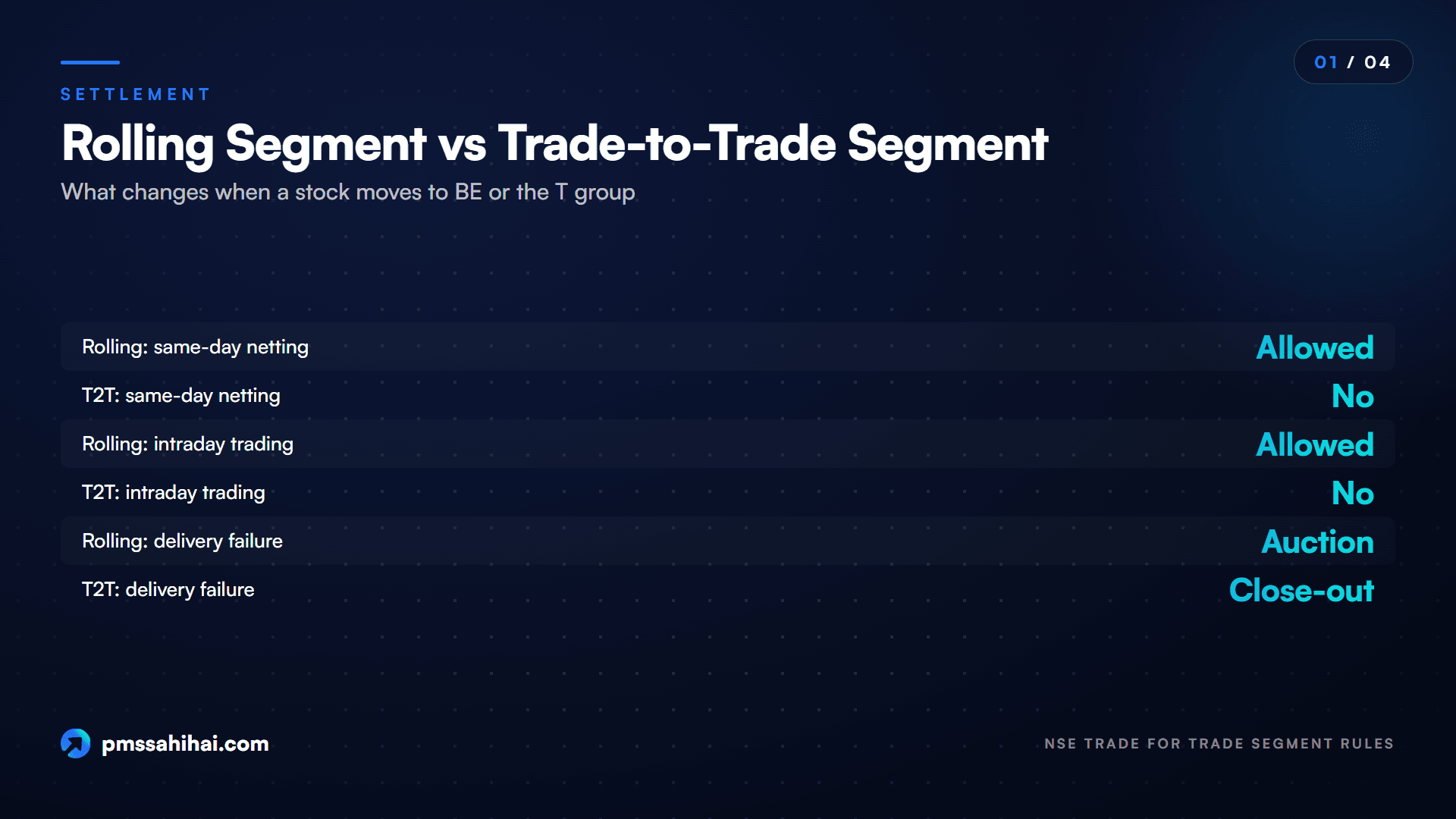
In the normal equity market, called the rolling segment, a broker's buys and sells in a stock on the same day are netted against each other. If you buy 100 shares in the morning and sell 100 in the afternoon, nothing changes hands at settlement; you simply receive or pay the price difference. That netting is what makes intraday trading possible.
The trade-to-trade segment switches netting off. NSE's description of the trade for trade segment is plain: scrips in this segment trade under the BE series, settlement "is done on a trade for trade basis and no netting off is allowed". Every purchase becomes an obligation to pay in full and receive shares. Every sale becomes an obligation to deliver shares. The two are never offset.
Gross Settlement and No Netting Off
The practical effect is compulsory delivery on both sides of every trade:
- Buyers must pay the full value and take the shares into their demat account. There is no intraday square-off.
- Sellers must already hold the shares, or must deliver them by the settlement deadline. A sale against shares you have not yet received is a delivery failure waiting to happen.
- Each trade stands alone. A buy and a sell of the same stock on the same day are two separate settlement obligations, not one net figure.
NSE's surveillance documents call this "gross" settlement, and it is the same idea. For an ordinary long-term investor who buys and holds, little changes except the price band and liquidity. For a trader whose strategy depends on same-day reversal, the segment shuts the door.
How T2T Differs From the Rolling Segment
| Feature | Rolling segment (NSE EQ series) | Trade-to-trade segment (NSE BE series) |
|---|---|---|
| Netting of same-day buys and sells | Allowed | Not allowed |
| Intraday trading | Allowed | Not possible; every buy is delivery |
| Settlement | T+1 rolling, netted | T+1, trade by trade |
| Delivery failure | Buy-in auction, then close-out if needed | Direct close-out at a penal price |
| Typical price band | Depends on the stock | 5% or lower for surveillance cases |
| SME equivalent | SM series | ST series |
| BSE equivalent | Groups such as A, B or X | T group (and XT for some scrips) |
The T group on BSE is the counterpart of NSE's BE series. BSE classifies equities into groups such as A, B, T and Z, with T reserved for securities settled trade-to-trade as a surveillance step. On NSE's SME platform, the T2T series is ST and the rolling series is SM.
How NSE Picks Stocks for Trade for Trade
The criteria for shifting scrips to and from trade for trade are, in the words of NSE's periodic review page, "decided jointly by the Stock Exchanges in consultation with SEBI and reviewed periodically". Two reviews run in parallel: a fortnightly review that identifies new candidates, and a quarterly review that moves stocks both in and out.
The Fortnightly Review: Valuation, Price and Size
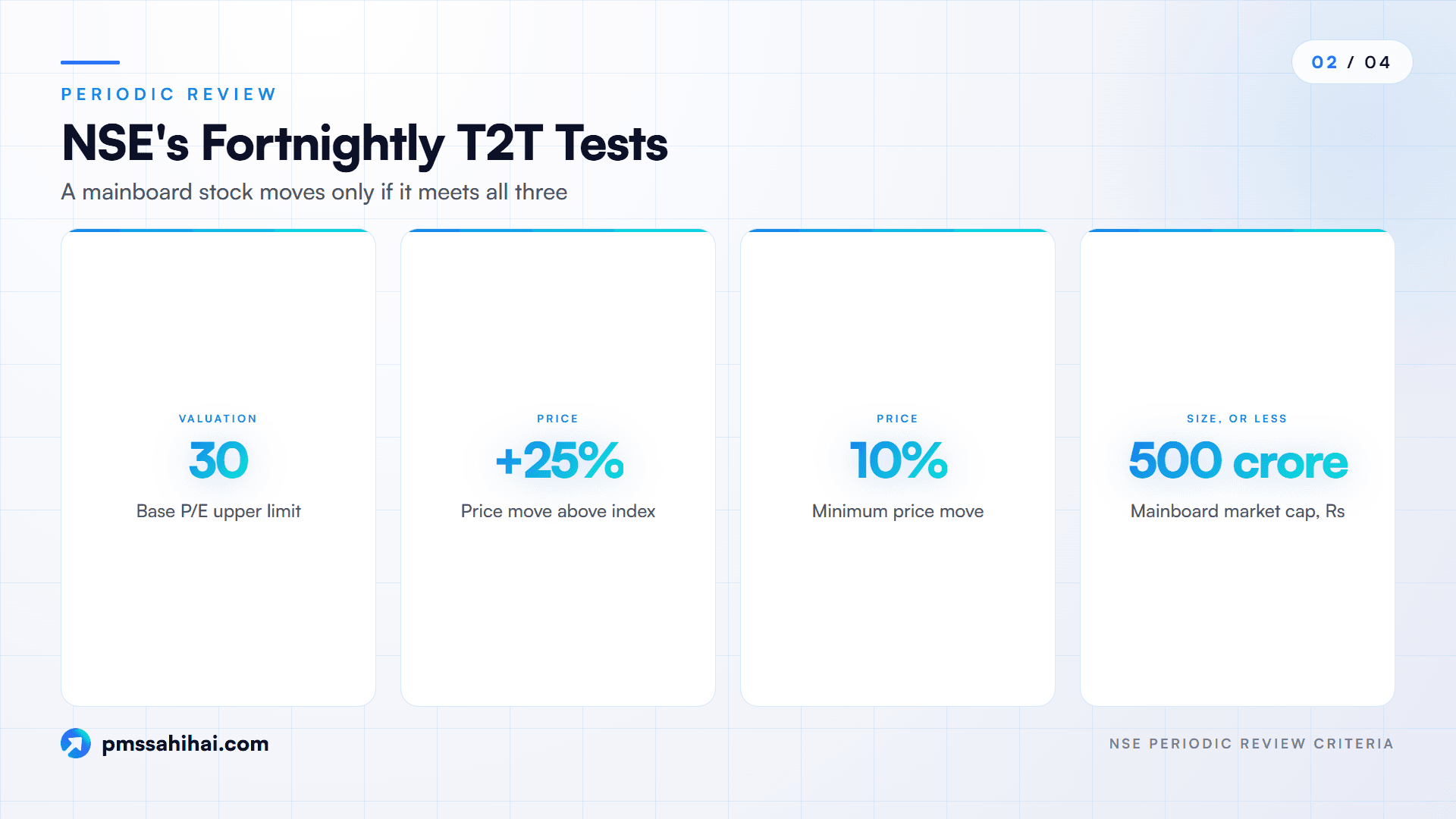
A mainboard stock moves to T2T in the fortnightly review only if it meets all three tests on the relevant date:
- Valuation. Its price-earnings multiple is zero or negative, or at least an upper limit (subject to a minimum of 25). The upper limit is 30 when the Nifty 50 P/E is between 15 and 20; if the Nifty 50 P/E is outside that range, the difference is added to or subtracted from 30.
- Price variation. Its fortnightly price move is at least the move in its sectoral index or the Nifty 500, plus 25%, subject to a minimum of 10%.
- Size. Its market capitalisation is Rs 500 crore or less for mainboard stocks, or Rs 100 crore or less for SME stocks.
Put together, the fortnightly screen looks for small companies that are loss-making or richly valued and whose price is running well ahead of the market. That combination is what pump-and-dump schemes tend to leave behind.
Some securities are kept out of the fortnightly review altogether: those with dynamic price bands (typically stocks with derivatives), newly listed IPO shares in their first 10 trading days, and stocks that have just been moved out of T2T in the quarterly review.
The Quarterly Review: Four Routes In and Two Routes Out
The quarterly review is broader. A stock is moved to trade for trade if it meets any one of four criteria:
| Criterion | What it catches |
|---|---|
| A | P/E zero or negative, or at the upper limit, plus a price move of 25% above the index over two fortnights, plus volatility more than three times that of the Nifty 50 over six fortnights |
| B | Positive P/E below the limit, but a price move of 50% above the index over two fortnights and the same volatility test |
| C | For smaller companies: average daily volume up more than 200% (plus the Nifty 500 average change), top 10 clients by PAN making up over 25% of trading, and the 25% price move |
| D | Fewer than 500 non-promoter shareholders (100 for SME stocks) |
The quarterly review also has a way out. A stock that would otherwise qualify is dropped if its market capitalisation is above Rs 500 crore and institutional holding exceeds 20%, or if the company has paid a dividend (or issued bonus shares without a dividend) in at least two of the last three years. Stocks moving back to the rolling segment start with a 5% price band until the next review of price bands.
Two practical takeaways follow. First, the rules are mechanical, so a stock can enter T2T simply because it rallied hard while still small. Second, getting out takes time: a stock needs to stop meeting the criteria at a quarterly review, and then it still trades in a narrow band for a while.
Surveillance Frameworks That End in Trade for Trade
The periodic review is not the only route into gross settlement. Two exchange surveillance frameworks, applied jointly by SEBI and the exchanges, push stocks there at their higher stages.
Long-Term ASM Stage IV
The Additional Surveillance Measure (ASM) framework came into force on 26 March 2018, according to NSE's ASM FAQ of August 2026. It shortlists stocks using market data: high-low and close-to-close price variation, the share of trading done by the top 25 clients, market capitalisation, volume variation, delivery percentage, the number of unique PANs trading, and P/E.
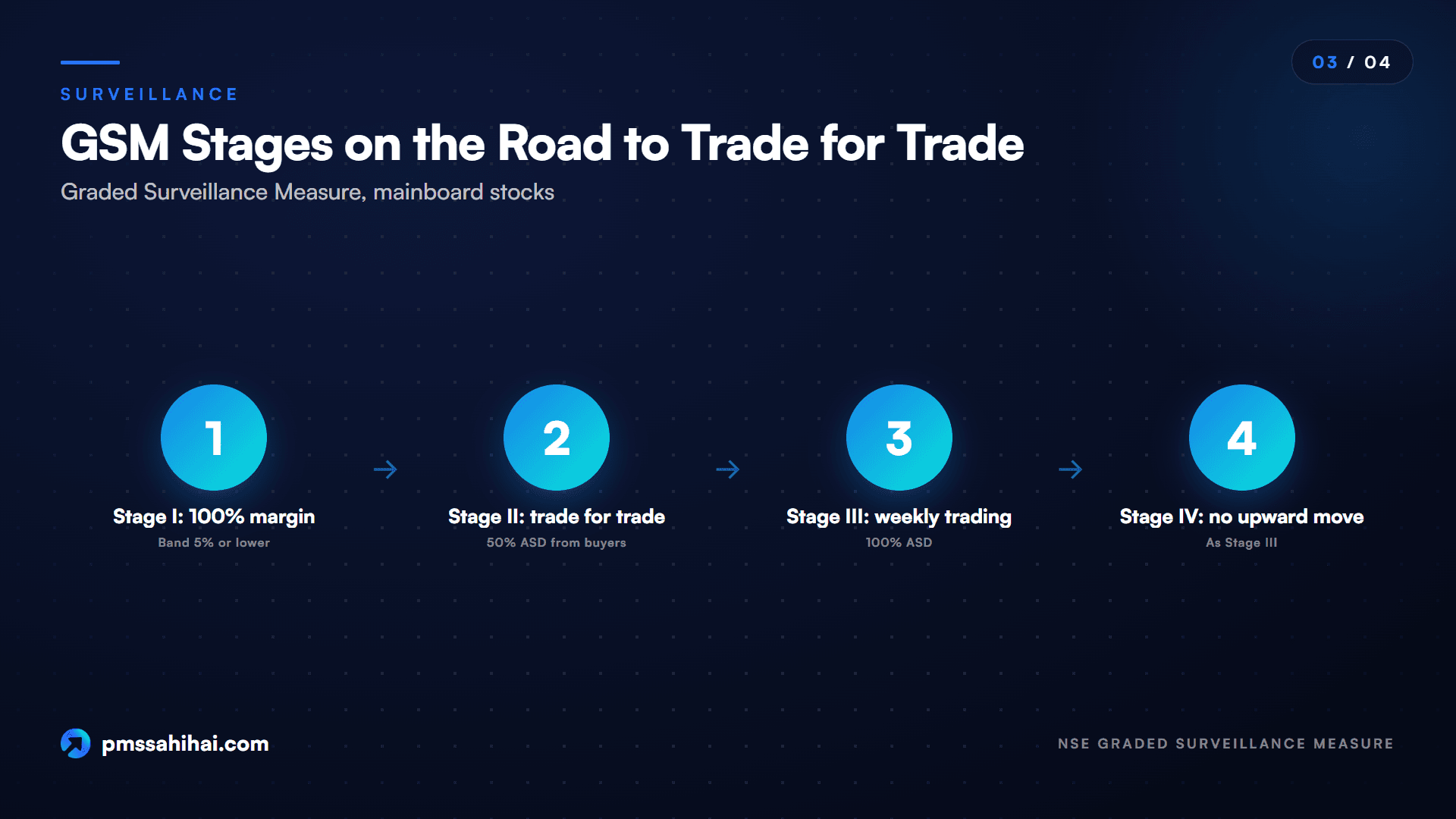
Long-term ASM moves a stock up through four stages. Stage I brings a 100% margin. Stages II and III tighten the price band. Stage IV is where trade for trade arrives: NSE's FAQ states that settlement "shall be on Gross basis with 100% margin for all clients and 5% price band". One criterion goes further. Stocks that have run up 200% or more in a year while being heavily concentrated among a few clients are placed directly in Stage IV for at least 90 calendar days.
Stocks already in trade for trade, or already under GSM, are excluded from ASM shortlisting. The frameworks are layered, not stacked twice. NSE also says plainly that shortlisting under ASM "should not be construed as an adverse action against the concerned company".
GSM Stages II to IV and the Surveillance Deposit
The Graded Surveillance Measure (GSM) framework started with an NSE circular of 23 February 2017. NSE's GSM page says it targets securities with "price not commensurate with financial health and fundamentals". The mainboard screen looks for companies with net worth of Rs 10 crore or less, net fixed assets of Rs 25 crore or less and a P/E above twice that of the Nifty 500 (or negative), or with full market capitalisation under Rs 25 crore and a stretched P/E or price-to-book.
| GSM stage | Surveillance action |
|---|---|
| I | 100% margin and a price band of 5% or lower |
| II | Trade for trade, band of 5% or lower, and an Additional Surveillance Deposit (ASD) of 50% of trade value from buyers |
| III | Trade for trade, trading only once a week (Monday or the first trading day), and ASD of 100% |
| IV | As Stage III, with no upward price movement allowed |
The ASD is paid in cash and retained until further notice. That is a real cost for anyone buying a GSM Stage II to IV stock, since the deposit locks up capital on top of the purchase price.
GSM is reviewed quarterly. A joint SEBI-exchange meeting on 15 May 2026, announced in NSE circular NSE/SURV/74254, narrowed its exclusions from the 19 June 2026 review onward. Index membership now protects only Nifty 500 or BSE 500 constituents, and some old carve-outs (for example, for companies with three straight years of dividends) were removed. Stocks with derivatives and IPOs listed within the past year remain outside GSM.
IPOs and Re-Listed Shares Start in Trade for Trade
Not every stock in the BE series is under suspicion. A SEBI circular of 20 January 2012 set trade controls for the first days after listing, citing "high volatility and price movement observed on first day of trading". For an IPO with an issue size of up to Rs 250 crore, trading takes place in the trade-for-trade segment "for first 10 days from commencement of trading", with a 5% band around the discovered price on day one. Larger issues get a 20% first-day band and are not routed through T2T by that circular. Re-listed shares also trade in T2T for their first 10 days.
NSE then issues a routine circular moving the stock back. In September 2026, for example, NSE announced that Jindal Supreme (India) Ltd, a recent IPO, would move from the trade-for-trade segment (series BE) to the rolling segment (series EQ) from 8 October 2026. SME listings follow the same pattern, moving from series ST to SM. If you see a fresh listing in BE, this is usually why, and it is temporary by design.
Compulsory Delivery, Close-Out and the BTST Trap
Because the trade-to-trade segment has no netting, a sale has to be backed by shares that will actually be delivered. India settles equity trades on a T+1 basis, and NSE Clearing's settlement cycle uses a separate settlement type for these trades: "Trade for trade Surveillance (Z)".
What happens when delivery fails is the part most retail explainers get wrong. In the normal segment, NSE Clearing runs a buy-in auction on T+1 to source missing shares. For trade-for-trade surveillance deals there is no auction. NSE's rules on shortages handling say such shortages are "directly closed-out" at the highest price across exchanges from the trade day to T day, or 20% above the settlement price on T day, whichever is higher. A seller who fails to deliver pays that close-out price, not the market price. In a thinly traded stock that has been moving sharply, it can be a painful number.
That is why the familiar BTST shortcut is dangerous here. If you buy T2T shares today and try to sell them tomorrow before they have reached your demat account, you are selling shares you cannot yet deliver. Many brokers block such orders, and Zerodha, for example, notes that a T2T stock bought today can be sold only on the next trading day. BTST in T2T stocks is a topic of its own; the point for this guide is simply that compulsory delivery leaves no room for selling ahead of settlement.
Three practical rules follow for anyone who holds T2T stocks:
- Sell only shares that are already in your demat account.
- Budget the full purchase value in cash, plus any ASD if the stock is under GSM Stage II or above.
- Expect slower exits: in a 5% band, a heavy seller can face several sessions at the lower limit.
How to Check Whether a Stock Is in T2T
You do not need a terminal to check a stock's status:
- Look at the series. On NSE, BE means trade for trade and EQ means rolling. On NSE's SME platform, ST means trade for trade and SM means rolling. On BSE, look for the T or XT group.
- Check the exchange lists. NSE publishes a revision file for trade for trade, a calendar of review dates, and lists of securities under ASM and GSM. Circulars announce each move, usually a trading day before it takes effect.
- Watch the order screen. NSE member terminals display "Security is under Surveillance Measure" when an order is placed in a flagged stock, and most broker apps disable intraday orders for BE or T stocks.
- Read the circular. The circular tells you why. An NSE circular for Nityas Gems and Jewellery, for instance, cites the 2012 IPO rule. The usual reasons are: periodic review, ASM stage, GSM stage, or an IPO's first 10 days. Each has very different implications.
For a PMS client, there is a fifth step: ask your portfolio manager. Your holdings sit in your own demat account, so your statement shows each stock, but the series tag may not appear there.
What the T2T Segment Does Well for Investors
The trade-to-trade segment is often described only as a restriction. It also does useful work for ordinary investors.
- It slows speculative churn. When every trade must settle by delivery, there is far less room to inflate volumes with same-day round trips. That makes pump-and-dump schemes harder to run.
- It is a public early warning. A move to BE or T is announced by circular. Investors who notice it get a free signal that the exchange has seen something unusual in price, volume or valuation.
- The criteria are published. The fortnightly and quarterly tests, the ASM stages and the GSM screens are all on exchange websites. Anyone can check why a stock qualified.
- Settlement becomes cleaner. Gross settlement means each obligation is visible. Positions cannot be hidden by offsetting buys and sells.
- It is reversible. Stocks move back to rolling settlement when they stop meeting the tests, and IPO stocks leave after 10 days.
- It cools first-day frenzy in small IPOs. That was SEBI's stated aim in 2012.
How PMS Sahi Hai Helps You Read T2T Risk in a Small Cap PMS
The trade-to-trade segment matters most to investors in small and micro cap strategies, and that is where PMS Sahi Hai's tools help. To be clear about the limits first: PMS Sahi Hai does not publish a live feed of which stocks in each PMS are in BE, T, ASM or GSM, and its strategy pages do not show holdings tables. That question still has to go to the manager. What the platform does is put the outcomes of liquidity risk side by side, so you know which managers to question hardest.
- Compare small cap strategies on downside as well as upside. The PMS comparison shelf lets you filter by the Small Cap category and line up strategies by fund house, AUM and return period. Each strategy page shows maximum drawdown and AUM next to returns. A small strategy with a deep drawdown is exactly where thin liquidity and narrow price bands tend to show up.
- See how Nyra weighs the risk. The Nyra methodology scores every rated strategy on five fixed pillars. Downside Protection (maximum drawdown, volatility and beta) carries 20%, and Structure & Stewardship (track record, asset base and diversification) carries 10%. Nyra does not read T2T flags directly, but these two pillars capture the damage that illiquid holdings do when markets turn.
- Score what you already own. The portfolio health check runs your existing PMS through the same rubric, covering returns against the right benchmark, drawdown and recovery, manager tenure and fees. You can then ask Nyra follow-up questions in plain English, such as how concentrated a small cap strategy is or how its drawdowns compare with its peers.
- Understand how exits really work. PMS Sahi Hai's guide to exiting a PMS or AIF explains that in a PMS you own the shares in your own demat, so the manager sells in the open market, and that concentrated small-cap positions take longer to exit at fair value. A T2T flag makes that point sharper.
If micro caps are on your shortlist, PMS Sahi Hai's explainer on what a micro cap PMS really buys covers impact cost, SME listings and position sizing. This guide sticks to the settlement rules.
What T2T Means for a Small Cap PMS Portfolio
A PMS is different from a mutual fund in one way that matters here: you own the shares directly in your own demat account, and the manager trades them on your behalf. When one of those shares moves into the trade-to-trade segment, the restriction applies to your holding, not to a pooled fund. Small and micro cap strategies are the most exposed, because the fortnightly screen catches only companies of Rs 500 crore or less, and GSM looks at companies much smaller still.
Here is what changes for the manager, and therefore for you:
- Exits slow down. With a 5% price band and thinner trading, the manager may need many sessions to sell a position without pushing the price to the lower limit.
- New buying costs more cash. Under GSM Stage II to IV, buyers must deposit 50% to 100% of trade value as ASD, on top of the purchase price. Ask your manager how this is funded and who bears it.
- Same-day switching stops working. With no netting off, a manager cannot net one client's sale against another's purchase of the same stock on the same day at settlement; each trade settles gross.
- Valuations can look stale. If a stock is pinned at its band limit, the last traded price may not be a price at which the position could actually be sold.
A Worked Example: One Holding Moves to BE
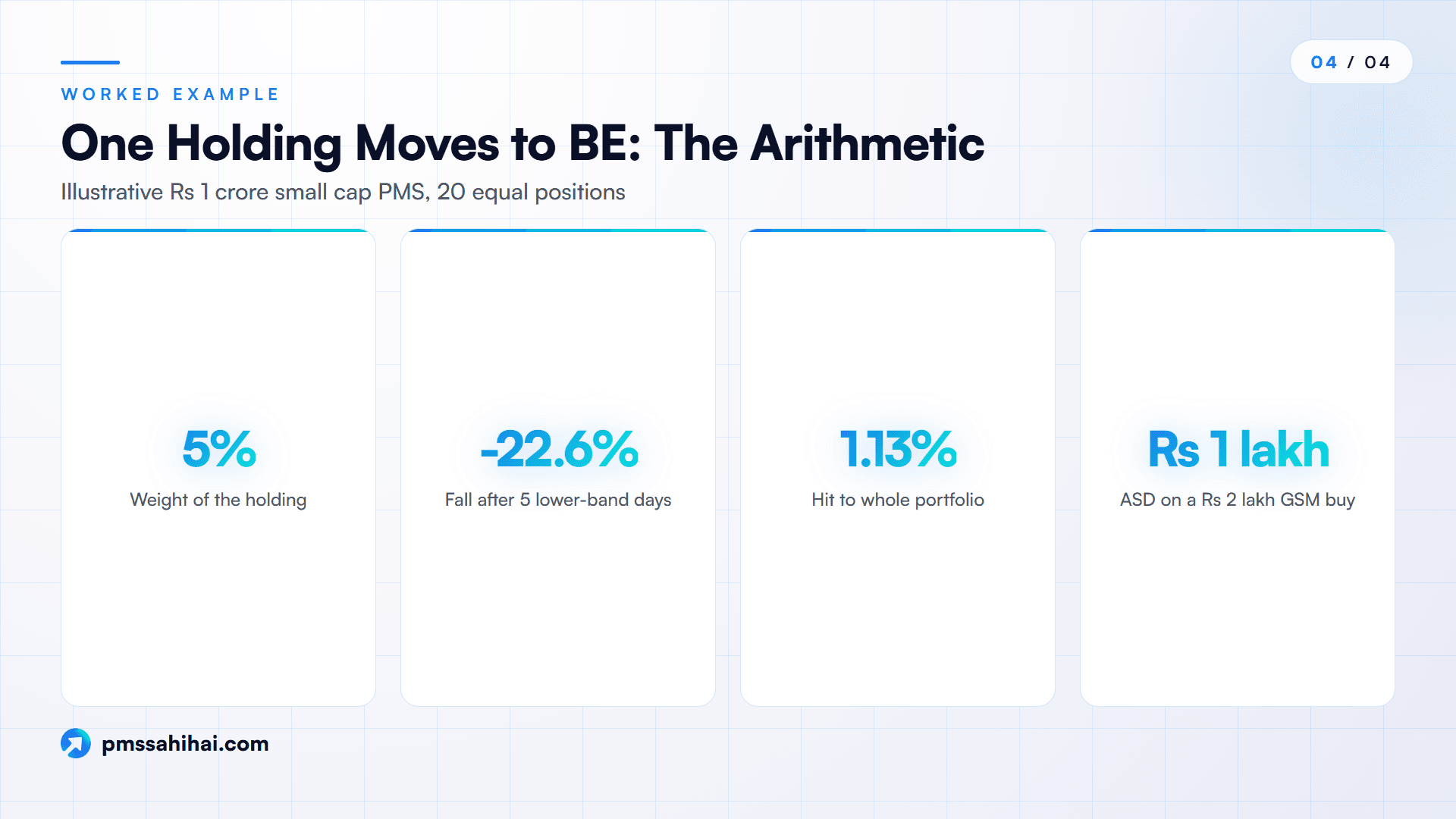
The figures below are hypothetical and only show the arithmetic. Take a client with Rs 1 crore in a small cap PMS of 20 equal positions, so each holding is worth Rs 5 lakh, or 5% of the portfolio. One holding, Company X, has a market capitalisation of Rs 450 crore and a P/E of 60, and it has rallied 40% in a fortnight while its sector index rose 5%. It meets all three fortnightly tests, so it moves to the BE series with a 5% price band.
Bad news follows, and sellers outnumber buyers. The stock closes at its lower limit for five straight sessions. The price falls to 0.95 to the power of 5, or about 77.4% of where it started, a decline of roughly 22.6%.
- Company X position: Rs 5,00,000 becomes about Rs 3,87,000.
- Portfolio impact: a 5% weight times a 22.6% fall is about 1.13% of the whole portfolio, or roughly Rs 1.13 lakh.
- If the manager runs the same holding across many clients, the strategy as a whole is trying to sell a much larger block into a market that allows only small daily moves.
Now flip it. Suppose instead the stock is under GSM Stage II and the manager wants to add Rs 2 lakh for a new client. On top of the Rs 2 lakh purchase, an ASD of Rs 1 lakh (50%) must be deposited in cash and stays locked until the exchange releases it.
Neither case is a disaster for a diversified portfolio. Both show why a small cap PMS investor should know how much of the book sits in T2T, ASM or GSM stocks at any time.
Limits and Blind Spots of the T2T Segment
The trade-to-trade segment has real limits as a protection tool:
- It is backward-looking. Every test uses past prices, volumes and reported earnings, so by the time a stock qualifies, much of a speculative move may already have happened.
- It can trap genuine holders. A sound small company whose price re-rates sharply after good results can meet the valuation and price tests just as a manipulated stock would. Long-term holders then face a 5% band and thinner liquidity through no fault of their own.
- It raises the cost of exiting. Lower liquidity and narrow bands mean wider effective spreads. For a concentrated portfolio, that is a direct hit to returns when the manager needs to sell.
- Delivery failures are punished hard. Close-out at the higher of the highest price up to T day or 20% above settlement price can turn a small operational slip into a large loss.
- It covers only some risk. Stocks with derivatives and large index constituents sit outside most of these screens, and a stock outside T2T is not automatically safe.
Reading a T2T Flag Without Panicking
A move into the trade-to-trade segment is information, not a sell signal. The right response depends on why the stock moved:
- IPO or re-listing: usually temporary and procedural. Expect a return to EQ after 10 trading days.
- Periodic review: the stock is small and has outrun the market on price, valuation or concentration. Check whether the fundamentals justify the move.
- ASM Stage IV or GSM Stage II and above: the exchange sees a sustained mismatch between price and fundamentals or trading patterns. This is the most serious case. Liquidity and cash costs will be at their worst.
For a PMS investor the questions are simple. How many holdings are in T2T, ASM or GSM today? What share of the portfolio do they represent? How would the manager exit if needed? A good manager will answer without hesitation, because liquidity management is part of the job in small caps. Put those answers next to the drawdown and Nyra score that PMS Sahi Hai shows for the strategy, and you have a far better picture than the headline return gives.
Check Your Small Cap PMS Exposure With PMS Sahi Hai
The trade-to-trade segment is one of the quiet details that separates a small cap portfolio's headline return from the return you can actually realise. Before you commit to a small or micro cap strategy, or while you hold one, ask how much of it sits in BE, T, ASM or GSM stocks and how the manager plans exits. Compare strategies on drawdown, consistency and liquidity, not just on past returns.
PMS Sahi Hai makes that comparison quicker. Filter small cap strategies on the PMS comparison page, check each one's Nyra score and maximum drawdown, or ask Nyra to review your current portfolio for overlap, drift and fee drag. Then take the T2T questions above to your manager before you invest, not after a holding hits its lower band.
PMS Sahi Hai is a distributor of Portfolio Management Services and Alternative Investment Funds, APMI-registered (Registration No. APRN08358). This article is for education only and is not investment advice, a recommendation, or an offer to buy or sell any security. Investments in securities markets are subject to market risks; read all scheme-related documents carefully. Past performance is not indicative of future results. Consult your advisor before investing.
Ishaan founded PMS Sahi Hai to make India's PMS, AIF and GIFT City markets legible to serious investors, comparing every SEBI-registered manager on the same comparative basis, with no shelf products and no commission bias.
Frequently asked
What is the trade-to-trade segment in the Indian stock market?
The trade-to-trade segment is a part of the market where every trade must be settled by actual delivery of shares and full payment, with no netting of buys and sells. NSE lists these stocks in the BE series (ST for SME stocks) and BSE in the T group. Exchanges use it to curb speculation in small, volatile or richly valued stocks.
Why do NSE and BSE move a stock to the T2T segment?
There are three main routes. NSE's fortnightly and quarterly reviews test valuation, price variation, volatility, trading concentration, shareholder count and market capitalisation. Long-term ASM Stage IV and GSM Stages II to IV impose trade for trade as a surveillance step. And IPOs of up to Rs 250 crore trade in T2T for their first 10 days under a 2012 SEBI circular.
Can I do intraday trading in T2T stocks?
No. Because every trade in the trade-to-trade segment settles separately with compulsory delivery, a same-day buy and sell cannot be netted, so intraday square-off is not possible. Each purchase must be paid for in full and taken into your demat account. Each sale must be backed by shares you already hold or will deliver by the settlement deadline.
How long does a stock stay in the trade-to-trade segment?
It depends on the route. IPO and re-listed stocks leave after their first 10 trading days. Stocks moved through NSE's periodic review leave at a quarterly review once they stop meeting the criteria, then trade in a 5% band for a while. ASM and GSM stocks move between stages on weekly or quarterly reviews; some ASM cases stay at least 90 days.
What happens if I sell T2T shares I have not received?
You risk a short delivery. In the trade-to-trade segment NSE does not hold a buy-in auction for such shortages. It closes them out directly at the higher of the highest price across exchanges from the trade day to T day, or 20% above the settlement price on T day. That penal price can be far above what you sold at.
Is a stock in the T2T segment a bad investment?
Not necessarily. NSE states that surveillance shortlisting should not be read as adverse action against the company, and new IPOs pass through T2T routinely. A move to BE or T does mean the stock has shown unusual price, valuation or trading behaviour, liquidity will be thinner, and exits slower. Treat it as a reason to look harder at the fundamentals.
How does the T2T segment affect a PMS portfolio?
Because PMS clients own shares directly, a holding that moves to T2T faces a narrow price band, thinner trading and gross settlement. The manager may need longer to exit. If the stock is under GSM Stage II or above, new purchases need a cash deposit of 50% to 100%. Ask your manager how much of the portfolio sits in such stocks.
What is the difference between the EQ and BE series on NSE?
EQ is the rolling segment, where same-day buys and sells are netted and intraday trading is allowed. BE is the trade-to-trade segment, where each trade settles separately by delivery, with no netting off. A stock moves between the two by exchange circular, for example when an IPO completes its first 10 days or a quarterly review clears it.
Keep reading
All articles
Selection Bias in Investing: Who Chose the Data You Are Looking At?
Selection bias in investing: how voluntary databases, incubated funds, peer groups and model portfolios inflate returns, and how to correct for it.
Downside Deviation in Investing: MAR, Formula and Worked Example
What downside deviation measures, how to pick a minimum acceptable return, the formula, a two-fund example and how it differs from standard deviation.
What Is an Accredited Investor? SEBI’s Rules and What They Unlock
SEBI's accredited investor rules after the October 2026 amendment: who qualifies, what it unlocks in AIFs and PMS, and what protection you give up.
Read it. Now pressure-test it.
Ask Nyra how this applies to your portfolio, or talk to our team, no pitch, no pressure.