
Advisory PMS Explained: Expert Advice, Your Money, Your Call

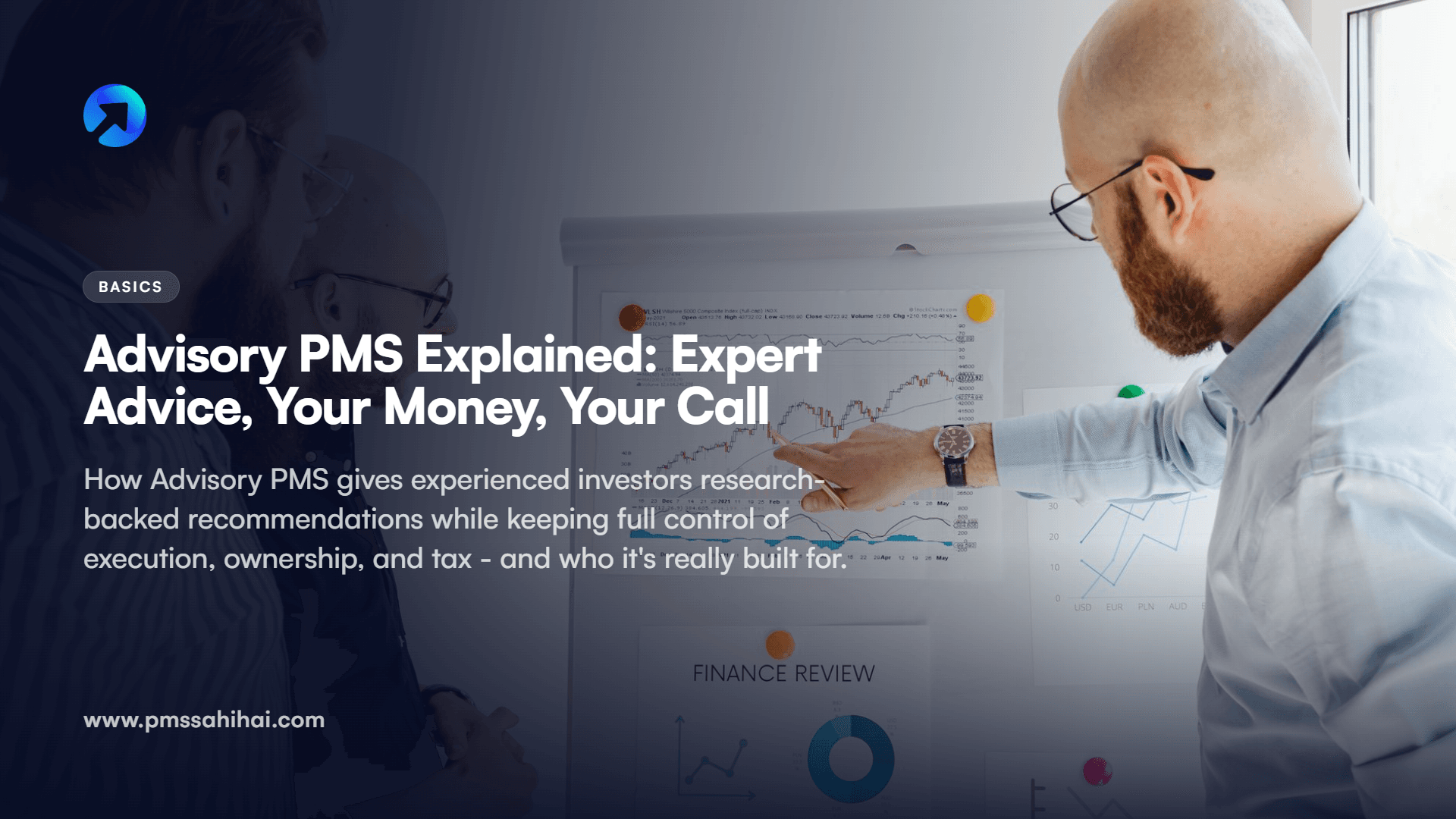
Advisory Portfolio Management Services (Advisory PMS) is the version of PMS where a SEBI-registered portfolio manager hands you research-backed buy and sell recommendations — but you stay firmly in the driver's seat. Every trade is approved and executed by you, in your own demat account, and the securities never leave your name. It sits at the maximum-control end of the PMS spectrum, one step beyond discretionary and non-discretionary PMS. You need a minimum of ₹50 lakh to begin, fees are usually lower than discretionary PMS (because the manager advises rather than executes and custodies your money), and since you hold the shares yourself, your gains are taxed exactly like direct equity investing. In short, Advisory PMS is built for the experienced, hands-on investor who wants an expert's brain without surrendering the steering wheel — and who has the time to act on advice quickly.
What Advisory PMS Really Means for Your Money
At its core, Advisory PMS is an investment service in which a professional portfolio manager provides research, insights and specific recommendations, while complete control over trade execution stays with the investor. The manager acts as a consultant — surfacing ideas, building model strategies, and flagging when to rebalance — but never touches your account. You approve each recommendation and place the trade yourself through your own broker, and the shares are held in your own demat account, in your own name.
That single design choice — advice in, execution kept by you — is what separates Advisory PMS from every other flavour of portfolio management. According to Groww's breakdown of Advisory PMS, the portfolio manager offers "professional recommendations and investment guidance along with research," yet "the complete control over trade execution remains with investors." India's market regulator frames it the same way: on the SEBI investor education portal, advisory PMS is described as the arrangement where the manager offers advice and "the investor executes transactions independently."
The practical upshot is that Advisory PMS gives you the research capability of a fund house with the autonomy of a self-directed investor. You are never locked out of your own portfolio, you can override any recommendation you disagree with, and you retain full visibility over every holding at all times. It is portfolio management for people who want a co-pilot, not an autopilot.
From ₹5 Lakh to ₹50 Lakh: How PMS and the Advisory Model Evolved in India
Portfolio Management Services did not arrive fully formed. In India, PMS has been shaped over three decades by a steadily rising bar for who can participate — a story that explains why Advisory PMS is a premium, high-net-worth product today rather than a mass-market one.
When SEBI first formalised the minimum ticket size for PMS back in 1993, the entry bar was just ₹5 lakh. As the industry matured and regulators grew more focused on protecting smaller investors from a lightly-standardised, higher-risk product, that minimum was raised to ₹25 lakh, and then doubled again to the current ₹50 lakh in January 2020. Each increase pushed PMS — advisory included — further toward a serious, well-capitalised investor base.
The modern rulebook is the SEBI (Portfolio Managers) Regulations, 2020, the framework that governs every registered portfolio manager in the country and which has since been refined (it was last amended in September 2025). That regime tightened net-worth, disclosure and fee norms, and it is the reason today's PMS providers are far more transparent than the industry of the 1990s. Within this framework, the market settled into three recognisable service structures — discretionary, non-discretionary and advisory — with advisory occupying the highest-control, lowest-intervention corner. Worth knowing: pure advisory mandates remain the least common of the three in India, because most managers build their businesses around discretionary execution. That relative rarity is exactly why it pays to understand the model before you go shopping for it.
Advisory vs Discretionary vs Non-Discretionary PMS: The Control Spectrum
The easiest way to understand Advisory PMS is to see it next to its siblings. All three are legitimate forms of PMS regulated by SEBI; they differ only in who decides and who executes.
| Factor | Discretionary PMS | Non-Discretionary PMS | Advisory PMS |
|---|---|---|---|
| Who makes the decision? | The portfolio manager | The investor, on the manager's recommendation | The investor |
| Who executes the trade? | The portfolio manager | The portfolio manager, after your approval | You do — in your own account |
| Your involvement | Low (hands-off) | Moderate | High (hands-on) |
| Control you retain | Least | Medium | Most |
| Typical fees | Highest | Middle | Generally Lowest |
| Best for | Time-poor investors who trust the manager | Investors who want a say on each move | Experienced, active investors with time |
In discretionary PMS, the manager "has complete autonomy to make investment decisions on behalf of the investor," to quote the -SEBI investor portal — you delegate, they act. In non-discretionary PMS, the manager recommends but "the final decision to buy or sell rests with the investors themselves," and the manager then executes once you say yes. Advisory PMS goes one step further along the control spectrum: the manager only advises, and you handle the execution entirely yourself.
Think of it as a dial. Turn it all the way toward convenience and you get discretionary PMS. Turn it all the way toward control and you get Advisory PMS. Non-discretionary sits in the middle. None is objectively "better" — the right choice depends on how much time you have, how much you trust your own judgment, and how much of the wheel you are willing to give up.
How Advisory PMS Works Today, Step by Step
Stripped to its mechanics, an Advisory PMS relationship runs on a repeatable loop. Understanding that loop makes the value — and the responsibility — obvious.
Step one: profiling. The portfolio manager assesses your financial goals, risk tolerance and investment horizon, then designs a strategy or model portfolio tailored to you rather than pushing a one-size-fits-all product.
Step two: recommendation. The manager delivers specific, research-backed advice — which securities to buy or sell, in what weights, and why. This is the intellectual heart of the service: professional research, sector views and diversification guidance across asset classes and geographies.
Step three: your decision. You review each recommendation and decide. Accept it, modify it, or reject it — nothing moves without your sign-off. This is the step that defines Advisory PMS.
Step four: your execution. You place the approved trades through your own brokerage account. The securities settle into your own demat account, held in your name, giving you direct ownership and complete transaction transparency.
Step five: monitoring and rebalancing. The manager tracks the portfolio, watches for sector shifts and rebalancing triggers, and sends fresh recommendations as conditions change — and you decide, again, whether and when to act. Because the whole cycle depends on you executing promptly, timing discipline is part of the deal.
Where Technology and AI Now Fit Into Investment Advice
Advisory PMS is, structurally, the most technology-friendly of the three PMS models — and that is not an accident. Because the manager never takes custody of your assets and never touches your account, everything they provide is, in essence, information: recommendations, model portfolios, research notes, rebalancing signals. Information travels well through software, which is why the advisory model has been quietly transformed by digital tools.
In practice, modern advisory relationships increasingly run on dashboards rather than paper. Recommendations arrive through apps. Model portfolios update in near real time. Analytics engines scan an investor's existing holdings for hidden overlap, sector concentration and duplication risk — the kind of analysis that used to take an analyst a week. And a growing layer of AI-assisted evaluation now helps investors screen and compare large numbers of strategies against their own profile before they commit a single rupee.
This is precisely the gap platforms like PMS Sahi Hai were built to close. Its AI-powered assistant, Nyra, is designed as an "AI Wealth Compass" that tracks 1,000+ PMS and AIF strategies and evaluates them against your goals — so that the "advice" layer of your investing life is grounded in data and comparison rather than a single salesperson's pitch. As the brand puts it, "hard-earned wealth shouldn't rely on random advice." We will come back to how that works in practice further down; for now, the point is simply that advisory investing in 2026 is a software-assisted discipline, and the investors who lean into that get a sharper, more comparable view of their options.
Seven Advantages That Make Advisory PMS Compelling
Advisory PMS earns its place for a specific investor profile. Here are the advantages that matter most.
- Maximum control. You approve and execute every trade; nothing happens in your portfolio without your explicit green light. For investors who want the final word, this is the headline benefit.
- Direct ownership and transparency. Your securities sit in your own demat account, so every holding and every transaction is fully visible to you in real time — there is no black box.
- Professional research and customisation. You gain access to a portfolio manager's research, market insights and strategy, tailored to your personal goals and risk profile rather than a generic model.
- Generally lower fees than discretionary PMS. Because the manager advises rather than executes and custodies your assets, Advisory PMS typically carries lower fees than its discretionary cousin — you are paying for brains, not back-office.
- Diversification guidance. Good advisory managers steer you across asset classes, sectors and geographies, helping you build genuine diversification instead of accidental concentration.
- Regular reporting. You receive performance and fee reporting, so you always know how the strategy is doing and what it is costing you.
- A SEBI-regulated safety net. Advisory PMS operates inside a strict framework: managers must be SEBI-registered, maintain a minimum net worth of ₹5 crore, and follow mandatory disclosure norms, according to the official SEBI FAQ for portfolio managers. That regulatory floor is a meaningful layer of investor protection.
How Advisory PMS Makes a Serious Investor's Life Easier
Beyond the feature list, Advisory PMS solves a very human problem. The hardest part of self-directed investing is rarely the clicking of the "buy" button — it is knowing what to do and why, week after week, across a market that never sits still.
Advisory PMS outsources exactly that cognitive load while leaving the decision rights, custody and tax control in your hands. You get a professional's answer to "what should I do with this portfolio right now?" without having to give up ownership, without wondering whether someone is churning your account for fees, and without losing the ability to say no. For a busy business owner or professional who has the knowledge to invest but not the hours to do the research, that is a genuine simplification: the thinking is delegated, the control is retained.
It also solves the trust problem in a subtle way. Because you execute your own trades and hold your own securities, the alignment of incentives is cleaner — the manager is paid to give you good advice, not to generate transactions. When the model is paired with a comparison-first mindset — evaluating strategies and managers side by side before you commit — the investor ends up with something rare in Indian wealth management: professional guidance they can actually audit.
The Honest Limitations and Risks You Should Weigh Carefully
No product is right for everyone, and Advisory PMS carries real trade-offs. An honest look at the cons is essential before you commit ₹50 lakh.
The execution burden is entirely yours. The flip side of control is responsibility. You must act on advice yourself, and act in time. A great recommendation acted on three days late can turn into a mediocre outcome, and any timing or execution error is your own. If you are not genuinely available and disciplined, this model can quietly cost you.
Returns hinge on the quality of the advice. You are dependent on the manager's research. Poor recommendations damage the portfolio directly, and unlike a discretionary setup, there is no manager pulling the trigger to correct course in real time — the correction only happens when you act.
It is expensive to enter and to run. Beyond the ₹50 lakh minimum, you face management and performance fees, brokerage on every trade you place, and 18% GST on fees — costs that compound and erode net returns. Advisory PMS is not a low-cost product.
It demands time and market knowledge. This is emphatically not a "set-and-forget" investment. It suits investors who understand markets and can dedicate time to reviewing and acting on advice; for anyone else, discretionary PMS or mutual funds may be a better fit.
Concentration and liquidity risk are real. Advisory strategies can concentrate in particular sectors or in smaller-cap stocks that are harder to exit quickly, which can amplify both gains and losses.
Fees, the ₹50 Lakh Minimum, and How Advisory PMS Is Taxed
Let us talk numbers, because the economics of Advisory PMS are where a lot of investors get surprised.
The minimum. SEBI mandates a ₹50 lakh minimum investment for PMS in India, and that threshold still stands in 2026. It applies across the PMS framework, advisory included, and is the single biggest reason PMS remains an HNI product.
The fees. Portfolio managers may charge a fixed fee, a performance-based fee, or a combination of both, and — importantly — SEBI rules state that no upfront fees may be charged to clients, per the SEBI portfolio managers FAQ. In practice, management fees commonly run in the region of 1–3% per year, while performance fees typically sit around 10–20% of gains above a hurdle rate, as detailed in Groww's guide to the SEBI PMS framework. Two terms are worth knowing here. A hurdle rate is the minimum return the portfolio must beat before any performance fee kicks in. A high-water mark ensures you pay performance fees only on new profits, not on gains that merely recover a previous loss. Add 18% GST on fees, and the all-in cost becomes clear — which is why comparing fee structures before you sign matters so much.
The tax. Here is where Advisory PMS quietly differs from discretionary PMS. Because you hold the securities directly in your own demat account and execute the trades yourself, your gains are taxed exactly like direct equity investing — there is no separate "PMS tax." For listed equity shares, gains on holdings sold within 12 months are short-term capital gains taxed at 20% under Section 111A, while gains on holdings sold after 12 months are long-term capital gains taxed at 12.5% under Section 112A, above an annual exemption of ₹1.25 lakh, following the Budget 2024 changes effective 23 July 2024. You can verify the current rates via ClearTax's LTCG guide and the Income Tax Department's capital gains page. The advantage of the advisory structure is tax control: since you decide when to sell, you decide when to realise gains.
Who Advisory PMS Is Right For (and Who Should Skip It)
Put all of this together and the ideal Advisory PMS investor comes into sharp focus.
Advisory PMS is right for you if you have at least ₹50 lakh to deploy, you genuinely understand markets, you want professional research without surrendering control, and — crucially — you have the time and discipline to act on advice promptly. It fits the experienced business owner, the finance-literate professional, or the next-generation investor modernising an inherited portfolio who wants a co-pilot rather than a chauffeur.
You should probably skip Advisory PMS if you are time-poor, if you would rather a professional simply handle everything (discretionary PMS is built for you), if you are uncomfortable executing your own trades, or if ₹50 lakh represents too large a share of your net worth to concentrate in a single actively-managed strategy. There is no shame in choosing convenience — portfolio management is not a test of toughness, and the "best" structure is simply the one you will actually use well.
How PMS Sahi Hai Helps You Understand the Inner Clause
PMS Sahi Hai positions itself as India's first AI-powered PMS and AIF marketplace — a place to compare, evaluate and invest in PMS and AIF strategies "smarter and faster," as a SEBI-aligned distributor and advisor. Instead of taking one manager's word for it, you get an independent, side-by-side view of strategies, their fee structures, and their track records. The platform's explainer on what PMS is and its PMS FAQ library are designed to translate exactly the kind of fine print this article has been describing into plain language — so the "inner clause" stops being a place where value leaks out.
At the centre of it is Nyra — the AI Wealth Compass. Nyra runs a simple but powerful loop: it profiles your goals and risk appetite, analyses your existing portfolio for hidden overlap and concentration, matches you to curated PMS and AIF strategies from a universe of 1,000+ options, helps you compare and invest, and then monitors continuously — tracking sector shifts and liquidity and sending actionable rebalancing alerts. For an Advisory PMS investor in particular, that continuous, data-grounded second opinion is enormously valuable, because in the advisory model you are the one making the calls — and you deserve better than random advice to make them on. You can explore Nyra directly at nyra.pmssahihai.com.
The philosophy is deliberately practical: your hard-earned wealth shouldn't rely on random advice. Whether you ultimately choose advisory, non-discretionary or discretionary PMS, the smart first move is the same — understand the structure, read the clauses, and compare before you commit. That is the entire reason PMS Sahi Hai exists.
The Bottom Line on Advisory Portfolio Management Services
Advisory Portfolio Management Services is the purest expression of a simple idea: expert guidance, your money, your call. It hands you a professional research engine while leaving ownership, execution, timing and tax firmly in your hands. For the experienced, well-capitalised, hands-on investor, that combination is genuinely powerful — you get the intelligence of a fund house without the loss of control that makes some investors uneasy about discretionary mandates.
But the model asks something back. It asks for time, discipline and market knowledge, and it charges real fees on a ₹50 lakh-plus base. The investors who thrive in Advisory PMS are the ones who treat the manager's advice as a serious input and then act on it decisively — and who compare their options before committing rather than accepting the first pitch they hear. Do that, lean on data-driven tools like Nyra to keep your decisions honest, and Advisory PMS can be one of the most rewarding structures in Indian wealth management. Skip the homework, and even the best advice in the world can go to waste.
Ready to Invest Smarter? Your Next Step With PMS Sahi Hai
If Advisory PMS sounds like your kind of structure — expert research, total control, your money in your name — the smartest next move isn't to sign with the first manager you meet. It's to compare your options side by side, read the inner clauses, and choose from a position of knowledge.
That is exactly what PMS Sahi Hai makes possible. Let Nyra, your AI Wealth Compass, profile your goals, analyse your current portfolio for hidden overlap, and match you against 1,000+ PMS and AIF strategies — so every decision you make is grounded in data, not a sales pitch. Compare, evaluate and invest — smarter and faster.
PMS Sahi Hai is a distributor of Portfolio Management Services and Alternative Investment Funds, APMI-registered (Registration No. APRN08358). This article is for education only and is not investment advice, a recommendation, or an offer to buy or sell any security. Investments in securities markets are subject to market risks; read all scheme-related documents carefully. Past performance is not indicative of future results. Consult your advisor before investing.
Ishaan founded PMS Sahi Hai to make India's PMS, AIF and GIFT City markets legible to serious investors, comparing every SEBI-registered manager on the same comparative basis, with no shelf products and no commission bias.
Frequently asked
What is Advisory PMS in simple terms?
Advisory PMS is a portfolio management service where a SEBI-registered portfolio manager gives you research-backed investment recommendations, but you make every decision and execute every trade yourself in your own demat account. The manager advises; you retain full control and ownership. It is the highest-control, lowest-intervention structure in the PMS family, ideal for hands-on investors who want expert input without delegating execution.
How is Advisory PMS different from Discretionary PMS?
The difference is who pulls the trigger. In discretionary PMS, the portfolio manager makes and executes investment decisions on your behalf with full autonomy. In Advisory PMS, the manager only recommends — you approve and execute each trade yourself, and the securities stay in your own demat account. Discretionary PMS suits time-poor investors who want to delegate; Advisory PMS suits experienced investors who want control. Advisory PMS also typically costs less, because the manager isn't handling execution or custody.
How much does Advisory PMS cost?
Fees vary by manager but usually combine a management fee of around 1–3% per year with a performance fee of roughly 10–20% of gains above a hurdle rate, plus 18% GST on fees. SEBI prohibits upfront fees. Advisory PMS is generally cheaper than discretionary PMS because the manager advises rather than executes and custodies your assets. Always check whether the performance fee includes a high-water mark before signing.
Is Advisory PMS safe and SEBI-regulated?
Yes. Advisory PMS operates under the SEBI (Portfolio Managers) Regulations, 2020. Registered portfolio managers must maintain a minimum net worth of ₹5 crore, follow strict disclosure norms, and cannot charge upfront fees. That said, "regulated" does not mean "risk-free" — your returns still depend on the quality of the advice and on your own execution, and market and concentration risks remain.
Is Advisory PMS common in India?
It is the least common of the three PMS structures. Most portfolio managers build their businesses around discretionary execution, so pure advisory mandates are relatively rare. That scarcity makes it especially important to compare providers carefully and understand the fine print — a comparison-first platform can help you find and evaluate the advisory options that do exist.
Keep reading
All articles
Are 30% CAGR PMS Return Claims Realistic? A Reality Check
Is a 30% CAGR PMS return realistic? We check the claim against 10-year data, SEBI rules, fees and taxes — and show how to verify any PMS pitch.
PMS Returns in India 2026: What the APMI Data Actually Shows
What Is SIF? Specialised Investment Funds in India Explained
SIF explained: SEBI's ₹10 lakh investment class with long-short strategies. Rules, 7 strategies, SIF vs PMS vs AIF, taxation, risks and how to evaluate one.
Read it. Now pressure-test it.
Ask Nyra how this applies to your portfolio, or talk to our team, no pitch, no pressure.