
Marcellus Investment Managers: Strategy, Track Record & Who It Suits
Marcellus Investment Managers' quality-investing strategy, honest track record, and who its concentrated, patient-capital approach actually suits.

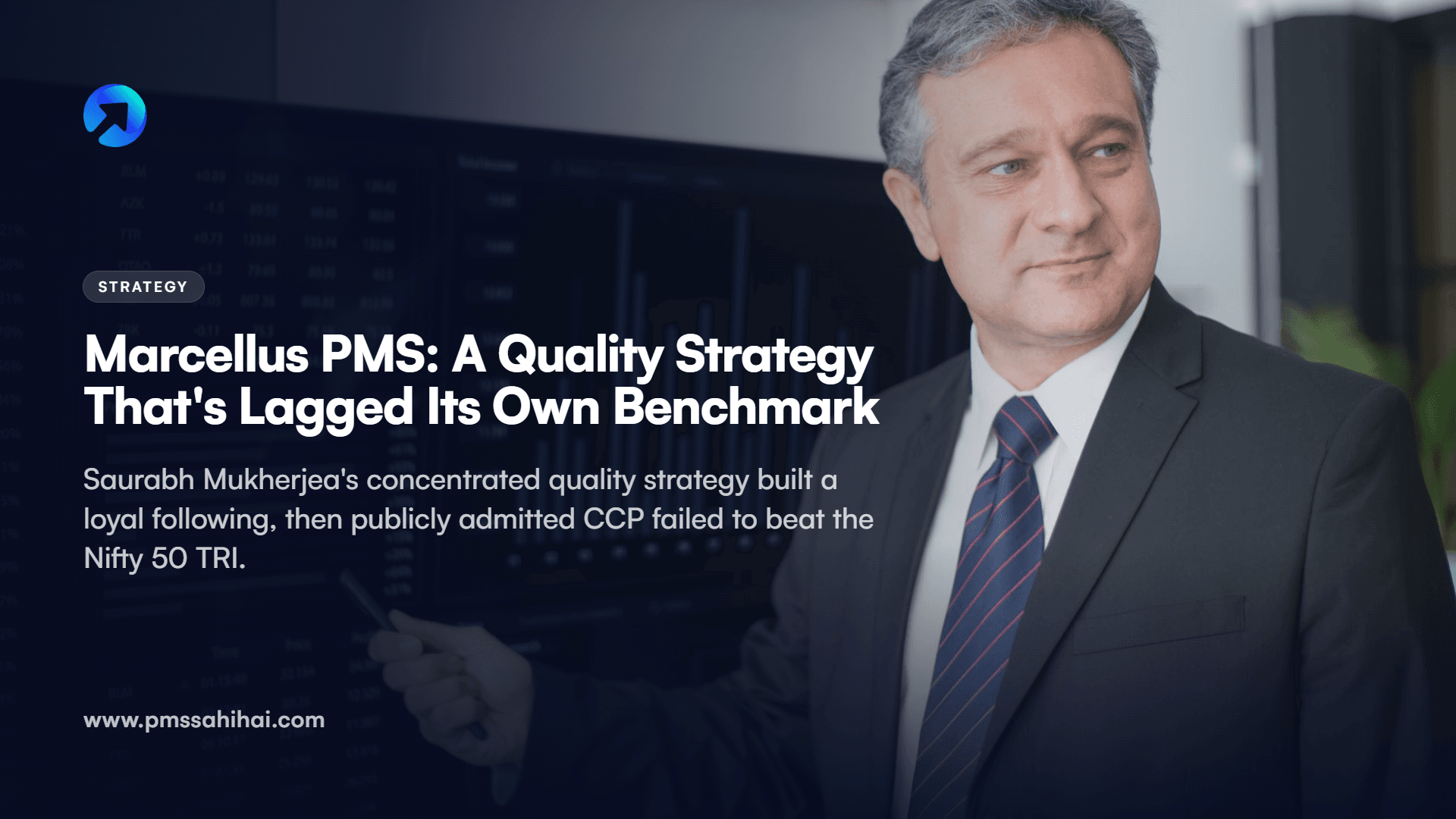
Marcellus Investment Managers is a Mumbai-based, SEBI-registered Portfolio Management Service (PMS) founded in 2018 by Saurabh Mukherjea and a team largely from Ambit Capital. Its whole identity rests on one disciplined idea: own a concentrated portfolio of ~20 "consistent compounders" — companies with clean accounts, smart capital allocation, and durable competitive moats — and hold them for years. That philosophy made Marcellus one of India's most talked-about PMS brands. But the last few years have been humbling: the flagship Consistent Compounders Portfolio (CCP) has trailed the Nifty 50 TRI across 1-, 3-, and 5-year windows, PMS assets have fallen roughly 64% from their peak to about ₹2,515 crore (May 2026), and Mukherjea himself has publicly called it a "failure to beat the market." The strategy is coherent and the businesses it owns are genuinely high-quality but Marcellus suits a patient HNI with a 7–10 year horizon who understands they're buying a style, not a guarantee. This guide breaks down the strategy, the honest numbers, the real pros and cons, and exactly who should (and shouldn't) invest.
From Ambit To Independence: How Marcellus Was Born
The Marcellus story begins with a reputation built elsewhere. Before founding the firm, Saurabh Mukherjea had become one of India's most recognisable equity voices at Ambit Capital, where he ran research and portfolio management and authored best-selling books on Indian investing. In 2018, he broke away to build something of his own, taking a founding team drawn largely from Ambit — including Rakshit Ranjan, who would go on to manage the flagship strategy, and Pramod Gubbi. The firm's SEBI Portfolio Manager registration is dated 22 October 2018, which anchors its founding year. (You can verify any registered portfolio manager's filings on the SEBI Portfolio Manager monthly report database.)
The name itself is a tell. Marcus Claudius Marcellus was a Roman general famed for combining patience with decisive action — a fitting metaphor for a firm that markets itself on discipline and long holding periods. From day one, Marcellus positioned itself not as a trader chasing momentum but as a buy-and-hold owner of great businesses, closer in spirit to a private-equity mindset than to a typical mutual fund. That framing, amplified by Mukherjea's prolific media presence and writing, gave the brand enormous early gravity. Indian financial media covered its every move —
The Marcellus story begins with a reputation built elsewhere. Before founding the firm, Saurabh Mukherjea had become one of India's most recognisable equity voices at Ambit Capital, where he ran research and portfolio management and authored best-selling books on Indian investing. In 2018, he broke away to build something of his own, taking a founding team drawn largely from Ambit — including Rakshit Ranjan, who would go on to manage the flagship strategy, and Pramod Gubbi. The firm's SEBI Portfolio Manager registration is dated 22 October 2018, which anchors its founding year. (You can verify any registered portfolio manager's filings on the SEBI Portfolio Manager monthly report database.)
The name itself is a tell. Marcus Claudius Marcellus was a Roman general famed for combining patience with decisive action — a fitting metaphor for a firm that markets itself on discipline and long holding periods. From day one, Marcellus positioned itself not as a trader chasing momentum but as a buy-and-hold owner of great businesses, closer in spirit to a private-equity mindset than to a typical mutual fund. That framing, amplified by Mukherjea's prolific media presence and writing, gave the brand enormous early gravity. Indian financial media covered its every move — a level of attention you can still trace through outlets like the Economic Times' Marcellus coverage.
The core promise was refreshingly simple in a noisy industry. Instead of owning fifty or sixty stocks and quietly hugging the index, Marcellus would own a small, high-conviction portfolio of companies it had researched to the bone. If those businesses were truly exceptional — dominant, cash-generative, cleanly run — then time, not timing, would be the investor's greatest ally. It was an idea perfectly suited to the moment: India's quality stocks were entering a powerful multi-year run, and Marcellus became one of its defining beneficiaries.
The core promise was refreshingly simple in a noisy industry. Instead of owning fifty or sixty stocks and quietly hugging the index, Marcellus would own a small, high-conviction portfolio of companies it had researched to the bone. If those businesses were truly exceptional — dominant, cash-generative, cleanly run — then time, not timing, would be the investor's greatest ally. It was an idea perfectly suited to the moment: India's quality stocks were entering a powerful multi-year run, and Marcellus became one of its defining beneficiaries.
The founder-led brand and its double edgeIt's worth naming something that makes Marcellus unusual: it is deeply founder-led. Mukherjea is the strategy's public face, its chief communicator, and its most quoted defender. That has been a huge asset in building trust and gathering assets. But it also concentrates reputational risk — when performance turned, the same visibility that built the brand meant every stumble was discussed in public. As we'll see, Marcellus has handled that scrutiny with unusual candour, which is itself a point in its favour.
Inside The Marcellus Method: Clean Accounts, Capital Allocation And Moats
with the full universe of listed Indian companies and narrows it to an investable shortlist of roughly 50 high-quality names, then does deep, bottom-up research to build a concentrated portfolio of around 20 stocks. Three questions drive that funnel, and understanding them is the key to understanding everything Marcellus does.
Filter one — forensic, clean-accounting screeningMarcellus is obsessive about accounting quality. Its research process applies forensic-accounting screens designed to weed out companies that flatter their books — aggressive revenue recognition, suspicious cash-flow gaps, related-party games, or working-capital red flags. The logic is that no amount of growth matters if the reported numbers can't be trusted. This screen removes a large chunk of the market before a single valuation model is built, and it is arguably Marcellus's most distinctive edge. In a market where governance quality varies widely, refusing to own companies with murky accounts is a genuine risk-management discipline, not a marketing line.
Filter two — disciplined capital allocationThe second filter asks: what does management do with the cash the business throws off? Marcellus favours companies that generate strong free cash flow and reinvest it at high rates of return, compounding shareholder capital rather than diluting it or chasing empire-building acquisitions. A useful shorthand here is Return on Capital Employed (RoCE) — a measure of how efficiently a company turns capital into profit. You can read a clean primer on RoCE on Investopedia. Marcellus wants businesses whose high RoCE is sustainable, funded internally, and reinvested wisely — the mathematical engine of long-term compounding.
Filter three — deep, durable competitive moatsThe third filter is the most famous: the economic moat. Borrowing the concept popularised by Warren Buffett, Marcellus looks for businesses protected by structural advantages — brands, distribution networks, switching costs, regulatory positioning, or scale — that let them fend off competitors and preserve pricing power for years. (Investopedia has a solid explainer on the economic moat concept.) A wide moat is what turns a good company into a compounder: it protects the high returns on capital that filters one and two identify, so the compounding engine can run undisturbed. The result is a portfolio of ~20 heavily moated companies meant to be held for very long periods with minimal churn — the operational signature of the whole firm.
The elegance of this method is that all three filters reinforce one another. Clean accounts make the reported returns trustworthy; disciplined capital allocation keeps those returns high; and a durable moat protects them from erosion. Where the method gets tested — as the last few years proved — is on the one variable it historically de-emphasised: the price you pay.
The Marcellus Product Line-Up: Six Ways To Own Quality
Although the Consistent Compounders Portfolio is the headline act, Marcellus has extended the same quality philosophy across market segments. Here's the current line-up.
| Strategy | Segment | Launched | What it does |
|---|---|---|---|
| Consistent Compounders (CCP) | Large-cap | Dec 2018 | The flagship — ~20 heavily moated, high-quality Indian businesses held for the long term |
| Little Champs | Small-cap | Aug 2019 | The 3-filter method applied to well-governed small-cap champions |
| Kings of Capital | Financials | Jul 2020 | A focused portfolio of high-quality banks, NBFCs, insurers, AMCs and brokers |
| Rising Giants | Mid-cap | Dec 2021 | Mid-cap companies with the potential to become tomorrow's large-cap compounders |
| MeritorQ | Multi/flexi-cap | Nov 2022 | A rules-based, quantitative strategy screening for low leverage and consistent profitability |
| Global Compounders | Global equities | - | 20–30 deeply moated global businesses, extending the philosophy beyond India |
To this the firm has added a Multi-Asset portfolio for investors who want built-in diversification across asset classes, plus a trend-following sleeve. The common thread across all of them is the insistence on quality and moats — even the quantitative MeritorQ strategy is essentially the same beliefs expressed in code rather than in a fund manager's judgement.
For most conversations about "investing with Marcellus," though, the reference point is CCP — it remains the largest strategy (roughly ₹1,600 crore of the firm's assets) and the clearest expression of the house style. When you read Marcellus's performance debates in the media, they are almost always really about CCP.
Where Modern Wealth-Tech Meets Old-School Quality Investing
It would be easy to file Marcellus under "traditional stock-picking," but that misses how the firm sits inside today's wealth-tech landscape. Its MeritorQ strategy is openly quantitative — a systematic, rules-based engine that removes human emotion from the buy-and-sell decision. Its clean-accounting edge depends on running forensic screens across large datasets of listed companies, exactly the kind of data-heavy analysis modern computing accelerates. And its client experience increasingly runs through digital onboarding, dashboards, and detailed monthly newsletters rather than purely relationship-led sales.
But the bigger technology shift is happening one level up — in how investors choose a PMS in the first place. For years, picking between Marcellus, its peers, and dozens of AIFs was an opaque, advisor-gated process built on glossy pitchbooks and cherry-picked return windows. That is changing fast. AI-powered PMS & AIF comparison marketplaces now let investors line up 1,000+ strategies side by side, normalise their returns, surface fees, and — crucially — detect portfolio overlap before committing capital. This is where a platform like PMS Sahi Hai and its AI wealth assistant, Nyra, changes the game: the decision to invest with Marcellus stops being a leap of faith based on a founder's reputation and becomes a data-driven choice you can actually stress-test. We'll return to exactly how that works later, because it's central to using Marcellus intelligently.
There's a macro dimension too. The firm's own February 2026 commentary flagged concerns about India's consumer-debt surge, echoing warnings in the Reserve Bank of India's Financial Stability Report about rising retail credit risk. That kind of top-down awareness — knowing which risks are building in the system — is part of what an investor is paying a specialist manager to watch on their behalf.
The Track Record, Told Honestly: Returns, Drawdown And A Founder's Admission
Here is where most reviews either cheerlead or attack. We'll do neither — just the dated facts.
For its first few years, Marcellus rode the quality wave beautifully, and its brand ballooned along with its assets. Then the market regime changed. From roughly 2022 onward, cheaper "value" and cyclical stocks led the market, richly valued quality names de-rated, and Marcellus's flagship began to lag. The numbers tell the story plainly. Across recent data, the Consistent Compounders Portfolio has underperformed the Nifty 50 TRI across 1-, 3-, and 5-year periods. In the firm's own March 2025 disclosures, CCP's roughly 17.4% since-a-point CAGR essentially tracked its portfolio's ~17.8% earnings growth — meaning the businesses grew, but the valuation tailwind that had earlier boosted returns went into reverse. (The Nifty 50 TRI is the "total return" version of the index, including dividends — a fair, tough benchmark; here's a primer on the total return index concept, and the index itself is maintained by the NSE.)
What's genuinely admirable is how the firm responded. Rather than spin the numbers, Saurabh Mukherjea publicly owned the miss. In a widely reported March 2025 note, he listed among his career failures the "failure to beat the market over the past 3 years," and Marcellus attributed the shortfall to not acting on its own "learnings on valuations" — in plain English, holding great businesses at prices that had become too rich, and not trimming when it should have. You can read the coverage of that admission on Business Today. This is not a minor detail: a manager who names his mistake in public is far more useful to an investor than one who buries it.
What the drawdown did to the businessPerformance pain fed directly into asset flows. Marcellus's PMS assets under management have fallen roughly 64% from their peak, sliding to about ₹2,515 crore across 2,133 clients as of May 2026, based on SEBI-sourced data — a striking reversal for a firm that was once a poster child of the PMS boom. The flagship saw large redemptions during the drawdown, with media reporting quarterly outflows in the four-figure-crore range from CCP at one point as covered by Moneycontrol. You can cross-check the current scheme-level assets and returns on independent trackers such as Business Today's PMS data page.
The other side of the ledgerTo be fair, the picture is not uniformly bleak, and the businesses Marcellus owns have kept growing. In its February 2026 update, the firm reported that CCP's holdings delivered weighted-average year-on-year EBITDA growth of about 19% and EPS growth of about 17% in the December 2025 quarter — evidence that the underlying earnings engine is intact even when the share prices lagged. Its Kings of Capital financials strategy has also held up better than the flagship, benefiting from a strong run in banking stocks. History suggests that when the quality factor comes back into favour — as it periodically does — concentrated quality portfolios can re-rate quickly. The honest summary: the strategy's businesses compounded, but its returns did not, because valuations worked against it. Whether that reverses is the central bet an investor is making today.
Five Real Advantages Of The Marcellus Approach
Despite the rough patch, there are concrete, durable reasons investors are drawn to Marcellus. These advantages are real regardless of any single year's returns.
- A clear, repeatable philosophy. The clean-accounting → capital-allocation → moats funnel is transparent and consistent. You always know why a stock is in the portfolio, which is more than can be said for many discretionary managers who drift with the mood of the market.
- Genuine concentration and conviction. With around 20 holdings, Marcellus builds a differentiated portfolio, not a closet index. That means your money is expressed as real, high-conviction bets — the only way to meaningfully beat an index over time is to look different from it.
- Low churn and tax-efficient patience. Marcellus's minimal portfolio turnover and long holding periods reduce trading costs and defer capital-gains tax, letting more of your capital stay invested and compounding rather than leaking to the taxman each year.
- Rare transparency and communication. Detailed monthly performance-and-fundamentals newsletters and a visible, accountable founder set a high bar for candour. As the public admission of underperformance showed, Marcellus tells you the bad news, not just the good — invaluable for trust.
- A full quality-investing toolkit. From large-cap CCP to Little Champs (small-cap), Kings of Capital (financials), Rising Giants (mid-cap), the quantitative MeritorQ, and Global Compounders, an investor can express the same philosophy across segments and geographies under one research roof — with holdings sitting directly in their own demat account, a structural benefit of the PMS format over pooled funds.
The Honest Cons And Limitations Of Investing With Marcellus
An honest guide has to weigh the risks just as clearly. These are the real limitations, not hypothetical ones.
- Multi-year benchmark underperformance. The single biggest issue: the flagship CCP has trailed the Nifty 50 TRI across 1-, 3-, and 5-year windows. Paying premium fees to lag a cheap index fund is the hardest thing to justify in investing, and it's the crux of every critical review.
- A steep asset decline signals real pressure. A ~64% drop in PMS AUM from the peak and heavy redemptions are not just optics — outflows can force selling and reflect a crisis of investor confidence the firm is still rebuilding. Independent coverage on outlets like Mint has tracked this closely.
- High fees against recent returns. A ₹50 lakh minimum investment and management fees of around 2% per year (with performance-fee options) are steep when performance lags. Fees are certain; outperformance is not.
- Overlap with what you may already own. Because CCP is large-cap, it can hold many of the same blue-chip names an investor already owns through large-cap mutual funds — meaning you may pay PMS-level fees for diversification you don't actually get. This is the most under-appreciated risk, and the easiest to check before investing.
- Concentration cuts both ways. A ~20-stock portfolio amplifies outcomes. When the quality-and-valuation style is out of favour, drawdowns are sharper than a diversified fund's — you must be able to stomach the volatility to earn the eventual reward.
Who Marcellus Actually Suits — And Who Should Skip It
Put the strategy, the numbers, and the risks together, and a clear profile emerges. Marcellus is not for everyone — and that's the point of choosing it deliberately.
Marcellus tends to suit you if: you are an HNI, NRI, or family office who can comfortably meet the ₹50 lakh minimum; you have a genuine 7–10 year horizon and won't panic-sell in a bad 18-month stretch; you believe in quality investing as a style and want a specialist to run it with discipline; and you value transparency and clean governance over quarter-to-quarter performance chasing. For this investor, Marcellus's recent underperformance may even be an opportunity — buying a coherent process after quality has de-rated rather than at its euphoric peak.
You should probably skip Marcellus if: you need or expect reliable index-beating returns on a short leash; you already hold substantial large-cap mutual funds and would simply be duplicating your exposure at higher cost; you're uncomfortable with a concentrated, benchmark-agnostic portfolio that can lag for years; or the ₹50 lakh commitment would over-concentrate your net worth in a single manager's style. There is no shame in any of these — they simply mean a different vehicle fits you better.
The uncomfortable truth is that most of these questions — Does this overlap with what I own? Is 20 stocks too concentrated for my situation? Am I paying for a style I already have? — are hard to answer alone, with a pitchbook in front of you. That's precisely the gap modern tools now close.
How PMS Sahi Hai And Nyra Help You Read The Inner Clause
Choosing a PMS like Marcellus has always had an "inner clause" problem: the glossy brochure shows the philosophy and the best return window, but the details that actually determine your outcome — how it overlaps with your existing holdings, whether the fee structure suits your ticket size, how concentrated your total wealth becomes — live in the fine print, if they're visible at all. PMS Sahi Hai was built to drag that fine print into the light.
As India's 1st AI-powered PMS & AIF marketplace, PMS Sahi Hai lets you compare, evaluate, and invest in over 1,000 PMS and AIF strategies — including Marcellus's line-up — on a single, transparent screen. Instead of taking any manager's word for it, you can see how Consistent Compounders, Kings of Capital, or Little Champs stack up against genuine peers on the metrics that matter. It's the difference between reading one firm's marketing and seeing the whole market at once. (New to the format? The plain-English primer on what a PMS actually is is a good starting point.)
The real intelligence, though, comes from Nyra - Your AI Wealth Compass. Nyra doesn't hand you a sales pitch; it runs a genuine, five-step diagnostic on your situation:
- Profile & Goals — Nyra starts by understanding your risk appetite, horizon, and goals, so any Marcellus strategy is judged against your needs, not a generic template.
- Analyse Your Portfolio — it examines your existing PMS, AIFs, and funds to reveal hidden overlaps and sector concentration — the exact "am I just duplicating my large-cap funds with CCP?" question, answered with data.
- Curated PMS & AIF Match — its AI and research engine evaluates 1,000+ strategies and surfaces only those that genuinely fit your profile and fill real gaps.
- Smart Investing — you compare, evaluate, and invest directly, with seamless onboarding to India's top managers.
- Continuous Monitoring — Nyra keeps watching sector shifts and liquidity, sending actionable rebalancing alerts long after you invest.
This is the brand's founding conviction in action: "hard-earned wealth shouldn't rely on random advice." For a strategy like Marcellus — powerful but style-dependent and prone to long lulls — that data-first lens is exactly what turns a reputational bet into an informed allocation. You can put any of its strategies through this test yourself using the Nyra app or the side-by-side PMS comparison tool.
The Bottom Line On Marcellus Investment Managers
Marcellus Investment Managers is a genuinely serious investment house with a coherent, admirable philosophy: own a small number of exceptional, cleanly run, deeply moated businesses and hold them with patience. Its transparency and its willingness to own its mistakes in public put it ahead of most of the industry on integrity. What it cannot promise — and, to its credit, no longer pretends to — is that this style will beat the index every year. The last few years have been a hard, honest reminder that even great businesses can be poor investments if you overpay, and that concentrated quality can lag for uncomfortably long stretches.
So the decision comes down to fit, not fandom. If you're a patient, long-horizon investor who wants quality expressed with conviction and can size the position sensibly within your overall wealth, Marcellus can be a rewarding core holding — potentially an attractive one after quality's de-rating. If you need dependable outperformance, already own the same blue chips, or can't ride out multi-year lulls, it isn't for you. The smartest move isn't to guess which camp you're in — it's to check, with data. Run your profile and your existing portfolio through Nyra, see exactly how a Marcellus strategy would interact with what you already hold, and let the numbers — not a reputation — make the call. That's how you read the inner clause before you sign it.
Compare Marcellus The Smart Way: Your Next Step
Don't invest in Marcellus or any PMS on reputation alone. Compare it against 1,000+ PMS and AIF strategies, check it for overlap with what you already own, and match it to your real risk profile in minutes. Start with PMS Sahi Hai, put your portfolio through Nyra, your AI Wealth Compass, and make a decision backed by data — because hard-earned wealth shouldn't rely on random advice.
PMS Sahi Hai is a distributor of Portfolio Management Services and Alternative Investment Funds, APMI-registered (Registration No. APRN08358). This article is for education only and is not investment advice, a recommendation, or an offer to buy or sell any security. Investments in securities markets are subject to market risks; read all scheme-related documents carefully. Past performance is not indicative of future results. Consult your advisor before investing.
Ishaan founded PMS Sahi Hai to make India's PMS, AIF and GIFT City markets legible to serious investors, comparing every SEBI-registered manager on the same comparative basis, with no shelf products and no commission bias.
Frequently asked
What is Marcellus Investment Managers?
Marcellus is a Mumbai-based, SEBI-registered Portfolio Management Service founded in 2018 by Saurabh Mukherjea and a team largely from Ambit Capital. It runs concentrated, quality-focused equity portfolios — most famously the Consistent Compounders Portfolio — for HNIs, NRIs, and family offices.
What is the minimum investment in Marcellus PMS?
Like all PMS providers in India, Marcellus requires a minimum investment of ₹50 lakh, the floor mandated by SEBI for portfolio management services.
Has Marcellus PMS underperformed?
Yes, honestly, over recent periods. The flagship Consistent Compounders Portfolio has trailed the Nifty 50 TRI across 1-, 3-, and 5-year windows, and founder Saurabh Mukherjea publicly described it as a "failure to beat the market over the past 3 years," attributing the miss largely to valuation discipline. The underlying businesses, however, have continued to grow their earnings.
How much are Marcellus PMS fees?
Fee structures typically involve a fixed management fee of around 2% per year, with performance-fee alternatives (for example, a lower or zero fixed fee plus profit-sharing above a hurdle rate). There is generally no lock-in or exit load, though you should confirm the exact terms and slabs before investing.
What is Marcellus's AUM now?
Marcellus's PMS assets have fallen roughly 64% from their peak to about ₹2,515 crore across 2,133 clients as of May 2026, per SEBI-sourced data — a sharp decline driven by underperformance and redemptions.
Who should invest in Marcellus PMS?
It suits patient, long-horizon HNIs who believe in quality investing, can meet the ₹50 lakh minimum, and can tolerate multi-year underperformance. It's a poor fit for investors who need reliable index-beating returns, already hold large-cap mutual funds (overlap risk), or can't stomach a concentrated portfolio.
Keep reading
All articles
Motilal Oswal PMS: Strategies, Fees, and Who It Really Fits
Motilal Oswal PMS isn't one product — it's a shelf of eight strategies with wildly different track records. Here's the fee reality, the dated numbers, and why the flagship isn't automatically the right pick.
ASK Investment Managers PMS: A Plain-English Review
ASK Investment Managers is Blackstone-backed, decades-old, and one of India's most recognised PMS names — but its flagship portfolios have quietly trailed the benchmark for years. Here's the plain-English review, numbers included.

PMS Sahi Hai’s Six Commitments: A Trust Framework for Investors
Most advisors ask you to trust them. Here are six specific, testable commitments — on advice, fees, data, custody, and follow-through — that show you how PMS Sahi Hai actually earns it.
Read it. Now pressure-test it.
Ask Nyra how this applies to your portfolio, or talk to our team, no pitch, no pressure.