
What Is Short Term Capital Gains Tax in India? 2026 Rates by Asset
STCG tax in India for 2026-27: 20% on listed equity under section 196 (old 111A), slab rates for other assets, holding periods and loss set-off.

Short term capital gains tax is the tax on profit from an asset sold soon after you bought it: within 12 months for listed shares and equity funds, within 24 months for most other assets. For the tax year 2026-27, gains on STT-paid listed shares, equity-oriented funds and listed REIT or InvIT units are taxed at a flat 20% under section 196 of the Income-tax Act, 2025 (old section 111A). Most other short-term gains, including debt fund units bought after 1 April 2023, unlisted shares, property and gold, are taxed at slab rates. A short-term capital loss can be set off against any capital gain and carried forward for eight years. This is general information as of 6 November 2026; check your position with a tax adviser.
What Short Term Capital Gains Tax Means for Indian Investors
When you sell an asset for more than you paid, the profit is a capital gain. Indian tax law sorts every gain into short-term or long-term, and the bucket decides the rate. Short term capital gains tax is the tax on the first bucket.
Three things make it harder than it sounds:
- The holding period differs by asset: 12 months for listed shares, 24 months for a flat or gold.
- The rate differs too: some short-term gains pay a flat 20%, the rest are taxed at your slab rate, up to 30% before surcharge.
- The section numbers changed on 1 April 2026, when the Income-tax Act, 2025 replaced the 1961 Act. Most guides still quote the old ones.
This guide is for resident individuals and HUFs selling shares, mutual funds, property, gold or bonds in the tax year 2026-27 (1 April 2026 to 31 March 2027), including investors in a portfolio management service (PMS), where short-term capital gains arise each time the manager sells. Non-residents pay the same rates but face tax deducted on every sale; our guide to NRI capital gains tax on shares and mutual funds covers that.
How India's Short-Term Capital Gains Rules Evolved Since 2004
The 2004 STT bargain and the 2008 increase
The modern equity regime began with the Finance (No. 2) Act, 2004. It introduced securities transaction tax (STT), collected by the exchange on each trade, and in return gave STT-paid equity a concessional 10% rate on short-term gains. That rate rose to 15% from 2008. Other short-term gains stayed at slab rates.
The July 2024 reset
The Finance (No. 2) Act, 2024 changed the regime for transfers on or after 23 July 2024:
- The short-term rate on STT-paid listed equity, equity-oriented fund units and business trust units rose from 15% to 20%.
- Only two holding periods remained: 12 months for listed securities, 24 months for everything else. Gold, bonds and debentures moved from 36 to 24 months; listed REIT and InvIT units from 36 to 12.
- Unlisted bonds and debentures joined the rule that treats certain debt gains as short-term whatever the holding period.
A year earlier, from 1 April 2023, debt-oriented mutual fund units bought on or after that date had lost long-term treatment.
The Income-tax Act, 2025 and the Finance Act, 2026
The Income-tax Act, 2025 came into force on 1 April 2026 and repealed the 1961 Act, with transitional provisions for earlier years. The capital gains rules moved across largely unchanged, under new numbers, and "previous year" became "tax year".
The Finance Act, 2026 left the 20% rate alone but made two relevant changes from 1 April 2026: buyback proceeds are taxed as capital gains again, not as dividends, and the Sovereign Gold Bond redemption exemption is limited to original subscribers who hold to maturity.
Elsewhere, short-term gains are usually taxed as ordinary income; in the US, gains on assets held a year or less are taxed at regular income rates. India's flat 20% on listed equity is a deliberate carve-out from that approach.
Income-tax Act 2025 Section Numbers for STCG, Old and New
The Income-tax Act, 2025 came into force on 1 April 2026, and the e-filing portal confirms that the 1961 Act stands repealed from that date, with transitional provisions for pending matters. Broker statements and older articles will use both sets of numbers for a while. This table maps the provisions used in this guide.
| Rule | 1961 Act | 2025 Act |
|---|---|---|
| Short-term capital asset and holding periods | 2(42A) | 2(101) |
| Demat securities: FIFO and beneficial owner | 45(2A) | 67(7) |
| Computation of gains | 48 | 72 |
| Deemed short-term gains: specified funds, MLDs, unlisted bonds | 50AA | 76 |
| Stamp duty value for land and buildings | 50C | 78 |
| Speculative transaction | 43(5) | 66(31) |
| 20% rate on STT-paid equity STCG | 111A | 196 |
| Long-term gains on STT-paid equity | 112A | 198 |
| Default tax regime slabs | 115BAC | 202 |
| Rebate | 87A | 156 |
| Set-off within capital gains | 70 | 108(2) |
| Carry forward of capital loss | 74 | 111 |
| Return needed to carry forward | 80 | 121 |
| Advance tax and interest | 208, 234C | 404, 425 |
For the tax year 2026-27, the 2025 Act governs; old numbers only help you read older documents.
Holding Periods That Decide Short-Term or Long-Term
Twelve months for listed securities, 24 for the rest
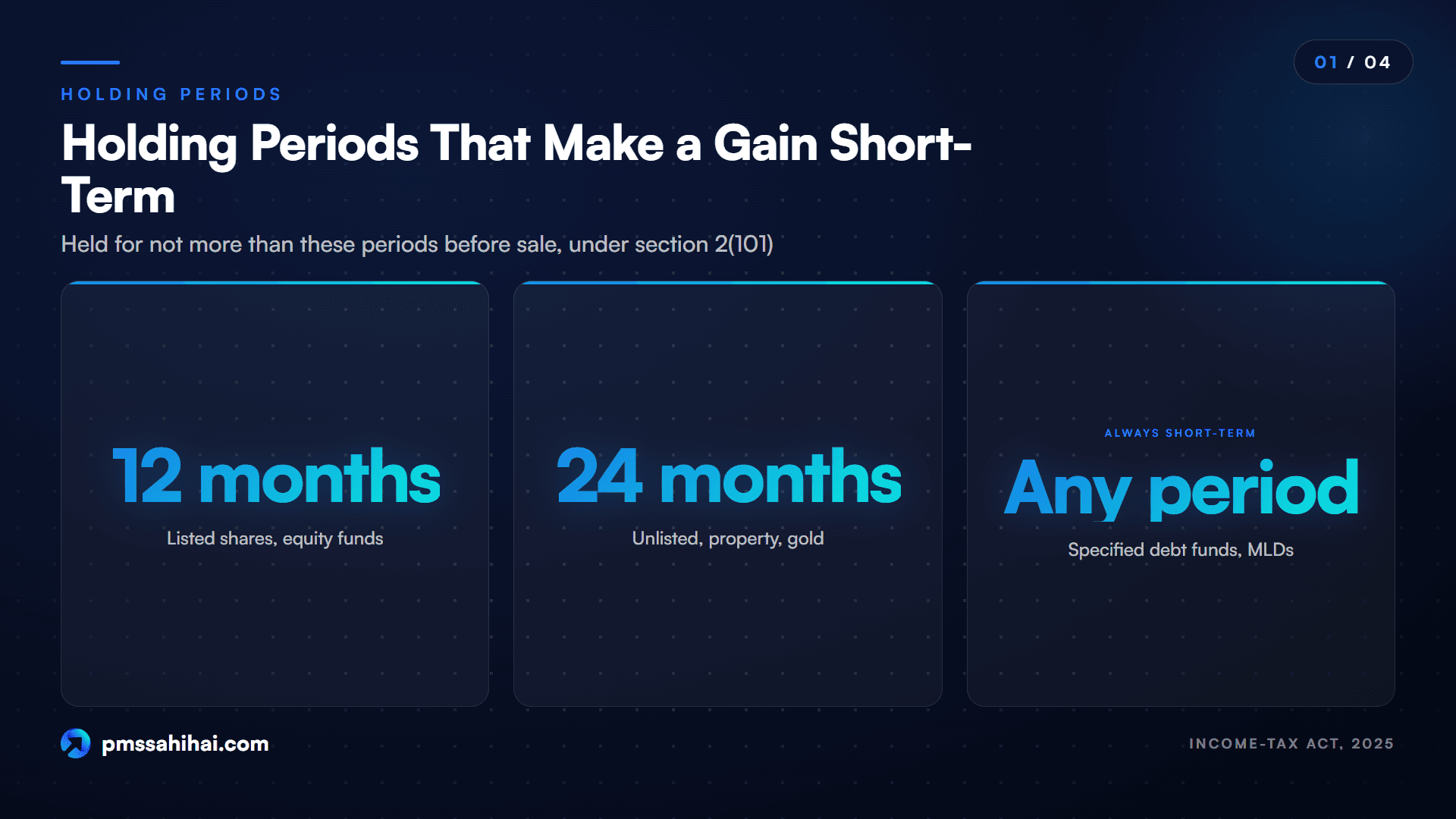
Under section 2(101) of the Income-tax Act, 2025, an asset is short-term if held for not more than 24 months before transfer, or not more than 12 months for:
- securities listed on a recognised Indian stock exchange (shares, listed bonds, listed REIT and InvIT units, ETFs)
- units of UTI and of an equity-oriented fund
- zero-coupon bonds
Everything else uses 24 months: unlisted shares, land and buildings, physical gold, unlisted fund units such as gold or international funds, and most other assets.
"Not more than 12 months" means a sale around the anniversary can still be short-term. If you are close to the line, wait a few days and confirm dates on your broker statement.
Whose clock counts: FIFO, bonus, rights and inherited assets
- Demat holdings use first-in-first-out (FIFO). Section 67(7) applies FIFO to cost and holding period, so the oldest lot is sold first.
- Bonus and rights shares count from allotment.
- Inherited or gifted assets include the previous owner's holding period.
- Shares received in a merger or demerger include the period you held the original shares.
STCG Tax Rate on Listed Shares and Equity Funds Under Section 196
The three conditions
Section 196 taxes short-term capital gains, including STCG on shares, at 20% when:
- the asset is an equity share, a unit of an equity-oriented fund, or a unit of a business trust (REIT or InvIT);
- it was held 12 months or less; and
- the sale is chargeable to securities transaction tax.
An equity-oriented fund invests more than 65% in equity shares of domestic companies. Equity mutual funds, equity ETFs and most arbitrage and aggressive hybrid funds qualify; check the scheme document.
The gain is the sale price minus cost and transfer expenses such as brokerage. STT itself is not deductible under section 72(3). Trades on an IFSC exchange paid in foreign currency qualify without STT.
What falls outside: intraday, F&O and off-market sales
- Intraday trades settle without delivery, so section 66(31) treats them as speculative: the profit is business income at slab rates, not short-term capital gain.
- Futures and options profits are usually non-speculative business income at slab rates. The STT on options rose to 0.15% of premium and on futures to 0.05% from 1 April 2026.
- Off-market sales of listed shares, with no STT, fall outside section 196 and are taxed at slab rates.
Whether frequent delivery trading is capital gains or business income is a separate question. CBDT guidance from 2016 lets investors choose capital gains treatment for listed shares held over 12 months, but very active trading can still be business income. Our post on PMS fees and income tax covers it.
Short-Term Gains Taxed at Slab Rates: Debt Funds, Property, Gold and Unlisted Shares
Any short-term gain outside section 196 joins your total income and is taxed at your slab rate: under the default regime slabs for 2026-27, nil up to Rs 4 lakh rising to 30% above Rs 24 lakh.
Specified mutual funds, market linked debentures and unlisted bonds
Under section 76, the gain is always short-term, however long you hold, for:
- units of a specified mutual fund bought on or after 1 April 2023
- market linked debentures (MLDs)
- unlisted bonds and debentures transferred, redeemed or maturing on or after 23 July 2024
A specified mutual fund invests more than 65% in debt and money market instruments, or 65% or more in units of such a fund. Liquid, gilt and corporate bond funds are inside; gold, international and equity funds are not. Debt fund units bought before 1 April 2023 follow the ordinary 24-month rule (12 if listed).
Property and the stamp duty value rule
Property is short-term if held 24 months or less, taxed at slab rates. Under section 78, if the sale price is below the stamp duty value by more than 10%, the stamp duty value is treated as the sale price. Reinvestment exemptions for property apply only to long-term gains.
Gold, gold ETFs and Sovereign Gold Bonds
- Physical gold and jewellery: short-term up to 24 months (36 before 23 July 2024); slab rates.
- Gold ETFs: listed, so 12 months; slab rates, since they are not equity.
- Gold mutual funds and fund of funds: unlisted units, 24 months; slab rates.
- Sovereign Gold Bonds: from 1 April 2026, redemption is exempt only for original subscribers holding to maturity. Bonds traded on the exchange use the 12-month listed rule.
Unlisted shares and other assets
Unlisted shares, including pre-IPO and employee stock, are short-term up to 24 months and taxed at slab rates, as are most other capital assets.
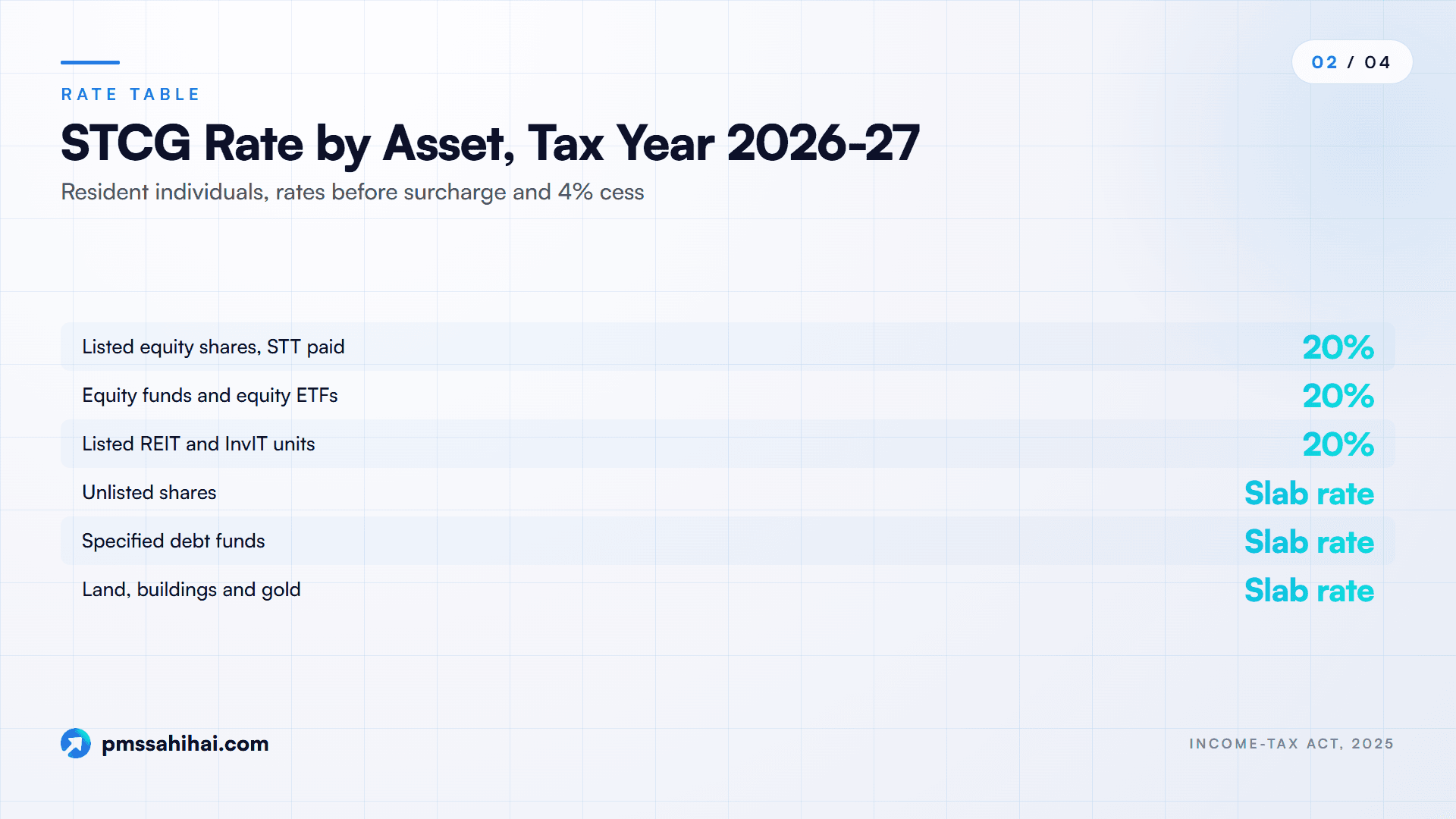
STCG Rate Table by Asset for Tax Year 2026-27
Rates before surcharge and 4% cess, for resident individuals.
| Asset | Short-term if held | STCG tax rate | Section (2025 Act) |
|---|---|---|---|
| Listed equity shares, STT paid | 12 months or less | 20% | 196 |
| Equity-oriented funds and equity ETFs | 12 months or less | 20% | 196 |
| Listed REIT and InvIT units | 12 months or less | 20% | 196 |
| Listed shares sold off-market, no STT | 12 months or less | Slab rate | 2(101) |
| Unlisted shares | 24 months or less | Slab rate | 2(101) |
| Specified debt funds bought from 1 April 2023 | Any period | Slab rate | 76 |
| Debt fund units bought before 1 April 2023 | 24 months or less (12 if listed) | Slab rate | 2(101) |
| MLDs; unlisted bonds from 23 July 2024 | Any period | Slab rate | 76 |
| Listed bonds and debentures | 12 months or less | Slab rate | 2(101) |
| Land and buildings | 24 months or less | Slab rate | 2(101), 78 |
| Physical gold and jewellery | 24 months or less | Slab rate | 2(101) |
| Gold and silver ETFs | 12 months or less | Slab rate | 2(101) |
| Unlisted gold, international and other non-equity funds | 24 months or less | Slab rate | 2(101) |
| Intraday equity trades | Not capital gains | Slab rate (business income) | 66(31) |
Rebate, Basic Exemption, Surcharge and Cess on Short-Term Gains
Using the basic exemption limit
If your other income is below the basic exemption limit, section 196(2) lets a resident individual or HUF use the shortfall against section 196 gains. Under the default regime the limit is Rs 4 lakh, so a retiree with Rs 2.5 lakh of other income can earn Rs 1.5 lakh of equity short-term gains without the 20% bite. Non-residents do not get this adjustment.
Why the rebate does not cover section 196 tax
Section 156 gives a default-regime rebate of up to Rs 60,000 where income does not exceed Rs 12 lakh. But section 156(3) limits it to tax at the slab rates in section 202(1). Tax on section 196 gains is at a special rate, so on this reading the rebate cannot remove it, while slab-rate short-term gains sit inside the rebate. Confirm your case with a tax adviser. No Chapter VIII deductions (the old 80C to 80U family) can be set against section 196 gains either.
Surcharge and cess
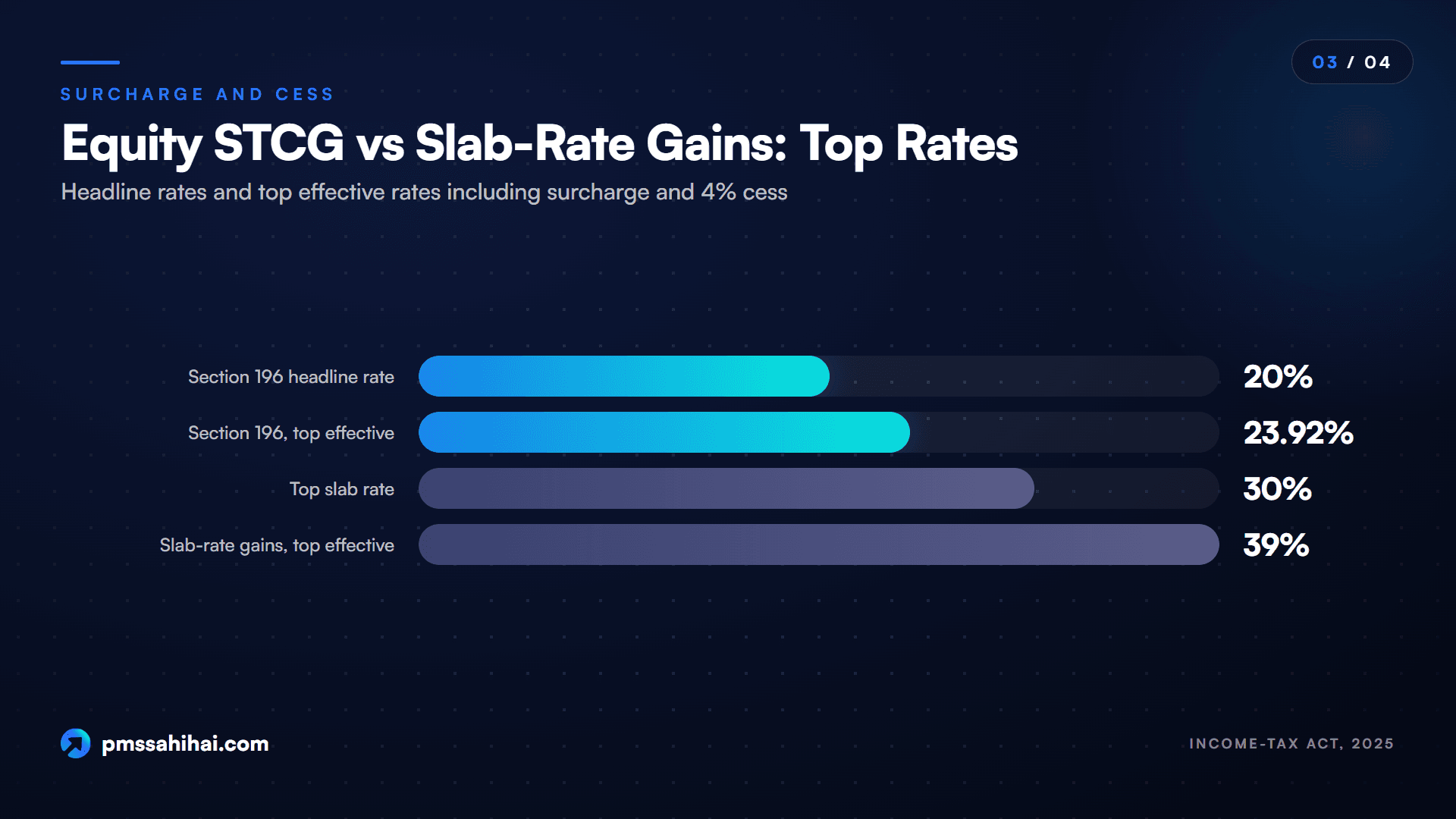
For 2026-27, surcharge is 10% above Rs 50 lakh, 15% above Rs 1 crore and 25% above Rs 2 crore in the default regime. On section 196 gains, and on dividends and gains under sections 197 and 198, it cannot exceed 15%. With 4% cess, the top effective rate on equity short-term gains is 23.92%; slab-rate gains can reach 39%.
How Short-Term Capital Loss Is Set Off and Carried Forward
The rules sit in sections 108 to 111 and 121:
- Same year. A short-term capital loss can be set off against any capital gain; a long-term loss only against long-term gains.
- Not against other income. Under section 109(2), a capital loss cannot reduce salary, rent, business income or interest.
- Eight tax years. Unabsorbed losses carry forward for eight tax years under section 111 with the same restriction.
- File on time. Section 121 allows carry-forward only for a loss shown in a return filed by the due date under section 263(1).
Order matters. A short-term loss set against a 20% gain saves more than one set against a long-term gain at 12.5%, especially after the Rs 1.25 lakh long-term exemption. Whether a loss on a 20% asset can be set against a slab-rate short-term gain has produced differing tribunal rulings; the Act distinguishes only short-term from long-term, so ask your adviser.
Tax-loss harvesting, booking a loss before 31 March to set against gains, is common planning. But brokerage, impact cost and a reset holding period are real costs, so do not sell just for tax.
How STCG Arises Inside a PMS Account
A portfolio management service is not a fund. Under the SEBI (Portfolio Managers) Regulations, 2020, the manager must keep each client's securities separate and may not hold them in its own name (regulation 24), and trades are ordinarily made separately for each client. The shares sit in your demat account, so every sale is your transfer.
- Each trade is your taxable event. A stock sold at a profit eight months after purchase gives you a section 196 gain that year, whether or not you withdraw money.
- FIFO applies across your demat. Section 67(7) taxes the beneficial owner, so the manager's lots and any shares you hold in the same account interact.
- Losses net across all your gains. A short-term loss inside the PMS can be set against a mutual fund or property gain elsewhere.
- Turnover drives the split. High-turnover strategies realise more gains at 20% than buy-and-hold ones paying 12.5% after a year.
Ownership and churn are covered in more depth in the PMS Sahi Hai section below. A mutual fund, by contrast, taxes you only when you redeem units.
How Brokers, Registrars and the E-Filing Portal Track Short-Term Gains
Calculating short-term capital gains once meant a spreadsheet of contract notes. Today:
- Brokers issue capital gains statements that apply FIFO and separate short-term from long-term.
- Fund registrars report realised gains by folio; PMS providers report them per client.
- Exchanges collect STT electronically, which evidences the section 196 condition.
- E-filing return forms carry a capital gains schedule; the ITR-2 user manual lists Schedule Capital Gains alongside schedules for current-year set-off (CYLA), brought-forward losses (BFLA) and losses carried forward (CFL).
Returns filed in July 2026 for the year ended 31 March 2026 used the old Act's forms; the tax year 2026-27 return, filed in 2027, follows the new Act. Reconcile every statement with your own records.
Worked Examples of Short Term Capital Gains Tax for 2026-27
Resident individual, default regime, tax year 2026-27, 4% cess, no surcharge. Illustrations only.
Example 1: A salaried investor with a PMS and a fund redemption
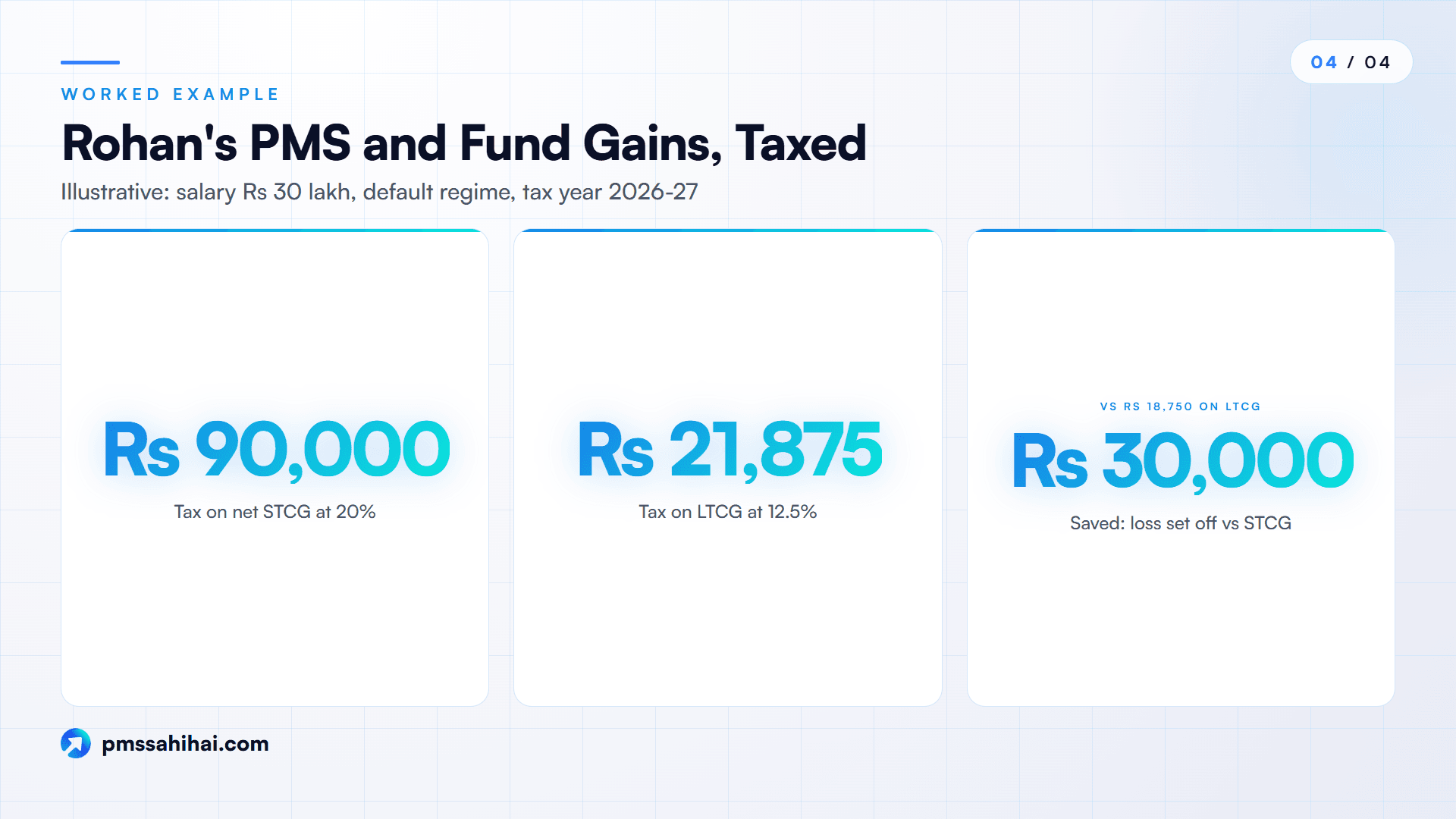
Rohan has taxable salary of Rs 30 lakh. His PMS books short-term gains of Rs 6,00,000 and short-term losses of Rs 1,50,000 on listed shares. He also redeems an equity fund held 20 months for a long-term gain of Rs 3,00,000.
| Step | Amount |
|---|---|
| Net short-term gain (6,00,000 minus 1,50,000) | Rs 4,50,000 |
| Tax at 20% under section 196 | Rs 90,000 |
| Long-term gain above Rs 1.25 lakh | Rs 1,75,000 |
| Tax at 12.5% under section 198 | Rs 21,875 |
| Total with 4% cess | Rs 1,16,350 |
Setting the loss against the 20% gain saves Rs 30,000, against Rs 18,750 if set against the long-term gain.
Example 2: A retiree, an equity fund and a debt fund
Meena has pension income of Rs 2,50,000 after deductions.
- Case A: equity fund units held 10 months, gain Rs 3,00,000. The unused exemption of Rs 1,50,000 absorbs half; the other Rs 1,50,000 is taxed at 20%: Rs 30,000, or Rs 31,200 with cess. On the section 156(3) reading, the rebate does not apply.
- Case B: the same gain on a debt fund bought in 2024 is short-term under section 76 and joins her income: Rs 5,50,000. Slab tax of Rs 7,500 is removed by the rebate. Tax: nil.
The lower headline rate is not always the cheaper outcome.
Example 3: A flat sold after 22 months
Arjun bought a flat in March 2025 for Rs 80 lakh, including stamp duty, and sells it in January 2027 for Rs 92 lakh, paying Rs 1 lakh brokerage. The stamp duty value of Rs 95 lakh is within 110% of the price, so Rs 92 lakh counts. His short-term gain of Rs 11 lakh is taxed at his slab rate, about Rs 3.3 lakh plus cess at 30%. Selling after March 2027 would make it long-term at 12.5%.
What the Current STCG Rules Get Right for Investors
- A flat 20% on listed equity, below the 30% top slab and the same for every investor.
- A 15% surcharge cap, keeping equity short-term gains at no more than 23.92% all-in.
- Flexible short-term losses, usable against short- and long-term gains for eight years.
- Two holding periods instead of three since July 2024, with gold and bonds turning long-term sooner.
- Protection for low incomes through the basic exemption adjustment.
- No interest penalty for unexpected gains if advance tax is paid in later instalments.
How PMS Sahi Hai Helps You See the Short-Term Tax Cost of a Strategy
Short-term capital gains in a PMS are decided by what the manager does: how often positions are sold, and whether they are held past 12 months. That makes choosing a strategy partly a tax decision, and it is the part PMS Sahi Hai is built to make clearer. Here is what the platform offers today, going only by its own pages.
- A side-by-side view of strategies. The PMS comparison tool listed 657 PMS strategies on 6 November 2026, with AUM, 1, 3 and 5-year returns, style, minimum ticket and Nyra score, and lets you pin up to four to compare drawdown, fee structure and Sharpe ratio on the same calendar.
- Nyra, an AI research analyst with tax intelligence. Nyra's about page describes "tax intelligence: STCG / LTCG, pass-through and tax-loss harvesting", and an Honest Mirror that surfaces hidden fees and "post-tax drag on what you own". Nyra is grounded in SEBI, AMC and IFSCA primary sources, cites the source for each answer, and is clear that it is an analytical tool, not a SEBI-registered investment adviser.
- A plain-language tax primer. The PMS and AIF tax guide shows how the same gains can cost about Rs 1.18 lakh more when they are all short-term instead of long-term.
- Deeper reading on the PMS angle. Guides on portfolio turnover ratio and why PMS gains are taxed in your own hands explain how churn turns into short-term capital gains on your return.
What the platform does not do matters as much. There is no STCG calculator, and strategy pages do not show portfolio turnover or post-tax returns, so the split between short-term and long-term gains still has to come from the manager. A practical sequence:
- Shortlist strategies on the comparison tool by style, fees and track record.
- Ask Nyra to review your current holdings for overlap, fee drag and post-tax drag.
- Ask each shortlisted manager for portfolio turnover and the share of last year's realised gains that was short-term.
- Apply the rate table in this guide, then take the estimate to your tax adviser before you invest.
Limitations, Grey Areas and Common STCG Mistakes
- The 2024 increase was large. Going from 15% to 20% raised tax on equity short-term gains by a third, hardest on high-turnover portfolios.
- Debt gains have no long-term route. Specified fund units, MLDs and unlisted bonds pay slab rates however long you hold.
- The rebate and deductions do not reach section 196 tax, which surprises retirees and young investors.
- Business income or capital gains? Very frequent trading can be taxed as business income.
- PMS fees. Whether fees reduce capital gains is disputed before tribunals; see our PMS fees post.
- Buybacks. Since 1 April 2026 they produce capital gains, but how the holding period and STT condition apply to a given offer needs an adviser's check.
- Common mistakes: using the wrong lot's date, ignoring stamp duty value, filing late and losing a loss, and assuming a hybrid fund is equity-oriented without checking.
Advance Tax, Return Filing and Records for Short-Term Gains
Advance tax
If your tax for the year, after TDS, is Rs 10,000 or more, section 404 requires advance tax: 15% by 15 June, 45% by 15 September, 75% by 15 December and 100% by 15 March. Section 425(4) waives interest on a shortfall caused by capital gains if you pay the tax in the remaining instalments after the gain, or by 31 March. In practice, pay in the next instalment after a large sale.
Return filing and records
A return with short-term capital gain cannot use ITR-1, the simplest salaried form; you need one with a capital gains schedule. File by the due date if you have losses to carry forward. Keep contract notes, broker and registrar statements, PMS annual statements, property deeds and stamp duty valuations, gold bills, and proof of cost and dates for inherited assets.
Key Points to Remember About STCG in 2026-27
Short term capital gains tax in India turns on four questions: how long you held the asset, whether it is listed equity or an equity fund, whether STT was paid, and whether you have losses to set off. Answer them and the rate follows: 20% under section 196 for STT-paid listed equity, equity funds and business trust units held 12 months or less, slab rates for almost everything else.
Before any sale, check the date, since a few weeks can turn a gain long-term, and look at the account as a whole, especially in a PMS where the manager's trades land on your return. PMS Sahi Hai and Nyra can help you compare strategies and see where short-term gains come from, but the details of your case belong with a tax adviser.
Plan Your Next Sale With a Tax Adviser
Before you sell, list each holding with its purchase date, cost and type, and work out which bucket each gain falls into. Check whether a short wait would make a gain long-term, whether losses are available, and whether an advance tax instalment is due. If you hold a PMS, ask your manager for realised short-term and long-term gains so far this year. To compare strategies before you invest, use the PMS Sahi Hai comparison tool and ask Nyra to review your holdings for fee and post-tax drag. Then take the numbers to a qualified tax adviser, who can apply the rules to your full return.
PMS Sahi Hai is a distributor of Portfolio Management Services and Alternative Investment Funds, APMI-registered (Registration No. APRN08358). This article is for education only and is not investment advice, a recommendation, or an offer to buy or sell any security. Investments in securities markets are subject to market risks; read all scheme-related documents carefully. Past performance is not indicative of future results. Consult your advisor before investing.
Ishaan founded PMS Sahi Hai to make India's PMS, AIF and GIFT City markets legible to serious investors, comparing every SEBI-registered manager on the same comparative basis, with no shelf products and no commission bias.
Frequently asked
What is short term capital gains tax in India?
It is the tax on profit from selling a capital asset held for a short period: 12 months or less for listed securities and equity fund units, 24 months or less for most other assets. Under the Income-tax Act, 2025, STT-paid listed equity, equity fund and business trust gains are taxed at 20% under section 196; other short-term gains are taxed at slab rates.
What is the STCG tax rate on shares in 2026?
For the tax year 2026-27, short-term gains on listed equity shares sold on a stock exchange with STT paid are taxed at a flat 20% under section 196, the successor to section 111A. Surcharge, capped at 15%, and 4% cess are added. Off-market sales without STT and unlisted shares are taxed at slab rates.
How long must I hold shares to avoid short-term capital gains tax?
Listed shares and equity fund units must be held for more than 12 months for the gain to be long-term; unlisted shares need more than 24 months. In a demat account the first shares bought are treated as the first sold, so check which lot you are selling.
Is short-term capital gain added to my total income?
Yes, all capital gains are part of total income, but tax is computed differently. Section 196 gains are taxed at a flat 20% alongside the tax on your other income. Slab-rate short-term gains, such as on debt funds or property, are added to income and taxed at your slab rate.
Can short-term capital loss be set off against long-term capital gains?
Yes. A short-term capital loss can be set off against both short-term and long-term gains in the same year, while a long-term loss can offset only long-term gains. Neither can reduce salary or other income. Unused losses carry forward for eight tax years if your return is filed on time.
Is the rebate available on STCG under the new tax regime?
Section 156(3) of the Income-tax Act, 2025 limits the default-regime rebate to tax computed at the slab rates in section 202(1). Tax on section 196 equity gains is at a special rate, so the rebate is generally read as not covering it. Slab-rate short-term gains can benefit. Confirm with a tax adviser.
How is STCG taxed in a PMS account?
The securities sit in your own demat account, so each sale by the portfolio manager is your transfer. Gains on listed shares held 12 months or less are taxed at 20% in your hands in the year of sale, even if you withdraw nothing, and PMS losses can be set off against your other capital gains.
Do I need to pay advance tax on short-term capital gains?
Yes, if your total tax for the year, after TDS, is Rs 10,000 or more. Because gains are unpredictable, no interest is charged for earlier instalments if you pay the tax on the gain in the remaining instalments after the sale, or by 31 March of the tax year.
Keep reading
All articles
Strategic Asset Allocation: How to Build a Policy Mix That Lasts
What strategic asset allocation is, what the research shows, and how to set a policy mix by goals, risk and horizon, with PMS and AIF in place.

UHNI Wealth Management Strategies: Structure, Allocation, Liquidity
Eight UHNI wealth management strategies: family balance sheet, structures, PMS/AIF/GIFT City allocation, liquidity tiers and estate planning.

Types of Rebalancing Strategies: Rules, Trade-offs and Indian Costs
Calendar, threshold, hybrid, cash-flow, constant-mix and CPPI rebalancing explained, with the tax and exit-load cost of rebalancing in India.
Read it. Now pressure-test it.
Ask Nyra how this applies to your portfolio, or talk to our team, no pitch, no pressure.