
SIF Taxation: Is a Specialised Investment Fund Taxed Like a Mutual Fund?
SIF taxation under the Income-tax Act 2025: equity, hybrid and debt SIF rules, 12 vs 24-month clocks, and TDS for NRIs.

Yes, in law a Specialised Investment Fund is part of a mutual fund, so SIF taxation follows mutual fund rules: the fund itself pays no tax and you are taxed only when you redeem or receive a payout. But "taxed like a mutual fund" does not mean "taxed like an equity fund". Each SIF strategy falls into one of three buckets under the Income-tax Act, 2025, decided by what the portfolio actually held over the year, not by its SEBI category name. Two hybrid long-short SIFs can therefore be taxed differently, and the holding period for listed non-equity SIF units is still unsettled. NRIs also face TDS on every redemption, so plan with a tax adviser before you invest.
Why SIF Taxation Starts With the Mutual Fund Rulebook
A Specialised Investment Fund sits between a mutual fund and a portfolio management service. It needs a minimum of Rs 10 lakh, it can short up to 25% of its book through derivatives, and it is run by a mutual fund's asset management company under a separate brand. Investors meeting it for the first time ask one SIF tax question more than any other: is a SIF taxed like a mutual fund?
The short answer is yes. The longer answer is where the money is made or lost, because mutual fund taxation itself has three very different outcomes. This guide explains SIF taxation from the statute up, as it stands on 27 October 2026, with section numbers from both the Income-tax Act, 2025 and the old 1961 Act.
If you are new to the product itself, start with our explainer on what a SIF is; this post assumes you know the basics and focuses only on tax.
A SIF Is Legally Part of a Mutual Fund
Specialised investment fund taxation begins with structure. SEBI did not create the SIF as a separate kind of entity. It amended the Mutual Funds Regulations so that a registered mutual fund can set up a SIF, and, as the SEBI circular on the SIF framework puts it, each SIF "investment strategy" is a scheme of that mutual fund launched under the SIF. SEBI's FAQs on SIFs of 22 September 2026 confirm the position under the new SEBI (Mutual Funds) Regulations, 2026: a SIF is established by a registered mutual fund under regulation 16(4).
That legal plumbing matters for tax. The Income-tax Act does not mention SIFs by name, and there is no separate SIF tax code. It taxes "units of a mutual fund", and SIF units are exactly that.
No Tax Inside the Fund Under Schedule VII
Under the Income-tax Act, 2025 as published in the Gazette, persons listed in Schedule VII are not chargeable to tax on their total income. Serial number 20 of that Schedule is "a Mutual Fund registered under the Securities and Exchange Board of India Act, 1992 or regulations made thereunder", with no conditions attached. This is the old section 10(23D) carried forward.
So when a SIF manager sells a stock at a profit, rolls a futures position or earns interest on a bond, nothing is taxed inside the fund. The gain stays in the NAV. You pay tax only when you redeem, switch, sell units on the exchange or receive an income distribution (IDCW). Every SIF offer document repeats this: the tax column for the fund itself reads "Nil".
How SIF Taxation Evolved From 2024 to the Income-tax Act 2025
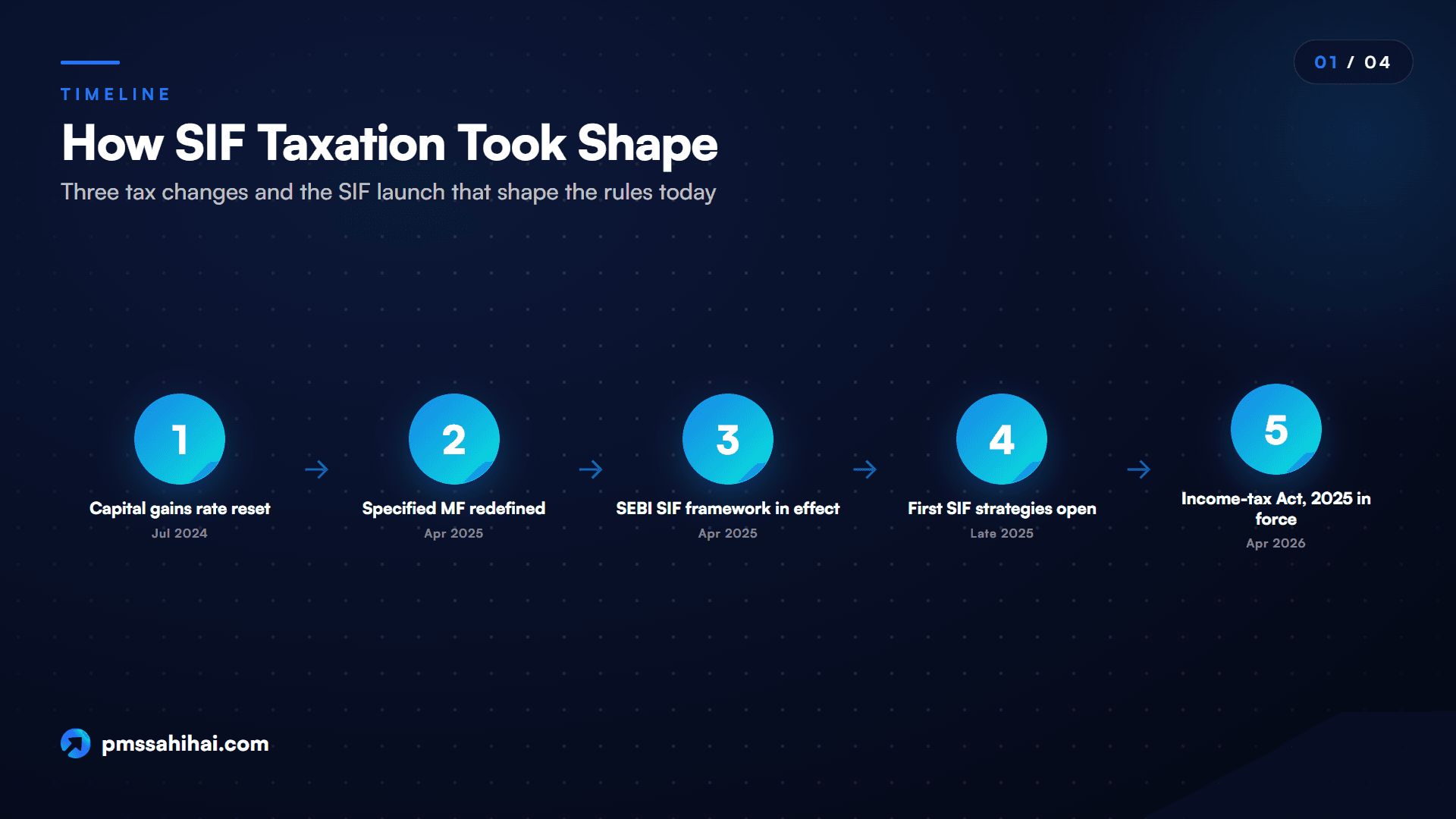
SIFs arrived during the busiest stretch of capital gains reform in a decade. Three dated changes shape the SIF taxation rules an investor faces today.
The July 2024 Capital Gains Reset
The Finance (No. 2) Act, 2024 rebuilt the capital gains rate card from 23 July 2024. Its Budget 2024 memorandum said there would be only two holding periods: 12 months "for all listed securities" and 24 months for all other assets. The short-term rate on STT-paid equity and equity-oriented fund units rose from 15% to 20%. Long-term gains became 12.5% across asset classes, without indexation, and the annual exemption for listed equity gains rose to Rs 1.25 lakh.
The April 2025 Specified Mutual Fund Redefinition
From 1 April 2023, units of "specified mutual funds" bought on or after that date lost long-term treatment altogether. The definition then caught any fund with 35% or less in domestic equity. From 1 April 2025 it was narrowed: a specified mutual fund is now one that invests more than 65% in debt and money market instruments, or 65% or more in units of such a fund. Several popular SIF tax guides still quote the old 35% test. It is out of date.
The Income-tax Act 2025 Renumbering
The Income-tax Act, 2025 came into force on 1 April 2026 and, as the e-filing portal notes, replaced the 1961 Act. The substance of mutual fund taxation carried over, but every section number changed. SEBI's SIF circular framework, in turn, took effect on 1 April 2025, and the first strategies opened in late 2025.
| Rule | Income-tax Act, 1961 | Income-tax Act, 2025 |
|---|---|---|
| Mutual fund not taxed | Section 10(23D) | Schedule VII, Sl. No. 20 (with s.11(3)) |
| Short-term vs long-term holding period | Section 2(42A) | Section 2(101) |
| Specified mutual fund (debt-heavy) always short-term | Section 50AA | Section 76 |
| STCG on STT-paid equity-oriented units | Section 111A | Section 196 |
| LTCG on other assets | Section 112 | Section 197 |
| LTCG on STT-paid equity-oriented units, definition of equity-oriented fund | Section 112A | Section 198 (definition in s.198(8)) |
| TDS on mutual fund income, residents | Section 194K | Section 393(1), Table Sl. No. 4(i) |
| TDS on mutual fund income, non-residents | Section 196A | Section 393(2), Table Sl. No. 10 |
| TDS on other sums to non-residents | Section 195 | Section 393(2), Table Sl. No. 17 |
| Set-off and carry forward of capital losses | Sections 70 and 74 | Sections 108 and 111 |
Many AMC documents written before April 2026 still cite the old numbers. The rules are the same; only the references moved.
The Three Tax Buckets Every SIF Strategy Falls Into
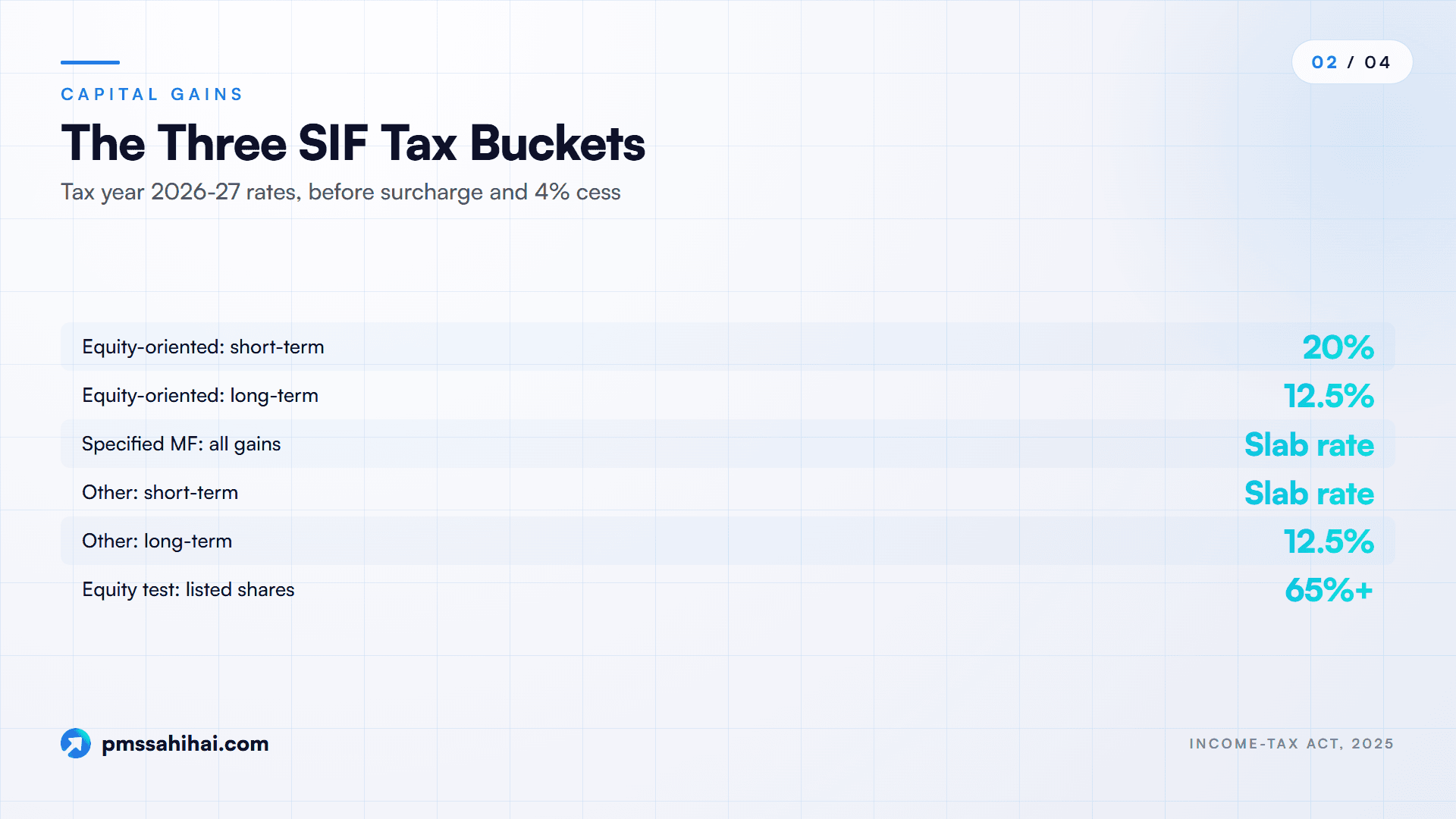
For SIF capital gains tax, every strategy, in every tax year, lands in one of three buckets. The bucket decides the rate, the holding period and whether long-term treatment exists at all.
Bucket One: Equity-Oriented SIF
Section 198(8) defines an equity-oriented fund as a scheme of a mutual fund in Schedule VII where at least 65% of total proceeds is invested in equity shares of domestic companies listed on a recognised stock exchange. For an equity-oriented SIF:
- Units held for 12 months or less give short-term gains taxed at 20% under section 196.
- Units held for more than 12 months give long-term gains taxed at 12.5% under section 198 on the amount above Rs 1.25 lakh in a tax year.
- Securities transaction tax of 0.001% applies on redemption, which is the STT condition these sections rely on.
The Rs 1.25 lakh threshold is one limit per person per year, shared with your listed shares and equity mutual funds.
Bucket Two: Specified Mutual Fund (Debt-Heavy SIF)
Section 76 treats any gain on units of a specified mutual fund acquired on or after 1 April 2023 as short-term, however long you hold. Every SIF unit was bought after that date, so a debt-heavy SIF strategy that crosses the 65% debt line gives slab-rate tax on every rupee of gain. Holding for three years does not help.
Bucket Three: Everything Else
A SIF strategy that is neither equity-oriented nor specified sits in the residual bucket, and this is where SIF taxation gets least intuitive. Short-term gains are taxed at slab rates. Long-term gains are taxed at 12.5% under section 197, without indexation and without the Rs 1.25 lakh exemption. The holding period for long-term status is either 12 or 24 months, and for SIFs that question is not fully settled (see below).
| Bucket | Test (annual average) | Short-term | Long-term | Long-term after |
|---|---|---|---|---|
| Equity-oriented | 65%+ in listed domestic equity shares | 20% (s.196) | 12.5% above Rs 1.25 lakh (s.198) | 12 months |
| Specified mutual fund | More than 65% in debt and money market | Slab rate (s.76) | Not available | Never |
| Other | Neither test met | Slab rate | 12.5%, no exemption (s.197) | 24 months (12 if listed, disputed) |
Rates are for the tax year 2026-27, before surcharge and 4% cess.
How a SIF's Tax Bucket Is Decided Each Year
The most common SIF taxation mistake is to read the bucket from the strategy's name. SEBI's own circular groups SIF strategies under headings called "Equity Oriented", "Debt Oriented" and "Hybrid". Those are regulatory labels for portfolio rules. They are not the tax test.
The Annual-Average Tests
The equity test in section 198(8) is computed on the annual average of the monthly averages of the opening and closing figures. The debt test in section 76 uses the annual average of the daily closing figures. Three consequences follow:
- A single month's factsheet proves nothing. A strategy at 70% equity in March may have averaged 60% over the year.
- The status can change from year to year. The qsif Sector Rotation Long-Short Fund offer document warns that if the manager keeps equity lower "for a prolonged period", the fund "may be regarded as a debt oriented fund" for that year, and investors who redeem in that year may pay tax at debt-fund rates.
- The test is applied to the fund, but you bear the result. Your redemption year matters more than the year you invested.
Do Derivatives Count Towards the 65% Test?
The statute counts "equity shares of domestic companies listed on a recognised stock exchange". SEBI's portfolio rules, by contrast, count "equity and equity related instruments", which include derivatives. The gap matters. A long-short strategy that meets SEBI's 80% equity floor partly through long futures could hold less than 65% in actual listed shares. Only the shares count towards the tax test; a futures contract is not an equity share.
Short positions do not reduce the share count either. The test looks at what the fund invested in shares, not at its net market exposure.
Why Arbitrage Positions Usually CountAn arbitrage trade buys shares in the cash market and sells matching futures. The shares are real listed equity shares, so they count towards 65% even though the position is fully hedged. This is why arbitrage mutual funds are taxed as equity, and it is the route by which a hybrid long-short SIF can reach equity taxation while carrying little net equity risk.
SIF Capital Gains Tax by Strategy Category
SEBI permits a fixed menu of SIF strategies, one per category per SIF. Here is how SIF capital gains tax maps to each.
Equity Long-Short, Ex-Top 100 and Sector Rotation
These three equity strategies must invest at least 80% (equity long-short, sector rotation) or 65% (equity ex-top 100) in equity and equity-related instruments, with unhedged shorts capped at 25%. These are usually run as equity-oriented SIF strategies, and their offer documents are written for equity taxation: the WSIF Equity Long-Short Fund document, for example, shows 20% short-term and 12.5% long-term above Rs 1.25 lakh after 12 months.
The ex-top 100 strategy deserves care because its floor is exactly 65% of equity and equity-related instruments. If part of that floor is met with derivatives, the share-only tax test could slip below 65% in some years. Ask the AMC for the annual-average equity share figure.
Why Two Hybrid Long-Short SIFs Can Be Taxed Differently
A hybrid long-short SIF must hold at least 25% in equity and at least 25% in debt, may short up to 25% unhedged, and redeems no more than twice a week. Within those limits a manager can build very different portfolios, and the tax follows the portfolio.
Two launches from 2025 show how hybrid long-short SIF taxation can split. Business Standard reported in September 2025 that SBI's Magnum hybrid long-short strategy was aimed at investors "seeking debt-like returns with equity taxation", with a large arbitrage and covered-call book. The same paper reported that returns from Edelweiss's Altiva hybrid long-short strategy would be taxed at 12.5% only after 24 months, with slab rates before that.
Same SEBI category, two tax outcomes. The difference is whether the annual average of listed shares, including hedged arbitrage shares, stays at 65% or more. This is the single most important point in hybrid long-short SIF taxation, and the reason to read the tax section of each offer document rather than a category table.
| Hybrid long-short design | Likely bucket | What to check |
|---|---|---|
| 65%+ in listed shares, much of it hedged arbitrage | Equity-oriented | Annual-average share figure; STT on redemption |
| Balanced equity and debt, little arbitrage | Other | 24-month (or 12-month) long-term clock |
| Debt above 65% on daily average | Specified mutual fund | Slab rate on all gains |
Debt Long-Short and Active Asset Allocator Strategies
For SIF capital gains tax, the two debt strategies (debt long-short and sectoral debt long-short) invest mainly in debt instruments and are interval strategies. If debt and money market instruments average more than 65%, they are specified mutual funds and every gain is short-term at slab rates. For an investor in the 30% slab, that is broadly the same tax as a bank deposit, deferred until redemption.
The active asset allocator long-short strategy has no minimum allocation to any asset class. It can move between equity, debt, REITs, InvITs and commodity derivatives, so it can land in any bucket in any year. Treat its tax status as a variable, not a fact.
The 12 or 24 Month Question for Listed SIF Units
SEBI requires units of all close-ended and interval SIF strategies to be listed on a stock exchange, and any strategy without daily subscription or redemption counts as interval. Hybrid long-short and debt strategies are interval strategies, so their units are listed.
That creates a question no regulator has answered yet. Section 2(101) of the 2025 Act gives a 12-month holding period to any "security listed in a recognised stock exchange in India", alongside equity-oriented fund units. Mutual fund units are securities under the Securities Contracts (Regulation) Act, and the 2024 memorandum spoke of 12 months "for all listed securities". On that reading, a listed non-equity SIF unit becomes long-term after 12 months.
Fund houses have not taken that view. The qsif Hybrid Long-Short Fund offer document, for instance, applies slab rates to non-equity gains "up to 24 months" and 12.5% beyond, and the Business Standard report on Altiva used 24 months. One independent SIF tax guide argues for 12 months on listed units.
For SIF capital gains tax planning, our reading is that the statute supports 12 months, but the question is untested and the AMC will compute any TDS on its own view. Until the CBDT clarifies or a ruling settles it, plan on 24 months and treat an earlier long-term claim as a position to discuss with your tax adviser before you file.
TDS on SIF for Resident and NRI Investors
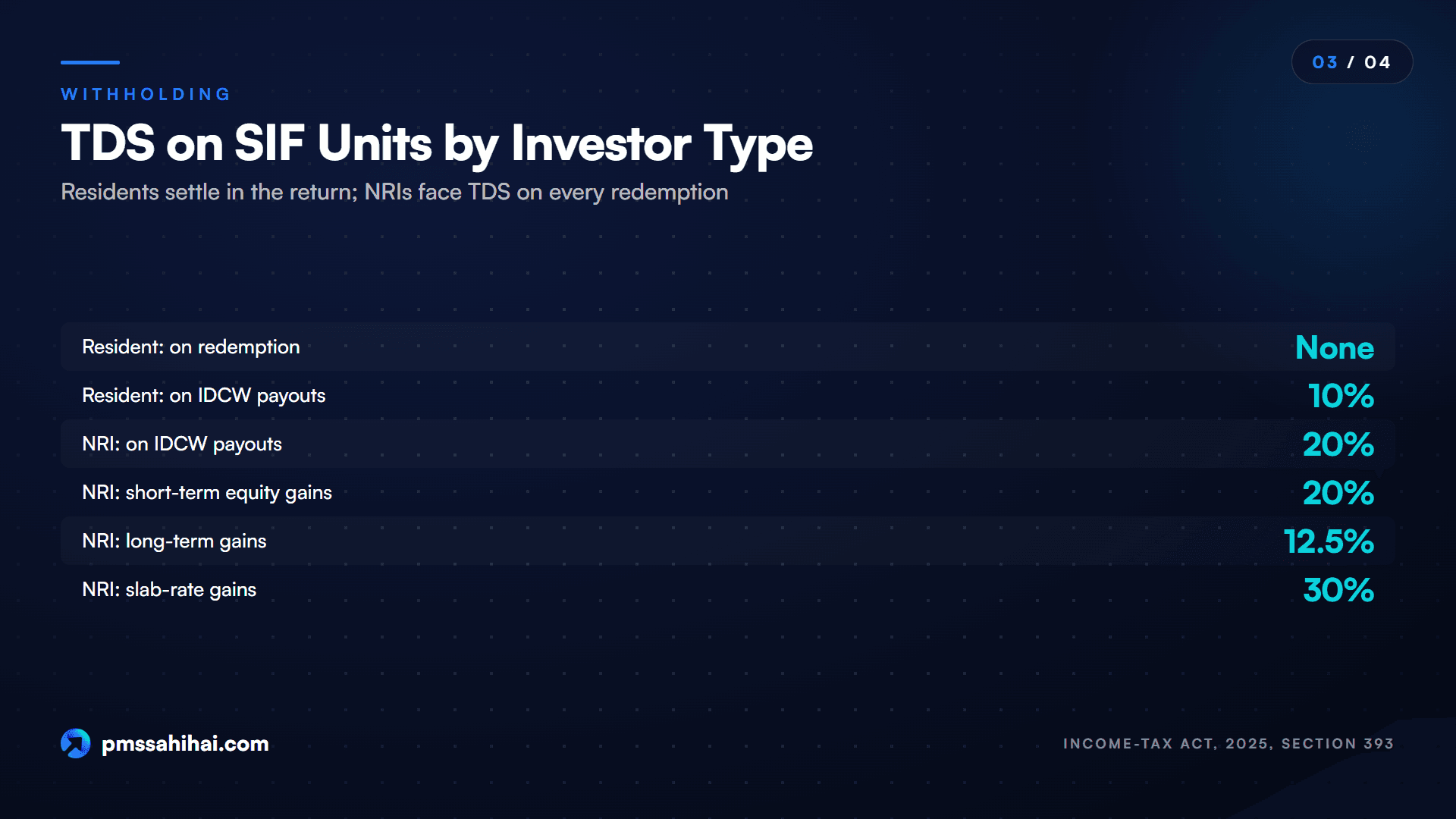
TDS on SIF units follows the same tables as mutual funds, and the gap between resident and non-resident treatment is wide.
Resident Investors: No TDS on Redemption
- Redemptions and switches: no TDS. You compute and pay the tax in your return.
- IDCW payouts: 10% TDS under section 393(1), Table Sl. No. 4(i), once payouts from the fund exceed Rs 10,000 in a tax year. The payout is then taxed at your slab rate.
- Interest costs: from 1 April 2026, the Budget 2026 changes remove any deduction for interest paid to earn mutual fund income, so borrowing to invest in an IDCW plan no longer reduces the tax.
NRI Investors: Withholding at Rates in Force
For non-residents, TDS on SIF payouts is deducted by the fund house before paying you, on every redemption:
- IDCW and other income in respect of units: section 393(2), Table Sl. No. 10, with Note 2: 20%, or the lower rate in a tax treaty if you give a tax residency certificate.
- Capital gains on redemption: withheld at the "rates in force" for 2026-27, which fund houses apply as 20% on short-term equity-oriented gains, 12.5% on long-term gains and 30% on slab-rate gains, plus surcharge and cess.
Three practical effects follow. TDS is per redemption, so a loss in one SIF does not reduce TDS on a gain in another. Deductors generally apply 12.5% to the whole long-term gain and leave you to claim the Rs 1.25 lakh threshold in your return; that is deductor practice, not statute. And sections 196 to 198 give the basic-exemption adjustment only to residents, so an NRI's gains are taxed from the first rupee above the threshold.
Using a Treaty or a Lower Deduction Certificate
A treaty rate on income in respect of units needs a tax residency certificate and the self-declaration that used to be Form 10F (now Form 41 under the Income-tax Rules, 2026). Whether a treaty relieves capital gains on mutual fund units depends on the specific treaty and, for some countries, on disputed tribunal rulings, so check your treaty with an adviser before relying on it.
Where your final liability will be lower than TDS, for example because of carried-forward losses, you can apply under section 395(1) for a lower or nil deduction certificate, reportedly on Form 128. It must be in place before you redeem.
SIF vs Mutual Fund Taxation and Other Wrappers
On the law, SIF vs mutual fund taxation is identical: same Act, same sections, same buckets. The practical differences come from what SIFs are allowed to hold.
| Point | Regular mutual fund | SIF |
|---|---|---|
| Tax inside the fund | None | None |
| Buckets | Equity-oriented, specified, other | Same |
| How close to the 65% lines | Most categories sit far from them | Long-short and hybrid strategies can sit near them |
| Units listed | Only ETFs and closed-ended schemes | All interval and close-ended strategies |
| Switches between schemes | Taxable redemption | Taxable redemption |
| Minimum ticket | Rs 100 to Rs 5,000 typical | Rs 10 lakh across a SIF, at PAN level |
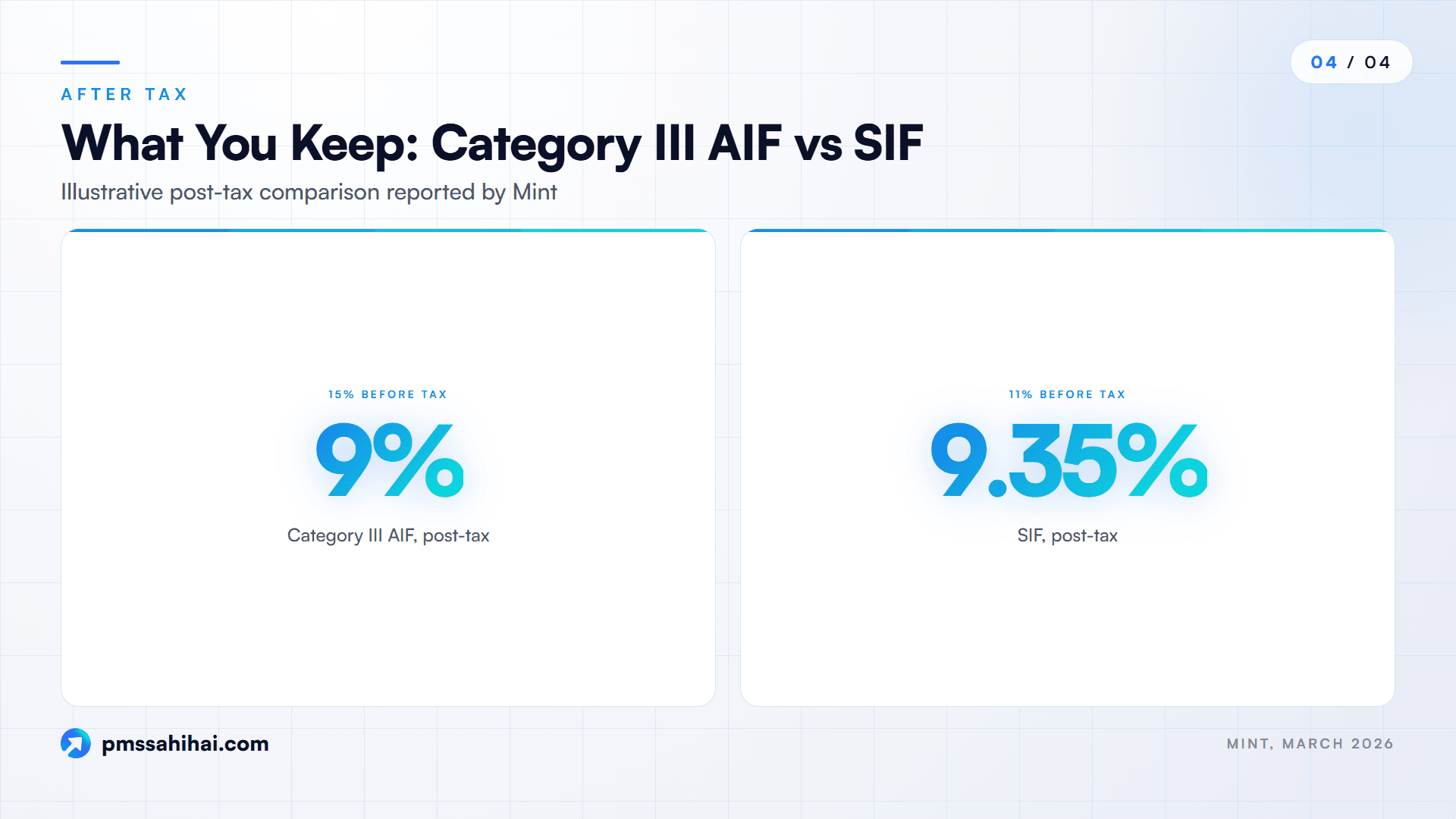
The bigger SIF tax gap is with other wrappers. In a PMS you own the shares directly, so every profitable sale by the manager is a taxable event in your name. In a Category III AIF, income is taxed at the fund level because there is no statutory pass-through. Mint's March 2026 illustration shows the effect: a Category III AIF earning 15% before tax and taxed at 39% leaves about 9%, while a SIF earning 11% with an effective 15% long-term tax leaves about 9.35%. Our guide to long-short funds in India covers how SIF and AIF long-short books differ beyond tax.
What the SIF Tax Framework Does Well for Investors
For all its traps, SIF taxation gives investors real advantages:
- Deferral. No tax while the manager trades. A long-short book that turns over heavily compounds on the full pre-tax value until you exit.
- Equity rates on hedged books. An equity-oriented SIF that uses arbitrage or hedges still qualifies for 20% and 12.5%, because the test counts shares held, not net exposure.
- Simple filing. You report one redemption per transaction in the capital gains schedule, not hundreds of PMS trades.
- No TDS for residents on gains. Cash flow stays with the investor until the return is filed.
- Treaty access for NRIs. IDCW withholding drops to the treaty rate with the right certificate.
- Loss flexibility. Short-term capital losses can be set off against any capital gains, long-term losses against long-term gains, and both carry forward for eight tax years if you file on time.
How PMS Sahi Hai Helps You Read a SIF's Tax Clauses
SIF taxation is the part of the product that a factsheet hides best. The strategy name says "hybrid" or "long-short"; the offer document's tax table, the annual-average equity figure and the holding period are where the post-tax return is actually decided. PMS Sahi Hai is built around the idea that you should compare investment options on what you keep, with the source in front of you.
Here is how to use it alongside this guide, based on what the site describes today:
- Start with the rulebook, then the wrapper. Our explainer on what a SIF is covers the product, and the SIF vs PMS comparison sets out the non-tax trade-offs. Read them with the three tax buckets above in mind.
- Put the alternatives on the same table. PMS Sahi Hai's compare pages and AIF comparison page line up PMS and AIF strategies side by side. SIFs are mutual fund products and are not listed or scored there, so use the SIF's own offer document for its numbers and the platform for the PMS and Category III options competing for the same money. Our guide to Category III AIF taxation explains the fund-level tax you would be comparing against.
- Ask Nyra for the rule and the source. Nyra is described on the site as an AI research tool grounded in SEBI, AMC and IFSCA primary sources that cites its working and declines when it cannot find a verifiable source. Ask it which SEBI category a strategy belongs to, what its allocation limits are, or how a Category III AIF is taxed, then check the answer against the document it cites. Nyra is an analytical tool, not a SEBI-registered Investment Adviser, and its published methodology scores strategies on five pillars that do not include tax.
- NRIs: check the treaty first. Our DTAA explainer covers which country can tax your Indian gains before you weigh TDS on a SIF.
The point is not to replace your tax adviser on SIF taxation. It is to arrive at that conversation with the right three questions: which bucket, which clock, and how much TDS.
Limits and Open Questions in SIF Taxation
The honest list of SIF tax drawbacks:
- Status can flip. A strategy can move between buckets from one tax year to the next, and you find out after the year closes.
- Debt-heavy SIFs get no long-term relief. For high-slab investors, a debt long-short SIF is no more tax-efficient than a deposit, only deferred.
- The listed-unit clock is unsettled. Until clarified, a 12-month long-term claim on a non-equity SIF carries dispute risk.
- NRIs pay first and reclaim later. Per-redemption TDS, top-slab rates on slab-rate gains and the threshold being claimed only in the return all tie up cash.
- Costs inside the NAV rose in 2026. The Budget 2026 changes raised STT on futures from 0.02% to 0.05% of traded price and on options premium from 0.1% to 0.15% from 1 April 2026. Strategies that roll futures each month bear that cost in their returns.
- There is no SIF-specific guidance. SEBI's investor FAQ on SIFs says only that tax "depends on the nature and classification of the investment strategy and the income-tax law in force at the relevant time".
Making SIF Taxation Work for Your Portfolio
A practical SIF taxation checklist before you commit Rs 10 lakh or more:
- Read the tax table in the offer document. It tells you which bucket the AMC expects and which holding period it will apply.
- Ask for the annual-average listed-share percentage for the last completed year, not the latest factsheet figure.
- Match the holding period to the bucket. Equity-oriented: plan to stay beyond 12 months. Other: plan for 24. Specified: holding period does not change the rate.
- Avoid switching inside the year if a gain is short-term. A switch is a redemption.
- Use the Rs 1.25 lakh threshold deliberately across SIFs, equity funds and shares.
- NRIs: lodge the tax residency certificate and Form 41 before the first IDCW and consider a lower deduction certificate where TDS will overshoot.
So, is a SIF taxed like a mutual fund? Yes, exactly like one. The catch is that "mutual fund" covers three tax regimes, and SIF strategies are built to sit closer to the boundaries than ordinary funds do. Read the portfolio, not the label, line the SIF up against the PMS and AIF alternatives on PMS Sahi Hai, use Nyra to pull up the rules with their sources, and confirm your own position with a tax adviser.
Compare SIF Strategies After Tax With Nyra
SIF taxation rewards investors who read past the label: check the bucket, the holding period and the TDS before you invest, and compare options on what you keep after tax.
- Shortlist the alternatives. Use PMS Sahi Hai's compare pages and AIF comparison page to line up the PMS and Category III strategies competing with a SIF for the same money.
- Ask Nyra for the rule behind the number. Ask Nyra about a strategy's category, allocation limits or tax treatment, and check the source it cites.
- Talk it through. Book a private consultation with the PMS Sahi Hai team to go through your shortlist, then confirm your tax position with your own tax adviser.
Rules and rates in this guide are as of 27 October 2026 and can change with each Finance Act. This is general information, not tax or investment advice.
PMS Sahi Hai is a distributor of Portfolio Management Services and Alternative Investment Funds, APMI-registered (Registration No. APRN08358). This article is for education only and is not investment advice, a recommendation, or an offer to buy or sell any security. Investments in securities markets are subject to market risks; read all scheme-related documents carefully. Past performance is not indicative of future results. Consult your advisor before investing.
Ishaan founded PMS Sahi Hai to make India's PMS, AIF and GIFT City markets legible to serious investors, comparing every SEBI-registered manager on the same comparative basis, with no shelf products and no commission bias.
Frequently asked
Is a SIF taxed like a mutual fund in India?
Yes. A SIF is set up by a SEBI-registered mutual fund, and its strategies are mutual fund schemes, so SIF units are taxed as mutual fund units under the Income-tax Act, 2025. The fund pays no tax under Schedule VII. You pay tax only on redemption, switch, sale or IDCW, at rates that depend on whether the strategy is equity-oriented, a specified (debt-heavy) fund or neither in that tax year.
Does a SIF pay tax when the fund manager trades?
No. A mutual fund registered with SEBI is listed in Schedule VII, Sl. No. 20 of the Income-tax Act, 2025, and is not chargeable to tax. Gains from the manager's buying, selling, shorting and futures rolls stay inside the NAV. Tax arises only for the investor, when units are redeemed, switched or sold, or when an income distribution is paid. This is the old section 10(23D) exemption.
What is the holding period for long-term capital gains on a SIF?
For an equity-oriented SIF it is more than 12 months. For a SIF that is neither equity-oriented nor debt-heavy, fund houses apply more than 24 months, although listed units arguably qualify after 12 months under section 2(101); that question is unsettled. Debt-heavy SIFs classed as specified mutual funds never become long-term, because section 76 treats every gain as short-term.
How is a hybrid long-short SIF taxed?
It depends on the portfolio, not the category. If at least 65% of the fund, on an annual average, sits in listed Indian shares, including hedged arbitrage positions, it is taxed as equity: 20% short-term and 12.5% long-term after 12 months. If not, short-term gains are taxed at slab rates and long-term gains at 12.5% after 24 months. Check each offer document's tax table.
Do derivatives count towards the 65% equity test for SIFs?
No, not directly. Section 198(8) counts investment in equity shares of listed domestic companies. Futures and options are not equity shares, so a strategy meeting SEBI's equity floor partly through long futures may fall short for tax. Shares bought as one leg of an arbitrage trade do count, even though they are hedged, which is how some hybrid SIFs qualify as equity-oriented.
How much TDS is deducted on SIF redemption for NRIs?
For 2026-27, fund houses withhold 20% on short-term gains and 12.5% on long-term gains from equity-oriented SIFs, and 30% on slab-rate gains from other SIFs, plus surcharge and cess. IDCW is withheld at 20% or a lower treaty rate with a tax residency certificate. Tax is deducted on each redemption, and the Rs 1.25 lakh threshold is usually claimed in the return.
Is switching between two SIF strategies taxable?
Yes. A switch from one SIF strategy to another, even within the same AMC, is a redemption of the first followed by a purchase of the second. The redemption is a transfer of units, so it creates a capital gain or loss in that tax year at the rate for that strategy's bucket and your holding period. Only certain scheme mergers by the fund house are exempt.
Is a SIF more tax-efficient than a Category III AIF?
Usually, for individual investors. A Category III AIF has no statutory pass-through, so its income is taxed at the fund level, often near the top marginal rate. An equity-oriented SIF defers tax until redemption and then charges 20% or 12.5%. Mint's March 2026 example showed a SIF earning 11% keeping more after tax than a Category III AIF earning 15%.
Keep reading
All articles
What Is an ETF-Based PMS? Passive Building Blocks, Active Allocation
What an ETF-based PMS is, its two cost layers, ETF liquidity and tax on every switch, PRIM from April 2027, and how it compares with DIY ETFs.

What Happens to Your GIFT City Investment When You Return to India
Returning NRI? What happens to GIFT City funds, deposits and PMS when FEMA and tax residency change: RNOR rules, the 3-month exit and a dated checklist.

DTAA Benefits for NRIs: How to Claim the Treaty Rate on Indian Income
How NRIs claim DTAA benefits in 2026: tax residency certificate, Form 41, who gets the papers, the treaty rate at source and TDS refunds.
Read it. Now pressure-test it.
Ask Nyra how this applies to your portfolio, or talk to our team, no pitch, no pressure.