
What Is a General Power of Attorney (GPA)? Scope, Risks and Limits
What a general power of attorney (GPA) can and cannot do in India: scope, stamp duty, registration, risks, revocation and when to avoid one.


A general power of attorney is a document that lets one person act for another across a wide range of affairs, rather than on a single task. In India it creates an agency, not a transfer, so it cannot by itself pass ownership of property. It ends when the principal revokes it, dies or becomes of unsound mind, and Indian statute offers no general "durable" version. Use one only when a narrower document will not do, name someone you trust completely, and have a lawyer draft it.
What a General Power of Attorney Means in Plain Terms
Suppose you are moving abroad for three years. A flat needs a tenant, a tax notice may arrive and a court matter is still running. Rather than fly home each time, you sign one document letting your sister handle them in your name. That document is a general power of attorney, usually shortened to GPA.
The person who gives the authority is the principal, also called the donor. The person who receives it is the agent, also called the attorney, the donee or the GPA holder. The word "attorney" here has nothing to do with being a lawyer.
The Powers-of-Attorney Act, 1882 defines the instrument in a single line: it includes any instrument empowering a specified person to act for and in the name of the person executing it. Section 2 of that Act adds the useful part. Whatever the holder signs within that authority is as effective in law as if the principal had signed it.
The word "general" describes breadth. A general power of attorney covers a range of matters, or even most of a person's affairs. A special power of attorney covers one act or a defined type of act. Nothing in the 1882 Act actually creates these two labels. They come from legal practice and from the common-law tradition, and the document's wording decides what it does. A document headed "General Power of Attorney" that only authorises the sale of one car is special in substance.
The Supreme Court has summed the nature of the document up neatly. In State of Rajasthan v. Basant Nahata (2005), it described a power of attorney as "a document of convenience". That phrase is worth keeping in mind. A GPA is a convenience tool built on trust. It is not a way to transfer wealth, plan an estate or run a portfolio.
A note before going further: this article explains general principles as they stood on 30 October 2026. It is not legal advice, and power of attorney law has state-level variations. Consult a lawyer before you sign or rely on one.
How the General Power of Attorney Evolved in Indian Law
There is no single GPA statute. The law sits across several older Acts, and the courts have filled in the gaps.
| Year | Milestone | What it did |
|---|---|---|
| 1872 | Indian Contract Act, Chapter X | Set the rules of agency: authority, duties, termination |
| 1882 | Powers-of-Attorney Act | Made acts done by the holder effective as the principal's own |
| 1899 | Indian Stamp Act | Made powers of attorney chargeable to stamp duty, now with state variations |
| 1908 | Registration Act | Sections 32 and 33 fixed which powers of attorney can be used to present documents |
| 2005 | Basant Nahata | Described the document as an agency and a document of convenience |
| 2011 | Suraj Lamp | Held that a power of attorney is not an instrument of transfer |
| 2025 | Ananthamurthy and Ramesh Chand | Reaffirmed that agency ends on death unless coupled with interest, and that a GPA does not confer title |
The Suraj Lamp judgment of 11 October 2011 describes how these "SA/GPA/Will" arrangements worked. A seller took the money, handed over possession, and signed an agreement of sale, a general power of attorney and a will in the buyer's favour. The Court noted that the arrangements evolved to avoid stamp duty, registration charges and capital gains, and to invest unaccounted money. It called the very label "GPA sale" a misnomer, because there cannot be a sale by executing a power of attorney.
What a GPA Holder Can and Cannot Do
The scope comes from two places: the words of the document and the default rules of agency law.
The Wide Authority a GPA Normally Carries
A well-drafted general power of attorney lists its powers one by one. Common categories include:
- Property management: letting, collecting rent, paying municipal taxes, dealing with utilities and society matters
- Banking: operating accounts, subject to the bank's own acceptance and rules
- Contracts: signing and enforcing agreements for the principal
- Litigation: engaging lawyers, filing and defending cases
- Business: running day-to-day affairs for a sole proprietor or partner
Section 188 of the Contract Act gives the holder some extra room. An agent with authority to do an act also has authority to do every lawful thing necessary to do it. An agent with authority to carry on a business may do what is necessary for it, or what is usually done in the course of it.
Where the Authority Stops
Courts read the words closely. Powers of attorney are construed strictly, though with an eye to their purpose, as the Supreme Court said in Syed Abdul Khader v. Rami Reddy (1979). If you want the holder to sell or mortgage, the document should say so. A wide sweep of "all acts" is a poor substitute. In Ramesh Chand v. Suresh Chand (2025 INSC 1059), reports say the GPA allowed management such as letting and mortgaging but was silent on conveyance, which counted against the claim to title.
The holder generally cannot pass the job on. Section 190 of the Contract Act bars an agent from delegating acts that were to be performed personally, except where custom or the nature of the agency requires a sub-agent. A Karnataka High Court ruling in 2017 treated sub-delegation by a holder as invalid unless the GPA expressly allowed it.
The holder cannot stand in for you as a witness on everything. Courts have drawn a line between acting for a party and testifying to what only that party knows. The Supreme Court has accepted that a holder can file a cheque-bounce complaint under Section 138 of the Negotiable Instruments Act when the holder has personal knowledge of the transaction and says so.
A GPA cannot do what a will does. It operates only during the principal's lifetime and stops at death, so it cannot direct who inherits anything.
The holder must act for you, not for themselves. Sections 211 to 216 of the Contract Act require the agent to follow directions, use skill and diligence, render proper accounts on demand and not deal on their own account without your informed consent. If they do, you may repudiate the transaction in the cases the Act describes and claim any benefit they gained.
Exceeding authority has defined consequences. Under Sections 227 and 228, where the authorised part of an act can be separated from the rest, you are bound only by the authorised part. Where it cannot be separated, you are not bound by the transaction at all.
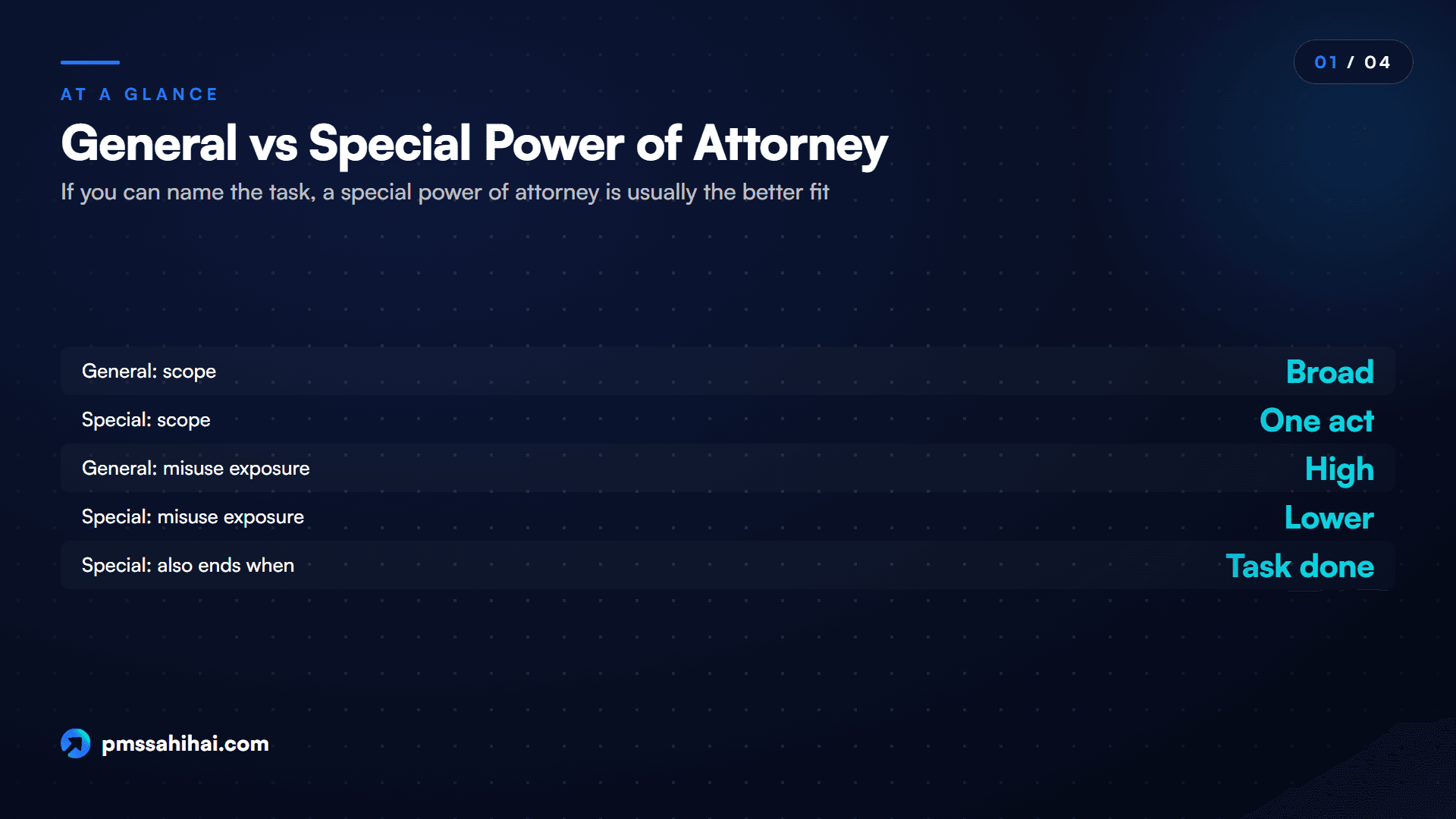
General vs Special Power of Attorney at a Glance
The special power of attorney deserves its own explanation, so here is only the contrast that matters when choosing.
| Feature | General power of attorney | Special power of attorney |
|---|---|---|
| Scope | Many matters, often ongoing | One act or a defined type of act |
| Typical use | Long absence, running affairs | One sale, one loan, one court case |
| Natural end | Revocation, death, unsound mind | Those, plus completing the task |
| Misuse exposure | High, because authority is wide | Lower, because authority is narrow |
| Third-party comfort | Often lower, and may need more checks | Often higher for a defined deal |
If you can name the task, use a special power of attorney. Reserve a general power of attorney for the situation where you honestly cannot predict what will come up.
How to Make a General Power of Attorney in India
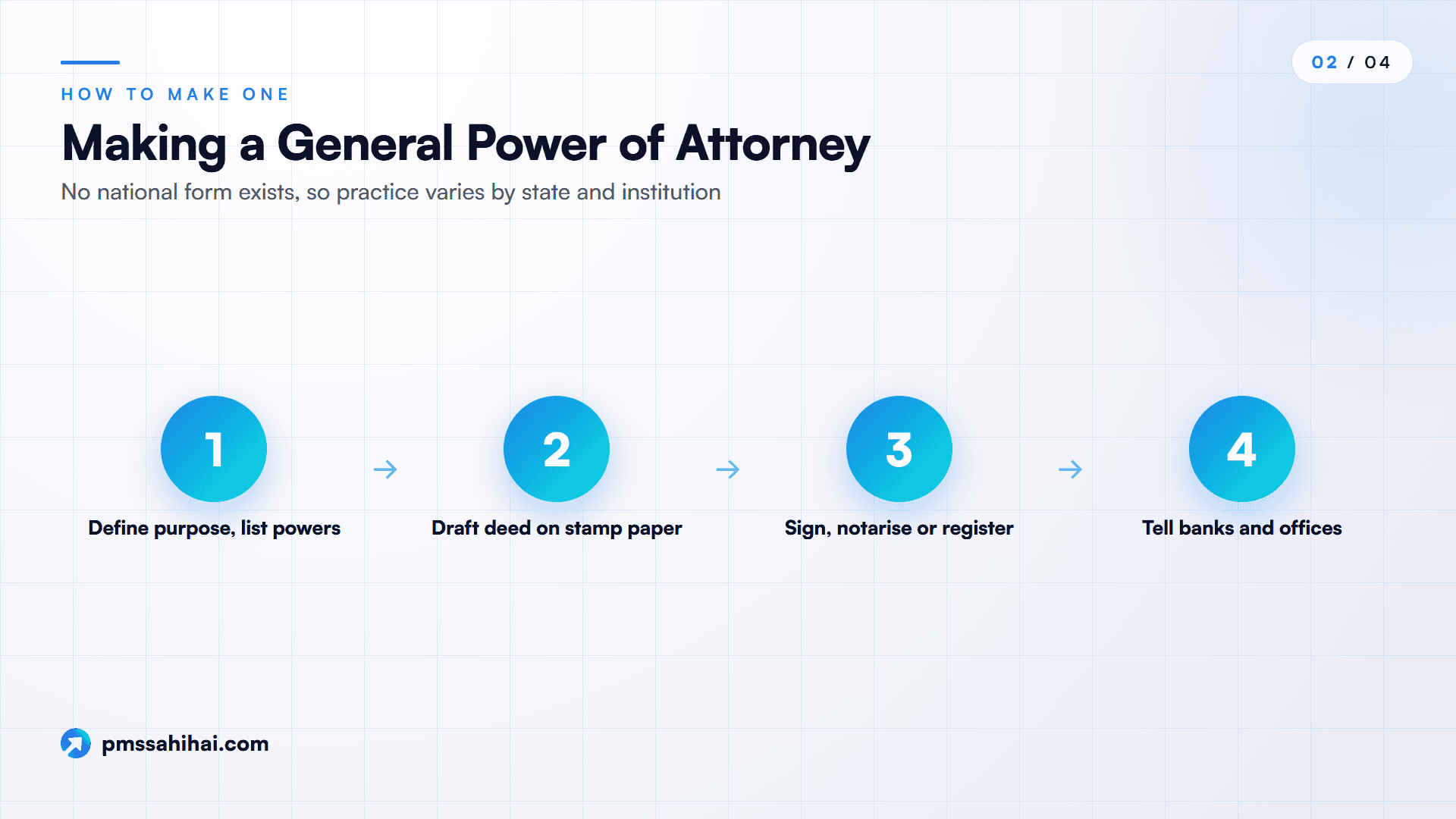
No national form exists, so practice varies by state and by the institution that will rely on the document. The usual sequence is below.
- Define the purpose and list the powers, with a lawyer's help.
- Draft the deed on stamp paper of the right value, naming the principal, the holder, the powers, any limits and any end date.
- Sign before witnesses, then notarise, or authenticate or register it, depending on the use.
- Tell the banks and offices where it will be used, and ask in advance what they accept.
Stamp Duty Depends on the State
Powers of attorney are chargeable under Schedule I, Article 48 of the Indian Stamp Act, 1899, and states have their own rates and schedules. General power of attorney stamp duty can differ widely depending on the state, the relationship between the parties and whether the holder is empowered to sell immovable property. Published guides quote figures that do not always agree, so we are not repeating them here. Check the current schedule with the local sub-registrar or a lawyer.
Notarisation and the Registration Question
This is the point where ranking guides contradict one another. Some say general power of attorney registration is optional and merely advisable. Others say every power of attorney over immovable property must be registered. A few say both on the same page.
Here is what the text supports. Section 17(1)(b) of the Registration Act compels registration of non-testamentary instruments that create, declare, assign, limit or extinguish a right, title or interest in immovable property worth Rs 100 or more. The Supreme Court says a power of attorney is not an instrument of transfer of any such right, title or interest. So a plain agency document does not obviously fall within that clause.
But three practical realities push the other way:
- Section 33 sets its own test. A holder who presents a document for registration on the principal's behalf under Section 32(c) must hold a power of attorney authenticated in the manner Section 33 recognises. For a principal living in India, this means executed before and authenticated by the Registrar or Sub-Registrar within whose area the principal resides.
- States can add rules. Stamp and registration rules vary, and some registration offices apply their own requirements for property work.
- Institutions set their own bar. A bank, buyer or housing society may insist on a registered document whatever the statute says.
Our plain reading: for property use, plan on registration or authentication, and treat a merely notarised GPA as insufficient until a local lawyer confirms otherwise. For non-property use, a notarised document is often used, but ask the institution first.
Signing a GPA From Outside India
A common situation is the NRI who needs someone at home to act. Section 33(1)(c) of the Registration Act recognises, for a principal who does not live in India, a power of attorney executed before and authenticated by a notary public, a court, a judge, a magistrate, or an Indian consul or vice-consul.
India has been a member of the Hague Apostille Convention since 2005, and the Ministry of External Affairs says a document apostilled by a member country should be treated as legalised for all purposes in India, with no further attestation required. For non-member countries, the consular route is the usual one. Once the document reaches India, it will generally need to be stamped. A three-month window from receipt is widely cited, so check it with the local authority as soon as the document arrives.
When a General Power of Attorney Makes Sense
The Supreme Court itself gave examples of genuine use. In Suraj Lamp, it said its observations were not meant to affect powers of attorney in genuine transactions, such as a person authorising a spouse, son, daughter, brother, sister or relative to manage their affairs or to execute a deed of conveyance. It also mentioned a developer holding a power of attorney under a development agreement.
- Long absences abroad. An NRI with property, bank accounts and paperwork in India needs someone local. Note that RBI restricts operation of NRE and NRO accounts by a power of attorney holder to specified local payments and remittances.
- Ageing parents who are still fully capable. A parent who finds travel and queues hard may want a trusted child to handle routine matters. Capacity at signing is essential, and the document's limits on incapacity, discussed below, must be understood.
- A sole business owner. A proprietor who is travelling or recovering from surgery can keep the business running.
Practical Benefits of Using a GPA
- Continuity. Your affairs keep moving while you are away, without a fresh authorisation for each task.
- One instrument for many tasks. You avoid signing a new special document every time something new arises.
- Low cost. Compared with a trust deed or a court process, the paperwork is modest, although stamp duty can rise where property sale powers are included.
- Reversibility. Unless made irrevocable in a manner the law recognises, you can withdraw the authority.
- Cross-border reach. The notary, consul and apostille routes let you act in India without being there.
Using a GPA for Demat Accounts and PMS Investments
This site's readers tend to ask this, so here is the short answer: a GPA is rarely the right tool for your investments, and institutions usually have their own formats.
Broker and demat access. SEBI's Demat Debit and Pledge Instruction, or DDPI, set out in circulars of 4 April 2022 and 6 October 2022, is a separate document for defined purposes. These include transfers for exchange settlement, pledging and re-pledging, mutual fund transactions on exchange platforms, and tendering shares in open offers. The direction of travel is clear: purpose-limited authority is preferred over wide authority.
Portfolio managers. A PMS requires a written agreement with the portfolio manager under the SEBI (Portfolio Managers) Regulations, 2020, which remain in force until the 2026 Regulations take effect on 1 April 2027. Any power of attorney you give the manager is a scoped document for that mandate. A family member holding your GPA does not become your portfolio manager. Assets are held with a custodian, not with the manager or your relative.
If a relative must operate your account. Ask the depository participant, broker or fund house for their own format and rules before you sign anything. SEBI's March 2026 consultation paper on nomination proposed that the existing power of attorney mechanism may be used where an investor is incapacitated "but still has the capacity to contract". That wording is telling. A power of attorney depends on the investor's legal capacity. It cannot be relied on as a safety net once that capacity is lost.
How PMS Sahi Hai Helps You Read the Authority You Sign
Let us be clear about the fit first. PMS Sahi Hai is not a law firm. It does not draft, review or register powers of attorney, and we found nothing in its material suggesting a GPA service. Where it helps is the investment decision that sits next to the paperwork, because authority is easier to judge once you know what is being managed and by whom.
PMS Sahi Hai describes itself as India's first AI-powered PMS and AIF marketplace. Its research tool, Nyra, is described as an AI-powered research platform covering PMS, AIF and GIFT City funds, with more than 900 tracked offerings scored on a single 0 to 10 Nyra Score. Nyra is an analytical tool, not a SEBI-registered investment adviser, and its output is informational rather than personalised advice. It does not read your legal documents.
Three parts of the site are useful if a power of attorney is part of your investing life:
- Who holds what. Our explainer on what a custodian does, and why your manager can't touch your money, shows where your assets actually sit, which helps you see what any authority does and does not reach.
- What you sign at onboarding. The guide to the PMS onboarding process walks through the journey, and the NRI PMS documents checklist covers the extra legalisation layer for a power of attorney signed abroad.
- What the manager tells you. Our guide on how to read a PMS disclosure document shows you how to check a manager's terms before you give anything.
When you are comparing strategies, the PMS comparison view lets you set options side by side. If you are unsure how a particular manager handles a relative's or attorney's involvement, ask the manager directly, and raise it in a conversation with our team.
The Real Risks of a General Power of Attorney
You are bound by what your holder does. Under Section 226 of the Contract Act, contracts made through an agent can be enforced as if you had made them yourself. A holder who signs a loan guarantee within their authority may leave you to deal with it.
Misuse is hard to spot. Because the holder acts in your name and may hold original papers, you might not learn of a transaction for months. Family relationships also change: the trusted sibling of today may be in a dispute with you in five years.
Forgery and stale documents. Courts continue to see disputes over forged GPAs and old GPAs revived after a principal's death. Counterparties may therefore ask for fresh confirmation that the principal is alive and the document still stands, and that can delay genuine work.
The incapacity gap. Section 201 of the Contract Act ends an agency when the principal becomes of unsound mind. This is often the very moment a family most wants someone to step in. Many online guides describe a "durable" power of attorney as an answer, a concept drawn largely from countries such as the United States, where statute provides for it. Section 201 contains no such exception, and we found no Indian statute creating a general durable power. Alternatives for that situation, such as court-appointed guardianship or a trust set up while capable, should be discussed with a lawyer.
Third-party protection can work against you. Under Section 208, revocation takes effect for third persons only when it becomes known to them. Section 3 of the 1882 Act similarly protects a person who acts in good faith under a power without knowing of the donor's death, unsoundness of mind, insolvency or revocation. In other words, a revoked document can still cause real harm until you have told everyone.
Why a GPA Does Not Sell Your Property
Suraj Lamp stated the point directly: a power of attorney is not an instrument of transfer in regard to any right, title or interest in immovable property, and even an irrevocable one does not transfer title. A holder with express authority can execute a registered sale deed on your behalf, and that deed transfers the property. The GPA alone does not.
The Court was careful about the past. Transactions entered into before the judgment could still support applications for regularisation, specific performance and defence of possession, and mutations already made need not be disturbed merely on account of the decision. Since 2011, the message has only grown firmer, and Ramesh Chand in 2025 repeated that a GPA does not confer title.
One question remains open. In G. Kalawathi Bai v. G. Shashikala (2025 INSC 851), a two-judge Bench doubted an earlier ruling and referred to a larger Bench whether a holder who signs a sale deed becomes the "executant" for Section 32(a) of the Registration Act. We found no reported larger-Bench decision as of 30 October 2026. If you are buying or selling through a holder, ask your lawyer how registration should proceed.

How a General Power of Attorney Ends
Section 201 of the Contract Act lists the ways an agency ends: revocation by the principal, renunciation by the agent, completion of the business, the death or unsoundness of mind of either party, or the principal being adjudicated insolvent.
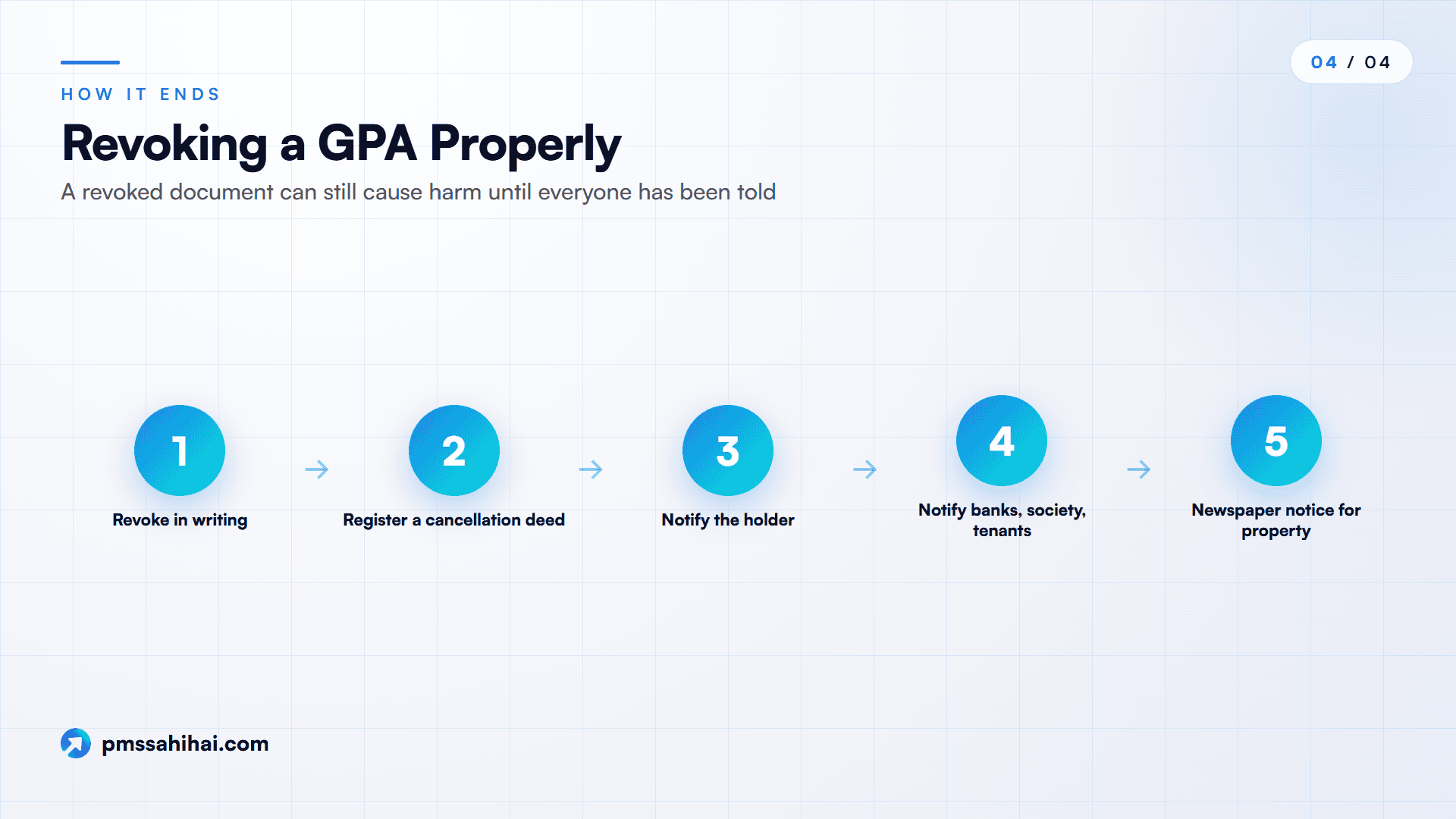
Revocation. Revocation of general power of attorney authority should be done in writing, and a registered GPA is usually cancelled by a deed registered at the same office. Then comes the step people forget: tell the holder and everyone who may rely on the document. Section 206 requires reasonable notice, and Section 208 explains why it matters. Send written notice to your banks, housing society, tenants and registrar, and consider a public newspaper notice where property is involved.
Death of the principal. In M.S. Ananthamurthy v. J. Manjula, decided on 27 February 2025, the holder executed a sale deed on 1 April 1998, after the owner's death on 30 January 1997. The Supreme Court, as reported, held the deed invalid because the agency ended with the death. Acts after that point rest on nothing.
Irrevocable powers. Section 202 provides the main exception. Where the agent has their own interest in the property that is the subject of the agency, the agency cannot, absent an express contract, be terminated to the prejudice of that interest, and its illustrations show such authority surviving the principal's insanity or death. The classic example is authority to sell land and repay a debt from the proceeds. However, Ananthamurthy, as reported, makes clear that the mere use of the word "irrevocable" in a document does not make it so. The interest has to be real.
Unsound mind and insolvency. Both are listed in Section 201. If the holder dies or loses capacity, the authority ends too, so ask your lawyer whether a substitute holder can be named.
Drafting Safeguards Before You Sign a GPA
- Prefer narrower when possible. List powers instead of writing "all acts".
- Carve out the dangerous ones. Unless truly needed, exclude sale, mortgage, gifts, guarantees and borrowing, or require your written consent for each.
- Add an end date. A two-year term forces a review.
- Cap the money. Set a transaction limit and name the accounts covered.
- Require reports. Section 213 already lets you demand accounts. Add a fixed quarterly reporting duty and access to statements.
- Ban self-dealing and sub-delegation explicitly, unless agreed.
- Consider two holders. Joint action on larger decisions adds a check.
- Avoid imported templates. Some online samples carry foreign notary blocks with "State" and "County" fields, which do not fit Indian practice.
Choosing Whether to Grant a GPA at All
Ask yourself three questions before you sign. Can I name the task? If yes, choose a special document. Would I give this person my signature on a blank cheque? If not, do not give them a general power of attorney, since the effect may be similar. Is my real concern what happens if I lose capacity or die? Then a GPA is the wrong instrument, and you need to discuss a will, a trust or other planning with a lawyer.
For many readers, the right outcome is a narrow, dated, well-supervised document. A general power of attorney in India remains a useful convenience when you need broad help for a limited period, from a person you trust fully, with safeguards written in and an exit plan ready. If the assets in question include a PMS or AIF, settle the investment question separately: Nyra and PMS Sahi Hai can help with that comparison, while a lawyer handles the document.
Get a Second Opinion Before You Hand Over Authority
Before you sign, write down the three tasks you actually need done. Take that list to a lawyer and ask whether a narrower document would cover them, what your state's stamp duty and registration rules require, and how you would revoke it.
If part of that authority touches your investments, book a 15-minute call with PMS Sahi Hai. Tell the team what you hold and who may need to act for you, and use Nyra to compare the strategies involved. We will not draft your document, but we can help you ask your manager and your lawyer the right questions.
PMS Sahi Hai is a distributor of Portfolio Management Services and Alternative Investment Funds, APMI-registered (Registration No. APRN08358). This article is for education only and is not investment advice, a recommendation, or an offer to buy or sell any security. Investments in securities markets are subject to market risks; read all scheme-related documents carefully. Past performance is not indicative of future results. Consult your advisor before investing.
Ishaan founded PMS Sahi Hai to make India's PMS, AIF and GIFT City markets legible to serious investors, comparing every SEBI-registered manager on the same comparative basis, with no shelf products and no commission bias.
Frequently asked
What is a general power of attorney in simple words?
A general power of attorney is a document by which one person, the principal, authorises another, the agent, to act on their behalf across a broad range of matters such as property management, banking and legal work. Acts done within that authority bind the principal as if they had done them personally. It is an agency arrangement, and it does not transfer ownership of anything to the holder.
Is registration of a GPA mandatory in India?
No single answer fits all cases. A plain agency document does not obviously fall within the compulsory registration clause of Section 17, but guides disagree, and property use often calls for authentication under Section 33 or registration. Banks, buyers and registrars may also insist on it. Ask a local lawyer or the sub-registrar before relying on a merely notarised document for property work.
Can a GPA holder sell my property?
A holder can sign a registered sale deed for you only if the document clearly authorises sale, and only while the agency is alive. The registered deed transfers the property, not the GPA itself. The Supreme Court held in Suraj Lamp (2011) that a power of attorney is not an instrument of transfer, and buyers should insist on a registered conveyance.
Does a general power of attorney remain valid after the principal dies?
No. Under Section 201 of the Contract Act, an agency ends when the principal dies, unless Section 202 applies because the agent has a genuine interest in the subject matter. In 2025, the Supreme Court, as reported in M.S. Ananthamurthy v. J. Manjula, held invalid a sale deed executed by a holder after the owner's death. Property then passes under succession law or a will.
Does a GPA continue if the principal loses mental capacity?
Generally not. Section 201 of the Contract Act says an agency ends when the principal becomes of unsound mind, and it contains no durable exception. Section 202 protects an agent with their own interest in the property, which is a narrow case. Families facing this situation should take legal advice on court-appointed guardianship, trusts set up while capable, and other options.
How do I cancel a general power of attorney?
Execute a written revocation deed, and register it at the same office if the original was registered. Serve notice on the holder and on every bank, buyer, tenant, society or office that may rely on the document, because revocation affects third parties only once they know of it. Recover the original if you can, and consider a newspaper notice for property matters.
Can an NRI give a general power of attorney from abroad?
Yes. An NRI can sign before a notary and apostille the document where the country is a Hague Convention member, or use an Indian consulate. The document generally needs stamping after it reaches India, with a three-month window widely cited. RBI also restricts what a holder can do on NRE and NRO accounts, so check those limits with your bank first.
Can I use a GPA for my demat account or PMS?
It is rarely the right tool. Brokers use SEBI's limited-purpose Demat Debit and Pledge Instruction for defined tasks, and a portfolio manager works under a written agreement and its own scoped authority. If a relative needs to operate your account, ask the broker, depository participant or fund house for its own format. They decide what they will accept, so check before signing.
Keep reading
All articles
Nifty Fell 16% From Its High in 2026: What It Means for Your PMS
Nifty fell 16% peak to trough in 2026. What it means for PMS holders: the ₹50 lakh floor, high-water marks, exit loads, loss set-off and switching costs.

What Is Micro Cap PMS? The Highest-Risk Corner of Portfolio Management
Micro cap PMS explained: no SEBI category, impact cost, SME stocks, ASM/GSM/ESM curbs, drawdowns, position sizing and who it really suits.

What Is Unlisted Equity? Risks, Rewards and How You Actually Exit
Unlisted equity explained: what you own, how prices are set, every exit route, the IPO lock-in, 2026 tax and ITR rules, and the real risks.
Read it. Now pressure-test it.
Ask Nyra how this applies to your portfolio, or talk to our team, no pitch, no pressure.