
What Is a Durable Power of Attorney? The Position in India
India has no durable power of attorney. See what Section 201 does, why a POA ends on incapacity, and how guardianship and trusts fill the gap.

A durable power of attorney is a document that keeps an agent's authority alive after the person who granted it loses mental capacity. It is a US concept, with similar tools in the UK, and India has no statutory equivalent. Section 201 of the Indian Contract Act, 1872 ends an agency when the principal becomes of unsound mind, so an Indian POA generally stops at the moment a family needs it most. The workable routes are a private trust set up in advance, or a court-appointed legal guardian afterwards. Take advice from a lawyer before relying on any of them.
What a Durable Power of Attorney Means in Plain Terms
Picture a retired investor in Pune, aged 78, with a portfolio in her own name. Her son holds a power of attorney she signed years ago, and it has worked well. Then she is diagnosed with advanced dementia. The son assumes the paper still lets him act. Under Indian law, that assumption is probably wrong.
This is the problem a durable power of attorney was built to solve. A power of attorney is a document in which one person, the principal, authorises another, the agent or attorney, to act on their behalf. Under the ordinary rule, that authority ends when the principal loses mental capacity. A durable power of attorney is written to carry on through that loss. In the words of the US legal publisher FindLaw, it "remains in effect during your disability or incompetence".
Most of what you will read online about a durable POA comes from American websites, which describe state laws that do not apply in India.
How a Durable POA Differs From an Ordinary Power
Three features define the concept in the countries that have it:
- It survives incapacity. The ordinary power ends when capacity goes. The durable version does not.
- It still ends at death. A common mistake, repeated on at least one Indian legal site we read, is to say a durable power continues after death. It does not, as both FindLaw and Policygenius explain. After death, the will, succession law and the estate take over.
- It usually needs express wording and formalities. US sources say the document needs specific durability language, and that witness or notary requirements vary by state.
| Feature | Ordinary power of attorney in India | Durable power of attorney in the US |
|---|---|---|
| Legal basis | Agency under the Contract Act, 1872 | State statute |
| On principal's loss of capacity | Agency ends under Section 201 | Continues |
| On principal's death | Ends | Ends |
| Who supervises the agent | No standing supervisor | Depends on state law |
| Court needed after incapacity | Usually, for a guardian | Often avoided |
Why Investors in India Keep Running Into the Term
NRI families read US or UK estate guides. Children of ageing parents search for answers after a diagnosis. PMS clients, who sign a power of attorney at onboarding, wonder what happens to it if they fall seriously ill. This article looks only at what happens when capacity is lost, not at what a manager may do under a PMS power.
Does Indian Law Recognise a Durable Power of Attorney?
The short answer is no. India has no statute creating a durable power of attorney, an enduring power of attorney or a lasting power of attorney. Practitioners say so directly. Trilegal partner Tanmay Patnaik, writing in Mint, says India has no equivalent of the "lasting" or "durable" powers found abroad. The India chapter of Chambers Private Wealth 2026, written by Cyril Amarchand Mangaldas lawyers, is just as direct: "Once mental incapacity arises, the power of attorney ceases to have effect."
What Section 201 of the Contract Act Says
A power of attorney in India is treated as a contract of agency, and agency is governed by Chapter X of the Indian Contract Act, 1872. Section 201 lists the ways an agency ends. It reads: "An agency is terminated by the principal revoking his authority; or by the agent renouncing the business of the agency; or by the business of the agency being completed; or by either the principal or agent dying or becoming of unsound mind; or by the principal being adjudicated an insolvent".
The words that matter are "becoming of unsound mind". The law does not say the agency ends only if a court declares it, and it does not say the parties may agree otherwise. The Act's test for a sound mind, in Section 12, asks whether a person can understand a contract and form a rational judgment about its effects. Dementia, a coma or a severe brain injury can all raise that question.
This is why the power of attorney mental incapacity problem is so awkward in practice. There is no certificate that switches a power off. The agent may keep signing, and a bank or broker may keep accepting, while the authority behind those signatures has already gone. Any transaction done in that window can later be attacked by a sibling, an heir or a buyer's lawyer.
Why a Survival Clause Is Not a Safe Fix
Some firms suggest adding a line stating that the power stays effective if the principal later loses capacity. One Indian law firm article recommends exactly that, while conceding that India has no statutory lasting power and that agency relationships can be challenged once incapacity is established. Other commentators say flatly that such powers are not recognised.
Our reading is that you should not rely on such a clause. Section 201 contains no "unless agreed otherwise" wording, and the practitioner sources above treat the authority as ending regardless. We did not find a reported Indian decision upholding a survival clause in an ordinary power, though our search was not exhaustive. A clause like this may do no harm, and it records your wishes, but it should never be your only plan. Ask your lawyer about it specifically.
Registering or notarising the deed does not change this. Formalities prove a document was signed properly; they do not rewrite Section 201.
Why a Foreign Durable POA Does Not Solve It
NRIs often ask whether a US durable POA or a UK lasting power of attorney will cover their Indian assets. Do not assume it will. A UK lasting power is, in the UK government's own words, legally binding only in England and Wales. The Chambers chapter warns that overseas clients relying on Indian powers face a "significant practical risk" that later transactions will be invalid. An overseas document must also be accepted by Indian banks, depositories and registrars, and an RBI FAQ shows that POA operations on NRE and NRO accounts are already restricted. Ask an Indian lawyer, and assume you need a separate India plan.
How the Durable Power Evolved Abroad and Stalled in India
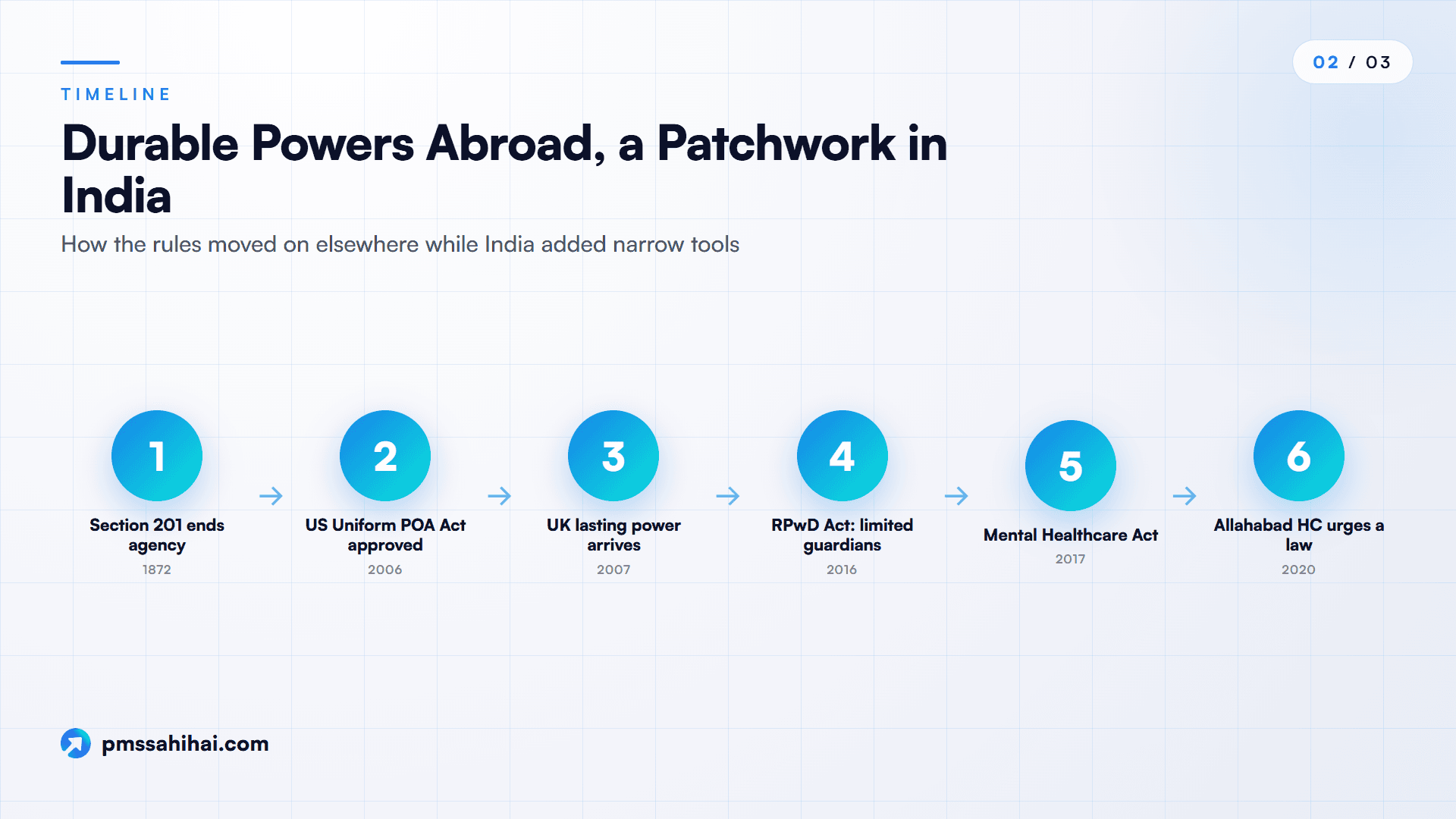
The Indian rule is old. Section 201 dates to 1872. The Powers of Attorney Act and the Indian Trusts Act followed in 1882. Neither created a power that outlasts capacity.
Other systems moved on. In England and Wales, the lasting power of attorney arrived in 2007 under the Mental Capacity Act 2005, replacing the older enduring power of attorney, though enduring powers validly made earlier still work. The UK version comes in two types, one for property and financial affairs and one for health and welfare. It must be registered with the Office of the Public Guardian, which is the supervision India's system lacks.
In the US, the Uniform Law Commission approved the Uniform Power of Attorney Act in 2006, and 26 states had enacted it as of 2019. The US model treats the agent as a fiduciary, and requirements still differ by state.
India took a different path, in pieces:
- 2016: The Rights of Persons with Disabilities Act introduced limited guardianship.
- 2017: The Mental Healthcare Act created advance directives and nominated representatives, for mental healthcare only.
- 2018 and 2023: In Common Cause v Union of India, the Supreme Court upheld living wills and later simplified the procedure.
- 2019: The Kerala High Court, in Shobha Gopalakrishnan, framed interim guidelines for guardians of comatose patients.
- 2020: The Allahabad High Court, in Uma Mittal, followed with its own guidelines and urged the Central Government to legislate.
Those are real advances, but none is a durable power of attorney. As of October 2026, we found no Indian law creating one.
What a Durable Power Offers Where It Exists
It helps to know what India is missing:
- Choice: you pick your decision-maker while you can still choose.
- Speed: the agent can often act without waiting for a court.
- Privacy: family finances stay out of court records.
- Continuity: bills, taxes and investments keep moving.
- Lower cost: a document is generally cheaper than a court process.
Those are the features to recreate, as far as possible, with the tools Indian law does allow.
Narrow Exceptions and Grey Areas Under Indian Law
The Section 201 rule has edges. None of them turns an ordinary power into a durable one, but each comes up often enough to understand.
Agency Coupled With an Interest Under Section 202
Section 202 says that where the agent "has himself an interest in the property which forms the subject-matter of the agency", the agency cannot, absent an express contract, be ended to the prejudice of that interest. Its illustration is clear: A authorises B to sell A's land and repay himself from the proceeds of a debt A owes him. The Act says that authority cannot be terminated by A's insanity or death.
This helps a creditor, not a caregiver. A son who manages his mother's money out of love has no such interest. Nor does calling a deed "irrevocable" create one, because the interest must really exist in the property. A portfolio manager's fee is unlikely to count either, in our reading, though no source we read tests this directly.
Acts Done Before Anyone Knows Under Section 208
Section 208 says the termination of an agent's authority does not take effect, for the agent, before it becomes known to him, or, for third persons, before it becomes known to them. So a good-faith transaction done before anyone knew of the incapacity may stand. It is not a licence to carry on: once the agent knows, the protection for the agent falls away.
Section 209 adds a duty. When agency ends because the principal has died or become of unsound mind, the agent must take "all reasonable steps for the protection and preservation of the interests entrusted to him". That is a duty to preserve, not a general power to keep running the portfolio.
Physical Incapacity With a Sound Mind
Here is the distinction most online summaries miss: incapacity is not the same as unsoundness of mind. A person paralysed by a stroke, or too frail to travel, may be perfectly able to understand and decide. Section 201 is not triggered by physical illness. An ordinary power of attorney works well in that case, and it can be signed then, if the person can understand it.
SEBI drew the same line. Its October 2024 board memo said that where an incapacitated investor still has the capacity to contract, a POA or mandate could be used. Where the investor does not, a guardianship certificate from a court would be required. A medical note confirming capacity at signing can help defend a deed later, and a lawyer can advise on one.
Guardianship Routes When Capacity Has Already Gone
Once capacity has gone, it is too late to sign a new power or a trust deed. A family then generally needs a legal guardian. India has no single statute for this. The Guardians and Wards Act, 1890 covers minors, so adult cases run through a patchwork.
| Route | Who it fits | Decision-maker | Main limit |
|---|---|---|---|
| RPwD Act 2016, Section 14 | Persons with disabilities | District Court or designated authority | Limited guardianship, for specific decisions and periods |
| National Trust Act 1999 | Autism, cerebral palsy, intellectual disability, multiple disabilities | Local Level Committee | Four conditions only |
| Mental Healthcare Act 2017 | Persons with mental illness | Nominated representative; Board in default | Mental healthcare only, no property management |
| Article 226 writ petition | Coma, vegetative state, advanced dementia and others | High Court | Case by case, varied conditions |
Rights of Persons With Disabilities Act 2016
Section 14 lets a District Court or designated authority appoint a limited guardian to take joint decisions with, or decisions for, a person with a disability, on specific matters and for a limited time. In Bindumol A T v Union of India (8 January 2025), the Kerala High Court said permanent guardianship is "alien" to this Act. A family may therefore have to return for extensions.
National Trust Act 1999
This Act has a less formal route through a Local Level Committee, but it covers only four listed conditions. In Bindumol, the Kerala High Court upheld the committee's refusal because the Act has no provision for a guardian of a person with mental illness. Dementia is not on the list either.
Mental Healthcare Act 2017
Section 5 lets an adult make an advance directive about mental illness treatment and name a nominated representative. Section 14 lets any adult appoint one in writing on plain paper. But the representative acts "for the purposes of this Act", meaning mental healthcare. The Act gives them no general power to sell shares, run a bank account or instruct a portfolio manager. It is well worth doing, for what it covers.
High Court Writ Petitions Under Article 226
For coma, vegetative states and often advanced dementia, families go to the High Court, which acts as parens patriae, the guardian of those who cannot protect themselves. Recent orders show how it works:
- Arun Singh v Govt of NCT of Delhi (Delhi High Court, 11 March 2026): A nephew sought guardianship of his aunt, about 84, who had progressive dementia. The court ordered a medical board at Safdarjung Hospital and noted the no-objection of her son in the US. It appointed the nephew legal guardian for legal and financial purposes. The order recalls a "vacuum" in the statutory framework that does not stop a High Court acting.
- Preeti Sahota v Union of India (Bombay High Court, 11 November 2025): A wife became guardian of her comatose husband and of his property, with authority to operate his bank accounts.
- Anjuben Karansinh Dodiya v State of Gujarat (Gujarat High Court, reported July 2024): The wife had to report property transactions to the Registrar General every three months and keep accounts, and the court could revoke her powers on misuse.
- Uma Mittal v Union of India (Allahabad High Court, 2020): The wife could not sell or encumber immovable property without the Registrar General's permission.
The Arun Singh petition first came up on 15 January 2026 and ended on 11 March 2026, roughly eight weeks. That is one uncontested case with willing relatives, not a promise. A dispute could stretch it, and meanwhile nobody may have clear authority over the assets.
Planning Tools That Work Before Capacity Is Lost
The real lesson is about sequence. The tools below must be set up while you can still understand and sign them.
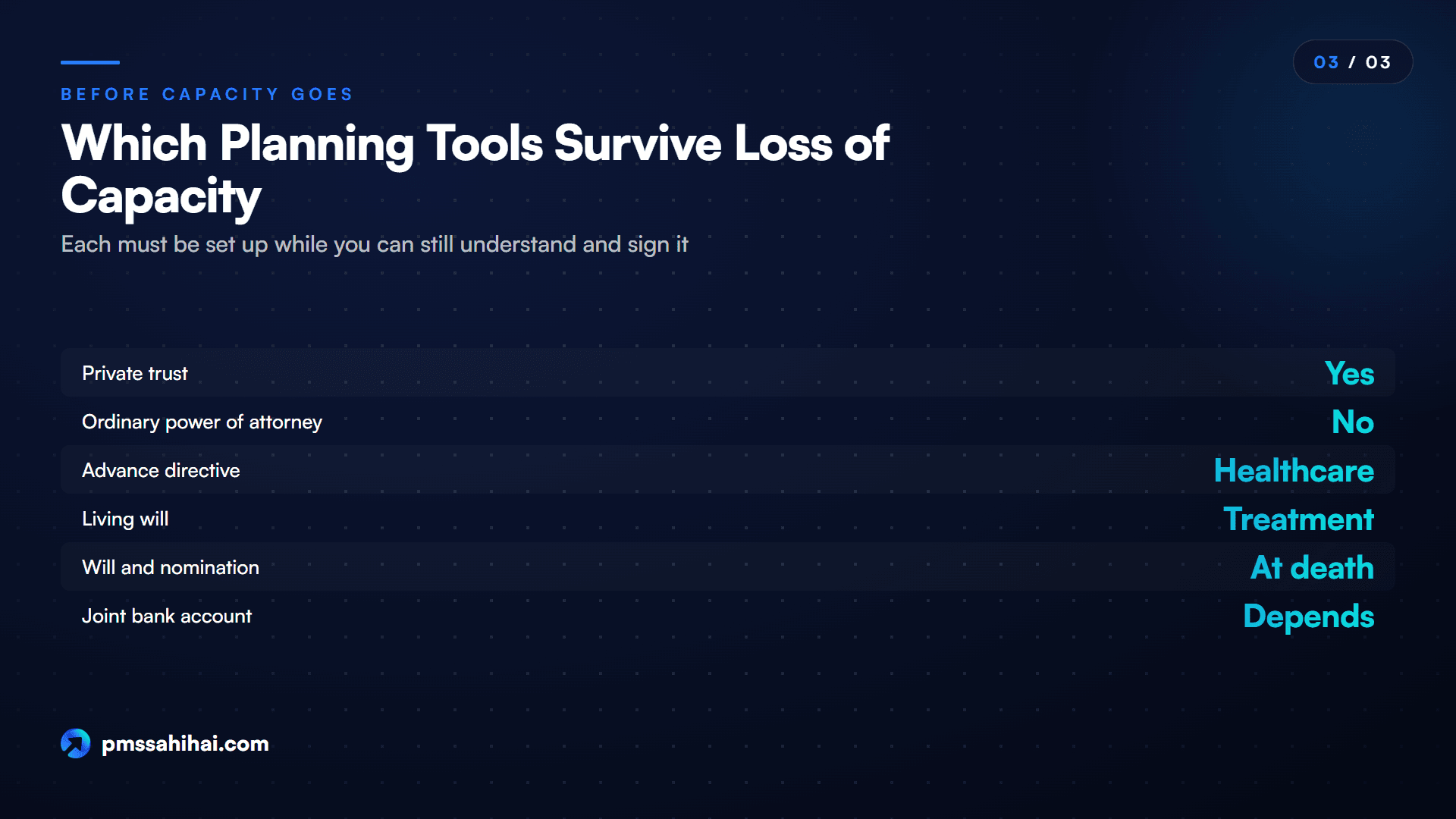
| Need | Tool in India | Works after capacity is lost? |
|---|---|---|
| Someone to run investments long term | Private trust with chosen trustees | Yes, trustees keep their role under the deed |
| Help with paperwork while you are capable | Ordinary power of attorney | No, it ends under Section 201 |
| Mental healthcare decisions | Advance directive, nominated representative | Yes, for healthcare only |
| End-of-life treatment wishes | Living will, Common Cause framework | Yes, for treatment only |
| Passing assets at death | Will and nomination | Operate at death only |
| Day-to-day household access | Joint bank account | Depends on mandate and bank |
Private Trust
A private trust under the Indian Trusts Act, 1882 is the closest thing India has to a durable plan. You transfer assets to trustees, who hold them for the beneficiaries, including you, on terms in the deed. The reasoning is simple: a trustee is not your agent. The trustee's authority comes from holding the property under the deed, so Section 201 has no agency to end. Your later incapacity does not, on that logic, disturb the trustee's role. Policygenius makes the mirror-image point for the US: a power of attorney does not reach trust assets, because the trustee manages them.
The deed should do the work a durable power would have done: name a successor trustee, say how the trustees are to support you, and require accounts to someone independent. Think about revocation early. Under Section 78, a non-testamentary trust can generally be revoked only if a power was expressly reserved, or with the consent of all beneficiaries competent to contract. If capacity is lost, a reserved power may be of no practical use.
Ordinary Power of Attorney While Capacity Lasts
An ordinary power remains useful. It covers travel, physical frailty and the early period of an illness. Keep it narrow, name a trusted agent, and pair it with a plan for what follows. Tell the agent, in writing, to stop and seek advice if your capacity is ever in doubt.
Joint Holding, Nomination and a Will
None of these replaces a durable power. A will speaks only at death. Nomination works at death too, and the nominee is not the owner, as the Supreme Court held in Shakti Yezdani (December 2023). SEBI's July 2026 transmission circular likewise deals with what happens after death. Joint holding can help, but it is not a free pass: on a demat account, joint holders' consent is needed for nominee changes regardless of mode of operation, so ask your broker or depository participant what a surviving, capable holder can do alone.
What This Means for Your PMS and Demat Account
Here the general rule meets your portfolio. Under SEBI's Investor Charter, onboarding includes franking and signing a power of attorney so the manager can make investment decisions for you. It is agency, so the logic of Section 201 applies to it as to any other power, and that is how a lawyer would start the analysis. A text search of the Master Circular for Portfolio Managers (16 July 2025) found no provision on what happens if a client loses capacity. So look to your PMS agreement, which may say more, and ask the manager how it responds to news of incapacity.
SEBI Tried a Nominee Route, Then Dropped It
In January 2025, SEBI allowed investors to empower a nominee to operate a demat account or mutual fund folio if the investor became incapacitated. The facility was for investors who still had capacity to contract. In its consultation paper of 17 March 2026, SEBI recorded the industry's objections: high implementation cost, weak audit trails and significant risks of fraud, misuse and legal disputes. It proposed that the existing POA mechanism be used instead.
The final circular of 29 May 2026 supersedes the earlier nomination circulars and does not contain that facility. Text searches of the circular found no mention of incapacity. If you recall reading that a nominee can step in while you are alive, that is out of date, and it never covered loss of capacity to contract.
If You Are an NRI
A POA signed overseas adds a legalisation step, so sign early, when your capacity is beyond question. Family may also be managing a crisis from another country: in the Arun Singh case, the son lived in the US.
How PMS Sahi Hai Helps You Plan Around the Gap
Let's be clear about what a marketplace can and cannot do. PMS Sahi Hai does not draft legal documents, and nothing in the pages we reviewed offers trust deeds, powers of attorney or guardianship help. Neither is it a substitute for your lawyer. The useful part sits one step earlier: knowing what you own and what you have signed, so the legal conversation starts with facts.
PMS Sahi Hai describes itself as India's first AI-powered PMS and AIF marketplace. Its research tool, Nyra, is described as an AI-powered research platform covering PMS, AIF and GIFT City funds, with more than 900 tracked offerings scored on a single 0 to 10 Nyra Score. Nyra is an analytical tool, not a SEBI-registered investment adviser, and its output is informational rather than personalised advice. It holds no authority over anyone's account, and it cannot act for you if you fall ill.
So here is a practical way to use the platform in a capacity plan:
- Simplify before you delegate. A family guardian or trustee inherits whatever you leave behind. Use the comparison tool to ask whether each strategy you hold still earns its place, because fewer, better-understood holdings are easier for someone else to oversee.
- Understand the costs someone else will inherit. Our guide to PMS charges explains the fees a trustee or guardian will need to review.
- Get NRI paperwork right the first time. Our NRI PMS documents checklist covers the contract set, including the power of attorney and its legalisation step.
- Ask the question nobody asks at onboarding. Before you invest, ask the manager what happens to your account if you lose capacity. Talk to the PMS Sahi Hai team if you want help framing it. The contact page offers a 15-minute conversation with no upfront fees.
Honest Limits of Every Workaround in India
- Trusts cost more than a form. Moving assets to trustees involves a deed, possible stamp duty, tax analysis and giving up direct ownership. Ask a tax adviser and a lawyer about both, and ask your portfolio manager whether it accepts a trust as a client.
- Trustees can also fail or fall out. A trust moves the risk of misuse; it does not remove it. Oversight must be written into the deed.
- Survival clauses are uncertain. They may record your wishes, but no institution is bound to honour them, and they may not stand up to challenge.
- Guardianship is slow, public and conditional. Families can face medical boards, inquiries, quarterly reports and limits on sales, depending on the court.
- High Court practice varies. There is no single national statute, and courts have treated these orders as interim fixes. The Allahabad High Court asked the Centre to legislate back in 2020.
- A durable power has its own dangers. Where it exists, it can give one person broad, largely unsupervised control over a vulnerable person's money. SEBI's concern about fraud and misuse in the nominee facility is a reminder of the risk.
Your Next Steps Before Capacity Becomes a Question
India does not offer a durable power of attorney, so the job is to build the same result with the tools available. Start with this list:
- List your assets and who can act on each today. Include PMS, demat, bank and property holdings.
- Read your existing powers. Note who holds them and how far they go, and assume they end on loss of capacity.
- Ask a lawyer about a private trust for assets you want professionally run through a long illness.
- Sign an advance directive and appoint a nominated representative for mental healthcare, and consider a living will.
- Update your will and nominations so that the plan for death matches the plan for illness.
- Brief your family. Tell them where the papers are, whom to call, and that a guardianship petition may be needed.
- Do it early. Everything above needs capacity, and capacity can go without warning.
Once the legal structure is in place, keep the portfolio inside it simple. That is where PMS Sahi Hai and Nyra can help: they support the investment research, while your lawyer handles the authority to act.
Talk to a Lawyer, Then Put Your Investment Paperwork in Order
A durable power of attorney is a useful idea that India's law has not adopted. Do not let a foreign template or a survival clause persuade you otherwise. Speak with a lawyer who handles private client work, ideally while your health is not in question, and bring your existing powers and your PMS agreement to that meeting. If you also want to review the investments that plan must cover, explore them with Nyra and book a 15-minute call with PMS Sahi Hai.
PMS Sahi Hai is a distributor of Portfolio Management Services and Alternative Investment Funds, APMI-registered (Registration No. APRN08358). This article is for education only and is not investment advice, a recommendation, or an offer to buy or sell any security. Investments in securities markets are subject to market risks; read all scheme-related documents carefully. Past performance is not indicative of future results. Consult your advisor before investing.
Ishaan founded PMS Sahi Hai to make India's PMS, AIF and GIFT City markets legible to serious investors, comparing every SEBI-registered manager on the same comparative basis, with no shelf products and no commission bias.
Frequently asked
What is a durable power of attorney?
A durable power of attorney is a document that lets a chosen agent keep acting for you after you lose mental capacity. Ordinary powers end at that point. It is a recognised tool in the US, with similar instruments such as the UK lasting power. It ends at death. India has no statutory equivalent, so Indian residents should plan differently.
Is a durable power of attorney valid in India?
India has no statute recognising one. Section 201 of the Contract Act, 1872 ends an agency when the principal becomes of unsound mind, and practitioners state that a power ceases to have effect at that point. Adding survival wording to a deed is not a safe fix. Consult a lawyer about your own documents and assets before relying on any such clause.
Does a power of attorney end if the principal gets dementia?
It can. The test is whether the person has become of unsound mind, not the diagnosis itself. Early-stage dementia may leave someone able to understand and decide, while advanced dementia generally will not. Once capacity has gone, the agent's authority ends, subject to narrow exceptions. Get medical and legal advice early, while a new document can still be signed.
What is the difference between a durable and a general power of attorney?
They answer different questions. General describes scope, meaning broad authority over many matters, while special or limited means specific tasks. Durable describes duration, meaning the power survives incapacity. Abroad, a power can be both general and durable. In India, a general power of attorney still ends on the principal's unsoundness of mind, whatever its scope.
Who can manage finances if someone is in a coma in India?
Usually a legal guardian appointed by a High Court under Article 226, because no statute clearly covers comatose adults. Courts have appointed spouses and other relatives after medical evidence, sometimes with reporting duties or limits on selling property. Banks and brokers then act on the court order. A lawyer can advise on the right High Court and the papers it expects.
Can a nominee operate my demat account if I am incapacitated?
Not under the current framework as we read it. SEBI's January 2025 circular offered that option for investors who still had capacity to contract, but its 29 May 2026 circular replaced those norms without the facility. SEBI's consultation paper pointed to the power of attorney route instead. Nominees come into the picture on transmission after death.
Can a trust replace a durable POA in India?
It is the closest substitute, though not identical. A trustee holds assets under the trust deed rather than acting as your agent, so Section 201 does not end the role if you lose capacity. It does require transferring assets while you are capable, and it brings cost, tax and stamp duty questions. Take advice from a lawyer and tax adviser.
Does a US durable power of attorney work for Indian assets?
Do not assume so. It was made under a US state's law, and Indian institutions and courts may apply Indian law to Indian assets. Practitioners warn of a significant practical risk that transactions under a power may be invalid after incapacity. An NRI with Indian holdings should get Indian legal advice and put a separate India plan in place.
Keep reading
All articles
Why Point-to-Point Returns Mislead PMS Investors: The Rolling Returns Test
One great year can lift a PMS's 1, 3 and 5-year returns at once. A worked example shows how rolling returns expose it, and what SEBI requires.

Special Power of Attorney (SPA): The One-Task Authority Explained
What a special power of attorney can and cannot do in India: scope, GPA contrast, stamp duty, NRI execution, revocation and risks, explained.
Springing Power of Attorney: Does It Work Under Indian Law?
A springing power of attorney is a foreign concept in India. See what section 201 does to it, what you can draft here and what works after incapacity.
Read it. Now pressure-test it.
Ask Nyra how this applies to your portfolio, or talk to our team, no pitch, no pressure.