
Springing Power of Attorney: Does It Work Under Indian Law?
A springing power of attorney is a foreign concept in India. See what section 201 does to it, what you can draft here and what works after incapacity.

A springing power of attorney is a document that stays dormant until a named event happens, usually the signer's incapacity. It is a foreign concept: we found no Indian statute that creates it and no reported Indian ruling that tests it. Section 201 of the Contract Act ends an agency when the principal becomes of unsound mind, so a power built to spring on mental incapacity would start at the moment the law ends it. A power tied to a different event, such as a date, a trip abroad or planned surgery, can be drafted, though third parties may resist it. For the risk of losing capacity, look at a trust, an immediate power signed while you are well, and court guardianship as the fallback, and take a lawyer's advice before signing anything.
Why Springing Power of Attorney Confuses Indian Families
The term usually reaches an Indian family from abroad. A son in New Jersey hears it from an estate lawyer, or a template turns up online with a clause saying the document "shall take effect only upon my incapacity". It sounds ideal: nobody gets power over your money while you are fine, and someone trusted steps in when you are not.
Then the family tries to use the idea in India, and the answer gets awkward. A few Indian web pages list it as one more type, in a single line. Others say a suitably worded clause will carry a power through incapacity, without naming a section or a case. Neither matches the statute.
This post answers one narrow question: what happens to the springing idea under Indian law? It is written for investors with real portfolios and for NRIs with assets here. It does not re-explain general, special or property powers, which have their own guides. Its focus is timing: when a power starts, and whether it can start at the point families most want it to.
This is general information as of 30 October 2026, not legal advice. Powers of attorney affect ownership and control of your assets, so consult a lawyer before you sign one.
How a Springing Power of Attorney Works Abroad
A power of attorney is a document in which one person, the principal, authorises another, the attorney or agent, to act for them. Most powers work from the day they are signed. A springing power of attorney does not. It has no effect until a stated event occurs, and then it "springs" into force.
Cornell Law School's legal encyclopedia describes the common US form neatly: it is called springing because it begins at a future time after signing, and durable because it continues after the principal can no longer decide. Those are two separate features, and people often merge them.
| Feature | The question it answers | Example wording |
|---|---|---|
| Springing | When does the power start? | "Effective only when two doctors certify I cannot manage my finances" |
| Durable | Does it survive incapacity? | "This power shall continue despite my later incapacity" |
| Springing and durable | Both | Starts on incapacity, continues through it |
The durable question is covered in our separate guide. Here, what matters is that the two usually travel together abroad. A springing POA tied to incapacity is useless unless the local law also lets it survive incapacity.
The Trigger and Who Certifies It
Everything turns on the trigger. US consumer guides describe several kinds, and most name a doctor's certificate as the normal proof. LegalZoom's guide says a springing document should state who declares the principal incapacitated, and whether one or two doctors are required. SmartAsset also describes a financial form that activates while a service member is on duty abroad, which shows that incapacity is common but not essential.
The same guides list the weaknesses. The agent must wait for the doctors while bills go unpaid. Relatives can challenge the finding. These problems exist even where the law fully supports the document.
Where the Springing Concept Came From
The starting point is an old common-law rule. A simple power of attorney was treated as ineffective once the grantor died or became incapacitated, because an agent's authority was seen as flowing from a principal able to give it. If nothing else was in place, the family's route was a court-appointed guardian or conservator.
Common-law countries then began to legislate around that rule, and this is the part India did not follow.
| Period | Development | Where |
|---|---|---|
| 1872 | Contract Act section 201 ends agency on the principal's unsound mind | India |
| 2007 | Lasting power of attorney introduced under the Mental Capacity Act 2005 | England and Wales |
| 1 Oct 2011 | Florida makes new future-event powers ineffective | Florida, US |
| 2019 | Kerala High Court issues interim guidelines for guardians of comatose patients | India |
| Jan 2025 to May 2026 | SEBI adds, then drops, a nominee-operates route for incapacitated investors | India |
| Oct 2026 | Kerala High Court appoints a guardian for a 93-year-old with dementia | India |
Florida is the useful counterpoint. Its statute says a power of attorney is exercisable when executed, and that one providing for effect at a future date or on a future event is ineffective, with a transition rule for powers signed before 1 October 2011 and a narrow exception cross-referenced in the same section. So even inside the US the idea is not universal, and a template from one state can be wrong in the next.
Where Indian Law Stands on Springing Powers
The Short Answer
Indian law has *no statutory springing power of attorney*. We searched for an Indian statute or reported judgment that recognises or rejects one by name and found neither. That is not proof that none exists, but it is why you should treat any confident statement to the contrary with suspicion and ask for the citation.
Practitioners writing about the wider point are direct. The India chapter of the Chambers Private Wealth 2026 guide, contributed by Cyril Amarchand Mangaldas, says that once mental incapacity arises the power of attorney ceases to have effect, and that India does not provide continuing authority of the kind found in lasting powers elsewhere. Trilegal's Tanmay Patnaik, in a piece first published in Mint, makes the same point: a power of attorney is treated as an agency, valid only while the principal has legal capacity, and India has no equivalent of the UK's lasting power.
What Section 201 Actually Does
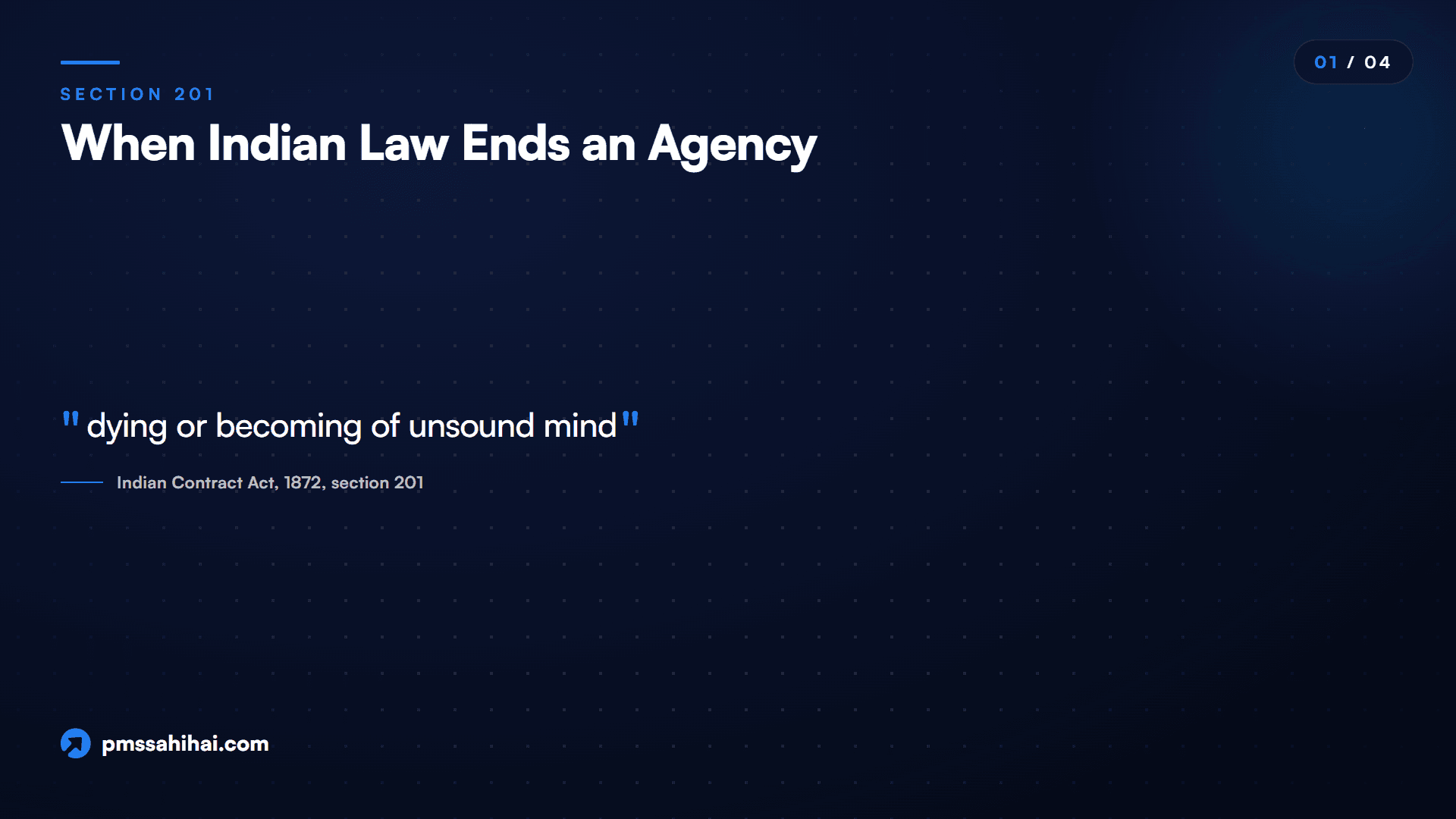
Powers of attorney in India rest on the agency chapter of the Indian Contract Act, 1872. Section 201 of the Contract Act says an agency is terminated by the principal revoking the authority, by the agent renouncing the business, by the business being completed, by either the principal or agent "dying or becoming of unsound mind", or by the principal being adjudicated insolvent.
Note what the words do and do not cover. They do not say a contract may provide otherwise. They do not list physical illness, absence or old age. The trigger for termination is an unsound mind, which is narrower than the word "incapacity" used in foreign templates. That gap matters a great deal, as the next section shows.
The Act is silent on start dates. Section 186 says an agent's authority may be express or implied. Sections 31 and 32 recognise contingent contracts, which cannot be enforced until the uncertain event has happened. Nothing we read in the agency chapter forbids authority that begins later. So our reading, which is reasoning and not a court ruling, is that a conditional power of attorney is not unlawful simply because it starts on an event. Whether it will work depends on the event.
Why an Incapacity Trigger Defeats Itself in India
The Trigger and Termination Collide
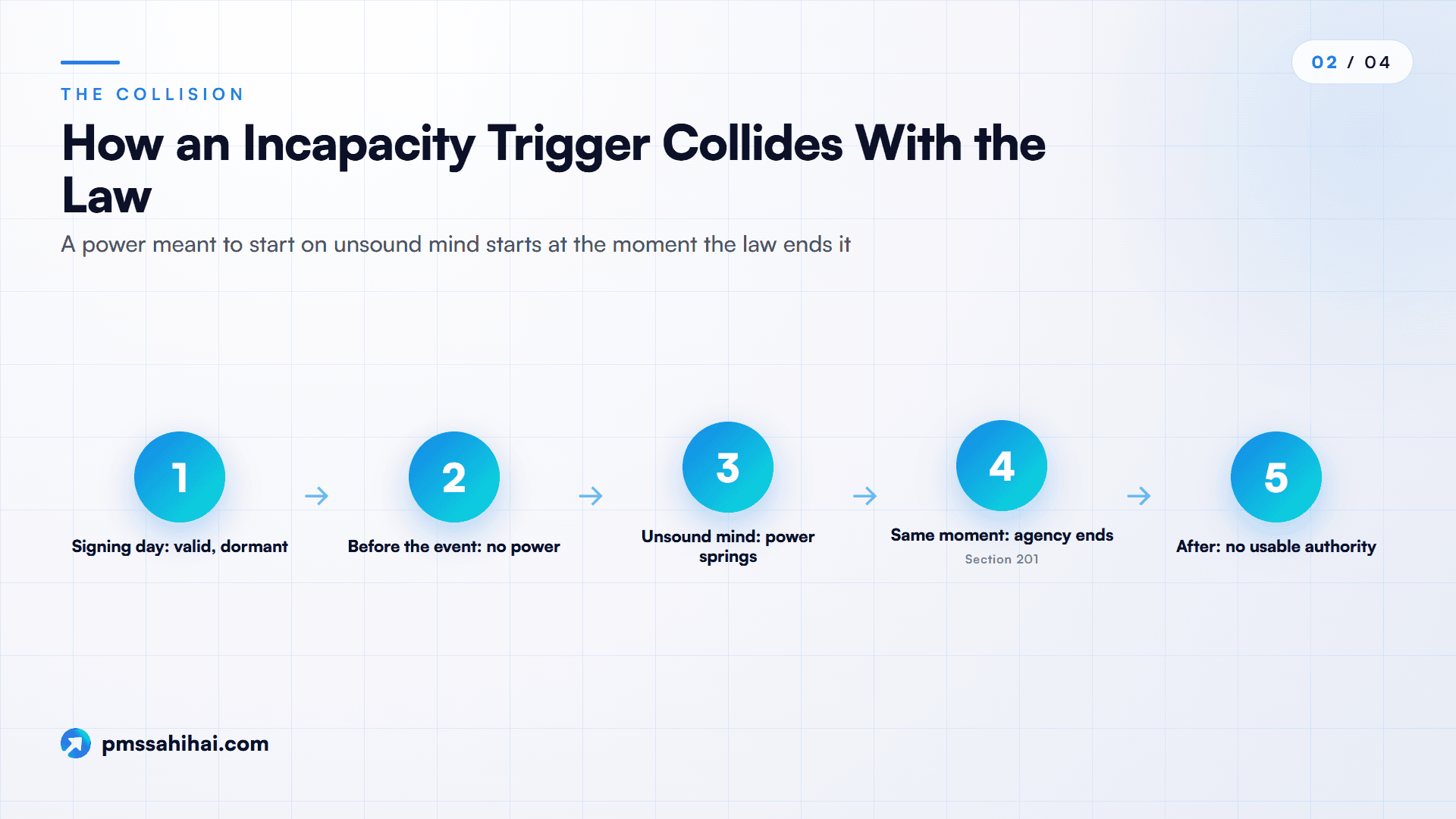
Take a power that says: "This power takes effect only if I become of unsound mind." Walk through it.
| Day | Foreign springing logic | Indian Contract Act |
|---|---|---|
| Signing day | Valid, dormant | Principal is sound, agency can be created |
| Before the event | Attorney has no authority | Same |
| Principal becomes of unsound mind | Power springs into force | Section 201 terminates the agency |
| After | Attorney acts, durable clause keeps it alive | No authority to act; family needs another route |
The event that is meant to start the authority is the event that the statute says ends it. There is no moment at which the attorney holds usable power. The usual reply is to add a clause saying the power "shall survive my incapacity". Some Indian web pages suggest this, and one law firm advises it as a practical step while admitting the agency can be challenged once incapacity is established. Treat that clause as an argument, not a shield. We found no statute giving it effect, and the Chambers and Trilegal commentary above states the opposite position. Section 201 also has two awkward details. Under section 208, termination takes effect on the agent only when it becomes known to the agent, and on third parties when it becomes known to them. That protects innocent dealings, not knowing ones. And section 209 requires the agent, on the principal becoming of unsound mind, to take all reasonable steps to protect the interests entrusted to them. That is a duty to preserve, not a mandate to run the portfolio.
The Grey Zones Between Physical and Mental Incapacity
Here is where careful drafting has real room. Not all incapacity is an unsound mind. The Contract Act's test in section 12 is whether a person can understand a contract and form a rational judgment about its effect on their interests. That section is written about making a contract, so applying it to section 201 is an inference, but it is the natural guide.
SEBI's own wording draws the same line. Its March 2026 consultation paper discusses an investor who is "incapacitated, but still has the capacity to contract". That investor exists: someone paralysed by a stroke but mentally clear, or recovering from major surgery.
| Situation | Likely position under section 201 | Comment |
|---|---|---|
| Lucid but bedridden or paralysed | Agency continues | The strongest case for a power, but sign it immediately, not on a trigger |
| Long stay abroad or remote posting | Agency unaffected | A date or event trigger can work |
| Planned surgery, short sedation | Unsettled | We found no ruling on brief sedation; do not rely on the power during it |
| Coma | Treated as loss of capacity | Commentary treats authority as ended; Kerala families had to go to court |
| Dementia, gradual | Terminates once the mind is unsound | The date is hard to fix, so transactions become open to challenge |
With dementia there is no single day when the mind turns unsound, and a springing power adds a second disputed date: the day it began.
Why a Coupled Interest Is Not a Workaround
Section 202 is the real exception. Where the agent has an interest in the property that forms the subject matter of the agency, the agency cannot, absent an express contract, be terminated to the prejudice of that interest. The Supreme Court applied this in P. Seshareddy v State of Karnataka (2024), saying section 201 cannot be read in isolation from section 202. Illustrations to the section include an agent authorised to sell land and repay himself a debt from the proceeds.
This does not help a family. A son who is simply trusted has no such interest. Calling a power "irrevocable" does not create one either. As Bar and Bench's April 2025 review of MS Ananthamurthy v J Manjula explains, the courts look for an agency plus a real interest in the subject matter, and the label on the document is not decisive. Building a true interest would mean giving the attorney a genuine financial stake in the assets, which is a transfer decision with its own legal and tax results, not a drafting trick.
What You Can Draft in India Today
Three arrangements are realistic. None is a springing power of attorney in the foreign sense, and each should be drafted by a lawyer familiar with the relevant state's stamp rules.
A Conditional Power on a Non-Incapacity Event
This is the closest honest equivalent. The power starts on a stated date or an objectively provable event unrelated to mental capacity, such as your departure from India for an assignment, or the day you are admitted for planned surgery while still lucid. It must be an event a stranger can check from a document, such as a passport stamp or admission record. Section 201 is not engaged because your mind is unaffected, and if it later becomes unsound the power ends like any other.
An Immediate Power With Internal Limits
Many families would be better off with a power effective from signing, restricted in scope, with a private instruction letter telling the attorney not to use it unless you are unwell. This removes the proof problem, since a third party sees a live power. It also removes the protection, since a third party does not know about the letter. Under section 237, a principal can be bound where their own words or conduct led third parties to believe the agent was authorised. Trust in the attorney is doing the real work here.
A Narrow Power Plus a Standby Trust
For larger holdings the strong combination is a limited power for day-to-day matters plus a trust for the assets that must keep running. We come back to it below.
Clause Checklist for Any Conditional Power- Trigger: one objective event, the document that proves it, and who may certify it.
- Scope: named accounts and actions, not "all my affairs".
- Exclusions: no gifts, no change of nominees, no self-dealing without written consent.
- Reporting: statements to a second family member, as India Law Offices also suggests.
- Thresholds: joint signatures above a set amount.
- End date: a review date, so the power does not outlive your plan.
- Capacity evidence: consider a contemporaneous doctor's note at signing, in case a relative later disputes your state of mind.
- Formalities: the Indian Stamp Act's Article 48 makes powers chargeable, with rates that vary by state; registration and notarisation depend on the asset. Powers for property have stricter rules, covered in our separate property guide.
- Signed abroad: expect consular attestation or notarisation plus apostille, then stamping in India.
Advantages of a Conditional Power When It Fits
A conditional power of attorney still has genuine uses, provided the trigger is outside the section 201 danger zone.
- It keeps the attorney out until needed. Nobody has authority over your accounts during the months you are fully able to act.
- You keep sole control meanwhile. Under section 203 you can revoke the authority at any time before it has been exercised to bind you.
- It suits defined absences. Posting abroad, a sabbatical or planned surgery are events people can plan around, and NRIs often have recurring ones.
- It records your intent, which reduces argument on a bad day.
- It avoids a court process for the cases it covers. A clear-headed but absent principal needs no guardianship petition for that episode.
In practice this makes life easier for a specific person: the executive who travels, the NRI with a tax payment due, the patient planning a long recovery while mentally clear.
How Banks, Depositories and PMS Managers Treat These Powers
A conditional document only works if the institution holding your money accepts it, and institutions run on checklists. We found no central Indian register or digital system that records whether a person's capacity has changed, or that activates a power automatically. Someone at a desk reads a paper and decides. India Law Offices notes that banks may refuse cheques, new mandates or property documents once capacity is in doubt.
What SEBI's 2026 Nomination Change Means
The most useful recent signal concerns securities. SEBI's circular of January 2025 let investors empower a nominee to operate an account if they became incapacitated but retained capacity to contract. Its March 2026 consultation paper said industry found this hard and costly to implement, with difficulty in maintaining audit trails, and that it posed risks of fraud, misuse and legal disputes. It observed that a nominee conventionally has no power over assets while the investor is alive, and proposed that the existing power of attorney route be used instead.
The final circular of 29 May 2026, effective 1 September 2026, contains no provision for a nominee to act for an incapacitated investor. Nominee and attorney are therefore separate jobs. A nominee's role begins on death: SEBI's July 2026 transmission framework says nominees receive assets as trustee on behalf of legal heirs. For a living investor, the power of attorney is the route, and SEBI's wording covers those who still have capacity to contract. It does not extend to those who have lost it.
Bank Accounts
RBI's Master Circular on Customer Service in Banks of 1 July 2015 has separate tracks. For physically incapacitated customers, section 9 allows a thumb or toe impression, or a mark, identified by two witnesses, with a named person collecting the money. For mental conditions, section 11 points banks to orders and certificates from the competent authority. That section still cites the Mental Health Act 1987, since replaced, so check current practice. For NRIs, RBI also limits what a power holder can do on NRE and NRO accounts.
Your PMS Account
A PMS works through a power too. You sign an agreement and a power of attorney so that the manager can act on your portfolio under the SEBI (Portfolio Managers) Regulations, 2020, which apply until the 2026 Regulations take effect on 1 April 2027. That is an agency as well, and we found no specific SEBI rule on what happens to it if a client becomes of unsound mind. Ask your manager in writing what its agreement says, whose instructions it would accept on withdrawals and what paper it would need. Your securities sit in a custodian-held structure, so an informal family request will not move them. Each institution reads each document separately, so list your accounts when instructing a lawyer.
How PMS Sahi Hai Helps You Read the Fine Print
We will be plain about the fit. PMS Sahi Hai is a research and comparison platform for PMS, AIF and GIFT City strategies. It does not draft powers of attorney, give legal advice or decide whether your document will hold. We also found nothing on the platform specifically about springing powers. Where it helps is the portfolio side of the same conversation, which is where a family's questions usually end up.
Before you sign, understand what you already authorised. Most PMS investors signed a power of attorney during onboarding. Our walkthrough of the PMS onboarding process covers that stage, and the piece on why your manager can't touch your money explains the custody structure your family would have to deal with. NRIs can use the NRI PMS documents checklist, which covers powers signed abroad.
Use Nyra to prepare your questions. Nyra, the platform's AI research tool, answers plain-English questions with cited sources. It can help you frame what to ask a manager: what the termination clause covers, how a trust account would be onboarded, or how a transfer would be taxed. The site describes Nyra as an analytical tool and not a SEBI-registered investment adviser, so treat its answers as research and take them to your lawyer.
Compare with a family lens. If you would want someone else to step in one day, the simplicity of a strategy matters as much as its returns. The compare page lets you line up to four PMS, AIF or GIFT City strategies side by side, so you can see what your family might one day have to deal with.
Limits and Risks of Conditional Powers
- *It cannot cover the case you fear most*. Dementia, severe brain injury and similar conditions end the agency, whatever the trigger says.
- Proof creates delay. Every event has to be shown to someone. A bill due on Monday does not wait.
- Refusal is a real risk. No Indian rule we found obliges a bank or a depository to honour an unusual trigger, and some may ask for their own format.
- Disputes attract attention. Heirs may later argue the event did not happen, or that your mind was already affected at signing. Transactions under a power that had already ended can be attacked.
- Foreign documents do not cross over. A springing power signed in the US or UK is not automatically useful for Indian assets, and it will still need attestation and stamping.
What Actually Works After Capacity Is Lost
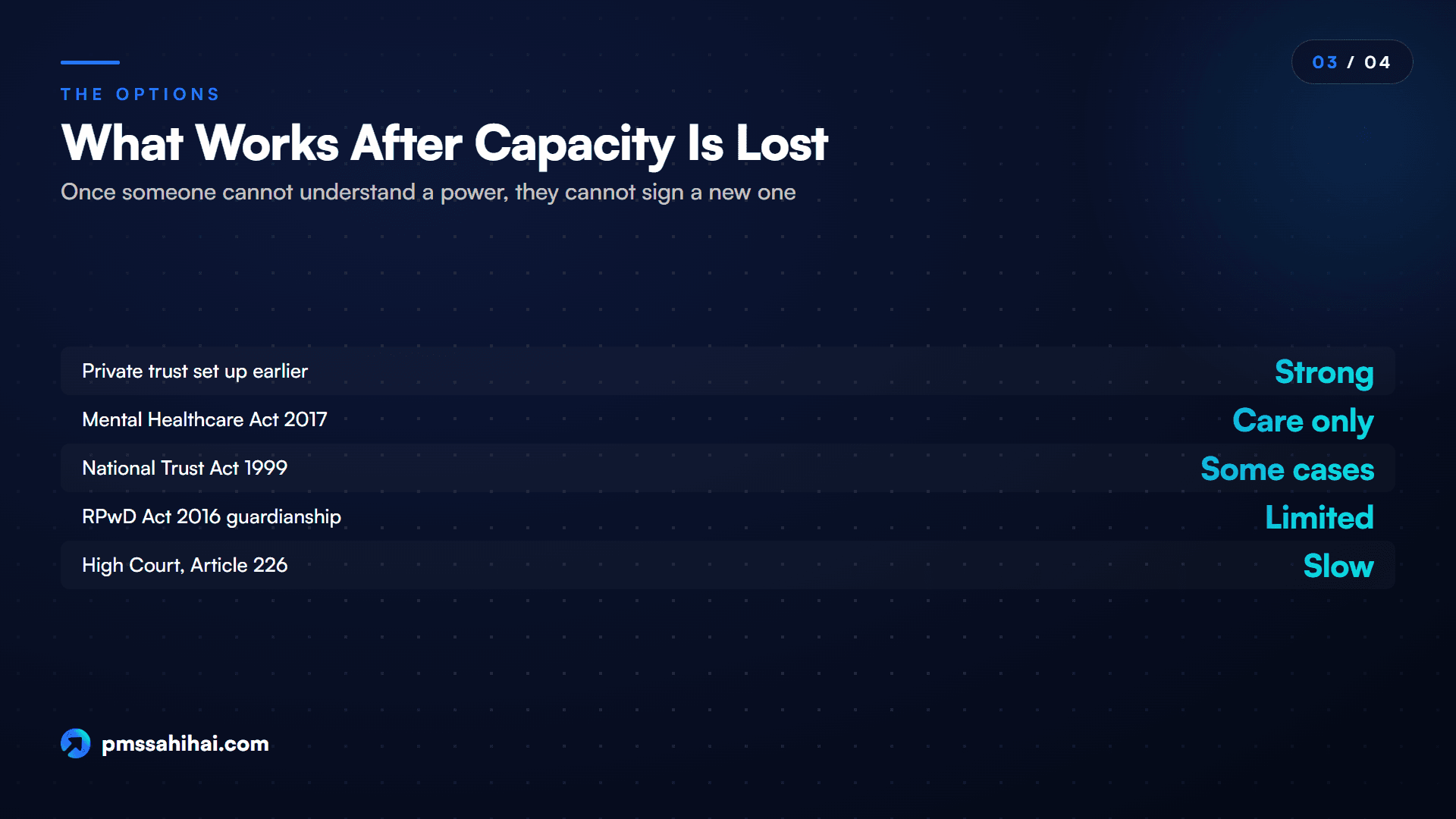
Once someone can no longer understand a power, they also cannot sign a new one. The choices then narrow to what was set up earlier, or to the courts.
| Route | What it covers | Who decides | Fit for investors |
|---|---|---|---|
| Private trust set up earlier | Assets moved into the trust | Trustees, under the deed | Strong, but must be done while capable |
| Mental Healthcare Act 2017 nominated representative | Mental healthcare and treatment only | Named by the individual | Does not cover property |
| National Trust Act 1999 guardian | Autism, cerebral palsy, intellectual and multiple disabilities | Local Level Committee | Only these conditions |
| Rights of Persons with Disabilities Act 2016 | Limited guardianship for specific decisions and period | District court or designated authority | Depends on the condition |
| High Court, Article 226 | Coma, dementia and gaps elsewhere | High Court | Works, but slow and conditional |
Why a Trust Answers a Different Question
A private trust does not depend on agency. Assets are transferred to trustees, who hold them under the deed, so the trustees' authority does not come from the settlor's continuing capacity. That is why it is the usual answer to the problem a springing POA tries to solve abroad. Name a successor trustee and write clear instructions on your care and expenses.
The trade-off is real. You give up direct ownership, and the transfer can have tax and stamp consequences. Portfolio managers and depositories may have their own requirements for trust accounts. Consult a lawyer and a tax adviser before moving anything.
Court Guardianship as the Fallback
There is no general adult guardianship statute covering every case. A viewpoint article on PubMed Central notes that the Mental Healthcare Act 2017, unlike the 1987 Act, has no provision for appointing a guardian for an adult's property. Kerala's High Court said in Shobha Gopalakrishnan (2019) that no legislation provides for a guardian for a comatose person. It set out interim guidelines until Parliament acts: a medical board, disclosure of property, a revenue officer's report, legal heirs made parties, and six-monthly accounts.
In October 2026, LiveLaw reported that the same court had appointed a sister as guardian for a 93-year-old woman with dementia and Alzheimer's in X v State of Kerala. Justice Bechu Kurian Thomas relied on the Bombay High Court's 2021 decision in Vijay Ramachandra Salgaonkar, and required six-monthly reports and court permission to move the patient out of the state. Other High Courts may take different approaches, so this is a route rather than a formula. Kerala's guidelines limit the guardian to the property and accounts named in the order, so list every account accurately.
Choosing Your Incapacity Plan While You Still Can
Everything that actually helps has one condition: you must act while you are of sound mind. Here is a simple order of work.
- Take stock. List bank accounts, demat accounts, PMS and AIF holdings, property and who has access.
- Use the right tool for the risk. Absence or physical illness: a clear immediate or event-based power. Loss of mental capacity: a trust, with guardianship as the fallback. Death: a will and nominations.
- Ask each institution first. Send your bank, depository participant and portfolio manager the draft, and ask if they will accept it.
- Pick the person and a backup. Section 201 also ends the agency if the attorney dies or loses capacity.
- Review every few years, and after any diagnosis or move abroad.
The practical takeaway on the springing power of attorney in India is simple. Keep the idea of a defined trigger for ordinary absences, and stop relying on it for the risk it was invented to solve.

Check Your Portfolio Paperwork Before You Need It
The most useful thing you can do this week is simple: find the power of attorney in your PMS agreement, list who can act on each of your accounts, and book a lawyer to review the gaps while you can still sign. The law on the springing power of attorney in India may develop, and consumer groups have called for reform of adult guardianship, but the plan you make today has to work under today's rules. When your paperwork is in order, compare PMS strategies side by side on PMS Sahi Hai, ask Nyra what to raise with your manager, or book a conversation with the team.
This article is general information as of 30 October 2026, not legal or tax advice. Consult a lawyer on powers of attorney, trusts and guardianship, and a tax adviser on any transfer of assets.
PMS Sahi Hai is a distributor of Portfolio Management Services and Alternative Investment Funds, APMI-registered (Registration No. APRN08358). This article is for education only and is not investment advice, a recommendation, or an offer to buy or sell any security. Investments in securities markets are subject to market risks; read all scheme-related documents carefully. Past performance is not indicative of future results. Consult your advisor before investing.
Ishaan founded PMS Sahi Hai to make India's PMS, AIF and GIFT City markets legible to serious investors, comparing every SEBI-registered manager on the same comparative basis, with no shelf products and no commission bias.
Frequently asked
What is a springing power of attorney?
It is a power of attorney that has no effect when signed and starts only when a stated event happens or a stated date arrives. Abroad the usual trigger is incapacity, certified by one or more doctors. In India it has no statutory definition, so the same wording is analysed under the ordinary agency rules in the Contract Act, 1872.
Is a springing power of attorney valid in India?
No Indian statute or reported ruling we found recognises it by name. A power that starts on a date or a provable event unrelated to mental capacity looks permissible on our reading, though untested. A power that starts on mental incapacity fails in practice, because section 201 of the Contract Act ends agency at that same point. Ask a lawyer before relying on either form.
What is the difference between a durable and a springing power of attorney?
They answer different questions. Springing is about when authority starts: later, on a trigger. Durable is about when it ends: it survives the principal's incapacity. Abroad they are often combined in one document. Indian law provides neither by statute, and the Contract Act's rule on unsound mind is the main obstacle to the combined version that foreign templates use.
Does a power of attorney end if the principal loses mental capacity in India?
Generally yes. Section 201 of the Contract Act ends an agency when the principal becomes of unsound mind. The narrow exception is section 202, where the agent holds a real interest in the subject matter. Under section 208, termination affects the agent and third parties only once they know of it, and section 209 requires reasonable steps to protect the principal's interests.
Can a nominee operate my demat account if I become incapacitated?
No. SEBI's January 2025 circular had provided for this, but its March 2026 consultation paper cited fraud, misuse and implementation concerns. The circular of 29 May 2026, effective 1 September 2026, contains no such provision. A nominee's role starts on death. For a living investor who can still contract, SEBI's paper points to the existing power of attorney route instead.
What happens if someone is in a coma and has no plan in place?
The family generally has to approach a court, usually the High Court under Article 226, to appoint a guardian. Kerala's High Court set out interim guidelines in Shobha Gopalakrishnan in 2019, including a medical board, disclosure of property, and six-monthly accounts. Other courts may differ, so take a local lawyer's advice, and list each account and property you need the order to cover.
Keep reading
All articles
Why Point-to-Point Returns Mislead PMS Investors: The Rolling Returns Test
One great year can lift a PMS's 1, 3 and 5-year returns at once. A worked example shows how rolling returns expose it, and what SEBI requires.

Special Power of Attorney (SPA): The One-Task Authority Explained
What a special power of attorney can and cannot do in India: scope, GPA contrast, stamp duty, NRI execution, revocation and risks, explained.

What Is a Durable Power of Attorney? The Position in India
India has no durable power of attorney. See what Section 201 does, why a POA ends on incapacity, and how guardianship and trusts fill the gap.
Read it. Now pressure-test it.
Ask Nyra how this applies to your portfolio, or talk to our team, no pitch, no pressure.