
Special Power of Attorney (SPA): The One-Task Authority Explained
What a special power of attorney can and cannot do in India: scope, GPA contrast, stamp duty, NRI execution, revocation and risks, explained.


A special power of attorney, or SPA, lets someone act for you on one defined task, such as registering the sale of a named flat, and it ends when that task is done. It gives you far less exposure than a broad authority, but only if it is drafted tightly, stamped correctly and authenticated in the way Indian registration law requires. It never transfers ownership, and it stops working when you die or become of unsound mind. This guide covers its scope, the general power of attorney contrast, execution from India and abroad, and the risks. It is general information, not legal advice, so have a lawyer in the relevant state review your document.
What a Special Power of Attorney Means in Plain Terms
Suppose you live in Singapore and your late father's flat in Pune has found a buyer. You cannot fly back for the registration. You want your sister to sign and appear for you on that one sale, and nothing else. She should not be able to touch your bank account or sell your other plot. The document that does this job is a special power of attorney.
A special power of attorney is limited to a specified act or type of act. It is a written authority in which one person, the principal, empowers another, the attorney or agent, to carry out a specified act or a narrow set of connected acts. It is also called a limited power of attorney, a specific power of attorney, or simply an SPA. The attorney here need not be a lawyer. Any person you trust and who is competent to act can hold the role.
The label matters less than people assume, and this is the first thing most explainers miss. Indian statutes do not set up "special power of attorney" as a defined category with its own rulebook. The Powers-of-Attorney Act, 1882 defines a power of attorney as any instrument empowering a specified person to act for and in the name of the person executing it. It says nothing about special or general. The split is a working classification used by lawyers, courts and registrars, based on what the document actually authorises.
So a document headed "Special Power of Attorney" that allows the holder to "do all acts relating to my properties" is, in substance, a broad authority. A document headed "General Power of Attorney" that covers one sale is narrow in effect. Read the operative clause, not the title.
The Indian Laws That Shaped the Limited Power of Attorney
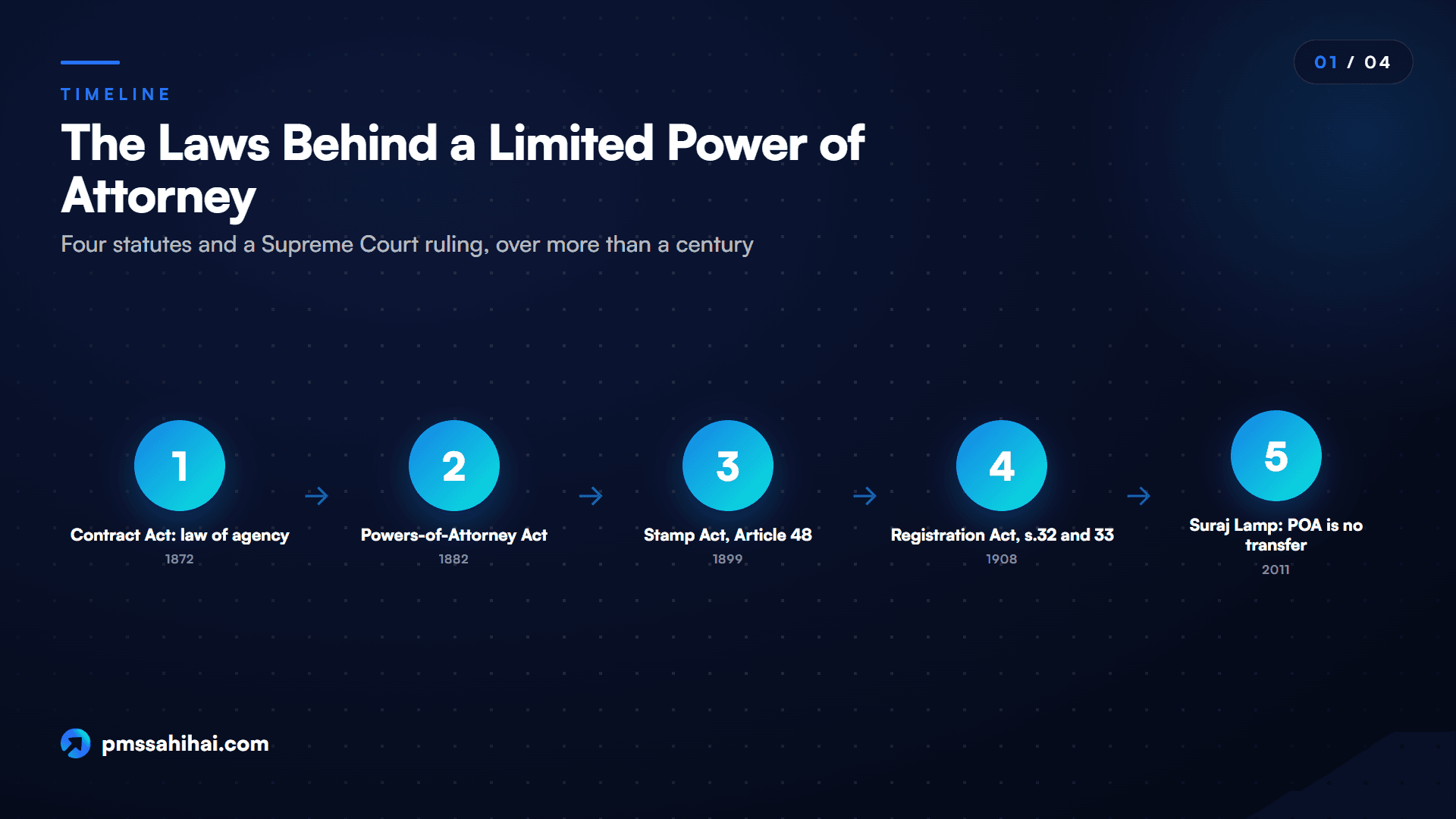
No single law governs an SPA. Four statutes and a line of court decisions do the work, and they arrived over more than a century.
- 1872, Indian Contract Act. Chapter X sets out the law of agency: how authority arises, how far it extends, what duties the agent owes and how the relationship ends. Every SPA is an agency, so this remains the core law.
- 1882, Powers-of-Attorney Act. In force from 1 May 1882, this short Act lets the holder sign in their own name by the authority of the donor, and treats that signature as being as effective as the donor's own. The definition described above was added only in 1982, with effect from 22 October 1982.
- 1899, Indian Stamp Act. Article 48 of Schedule I charges stamp duty on powers of attorney, and it is the closest the statute book comes to the special and general divide. It separates a power for a single transaction from one covering more than one transaction or acting generally.
- 1908, Registration Act. Sections 32 and 33 decide when an agent may present a document for registration, and which powers of attorney a registering officer may recognise for that purpose.
The courts then settled what a power of attorney cannot be. In Suraj Lamp and Industries v State of Haryana, decided on 11 October 2011, the Supreme Court said a power of attorney is not an instrument of transfer of any right, title or interest in immovable property. The Court also made clear that it was not disturbing powers of attorney in genuine transactions, including those given to a relative to manage affairs or execute a conveyance. A narrow SPA for one sale sits comfortably within that second category.
What a Special POA Can and Cannot Authorise
The value of a special POA lies in its edges, so it helps to know how the law draws them.
Implied Powers Can Widen a Narrow Grant
Authority under the Contract Act can be express or implied (section 186). Section 188 then adds a rule that surprises many principals: an agent authorised to do an act may do every lawful thing necessary to do that act. An SPA to sell a flat therefore carries some unwritten room, such as handling routine steps needed to complete the sale.
That is useful and also a reason to draft with care. If you do not want your attorney to receive the sale money, say so. If you want the money paid only into a named account, say that too. The fix for an unwanted implied power is an express limit.
What Happens When an Attorney Goes Beyond the Document
Section 227 says that if an agent exceeds authority and the authorised part can be separated from the rest, the principal is bound only by the authorised part. Section 228 says that if the two cannot be separated, the principal is entitled to repudiate the whole transaction.
This is why the people on the other side care about your drafting. A buyer, bank or registrar dealing with an attorney will want to see the act within the four corners of the document. If it is not there, expect them to refuse, or expect a dispute later.
Three Things a Limited Power of Attorney Never Does
- It does not transfer ownership. You remain the owner until a registered conveyance is executed. Suraj Lamp is direct on this: even an irrevocable power does not pass title to the grantee.
- It does not let the attorney act for their own gain. Under sections 215 and 216, an agent who deals on their own account without the required consent and disclosure can see the deal repudiated, and the principal can claim the benefit.
- It does not automatically allow delegation. Section 190 bars an agent from handing personal duties to someone else, unless trade custom or the nature of the agency requires it. If a substitute may be needed, the document should say who.
An attorney also owes ordinary duties throughout: to follow your directions (section 211) and to give proper accounts on demand (section 213).
Special Power of Attorney vs General Power of Attorney
This post stays on the narrow instrument, so only the contrast with a general power of attorney matters here.
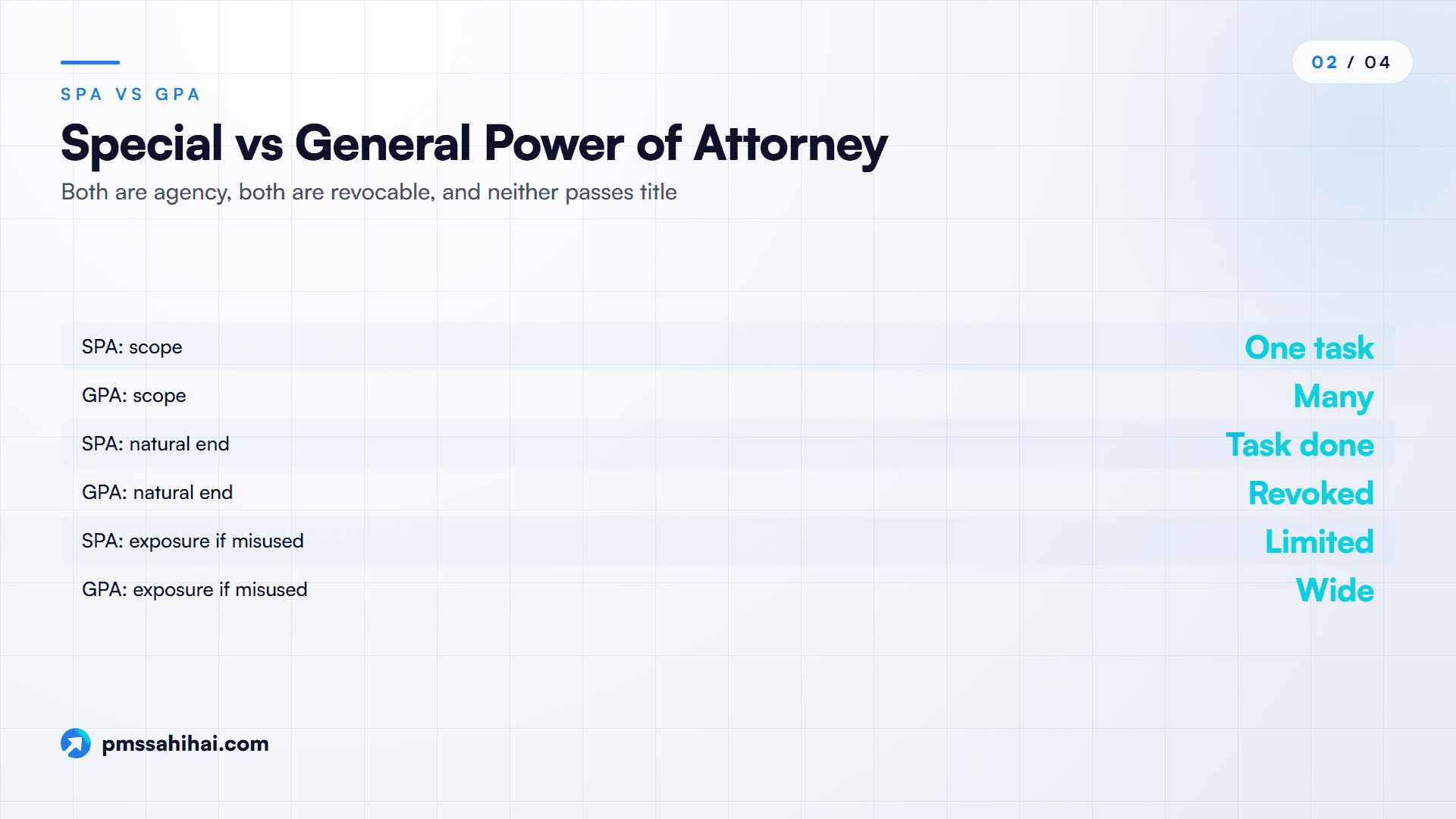
| Point | Special power of attorney | General power of attorney |
|---|---|---|
| Scope | One act, transaction or narrow connected set | Many matters, or all of a class of affairs |
| Typical example | Sign and register the sale of one named flat | Manage all properties and related dealings |
| Natural end | Completion of the task, or an earlier date set in the document | Revocation, or a date set in the document |
| Exposure if misused | Limited to the named task | Potentially wide |
| Convenience | New document for each new task | One document covers repeat needs |
| Central stamp schedule (Article 48) | Single-transaction clause, or a registration-only clause | Multi-transaction or general clause |
Both share the same foundation. Both are agency, both can be revoked subject to section 202, both end on the principal's death or unsoundness of mind, and neither passes title. A general power of attorney is not a stronger version of the same thing. It is a wider risk accepted for ongoing convenience. If your need has a clear finish line, the SPA is normally the better starting point.
Common Situations That Call for an SPA
The term fits wherever a single task can be named precisely. Typical uses in Indian practice include:
- Selling or buying one property. The attorney signs the agreement and sale deed and appears for registration.
- Registration only. The principal signs a document personally, and the attorney merely presents it and admits execution. Article 48 has its own clause for this.
- Collecting or handing over one thing. Original title deeds from a bank after a loan closes, a society share certificate, or a utility connection in your name.
- One lawsuit or one tax matter. Representation in a named case or before an authority, where the forum's rules allow an agent to act. Check those rules first.
- A single banking step. A bank may ask for its own format, and NRI accounts have further limits discussed below.
How to Draft and Execute a Special POA in India
Procedure varies by state, so treat the following as the general path and confirm details with an advocate or the local Sub-Registrar's office.
Step 1: Name the Parties and the Purpose
Give full names, parents' or spouses' names, addresses and identity details for principal and attorney. State in a recital why the authority is being given. Precision here prevents the most common objection at the registration counter.
Step 2: Write the Scope as a List of Acts
This is the clause that decides everything. For a property, give the survey or flat number, area and address. Then list each permitted act: sign the agreement to sell, sign the sale deed, present it for registration, admit execution, receive a stated cheque in a stated account. Avoid catch-alls such as "all acts necessary", which invite the wide reading you were trying to avoid.
Step 3: Set an End Point
Authority ends when the business is completed, under section 201, but do not rely on that alone. Add an expiry date. A dated limit is easier for a third party to check than an argument over whether a task has finished.
Step 4: Pay the Correct Stamp Duty
Stamp duty is set by state law, so the state where the document will be used governs. In the central schedule, Article 48 separates registration-only powers, single-transaction powers, multi-transaction powers and a power given for consideration that authorises the sale of immovable property. That last clause is a trap. Practitioner guides warn that a flat small-value stamp can be wrong where an attorney is empowered to sell for consideration, and that duty may then run far higher. One consumer guide lists SPA duty at roughly Rs 50 to Rs 500 depending on the state, but we could not verify those figures, so use them only as a sense of scale. Check the current state schedule. Use e-stamping where it is available. An instrument that is not duly stamped is inadmissible in evidence under section 35 of the Stamp Act.
Step 5: Execute and Authenticate the Right Way
Two adult witnesses are common practice, and many offices expect them. The bigger question is authentication, and it is different from registration:
- Authentication under section 33. If your attorney will present a document for registration, section 33 of the Registration Act says only certain powers are recognised. For a principal living in India, that means a power executed before and authenticated by the Registrar or Sub-Registrar of the district where the principal lives. A notarised SPA alone does not meet this requirement. A principal who is infirm, for example, need not travel, because the officer may attend or issue a commission to examine them.
- Registration of the SPA itself. Sources conflict on whether this is compulsory for property SPAs. The central Registration Act does not plainly require it for a bare authority, since a power of attorney is not a transfer, yet some states have added requirements. The Odisha and Rajasthan amendments, for instance, bring in certain powers relating to transfer of immovable property. Practice leans towards registering any SPA used for property, in the office where the property sits. Anyone presenting a document must also affix a photograph and fingerprints under section 32A.
Step 6: Keep Originals and Tell the Attorney in Writing
Give the attorney the original, keep a certified copy, and record any instructions separately. A registrar or counterparty will usually want to see the original rather than a copy.

How NRIs Give a Special Power of Attorney From Abroad
For non-residents, a special power of attorney is often the only practical way to complete an Indian transaction, and it adds three layers.
Authentication abroad. Section 33(1)(c) of the Registration Act recognises a power executed before and authenticated by a Notary Public, a court, judge or magistrate, an Indian Consul or Vice-Consul, or a representative of the Central Government.
Apostille or consular route. India's membership of the Hague Apostille Convention has been in force since 14 July 2005, and the Ministry of External Affairs says a document apostilled by a member country needs no further legalisation and should be treated as legalised for all purposes in India. Residents of non-member countries generally use the Indian mission instead. The UAE, for example, was not on the contracting-states list we checked, so Gulf residents should confirm the route with their mission first. An apostille confirms the notary's authority, not that your drafting is any good.
Stamping in India. Section 18 of the Stamp Act allows an instrument executed only outside India to be stamped within three months after it is first received in India. Miss that and you can face a penalty. Adjudication by the Collector under sections 31 and 32 gives you an endorsement that the right duty was paid. Scans generally will not do, so courier the signed original.
Two further points catch people out. First, an SPA does not widen what your bank allows. The RBI says operations under a power of attorney on an NRE account are restricted to withdrawals for permissible local payments or remittance to the account holder through normal banking channels. On an NRO account they are restricted to local rupee payments, remittance of current income to the holder abroad, or remittance to the holder, within repatriability limits. Second, an SPA says nothing about the tax on any sale. Take advice from a tax adviser before funds move.
Limited Authority in Securities and Digital Signing
Investors meet the idea of limited authority at the broker's desk, often without realising it. SEBI's guidelines on powers of attorney given to brokers date from April 2010, and they were reiterated in August 2020 with a clear statement that a PoA is optional for opening an account. In its circular of 4 April 2022, SEBI moved the core purposes into a separate document, the Demat Debit and Pledge Instruction (DDPI), which it said would serve the same purpose while significantly reducing misuse. SEBI's stock broker FAQs now list four permitted purposes for a DDPI: settlement transfers, pledging for margin, mutual fund transactions on exchange platforms, and tendering shares in open offers through exchange platforms. Existing PoAs stay valid until the client revokes them, and a broker cannot compel a client to sign either.
The DDPI is not legally the same instrument as an SPA, but it shows the same thinking: name the permitted acts and allow nothing else. How broker PoAs and DDPI work in detail is a subject for a separate guide.
A portfolio manager's mandate is a different case. SEBI's Investor Charter refers to a power of attorney signed so that the manager can act on your portfolio. That authority is limited by subject, yet it is ongoing and discretionary within the mandate, so it does not behave like a classic one-task SPA. Read its specific clauses rather than assuming any label.
Technology has moved quickly here, but not uniformly. A DDPI can be digitally signed under SEBI's circular. A power of attorney in the wider legal sense sits outside the e-signature framework: section 1(4) and the First Schedule of the Information Technology Act, 2000 exclude a power of attorney, along with wills and trusts, from the Act. So do not assume that an e-signed SPA for a property sale will be accepted, even if an online service offers one. E-stamping helps with the payment step, not the signature. Ink, stamp and an appearance before the proper officer remain the safe default.
Advantages of Choosing a Limited Power of Attorney
Done properly, a limited power of attorney makes life simpler in ways that are easy to underrate.
- Your exposure is capped. The attorney can only harm you within the named task. Everything else you own stays out of reach.
- It finishes on its own. Section 201 ends the agency when the business is completed, so there is less old authority left lying around.
- Trust is easier to give. You may hesitate to give a relative control over everything, yet be comfortable asking them to attend one registration.
- Counterparties can check it fast. A buyer, bank or registrar can compare the act in front of them with the list in the document, with no need to interpret broad wording.
- Distance stops being a blocker. NRIs, travellers and elderly or unwell family members can complete a transaction without being physically present.
How PMS Sahi Hai Helps You Read the Authority Clauses in a PMS Mandate
A one-task SPA is usually a lawyer's job. Where PMS Sahi Hai comes in is the other authority an investor is likely to sign: the one that sits inside a portfolio management relationship.
Let us be plain about the limits first. PMS Sahi Hai does not draft, stamp, authenticate or register powers of attorney, and we found nothing on its published pages that offers this, nor a page dedicated to the SPA. Nyra, its research tool, is described as an AI-powered research platform covering PMS, AIF and GIFT City funds, with more than 900 tracked offerings scored on a single 0 to 10 Nyra Score. It is an analytical tool, not a SEBI-registered investment adviser, and its output is informational rather than personalised advice. It will not tell you whether a clause is safe.
What the platform can do is help you reach that clause better prepared.
- Choose first, then read. The PMS comparison view lets you filter strategies and set up to four side by side. Authority wording means more once you know which manager you may actually be handing it to.
- Read the wider paperwork. The guides on the PMS onboarding process, on how to read a PMS disclosure document and on why a custodian stands between your manager and your money show where a power of attorney fits among the other safeguards.
- Handle the NRI layer. The NRI PMS documents checklist covers apostille, stamping and the RBI's account limits in the PMS context.
- Ask a person. The contact page offers a 15-minute conversation. A useful question is what acts a given manager's power of attorney allows, so you can put the tests from this guide to it. PMS Sahi Hai operates through Nyra Capital Partners Consultancy Pvt Limited, an APMI-registered distributor (APRN08358).
The discipline carries over from the SPA. Whoever holds your authority, list what they may do, what they may not, and how you can stop them. Use a lawyer for the legal reading.
How a Special Power of Attorney Ends or Gets Revoked
Section 201 of the Contract Act lists the ways an agency ends: the principal revokes, the agent renounces, the business is completed, either party dies or becomes of unsound mind, or the principal is adjudicated insolvent.
Death. Authority does not survive the principal. In M.S. Ananthamurthy v J. Manjula, decided on 27 February 2025, the Supreme Court upheld a High Court ruling that a sale deed executed by a power of attorney holder after the principal's death was invalid, according to a summary by law firm Argus Partners.
Irrevocability. Writing "irrevocable" on the document does not make it so. Section 202 protects an agency only where the agent has an interest in the subject matter, and the same 2025 decision is reported as saying the label alone, or the fact of consideration, is not enough.
Unsoundness of mind. Section 201 ends the authority here too. Do not assume clever wording gets around this, and take a lawyer's advice if incapacity is the real concern.
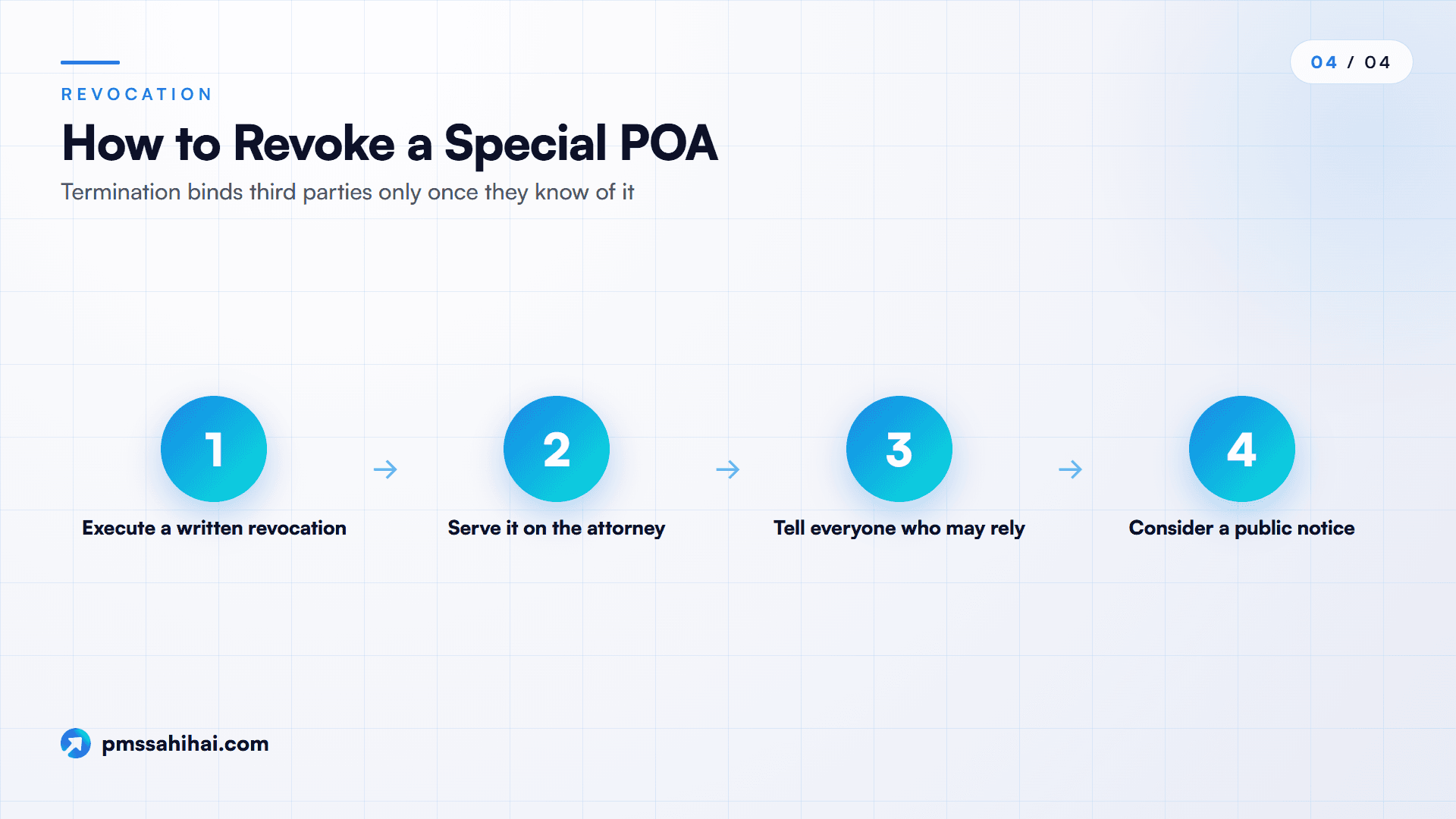
To revoke an SPA yourself, section 203 lets you act any time before the authority has been exercised so as to bind you. In practice:
- Execute a written revocation, and register it if the SPA was registered.
- Serve it on the attorney, with proof of delivery. Section 206 expects reasonable notice.
- Tell everyone likely to rely on the SPA, such as the bank, the society, the buyer and the Sub-Registrar.
- Consider a public notice in a newspaper for property matters.
Step 3 matters because of section 208. Termination takes effect against an agent only once the agent knows of it, and against third parties only once they know. If an innocent buyer has not heard of your revocation, you may still have a dispute on your hands.
Limitations and Risks of a Special POA
A narrow document is safer, not safe. The honest list of downsides is longer than most guides admit.
- It can be too narrow. If a sale deed needs a rectification or a loan NOC appears at the last minute, your attorney may have no authority to act, and you are back at the notary's desk. Corpzo's guide notes that authorities may also reject an SPA that is unclear or not properly executed.
- Misuse is still possible. Within the named task the attorney can do real damage, for instance by selling below your price if no floor is stated. Set the price, payment account and deadline in writing.
- It stops when you cannot speak for yourself. Death or unsoundness of mind ends it, so it is not a tool for incapacity planning.
- The formalities are state-specific. Stamp and registration rules differ by state, and our statute copies come from one state's published version. Your lawyer should check the amendments that apply.
- Some law remains unsettled. Whether a holder who signs a sale deed becomes its "executant" under section 32(a) of the Registration Act was referred to a larger Supreme Court bench in G. Kalawathi Bai v G. Shashikala (2025 INSC 851), which questioned the earlier view in Rajni Tandon (2009). We could not confirm a final answer. The practical course is to satisfy sections 32(c) and 33 fully rather than rely on the older shortcut.
- It cannot replace a sale deed. Agreement-plus-power-plus-will arrangements do not convey title, and the 2011 ruling is clear on that point.
Key Takeaways Before You Sign an SPA
A special power of attorney is one of the simplest ways to delegate, and one of the easiest to get subtly wrong. Name one job, list the acts, add an expiry date and state any money limits. Pay the correct state stamp duty, authenticate as section 33 requires if registration is involved, and keep the original safe. Remember that it does not transfer ownership and ends on death. When the task is done, take a written close-out so nobody relies on it later. If a PMS mandate is your next signature, PMS Sahi Hai and Nyra can help you compare the managers first, though the legal reading stays with your lawyer.
Because these rules sit across several Acts and state amendments, have a lawyer in the relevant state review the draft. For any sale proceeds or remittance, consult a tax adviser as well. Rules stated here are as read on 30 October 2026.
Next Steps Before You Grant Any Authority
Before you sign, write down the single task, the person, the end date and the money limit on one page. If you cannot do that, you may not need an SPA yet. Take that page to a lawyer in the state where the document will be used, and have it drafted, stamped and authenticated properly. Delegating well takes one careful afternoon, and it can spare you a long dispute later.
If the authority you are weighing is part of a PMS, compare strategies on PMS Sahi Hai, use Nyra to see how a manager sits against peers, and book a 15-minute call with your questions about the paperwork.
PMS Sahi Hai is a distributor of Portfolio Management Services and Alternative Investment Funds, APMI-registered (Registration No. APRN08358). This article is for education only and is not investment advice, a recommendation, or an offer to buy or sell any security. Investments in securities markets are subject to market risks; read all scheme-related documents carefully. Past performance is not indicative of future results. Consult your advisor before investing.
Ishaan founded PMS Sahi Hai to make India's PMS, AIF and GIFT City markets legible to serious investors, comparing every SEBI-registered manager on the same comparative basis, with no shelf products and no commission bias.
Frequently asked
What is a special power of attorney in simple words?
A special power of attorney is a written authority that lets a person you choose carry out one defined task for you, such as registering the sale of a particular flat. It gives them no wider control over your affairs. Their authority ends when the task is complete, on the expiry date in the document, or earlier if you revoke it or die.
What is the difference between GPA and SPA?
An SPA covers one act or a narrow connected set of acts, while a general power of attorney covers many matters or a whole class of affairs. Both are forms of agency, both end on the principal's death, and neither transfers ownership. The SPA limits your exposure, while the general form offers ongoing convenience with greater risk.
Is registration of a special power of attorney compulsory?
Not in every case. Sources conflict on property SPAs. The central Registration Act does not plainly require registering a bare authority, but some states have added requirements. Separately, section 33 requires authentication if the attorney will present documents for registration. Practitioner guides generally favour registering any property SPA, so confirm the current position with a lawyer in that state.
Can a special power of attorney holder sell my property?
Yes, if the document expressly authorises that sale, and the sale is completed by a registered deed. The holder acts for you and the property does not become theirs. The Supreme Court in Suraj Lamp (2011) accepted that a person may give a power of attorney to a relative to execute a conveyance, while rejecting such powers as a substitute for a transfer.
When does a special power of attorney end?
Under section 201 of the Contract Act it ends when the business is completed, when you revoke it, when the attorney renounces it, when either party dies or becomes of unsound mind, or when you are adjudicated insolvent. A stated expiry date also ends it. Against outsiders, termination counts only once they know of it, so give notice.
Can a special power of attorney be revoked?
Yes, you can generally revoke it any time before the authority has been exercised so as to bind you. Use a written revocation, register it if the SPA was registered, and notify the attorney and third parties. The word "irrevocable" alone does not prevent this. Section 202 protects only an agent who has an interest in the subject matter.
How can an NRI give a special power of attorney from abroad?
Sign it before a notary, court or Indian consular officer abroad, as section 33(1)(c) of the Registration Act allows. Apostille it if the country is a Hague Convention member, or use the Indian mission otherwise. Send the original to India and get it stamped within three months of first receipt there. Then register it if the property's state or practice requires that.
Can a special power of attorney be signed electronically?
Do not assume so. The First Schedule of the Information Technology Act, 2000 excludes powers of attorney from the Act, so the usual e-signature framework does not cover them. SEBI's DDPI is a separate instrument which may be digitally signed under its own circular. For property use, plan for wet ink, proper stamping and authentication, and ask your lawyer about any exceptions.
Is a limited POA needed to open a demat account?
No. SEBI has said a power of attorney is optional and should not be insisted upon for opening a client account, and brokers cannot deny services if you refuse a PoA or DDPI. You can settle trades using an electronic or physical delivery instruction instead. A portfolio manager's mandate, which usually involves a power of attorney, is a different arrangement.
Keep reading
All articles
Why Point-to-Point Returns Mislead PMS Investors: The Rolling Returns Test
One great year can lift a PMS's 1, 3 and 5-year returns at once. A worked example shows how rolling returns expose it, and what SEBI requires.

What Is a Durable Power of Attorney? The Position in India
India has no durable power of attorney. See what Section 201 does, why a POA ends on incapacity, and how guardianship and trusts fill the gap.

Springing Power of Attorney: Does It Work Under Indian Law?
A springing power of attorney is a foreign concept in India. See what section 201 does to it, what you can draft here and what works after incapacity.
Read it. Now pressure-test it.
Ask Nyra how this applies to your portfolio, or talk to our team, no pitch, no pressure.