
Estate Planning vs Succession Planning: What Each One Actually Decides
Estate planning decides who owns your assets. Succession planning decides who runs the business. See where they differ and collide in India.


Estate planning decides who owns your assets when you die or lose capacity. Succession planning decides who owns and runs a business, and how power moves to them. A will can pass your shares but it cannot pass your seat on the board, so one plan rarely does the other's job. Salaried investors usually need only the first. Anyone with a family business needs both, drafted together, because the costliest disputes arise where the two documents disagree.
Why Families Confuse Estate Planning With Succession Planning
Estate planning vs succession planning sounds like a question with an obvious answer, yet the two terms are often used as if they meant the same thing. Banks and advisory firms commonly present them together, on one page and under one service.
The confusion has a simple cause. Both plans get triggered by the same events, namely death, illness or retirement, and both usually involve the same family. But they answer different questions:
- Estate planning asks: when I am gone, who owns what I own?
- Succession planning asks: when I step back, who owns and who runs what I built?
The difference between estate planning and succession planning matters most to people who hold both kinds of wealth, such as a promoter with a house, a portfolio and 60% of a company. Treating them as one document produces a tidy will sitting on top of a business nobody has authority to run.
Indian law does not define either term. Both are practitioner labels, so the definitions below reflect how advisers use them rather than a statute. This article covers the comparison only. For the instruments in depth, our separate guides handle wills, trusts and business transition on their own.
The Two Plans Defined in Plain Terms
Estate Planning: Moving Ownership of Personal Assets
Estate planning is the process of arranging how a person's assets are managed and passed on, in preparation for incapacity or death. Its subject is property: your home, bank deposits, shares, mutual funds, PMS portfolio, insurance and personal belongings. It also covers wishes about people, such as a guardian for minor children.
Its everyday tools are a will, a private family trust, nomination, joint holding and sometimes a gift during your lifetime. The result is a list of names and shares.
Succession Planning: Moving Ownership and Control of a Business
Succession planning, in the sense Indian families mostly use it, covers leadership transition, governance and continuity of a family business. Corporate HR uses the same phrase more narrowly, to mean grooming replacements for key jobs in any company.
For a family business, it splits into two tracks. Ownership succession moves shares, partnership interests or the vehicles that hold them. Management succession decides who actually runs things. Advisers at Treelife stress that these two tracks need different tools, timelines and conversations, and that they can be separated, for instance where the family owns the company and professionals manage it.
Its tools include shareholders' agreements, family constitutions, family councils, board design, holding structures and successor development programmes. The result is a set of rules for who decides.
Estate Planning vs Succession Planning Side by Side
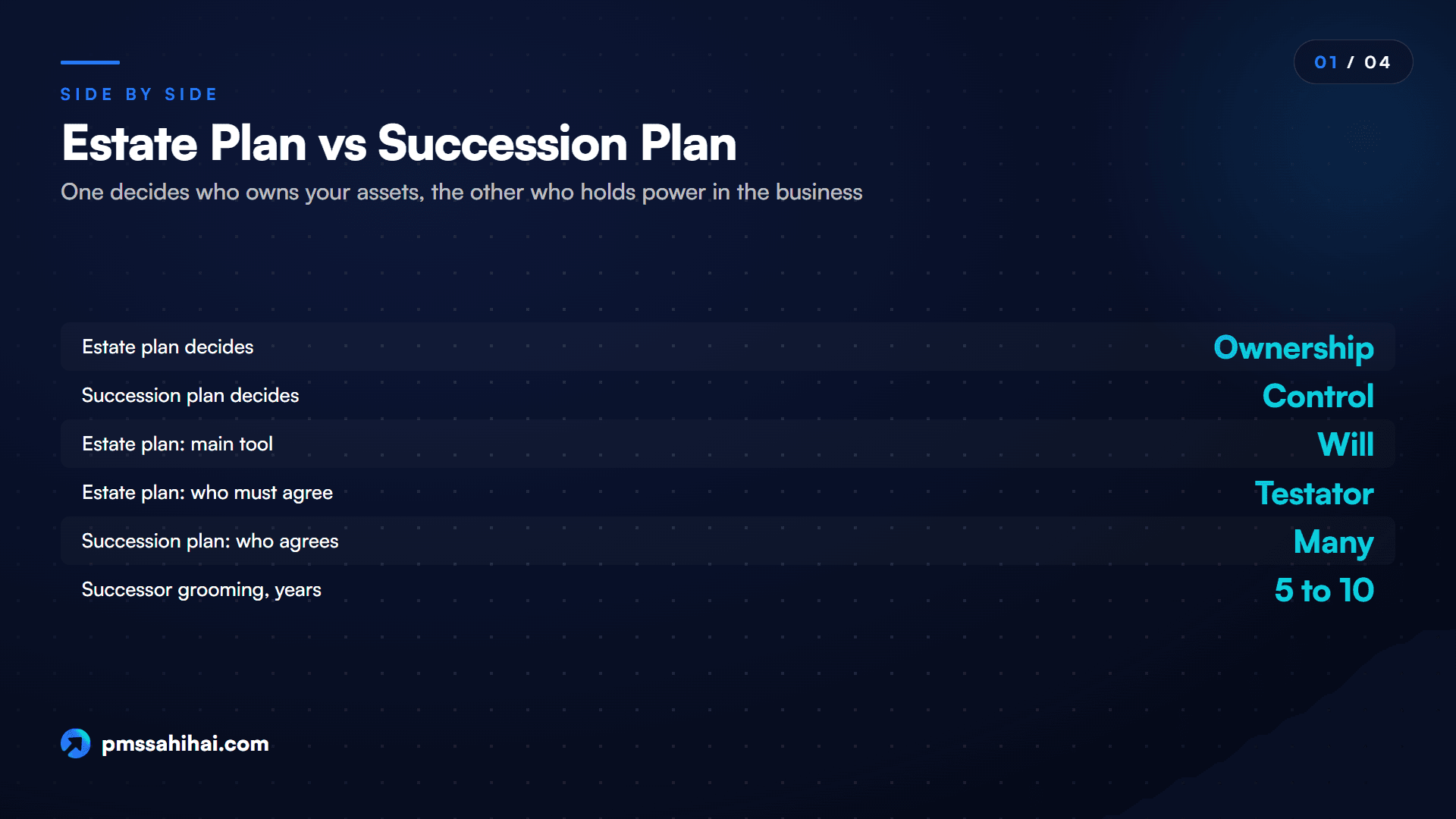
This table is the core of the comparison.
| Point of difference | Estate planning | Succession planning |
|---|---|---|
| Core question | Who owns my assets? | Who owns and runs the business? |
| Subject matter | Personal assets of one individual | A business and its control |
| Who needs it | Anyone with assets or dependants | Business owners, promoters, partners |
| Trigger | Death or loss of capacity | Death, incapacity, retirement or a planned exit |
| Timing | Mostly takes effect at the end | Runs for years while the founder is active |
| Main tools | Will, trust, nomination, joint holding | Shareholders' agreement, family constitution, board design, holding entity |
| Governing law | Succession laws, Indian Trusts Act, SEBI nomination rules | Companies Act, partnership law, company articles, SEBI takeover rules if listed |
| People involved | Lawyer, tax adviser, executor, trustee | Family, board, senior managers, investors, lenders |
| Main failure | Heirs fight, or assets get stuck | Business stalls, or family owners fight for control |
| Success looks like | Right people receive assets quickly | Business keeps running and the family stays aligned |
Two rows explain why succession planning and estate planning feel so different. The timing row is why the plans feel so different in practice: a will can be signed in an afternoon and then sit in a locker, whereas Treelife suggests successor development should start 5 to 10 years before a transition. The people row explains why succession planning is harder. A will needs only the testator's decision, while a business plan needs other people to agree.
How the Two Disciplines Grew Up Separately
The two ideas come from different traditions, which helps explain why they use different tools.
Estate planning grew out of property law and tax. India's trust law dates to the Indian Trusts Act of 1882, and its general succession law to the Indian Succession Act of 1925, with the Hindu Succession Act following in 1956. For about three decades, tax also drove the subject: estate duty applied from 1953 until it was abolished in 1985. Its removal took the death tax out of the picture but not the reasons to plan, since heirs can still fight and assets can still get stuck.
Business succession came from management practice. Wikipedia's account credits Walter Mahler with shaping General Electric's succession process in the 1970s, which became the reference point for corporate practice. Family business succession advisers later adapted those ideas to promoter families, adding what a corporation does not have to think about: siblings, in-laws and what the founder's children feel they are owed.
In India the two disciplines started meeting more often when the law itself shifted. Three moves stand out:
- The Hindu Succession (Amendment) Act, in force from 9 September 2005, made daughters coparceners by birth, which changed the map of who could claim a stake in family property.
- The Supreme Court ruled in Shakti Yezdani on 14 December 2023 that nomination does not override succession law.
- Section 213 of the Indian Succession Act was removed by the Repealing and Amending Act, 2025, and SEBI's transmission circular of 23 July 2026 dropped the mandatory requirement for probate of a will.
Technology has mainly touched the estate side. SEBI's nomination framework uses OTP-based online nomination, its 2023 mechanism lets an investor's death be reported centrally through KYC registration agencies, and its transmission framework standardises forms. Succession has seen far less change from software, as a family council still has to sit in a room and agree.
What Each Plan Cannot Do for the Other
This is where estate planning and succession planning part ways, and it is the most useful section for anyone holding both kinds of wealth.
What an Estate Plan Cannot Do for a Business
A will cannot hand over a board seat. Section 166(6) of the Companies Act, 2013 says a director "shall not assign his office and any assignment so made shall be void". Your will can pass your shares. Your directorship ends with you, and the board and shareholders fill the seat under the company's rules.
A will cannot make heirs agree. Leave a company in equal shares to three children and each receives a third of the votes, but nobody receives the power to decide. Equal shares are often fair as estate planning and unworkable as succession planning.
A will speaks too late. It takes effect on death. A founder who has a stroke at 68 is alive, so the will does nothing, while lenders still need signatures and salaries still need approval. Moneycontrol's reporting on legacy planning describes exactly this gap: ownership is clearly defined, authority is not, and board decisions stall and banking mandates get challenged.
A nomination cannot transfer control. Under SEBI's July 2026 framework, a nominee receives demat holdings "as trustee on behalf of legal heir(s)". Naming your son as nominee on promoter shares does not settle who ends up owning them.
What a Succession Plan Cannot Do for a Family
A shareholders' agreement cannot distribute your house. Business documents govern business assets. Your flat, your portfolio and your spouse's security sit outside them, and if you do not cover them, the succession law that applies to you will.
A family constitution cannot replace a will. A constitution records values, roles and rules for the family's relationship with the business. Unless it is backed by binding agreements and the company's articles, treat it as a moral commitment rather than an enforceable one, and ask your lawyer how far yours binds anyone.
A successor is not an heir. Choosing your daughter as next CEO gives her no ownership. If your will then splits the shares among four children, she may run a company in which she can be outvoted.
Control is not provision. A plan that keeps the company whole can leave a non-business child or a surviving spouse with shares that pay little and cannot easily be sold. Business succession alone does not provide anyone's income.
Where a Will Collides With a Business Plan
The most expensive family business succession problems sit where the two plans meet. Advisers at iVentures make the same point: a will and a succession agreement can conflict and cause disputes, so the two need designing together. Here is what that looks like.
Four Conflicts Worth Checking Today
1. Will vs shareholders' agreement. The agreement says that shares must first be offered to other family shareholders. The will leaves them directly to a son-in-law. Which prevails, and on what terms, can turn on how the agreement and the company's articles are drafted, and on the facts. Do not assume your will wins.
2. Nominee vs will vs business plan. The demat form names a spouse. The will names a son. The family constitution expects shares to stay with active members. After Shakti Yezdani, the nominee holds for the legal heirs, so the spouse has to pass the shares on, but only after an awkward delay in which nobody is sure who should vote them.
3. Ancestral vs self-acquired. A founder's will can dispose of what is his to give. If part of the business sits in a Hindu Undivided Family, or was acquired with ancestral funds, it does not all belong to him alone. Since 2005, a daughter's coparcenary claim is part of that picture.
4. Personal law limits. Your estate plan works inside the personal law that governs you. Legal 500's overview notes, for instance, that under Islamic law a bequest by will is limited to one-third of the estate unless the legal heirs consent. A business plan that assumes free disposal may simply fail for that family.
A Worked Example: One Family, Two Documents
Here is an illustrative family, not a real case.
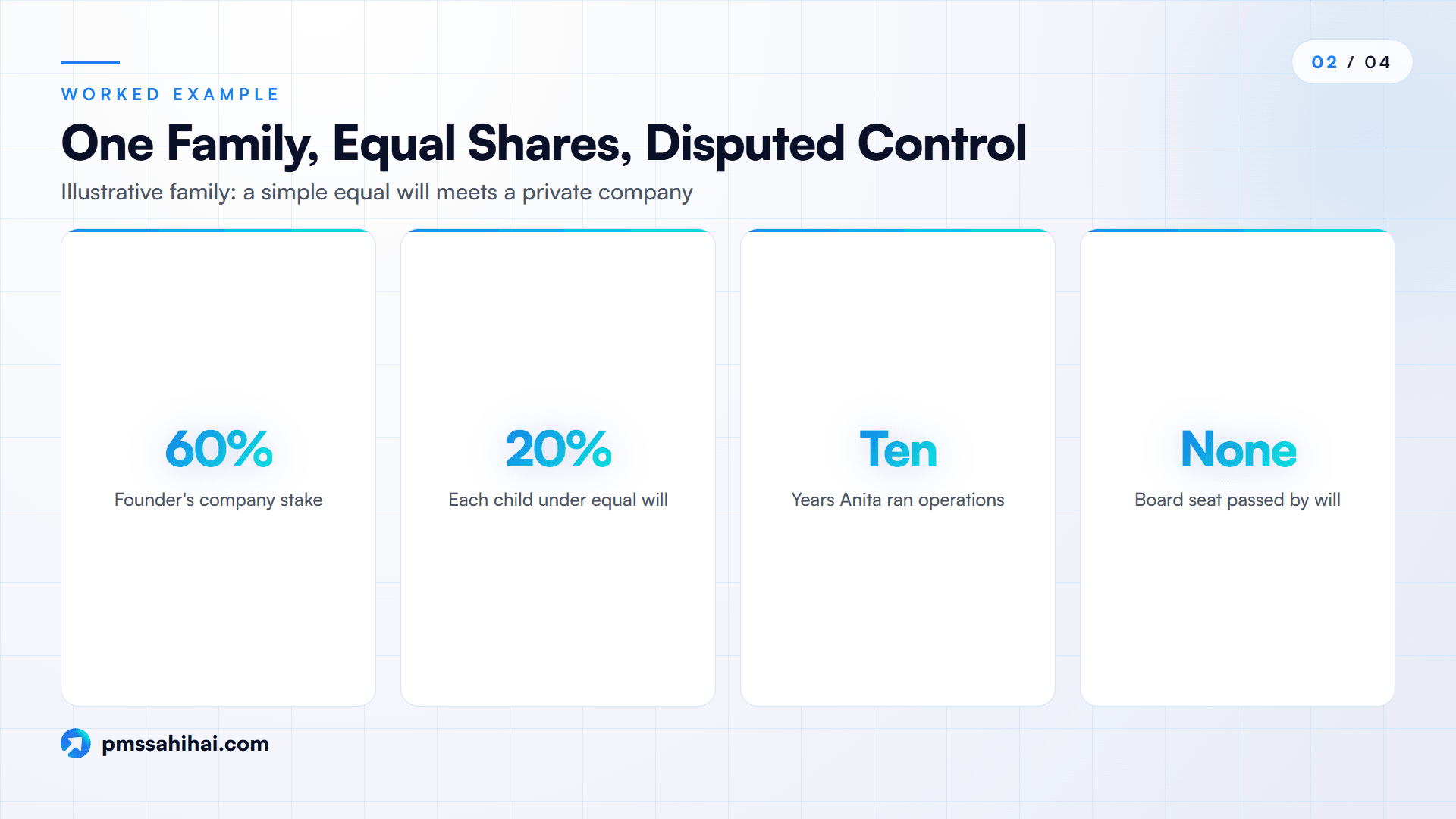
Rajiv, 66, owns 60% of a private manufacturing company. His children are Anita, who has run operations for ten years, Vikram, a doctor, and Neha, who lives overseas. He also has a home and a large investment portfolio. His will is simple: everything goes equally to the three children.
That is a respectable estate plan. Now look at what happens to the business if he dies:
- Votes: each child ends up with 20%. Anita can be outvoted by Vikram and Neha, who have never worked in the company.
- Board: Rajiv's seat falls vacant. Nothing says Anita gets it.
- Income: Vikram and Neha hold shares of a private company with little market and may want dividends, while Anita wants to reinvest.
- Result: fair ownership, disputed control.
A joined-up plan might look different without being less fair:
| Asset | Who receives it | Document that does the work |
|---|---|---|
| Company shares | Anita gets a controlling stake, others a smaller stake or an agreed exit price | Will or trust, matched to the shareholders' agreement |
| Portfolio and home | Weighted towards Vikram and Neha to balance the value | Will, with nominations aligned |
| Board and CEO role | Anita, with an independent director added | Board resolution and articles |
| Disputes and exits | Agreed valuation method and buyback terms | Shareholders' agreement |
| Rajiv's incapacity | A named stand-in at the company and a board transition path | Board rules and articles; take legal advice, since a power of attorney may end if the principal becomes of unsound mind |
The estate plan decides value, and the succession plan decides power. Neither one alone would have saved this family. Whether this split suits a given family is a judgement for that family and its lawyer.
One Extra Layer for Listed Promoters
If the shares are in a listed company, the SEBI takeover rules join the conversation. Regulation 10(1)(g) of the SEBI (SAST) Regulations, 2011 exempts an "acquisition by way of transmission, succession or inheritance" from the open-offer obligation. Planned lifetime moves are different: inter se transfers among promoters and immediate relatives have their own conditions, and moving shares into a family trust needs separate checking rather than an assumption that it is exempt. An estate lawyer alone may miss this, and a merchant banker alone may miss the will.
Which Plan Your Family Actually Needs
Answer three questions:
- Do you own at least part of a business in which you make decisions? If no, you need estate planning. You probably do not need succession planning in the family-business sense.
- Would the business stall for a month if you could not sign anything? If yes, you need succession planning even if you feel years from retirement.
- Is the person who should run the business the same as the people who should inherit it? If not, both plans must be drafted together, because this is where they will collide.
Here is how this tends to play out by profile:
| Profile | Estate plan | Succession plan |
|---|---|---|
| Salaried executive with home and portfolio | Essential | Not needed in the business sense |
| Retired HNI living on investments | Essential | Only if a family investment entity needs a decision-maker |
| Doctor, CA or lawyer with own practice | Essential | Light: who takes over clients, what the firm is worth |
| Partner in a firm or LLP | Essential | Essential: read your deed on what happens at a partner's death or exit |
| Promoter of a private family company | Essential | Essential, joined to the estate plan |
| Promoter of a listed company | Essential | Essential, with takeover rules checked |
| NRI with Indian assets | Essential, with FEMA and treaty advice | Only if a business is involved |
The point of the salaried-investor row is reassurance. You do not need a family constitution for a two-person household holding a home and a PMS account. A clean will and aligned nominations do most of the work.
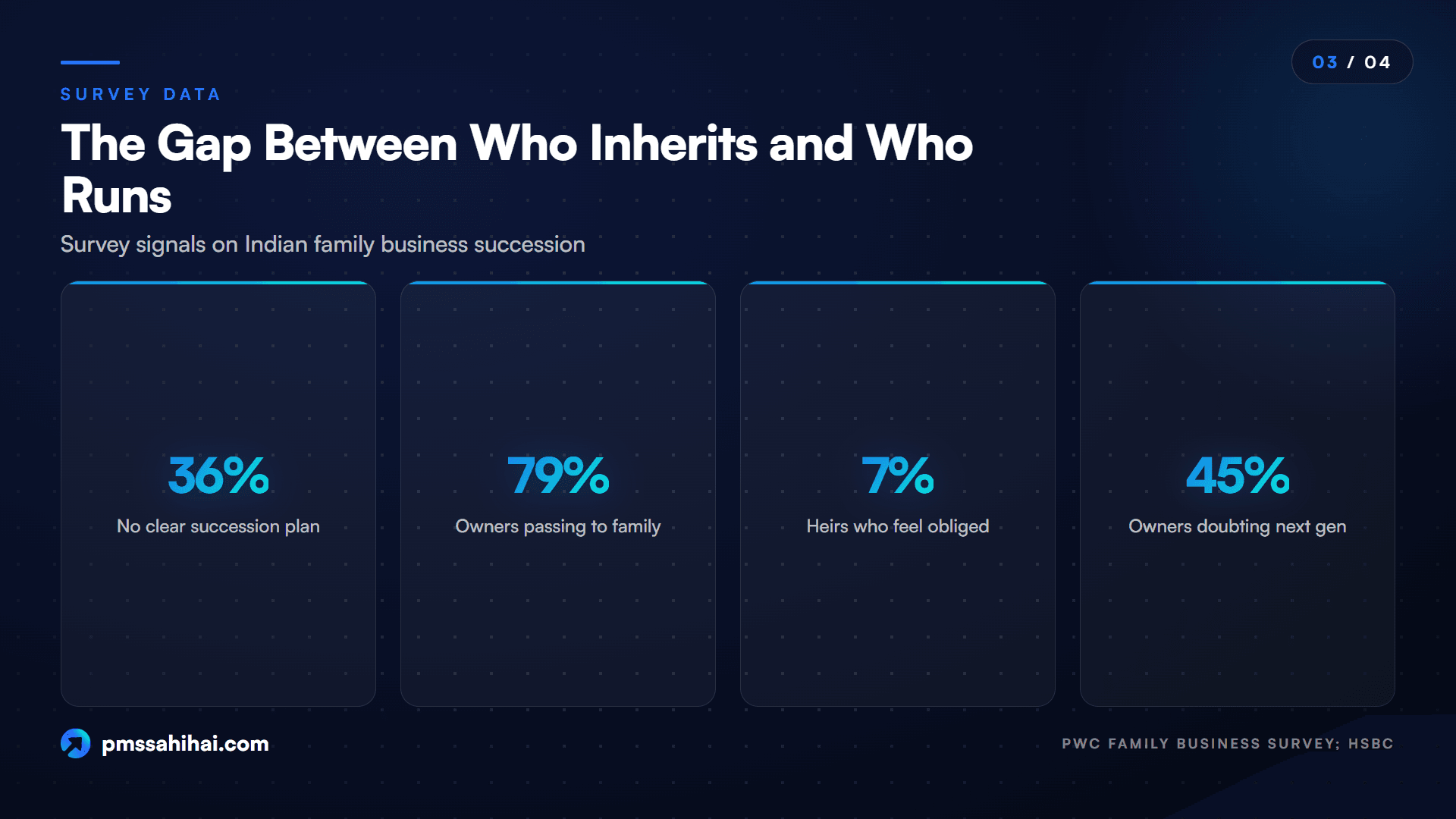
The point of the promoter rows is the opposite. Survey data suggests many have not done this yet. PwC's 12th Family Business Survey, released in 2026, reports that 36% of Indian family businesses have no clear succession plan against 28% globally, on an Indian sample of about 40 leaders, so treat it as a signal rather than a census. An HSBC report covered by Business Today found that 79% of Indian family business owners plan to pass the business to a family member, yet only 7% of heirs feel obliged to take it over, and 45% of owners do not expect the next generation to run it. That gap between who inherits and who runs is the very thing this comparison is about.
The Order to Build Both Plans
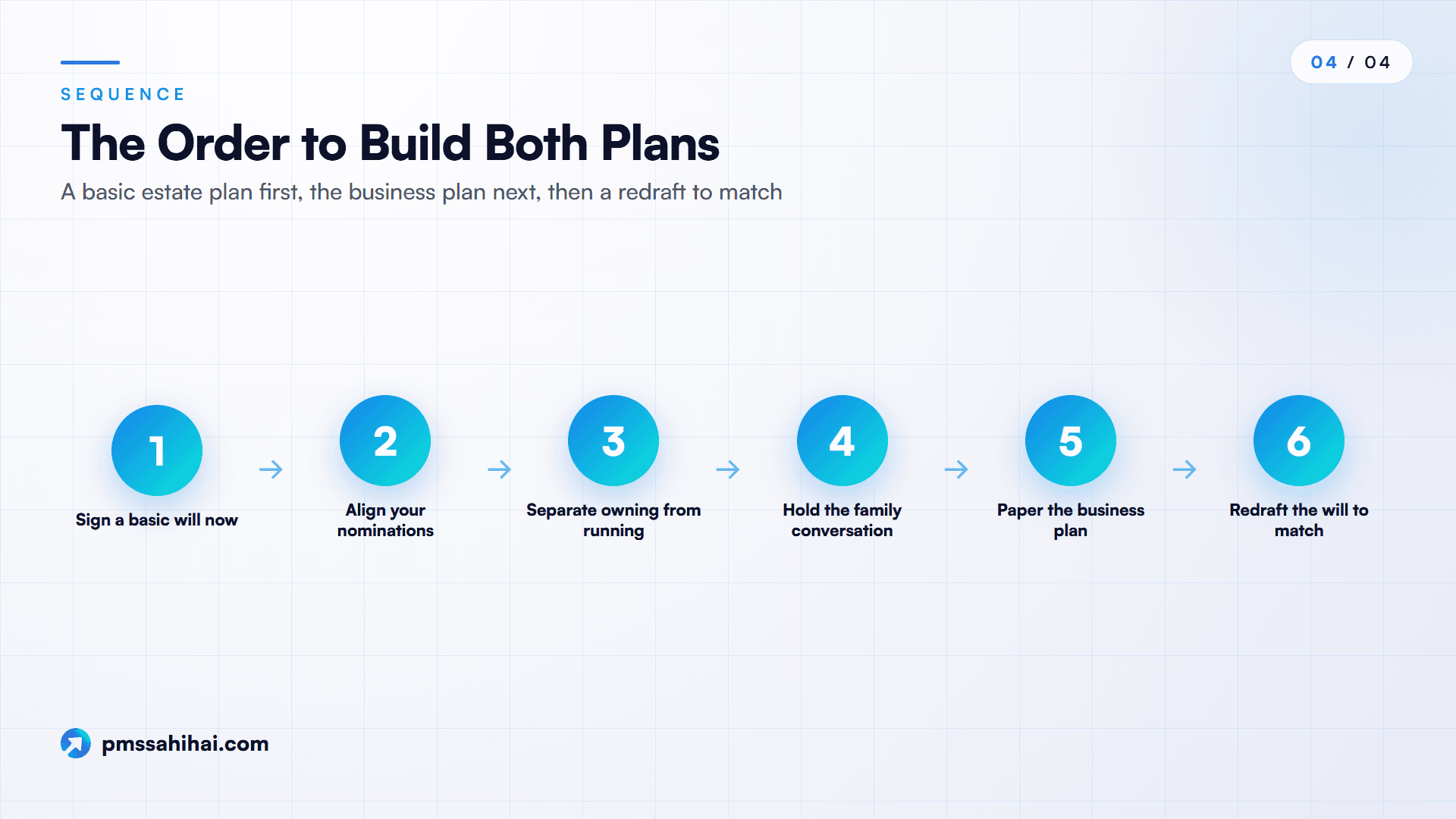
People ask which comes first. For most families the honest answer is a basic estate plan now, then the business plan, then a full redraft of the estate plan to match.
- Sign a basic will now. It is cheap, fast and protects your family if anything happens during the longer work. Two attesting witnesses are required; registration is optional.
- Align your nominations. SEBI's rules in force from 1 September 2026 allow up to three nominees on a demat account or mutual fund folio, or a formal opt-out. Nominate people who will pass assets on smoothly to those your will names.
- Separate the two questions. List who should own the business and who should run it. Treat them as different lists, even if the same names appear on both.
- Hold the family conversation. Do this while the founder can still lead it. Decide about active and non-active members, dividend expectations and exit routes.
- Paper the business plan. Shareholders' agreement, articles, board composition and any holding entity or trust. Treelife's suggested pattern is a hybrid: an irrevocable trust for the business and listed shares, with a will for remaining personal assets. Whether that fits you is a matter for your lawyer and tax adviser.
- Redraft the will to match. This is the step most people miss. The will should reflect the balance struck in the business plan, and every document should use the same assumptions.
- Plan for incapacity separately. Decide who signs if the founder cannot. Death planning alone leaves this gap open. Section 201 of the Indian Contract Act, 1872 ends an agency when the principal becomes of unsound mind, so do not lean on a power of attorney without specific legal advice.
- Review on a trigger. Marriage, divorce, a death, a sale, a fundraise or a change in law. Moneycontrol's report notes that succession now comes up at the private equity term-sheet stage, so a funding round is a sensible review point.
What Good Planning Makes Easier
Done together, estate and succession planning make several hard things simpler.
- Clear authority on the worst day. Banks, lenders and staff know whose signature counts, which keeps the company running during a family's most difficult week.
- Faster release of investments. SEBI's transmission circular sets a limit of 21 calendar days once all documents are in, and clean paperwork is what starts that clock.
- Fairness without forced co-ownership. Non-business children can get value from other assets, instead of being locked into a company they do not run.
- Lower cost of moving early. Advisers quoted by Moneycontrol point out that restructuring usually involves income tax, stamp duty or both, and that delay adds to the burden as asset values grow.
- Better conversations with outside capital. Investors and lenders want to know who runs the company if the promoter steps back. A real answer helps in that negotiation.
- Less guesswork for heirs. Tax is one thing they need not fear at the moment of receipt: India has no inheritance tax, and an heir generally takes the original owner's cost and holding period for capital gains. Ask a tax adviser how this applies to you.
How PMS Sahi Hai Fits Into the Estate Side of the Plan
Start with what PMS Sahi Hai does not do. It is a PMS and AIF comparison and research platform. Nothing we could find on it covers drafting wills, setting up trusts or running a family council, so it is not your estate planning or succession planning adviser. Your lawyer and tax adviser hold those jobs.
Where it helps is on one specific asset. Once a family has decided who gets what, someone has to look after the investment portfolio inside that estate, and that person is often a child who never chose the strategy. PMS Sahi Hai's published material speaks to that moment:
- Understand where the portfolio sits. Transmission runs through the custodian and depository participant. The guide on what a custodian does explains that chain.
- See what heirs can do with the shares. The explainers on in-specie transfers and the PMS exit process set out the difference between moving holdings and selling them.
- Plan for a manager-side event too. Estate plans assume the manager outlives the investor. The piece on what happens if a fund manager shuts down looks at the reverse case.
- Compare before you inherit a decision. The compare page lets an heir or trustee line up PMS, AIF or GIFT City strategies side by side before deciding to stay, switch or exit.
- Ask Nyra the awkward questions. Nyra, the platform's AI research tool, answers plain-English questions about a strategy, its fees and its benchmark. Its published methodology describes five scoring pillars and shows strategies with under 12 months of record as "Not Rated". Nyra is an analytical tool and not a SEBI-registered investment adviser, so treat its answers as research, not advice.
This matters for a succession plan in one specific way. When a founder sells a business or takes money out of it, business wealth turns into financial wealth, and the estate plan has to catch it. A portfolio that was an afterthought can become the main asset that balances a will, which is a good reason to understand it before it is inherited.
Honest Limits of Both Plans
Neither plan is a magic shield, and the sales literature rarely says so.
They do not stop litigation. A will can be challenged on capacity, undue influence or forgery. A trust can be attacked by creditors or heirs on its own grounds. Good drafting lowers the odds; it does not remove them.
They do not remove tax. India has no estate duty today, but income and gains on inherited assets remain taxable, and a discretionary trust can be taxed at the maximum marginal rate under the Income-tax Act, 2025. Stamp duty on moving property varies by state. Talk of bringing estate duty back has surfaced before; nothing here should be read as a forecast either way.
They cost time and goodwill. Legal fees are the smaller cost. The larger one is the conversation in which a founder tells one child that a sibling will lead. Some families put it off for years, and some never recover from having it badly.
They can go stale. Rules changed sharply in 2025 and 2026, as the nomination and probate changes above show. A plan signed in 2021 may rest on assumptions that no longer hold.
A plan cannot produce a successor. If no one in the family wants the job, or is good at it, the honest succession plan may be professional management or a sale. That is a legitimate outcome, and the estate plan then has to deal with cash instead of shares.
Some areas are unsettled. How a shareholders' agreement interacts with a will, or how far a family constitution binds members, depends on drafting and facts. Get advice from a lawyer on your own documents rather than relying on any general article, including this one.
Two Questions, Two Plans, One Family
The estate planning vs succession planning debate is really a false choice. One plan decides who owns your assets, and the other decides who holds power in your business. A salaried investor needs the first. A business family needs both, drafted by people who have read each other's work.
When the investment part of the estate comes up, PMS Sahi Hai and Nyra can help you understand what your heirs would actually hold. If you remember one test, use this: read your will alongside your shareholders' agreement. If they would produce different owners, you have found your next task.
Start With the Question Your Family Has Not Answered
Pick the question you have been avoiding: who gets what, or who decides what. Write down your answer this week and take it to a lawyer and a tax adviser. Then read your will and your business documents side by side.
When the portfolio in your estate needs a second look, compare PMS and AIF strategies on PMS Sahi Hai, ask Nyra what a fee or score means for your heirs, or book a 15-minute conversation with the team.
This article is general information as of 30 October 2026. It is not legal, tax or investment advice.
PMS Sahi Hai is a distributor of Portfolio Management Services and Alternative Investment Funds, APMI-registered (Registration No. APRN08358). This article is for education only and is not investment advice, a recommendation, or an offer to buy or sell any security. Investments in securities markets are subject to market risks; read all scheme-related documents carefully. Past performance is not indicative of future results. Consult your advisor before investing.
Ishaan founded PMS Sahi Hai to make India's PMS, AIF and GIFT City markets legible to serious investors, comparing every SEBI-registered manager on the same comparative basis, with no shelf products and no commission bias.
Frequently asked
What is the difference between estate planning and succession planning?
Estate planning decides who receives your personal assets on death or incapacity, using tools such as a will, trust and nomination. Succession planning decides who owns and runs a business and how control moves to them, using tools such as shareholders' agreements, family constitutions and board design. The first is about property. The second is about property and power.
Is succession planning part of estate planning?
Some advisers treat it that way, because shares in a family company are part of a person's estate. In practice they are separate jobs. Estate planning can move the shares, but it does not settle who runs the company, who sits on the board or how disputes get resolved. Those need their own documents, written to match the will.
Which should a family business do first?
Sign a basic will first, because it is quick and protects the family while longer work continues. Then build the succession plan, since that takes months or years of family discussion. Finally, redraft the will so it matches the shareholding and control decisions you reached. Treating the first will as final is a common and costly mistake.
Can a will transfer control of a company?
A will can transfer shares, which carry votes, so it can affect control. It cannot transfer a directorship, because section 166(6) of the Companies Act, 2013 voids any assignment of a director's office. Transfers may also be limited by the company's articles or a shareholders' agreement. Ask a lawyer to read your will alongside those documents.
Does a nominee get my shares in the family company?
Not as final owner. In Shakti Yezdani (December 2023), the Supreme Court held that nomination does not override succession laws. SEBI's July 2026 transmission framework says nominees receive demat assets as trustee on behalf of legal heirs. The nominee is a route for release, while your will or the applicable succession law decides who finally owns them.
Does a family trust solve both estate and succession planning?
It can help with both, but it does not replace either. A trust can hold shares together and keep them out of a fragmented inheritance, and its deed can set rules. It still needs trustees who can decide, a management plan for the business and tax advice. For listed shares, check the SEBI takeover rules before transferring anything into it.
Does a salaried investor need succession planning?
Usually not in the business sense. If you hold a home, deposits, mutual funds or a PMS portfolio and own no business, a clear will, aligned nominations and a plan for incapacity normally cover what you need. A family trust is worth considering only for special situations, such as minor children or a dependant with special needs.
Is there inheritance tax on assets or business shares in India?
There is no separate inheritance tax, because estate duty was abolished in 1985. Under the Income-tax Act, 2025, assets received by will or inheritance are not taxed as income for the heir. Later income and gains are taxed, generally using the original owner's cost and holding period. Consult a tax adviser, particularly if an heir is non-resident.
Keep reading
All articles
Long-Short SIF vs Hybrid SIF: Rules, Limits, Tax and Who Each Suits
Long-short SIF vs hybrid SIF: compare SEBI rules on equity floors, the 25% short cap, redemption, listing, tax tests and who each suits.

Hybrid Long-Short SIF vs Arbitrage vs Balanced Advantage Funds
Hybrid long-short SIF vs arbitrage fund vs balanced advantage fund: how each earns, how it is taxed, liquidity and minimums compared for 2026.

Equity vs Hybrid Long-Short SIFs: 24 Funds, NAVs and Fees Compared
All 24 equity and hybrid long-short SIFs compared on AMFI data to 26 Oct 2026: NAV since launch, drawdowns, holdings, fees and minimums.
Read it. Now pressure-test it.
Ask Nyra how this applies to your portfolio, or talk to our team, no pitch, no pressure.