
Hybrid Long-Short SIF vs Arbitrage vs Balanced Advantage Funds
Hybrid long-short SIF vs arbitrage fund vs balanced advantage fund: how each earns, how it is taxed, liquidity and minimums compared for 2026.

An arbitrage fund earns the gap between share prices and futures prices, so it behaves like a short-term deposit with equity-fund taxation. A balanced advantage fund, now officially called a dynamic asset allocation fund, moves money between equity and debt and can rise or fall with the market. A hybrid long-short SIF mixes debt, arbitrage, covered calls and up to 25% unhedged shorts, needs ₹10 lakh, redeems only on set days and is taxed according to how its own portfolio is built. Choose by horizon, tax slab and how quickly you may need the money, not by six months of returns.
Why Conservative Investors Are Comparing These Three Products Now
For years the conservative investor's menu was short. Money needed within a year went into a liquid or arbitrage fund. Money meant to grow without the full swing of equity went into a balanced advantage fund. Both were cheap to enter, redeemable on any business day and taxed as equity funds.
Since October 2025, fund houses have been launching a new rival under SEBI's Specialised Investment Fund framework: the hybrid long-short SIF, aimed at investors who want better-than-deposit returns, lower volatility than equity and an efficient tax outcome. On 30 September 2026, AMFI's monthly SIF report showed 11 hybrid long-short strategies holding ₹23,956.90 crore across 58,178 folios. That is about 63% of all SIF assets, and the category took in ₹4,486 crore in September alone.
The established products are far larger. On the same date, AMFI's monthly mutual fund report recorded ₹2,97,632 crore in 40 arbitrage funds and ₹3,15,741 crore in 36 balanced advantage and dynamic asset allocation funds. Arbitrage funds saw a net outflow of ₹3,956 crore in September, which is common around quarter-end.
So the question is real: hybrid long-short SIF vs arbitrage fund vs balanced advantage fund, which one fits which job? The honest answer depends less on recent returns and more on how each product earns money, how it is taxed, and how quickly you can get out.
An arbitrage PMS, with its ₹50 lakh minimum and tax on every trade, is a different product and outside this guide.
Three Products, Three Return Engines Explained
How an Arbitrage Fund Earns the Cash-Futures Spread
An arbitrage fund runs what traders call a cash-and-carry trade. It buys a share in the cash market and sells the same share's futures contract at the same time. Futures usually trade above the cash price, because the buyer of a future is effectively paying for not tying up money until expiry. When the contract expires, the two prices converge and the fund keeps the difference.
Say a share trades at ₹1,000 and its one-month future at ₹1,006. The fund buys the share and sells the future. On expiry both are worth the same, so the fund keeps ₹6 on ₹1,000, before costs, whichever way the share moved.
Three things follow from that design.
- Returns track short-term interest rates. The spread is, in effect, the market's price of money for a month. When rates and demand for leverage are high, spreads widen. When they are low, spreads shrink.
- Market direction barely matters. Each long share is matched by a short future, so the net equity exposure is close to zero.
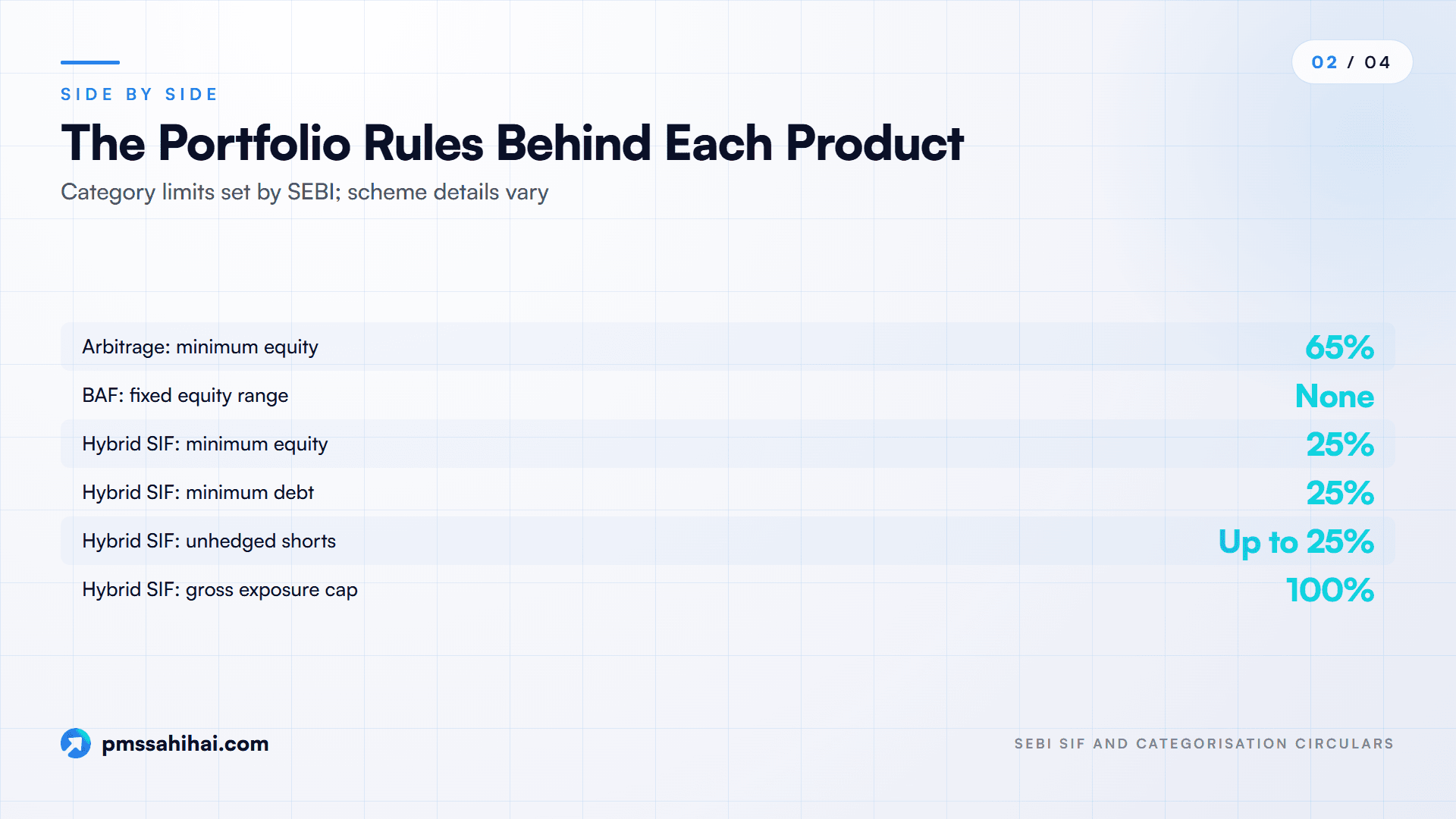
- The equity count is high. Because the fund physically owns shares, at least 65% of its assets are in equity, which is what earns it equity-fund taxation.
How a Balanced Advantage Fund Moves Between Equity and Debt
A balanced advantage fund has a different job. It is meant to give you equity returns over time with a smaller fall when markets drop. SEBI describes the category as "investment in equity/debt that is managed dynamically", with no fixed minimum or maximum.
Each fund house uses its own model, often built on valuation measures such as price-to-earnings, and describes it in the scheme document. When markets look expensive, the fund cuts net equity; when they look cheap, it adds.
The detail investors miss is how the fund cuts equity. Many balanced advantage funds do it through arbitrage. They keep owning shares but sell futures against part of the holding. Those hedged shares still count as equity for tax purposes but carry almost no market risk. So a fund that reports 70% equity might hold around 45% unhedged equity and 25% in arbitrage positions. The number to look for in the factsheet is net equity, not gross equity.
This design lets many balanced advantage funds keep at least 65% in equity on paper, and so stay equity-taxed, while their real market exposure moves up and down.
How a Hybrid Long-Short SIF Blends Debt, Arbitrage and Shorts
A hybrid long-short SIF sits under SEBI's SIF framework of 27 February 2025. The rule book is short. The strategy must hold at least 25% in equity and equity-related instruments, at least 25% in debt, and may take up to 25% in unhedged short positions through derivatives in equity and debt. Total gross exposure across cash and derivatives cannot exceed 100% of net assets, so there is no leverage.
Inside those wide limits, fund houses have built very different products.
- Altiva Hybrid Long-Short Fund (Edelweiss) describes a core of equity arbitrage and high-quality fixed income, with special situations such as IPOs, buybacks and open offers, pair trades and covered calls on top. On 31 July 2026, according to the fund house's portfolio update reported by Business Today, fixed income was 39.49% of the portfolio, cash-futures arbitrage and covered calls about 38%, other derivative strategies about 9% and REITs and InvITs about 5%.
- Magnum Hybrid Long Short Fund (SBI) holds 65% to 75% in equity and equity-related instruments, of which up to 75% can be hedged, 25% to 35% in debt and up to 25% in unhedged short derivatives.
- Arudha Hybrid Long-Short Fund (Bandhan) allows debt and equity between 35% and 65% each, with at least 35% of assets in fully hedged, market-neutral equity.
So the label tells you little. As Kalpesh Jain, a SIF fund manager at Kotak Mutual Fund, told Outlook Money, "hybrid long-short is a structure, not a strategy". Two funds with the same category name can have very different net equity, hedge ratios and risk budgets.
Many launched so far look like an arbitrage fund with extra levers: a larger debt book, covered-call income and the right to short. Each lever adds return potential and risk.
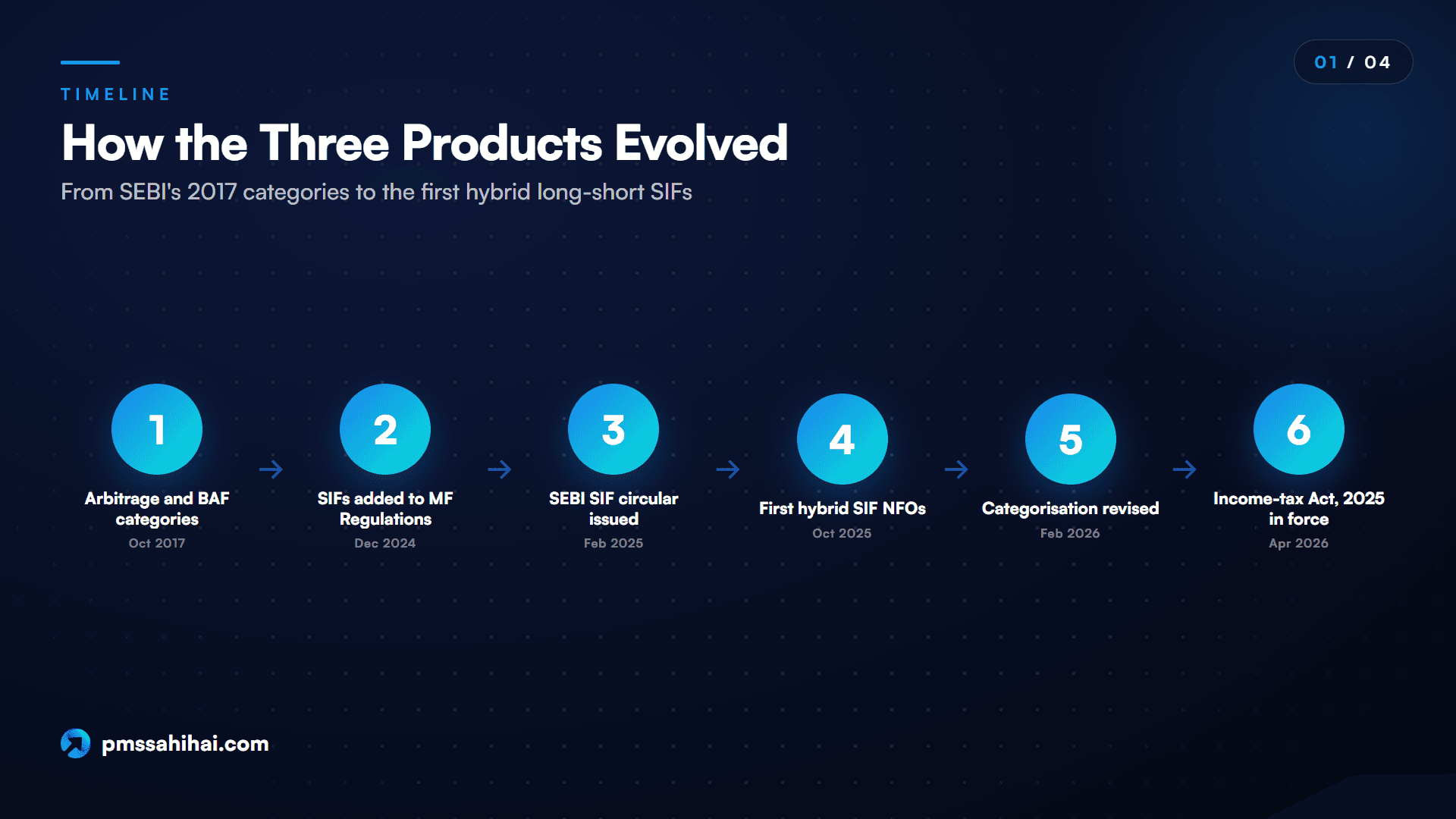
From 2017 Categories to 2026 SIFs: How the Three Evolved
| Date | Milestone |
|---|---|
| 6 October 2017 | SEBI's categorisation circular creates the Arbitrage Fund (minimum 65% equity, arbitrage strategy) and the "Dynamic Asset Allocation or Balanced Advantage" category |
| 16 December 2024 | SEBI amends the Mutual Funds Regulations to introduce Specialised Investment Funds |
| 27 February 2025 | SEBI's SIF circular defines seven strategy types, including the Hybrid Long-Short Fund; effective 1 April 2025 |
| 1 to 15 October 2025 | NFOs of the Altiva and Magnum hybrid long-short strategies, the first in the category |
| 26 February 2026 | SEBI's revised categorisation circular renames the BAF category and tightens the arbitrage fund's debt rules |
| 20 March 2026 | SEBI issues a new Master Circular for Mutual Funds |
| 1 April 2026 | The Income-tax Act, 2025 takes effect |
| 26 August 2026 | Example compliance date: HSBC applies the new hybrid rules to its schemes |
| 30 September 2026 | 11 hybrid long-short SIFs manage ₹23,956.90 crore |
What SEBI's February 2026 Circular Changed
Three changes in the February 2026 categorisation circular matter for this comparison.
First, the category formerly called "Dynamic Asset Allocation or Balanced Advantage" is now listed simply as Dynamic Asset Allocation Fund, described as a fund "investing in debt and equity instruments only". The circular also says a scheme's name should be the same as its category and should not use words that emphasise returns. Existing schemes were given six months to align. Some fund houses' notices issued in August 2026 still use the "Balanced Advantage" name, so check your scheme's latest addendum for its current name. This guide uses both terms.
Second, an arbitrage fund's debt portion is now narrower. The circular says exposure to debt instruments "shall be limited to government securities with maturity less than 1 year as well as repo of government bonds only", and arbitrage funds may not invest in InvITs. In plain terms, the non-arbitrage part of an arbitrage fund can no longer chase extra yield in corporate bonds.
The result is a cleaner shelf. Arbitrage funds are now closer to spread-plus-treasury products, dynamic asset allocation funds are limited to equity and debt, and the extra levers some investors want, such as credit, option writing and limited shorts, sit more naturally in a hybrid long-short SIF.
Side-by-Side Comparison of Rules, Risk and Access
This table compares the three on the points that change your outcome. Scheme-level details vary, so treat the right-hand columns as category rules plus typical practice.
| Feature | Arbitrage fund | Balanced advantage / dynamic asset allocation fund | Hybrid long-short SIF |
|---|---|---|---|
| Regulator's definition | Arbitrage strategy, minimum 65% equity | Equity and debt managed dynamically | Minimum 25% equity, minimum 25% debt, up to 25% unhedged short |
| Main return driver | Cash-futures spread | Net equity exposure plus debt accrual | Debt accrual, arbitrage, covered calls, special situations, limited shorts |
| Market direction risk | Very low | Moderate, depends on net equity | Low to moderate, depends on the scheme |
| Leverage | None | None | None; gross exposure capped at 100% |
| Minimum investment | Set by scheme, often ₹100 to ₹5,000 | Set by scheme, often ₹100 to ₹5,000 | ₹10 lakh at PAN level across a SIF's strategies |
| Redemption | Any business day | Any business day | At least twice a week, or less often; notice up to 15 working days |
| Typical exit load | Small and short, such as 0.25% within 15 days | Often 1% within one year beyond a free limit | 0.5% within 15 to 30 days for some, 2% within a year for others |
| Taxation | Equity-oriented | Equity-oriented if the 65% test is met | Depends on the scheme's own portfolio |
| Risk label | Mutual fund riskometer | Mutual fund riskometer | Five-level SIF risk-band |
| Who can sell it | Mutual fund distributors | Mutual fund distributors | Distributors with the NISM derivatives certification |
Two cells deserve emphasis: the ₹10 lakh minimum applies across all strategies of one SIF at PAN level (accredited investors are exempt), and a hybrid long-short SIF is by regulation an interval strategy, not a daily-dealing fund.
How Each Product Is Taxed Under the Income-tax Act 2025
From 1 April 2026, mutual fund gains are taxed under the Income-tax Act, 2025. The old section numbers have changed, but the structure is familiar. All three products are taxed in your hands when you redeem, not inside the fund. What differs is the bucket your units fall into.
| Tax bucket | When it applies | Short-term | Long-term |
|---|---|---|---|
| Equity-oriented fund | At least 65% of proceeds in listed Indian equity shares, measured on an annual average | 20% if held up to 12 months (s.196, old 111A) | 12.5% above ₹1.25 lakh a year after 12 months (s.198, old 112A) |
| Specified mutual fund | Debt-heavy funds as defined in s.76 (old 50AA) | Slab rate, whatever the holding period | Slab rate, whatever the holding period |
| Other funds | Neither of the above, including many hybrids | Slab rate | 12.5% without the ₹1.25 lakh exemption, after 24 months, or 12 months for listed units if the AMC's reading applies |
Surcharge and the 4% cess come on top. The ₹1.25 lakh exemption is shared across all your equity long-term gains in a year, not available per fund.
The 65% Test That Decides Equity Taxation
Section 198(8) of the Income-tax Act, 2025 defines an equity-oriented fund as one that invests at least 65% of its total proceeds in equity shares of domestic companies listed on a recognised stock exchange. The percentage is computed on "the annual average of the monthly averages of the opening and closing figures".
Two points follow.
- Hedged shares count. An arbitrage fund owns real shares, even though it has sold futures against them. That is why arbitrage fund taxation follows equity rules despite near-zero market exposure.
- Derivatives alone do not. A long futures position is not an equity share. A fund that gets its equity exposure through derivatives, or holds more debt than equity, will not pass.
Many balanced advantage funds manage their portfolios to stay above 65% gross equity. If a fund's annual average dips below, its tax treatment changes, so check the scheme document and the fund's own tax note.
Why Two Hybrid SIFs Can Be Taxed Differently
This is the most misunderstood point in the comparison. Hybrid SIF taxation is decided by each scheme's own portfolio, not by the category name.
- SBI's Magnum Hybrid Long Short Fund holds 65% to 75% in equity. SBI's product page says that "as the equity exposure is above 65%", the strategy follows equity mutual fund taxation.
- HSBC's RedHex Hybrid Long-Short Fund describes itself in its FAQ as "a listed fund (other than Equity oriented Mutual Fund and Specified Mutual Fund)". HSBC says gains on units held over 12 months may be taxed at 12.5% as long-term gains, because the units are listed, and short-term gains at slab rates.
- Bandhan's Arudha allows equity between 35% and 65%, so its tax bucket depends on where the annual average actually lands.
HSBC's 12-month reading rests on section 2(101), which applies a 12-month holding period to "a security listed in a recognised stock exchange". Some commentators apply 24 months to non-equity fund units even when listed. We found no ruling or CBDT clarification settling the point, so treat it as unsettled and consult a tax adviser before relying on it.
A Post-Tax Illustration for a 30% Slab Investor
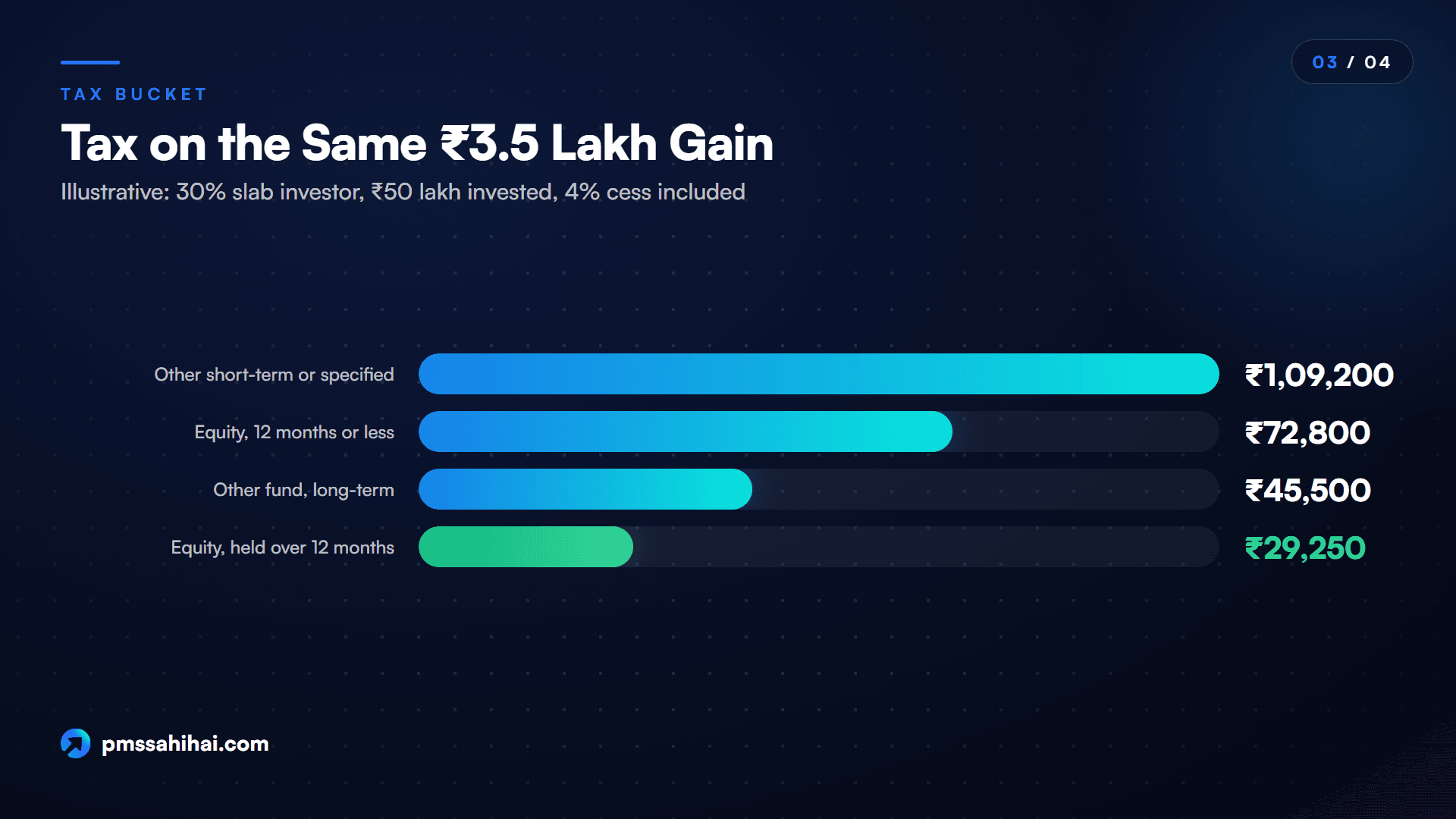
Here is a hypothetical example. An investor in the 30% slab invests ₹50 lakh and makes a gain of ₹3.5 lakh. The figures ignore surcharge, assume no other equity gains in the year and include the 4% cess. They show the effect of the tax bucket only. They are not return forecasts.
| Bucket and holding | Tax on ₹3.5 lakh gain | Gain kept |
|---|---|---|
| Equity-oriented, held over 12 months | ₹29,250 | ₹3,20,750 |
| Equity-oriented, held 12 months or less | ₹72,800 | ₹2,77,200 |
| Other fund, long-term at 12.5% | ₹45,500 | ₹3,04,500 |
| Other fund, short-term, or specified fund | ₹1,09,200 | ₹2,40,800 |
The gap between the best and worst rows is about ₹80,000 on the same pre-tax gain, which is why the tax bucket can matter more than a point of headline return. It also explains the arbitrage fund vs balanced advantage fund debate among top-slab investors, and why low-slab investors may keep almost as much in a plain debt fund.
Liquidity, Exit Loads and Minimums Compared
Liquidity is where the three products differ most, and where conservative investors most often get surprised.
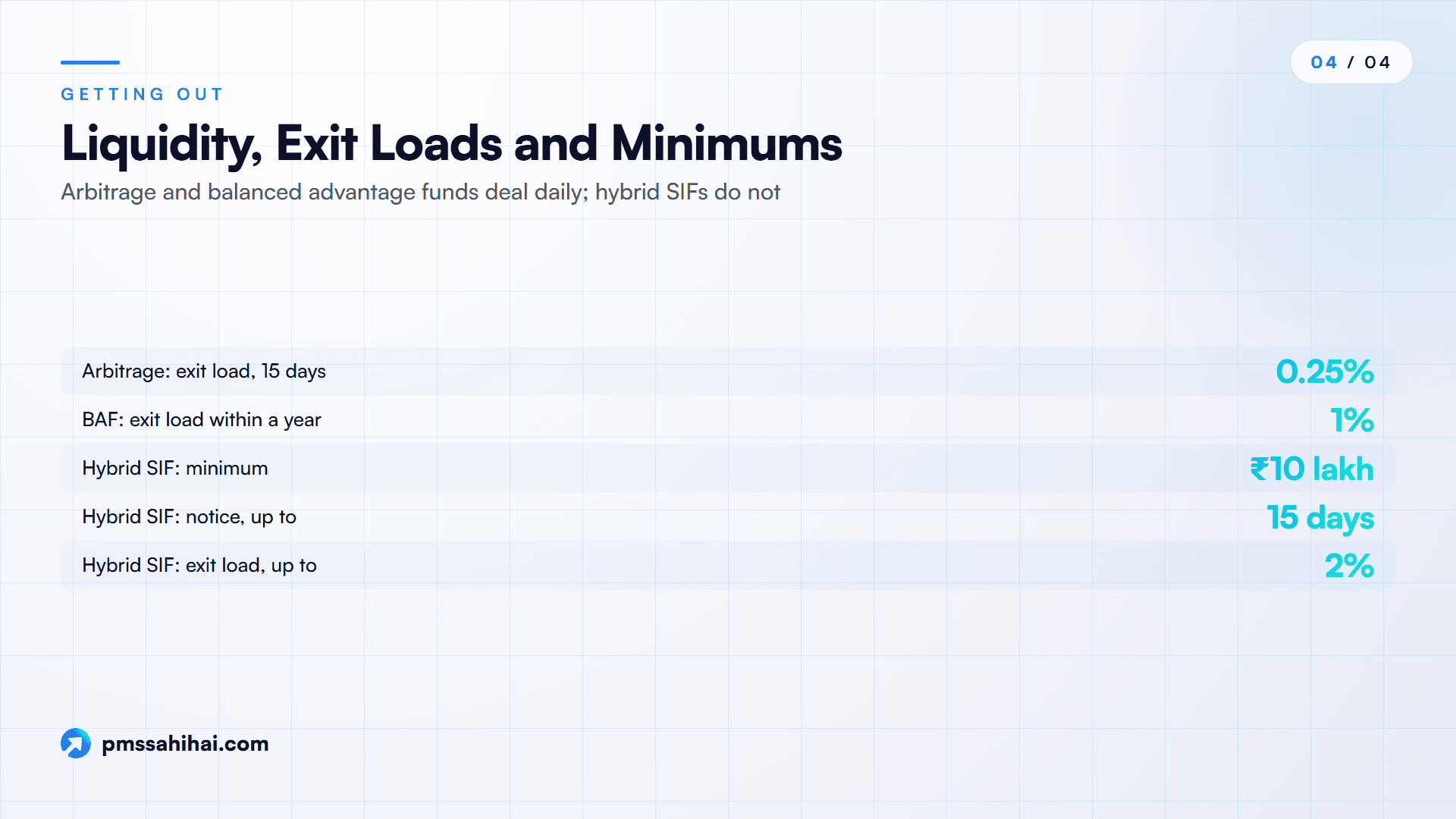
Arbitrage funds deal on any business day. In examples published by Upstox, SBI Arbitrage and Edelweiss Arbitrage charged 0.25% on units redeemed within 15 days, with minimums of ₹5,000 and ₹100.
Balanced advantage funds also deal daily. The HDFC and SBI examples in the same table charge 1% on units beyond a free allowance redeemed within a year.
A hybrid long-short SIF works differently.
- Redemption days are fixed. Magnum redeems twice a week, on Mondays and Wednesdays according to SBI's page. RedHex redeems every Monday.
- Notice periods are allowed. SEBI permits notice of up to 15 working days. RedHex applies a 10-working-day notice period, and you receive the NAV at the end of the notice period, not the day you asked.
- Exit loads vary widely. Magnum charges 0.50% up to 15 days and 0.25% up to one month. Altiva charges 0.50% within 30 days. RedHex charges 2% within one year.
- The ₹10 lakh floor binds on exit too. SEBI requires fund houses to ensure that your own redemptions do not take your SIF holding below ₹10 lakh. If a fall in NAV pushes you below, you can only redeem the whole remaining amount.
- Units are listed. Interval strategies must list on a stock exchange, a second exit route, though trading may be thin.
The practical rule: an arbitrage fund is a parking place for money you may need next week. A hybrid long-short SIF is not.
What the Early Numbers Show and What They Don't
Return comparisons are tempting, and most competing articles lead with them. Here is what the published data says, and the limits on reading it.
In a table published by Upstox on 24 August 2026, using ACE MF data with returns to 21 August 2026:
- SBI Arbitrage returned 6.84% in FY26 and 7.83% in FY25, with a standard deviation of 0.07.
- HDFC Balanced Advantage returned -0.14% in FY26, 8.40% in FY25 and 40.01% in FY24, with a standard deviation of 0.61.
- SBI Magnum Hybrid Long-Short (regular plan) had returned 5.79% since its October 2025 launch, with a standard deviation of 0.23 and a beta of 0.22.
- Altiva Hybrid Long-Short (regular plan) had returned 10.46% since launch, the highest of 11 funds in its category, with a standard deviation of 0.21 and a beta of 0.19.
Business Today, citing Edelweiss's July portfolio update, reported that when the Nifty 50 fell 11.31% in the March 2026 sell-off, Altiva fell 1.53%.
The pattern is plausible: arbitrage funds delivered steady mid-single-digit returns with almost no volatility, the balanced advantage fund behaved like diluted equity, and the two oldest hybrid SIFs sat in between with low betas. But the limits are serious.
- Track records are under a year old. No hybrid long-short SIF has been through a full rate cycle or a long bear market.
- Dispersion is wide. Upstox's July table showed since-launch returns from under 1% to above 9% across the category.
- Regular and direct plans differ. Several published figures are for regular plans, which carry distribution costs.
- Arbitrage returns reflect the spread environment, not manager skill.
Treat any since-launch return as a description of the past few months, not a forecast.
Where Each Product Earns Its Place
Each of the three has a job it does better than the other two.
Arbitrage funds are the best tool for short-term, high-slab parking.
- Daily liquidity, small and short exit loads, and very low volatility.
- Equity taxation: 20% short-term, which beats a 30% slab rate.
- A simpler debt book after the February 2026 rules.
Balanced advantage funds suit three-to-five-year money that can take some equity risk.
- Equity taxation in most schemes and a rules-based way to own more equity when it is cheap.
- Daily liquidity and SIP-friendly minimums.
A hybrid long-short SIF can suit one-to-three-year money above ₹10 lakh.
- More return levers. Credit and duration in the debt book, option-writing income, special situations and limited shorts.
- Potential tax efficiency. Some schemes are built to be equity-taxed; others aim at 12.5% long-term tax on listed units.
- Transparency. Offer documents, portfolio disclosures and a scenario analysis of derivative positions are public.
- A regulated alternative to Category III AIFs and PMS for investors who want a hedged, income-oriented strategy without a ₹50 lakh or ₹1 crore ticket.
For many investors the answer will be a combination: an arbitrage fund for the emergency and near-term bucket, a balanced advantage fund for medium-term equity-like money, and a hybrid long-short SIF only for a slice of surplus that does not need daily access.
How PMS Sahi Hai Helps You Read the Inner Clause of Hybrid SIF Choices
Choosing between these three is mostly a reading exercise: net equity, tax bucket, redemption terms. PMS Sahi Hai is built for that kind of homework, with one limit worth stating first. Its comparison shelf covers PMS, AIF and GIFT City strategies. Arbitrage funds, balanced advantage funds and SIFs are mutual-fund-family products, so you will not find them scored there. Their primary sources are the scheme documents and AMFI data cited above.
Here is where the platform does help.
- Background without the sales pitch. The site's published explainers cover what a SIF is, how long-short funds compare across the SIF and AIF wrappers, and when a ₹10 lakh SIF beats a ₹50 lakh PMS. Read them before a relationship manager's pitch, not after.
- A check on the next rung up. If your surplus is large enough for a PMS or a Category III AIF, the compare page lines up PMS, AIF and GIFT City strategies by category, fund house and benchmark, up to four side by side. That tells you whether a hedged or income-oriented PMS or AIF is a real alternative to a hybrid SIF at your ticket size.
- Questions framed properly. Nyra, the platform's AI research tool, answers plain-English questions and, by its own description, cites a primary source for every number and declines when it cannot find one. Ask it what "equity-oriented" means for a fund's tax, or how a notice period changes the NAV you receive. Nyra is an analytical tool, not a SEBI-registered investment adviser.
- The same caution on young track records. Nyra's published methodology scores strategies on five pillars and marks anything with under 12 months of history as "Not Rated". Apply the same discipline to a hybrid long-short SIF that launched this year.
- A look at what you already own. The portfolio health check reads PMS, AIF or mutual fund holdings on returns, risk, manager tenure and fees, so you can see whether a new low-volatility product fills a gap or duplicates one.
Limitations and Risks Investors Underestimate
No product in this comparison is risk-free. These are the risks that tend to be played down.
Arbitrage funds
- Returns shrink when spreads narrow. When the cash-futures gap compresses, so do returns, and there is no equity upside to compensate.
- Occasional small losses. Mark-to-market can produce a negative month even though the trade converges at expiry.
Balanced advantage funds
- They can lag in strong markets and still fall in weak ones. FY26 in Upstox's example shows a near-zero year.
- The model matters, and gross equity can mislead. Two funds in the category can behave very differently; read net equity.
Hybrid long-short SIFs
- Liquidity is limited. Fixed redemption days, notice periods and, in some cases, a 2% exit load within a year.
- Strategy risk is real. Shorts lose if prices rise, covered calls cap upside, special situations fail and bonds get downgraded.
- Tax depends on execution. Miss the 65% annual average and the tax bucket changes.
- The track record is short. Business Standard quoted experts in September 2026 cautioning that the early surge in SIF assets should not be read as long-term growth.
Choosing Between the Three: A Decision Framework
Use your horizon, tax slab and liquidity need as the three filters. This scenario table is a starting point, not advice.
| Your situation | Usually better fit | Why |
|---|---|---|
| Money needed within 3 to 12 months, 30% slab | Arbitrage fund | Daily liquidity, low volatility, 20% short-term equity tax |
| Money needed within a year, 5% to 20% slab | Liquid or money market fund, or arbitrage fund | Slab-rate tax may cost little more; compare post-tax |
| ₹10 lakh+ surplus, 1 to 3 years, can wait a week for money | Hybrid long-short SIF | More return levers, possible tax efficiency, limited liquidity |
| 3 to 5 years, comfortable with some equity swings | Balanced advantage / dynamic asset allocation fund | Dynamic equity with equity taxation and daily liquidity |
| Wants a single product for all of the above | None | Each product does one job well |
Before you invest in any of them, ask five questions.
- What is the net equity today, and what is the range in the scheme document?
- Which tax bucket does the fund house expect, and what happens if the 65% average is missed?
- On which days can I redeem, with what notice, and what is the exit load in year one?
- What exactly drives returns: spread, credit, option writing, shorts or market direction?
- How did the fund behave in its worst month, against its benchmark?
If the answers are clear and match your horizon, you have a candidate. If you need help framing the questions, Nyra on PMS Sahi Hai is a good place to rehearse them. The hybrid long-short SIF vs arbitrage fund choice is not a contest with one winner; it is matching a tool to a job.
Compare Before You Park Your Money
All three promise a smoother ride than equity. They deliver it in different ways, at different tickets, with different exits and tax bills. Start with the job the money has to do, read the scheme document for net equity, redemption terms, exit load and tax bucket, and compare post-tax outcomes at your own slab. Re-check every quarter: SEBI's rules for these products changed twice in eighteen months.
If part of your surplus could also go into a PMS or AIF, put those options side by side on the PMS Sahi Hai compare page, ask Nyra to explain any term in a scheme document, or book a 15-minute conversation with the team. Then decide with the post-tax number, the exit terms and the job the money has to do in front of you.
This article is for information only and is not investment, tax or legal advice. Figures are as of the dates stated and were checked on 27 October 2026. Tax treatment can change and some points are unsettled; consult a qualified tax adviser and read the scheme documents before investing.
PMS Sahi Hai is a distributor of Portfolio Management Services and Alternative Investment Funds, APMI-registered (Registration No. APRN08358). This article is for education only and is not investment advice, a recommendation, or an offer to buy or sell any security. Investments in securities markets are subject to market risks; read all scheme-related documents carefully. Past performance is not indicative of future results. Consult your advisor before investing.
Ishaan founded PMS Sahi Hai to make India's PMS, AIF and GIFT City markets legible to serious investors, comparing every SEBI-registered manager on the same comparative basis, with no shelf products and no commission bias.
Frequently asked
What is the difference between a hybrid long-short SIF and an arbitrage fund?
An arbitrage fund buys shares and sells matching futures to earn the price gap, with at least 65% in equity and daily liquidity. A hybrid long-short SIF must hold at least 25% each in equity and debt, can add up to 25% unhedged shorts, covered calls and special situations, needs ₹10 lakh and redeems only on fixed days.
Is a hybrid long-short SIF safer than a balanced advantage fund?
Not necessarily. A balanced advantage fund carries visible equity risk through its net equity. A hybrid long-short SIF usually has lower market exposure, but adds derivative, credit, strategy and liquidity risks, and has under a year of history. Compare each scheme's net equity, worst month and redemption terms rather than the category label.
How are hybrid long-short SIFs taxed in India?
Each scheme is taxed by its own portfolio. If at least 65% of its money, on an annual average, is in listed Indian shares, it is equity-taxed: 20% short-term and 12.5% long-term above ₹1.25 lakh. Otherwise it may be taxed as an other fund, where AMC readings on the long-term holding period differ. Consult a tax adviser.
Are arbitrage funds taxed as equity funds?
Yes. Arbitrage funds own real shares and hedge them with futures, so they meet the 65% listed-equity test in section 198(8) of the Income-tax Act, 2025. Gains on units held up to 12 months are taxed at 20%, and long-term gains at 12.5% above ₹1.25 lakh a year, plus surcharge and cess.
How often can I redeem a hybrid long-short SIF?
SEBI classifies the hybrid long-short SIF as an interval strategy with a minimum redemption frequency of twice a week, or less often if the fund house decides. Notice periods of up to 15 working days are allowed. For example, SBI's Magnum redeems on Mondays and Wednesdays, while HSBC's RedHex redeems on Mondays with ten working days' notice.
What is the minimum investment in a hybrid long-short SIF?
The minimum is ₹10 lakh, counted at PAN level across all strategies of one SIF. Accredited investors are exempt. Your own redemptions cannot take you below ₹10 lakh. Arbitrage and balanced advantage funds have scheme-set minimums, often between ₹100 and ₹5,000.
Did SEBI rename balanced advantage funds?
SEBI's February 2026 circular lists the category as Dynamic Asset Allocation Fund, investing in debt and equity instruments only, and says scheme names should match their category. Funds had six months to align. Some fund-house notices from August 2026 still use the Balanced Advantage name, so check your scheme's latest addendum.
Can a hybrid long-short SIF lose money?
Yes. Short positions lose if prices rise, covered calls cap gains, special situations can fail and bonds can be downgraded. Arbitrage and balanced advantage funds can also post negative months. No product in this comparison guarantees returns, so size each one to the risk you can carry.
Does PMS Sahi Hai compare arbitrage funds or hybrid SIFs?
No. PMS Sahi Hai's comparison shelf covers PMS, AIF and GIFT City strategies, so arbitrage funds, balanced advantage funds and SIFs are not scored there. The site's published SIF explainers, its Nyra research tool and its portfolio health check help you frame the decision, but the scheme documents and AMFI data remain the primary sources.
Keep reading
All articles
Equity vs Hybrid Long-Short SIFs: 24 Funds, NAVs and Fees Compared
All 24 equity and hybrid long-short SIFs compared on AMFI data to 26 Oct 2026: NAV since launch, drawdowns, holdings, fees and minimums.

Will vs Trust vs Nomination: Who Actually Gets Your PMS Portfolio
A nominee is not the owner. How SEBI's 2026 nomination and transmission rules, wills and trusts decide who gets your PMS portfolio.

Single Family Office vs Multi Family Office: Which Fits Your Wealth?
Single family office vs multi family office in India: wealth thresholds, cost break-even, SEBI and GIFT City rules, and which model fits your wealth.
Read it. Now pressure-test it.
Ask Nyra how this applies to your portfolio, or talk to our team, no pitch, no pressure.