
Long-Short SIF vs Hybrid SIF: Rules, Limits, Tax and Who Each Suits
Long-short SIF vs hybrid SIF: compare SEBI rules on equity floors, the 25% short cap, redemption, listing, tax tests and who each suits.

Every Specialised Investment Fund (SIF) strategy SEBI allows is technically a long-short fund, so the real comparison is between the equity-oriented strategies and the hybrid strategies. Equity long-short SIFs must keep at least 65% to 80% in equity and may offer daily redemption. Hybrid SIFs need as little as 25% in equity (or no fixed floor at all for the active asset allocator), must run as listed interval strategies, and can be redeemed at most twice a week. Both share the Rs 10 lakh minimum, the 25% cap on unhedged shorts and the 100% gross exposure cap. Tax is where they diverge most: an equity SIF is normally taxed like an equity fund, while a hybrid SIF can fall into any of three tax buckets depending on how it is built.
Why the Long-Short SIF vs Hybrid SIF Question Confuses Investors
The long-short SIF vs hybrid SIF question mixes two different ideas. "Long-short" describes a technique: as Investopedia's guide to long-short equity puts it, going long on stocks expected to rise and shorting ones expected to fall. "Hybrid" describes an asset mix: equity and debt in the same portfolio. A single fund can be both, and under SEBI's rules every hybrid SIF is also a long-short fund.
Every SIF Is Technically a Long-Short Fund
SEBI's regulatory framework for Specialised Investment Funds lists seven permitted SIF categories, and every one of them ends in the words "Long-Short Fund". There are three equity-oriented categories (Equity Long-Short, Equity Ex-Top 100 Long-Short and Sector Rotation Long-Short), two debt-oriented categories (Debt Long-Short and Sectoral Debt Long-Short) and two hybrid categories (Active Asset Allocator Long-Short and Hybrid Long-Short).
So when investors say "long-short SIF", they almost always mean the equity-oriented strategies, which behave like hedged equity. When they say "hybrid SIF", they mean the two hybrid categories, which behave more like a debt-plus product with an equity and derivatives layer on top. This post compares those two families rule by rule. Debt-oriented SIFs get only a passing mention because none had launched by 30 September 2026.
This post does not rank funds or compare returns since launch. The rules come first, because they decide what a fund is allowed to become.
How SEBI Built the SIF Categories in 2025 and 2026
SIFs were created to fill a gap SEBI identified between mutual funds and Portfolio Management Services (PMS). Mutual funds were tightly restricted on derivatives and could not take naked short positions, while PMS needed Rs 50 lakh, as SEBI's Master Circular for Portfolio Managers sets out, and Category III AIFs needed Rs 1 crore. SEBI amended the SEBI (Mutual Funds) Regulations, 1996 to create a new product inside the mutual fund structure, and on 27 February 2025 it issued the framework circular, effective 1 April 2025.
From the start, SEBI split the shelf by asset class, setting an asset floor, a short limit and a minimum redemption frequency for each category, and allowing only one strategy per category in each SIF. That design explains most of the differences below. The timeline:
| Date | Milestone |
|---|---|
| 27 Feb 2025 | SIF framework circular issued; categories, Rs 10 lakh minimum and 25% short cap set |
| 1 Apr 2025 | Framework comes into force |
| Late 2025 | First strategies reach investors; SBI's Magnum SIF hybrid long-short was reported to open on 1 Oct 2025 |
| 1 Jan 2026 | REITs count as equity-related instruments for mutual funds and SIFs |
| 20 Mar 2026 | SEBI's Master Circular for Mutual Funds consolidates the SIF rules in Chapter 21 |
| 21 Jul 2026 | New distributor certification rules for SIFs |
| 22 Sep 2026 | SEBI publishes SIF FAQs for investors, AMCs and distributors |
SIFs now sit under the SEBI (Mutual Funds) Regulations, 2026, but the categories have not changed since February 2025; the Master Circular repeats the same table and the FAQs clarify rather than rewrite it.
Long-Short SIF vs Hybrid SIF at a Glance: The Rulebook Table
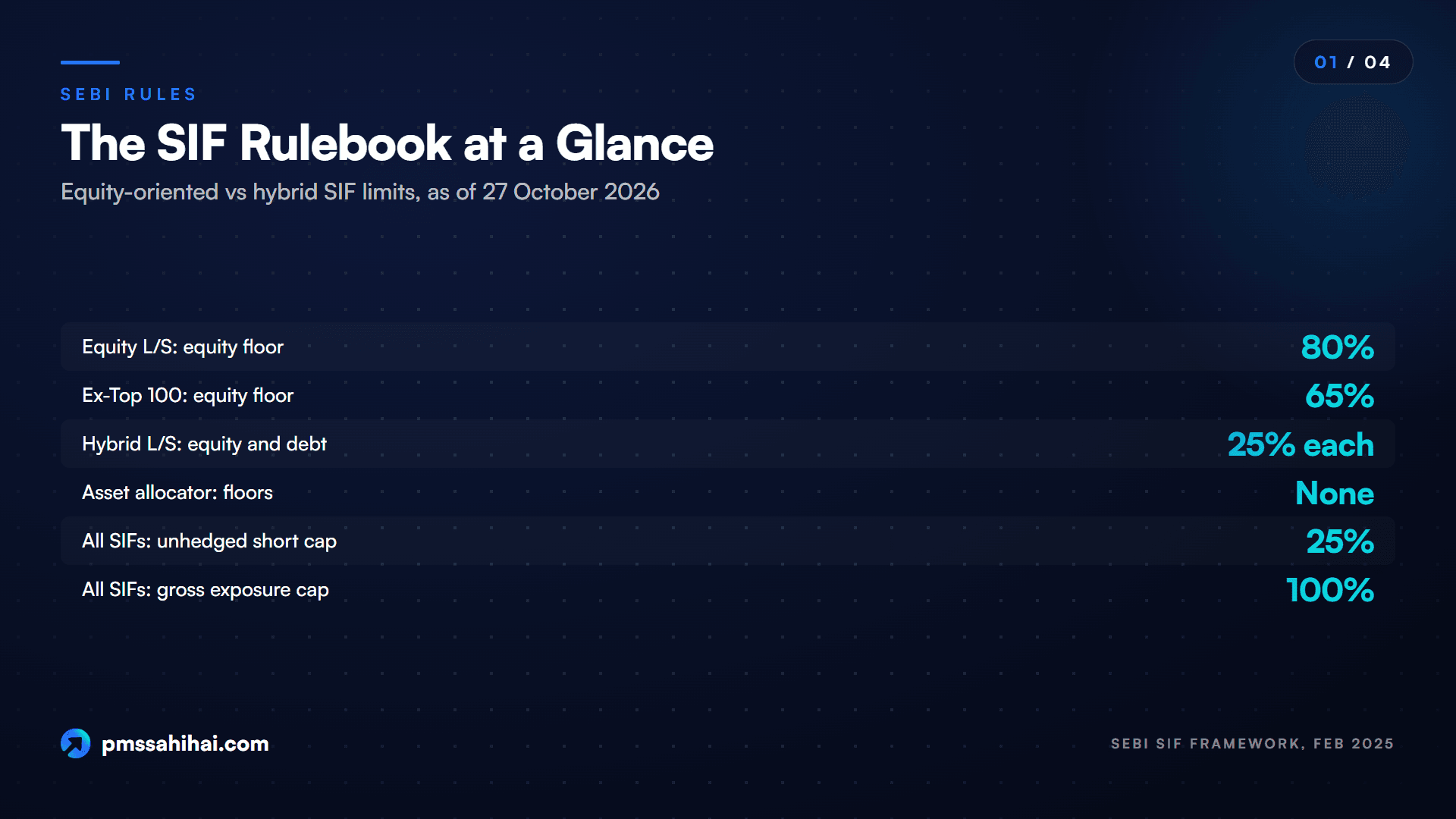
Here is the long-short SIF vs hybrid SIF comparison in one table, covering all five SIF categories that have launched. "Equity SIF" covers the three equity-oriented categories and "Hybrid SIF" covers the two hybrid categories. Rules are as of 27 October 2026.
| Rule | Equity-oriented (long-short) SIFs | Hybrid SIFs |
|---|---|---|
| Categories | Equity Long-Short; Equity Ex-Top 100 Long-Short; Sector Rotation Long-Short | Hybrid Long-Short; Active Asset Allocator Long-Short |
| Asset floor | 80% equity (Equity Long-Short); 65% equity outside the top 100 (Ex-Top 100); 80% equity in at most four sectors (Sector Rotation) | 25% equity and 25% debt (Hybrid Long-Short); no minimum in any asset class (Active Asset Allocator) |
| Other permitted assets | Residual in equity, debt, cash and derivatives within limits | Debt, equity and debt derivatives, REITs/InvITs; commodity derivatives for the Active Asset Allocator |
| Unhedged short cap | 25% of net assets, in equity derivatives | 25% of net assets, across equity and debt derivatives |
| Gross exposure cap | 100% of net assets | 100% of net assets |
| Structure | Open-ended or interval | Interval only |
| Minimum redemption frequency | Daily, or less often if the AMC chooses | Twice a week at most; never daily |
| Exchange listing | Required only if run as interval | Mandatory |
| Notice period | Optional, up to 15 working days | Optional, up to 15 working days |
| Benchmark | Broad equity index, such as Nifty, Sensex, BSE 100 or CRISIL 500 | Hybrid indices, such as NIFTY 50 Hybrid Composite Debt 50:50; multi-asset benchmarks for the allocator |
| Minimum investment | Rs 10 lakh across all strategies of one SIF, at PAN level | Same |
| Typical tax treatment | Usually equity-oriented | Equity-oriented, "other" or specified mutual fund, depending on the portfolio |
The short-selling rules are almost the same; liquidity and tax are the rows most likely to change an investor's decision.
Equity Long-Short Fund Rules: Floors, Shorts and Sector Limits
The equity-oriented family is built for investors who want equity returns with a limited hedge. All three categories must keep most of their money in equity, which means market direction still drives most of the result.
Equity Long-Short Fund
An equity long-short fund must invest at least 80% of its net assets in equity and equity-related instruments, with no market-cap or sector restriction, and may take unhedged short exposure of up to 25% through equity derivatives. It can be open-ended with daily redemption or run as an interval strategy. Because gross exposure is also capped at 100% of net assets, an equity long-short fund holding the minimum 80% long can carry at most 20% of unhedged shorts, leaving net equity exposure of about 60% at the most defensive.
Equity Ex-Top 100 Long-Short Fund
This category must hold at least 65% in equity of companies outside the top 100 by market capitalisation, using AMFI's half-yearly market-cap list. SEBI's FAQs for AMCs and distributors add two details most explainers miss. The residual portion, up to 35%, may be invested in top-100 stocks or index derivatives on them, but unhedged shorts are allowed only in stocks outside the top 100. The fund may, however, take hedged or unhedged positions on broad indices made up only of mid-cap and small-cap stocks. In plain terms, this is a mid- and small-cap long-short fund that cannot short the large caps.
Sector Rotation Long-Short Fund
A sector rotation strategy must keep at least 80% in equity across a maximum of four sectors, chosen from AMFI's sector classification. Its short side works at sector level: if it shorts a sector, every stock it holds in that sector must be held as a short. It cannot be long and unhedged short in the same sector at the same time, and every sector where it has either a long or a short position counts toward the four-sector limit. Long positions in auto, pharma and IT plus a short in FMCG already use up all four.
What unites the three is a high equity floor and the option of daily liquidity. The equity family substitutes for part of an equity allocation, not for debt.
Hybrid Long-Short Fund and Active Asset Allocator Rules Explained
The hybrid family is built differently. Instead of a high equity floor, it has a mixed mandate and a mandatory interval structure.
Hybrid Long-Short Fund: The 25-25 Floor
A hybrid long-short fund must invest at least 25% in equity and equity-related instruments and at least 25% in debt instruments, and may take unhedged short exposure of up to 25% through derivatives in both equity and debt. The remaining 50% is the manager's choice within the overall limits. That flexibility is why products in the same category can look very different.
Two examples show the range. SBI's Magnum Hybrid Long Short Fund describes gross equity of 65% to 75%, built mainly as "covered equity" (stock positions paired with options), debt of 25% to 35%, REITs and InvITs up to 10% and unhedged derivatives up to 25%. Business Standard reported that the fund would use a collar strategy, selling call options and buying put options on stocks it holds, and that SBI pitched it at investors seeking debt-like returns with equity taxation. HSBC's RedHex Hybrid Long-Short Fund, by contrast, describes a mix of credit opportunities in debt, equity arbitrage and REIT/InvIT exposure. Both are hybrid long-short funds; their risk and tax profiles are not the same.
SEBI's reference benchmarks for the category, such as the NIFTY 50 Hybrid Composite Debt 15:85, 50:50 or 65:35 indices, are a quick clue to how much equity the manager plans to run.
Active Asset Allocator Long-Short Fund: No Floors at All
The active asset allocator long-short fund has no minimum allocation to any asset class. It may move across equity, debt, equity and debt derivatives, REITs and InvITs, and commodity derivatives, with up to 25% unhedged short exposure in equity and debt. SEBI's FAQs add a limit that matters: commodity derivative shorts cannot count as unhedged positions, so the allocator cannot run a naked short on gold or crude. For benchmarking, SEBI points to the framework used for multi-asset allocation mutual funds.
This is the most flexible category, so its offer document matters most.
A note on REITs: under a SEBI circular of 28 November 2025, from 1 January 2026 SEBI treats REIT investments by mutual funds and SIFs as equity-related instruments, while InvITs remain hybrid instruments. That reclassification is a SEBI investment-limit rule; it does not by itself change how the income-tax law classifies a fund.
How the 25% Unhedged Short Exposure Works in Each Category
The unhedged short exposure limit is the same 25% of net assets across all SIF categories. What changes between families is what can be shorted and what the short is used for.
SEBI's circular is precise about the cap. A SIF may take exposure of up to 25% of net assets in exchange-traded derivatives "for purposes other than hedging and portfolio rebalancing", and this is in addition to derivatives used for hedging. Total gross exposure across equity, debt, derivatives, REITs, InvITs and other assets cannot exceed 100% of net assets. So no SIF in either family can use leverage in the way a Category III AIF can.
SEBI's FAQs define unhedged short exposure as naked short futures, short calls and short puts. Unhedged long derivatives do not count toward the 25%, covered calls on stocks the fund holds are treated as hedged, and option premium paid and received is capped at 20% of net assets. No SIF is required to hold any short at all.
How each family typically uses that room differs:
- Equity SIFs use shorts mainly on stocks or indices to reduce net market exposure or bet against specific names. In the ex-top-100 category, only stocks outside the top 100 can be shorted unhedged.
- Hybrid SIFs can short equity or debt derivatives. Many also run hedged positions, such as arbitrage (buying a stock and selling its future) or collars, that sit outside the 25% cap because they are hedged.
A Worked Example on a Rs 100 Crore Strategy
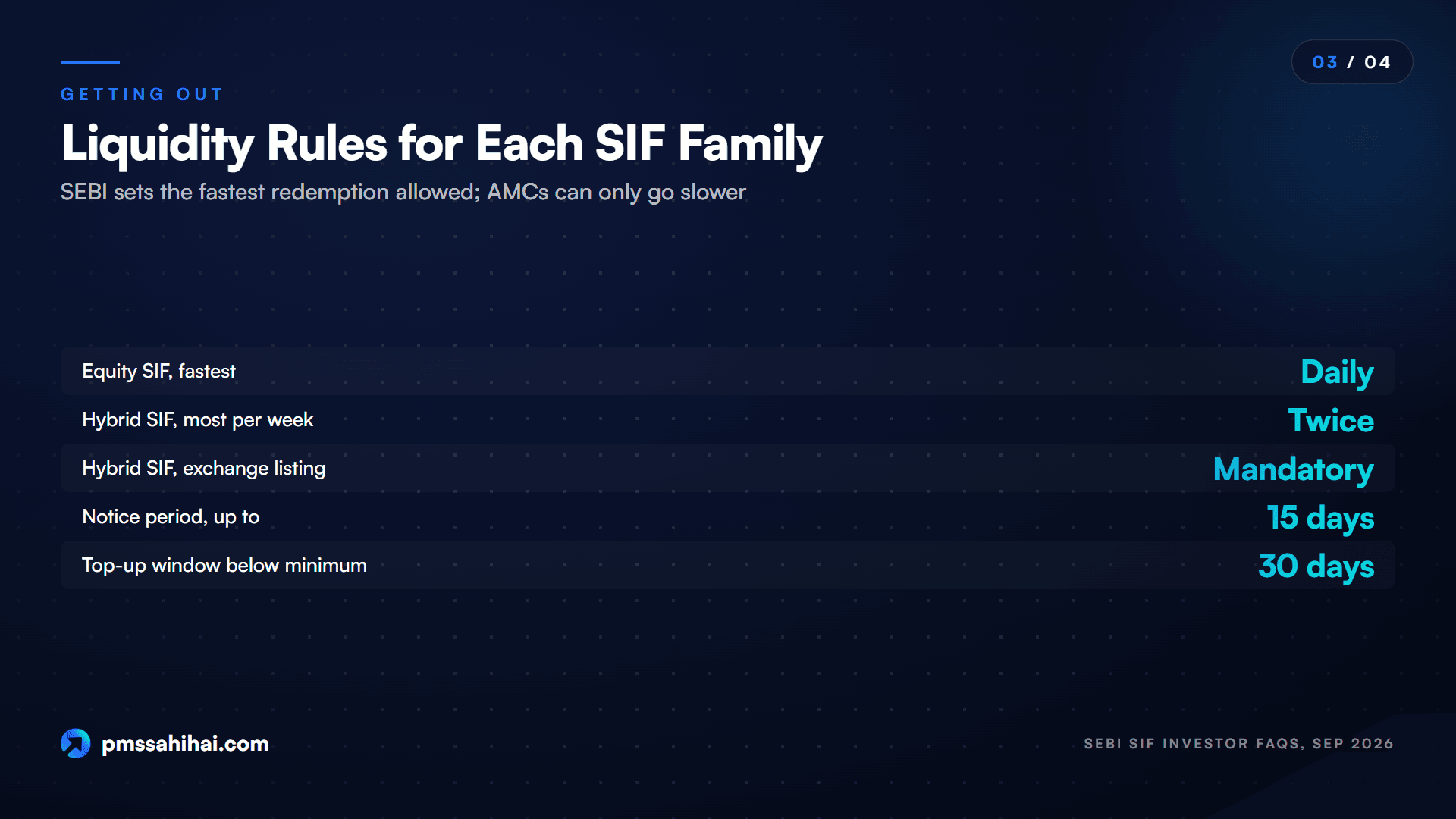
SEBI's own illustration uses a Rs 100 crore long-short equity strategy: at most Rs 25 crore of unhedged shorts in total, and Rs 10 crore in a single stock's futures. Apply the same caps to both families:
| Position | Equity long-short fund (illustrative) | Hybrid long-short fund (illustrative) |
|---|---|---|
| Equity held long | Rs 80 crore | Rs 40 crore, of which Rs 25 crore hedged through arbitrage |
| Debt and money market | Nil | Rs 45 crore |
| REITs / InvITs | Nil | Rs 5 crore |
| Unhedged shorts | Rs 20 crore in stock and index futures | Rs 5 crore in index futures |
| Cash and margin | Rs 20 crore | Rs 5 crore |
| Gross exposure | Rs 100 crore, right at the 100% cap | Rs 95 crore before offsetting |
These are illustrations, not real portfolios. They show why two funds with identical short limits can have very different market risk. The equity fund's net equity exposure is about 60%; the hybrid fund's directional equity exposure is about 10%, because its arbitrage book is hedged. Note also that the equity fund cannot add more shorts without cutting longs, since the 25% short cap and the 100% gross cap bind together. The real numbers for any fund are in its portfolio disclosure, published every alternate month.
Liquidity, Listing and Notice Periods Compared
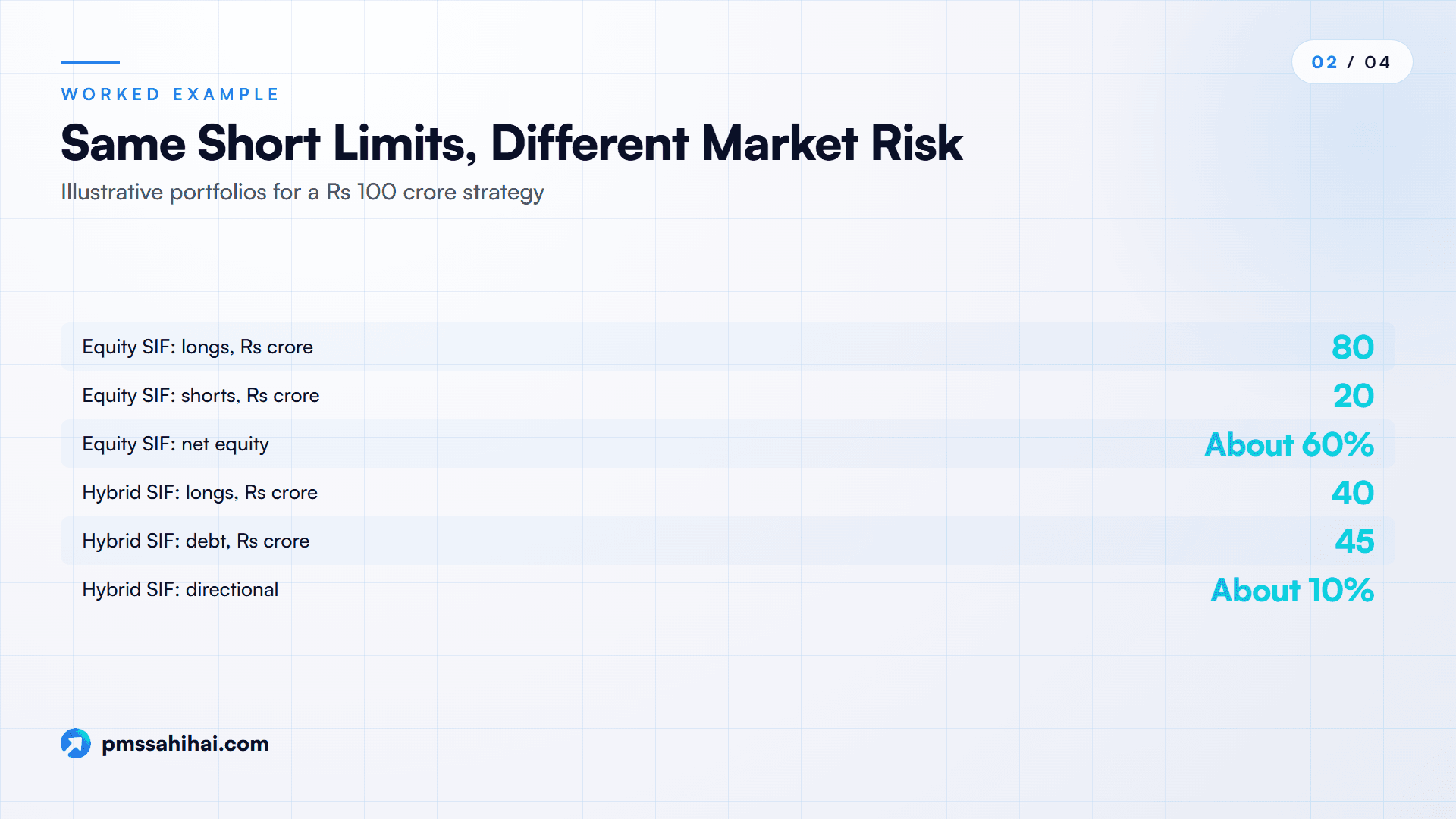
SIF redemption frequency is the clearest structural difference between the two families: SEBI sets the fastest permitted frequency by category, and each AMC can only go slower.
Under SEBI's investor FAQs, equity-oriented strategies may offer daily redemption, though an AMC can choose weekly, monthly or another interval. Hybrid strategies cannot offer daily redemption; their minimum redemption frequency is twice a week, and AMCs can choose anything less frequent, such as weekly or monthly. Debt strategies sit at once a week or less.
Any strategy that does not redeem daily is an interval investment strategy, and SEBI requires interval units to be listed on a stock exchange. So every hybrid SIF is listed, which gives a second exit between windows, though trading may be thin and prices can differ from NAV.
Both families can add a notice period of up to 15 working days. You submit a redemption request during the stated window and receive the NAV at the end of the notice period. SEBI's own example is a hybrid long-short fund that redeems on the 30th of each month and accepts requests only between the 15th and the 20th.
Real products vary widely. SBI's hybrid fund redeems on Mondays and Wednesdays with no notice period; HSBC's redeems every Monday with a 10-working-day notice period and a 2% exit load within one year. Lock-ins and exit loads are disclosed in each Investment Strategy Information Document (ISID).
The Rs 10 lakh minimum works identically in both families and can affect liquidity. The threshold applies at PAN level across all strategies of one SIF. If your own redemption would take you below Rs 10 lakh, your units across that SIF are frozen and you get 30 calendar days to top up, after which they are redeemed automatically. If the value falls below Rs 10 lakh only because NAV fell, nothing is forced, but you can then redeem only the entire holding, not part of it. Accredited investors are exempt from the minimum.
SIF Taxation: Why Two Hybrid Funds Can Be Taxed Differently
SIF taxation follows the mutual fund rules, because a SIF is a mutual fund product. SEBI's investor FAQs say only that tax depends on "the nature and classification of the investment strategy". The classification comes from the Income-tax Act, 2025, which applies from 1 April 2026, and it looks at the portfolio, not the SIF category name.
Three tests decide the bucket:
- Equity-oriented fund (section 198, old section 112A). At least 65% of the fund's money must be in equity shares of listed Indian companies, measured as the annual average of monthly averages of opening and closing holdings. Units are long-term after 12 months. Short-term gains are taxed at 20% under section 196 (old 111A); long-term gains at 12.5% above Rs 1.25 lakh a year under section 198.
- Specified mutual fund (section 76, old section 50AA). More than 65% of the money in debt and money market instruments, on the annual average of daily closing figures. Units bought on or after 1 April 2023 always produce short-term gains, taxed at your slab rate.
- Everything else. Short-term gains at slab rate; long-term gains at 12.5% under section 197, without indexation.
For the equity family, the answer is usually simple: with 65% to 80% equity floors, these funds normally clear the 65% listed-equity test, provided they hold the level on the yearly average.
For the hybrid family, the category tells you very little. SBI says its hybrid long-short fund "follows equity mutual fund taxation" because its equity exposure is above 65%; arbitrage and covered-call positions involve holding the shares themselves. HSBC's FAQ describes its hybrid long-short fund as a fund "other than equity oriented mutual fund and specified mutual fund", taxed at slab rate in the short term and at 12.5% in the long term. A hybrid fund holding more than 65% in debt would fall into the specified-fund bucket, with slab-rate tax however long you hold.
There is one open question for the "other" bucket. HSBC treats its listed units as long-term after 12 months. The Act gives the 12-month period to securities listed on a recognised exchange and to equity-fund units, but sources disagree on whether a listed non-equity fund unit qualifies or whether the 24-month period applies. Do not assume either answer for your holding; confirm with the AMC's tax note and a tax adviser.
NRIs also face TDS on redemptions. Check the ISID's tax section and consult a tax adviser before investing, because a hybrid fund's classification can change if its mix changes over a year.
How Each SIF Category Is Used in Portfolios Today
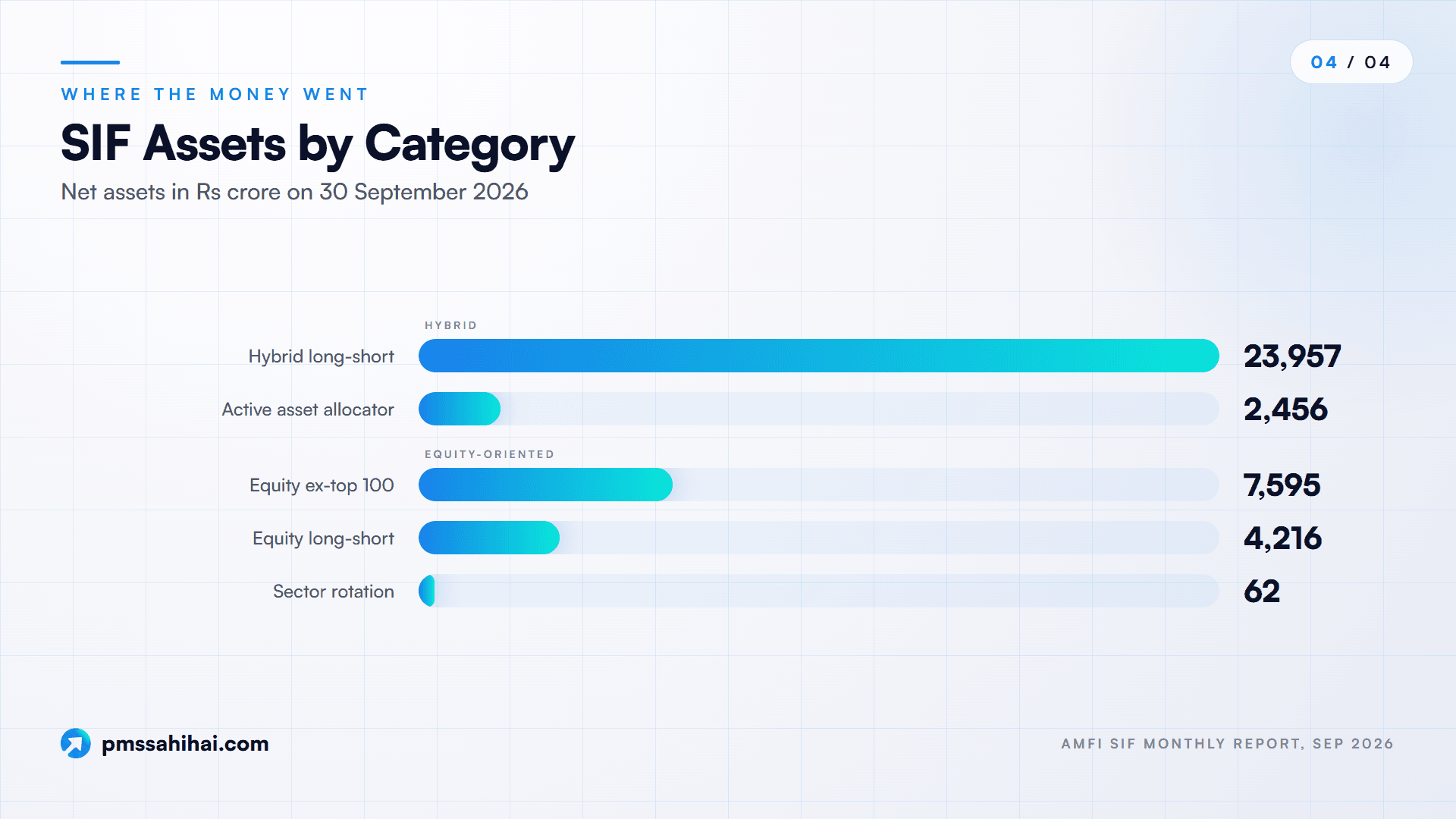
The money has chosen hybrid. AMFI's SIF monthly report for September 2026 shows 34 strategies with net assets of Rs 38,287 crore on 30 September 2026. Hybrid strategies held Rs 26,413 crore, about 69%, across 14 strategies: 11 hybrid long-short funds with Rs 23,957 crore and three active asset allocators with Rs 2,456 crore. The 20 equity-oriented strategies held Rs 11,874 crore, of which Equity Ex-Top 100 funds held Rs 7,595 crore, Equity Long-Short funds Rs 4,216 crore and the single Sector Rotation fund Rs 62 crore. No debt-oriented strategy had launched.
Usage follows the rules. Hybrid SIFs are positioned as alternatives to debt and arbitrage funds; equity SIFs as a hedged slice of equity, especially mid and small caps through the ex-top-100 category.
Cost differs too: Cafemutual's analysis of AMFI data for August 2026 put the average distributable expense ratio at 1.60% for equity long-short and 1.09% for hybrid long-short strategies, with wide ranges inside each.
Technology makes the comparison practical. SIF units appear in the Consolidated Account Statement, NAV is published daily, portfolios including derivatives are disclosed every alternate month in downloadable spreadsheets, and the Rs 10 lakh threshold is monitored daily by AMFI, exchanges and registrars. Each strategy carries a five-level risk band, reviewed monthly, and distributors need NISM Series V-D certification.
What the SIF Rulebook Does Well for Investors
Whichever family you choose, the shared rules offer real advantages.
- Lower entry. Rs 10 lakh across a SIF's strategies, compared with Rs 50 lakh for PMS and Rs 1 crore for an AIF.
- Hard limits on risk-taking. The 25% unhedged short cap and the 100% gross exposure cap stop either family from becoming a leveraged hedge fund.
- Clear category labels. Asset floors are written into regulation, so an equity long-short fund cannot quietly turn into a debt fund, and a hybrid long-short fund must always hold at least 25% debt.
- Mutual-fund-grade disclosure. Public offer documents, scenario analysis of derivative losses, bimonthly portfolio disclosure and a monthly risk band.
- A choice of liquidity. Daily redemption is possible in equity strategies; hybrid strategies add an exchange listing.
- Tax in your hands. Gains are taxed when you redeem, under mutual fund rules, rather than at fund level as in a Category III AIF.
In practice, four facts in the ISID (category, allocation ranges, redemption terms and tax treatment) tell you most of what you need to know.
How PMS Sahi Hai Helps You Read the Rules Behind Each SIF Category
A SIF's category name tells you less than its rulebook does, and the rulebook is spread across a circular, two sets of FAQs and every strategy's ISID. PMS Sahi Hai is built to make that kind of reading easier, with one honest limit stated up front: its comparison shelf covers PMS, AIF and GIFT City strategies, not SIFs, because SIFs are mutual fund products. Here is where it helps.
Start with the explainers. If the SIF format is new to you, read what a SIF is and how long-short funds work across AIFs and SIFs first. If your real question is whether a SIF beats the alternatives at your ticket size, SIF vs PMS and the four-way PMS, AIF, SIF and mutual fund comparison set the wrappers side by side.
Compare the alternatives on one screen. An investor weighing an equity long-short SIF may also be looking at a long-short Category III AIF or a PMS. The PMS Sahi Hai comparison tool lines up PMS, AIF and GIFT City strategies with trailing returns against benchmarks and a Nyra Score on each card, so you can see what the non-SIF route offers for the same job.
Ask Nyra the structural questions. Nyra is PMS Sahi Hai's AI research tool, described on the site as grounded in SEBI, AMC and IFSCA primary sources, citing its working and refusing when it has no verifiable source. Use it to frame the questions this article raises: which tax bucket a hybrid strategy is aiming for, what its redemption window and notice period mean for your cash needs, and how far its net equity exposure can move. Nyra's scoring methodology rates only strategies with at least 12 months of record, which is a useful reminder of how young every SIF still is.
Nyra is an analytical tool, not a SEBI-registered investment adviser. For any SIF, the ISID and your tax adviser have the final word.
Risks and Limitations of Long-Short and Hybrid SIFs
Neither family is low risk; SEBI's mandatory disclaimer warns of "potential loss of capital, liquidity risk and market volatility".
The equity family's main risk is market exposure. With 65% to 80% minimum equity and at most 25% of unhedged shorts, a fund will still fall in a broad sell-off. Ex-top-100 funds add small- and mid-cap volatility, sector rotation funds concentrate risk, and losses on short futures are not capped.
The hybrid family's risks are less obvious. Debt holdings carry credit and interest-rate risk; HSBC's FAQ notes that its fund may hold securities rated lower than A. Arbitrage returns depend on spreads that change with market conditions. Covered-call and collar strategies cap upside. And liquidity is structurally lower: twice a week at best, possibly with a notice period and exit load, plus listed units that may trade thinly.
Shared limitations:
- Short history. The first strategies opened only in late 2025, so no SIF has been through a full market cycle.
- Optional shorts. A fund need not hold any short position, so "long-short" in the name does not guarantee a hedge at any given time.
- Tax uncertainty in hybrids. The bucket depends on the portfolio, and the holding period for listed non-equity units is read differently by different sources.
Choosing Between an Equity Long-Short and a Hybrid SIF
The long-short SIF vs hybrid SIF decision comes down to the job you want the money to do.
| If you want… | Look first at | Why |
|---|---|---|
| A hedged slice of your equity allocation | Equity long-short fund | 80% equity floor, daily redemption possible, equity taxation |
| Mid- and small-cap exposure with a short book | Equity Ex-Top 100 Long-Short | 65% outside the top 100; shorts limited to non-large-caps |
| Tactical sector bets | Sector Rotation Long-Short | Up to four sectors; highest concentration |
| An alternative to debt or arbitrage funds | Hybrid long-short fund | 25% debt floor, hedged equity, interval liquidity; check its tax bucket |
| A manager-led multi-asset mix | Active asset allocator long-short fund | No fixed floors; widest asset menu |
A conservative investor weighing a hybrid SIF against arbitrage or balanced advantage funds should judge it on liquidity and tax as much as expected return. An investor adding an equity long-short SIF should ask how far net exposure moves in a falling market. Either way, read the ISID, put your open questions to Nyra on PMS Sahi Hai, and consult a tax adviser.
Compare SIF Categories Before You Invest Rs 10 Lakh
The difference between a long-short SIF and a hybrid SIF is written into SEBI's rulebook: asset floors, liquidity, listing and the tax test. Start with the job you want the money to do, shortlist the category that fits, then read each strategy's ISID for its allocation ranges, redemption terms and tax treatment. If you are also weighing a PMS or a long-short AIF for the same job, compare them on the PMS Sahi Hai comparison tool, ask Nyra to help frame your questions on rules and tax, or book a conversation with the team before you commit Rs 10 lakh.
PMS Sahi Hai is a distributor of Portfolio Management Services and Alternative Investment Funds, APMI-registered (Registration No. APRN08358). This article is for education only and is not investment advice, a recommendation, or an offer to buy or sell any security. Investments in securities markets are subject to market risks; read all scheme-related documents carefully. Past performance is not indicative of future results. Consult your advisor before investing.
Ishaan founded PMS Sahi Hai to make India's PMS, AIF and GIFT City markets legible to serious investors, comparing every SEBI-registered manager on the same comparative basis, with no shelf products and no commission bias.
Frequently asked
Are all SIFs long-short funds?
Yes. All seven SIF categories SEBI permits have "Long-Short Fund" in their name, including the two hybrid categories. Each may take unhedged short exposure of up to 25% of net assets through exchange-traded derivatives. When investors say "long-short SIF", they usually mean the three equity-oriented categories, and "hybrid SIF" means the Hybrid Long-Short and Active Asset Allocator Long-Short categories.
What is the main difference between an equity long-short SIF and a hybrid SIF?
The asset floor and liquidity. An equity long-short SIF must hold at least 80% in equity (65% outside the top 100 for the ex-top-100 category) and can offer daily redemption. A hybrid long-short SIF needs only 25% equity and 25% debt, must run as a listed interval strategy and can redeem at most twice a week.
Can a hybrid SIF short more than an equity SIF?
No. In the long-short SIF vs hybrid SIF comparison, both families share the same cap: unhedged short exposure of up to 25% of net assets, plus total gross exposure of no more than 100%. Hybrid SIFs can place shorts in both equity and debt derivatives, while equity SIFs short equity derivatives. Hedged positions such as arbitrage and covered calls sit outside the 25% cap in both.
How often can I redeem a hybrid SIF?
At most twice a week, and possibly less often. SIF redemption frequency is set by category, and SEBI's investor FAQs say hybrid strategies cannot offer daily redemption. AMCs can also set a notice period of up to 15 working days and an exit load. Because hybrid SIFs are interval strategies, their units must be listed on a stock exchange, which offers another exit route.
Is a hybrid long-short SIF taxed like an equity fund?
Only if it passes the SIF taxation test for equity: it must keep at least 65% of its money in listed Indian equity shares on the averaging basis the Income-tax Act, 2025 prescribes. Some hybrid funds are built to meet this test, using arbitrage or covered equity. Others are taxed as non-equity funds, and those with more than 65% in debt are specified funds taxed at slab rate. Check the ISID and consult a tax adviser.
Which is riskier, an equity long-short SIF or a hybrid SIF?
An equity long-short SIF usually carries more market risk, because 65% to 80% of its money must stay in equity and shorts are capped at 25%. A hybrid SIF usually has less equity risk but adds credit, interest-rate and liquidity risk. Compare each strategy's five-level risk band and scenario analysis in its ISID.
Does the Rs 10 lakh minimum apply separately to equity and hybrid SIFs?
No. The Rs 10 lakh minimum applies at PAN level across all strategies of one SIF, so equity and hybrid strategies from the same SIF count together. Strategies of a different fund house's SIF need their own Rs 10 lakh. Accredited investors are exempt, and regular mutual fund holdings do not count.
Keep reading
All articles
Estate Planning vs Succession Planning: What Each One Actually Decides
Estate planning decides who owns your assets. Succession planning decides who runs the business. See where they differ and collide in India.
Hybrid Long-Short SIF vs Arbitrage vs Balanced Advantage Funds
Hybrid long-short SIF vs arbitrage fund vs balanced advantage fund: how each earns, how it is taxed, liquidity and minimums compared for 2026.
Equity vs Hybrid Long-Short SIFs: 24 Funds, NAVs and Fees Compared
All 24 equity and hybrid long-short SIFs compared on AMFI data to 26 Oct 2026: NAV since launch, drawdowns, holdings, fees and minimums.
Read it. Now pressure-test it.
Ask Nyra how this applies to your portfolio, or talk to our team, no pitch, no pressure.