
GIFT City Investment Funds: The Complete Guide to IFSC Offshore Investing
GIFT City funds aren't one product, they're three tiers with different minimums, and several "explainer" pages online have the AIF number wrong. Here's what it actually costs to get in, how it's taxed, and where the real risks sit.

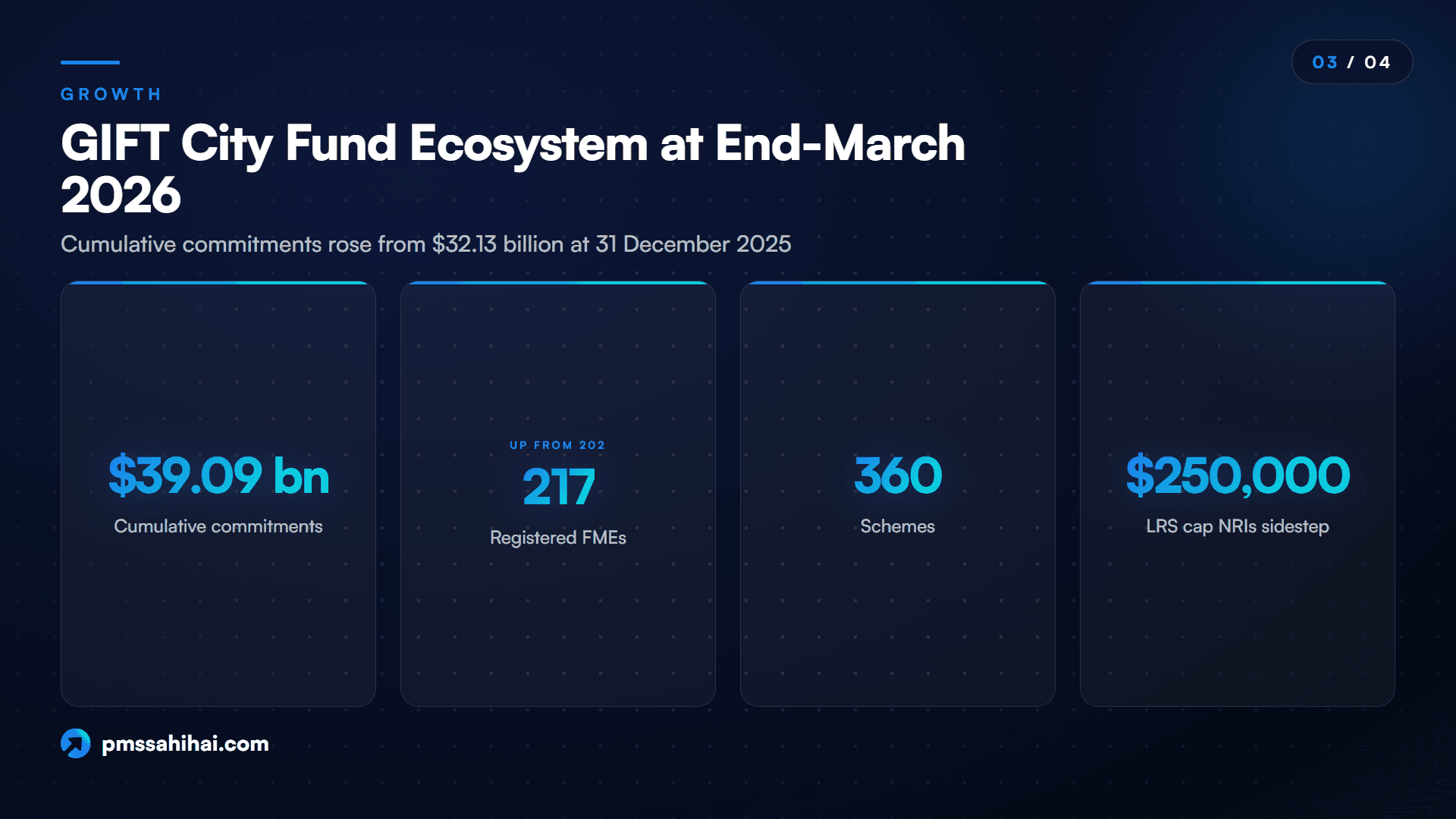
GIFT City: Gujarat International Finance Tec-City, is India's first International Financial Services Centre (IFSC), regulated by the IFSCA rather than SEBI, and it lets NRIs and eligible resident investors put money into dollar-denominated AIFs, PMS mandates, and retail schemes without routing through the Liberalised Remittance Scheme's $250,000 annual cap. The ecosystem splits into three distinct tiers Retail Schemes (scheme-specific minimums, often $500–$5,000), Portfolio Management Services (PMS) at a $75,000 minimum, and Alternative Investment Funds (AIFs) at a $150,000 minimum and runs on a dedicated tax framework built around Sections 10(4D), 10(4E) and 80LA of the Income Tax Act, with eligibility currently extended through 31 March 2030. As of end-March 2026, 217 IFSCA-registered Fund Management Entities had raised $39.09 billion in cumulative commitments across 360 schemes real, fast-growing numbers, though GIFT City deposits still carry no DICGC insurance and the regulatory track record is younger than what onshore SEBI-regulated products offer. This guide breaks down exactly how GIFT City funds work, what they cost to enter, how they're taxed, where they fall short, and how to weigh a GIFT City allocation against a domestic AIF or PMS before committing capital.
What Is GIFT City and Why It's India's Gateway to Global Finance
GIFT City (Gujarat International Finance Tec-City) is a purpose-built financial district in Gandhinagar, Gujarat, that houses India's first International Financial Services Centre, or IFSC. Unlike a conventional Special Economic Zone focused on manufacturing or IT exports, its SEZ status exists specifically to host financial-services business banking units, stock and commodity exchanges, insurance offices, and fund managers — inside a jurisdiction that operates under its own regulatory framework rather than the standard set of domestic Indian financial rules.
That framework is administered by the International Financial Services Centres Authority (IFSCA), a unified regulator that consolidates powers otherwise split across the RBI, SEBI, IRDAI, and PFRDA but only within the geographic and legal boundary of the IFSC. In practice, that means a fund registered in GIFT City is an IFSCA-regulated entity, not a SEBI-regulated one, even though it sits inside India. Funds here are typically denominated in USD (with some also offering GBP, EUR, and other major currencies), which is the detail that makes it fundamentally different from a normal Indian mutual fund: investors put in dollars, the fund invests in dollar or globally-denominated assets, and returns come back in dollars appealing to NRIs who earn and spend outside India, and to resident investors who want genuine currency diversification rather than just equity diversification.
From Gujarat's Vision to India's First IFSC: The GIFT City Origin Story
GIFT City's story starts with a specific, named ambition. The concept was first envisioned in 2007 by Narendra Modi, then Chief Minister of Gujarat, who wanted to build an Indian equivalent to London, Singapore, Hong Kong, and Dubai's DIFC — a single hub capable of pulling financial-services business that Indian companies were routing offshore back onto Indian soil. Gujarat International Finance Tec-City Company Limited was incorporated in 2009 to develop the project, and the foundation stone was laid on 28 January 2011 by then-Finance Minister Pranab Mukherjee alongside Modi.
The zone became official soon after: GIFT SEZ was notified as a multi-services Special Economic Zone under the SEZ Act, 2005 on 18 August 2011, according to the Government of India's official SEZ registry. It took several more years for the financial services piece to switch on — India's first IFSC was operationalized within GIFT SEZ around April 2015. The regulatory story completed itself five years later: the IFSCA was established in April 2020 under the IFSCA Act, 2019, replacing the earlier arrangement where the RBI, SEBI, IRDAI, and PFRDA each separately regulated their own slice of its financial activity. That consolidation — one regulator, one rulebook, purpose-built for cross-border finance — is what turned GIFT City from a real-estate project into an investable fund jurisdiction.
How GIFT City IFSC Funds Actually Work
"GIFT City fund" is an umbrella term, and most of the confusion around it — including on several competing explainer pages — comes from treating it as one product instead of three.
The Role of Fund Management Entities (FMEs)Every GIFT City fund is run by a Fund Management Entity (FME) — an IFSCA-registered manager, roughly analogous to an AMC or a SEBI-registered PMS/AIF manager, but licensed specifically under the IFSCA (Fund Management) Regulations, 2025. FMEs register in different categories depending on the products they run and their own net worth, and it's the FME — not IFSCA directly — that structures, markets, and manages the underlying scheme, AIF, or PMS mandate an investor ultimately buys into.
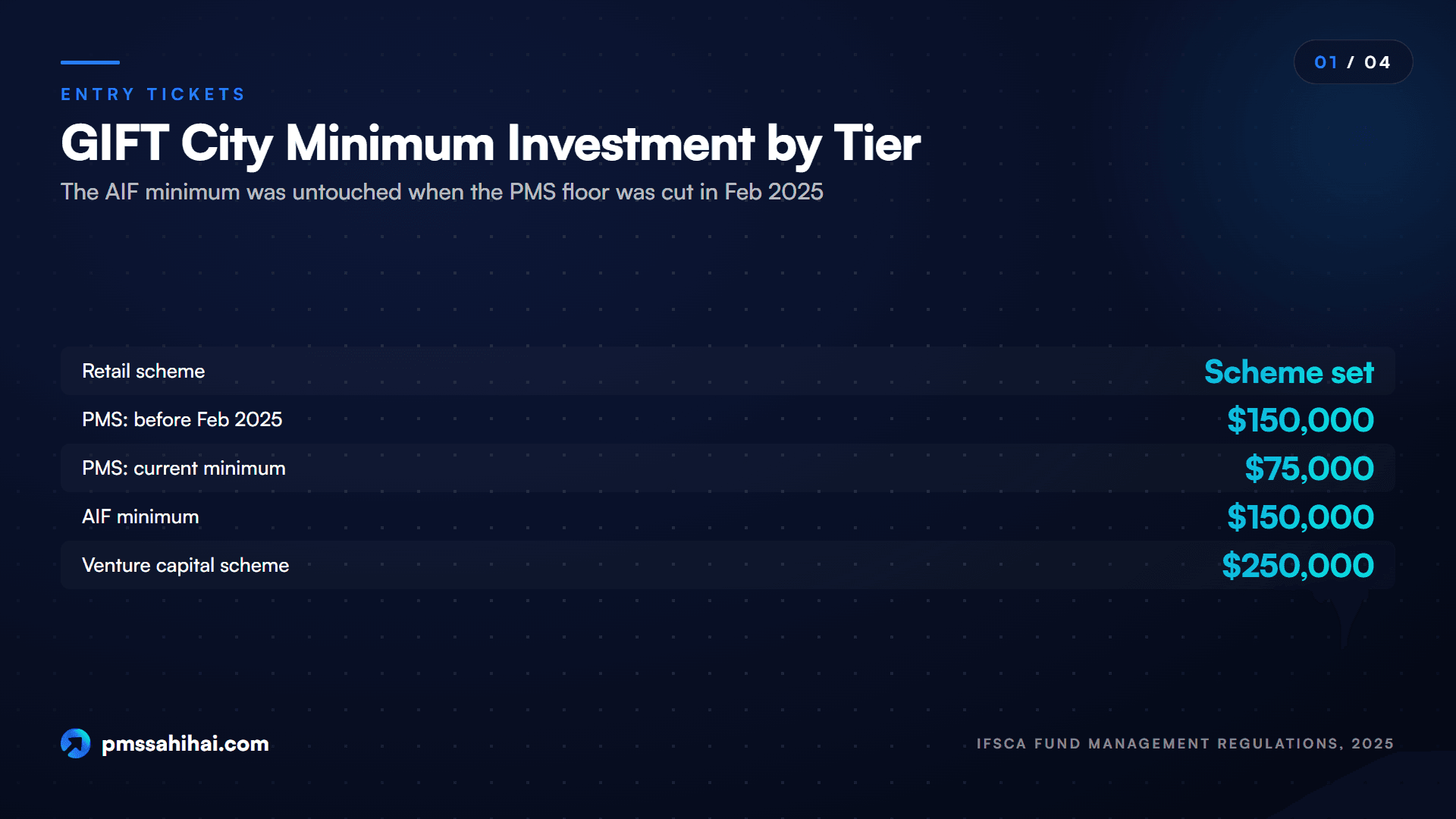
Retail Scheme vs. PMS vs. AIF — Minimum Investment ComparedThis is the single most consequential table in this guide, because it's also the point where a lot of published content gets it wrong. Multiple competitor articles state that the GIFT City AIF minimum investment is $75,000. It isn't. IFSCA's Fund Management Regulations, 2025, gazetted on 19 February 2025, cut the PMS minimum from $150,000 to $75,000 — the AIF minimum was untouched and remains $150,000 per investor.
| Fund tier | Minimum investment (per investor) | Regulatory basis |
|---|---|---|
| Retail Scheme | Scheme-specific: no blanket regulatory floor (e.g., $500 for one recently approved Tata Mutual Fund GIFT City scheme; $5,000 initial / $500 subsequent for a DSP GIFT City scheme) | IFSCA (Fund Management) Regulations, 2025 — structural rule of ~20 investors minimum per scheme, no single investor above 25% |
| Portfolio Management Services (PMS) | $75,000 (reduced from $150,000 in Feb 2025) | IFSCA (Fund Management) Regulations, 2025 |
| Alternative Investment Fund (AIF) | $150,000 (unchanged); Venture Capital scheme category is $250,000 | IFSCA (Fund Management) Regulations, 2025 |
Source for the regulatory minimums: IFSCA's official press release on the Fund Management Regulations, 2025. The fund-level minimum corpus for Retail and Non-Retail schemes was separately reduced from $5 million to $3 million in the same amendment, with open-ended schemes permitted to commence at $1 million.
GIFT City Funds vs. Domestic Mutual Funds and AIFs: A Side-by-Side Comparison
Once the three-tier structure is clear, the next natural question is how a GIFT City fund actually compares to the domestic products most Indian investors already understand.
| Aspect | Domestic Mutual Fund / AIF | GIFT City IFSC Fund |
|---|---|---|
| Regulator | SEBI | IFSCA |
| Currency | INR | Primarily USD (some schemes offer other major currencies) |
| Typical investor base | Resident Indians | NRIs, OCIs, and eligible resident investors |
| Cross-border route | N/A — domestic vehicle | Outside the RBI's LRS cap for NRIs; resident participation is still subject to FEMA/LRS rules |
| Entry minimum | As low as a few hundred rupees for mutual funds; ₹50 lakh+ for domestic PMS; ₹1 crore+ for domestic AIF Category I/II | $500–$5,000+ (Retail), $75,000 (PMS), $150,000 (AIF) |
| Governing regulation | SEBI Mutual Funds / AIF / PMS Regulations | IFSCA (Fund Management) Regulations, 2025 |
The practical takeaway: a GIFT City fund isn't a replacement for a domestic mutual fund, PMS, or AIF — it's a parallel, dollar-denominated track that exists alongside them, aimed squarely at the currency and cross-border needs a rupee-only product can't address.
Tax Treatment of GIFT City Investments: Sections 10(4D), 10(4E) and 80LA Explained
GIFT City's tax framework is genuinely one of its biggest draws, but it's also where competitor content most often blurs distinct provisions into one soundbite. Here's what each actually does, and to whom it applies.
| Provision | Who it applies to | What it does |
|---|---|---|
| Section 10(4D) | A "specified fund": broadly, a Category III AIF located in the IFSC, or the investment division of an IFSC banking unit | Exempts specified income, such as capital gains on securities, earned by the fund itself |
| Section 10(4E) | Non-resident counterparties | Exempts income from offshore derivative instruments, non-deliverable forward contracts, and OTC derivatives transacted with an IFSC banking unit or an IFSC-registered FPI |
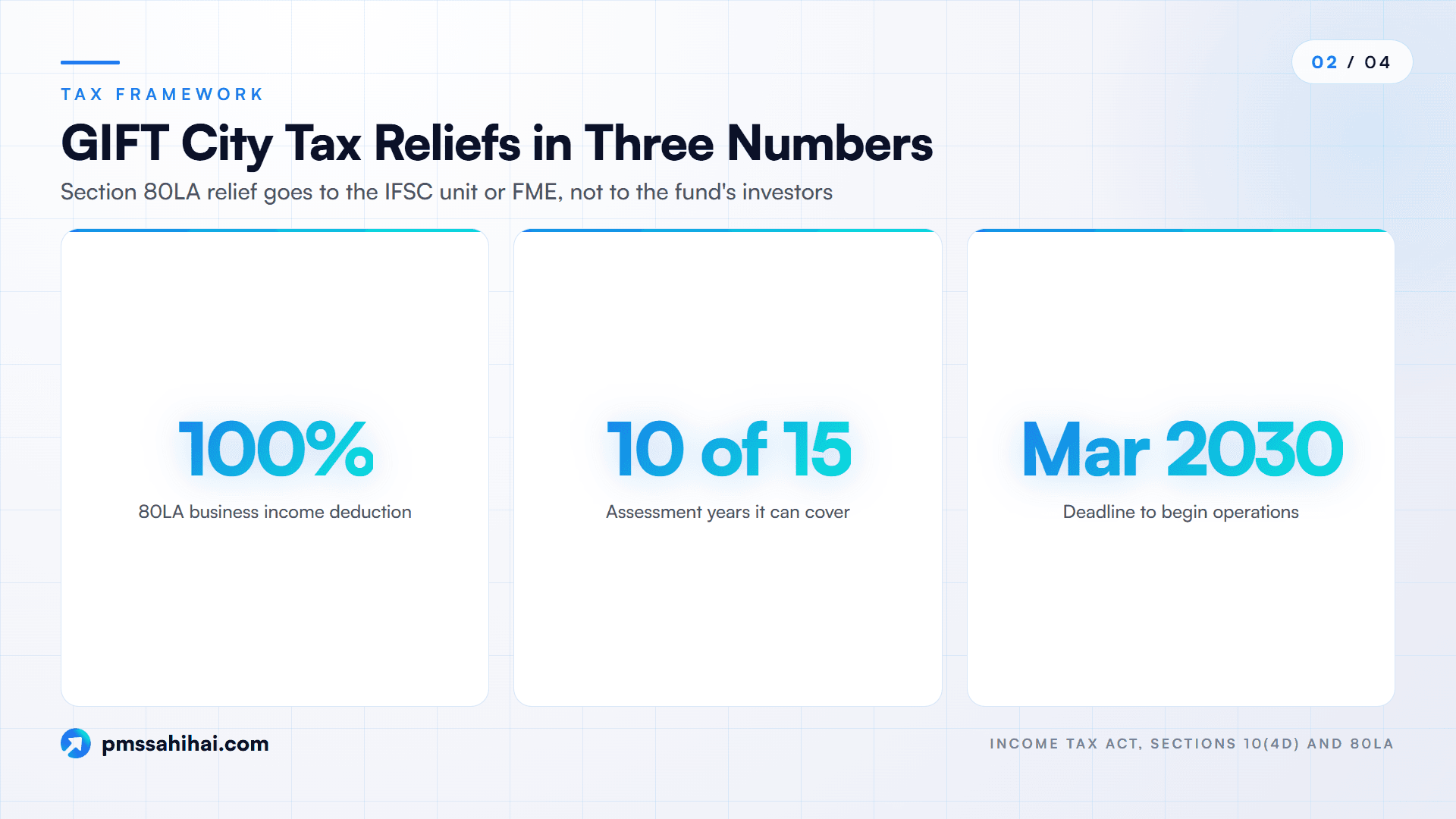
| Section 80LA | The IFSC Unit or FME itself (not the fund's investors) | A 100% deduction of business income for any 10 of 15 consecutive assessment years from the year of registration, subject to a CA certificate in Form 10CCF |
These are three different reliefs for three different parties the fund, the non-resident counterparty, and the manager not one blanket "GIFT City is tax-free" rule. There's also a deadline attached: Budget 2025 extended the window in which an IFSC unit, specified fund, or banking unit must commence operations to remain eligible for 10(4D), 80LA, and related benefits, pushing the sunset date from 31 March 2025 to 31 March 2030. You can read the underlying section text directly on the Income Tax Department's official portal for Section 10 and Section 80LA. Because these provisions interact with an investor's own residency status and, for NRIs, their country of tax residence, this is one part of the process where a qualified CA's sign-off is genuinely worth the fee before committing capital.
How PMS Sahi Hai's Nyra Helps You Compare GIFT City and Domestic Options
Reading the two tables above is one thing; deciding whether a GIFT City AIF or a domestic AIF actually belongs in your portfolio is another. That decision depends on things a static comparison table can't capture — your existing sector exposure, how much currency risk you already carry, your residency status, and whether a new allocation would genuinely diversify you or just duplicate a position you already hold.
This is precisely the gap Nyra, PMS Sahi Hai's AI-powered matching engine, is built to close. Nyra starts by profiling your goals and risk appetite, then analyzes your existing portfolio to surface hidden overlaps and concentration risk before it ever recommends something new including whether a new allocation here would add real diversification or simply mirror exposure you already have through a domestic fund. From there, it evaluates GIFT City and domestic PMS/AIF strategies side by side against your actual profile, rather than showing you whichever product a distributor is paid to push. You can see how it reasons about a match on the Nyra methodology page, or get the short version on what Nyra is and PMS Sahi Hai's own dedicated GIFT City hub is where the GIFT-City-specific comparison view lives for NRIs weighing the dollar route against a mainland rupee allocation.
The Technology Powering GIFT City's Next Chapter
GIFT City's fund ecosystem doesn't exist in isolation from India's broader fintech push — increasingly, it's a testbed for it.
IFSCA's FinTech Regulatory SandboxIFSCA runs a Regulatory Sandbox Framework, announced via the Press Information Bureau, that lets regulated and unregulated entities — including startups and individuals from India and FATF-compliant jurisdictions — test innovative fintech solutions in a live environment with a limited set of real customers, under case-by-case regulatory relaxations. A companion "Innovation Sandbox" lets fintech firms test against market data without live trading exposure, run through the IFSC's own Market Infrastructure Institutions.
The 2026 Young Builders' ProgramThat sandbox got a fresh on-ramp on 21 July 2026, when GIFT City and IFSCA jointly launched the Young Builders' Program a structured pathway from idea to regulatory validation for early-career fintech founders. Applications close 16 August 2026, a hackathon runs 21–22 August, and ten selected teams enter an eight-week residential program starting 1 September 2026, with the top three earning direct entry into IFSCA's FinTech Sandbox. It's a small program in absolute numbers, but it signals something larger: the jurisdiction is positioning itself not just as a place to park dollar-denominated capital, but as an active fintech innovation hub the same forces pushing AI-driven investment comparison and matching (the category PMS Sahi Hai's Nyra operates in) are being deliberately cultivated inside the IFSC itself.
Who Should Consider GIFT City Offshore Investing and the Real Advantages
GIFT City tends to make the most sense for NRIs and OCIs earning and holding wealth in foreign currency, resident HNIs looking for genuine currency diversification rather than just asset-class diversification, and investors who are already comfortable with AIF- or PMS-level minimums and want a regulated (not self-directed) way to access global exposure. It tends to make less sense for a beginner investor still building out a core domestic portfolio — the higher minimums and added currency risk are easier to justify once the fundamentals at home are already in place. Within the right audience, the concrete advantages are real:
- A dollar-denominated route that sidesteps the LRS cap. NRIs investing through GIFT City aren't bound by the RBI's Liberalised Remittance Scheme, which caps resident Indians investing abroad directly at $250,000 per financial year.
- A tax framework purpose-built for cross-border capital. Sections 10(4D) and 10(4E) create fund- and counterparty-level exemptions unavailable to standard onshore vehicles, while Section 80LA gives managers a genuine incentive to build and sustain operations in the IFSC.
- Professional, regulator-supervised management. Every GIFT City AIF and PMS mandate is run by an IFSCA-registered FME, not a self-directed offshore brokerage account.
- A fast-scaling, increasingly liquid ecosystem. Cumulative fund commitments grew from $32.13 billion (31 December 2025) to $39.09 billion (31 March 2026) in a single quarter, alongside FME registrations climbing from 202 to 217 real, regulator-published growth, not a marketing estimate.
- Multi-currency access without a separate foreign brokerage relationship. Investors get international exposure through a structure that remains regulated on Indian soil, rather than opening and maintaining an account with an overseas broker.
The Honest Risks and Limitations of GIFT City Investing
None of the above should be read as "GIFT City is strictly better" — it isn't, for every investor, and the honest limitations matter as much as the advantages.
Deposits are not covered by DICGC insurance. Both ICICI Bank's own GIFT City disclosures and Bank of Baroda's IFSC Banking Unit FAQ state plainly that deposits held with an IFSC Banking Unit are not insured by DICGC — a real, verifiable gap compared to a standard onshore savings account or fixed deposit, where deposit insurance is a given (per the DICGC's own information booklet, insured deposits are specifically defined to exclude deposits received outside India, and IBUs are treated as such for this purpose).
Entry minimums are high relative to domestic alternatives. At $75,000 for PMS and $150,000 for AIF, GIFT City's non-retail tiers sit well above what many domestic PMS and even some domestic AIF products require, which prices out investors who haven't already crossed a meaningful wealth threshold.
The regulatory and track-record history is comparatively young. IFSCA has only existed as the unified regulator since 2020, and a large share of currently registered FMEs and schemes are recent — investors are evaluating a fast-growing but shorter audited history than they'd find with an established, decades-old domestic AMC or PMS manager.
Currency exposure and cross-border tax rules add complexity. Returns are earned and typically repatriated in foreign currency, layering currency risk on top of market risk — and globally mobile NRIs, particularly those taxed in the US, UK, or Canada, need to independently confirm how their specific fund structure is treated under home-country tax rules before assuming a GIFT City structure is automatically the cleaner option.
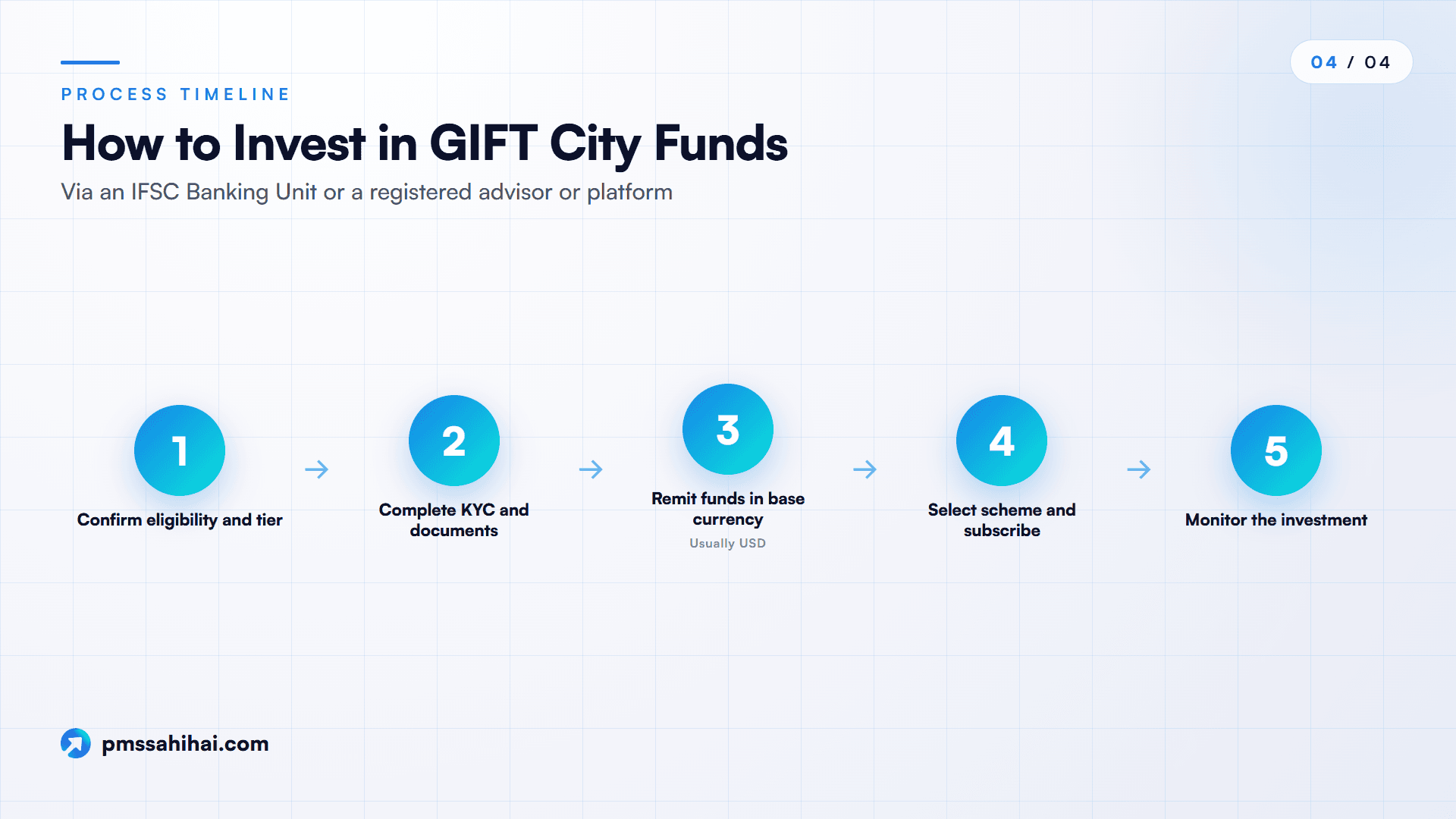
How to Invest in GIFT City Funds: Step-by-Step Process
There are two practical channels in: directly through a bank's IFSC Banking Unit (IBU) at GIFT City, or through a registered financial advisor or investment platform that facilitates IFSC investments on your behalf. Most first-time investors find the second route simpler, since it bundles fund selection, documentation, and onboarding into one process rather than requiring a separate bank relationship in Gandhinagar.
- Confirm your eligibility and pick a tier. NRIs and OCIs generally have the most straightforward path; resident Indians can participate too, subject to FEMA and LRS compliance. Match your available capital to the Retail Scheme, PMS, or AIF minimum from the table above.
- Complete KYC and gather documentation. Typical requirements are a valid PAN card, KYC documents (Aadhaar or passport, as applicable), bank account details, and — for NRIs — additional proof such as an overseas address. Open a foreign-currency account if your chosen route requires one.
- Remit or transfer funds in the scheme's base currency — usually USD — following your bank's or advisor's funding process.
- Select a scheme and complete the subscription, reviewing the private placement memorandum or scheme documents the FME provides, and confirming the declared Net Asset Value at which units are allotted.
- Monitor the investment over time. These products, like their domestic counterparts, need ongoing review as sector exposure, currency conditions, and your own goals shift — which is where a continuously-monitoring tool rather than a one-time purchase decision earns its keep.
How PMS Sahi Hai Helps You Understand the Inner Clause
Every GIFT City fund — and every domestic AIF or PMS, for that matter — has an "inner clause": the fee structure, the lock-in terms, the FME's actual track record, the custodian arrangement, the fine print that a glossy one-pager doesn't lead with. That's where most investors, and most competitor content, stop short. PMS Sahi Hai was built on the opposite premise: "hard-earned wealth shouldn't rely on random advice."
Concretely, that means a few things when you're evaluating a GIFT City allocation. PMS Sahi Hai's manager directory lets you look up an FME or AMC's track record in one place rather than piecing it together from marketing PDFs. The fee disclosure page spells out exactly what you pay — PMS Sahi Hai runs on trail-only, AMC-paid commissions, so the comparison you get isn't skewed toward whichever product pays the platform more. And because that decision sits inside a wider one about currency exposure, tax residency, and portfolio overlap, resources like the PFIC explainer and DTAA guide exist specifically to help NRIs — especially those taxed in PFIC-sensitive jurisdictions like the US — understand how a given fund structure actually behaves once their home-country tax rules are layered on top of India's. Nyra ties all of this together: not a sales funnel toward one product, but an AI wealth compass that reads the inner clause so you don't have to, and shows you, side by side, whether a GIFT City AIF or a domestic one is the better fit for the portfolio you actually have.
Start Comparing GIFT City and Domestic Funds With Nyra
GIFT City has gone from a 2007 vision to a genuine, fast-growing corner of India's investment landscape 217 FMEs, $39.09 billion in commitments, and a regulatory framework specifically designed for dollar-denominated, cross-border capital. It offers real advantages for the right investor: currency diversification, a purpose-built tax structure, and professionally managed access to global exposure without opening a separate offshore brokerage account. It also comes with real trade-offs no DICGC cover, high entry minimums, and a shorter track record than domestic alternatives that deserve equal weight in the decision, not just a footnote.
The right next step isn't picking GIFT City or domestic in the abstract: it's finding out which specific funds, at which specific minimums, actually fit the portfolio you already have. That's what Nyra does: it profiles your goals, checks your existing PMS and AIF holdings for overlap, and matches you against 1,000+ tracked strategies, GIFT City and domestic alike, so the comparison is built around your numbers rather than a generic guide. Talk to Nyra to see how a GIFT City allocation would actually change your portfolio, or start with a free portfolio score if you want to know what you're working with first.
PMS Sahi Hai is a distributor of Portfolio Management Services and Alternative Investment Funds, APMI-registered (Registration No. APRN08358). This article is for education only and is not investment advice, a recommendation, or an offer to buy or sell any security. Investments in securities markets are subject to market risks; read all scheme-related documents carefully. Past performance is not indicative of future results. Consult your advisor before investing.
Ishaan founded PMS Sahi Hai to make India's PMS, AIF and GIFT City markets legible to serious investors, comparing every SEBI-registered manager on the same comparative basis, with no shelf products and no commission bias.
Frequently asked
What is GIFT City and how is it different from a regular Special Economic Zone?
GIFT City (Gujarat International Finance Tec-City) is a purpose-built financial district in Gandhinagar housing India's first International Financial Services Centre. Unlike a typical SEZ focused on manufacturing or IT exports, its SEZ status exists specifically to host regulated financial-services activity banking, funds, insurance, and exchanges under a single dedicated regulator, the IFSCA, rather than the standard mix of RBI, SEBI, IRDAI, and PFRDA oversight.
What is the minimum investment for a GIFT City AIF?
The minimum investment for a GIFT City Alternative Investment Fund is $150,000 per investor, and this figure was not changed by IFSCA's February 2025 regulatory update. That update did reduce the PMS minimum from $150,000 to $75,000 a distinction several published guides get wrong by applying the lower PMS figure to AIFs as well.
Are GIFT City bank deposits covered by DICGC insurance?
No. Deposits held with an IFSC Banking Unit at GIFT City are not covered by DICGC deposit insurance, as confirmed directly in both ICICI Bank's and Bank of Baroda's official disclosures. This is a genuine structural difference from a standard onshore Indian bank account, where DICGC cover is automatic up to the insured limit, and it's worth weighing before parking significant cash in an IFSC banking unit rather than an investment product.
How is a GIFT City fund taxed differently from a domestic mutual fund?
GIFT City funds operate under a distinct set of Income Tax Act provisions rather than standard domestic capital-gains rules. Section 10(4D) exempts specified income earned by qualifying funds themselves; Section 10(4E) exempts non-residents' income from certain offshore derivative transactions; and Section 80LA gives the fund manager (the IFSC Unit or FME) a 100% deduction on business income for 10 of 15 consecutive assessment years. These are three separate reliefs for three separate parties, not a single blanket exemption, and eligibility for several of them requires operations to have commenced by 31 March 2030.
GIFT City AIF vs. domestic AIF: which one should I choose?
There's no universal answer: it depends on your residency, existing portfolio, and currency exposure. A GIFT City AIF makes sense when you specifically want dollar-denominated exposure outside the LRS cap or need a structure suited to non-resident tax treatment; a domestic AIF makes sense when you're a resident investor without meaningful foreign-currency income and want rupee-denominated exposure to Indian markets. Tools like Nyra are built precisely for this comparison evaluating both options against your actual profile and existing holdings rather than treating the decision as one-size-fits-all.
Is GIFT City safe for long-term investment?
GIFT City is a regulated jurisdiction with a dedicated authority (IFSCA) and growing oversight infrastructure, but "safe" depends on what you're comparing it to. Market risk and currency risk apply just as they would to any global investment, IFSC banking deposits lack DICGC insurance, and the regulatory track record is younger than India's decades-old SEBI framework — none of which makes it unsafe, but all of which are reasons to treat it as a considered allocation decision rather than a default "better than domestic" choice.
Keep reading
All articles
What Is a Hybrid SIF? The Fixed-Income Alternative Nobody Explains
What a hybrid SIF is, how hybrid long-short funds earn from debt, arbitrage and options, how they are taxed, and the risks versus FDs and debt funds.

What Is a Hedge Fund in India? Why SEBI Calls It a Category III AIF
What a hedge fund in India is, why SEBI registers it as a Category III AIF, the strategies used, the 2x leverage cap and the Rs 1 crore entry rule.
What Is Co-Investment? How HNIs Invest Alongside AIFs in Single Deals
How AIF co-investment works in India: SEBI's CIV scheme vs the PMS route, accredited investor rules, the 3x cap, fees, tax and risks.
Read it. Now pressure-test it.
Ask Nyra how this applies to your portfolio, or talk to our team, no pitch, no pressure.