
What Is a Hedge Fund in India? Why SEBI Calls It a Category III AIF
What a hedge fund in India is, why SEBI registers it as a Category III AIF, the strategies used, the 2x leverage cap and the Rs 1 crore entry rule.


A hedge fund is a privately pooled fund that can short, use derivatives and borrow to chase returns that do not depend only on a rising market. India has no separate hedge fund licence: SEBI's AIF Regulations, 2012 name hedge funds in the definition of a Category III AIF, the only AIF category allowed to run complex trading strategies and use leverage, capped at 2 times NAV. Entry needs Rs 1 crore unless you are an accredited investor, NAV comes at least monthly for open-ended schemes, and income is taxed inside the fund. Compared with a global hedge fund, an Indian one is more tightly boxed in on leverage, shorting and concentration, which shapes which strategies actually work here.
Why a Hedge Fund in India Looks Different From Its Global Cousin
Say "hedge fund" and most people picture billions of borrowed money and no rulebook. A hedge fund in India is a quieter animal. It is a SEBI-registered trust, it reports its leverage to a custodian every working day, it cannot run exposure of more than twice its net assets, and it can only short stocks that have a futures contract.
Indian law does not license "hedge funds". It licenses Alternative Investment Funds in three categories, and the definition of the third names hedge funds as an example. That one line explains how these funds are built, sold and taxed.
The segment is not small. SEBI's quarterly AIF data shows Category III AIF commitments of Rs 3,37,192 crore as of 30 June 2026, out of Rs 17,53,070 crore across all AIFs. That figure includes long-only equity funds, because SEBI does not split Category III by strategy, so the true hedge-fund slice is smaller. It has also come under pressure: two well-known houses have closed their absolute-return funds since January 2025, and SEBI's Specialised Investment Funds now offer hedged strategies from Rs 10 lakh.
This guide explains what a hedge fund is, why hedge funds in India are registered as Category III AIFs, which hedge fund strategies the rules allow, and how the Indian version differs from the global one. Tax gets a paragraph and a pointer to our separate post.
What Is a Hedge Fund? The Idea Behind the Label
So, what is a hedge fund? At its simplest, it is a pooled investment fund for a limited group of wealthy or professional investors that is free to use tools ordinary funds avoid: short selling, derivatives and borrowed money. The US SEC's investor education page on hedge funds describes one as "a private, unregistered investment fund" whose strategies "can include using leverage", short-selling and other speculative practices.
The word "hedge" describes the original idea of hedging market risk, not the risk level of today's funds. Many take more risk than a plain equity fund.
Three traits that make a fund a hedge fund
- Flexible mandate. The manager can go long or short, trade derivatives and move between assets. A mutual fund's mandate is narrow by design.
- Absolute-return goal. The aim is usually to make money in most market conditions, or to deliver returns that do not move in step with the index, rather than to beat a benchmark by a few points.
- Restricted investors and private terms. Entry is limited to investors who meet wealth or sophistication tests, the offer document is private, and liquidity, fees and lock-ups are negotiated contract terms rather than public scheme rules.
The SEC puts the typical global fee range at 1% to 2% of NAV plus 15% to 20% of profits, often subject to a high-water mark or hurdle. Indian fees are set fund by fund in the placement memorandum, so compare the actual numbers rather than assuming "2 and 20".
From A.W. Jones in 1949 to SEBI's Category III in 2012
The first hedge fund structure is credited to Alfred Winslow Jones in 1949. Jones bought stocks he liked, sold short stocks he disliked so that a market fall would hurt less, and used borrowed money to scale up the result. He called the fund "hedged", and he is also credited with the fee model of a 2% management charge plus 20% of gains.
The industry later spread into macro, arbitrage, credit and quant strategies, and produced the best-known warning about leverage. In 1998 Long-Term Capital Management, a highly leveraged US fund, received a $3.6 billion rescue from a group of 14 banks in a deal brokered by the Federal Reserve Bank of New York.
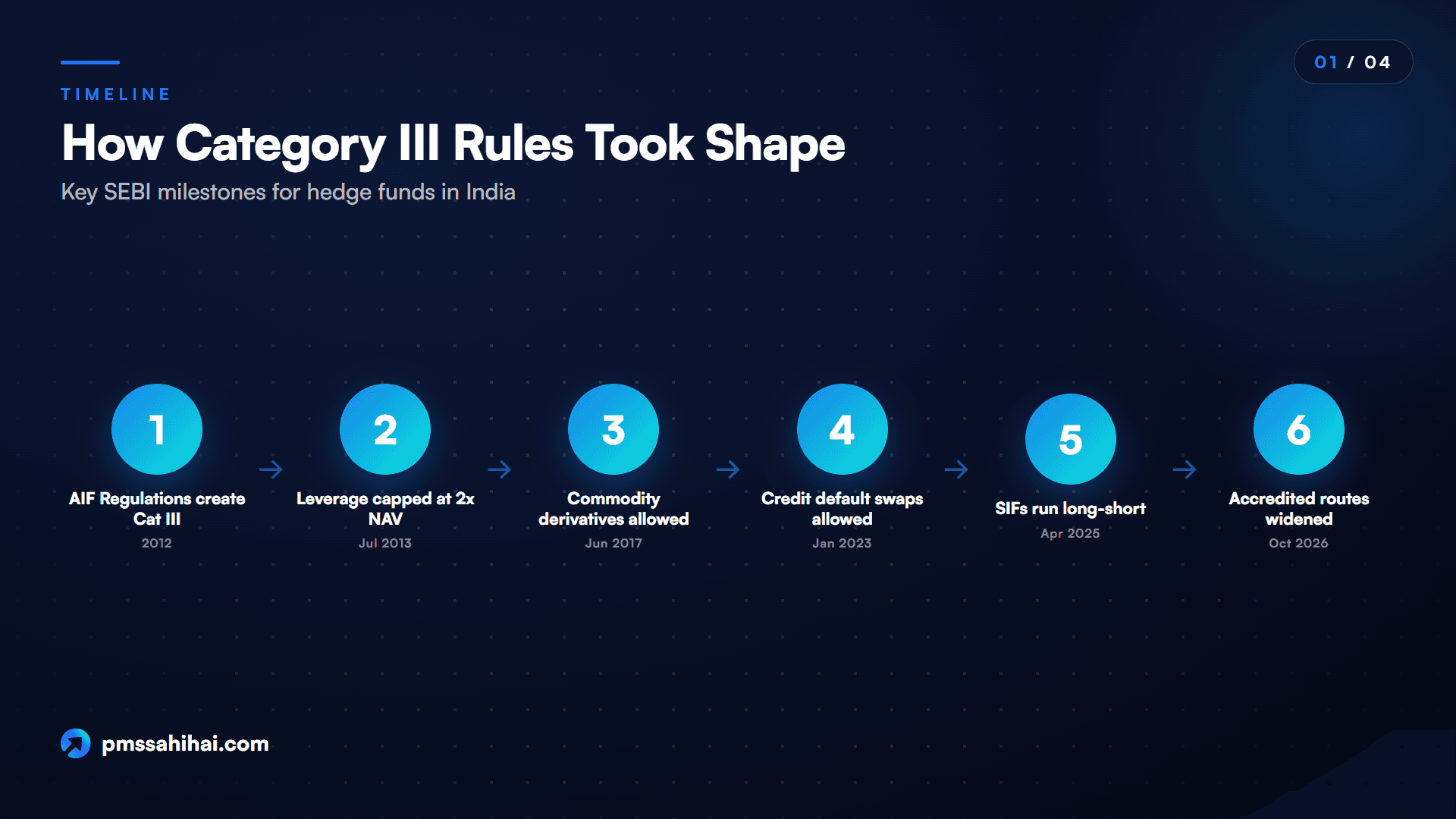
India needed a derivatives market, a short-selling framework and a fund regime first. The key dates:
| Date | Milestone |
|---|---|
| 2012 | SEBI's AIF Regulations create three categories; Category III's definition names hedge funds |
| 29 July 2013 | SEBI circular caps Category III leverage at 2 times NAV and sets risk, compliance and redemption norms |
| 21 June 2017 | Category III AIFs allowed to trade commodity derivatives |
| 9 January 2023 | Category III AIFs allowed to buy and sell credit default swaps |
| 5 January 2024 | SEBI restates its short-selling framework (no naked shorts) |
| 1 April 2025 | Specialised Investment Funds let mutual funds run long-short strategies from Rs 10 lakh |
| 3 June 2026 | Consolidated Master Circular for AIFs, last updated 7 September 2026 |
| 15 October 2026 | AIF Regulations amended to widen the routes to accredited-investor status |
Since 2025, competition from cheaper wrappers has pushed some managers out. In January 2025 Avendus Capital said it would wind down its hedge funds business. In March 2026 Tata Asset Management began an orderly liquidation of two Category III funds, citing taxation, minimum investment thresholds and the emergence of SIFs.
Why SEBI Registers Hedge Funds as Category III AIFs
The definition that names hedge funds outright
Regulation 3(4)(c) of the SEBI (Alternative Investment Funds) Regulations, 2012 defines a Category III AIF as a fund "which employs diverse or complex trading strategies and may employ leverage including through investment in listed or unlisted derivatives."
The Explanation underneath goes further. It says Category III includes "hedge funds or funds which trade with a view to make short term returns or such other funds which are open ended and for which no specific incentives or concessions are given by the government or any other Regulator."
So the answer is literal: the regulation says so. The useful question is why SEBI drew the line there.
Three things Category I and II funds cannot do
A hedge fund does three things the other two categories cannot.
- Leverage. Category II, the home of private equity and private credit, may not undertake leverage or borrowing except as specifically permitted, and Category I is similarly restricted. Category III may engage in leverage or borrow, with investor consent and within a SEBI limit.
- Open-ended structure. Category I and II funds must be close ended with a minimum tenure of three years. Schemes of a Category III AIF may be open ended or close ended, which suits funds that trade liquid listed instruments and want to offer periodic redemptions.
- Trading rather than holding. Categories I and II are built to invest in businesses and hold them for years. Category III is built for "diverse or complex trading strategies", including derivatives, structured products, commodity derivatives and credit default swaps.
A fourth reason is incentives. Category I covers funds the government wants to encourage, such as venture capital and infrastructure. Hedge funds get no such concession, which is also why Category III was left out of the statutory tax pass-through that Categories I and II enjoy, so a Category III fund pays tax inside the trust. The rates, the business-income question and the disputed top rate are covered in our separate post on Category 3 AIF taxation; this guide does not repeat them.
What registration brings with it
Category III is not a light-touch status. The rules add obligations aimed at leveraged trading funds:
- an independent risk management function and an independent compliance function for funds that use leverage;
- NAV calculated independently of the fund management team and disclosed at least monthly for open-ended schemes and quarterly for close-ended ones;
- independent valuation of unlisted securities and listed debt;
- quarterly risk reports to investors within 60 days of each quarter end;
- end-of-day leverage reported to the custodian by the next working day;
- a manager or sponsor stake of at least 5% of the corpus or Rs 10 crore, whichever is lower.
Hedge Fund Strategies Indian Managers Actually Run
In India, hedge fund strategies are shaped by three rules: shorting happens mostly through futures and options, leverage stops at 2 times NAV, and no more than 10% of investable funds can go into one company.
| Strategy | What it tries to earn | Indian rule that shapes it |
|---|---|---|
| Long-short equity | The spread between good and bad stocks, with less market exposure | Shorts mainly via stock and index futures; 2x NAV cap |
| Arbitrage and relative value | Small, repeatable price gaps | Needs derivatives and fast execution; returns depend on futures pricing |
| Quant and systematic | Returns from rules-based models | Same leverage and concentration caps; model risk |
| Event-driven | Price moves around corporate events | 10% single-company limit; deal risk |
| Options and volatility | Option premium or volatility moves | Options sold count at full underlying value for leverage |
| Credit, commodities, multi-strategy | Diversified sources of return | Commodity derivatives since 2017, CDS since 2023 |
Long-short equity
Buy stocks expected to do well, short stocks or indices expected to do badly, and earn the difference. An Indian fund shorts mainly by selling stock or index futures, because SEBI's short-selling framework bars naked short selling and limits shortable stocks to those traded in the F&O segment. Our long-short funds guide covers exposure maths, named funds and the SIF alternative.
Arbitrage and relative value
Arbitrage funds buy one instrument and sell a closely linked one when their prices drift apart. The most common Indian version is cash-futures arbitrage: buy a share in the cash market and sell its future at a higher price, locking in the gap until expiry. Pair trades extend the idea to two related stocks. Returns are modest, and leverage is what makes small spreads meaningful. The same cash-futures trade is also offered through arbitrage PMS and mutual fund wrappers, which have their own posts.
Quant and systematic strategies
Quant hedge funds trade on rules such as momentum, value, low volatility or mean-reversion. Inside a Category III AIF, a quant book can go long and short and use leverage, which a quant PMS cannot do in the same way. The main risk is the model: a factor can stop working, and investors usually see a description, not the code.
Event-driven strategies
Event-driven managers trade around corporate actions such as mergers, demergers, buybacks, open offers, index changes and restructurings. The bet is on whether and when the event completes. This differs from a special situations fund, a Category I sub-category that buys stressed assets for the long haul. Concentration matters here: a Category III AIF can put no more than 10% of investable funds into one company, or 20% for a large value fund for accredited investors, so a single deal cannot dominate the book.
Options, volatility and derivative-income strategies
Some Category III funds sell or buy options to earn premium, hedge tail risk or trade volatility. SEBI's leverage maths treats these very differently from futures. An option bought counts at the premium paid, but an option sold counts at the full market value of the underlying. A fund that writes index options can therefore reach its 2x NAV cap faster than the cash outlay suggests.
Credit, commodities and multi-strategy books
Category III funds can also trade commodity derivatives, permitted since June 2017 with a limit of 10% of investable funds in any single commodity, and can buy or sell credit default swaps, permitted since January 2023. Multi-strategy funds combine several of the approaches above. Global macro, the large currency and rates bets that made some global funds famous, is rarer onshore, where the 2x cap and exchange position limits leave less room for big directional trades.
Hedge Fund Leverage in India: How the 2x NAV Cap Works
Hedge fund leverage is what most separates the Indian version from the global one. SEBI's rule, first set in a July 2013 circular, is short: the leverage of a Category III AIF "shall not exceed 2 times of the NAV of the fund". The detail is in how exposure is counted.
How SEBI counts exposure
Leverage is total exposure divided by NAV, where total exposure is longs plus shorts after offsetting that SEBI allows for hedging and portfolio rebalancing. The AIF Master Circular sets the counting rules:
- Futures, long or short: futures price × lot size × number of contracts.
- Options bought: premium paid × lot size × number of contracts.
- Options sold: market price of the underlying × lot size × number of contracts.
- Other derivatives: notional value of the contract.
- Shorts through securities lending (SLBM) count as short exposure; a long put counts as short exposure and a short put as long exposure.
- Idle cash is not exposure, and NAV excludes any borrowed money.
The limits apply scheme by scheme. SEBI also defines "gross leverage", which is exposure without any offsetting, so investors should ask for both numbers.
A worked leverage example
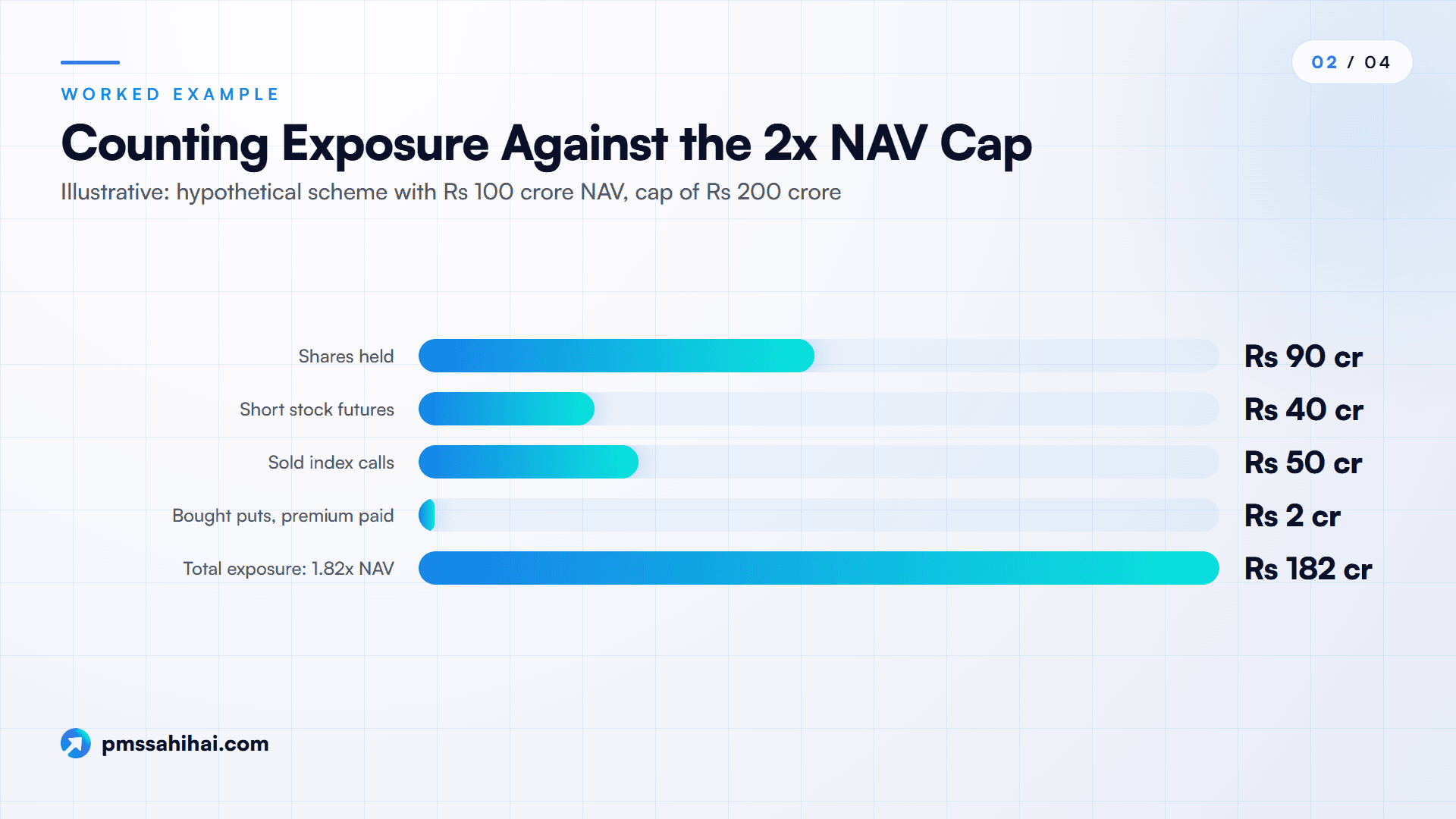
Take a hypothetical scheme with a NAV of Rs 100 crore. The cap allows total exposure, after permitted offsetting, of up to Rs 200 crore.
| Position (hypothetical) | How it is counted | Exposure |
|---|---|---|
| Rs 90 crore of shares | Market value | Rs 90 crore |
| Short Rs 40 crore of stock futures on different companies | Futures price × lot × contracts | Rs 40 crore |
| Sold index call options on an underlying value of Rs 50 crore | Underlying value | Rs 50 crore |
| Bought put options costing Rs 2 crore | Premium paid | Rs 2 crore |
| Total exposure | Rs 182 crore = 1.82x NAV |
The fund is inside the limit, but only just. If the market rallies and the shares and the sold calls both gain value, exposure can cross Rs 200 crore without the manager placing a single new trade. That is why daily monitoring matters.
What happens when a fund breaches the cap
The Master Circular sets a tight timetable when a Category III AIF breaches the limit:
- The fund reports the breach to its custodian the same day.
- It informs every investor, with reasons, before 10 a.m. on the next working day.
- It squares off the excess exposure by the end of the next working day and confirms that to investors.
- The custodian reports the breach to SEBI before 10 a.m. on the next working day.
Investors must also consent to leverage in the first place, and the fund must disclose how much leverage comes from borrowing, how much from derivatives, and the main source.
Concentration limits that sit beside leverage
A Category III AIF can invest no more than 10% of investable funds in one company (20% for large value funds for accredited investors). For listed equity it may measure the limit on NAV instead, must state its method in the placement memorandum, and must fix a passive breach within 30 days.
Hedge Fund Minimum Investment in India and Other Entry Rules
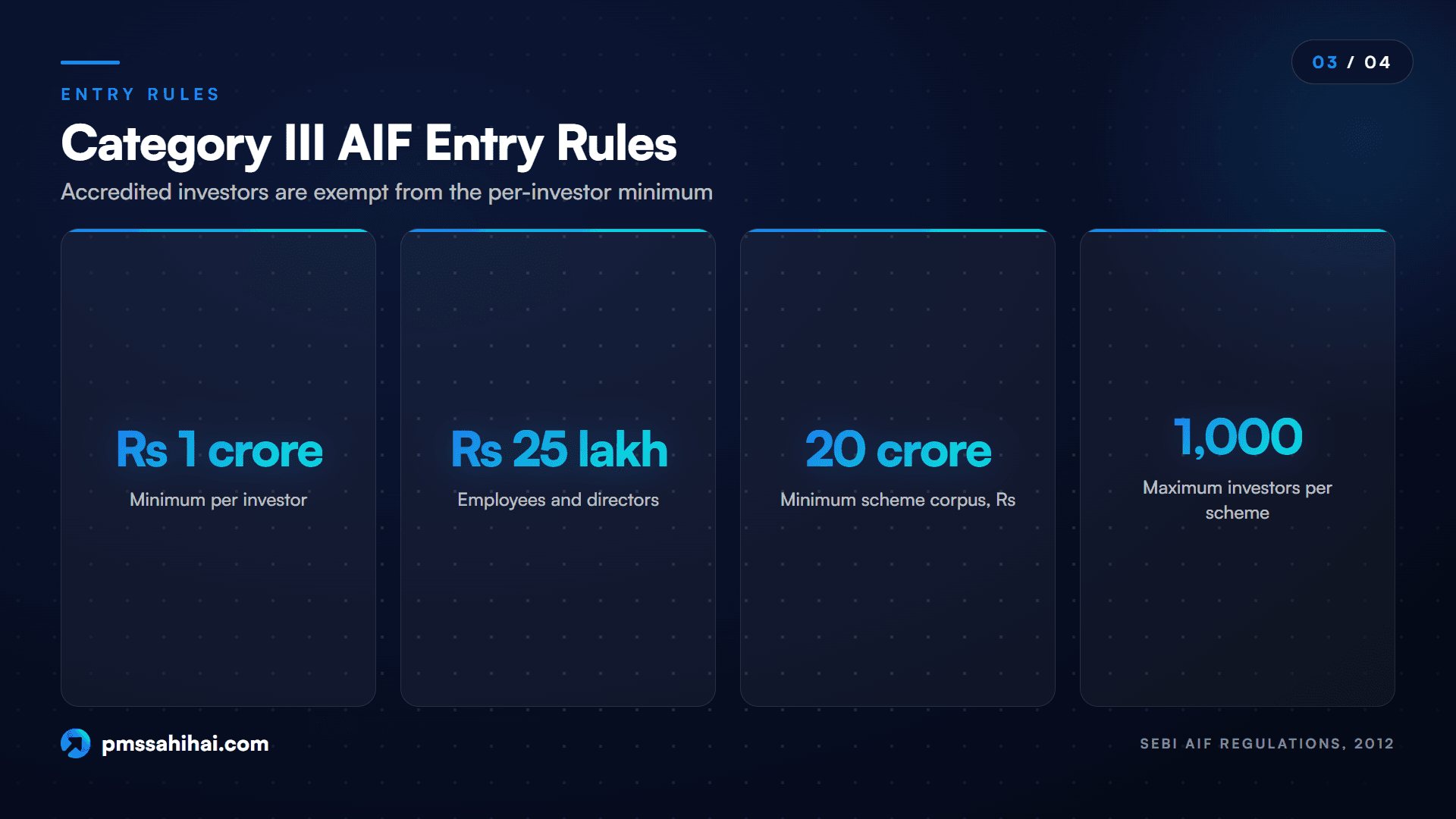
The hedge fund minimum investment in India is Rs 1 crore per investor, the same as every other AIF. Employees and directors of the fund or its manager can invest Rs 25 lakh. Accredited investors are exempt from the Rs 1 crore floor.
| Rule | Requirement for a Category III AIF |
|---|---|
| Minimum per investor | Rs 1 crore (Rs 25 lakh for employees/directors; accredited investors exempt) |
| Minimum scheme corpus | Rs 20 crore |
| Maximum investors per scheme | 1,000 (accredited investors not counted) |
| Manager/sponsor stake | At least 5% of corpus or Rs 10 crore, whichever is lower |
| Structure | Open ended or close ended |
| NAV disclosure | At least monthly (open ended) or quarterly (close ended) |
| Large value fund | Every investor accredited and investing at least Rs 25 crore |
| Distribution fee | Trail only, paid from the management fee; Direct Plan available |
Accreditation is worth a word because it changed this month. An individual qualifies with annual income of at least Rs 2 crore, or net worth of at least Rs 7.5 crore with at least half in financial assets, or income of Rs 1 crore plus net worth of Rs 5 crore with half in financial assets. The SEBI (Alternative Investment Funds) (Third Amendment) Regulations, 2026, in force from 15 October 2026, add a fourth route based on securities market exposure of at least Rs 5 crore, as SEBI specifies, and allow accreditation by specified SEBI-regulated entities as well as accreditation agencies. The same amendment deems persons resident outside India, as defined under FEMA, to be accredited investors, replacing the older deemed list that named Category I FPIs and sovereign wealth funds. On the text, that takes non-residents outside the Rs 1 crore floor. SEBI says these routes work "in a manner as may be specified", and as of 27 October 2026 no operating circular had been issued, so confirm with the fund how it is applying them before you size a ticket. Our AIF minimum investment guide covers the other exceptions.
For open-ended funds, a partial redemption cannot leave you below the minimum, and a scheme whose corpus falls below Rs 20 crore must restore it within three months or wind up.
Indian Hedge Funds vs Global Hedge Funds: Structural Differences
Hedge funds in India share a name with the global industry, not a rulebook. Six differences stand out, and tax is a seventh that our separate tax post covers.
| Feature | Indian Category III AIF | Typical global hedge fund |
|---|---|---|
| Legal status | SEBI-registered AIF, usually a trust | Private fund, often an offshore partnership or company; in the US "a private, unregistered investment fund" |
| Leverage | Capped at 2 times NAV, reported daily | No single SEBI-style cap; financed by prime brokers within margin rules and the fund's own limits |
| Shorting | Mainly via exchange F&O; no naked shorts | Securities borrowed through prime brokers across markets |
| Concentration | 10% per company (20% for large value funds) | Set by the fund's own documents |
| Investors | Rs 1 crore minimum or accredited investor | Accredited investors or qualified purchasers |
| Liquidity | Open-ended allowed; NAV at least monthly | Redemptions often quarterly or less; lock-ups of a year or more |
The biggest practical gap is the prime broker, the investment bank that lends securities to a global fund, finances its positions and clears its trades. Indian funds work mainly through exchange derivatives and stock lending, which limits shorts to larger, F&O-listed companies.
Global funds that want Indian exposure do not become Category III AIFs. They usually register with SEBI as foreign portfolio investors and trade directly. SEBI's data shows just Rs 81 crore of Category III money raised from FPIs, against Rs 2,27,047 crore from domestic investors and Rs 13,736 crore from NRIs as of 30 June 2026. For non-residents who want a dollar wrapper, GIFT City Category III funds are the other route, with their own leverage and tax rules covered in our GIFT City Category III AIF guide.
Hedge Fund vs Mutual Fund, SIF and PMS: Where Each Fits
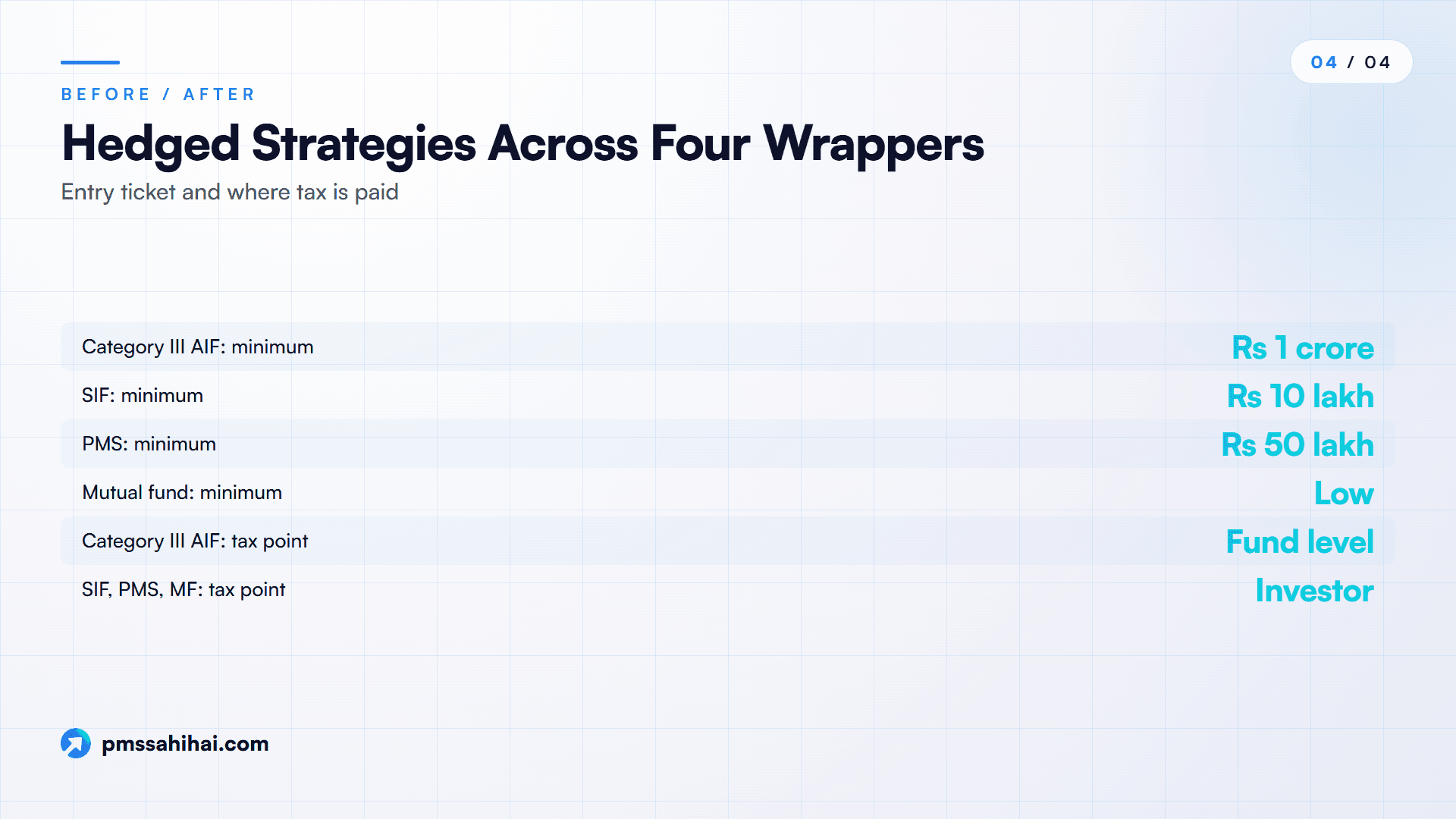
The hedge fund vs mutual fund question has become a four-way choice, because SEBI now offers hedged strategies inside more than one wrapper.
| Feature | Category III AIF | SIF | PMS | Mutual fund |
|---|---|---|---|---|
| Minimum | Rs 1 crore | Rs 10 lakh | Rs 50 lakh | Low, set scheme by scheme |
| Shorting | Yes, within 2x NAV | Unhedged derivatives up to 25% of net assets | Derivatives allowed; client portfolio cannot be leveraged | No unhedged short book |
| Ownership | Units in a pooled trust | Units in a scheme | Securities in your own name | Units in a scheme |
| Tax point | Fund level | Investor level | Investor level | Investor level |
| Disclosure | Private | Public offer document | Private | Public |
The rule of thumb: If you want a modest hedge on an equity portfolio, a SIF, under SEBI's February 2025 framework, does it at a tenth of the ticket. If you want a manager with the freedom to run a market-neutral or heavily hedged book, only a Category III AIF allows it. Our comparison of PMS, AIF, SIF and mutual funds walks through the full four-way decision.
What Category III Hedge Funds Do Well for Investors
A well-run Category III fund can do several things a long-only product cannot.
- Protect in falling markets. Short positions and index hedges can cushion drawdowns, so returns depend less on the direction of the Nifty.
- Earn from both good and bad stocks. Long-short and pair trades make money on the spread, not just on rising prices.
- Use the full derivatives toolkit. Commodity derivatives, credit default swaps and options strategies are open to Category III and closed or limited elsewhere.
- Offer periodic liquidity. Open-ended schemes and at least monthly NAV make it easier to track and exit than a ten-year private equity fund.
- Work under onshore guardrails. Daily leverage reporting, a custodian, independent valuation and breach rules give investors more protection than many offshore structures.
- Align the manager. The 5% or Rs 10 crore sponsor stake means the manager's own money sits in the same fund.
For an HNI who would otherwise run hedges personally through an F&O account, one mandate does the hedging, sizing and risk control.
How PMS Sahi Hai Helps You Look Inside a Category III Hedge Fund
The label "Category III" covers long-only equity funds, arbitrage books and leveraged long-short funds alike, so the first job is to separate them. PMS Sahi Hai, which describes itself as India's first AI-powered PMS and AIF marketplace, is built for that kind of side-by-side reading. It does not run a dedicated hedge fund screen or publish leverage figures, so use it to shortlist and frame questions, then take those questions to the manager.
- Filter to Category III first. The AIF compare page lists the AIFs the platform tracks, with a filter for Category I, II and III and columns for strategy, vintage, AUM, one-year return, lock-in and Nyra score. Filtering to Category III and reading the strategy column is the quickest way to split hedged books from long-only ones.
- Line up alternatives on the same fields. The compare directory lets you shortlist strategies side by side, so a long-short AIF can be weighed against a PMS before you commit Rs 1 crore. Where a fund has not disclosed something, the page shows a blank rather than a guess; treat each blank as a question for the placement memorandum.
- Ask Nyra the rule questions. Nyra, the platform's AI research analyst, takes a goal in plain English, lets you explore Category I, II or III funds by capital and timeline, and cites a source for every answer, declining when no verifiable source exists. That suits questions such as how options sold count towards the 2x cap.
- Read the score for what it is. Nyra scores strategies from 0 to 10 across five pillars under a published scoring methodology, and strategies with under 12 months of track record show as "Not Rated". The score is backward-looking; it does not grade gross leverage, short-book quality or fund-level tax, so use it as a filter, not a verdict.
Nyra is a research tool and does not give personalised investment advice; for that conversation, the team offers a private consultation.
Risks and Limits of Hedge Funds in India
A hedge fund in India carries real costs and risks, and recent exits show the business model is under strain.
- Leverage cuts both ways. At 2x exposure a 10% adverse move costs roughly 20% of NAV before costs. LTCM is the extreme global example of what leverage can do.
- Tax drag. Because tax is paid in the fund, often at high trust rates on derivatives income, post-tax returns can trail a SIF or mutual fund doing similar trades. Consult a tax adviser before investing.
- Liquidity is a contract term. Redemptions follow the placement memorandum, and managers may suspend redemptions in exceptional circumstances.
- High fees. Management plus performance fees compound against you; compare the high-water mark and hurdle terms.
- Thin, shrinking shelf. Tata Asset Management closed two Category III funds in 2026, other managers have exited since 2025, and with SIFs drawing assets long track records in Indian hedge-fund strategies are scarce.
Is a Hedge Fund in India Right for Your Portfolio?
A hedge fund in India is best understood as a set of strategies inside a regulated container. SEBI chose Category III for that container because it is the only one that permits leverage, open-ended trading and complex derivatives, and it paired that freedom with a 2x NAV cap, daily leverage reporting and tight concentration rules.
The real question is whether this wrapper suits the strategy you want. For a partial hedge, a SIF may do. For a market-neutral or multi-strategy manager, with Rs 1 crore to commit, a Category III AIF is the onshore route. Read the placement memorandum for leverage, liquidity and fees before the return chart, and use PMS Sahi Hai's comparison pages and Nyra to narrow the field before you do.
Compare Category III Hedge Funds Before You Commit
A hedge fund label tells you very little. The strategy, net and gross exposure, leverage source, fee terms, liquidity and tax line tell you almost everything. Line those up across funds before you sign a commitment, ask each manager for the numbers in this guide, and keep a tax adviser in the loop. Start on the PMS Sahi Hai AIF compare page, filter to Category III and shortlist the strategies whose terms match how you actually want to invest. Then ask Nyra to check the rules behind each one, with a source cited for every answer, and book a consultation with the PMS Sahi Hai team if you want a second pair of eyes before you sign.
PMS Sahi Hai is a distributor of Portfolio Management Services and Alternative Investment Funds, APMI-registered (Registration No. APRN08358). This article is for education only and is not investment advice, a recommendation, or an offer to buy or sell any security. Investments in securities markets are subject to market risks; read all scheme-related documents carefully. Past performance is not indicative of future results. Consult your advisor before investing.
Ishaan founded PMS Sahi Hai to make India's PMS, AIF and GIFT City markets legible to serious investors, comparing every SEBI-registered manager on the same comparative basis, with no shelf products and no commission bias.
Frequently asked
What is a hedge fund in simple terms?
A hedge fund is a private investment pool for wealthy or professional investors that can short sell, trade derivatives and use borrowed money to earn returns in most market conditions. Unlike a mutual fund, its mandate is flexible and its offer is private. In India, such funds must register with SEBI as Category III Alternative Investment Funds under the AIF Regulations, 2012.
Are hedge funds legal in India?
Yes. Hedge funds are legal in India, but only as SEBI-registered Category III AIFs. The AIF Regulations, 2012 name hedge funds as an example of Category III, and these funds must follow SEBI's rules on leverage, concentration, valuation, redemptions and reporting. An unregistered pooled fund raising money from Indian investors would breach SEBI rules.
How much leverage can a hedge fund in India use?
A Category III AIF can run total exposure of up to 2 times its NAV, after offsetting positions for hedging and rebalancing as SEBI permits. A fund with a NAV of Rs 100 crore can hold up to Rs 200 crore of longs and shorts. It must report leverage to its custodian daily and square off any breach by the next working day.
What is the minimum investment in a hedge fund in India?
The minimum is Rs 1 crore per investor, the standard AIF threshold. Employees and directors of the fund or manager can invest Rs 25 lakh, and accredited investors are exempt from the minimum. Since 15 October 2026 persons resident outside India are deemed accredited, though SEBI has yet to issue the operating circular. Each scheme also needs a corpus of at least Rs 20 crore and can have no more than 1,000 investors, excluding accredited investors.
Can Indian hedge funds short sell stocks?
Yes, but within limits. SEBI's short-selling framework bars naked short selling and limits shortable stocks to those in the F&O segment, so Indian hedge funds usually short through stock or index futures, bought put options or the securities lending mechanism. All short positions count towards the fund's 2x NAV leverage cap.
How is an Indian hedge fund different from a US hedge fund?
An Indian hedge fund is a SEBI-registered Category III AIF with a 2x NAV leverage cap, a 10% single-company limit and fund-level tax. A US hedge fund is usually a private, unregistered fund that borrows and shorts through prime brokers with no fixed regulatory leverage cap, and is limited to accredited investors or qualified purchasers.
Is a hedge fund better than a mutual fund?
Not automatically. A hedge fund can cushion falls and profit from shorts, but it costs more, needs Rs 1 crore, offers less liquidity and is taxed inside the fund. A mutual fund is cheaper, liquid and taxed in your hands. The right choice depends on your goal, ticket size and tax position.
Keep reading
All articles
What Is a Hybrid SIF? The Fixed-Income Alternative Nobody Explains
What a hybrid SIF is, how hybrid long-short funds earn from debt, arbitrage and options, how they are taxed, and the risks versus FDs and debt funds.

What Is Co-Investment? How HNIs Invest Alongside AIFs in Single Deals
How AIF co-investment works in India: SEBI's CIV scheme vs the PMS route, accredited investor rules, the 3x cap, fees, tax and risks.
What Is a Fund of Funds? How Layered Investing Works for HNIs
What a fund of funds is, how mutual fund and AIF FoFs work in India, SEBI's 2026 cost caps, the double fee layer, tax, and when HNIs should use one.
Read it. Now pressure-test it.
Ask Nyra how this applies to your portfolio, or talk to our team, no pitch, no pressure.