
What Is a Fund of Funds? How Layered Investing Works for HNIs
What a fund of funds is, how mutual fund and AIF FoFs work in India, SEBI's 2026 cost caps, the double fee layer, tax, and when HNIs should use one.


A fund of funds is a scheme that invests in other funds instead of buying shares or bonds itself. In India you meet it in two forms: mutual fund FoFs, now governed by the SEBI (Mutual Funds) Regulations, 2026, and AIFs that invest in units of other AIFs under the SEBI AIF Regulations, 2012. Every FoF adds a second layer of fees, and its tax treatment often differs from that of the funds it holds. For an HNI, the layer is worth paying for when it buys access, allocation or manager diversification you cannot get as cheaply on your own. This guide, current to 26 October 2026, shows how to tell the difference.
Why Investors Buy Funds That Own Other Funds
Most investors choose a fund because of what it owns. A fund of funds asks you to choose a fund because of the funds it owns. That one extra step changes the cost, the tax, the liquidity and the amount of control you keep.
Why pay one manager to pick other managers? It depends on what the extra layer does. Sometimes it opens a door: an overseas fund of funds lets you buy a US index fund in rupees. Sometimes it spreads a large entry ticket: one AIF commitment can reach several private equity or venture managers. And sometimes it only repackages funds you could have bought yourself, at a higher price.
High-net-worth investors meet these products often: asset allocation FoFs from wealth managers, multi-manager AIFs from private banks, international FoFs from fund houses. This guide explains the structure, then the Indian rules for mutual fund FoFs and AIF fund of funds, the double layer of fees, fund of funds taxation in 2026 and the questions to ask before you commit. It stays onshore: GIFT City feeders work under a different regulator and have their own guide.
The regulations cited were read in SEBI's versions amended up to October 2026. Confirm the position, and your own tax result, with a qualified adviser before you invest.
What a Fund of Funds Is and How the Layers Work
A fund of funds is a pooled vehicle whose portfolio consists mainly of units of other pooled vehicles. Investors buy units of the top fund. The top fund buys units of the underlying funds. The underlying funds buy the actual securities: shares, bonds, gold, startup equity or loans.
Indian law defines the mutual fund version precisely. The SEBI (Mutual Funds) Regulations, 2026 define a fund of funds scheme as a mutual fund scheme that invests primarily in other schemes of the same mutual fund or other mutual funds. AIF rules take a different route. They do not define a separate FoF product any more. Instead, any AIF whose documents allow it may invest in units of other AIFs, subject to conditions explained later.
The Three Roles in Every Fund of Funds
Every layered structure has three roles, even when one firm plays two of them.
- The investor holds units of the top fund and sees one net asset value (NAV).
- The FoF manager decides which underlying funds to hold, in what proportion, and when to switch. This is the service the extra layer charges for.
- The underlying managers run the actual portfolios and deduct their own fees inside the underlying NAV.
You never see the underlying fee as a separate bill, which is why the total cost of a fund of funds is easy to underestimate.
Fund of Funds, Feeder Fund and Multi-Manager Mandate Compared
| Structure | What it holds | What the top manager decides | Typical use |
|---|---|---|---|
| Fund of funds | Units of several funds | Selection and weights across funds | Allocation, diversification, access |
| Feeder fund | Units of one master fund | Mainly cash, currency and access | Letting new investors into an existing fund |
| Multi-manager mandate or advisory | Your own account, several strategies | Recommendations or allocation | Large family offices with direct relationships |
A feeder adds access rather than selection. When you evaluate a layered product, ask which of these it really is.
How Fund of Funds Investing Evolved in India
- 29 May 2003. SEBI inserted the definition of a "fund of funds scheme" into the Mutual Funds Regulations, 1996, along with two lasting restrictions: a FoF may not invest in another FoF, and no ordinary scheme may invest in a FoF.
- 2012. The SEBI (Alternative Investment Funds) Regulations, 2012 arrived with separate "fund of funds" clauses for AIF categories, each barred from investing in other fund of funds.
- 2016. The government launched the Fund of Funds for Startups (FFS) with a Rs 10,000 crore corpus, which invests in startups only through SEBI-registered AIFs, never directly.
- 5 May 2021. SEBI's Second Amendment Regulations removed the separate AIF fund of funds clauses. Any AIF may now invest in units of other AIFs if its documents allow it, subject to look-through limits and a bar on further layering.
- 2023 to 2025. Debt-heavy fund units bought from 1 April 2023 became taxable at slab rates; equity fund rates rose to 20% and 12.5% from 23 July 2024; and from 1 April 2025 "specified mutual fund" was redefined to include FoFs with 65% or more in debt funds.
- 14 February and 13 April 2026. The Union Cabinet approved, and the government notified, the Startup India Fund of Funds 2.0 with a fresh Rs 10,000 crore corpus.
- 1 April 2026. The SEBI (Mutual Funds) Regulations, 2026 replaced the 1996 Regulations and restated FoF cost caps as a "base expense ratio". The Income-tax Act, 2025 also took effect from this date, renumbering the capital gains sections.
The direction is clear: layering is easier to use but harder to hide. Costs must include the underlying funds, concentration limits look through to the final company, and documents must disclose what the extra layer charges.
Mutual Fund FoF Types: Domestic, Overseas, Gold and ETF
The mutual fund FoF is open-ended, priced daily and available with small minimums. FoF units are ordinary mutual fund units, so you need no demat account even when the FoF holds exchange traded funds.
The common types are:
| Mutual fund FoF type | What it holds | Why investors use it |
|---|---|---|
| Asset allocation or multi-asset FoF | Equity, debt and gold schemes in set or flexible proportions | One holding with built-in rebalancing |
| Domestic equity FoF | Several Indian equity schemes or ETFs | Manager or style diversification |
| Overseas or international fund of funds | Foreign mutual funds, unit trusts or ETFs | Global exposure in rupees |
| Gold or silver ETF FoF | Units of a gold or silver ETF | Commodity exposure without a demat account |
| ETF FoF | Units of one or more Indian ETFs | Index exposure through SIPs |
The 2026 Regulations keep the two old guardrails. A fund of funds scheme shall not invest in any other fund of funds scheme, and it may hold nothing but mutual fund schemes, apart from cash needed for redemptions. No ordinary scheme may invest in a FoF. So a mutual fund FoF can never be more than two layers deep.
Why Overseas Fund of Funds Keep Closing to New Money
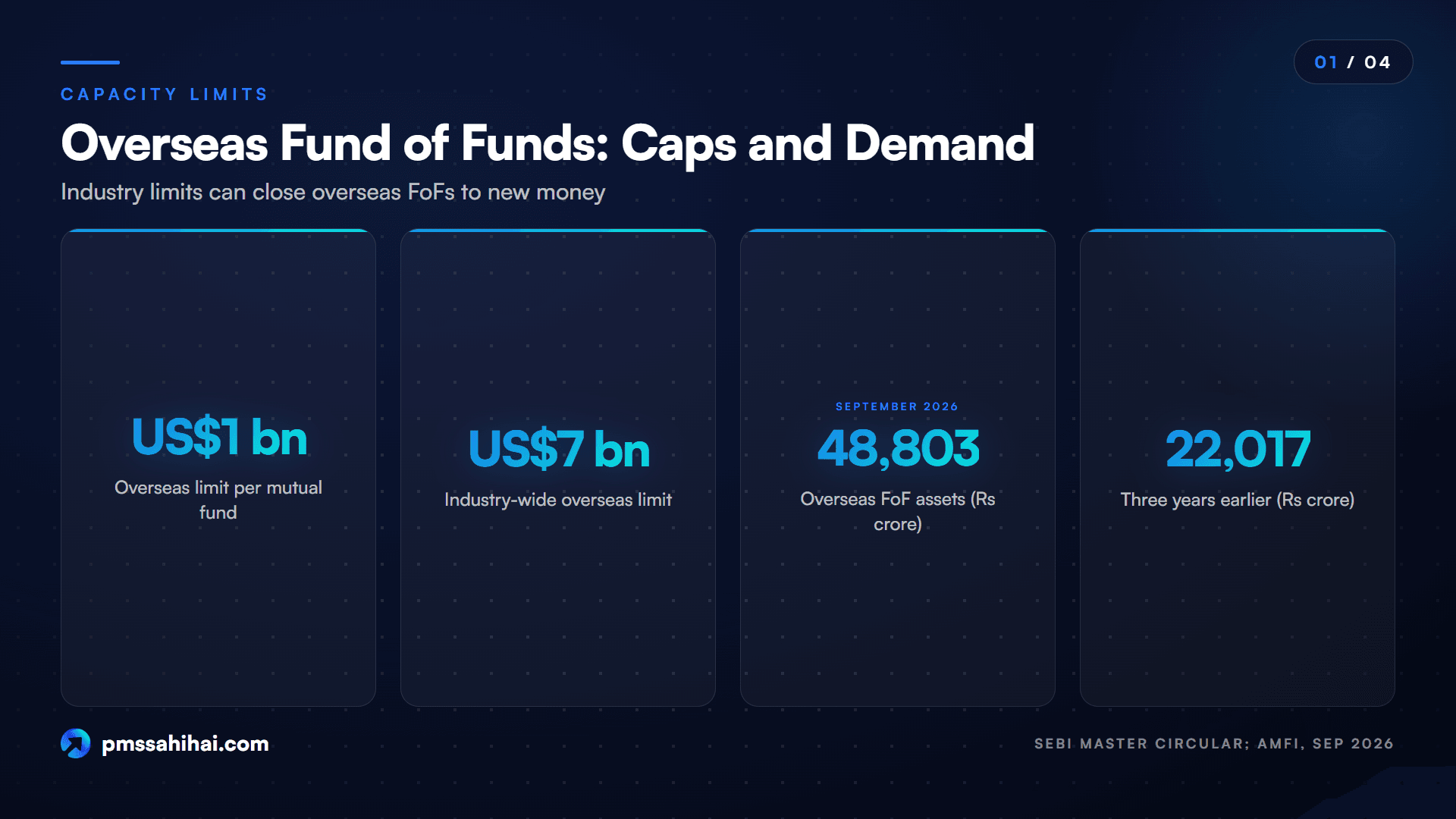
The overseas fund of funds is the category most shaped by regulation. Indian mutual funds can invest abroad only within an industry-wide ceiling. SEBI's master circular, as quoted in scheme documents filed with SEBI, sets a limit of US$1 billion per mutual fund within an overall industry limit of US$7 billion, and a separate limit for overseas ETFs of US$300 million per fund within an industry total of US$1 billion. Outlook Money reported in June 2026 that the caps were still in force and that AMFI would again ask the RBI, the government and SEBI to re-examine them.
Near the limit, fund houses pause fresh subscriptions or SIPs into international schemes, so an overseas FoF can be open one quarter and closed the next. It is a capacity limit, not a judgement on the fund.
Demand has grown anyway. AMFI's September 2026 monthly note shows that FoFs investing overseas held Rs 48,803 crore at the end of September 2026, up from Rs 22,017 crore three years earlier. September 2026 itself saw a small net outflow of Rs 159 crore.
Residents who want more can invest directly under the Liberalised Remittance Scheme or through GIFT City funds, which our GIFT City fund of funds guide covers.
AIF Fund of Funds Under SEBI's Investment Conditions
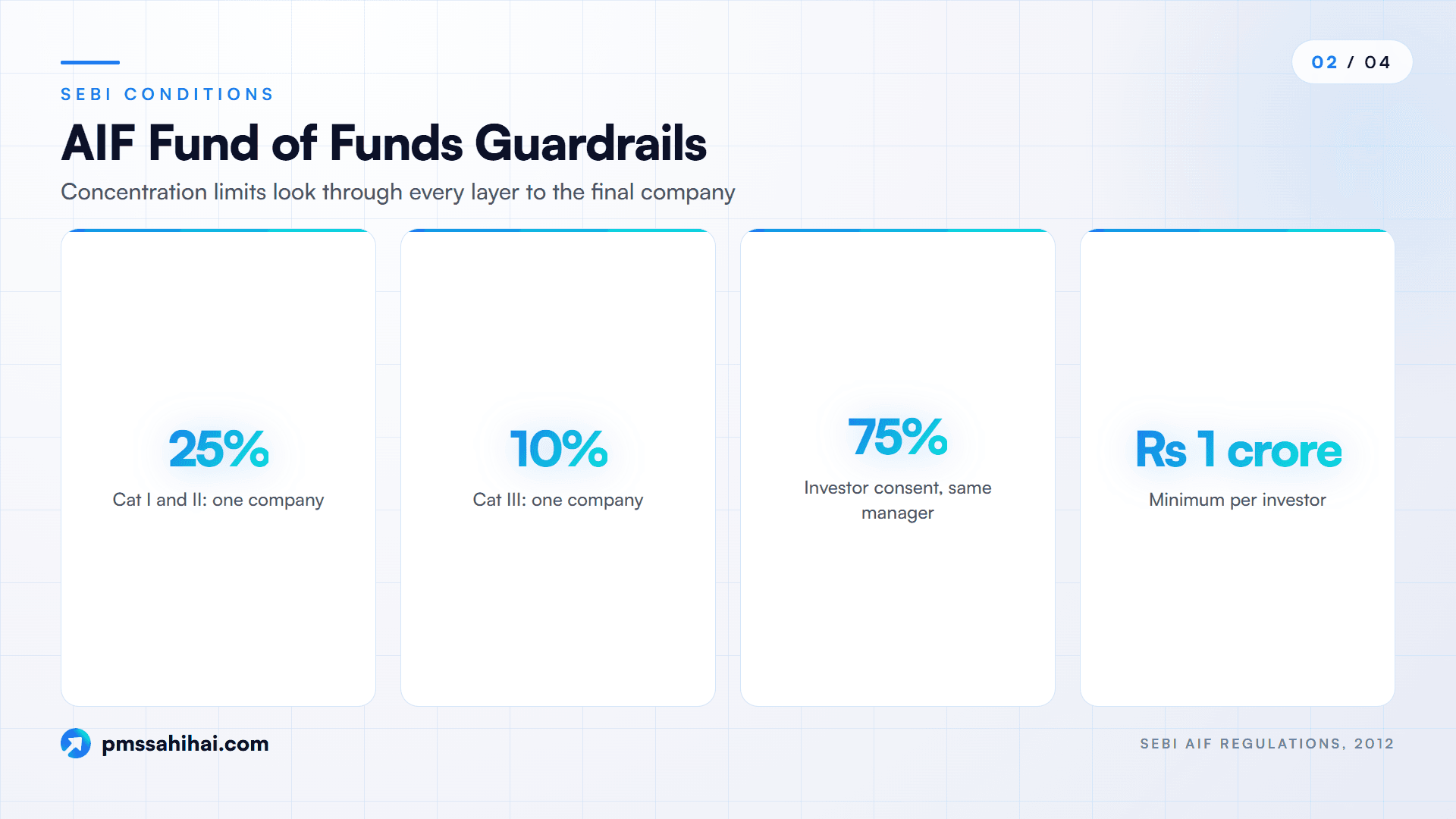
An AIF fund of funds works very differently from a mutual fund FoF. It is a closed pool for sophisticated investors, usually with commitments drawn down over several years, a long lock-in and a minimum of Rs 1 crore per investor (Rs 25 lakh for employees and directors of the manager; accredited investors are exempt from the minimum).
Since May 2021, SEBI no longer treats a fund of AIFs as a separate product. Its AIF master circular says AIFs may invest in units of other AIFs without labelling themselves as a Fund of AIFs. What matters is what the fund documents permit and which category the investing AIF belongs to:
- Category I AIFs may invest in units of other Category I AIFs of the same sub-category, or in Category II AIFs as specified.
- Category II AIFs may invest in units of Category I or other Category II AIFs, as disclosed in the placement memorandum.
- Category III AIFs may invest in units of other AIFs alongside listed and unlisted securities and derivatives.
The Look-Through Concentration Limits
The most important rule is that concentration limits look through the layers. Regulation 15(1)(c) caps Category I and II AIFs at 25% of investable funds in one investee company "directly or through investment in the units of other" AIFs. Large value funds for accredited investors may go up to 50%. For Category III the limit is 10%, or 20% for large value funds.
If three underlying funds hold the same startup, the FoF must add up its share of each.
The Two-Layer Ceiling and Related-Party Approvals
- No third layer. An AIF authorised to invest in units of AIFs "shall not offer their units for subscription to other" AIFs. Nothing can sit on top of a fund of AIFs.
- Related-party approval. Investing in AIFs managed or sponsored by the same manager, sponsor or their associates needs the approval of 75% of investors by value.
Category III funds holding units of other AIFs may not take leverage above two times NAV, calculated after excluding those units. And pooling vehicles created solely to invest in an AIF must themselves register as AIFs.
What the Placement Memorandum Must Disclose
An AIF that plans to invest in other AIFs must disclose four things in its placement memorandum (PPM):
- The proposed allocation to units of other AIFs.
- The portion of total fees and expenses that may be attributed to investment in units of other AIFs.
- The process the manager will follow to comply with the investment conditions.
- Whether it will invest in AIFs of the same manager, sponsor or their associates, with allocation, fees and expenses.
An existing AIF that did not plan such investments at launch may start only after updating its PPM and obtaining consent from at least two-thirds of unit holders by value. Read the fee section of the PPM before anything else; it is where the true cost of the AIF fund of funds sits.
Government-Backed Fund of Funds for Startups
India's best-known fund of AIFs is a government programme. Under the Fund of Funds for Startups launched in 2016, the entire Rs 10,000 crore corpus was committed to 145 AIFs, which in turn invested over Rs 25,500 crore in more than 1,370 startups, according to the government. Startup India Fund of Funds 2.0, notified on 13 April 2026, adds another Rs 10,000 crore for commitments to eligible AIFs across the 16th and 17th Finance Commission cycles, with SIDBI as implementation agency.
The government chose a fund of funds because it wanted professional managers, not officials, to pick startups. It also means many venture AIFs you may consider already carry government money alongside yours.
The Double Layer of Fees in a Fund of Funds
Every fund of funds charges twice: in the underlying funds and at the top. The question is whether the second layer is reasonable for what it does.
How SEBI Caps the Fund of Funds Expense Ratio
For mutual funds, SEBI caps the total, including the underlying funds. Under regulation 66(7)(b) of the 2026 Regulations as amended to 10 October 2026, the maximum base expense ratio for an open-ended fund of funds, including the weighted average expense ratio of the underlying schemes, is:
| Mutual fund FoF type | Maximum base expense ratio (including underlying) |
|---|---|
| FoF investing in liquid, index and exchange traded funds | 0.90% of daily net assets |
| FoF investing at least 65% in equity-oriented schemes | 2.10% |
| All other FoFs | 1.85% |
A second rule stops the top layer from swallowing the budget. The FoF's own charge over and above the underlying weighted average may not exceed two times that weighted average, within the overall ceiling. Statutory levies such as GST, brokerage within limits and transaction costs sit outside the base expense ratio, so the total expense ratio you see on a factsheet will be slightly higher.
These caps replaced the older limits of 1.00%, 2.25% and 2.00%, which many explainers still quote. Compare a FoF's expense ratio, stated including the underlying funds, with what those funds cost in their direct plans.
There is no equivalent cap for AIFs. Management fees, carried interest and hurdles are disclosed in the PPM, and both layers can charge them.
A Worked Example of Layered AIF Fees
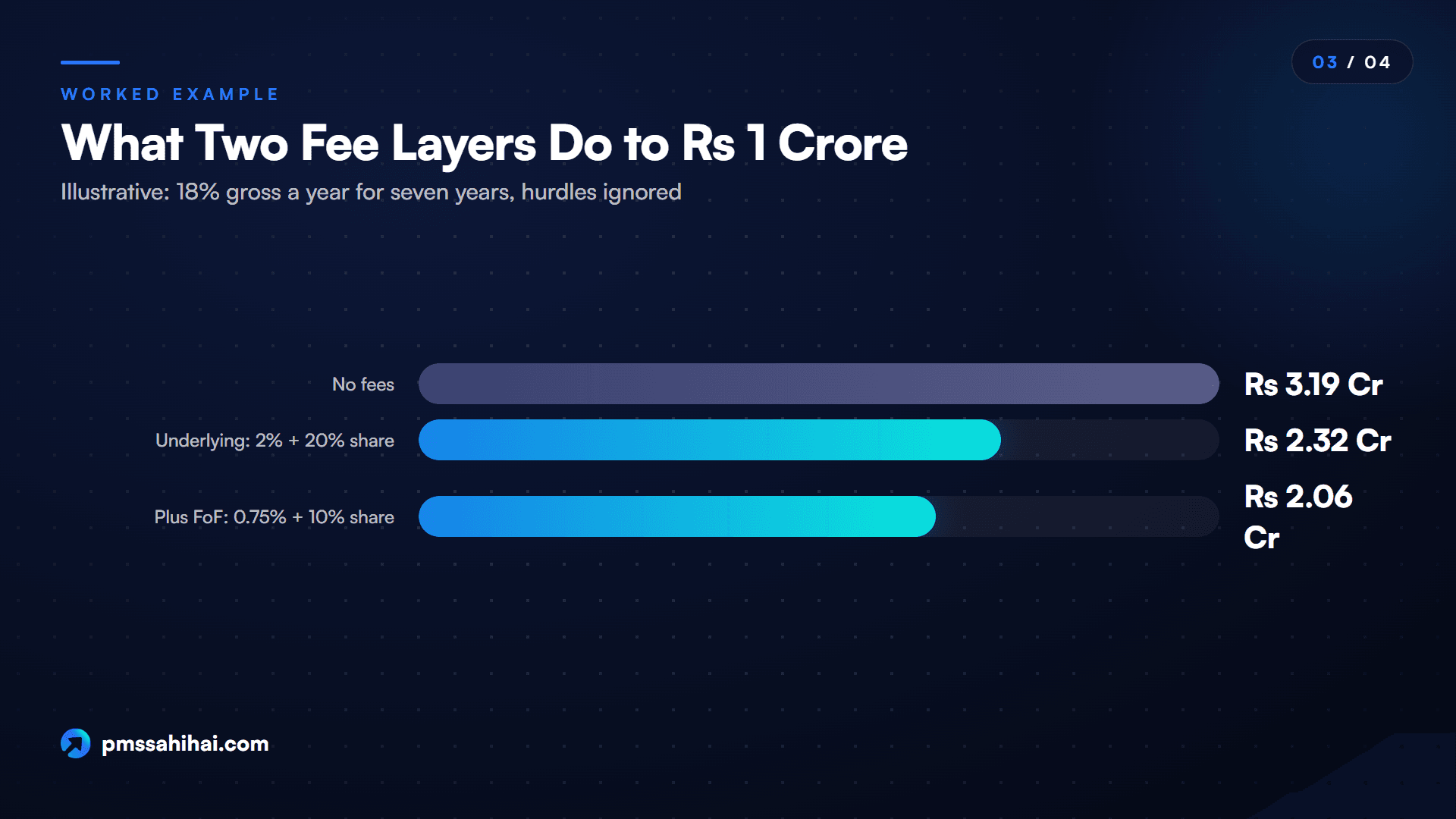
The figures below are illustrative assumptions, not any real fund's terms. They assume full investment from day one, charge fees and profit share yearly and ignore hurdles.
Assume Rs 1 crore earns a gross return of 18% a year for seven years in the underlying portfolios.
- No fees: Rs 1 crore grows to about Rs 3.19 crore.
- Underlying layer only (2% management fee, then 20% profit share): the net return falls to 12.8%, and the investment grows to about Rs 2.32 crore.
- With a FoF layer on top (0.75% management fee, then 10% profit share): the net return falls to about 10.8%, and the investment grows to about Rs 2.06 crore.
Here the second layer costs roughly Rs 26 lakh over seven years. That may be worth paying for access to funds you could not reach, or for managers well above average. It is a poor bargain if you could have bought the same funds directly.
For a mutual fund FoF the drag is smaller. An equity FoF holding schemes with a weighted expense ratio of 0.70% and charging 0.50% of its own totals 1.20%, inside the 2.10% cap, but you still pay 0.50% a year for allocation and rebalancing.
Fund of Funds Taxation for Resident Investors in 2026
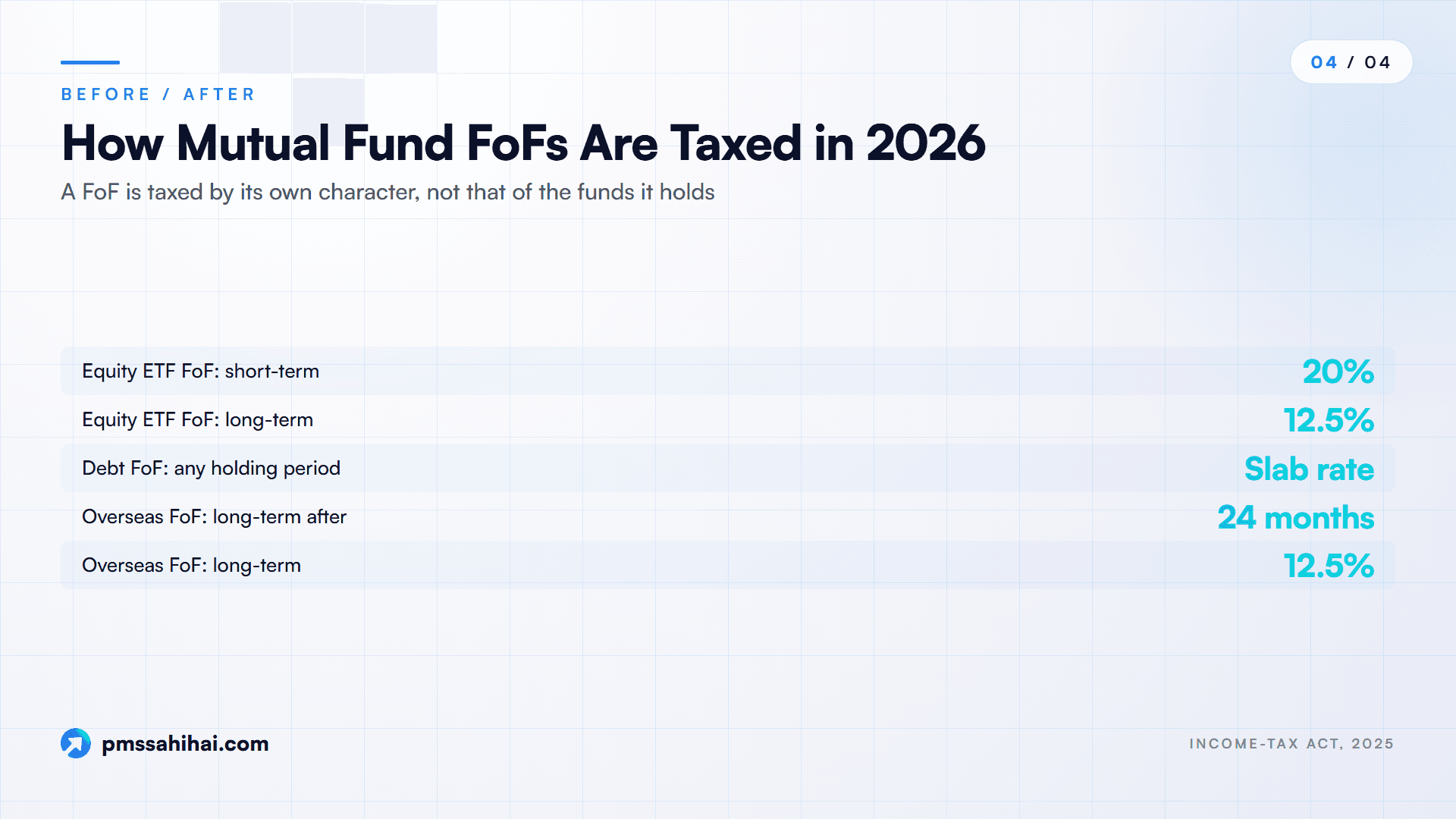
Fund of funds taxation surprises investors because a FoF is taxed by its own character, not that of its underlying funds. The Income-tax Act, 2025 applies from 1 April 2026; section numbers below are new, with the old number in brackets.
Mutual Fund FoF Tax by Type
| FoF type | If sold within the short-term period | If held longer |
|---|---|---|
| Domestic equity ETF FoF, investing over 90% in ETFs that hold at least 90% listed domestic equity | 20% under s.196 (old 111A) if held up to 12 months | 12.5% above Rs 1.25 lakh a year under s.198 (old 112A) after 12 months |
| Debt FoF, investing 65% or more in debt-oriented funds (a "specified mutual fund" under s.76, old 50AA), units bought after 31 March 2023 | Slab rate | Slab rate, whatever the holding period |
| Overseas fund of funds, gold or silver FoF, and other FoFs that fail both tests above | Slab rate if held up to 24 months | 12.5% without indexation after 24 months |
Three points stand out:
- Many equity FoFs are not taxed like equity funds. The equity test for a fund of funds needs over 90% in exchange traded units of funds that are themselves at least 90% in listed domestic equity. A FoF holding actively managed equity schemes generally fails it and falls into the third row, although the underlying schemes held directly would get equity treatment.
- International FoFs need two years. Short-term gains on an overseas fund of funds are taxed at your slab rate, which can be the top marginal rate for HNIs.
- Rebalancing inside the FoF is not your taxable event. You are taxed when you redeem FoF units, not when the manager switches schemes. A do-it-yourself portfolio would trigger tax at each rebalance.
How AIF Fund of Funds Income Is Taxed
Category I and II AIFs have statutory pass-through status under s.224 of the Income-tax Act, 2025 (old 115UB): income other than business income is taxed in the investors' hands as if they had earned it directly. When one Category I or II AIF invests in another, pass-through applies to each layer in principle, so income should flow to you with its character intact.
In practice the chain adds friction: each layer deducts tax at source and issues its own statements, and losses pass through only on units held for at least 12 months. Ask how tax credits will flow through both layers.
Category III AIFs have no pass-through and are taxed at the fund level, at rates that can be high. Layering one Category III fund over another risks tax at more than one level, and whether investors are taxed again on redemption is unsettled. Treat any Category III fund of funds with caution and get specific tax advice.
Advantages of Fund of Funds Investing for HNIs
A well-built fund of funds can earn its extra layer:
- Diversification across managers. One holding spreads manager risk, which matters in private markets where results vary widely between managers.
- Access to closed or large-ticket funds. Each AIF needs at least Rs 1 crore from you. One commitment to an AIF fund of funds can reach several managers, some closed to new direct investors.
- Vintage diversification. A fund of AIFs committing over several years spreads your private-market exposure across entry points.
- Global exposure in rupees. An overseas fund of funds gives international exposure without a foreign broker, and redemptions return to your Indian bank account.
- Tax-neutral rebalancing. Switches between underlying schemes happen inside the FoF without triggering capital gains for you.
- Regulatory guardrails. Mutual fund FoFs carry hard caps on total cost and cannot layer more than twice. AIF fund of funds face look-through concentration limits, a bar on third layers and mandatory fee disclosure.
- Delegated due diligence. A good FoF manager picks and monitors underlying managers and reports in one place.
How PMS Sahi Hai Helps You Judge the Fund of Funds Layer
The advantages above are real only when the layer beats the direct route. PMS Sahi Hai is built for that comparison: it puts PMS, AIF and GIFT City strategies on one shelf so you can see the alternatives before you pay a second set of fees.
First, the limits. The platform does not list mutual fund FoFs, and it does not calculate the combined cost of both layers of any fund of funds. For those you still need the scheme's factsheet or the PPM fee section described above.
Where it helps is on the AIF side, where the stakes are highest:
- Compare the layer with going direct. The AIF comparison page lists funds across Category I, II and III with strategy, vintage, AUM, one-year return, lock-in and a Nyra score, and lets you filter by category. If a fund of AIFs is pitched to you, filter for the categories it invests in and see which managers you could approach yourself. Where a manager has not disclosed a figure, the page leaves it blank rather than guessing; each blank is a question for the manager.
- Ask Nyra about the rules behind the layers. Nyra, the platform's AI research tool, is grounded in SEBI, AMC and IFSCA primary sources, cites a source for each answer and declines when none exists. Use it to check points this guide raises: the look-through concentration limit, the 75% consent for same-manager investments, or what a PPM must disclose about fees attributable to other AIFs.
- Read the score for what it is. Nyra scores strategies from 0 to 10 across five pillars under its published methodology, and anything with less than 12 months of track record shows as "Not Rated". A new fund of AIFs will often be unrated, and the score does not measure the extra fee a layer charges.
- Fill in the plumbing. Our guides to how AIFs work, the Rs 1 crore AIF minimum and its exceptions and GST on PMS and AIF fees cover the underlying layer in depth. GST at 18% applies to the fees at each layer.
Nyra is an analytical tool, not a SEBI-registered investment adviser, and nothing on the platform replaces the offer document.
Disadvantages and Limits of Layered Investing
The same structure has real costs:
- The double layer of fees. Every rupee pays twice. Where both layers charge management fees and carried interest, the drag can be large, as the worked example shows.
- Less control and transparency. You cannot choose or exit individual underlying funds, and you see their holdings only through periodic reports.
- Hidden overlap. Different underlying funds may hold the same companies, so diversification can be smaller than the number of funds suggests.
- Tax can be worse than going direct. An equity FoF that fails the 90% ETF test is taxed as a non-equity fund, and an overseas fund of funds needs 24 months for long-term treatment.
- Capacity limits. Overseas FoFs close to new money when industry caps are reached, which can disrupt an SIP plan.
- Longer, less liquid commitments in AIFs. An AIF fund of funds depends on the lock-ins and drawdown schedules of the funds underneath, and may add its own extension options.
- Diluted outperformance. The more managers a FoF holds, the more its result looks like the market average, while fees stay above average.
When a Fund of Funds Makes Sense for an HNI Portfolio
Pay for the layer only when it delivers something you cannot get as cheaply on your own.
A fund of funds tends to make sense when:
- You want private-market exposure but your allocation is too small to build a diversified set of AIFs at Rs 1 crore each.
- You want international equity in a rupee product and the fund is open, accepting that gains need 24 months for long-term treatment.
- You want one rebalanced holding for a goal, and you value tax-free switching inside the fund more than the extra fee.
- The FoF manager has demonstrable access to underlying funds that are closed or have minimums far above yours.
It tends not to make sense when:
- You could buy the same underlying funds directly at the same minimum, and you are comfortable rebalancing yourself.
- Your allocation is large enough to commit directly to several AIFs and negotiate fee terms.
- The FoF holds funds from its own group, without clear evidence that they are the best available.
- You need liquidity within the lock-in period of the underlying AIFs.
The same test applies to newer layered structures. The SEBI (Portfolio Managers) Regulations, 2026, effective from 1 April 2027, create a route for portfolio managers investing only in direct plans of mutual funds, with a Rs 25 lakh minimum.
Questions to Ask Before You Commit
- What is the total cost, including underlying funds, and how much of it does the top layer keep?
- Are the underlying funds available to me directly, and at what minimum?
- How many underlying funds will there be, and how much do their holdings overlap?
- Does the FoF invest in funds of its own group, and did investors approve that?
- How is the FoF taxed: equity-oriented, specified or other?
- For an AIF: what are the commitment period, lock-in, extension options and fees at both layers, as shown in the PPM?
The Bottom Line on Fund of Funds for HNIs
A fund of funds is a layer, and every layer has a price. Mutual fund FoFs have capped costs and no deeper layering, which makes them reasonable tools for allocation and access once you check the tax category. AIF fund of funds raise the stakes: two sets of fees and carry, longer lock-ins and complex tax, set against access to managers and vintages that would otherwise need many crores.
The approach is the same for both. Find out what the layer does, price it, compare it with going direct and check the tax. If the layer earns its fee, keep it; if not, buy the underlying funds yourself. For the AIF route, PMS Sahi Hai's comparison pages and Nyra can show you the direct alternatives and the rules behind them before you commit.
Compare Before You Add Another Layer
Before you buy any layered product, line it up against the funds it holds and the direct alternatives. Check the total expense, the fee each layer keeps, the tax category and the lock-in, and compare your options side by side before you commit capital.
For AIFs, start with the PMS Sahi Hai AIF comparison to see the funds a fund of AIFs might hold and the ones you could reach directly. Ask Nyra to check the SEBI rules for each structure, with a source for every answer. If you want a second pair of eyes on a layered offer before you sign, book a private consultation with the PMS Sahi Hai team.
PMS Sahi Hai is a distributor of Portfolio Management Services and Alternative Investment Funds, APMI-registered (Registration No. APRN08358). This article is for education only and is not investment advice, a recommendation, or an offer to buy or sell any security. Investments in securities markets are subject to market risks; read all scheme-related documents carefully. Past performance is not indicative of future results. Consult your advisor before investing.
Ishaan founded PMS Sahi Hai to make India's PMS, AIF and GIFT City markets legible to serious investors, comparing every SEBI-registered manager on the same comparative basis, with no shelf products and no commission bias.
Frequently asked
What is a fund of funds in simple words?
It is a fund that invests your money in other funds instead of buying shares or bonds directly. Its manager chooses the underlying funds and their weights, and you see a single NAV. For a fund of funds in India, mutual fund versions follow the SEBI (Mutual Funds) Regulations, 2026, and AIF versions the SEBI AIF Regulations, 2012.
Can a fund of funds invest in another fund of funds?
Not in mutual funds. SEBI's rules bar a FoF scheme from investing in any other FoF scheme, and bar ordinary schemes from investing in a FoF. AIFs have a similar ceiling: an AIF allowed to invest in units of other AIFs may not offer its own units to other AIFs, so a chain cannot go beyond two AIF layers.
What is the maximum expense ratio of a fund of funds?
Under the 2026 Mutual Funds Regulations, the cap on base expense ratio, including the underlying schemes, is 0.90% for FoFs investing in liquid, index and exchange traded funds, 2.10% for FoFs with at least 65% in equity schemes and 1.85% for others. The FoF's own share cannot exceed twice the underlying weighted average. Taxes and transaction costs are extra.
How is an international fund of funds taxed in India?
An international or overseas fund of funds is usually taxed as a non-equity fund. Gains on units held up to 24 months are added to your income and taxed at slab rates. Gains after 24 months are taxed at 12.5% without indexation. Check the scheme's own tax classification and consult a tax adviser for your situation.
Is a fund of funds taxed like an equity fund?
Only in a narrow case. A FoF gets equity treatment if it invests over 90% in exchange traded units of funds that themselves hold at least 90% in listed domestic equity. Most other FoFs, including many that hold actively managed equity schemes, are taxed as non-equity funds, and debt-heavy FoFs bought after 31 March 2023 are taxed at slab rates.
Can an AIF invest in another AIF?
Yes. Since May 2021 any AIF may invest in units of other AIFs if its fund documents allow it, without calling itself a fund of AIFs. It must disclose the allocation and attributable fees in its placement memorandum, respect look-through concentration limits, and obtain 75% investor approval to invest in AIFs of its own manager or sponsor.
Is a fund of funds a good investment for HNIs?
It can be, when the layer adds something you cannot get cheaply yourself, such as access to several AIF managers with one commitment or rupee exposure to overseas markets. It is poor value when it repackages funds you could buy directly. Compare total costs, tax treatment and lock-ins with the direct route before deciding.
Keep reading
All articles
What Is a Hybrid SIF? The Fixed-Income Alternative Nobody Explains
What a hybrid SIF is, how hybrid long-short funds earn from debt, arbitrage and options, how they are taxed, and the risks versus FDs and debt funds.

What Is a Hedge Fund in India? Why SEBI Calls It a Category III AIF
What a hedge fund in India is, why SEBI registers it as a Category III AIF, the strategies used, the 2x leverage cap and the Rs 1 crore entry rule.

What Is Co-Investment? How HNIs Invest Alongside AIFs in Single Deals
How AIF co-investment works in India: SEBI's CIV scheme vs the PMS route, accredited investor rules, the 3x cap, fees, tax and risks.
Read it. Now pressure-test it.
Ask Nyra how this applies to your portfolio, or talk to our team, no pitch, no pressure.