
What Is a Hybrid SIF? The Fixed-Income Alternative Nobody Explains
What a hybrid SIF is, how hybrid long-short funds earn from debt, arbitrage and options, how they are taxed, and the risks versus FDs and debt funds.

A hybrid SIF is a Specialised Investment Fund strategy that mixes equity, debt and derivatives, with up to 25% of net assets in unhedged short positions. SEBI allows two types: the hybrid long-short fund, which must hold at least 25% in equity and 25% in debt, and the active asset allocator long-short fund, which can also use REITs, InvITs and commodity derivatives. Many hybrid SIFs are built from a debt book, equity arbitrage and option income, and are sold as a fixed-income alternative with potentially better tax treatment. They are not deposits: they can lose money, redeem at most twice a week, need Rs 10 lakh, and their tax depends on how much equity each fund actually holds.
Why Hybrid SIFs Became the Biggest Corner of the SIF Market
When SEBI created Specialised Investment Funds, most of the attention went to the idea of a mutual fund that could short. The headline product was supposed to be the equity long-short fund. Investors had other plans.
By the end of September 2026, AMFI's monthly industry update showed SIF assets of Rs 38,287 crore. Hybrid strategies held Rs 26,413 crore of that, about 69%, against Rs 11,874 crore in equity-oriented strategies. Debt-oriented SIFs held nothing, because no fund house had launched one. In September alone, hybrid strategies took in Rs 5,174 crore of the month's Rs 7,578 crore of inflows.
The money is not coming from aggressive equity investors. Fund houses describe their flagship hybrid SIF in the language of fixed income: "low-volatility, income-oriented returns", "regular income", portfolios built on arbitrage and high-quality bonds. Wealth managers place these funds in the debt bucket of a client's portfolio, next to deposits and short-term bond funds, and the reason most often given is tax.
That is the gap this guide fills. Most coverage of the hybrid SIF stops at the headline rules or at the latest flow numbers. Few explain what the fund actually owns, where the return comes from, which tax bucket a given fund falls into, and why a product that looks like a bond fund can still lose money in a week when bonds do not. If you are weighing a hybrid long-short SIF as a fixed-income alternative, those are the questions that decide whether it belongs in your portfolio.
Equity long-short SIFs (see our guide to long-short funds in India), the detailed rules comparison between the two families, and the head-to-head with arbitrage and balanced advantage funds are covered in separate posts. This one stays on the hybrid side.
What a Hybrid SIF Is Under SEBI's Rules
A SIF is a separate brand run by a mutual fund house under SEBI's mutual fund rulebook. Each product inside it is called an investment strategy. SEBI's SIF circular of 27 February 2025, in force from 1 April 2025, permitted seven strategy types: three equity-oriented, two debt-oriented and two hybrid. Those provisions now sit in Chapter 21 of SEBI's Master Circular for Mutual Funds dated 20 March 2026.
A hybrid SIF is any strategy in the hybrid group. The defining features are a mix of asset classes and a licence to take limited short positions through derivatives, a pared-down version of the long/short equity approach hedge funds use.
The Two Hybrid Categories Side by Side
| Feature | Hybrid long-short fund | Active asset allocator long-short fund |
|---|---|---|
| What it may hold | Equity and debt securities, plus derivatives | Equity, debt, equity and debt derivatives, REITs/InvITs, commodity derivatives |
| Fixed minimums | At least 25% equity and equity-related; at least 25% debt | None stated; allocation is dynamic |
| Maximum unhedged short exposure | 25% of net assets, in equity and debt instruments | 25% of net assets, in equity and debt instruments |
| Structure | Interval investment strategy | Interval investment strategy |
| Redemption | Twice a week, or less often as the AMC decides | Twice a week, or less often as the AMC decides |
| Number per SIF | One | One |
The hybrid long-short fund is the one being sold as a fixed-income alternative. Its two floors, 25% in equity and 25% in debt, leave the manager a wide middle: a fund can sit anywhere from 25% to 75% debt. The active asset allocator long-short fund is closer to a multi-asset fund with a hedging toolkit.
Rules Every Hybrid SIF Shares
Both categories inherit the general SIF rules.
- Minimum investment. An investor must put in at least Rs 10 lakh across all strategies of one SIF, measured at PAN level. Accredited investors are exempt. If a market fall pushes your holding below Rs 10 lakh, that is a passive breach and you can stay invested, but the only redemption allowed afterwards is a full exit.
- Short limit. Up to 25% of net assets can be in exchange-traded derivatives for purposes other than hedging and rebalancing. SEBI's explanation is that this unhedged short exposure comes in addition to hedging positions.
- Gross exposure. Total exposure across equity, debt, derivatives, REITs, InvITs and other permitted assets cannot exceed 100% of net assets.
- Debt limits. A strategy may put no more than 20% of NAV in debt of a single AAA-rated issuer, 16% in a single AA issuer and 12% in a single issuer rated A or below, extendable by 5% with trustee and board approval. No more than 25% can go to one sector.
- Liquidity. Interval strategies must be listed on a stock exchange, and an AMC may impose a notice period of up to 15 working days, with the redemption priced at the NAV on the last day of the notice.
- Disclosure. The full portfolio, including derivatives, is published every alternate month on the AMC and AMFI websites. The offer document must include a scenario analysis of possible losses, and a five-level risk-band is reassessed every month.
Notice what is missing: there is no minimum short exposure. A hybrid long-short fund can carry the label while running few or no outright shorts. That makes the offer document, not the fund name, the place to find out what you are buying.
How a Hybrid Long-Short Fund Earns: Four Return Engines
A debt-heavy hybrid SIF is best understood as four engines bolted together. Each fund chooses a different mix, so the same category name can hide very different risk.
Engine 1: Equity Arbitrage
In a cash-and-carry arbitrage, the fund buys a stock in the cash market and sells the same stock's futures contract at a higher price. On expiry the two prices converge, and the fund keeps the spread. Because the long and the short cancel, the market direction barely matters. The return behaves like a short-term interest rate.
Arbitrage matters for two reasons. It is low-risk equity exposure, and it counts toward the fund's gross equity for tax purposes. A fund can therefore report 65% or more in equity while carrying little net market risk.
Engine 2: The Debt Book
The SEBI floor guarantees at least 25% in debt. Fund houses describe this sleeve as high-quality fixed income: government securities, AAA corporate bonds, money-market paper. It earns interest and moves with interest rates. Longer maturities add return when rates fall and lose value when rates rise.
Engine 3: Covered Calls and Other Option Income
In a covered call, the fund owns a stock and sells a call option on it. It collects a premium today and gives up gains above the strike price. SBI's Magnum Hybrid Long Short Fund names covered calls and cash-futures arbitrage as its route to "regular income". Other managers use protective puts, collars and pair trades.
Option income is steady in calm markets. In a sharp rally, the fund gives up upside. In a sharp fall, the premium cushions only part of the loss on the stock.
Engine 4: Unhedged Equity and Limited Shorts
The last engine is the directional one. Part of the equity book can be left unhedged to capture market gains, and up to 25% of net assets can be short through derivatives. This engine explains why funds in the same category produce very different results. Edelweiss's Altiva Hybrid Long-Short Fund added IPOs, buybacks and special situations to the mix.
A Worked Illustration of a Debt-Heavy Hybrid SIF
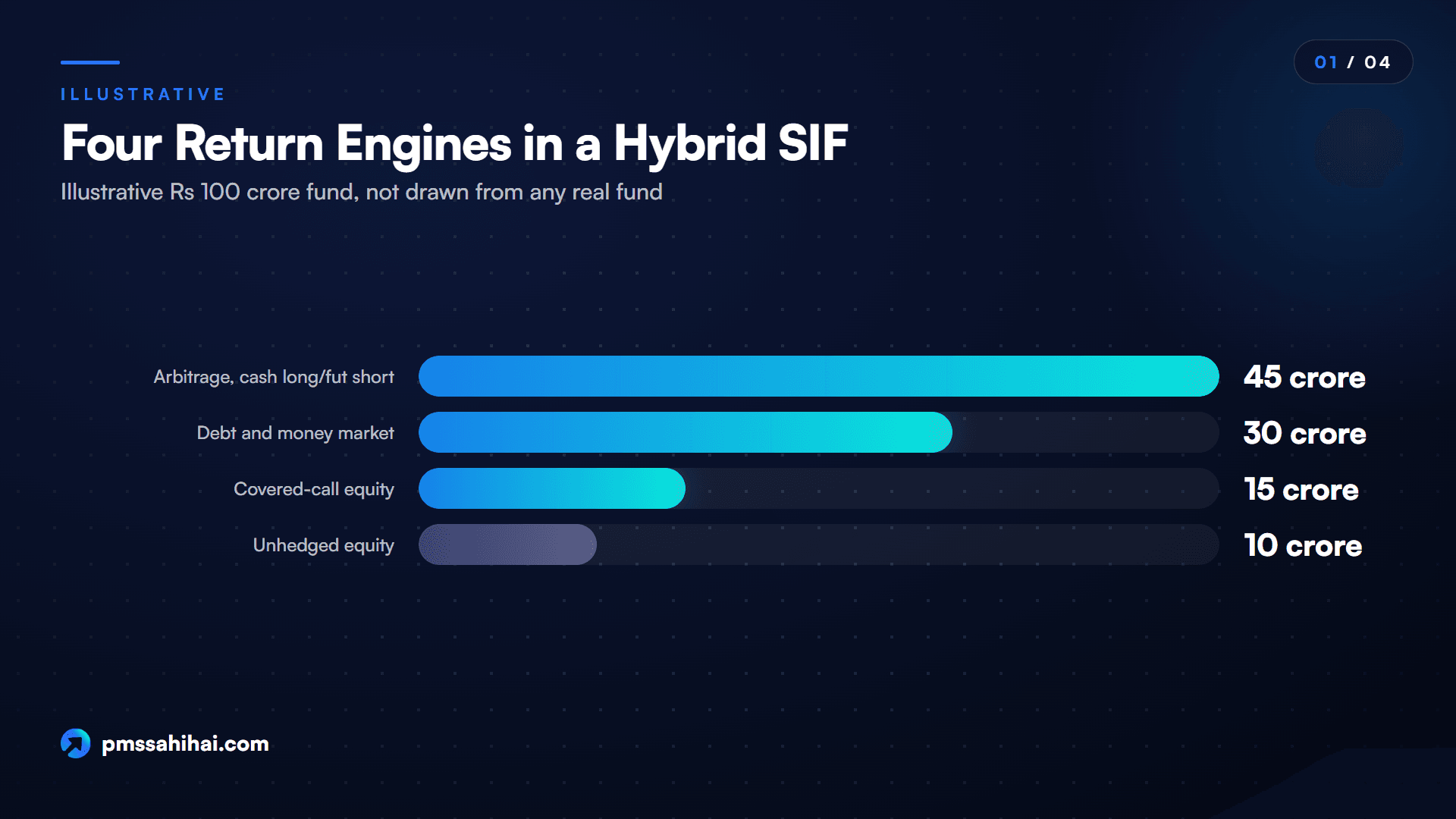
Take a hypothetical Rs 100 crore hybrid long-short fund. The numbers below are illustrative, not drawn from any real fund.
| Sleeve | Allocation | Net market exposure | What drives it |
|---|---|---|---|
| Debt and money market | Rs 30 crore | None to equity | Interest income, rate moves, credit quality |
| Arbitrage (cash long, futures short) | Rs 45 crore | Close to zero | Cash-futures spread |
| Covered-call equity | Rs 15 crore | Partly hedged | Option premium, capped upside |
| Unhedged equity | Rs 10 crore | Long | Stock market direction |
Gross equity here is 70%, above the 65% line used to decide equity taxation, while net equity exposure is far lower. Debt is 30%, above SEBI's 25% floor. On paper the fund looks like an equity fund for tax. In behaviour it is mostly a short-term debt fund with an equity overlay.
Change the mix and the profile changes. Move Rs 20 crore from arbitrage into unhedged equity, and the fund will rise and fall with the market far more. Move debt up to 70% and the fund may fall into a different tax bucket altogether. That is why two funds with the same category name can behave like different products.
Active Asset Allocator Long-Short Funds: The Multi-Asset Cousin
The second hybrid category has fewer fixed limits and a wider menu. An active asset allocator long-short fund can move across equity, debt, equity and debt derivatives, REITs, InvITs and commodity derivatives, with the same 25% cap on unhedged shorts.
Two launches show how differently fund houses read the category.
- ICICI Prudential's iSIF Active Asset Allocator Long-Short Fund opened its NFO on 19 May 2026. Its indicative ranges were 35% to 80% in equities, 10% to 55% in debt, up to 30% in commodities and up to 20% in InvITs. The fund described a counter-cyclical model that raises equity when valuations look attractive and cuts it when markets look expensive.
- Tata's Titanium Active Asset Allocator Long-Short Fund opened its NFO on 23 September 2026 and was described as having a "predominantly market-neutral orientation". It planned to use equity arbitrage, commodity arbitrage, fixed income and derivatives, with weekly redemptions on Mondays and a benchmark that blends a BSE 200 index, a short-term bond index and a commodity index.
One is a valuation-driven allocator that can be 80% in equities. The other leans toward market neutrality. For a fixed-income investor, the hybrid long-short fund is usually the closer fit, and the asset allocator variant is better read as a multi-asset product. Industry data compiled by ValueMetrics showed three active asset allocator schemes with about Rs 2,456 crore at the end of September 2026, against eleven hybrid long-short schemes with about Rs 23,957 crore.
Why Hybrid SIFs Are Pitched as a Fixed-Income Alternative
The pitch rests on one comparison: what an investor keeps after tax.
The Three Tax Buckets That Decide Your Post-Tax Return
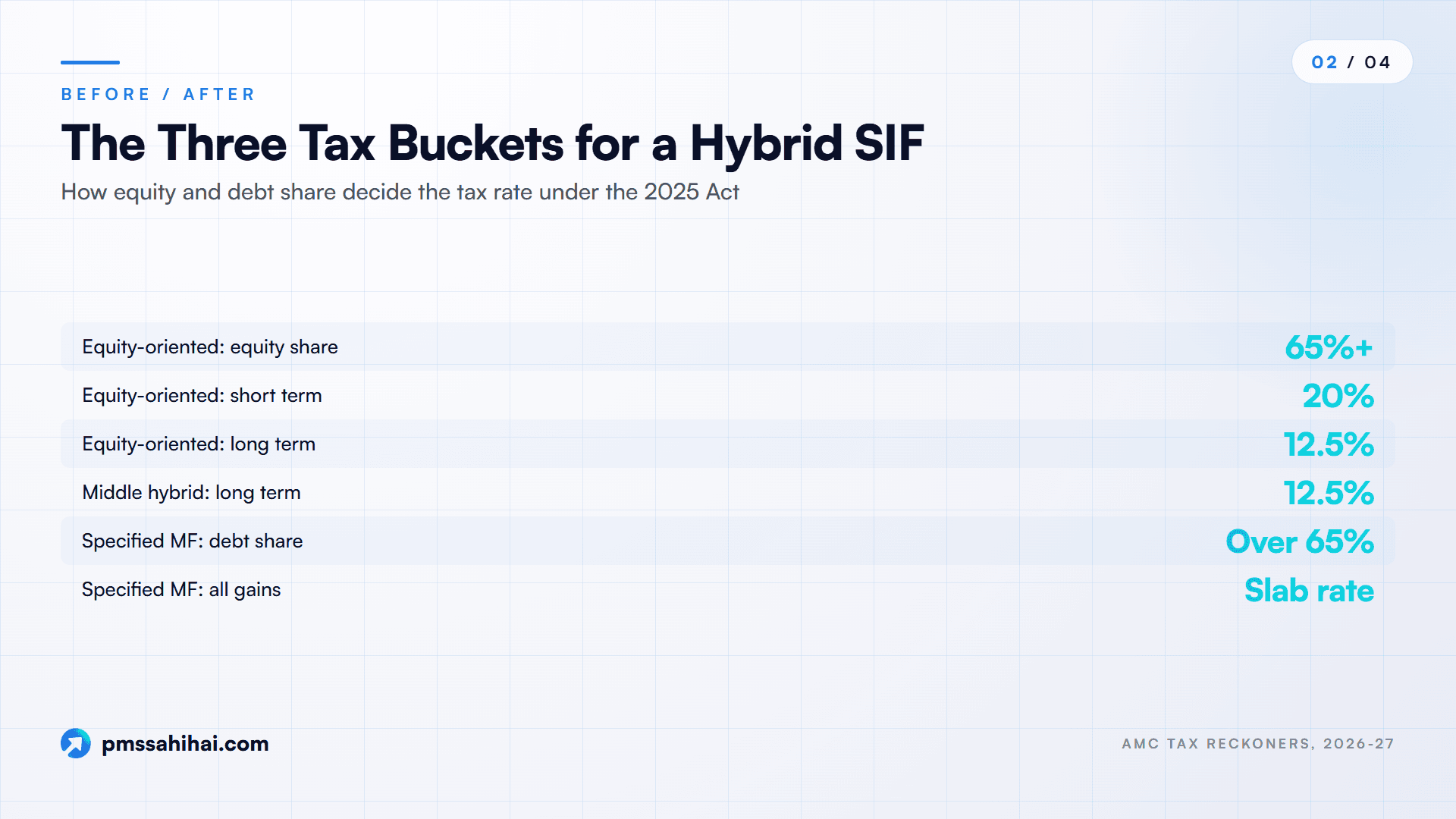
A SIF strategy is a mutual fund scheme, so its units are taxed in your hands under the mutual fund rules. Under the Income-tax Act, 2025, in force from 1 April 2026, the bucket depends on how much of the fund sits in equity and in debt. AMC tax reckoners for 2026-27 summarise it as follows.
| Bucket | Test | Short-term gains | Long-term gains |
|---|---|---|---|
| Equity-oriented fund | At least 65% in listed domestic equity (hedged arbitrage counts) | 20% (s.196, old s.111A) | 12.5% above Rs 1.25 lakh a year after 12 months (s.198, old s.112A) |
| Middle hybrid | More than 35% non-debt but less than 65% equity | Slab rate | 12.5%, after 12 months for listed units or 24 months otherwise |
| Specified mutual fund | More than 65% in debt and money-market instruments (s.76, old s.50AA) | Slab rate | Slab rate, no long-term benefit |
Interest on a fixed deposit is taxed at your slab rate every year, whether or not you withdraw it. Debt fund units bought on or after 1 April 2023 are taxed at slab rate whatever the holding period. For an investor in the 30% slab, the gap between slab-rate tax and 12.5% long-term gains is the whole selling point.
Three cautions apply.
- Each fund chooses its bucket. SBI says its Magnum Hybrid Long Short Fund keeps gross equity between 65% and 75% and therefore follows equity taxation. Business Today's launch report on Altiva, whose equity can range from 25% to 75%, cited 12.5% long-term tax after 24 months, which is the middle bucket.
- The bucket can change. If a fund's equity share drifts below 65% on the annual average test, the treatment changes. Ask how the fund monitors the line.
- Holding periods for listed interval units are not settled. Some sources apply 12 months for listed units and others 24 months. Hybrid SIF taxation for residents and NRIs is covered in a separate post, and any decision should be checked with a tax adviser.
Hybrid SIF vs Fixed Deposit vs Debt Fund
| Feature | Bank fixed deposit | Debt mutual fund | Debt-heavy hybrid SIF |
|---|---|---|---|
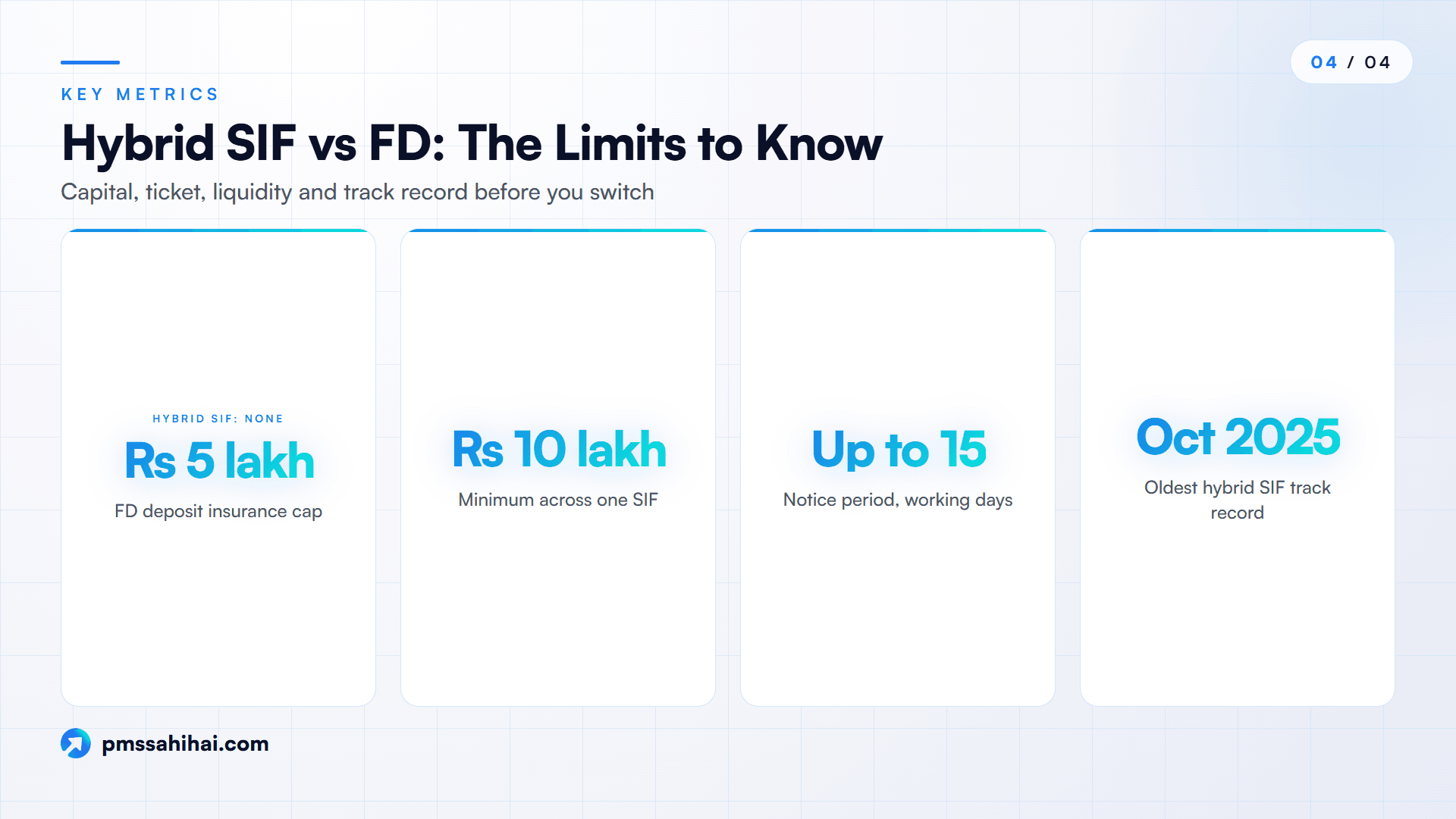
| Capital | Contractual; DICGC insurance up to Rs 5 lakh per depositor per bank | Market-linked; no guarantee | Market-linked; no guarantee; derivative risk added |
| Return source | Fixed interest rate | Interest and bond price moves | Debt interest, arbitrage spread, option premium, some equity |
| Liquidity | Premature withdrawal, often with a penalty | Usually daily | Twice a week or less often; notice of up to 15 working days possible |
| Minimum | Small | Small | Rs 10 lakh across the SIF |
| Tax | Slab rate on interest, yearly | Slab rate (units bought from April 2023) | Depends on bucket; equity or middle-bucket rates possible |
| Track record | Decades | Decades | From October 2025 at the earliest |
The table makes the trade clear. A hybrid SIF may offer a better post-tax outcome than an FD for a high-slab investor, but it buys that outcome with market risk, derivative risk, a large ticket and less liquidity. It is a fixed-income alternative only in the sense that it competes for the same money, not in the sense that it carries the same risk.
How the Hybrid SIF Category Took Shape: A Dated Timeline
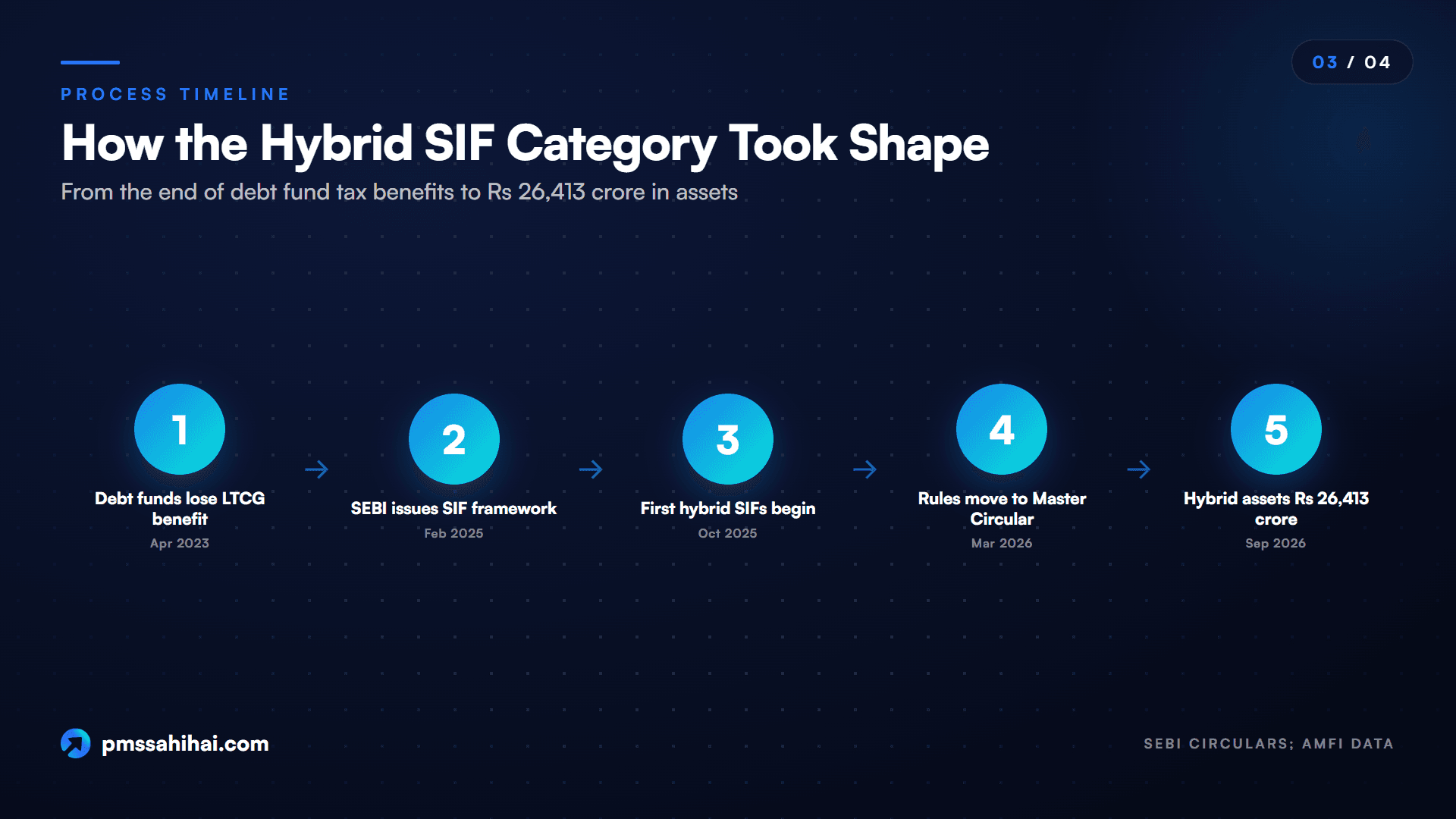
The hybrid SIF did not appear from nowhere. It sits where two policy changes meet: the end of favourable tax for debt funds and SEBI's attempt to fill the gap between mutual funds and portfolio management services.
| Date | Milestone |
|---|---|
| 1 April 2023 | Debt fund units bought from this date lose long-term capital-gains treatment |
| December 2024 | SEBI amends the Mutual Funds Regulations to introduce SIFs |
| 27 February 2025 | SEBI issues the SIF framework with two hybrid categories, effective 1 April 2025 |
| 18 September 2025 | Edelweiss announces Altiva, described as India's first hybrid long-short SIF; NFO 1 to 15 October 2025 |
| October 2025 | SBI's Magnum and quant's qsif hybrid long-short strategies begin operations |
| 31 January 2026 | Hybrid long-short funds hold about 84% of Rs 6,564 crore in SIF assets (ValueMetrics) |
| 20 March 2026 | SIF rules consolidated into Chapter 21 of SEBI's Master Circular for Mutual Funds |
| 19 May 2026 | ICICI Prudential opens the NFO of its active asset allocator long-short fund |
| 21 July 2026 | SEBI requires the new NISM Series-V-D certification for SIF distributors |
| 30 September 2026 | Hybrid strategies hold Rs 26,413 crore of Rs 38,287 crore in SIF assets (AMFI) |
The early mix is telling. The first SIF products to gather real money were not the hedge-fund-style equity strategies but the income-oriented hybrids, and the average hybrid folio in January 2026 was about Rs 32.8 lakh, according to ValueMetrics. That is HNI and family-office money, much of it moved out of fixed income.
The technology behind the category is mostly about visibility. AMFI, exchanges, depositories and registrars run systems to monitor the Rs 10 lakh threshold daily. Portfolios, including every derivative leg, are published as downloadable spreadsheets every alternate month, so an investor can check how much of a hybrid SIF is really arbitrage. Some managers, such as ICICI on its asset allocator, describe model-driven allocation built on valuation, macro and technical signals.
Advantages of a Hybrid SIF for Debt-Heavy Investors
Used for the right slice of money, a hybrid SIF offers real benefits.
- A potentially better post-tax outcome. A fund that stays in the equity-oriented bucket pays 12.5% on long-term gains above Rs 1.25 lakh a year, against slab rates on FD interest and post-2023 debt fund gains.
- Tax deferral. Gains are taxed when you redeem, not every year as FD interest is. Over several years, deferral itself adds to what you keep.
- More than one return engine. Arbitrage spreads, debt interest and option premium respond to different conditions, so the return does not rest on a single interest rate.
- A lower ticket than PMS or AIF. Rs 10 lakh against Rs 50 lakh for PMS and Rs 1 crore for an AIF, with systematic plans permitted once the threshold is met.
- Mutual-fund-grade regulation. Public offer documents, bi-monthly portfolio disclosure, a monthly risk-band and scenario analysis are more than most alternative products publish.
- Built-in limits. The 25% cap on unhedged shorts, the 100% gross exposure ceiling and single-issuer debt caps keep a manager from turning an income product into a leveraged bet.
- Better liquidity than most alternatives. Twice-weekly or weekly redemption is slower than a liquid fund but far quicker than a closed-ended AIF.
How PMS Sahi Hai Helps You Weigh a Hybrid SIF Against Other Options
A hybrid SIF rarely competes only with a fixed deposit. For an investor with Rs 10 lakh or more to place, the same money could go to a debt fund, a debt-oriented portfolio management strategy or, at Rs 1 crore and above, a Category III AIF running a hedged book. The useful question is not "is this hybrid SIF good?" but "is it better than the other things this money could do?"
PMS Sahi Hai is built for the second half of that comparison. Be clear about the limit first: SIFs are mutual fund products, and the platform's comparison shelf covers PMS, AIF and GIFT City strategies. It does not list or score SIFs, so for the SIF itself your primary sources remain the offer document, the latest portfolio and AMFI data.
Where it helps:
- See the PMS alternative. The PMS listing on PMS Sahi Hai can be filtered by category and by benchmark, and each strategy page shows trailing returns next to its stated benchmark. That lets you check what debt-tagged PMS strategies have delivered, and against which index, before you decide a hybrid SIF is the better container.
- See the AIF alternative. The AIF comparison page lists Category I, II and III funds with strategy, vintage, lock-in and a Nyra score, so a hedged Category III fund can be set beside a hybrid SIF on ticket size and liquidity. Our guide to Category III AIF taxation explains why the post-tax comparison often favours the SIF wrapper.
- Ask Nyra the rule-level questions. Nyra, the platform's AI research analyst, is described as grounded in SEBI, AMC and IFSCA primary sources, citing its working and declining when it has no verifiable source. It is an analytical tool, not a SEBI-registered Investment Adviser.
- Respect the track-record bar. Nyra's own scoring methodology marks strategies with under 12 months of history as "Not Rated". Many hybrid SIFs are barely past that line, which is a fair reminder of how little live data exists.
If you are new to the wrapper, start with our explainer on what a SIF is and the SIF vs PMS comparison.
Hybrid SIF Risks a Fixed-Deposit Investor Must Understand
Every advantage above has a matching risk. For an investor moving money out of deposits, these are the ones that matter most.
- Your capital is not protected. An FD comes with deposit insurance of up to Rs 5 lakh per depositor per bank. A hybrid SIF has none and can fall in value. SIF offer documents warn of potential loss of capital.
- Returns vary widely inside the category. Cafemutual, citing SIFPrime data to 14 October 2026, reported since-inception returns of 29.83% for qsif Hybrid Long-Short, 10.34% for Altiva and 3.4% for Magnum. A spread that wide shows how different the funds are underneath, and that a high return can mean much more equity risk than an FD investor expects.
- Track records are short. The oldest hybrid SIFs began in October 2025. None has been through a full rate cycle or a long bear market.
- Arbitrage spreads change. When markets are calm or crowded, the cash-futures spread narrows and the arbitrage engine earns less.
- Interest-rate and credit risk. The debt book carries duration risk when rates rise and credit risk on lower-rated bonds, within the issuer limits SEBI sets.
- Derivative and option risk. Covered calls cap gains in rallies. Shorts can lose without limit if a stock rises, and losses are settled in cash daily.
- Tax risk. If equity falls below the threshold, or the law changes, the post-tax case weakens. Tax treatment of some SIF features is still interpreted differently by different sources.
- Liquidity limits. Redemptions happen twice a week at most, often less, and notice periods can add up to 15 working days. Exit loads apply in the early months for many funds.
- The Rs 10 lakh rule works both ways. After a passive breach, you can only redeem the whole investment. Partial withdrawals that take you below the threshold are not allowed.
- Costs. Finnovate's data put direct-plan expense ratios of six hybrid SIFs between 0.29% and 0.79% in May 2026; regular plans cost more. For an income product, every basis point counts.
How to Check a Hybrid SIF Before You Invest
Before you move fixed-income money into a hybrid SIF, run through these checks in the offer document and the latest portfolio.
- Gross and net equity. How much of the equity is arbitrage or covered calls, and how much is unhedged? Net exposure tells you how the fund will behave in a crash.
- The tax bucket. Does the fund aim to stay above 65% equity, sit in the middle bucket, or neither? Ask how it handles drift.
- Debt quality and duration. What share is in government securities and AAA paper? What is the average maturity?
- Short usage. Does the fund actually use its 25% short allowance, and for what?
- Redemption days and notice period. Which days can you redeem, and can the AMC impose a notice period?
- Exit load and expense ratio. Compare the direct and regular plan costs, and the exit-load window.
- The scenario analysis. Read the ISID's estimate of losses under market stress, and the current risk-band.
- Benchmark choice. Funds use different hybrid indices, from a 15:85 equity-debt composite to a 50:50 one. The benchmark tells you how much equity risk the manager has in mind.
If the answers are vague, treat that as information about the fund.
Who Should Use a Hybrid SIF as a Fixed-Income Alternative
A hybrid SIF is a sensible fixed-income alternative for a narrow group: investors with a large debt allocation, a high tax slab, a horizon of a couple of years or more, and the ability to commit Rs 10 lakh without needing it back at short notice. For them, a fund with a clear arbitrage and high-quality debt core can replace part, not all, of a deposit or debt-fund ladder.
It is the wrong tool for an emergency fund, for money needed within months, for anyone who cannot accept a fall in value, and for investors in low tax slabs, for whom the tax advantage shrinks. It is also the wrong tool if you cannot read an offer document, because the category label tells you little.
The honest description is this: a hybrid SIF is a market-linked product that can deliver bond-like volatility with better tax, if the manager builds it that way and keeps it that way. Check that the fund you are offered is that kind of hybrid SIF before you treat it as part of your fixed income, and weigh it against the PMS and AIF alternatives on PMS Sahi Hai before you commit the money.
Compare Your Fixed-Income Options With PMS Sahi Hai and Nyra
A hybrid SIF can earn its place in a fixed-income allocation, but only if you know which kind you are buying. Read the offer document, check the latest portfolio for gross and net equity, confirm the tax bucket with your adviser, and size the position so that a twice-weekly redemption window never forces your hand.
Then line it up against the alternatives you already hold or could hold:
- Shortlist debt-tagged strategies on the PMS Sahi Hai PMS listing and check each against its benchmark.
- Ask Nyra to explain the SEBI rule behind any feature you do not understand, with the source shown.
- Revisit whether you need more debt at all with our guide to equity versus debt funds.
The right answer is rarely all of one product.
This article is for information only and is not investment or tax advice. Figures are as of the dates stated and were checked on 27 October 2026. SIF strategies involve derivatives and can lose capital. Read the offer document and consult a SEBI-registered adviser and a tax adviser before investing.
PMS Sahi Hai is a distributor of Portfolio Management Services and Alternative Investment Funds, APMI-registered (Registration No. APRN08358). This article is for education only and is not investment advice, a recommendation, or an offer to buy or sell any security. Investments in securities markets are subject to market risks; read all scheme-related documents carefully. Past performance is not indicative of future results. Consult your advisor before investing.
Ishaan founded PMS Sahi Hai to make India's PMS, AIF and GIFT City markets legible to serious investors, comparing every SEBI-registered manager on the same comparative basis, with no shelf products and no commission bias.
Frequently asked
What is a hybrid SIF in simple terms?
A hybrid SIF is a Specialised Investment Fund strategy that combines equity, debt and derivatives in one portfolio and may take short positions of up to 25% of net assets through derivatives. SEBI allows two types: the hybrid long-short fund, with at least 25% each in equity and debt, and the active asset allocator long-short fund, which can also hold REITs, InvITs and commodity derivatives.
Is a hybrid SIF safer than a fixed deposit?
No. A fixed deposit pays a contracted rate and carries DICGC insurance of up to Rs 5 lakh per depositor per bank. A hybrid SIF is market-linked, has no insurance and can lose capital through its equity, derivative and bond positions. Some funds are designed for low volatility, but low volatility is not a guarantee, and returns already differ widely across the category.
How is a hybrid SIF taxed?
It depends on the fund's mix. If at least 65% is in listed domestic equity, including hedged arbitrage, it is taxed like an equity fund: 20% short-term and 12.5% long-term above Rs 1.25 lakh. If debt exceeds 65%, gains are taxed at slab rates. Funds in between pay slab rates short-term and 12.5% long-term. Confirm with a tax adviser.
What is the minimum investment in a hybrid SIF?
The SIF minimum investment is Rs 10 lakh, measured across all strategies of the same SIF at PAN level. Accredited investors are exempt. Once the threshold is met, fund houses may offer SIPs, SWPs and STPs. If a market fall takes your holding below Rs 10 lakh, you may stay invested, but your only redemption option is then a full exit.
How often can I redeem a hybrid long-short SIF?
Hybrid SIFs are interval strategies. SEBI's framework allows redemptions twice a week or less often, as the AMC decides, and lets the AMC add a notice period of up to 15 working days, with the payout priced at the NAV at the end of the notice. Several funds redeem on Mondays and Wednesdays; others redeem weekly or monthly.
What is the difference between a hybrid long-short fund and an active asset allocator long-short fund?
A hybrid long-short fund must keep at least 25% in equity and 25% in debt and works mainly with those two asset classes. An active asset allocator long-short fund has no fixed floors and can move across equity, debt, REITs, InvITs and commodity derivatives. Both cap unhedged shorts at 25% of net assets, and both are interval strategies.
Can a hybrid SIF replace my debt mutual funds?
It can replace part of a debt allocation for a high-slab investor with a horizon of a couple of years, but it should not replace liquid or short-term funds used for emergencies. A hybrid SIF adds equity, derivative and liquidity risk that a plain debt fund does not carry. Treat it as a satellite to your fixed income, not its core.
Keep reading
All articles
What Is a Hedge Fund in India? Why SEBI Calls It a Category III AIF
What a hedge fund in India is, why SEBI registers it as a Category III AIF, the strategies used, the 2x leverage cap and the Rs 1 crore entry rule.
What Is Co-Investment? How HNIs Invest Alongside AIFs in Single Deals
How AIF co-investment works in India: SEBI's CIV scheme vs the PMS route, accredited investor rules, the 3x cap, fees, tax and risks.
What Is a Fund of Funds? How Layered Investing Works for HNIs
What a fund of funds is, how mutual fund and AIF FoFs work in India, SEBI's 2026 cost caps, the double fee layer, tax, and when HNIs should use one.
Read it. Now pressure-test it.
Ask Nyra how this applies to your portfolio, or talk to our team, no pitch, no pressure.