
What Is Co-Investment? How HNIs Invest Alongside AIFs in Single Deals
How AIF co-investment works in India: SEBI's CIV scheme vs the PMS route, accredited investor rules, the 3x cap, fees, tax and risks.


AIF co-investment lets an investor who already sits in a Category I or II AIF put extra money into one specific unlisted company the fund is buying, on the same terms and with the same exit as the fund. In India there are two legal routes: the CIV scheme created under regulation 17A of the AIF Regulations from 9 September 2025, which is open only to accredited investors, and the older co-investment portfolio manager route under the PMS Regulations, in force since December 2021. The CIV route caps each investor at three times their share of the fund's investment in that company and bans leverage, while the PMS route holds the shares in your own name but locks you in until the AIF exits. Co-investment can lower your average fee load and sharpen your exposure, but it concentrates risk in a single illiquid deal, so treat it as a satellite to your AIF holding, not a substitute for it.
Co-Investment Explained Through a Single AIF Deal
When you invest in a Category I or II Alternative Investment Fund, you buy into a blind pool. Every deal is shared by all investors in proportion to their commitments. You do not choose the companies, and you cannot ask for more of the one you like.
Co-investment breaks that rule for one deal at a time. SEBI's own illustration from its June 2025 Board meeting is the clearest way to picture it: a scheme of an AIF invests Rs 100 crore in a company as part of its portfolio, but the company needs Rs 300 crore. The manager can offer the additional Rs 200 crore of opportunity to investors of the scheme who want to invest more than their pro-rata share through the fund.
That is AIF co-investment in one line: a direct, deal-specific investment made alongside the fund, in the same unlisted company, at the same price. The AIF Regulations define "co-investment" as an investment by a manager, sponsor or investor of a Category I or II AIF in unlisted securities of investee companies where that AIF makes its investment.
Three features separate it from buying unlisted shares on your own:
- The deal is sourced and diligenced by the AIF manager, not by you or a broker.
- The terms cannot be better than the fund's, and the exit happens at the same time as the fund's exit.
- Only investors of the fund get the offer. A stranger cannot co-invest alongside an AIF they have not committed to.
Why AIF Managers Offer Co-Investment Opportunities
Managers do not offer co-investment as a favour. There are practical reasons on their side of the table:
- Ticket size. Diversification limits stop a fund putting too much of its corpus into one company; co-investors fill the gap.
- Relationships. Co-investment rights for large or strategic investors help the manager raise the next fund.
- Certainty. A manager who can bring known co-investors to a negotiation can commit to a larger round.
For you, the attraction is more money in the company the manager believes in most, possibly without a full layer of fund fees on that extra amount.
How SEBI's Co-Investment Rules Evolved Since 2020
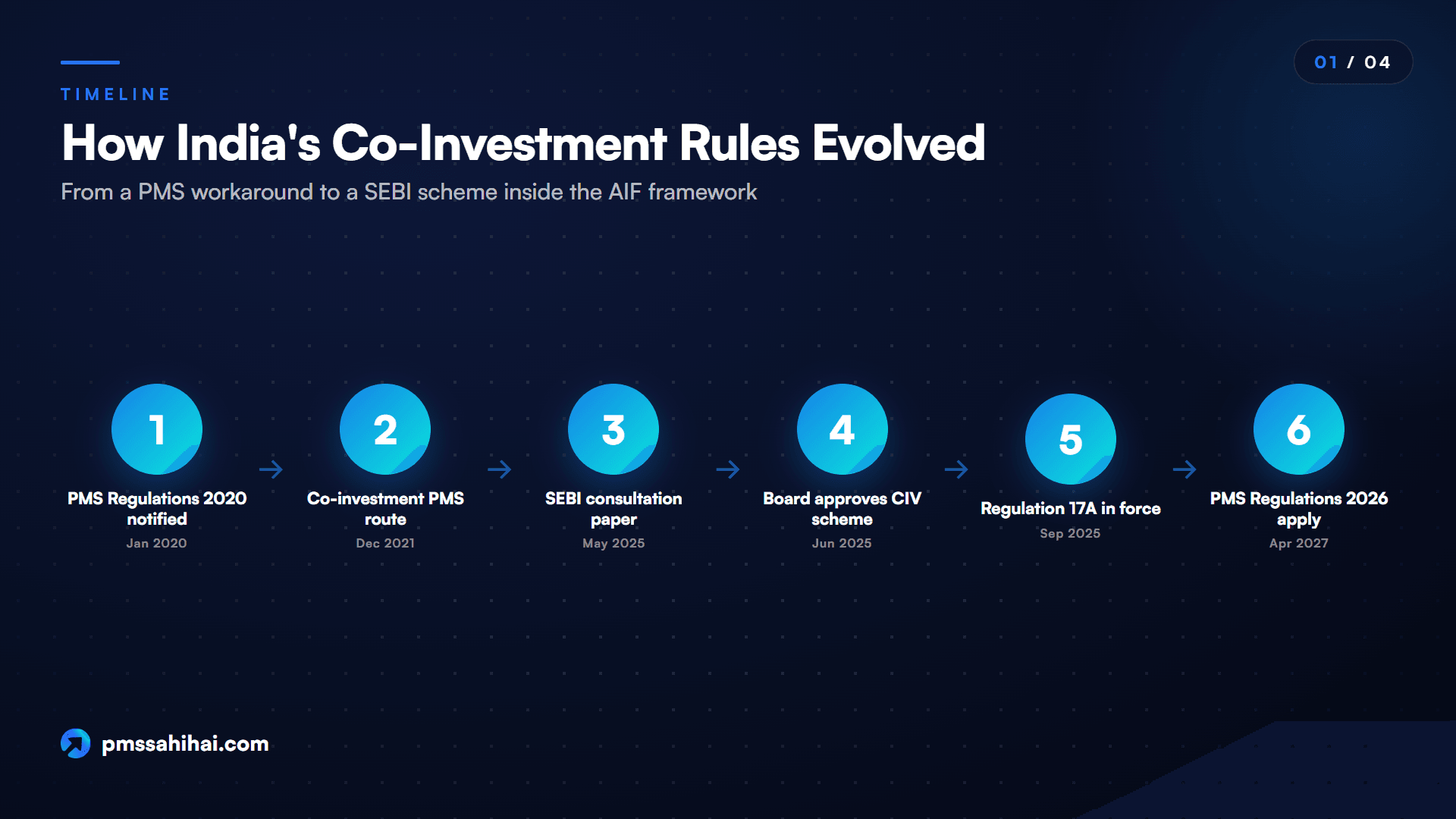
Five years of back-and-forth between the industry and SEBI explain why India has two routes rather than one.
| Date | What happened |
|---|---|
| Before 2020 | Managers routed co-investments through portfolio management under the 1993 PMS Regulations |
| 16 January 2020 | PMS Regulations 2020 notified; discretionary portfolio managers could no longer invest in unlisted securities, and non-discretionary or advisory managers were capped at 25% |
| FY 2020-21 | Industry asked to co-invest inside the AIF through a separate class of units; SEBI said no, because pooling is the defining feature of an AIF |
| 8 December 2021 | PMS (Fourth Amendment) Regulations 2021 created the co-investment portfolio manager, following a SEBI Board proposal |
| 9 May 2025 | SEBI consultation paper proposed co-investment within the AIF structure |
| 18 June 2025 | SEBI Board approved the co-investment scheme ("CIV scheme") |
| 9 September 2025 | Regulation 17A came into force and SEBI issued the operating circular |
| 3 June 2026 | The CIV rules were folded into Chapter 6 of the AIF Master Circular |
| 7–8 October 2026 | PMS Regulations 2026 notified, effective 1 April 2027, with a dedicated co-investment chapter |
| 15 October 2026 | The definition of accredited investor was widened |
The industry wanted co-investment inside the fund wrapper so investee companies would see one shareholder, not dozens. SEBI worried that segregated pockets inside a pooled fund could hide who really owns a stake and help investors dodge sector caps or disclosure norms. The 2021 compromise pushed co-investment into a special kind of portfolio manager; the 2025 compromise brought it back inside the AIF framework as a separate co-investment vehicle for each deal, with tight safeguards. The May 2025 consultation drew comments from 31 entities, and SEBI's Board note records that 28 of the 29 who commented on the core proposal supported it.
The CIV Scheme Route Under Regulation 17A
A co-investment scheme, usually called a CIV scheme, is a scheme of a Category I or II AIF that exists only to let investors of one particular scheme co-invest in one unlisted company the main scheme is investing in or has invested in. Regulation 17A of the AIF Regulations sets out the core rules:
- Only accredited investors of that Category I or II AIF can invest in the CIV scheme.
- One deal per vehicle. A separate CIV scheme is launched for each co-investment, and each scheme invests in only one investee company.
- No fund-of-funds use. A CIV scheme cannot invest in units of other AIFs.
- Shelf placement memorandum first. Before offering any co-investment, the manager must file a shelf placement memorandum with SEBI through a merchant banker, with a filing fee of Rs 1 lakh. Separate shelf documents are filed for different schemes of the same AIF.
- No better terms than the fund. The terms of the co-investment cannot be more favourable than the main scheme's terms, and the exit must happen at the same time as the main scheme's exit.
- Wound up on exit. Once the investment is sold, the CIV scheme is closed.
- No angel funds. An angel fund cannot launch a co-investment scheme.
Category III AIFs are outside this framework; the CIV scheme is a Category I and II tool for unlisted deals.
Safeguards Built Into Every CIV Scheme
SEBI's circular of 9 September 2025 adds operating safeguards that matter to you as an investor:
- Choose one route per deal. For a given investor and a given company, the manager uses either the PMS route or the CIV route, not both.
- Separate accounts. Each CIV scheme has its own bank account and demat account, and its assets are ring-fenced from every other scheme.
- The three times cap. Your co-investment in a company across CIV schemes cannot exceed three times your contribution to that company's investment through the main scheme (worked example below).
- No co-investing in a deal you skipped. If you were excused or excluded from the main scheme's investment in a company, or defaulted on the drawdown for it, you cannot co-invest in that company.
- No regulatory back doors. A CIV scheme cannot give you exposure you could not hold directly, cannot make an investment that would have triggered extra disclosure had you invested directly, and cannot invest where the company could not have taken your money directly.
- No leverage. A CIV scheme cannot borrow, directly or indirectly.
- Pro-rata rights. CIV investors share in the investment and its proceeds in proportion to their contribution, except for any carried interest paid to the sponsor, manager or the manager's team.
- Shared expenses. Costs of the co-investment are split between the main scheme and the CIV scheme in the ratio of their investments.
Compliance must be confirmed in the fund's compliance test report, and the Standard Setting Forum for AIFs may add implementation standards to stop misuse.
Rules a CIV Scheme Does Not Have to Follow
Because each CIV scheme is a single-deal vehicle, forcing it to behave like a full fund would make no sense. Regulation 17A(10) switches off several requirements, including:
- the minimum corpus for a scheme,
- the sponsor or manager's continuing interest in the scheme,
- the minimum tenure rules and tenure extensions,
- the Category I and II investment conditions, including diversification limits, and
- the normal placement memorandum contents and first-close timing, which are replaced by the shelf document.
So a manager can stand up a new single-deal vehicle far faster than a new fund, while you still deal with a SEBI-registered scheme with its own accounts and audit.
The Three Times Cap Worked Through With Numbers
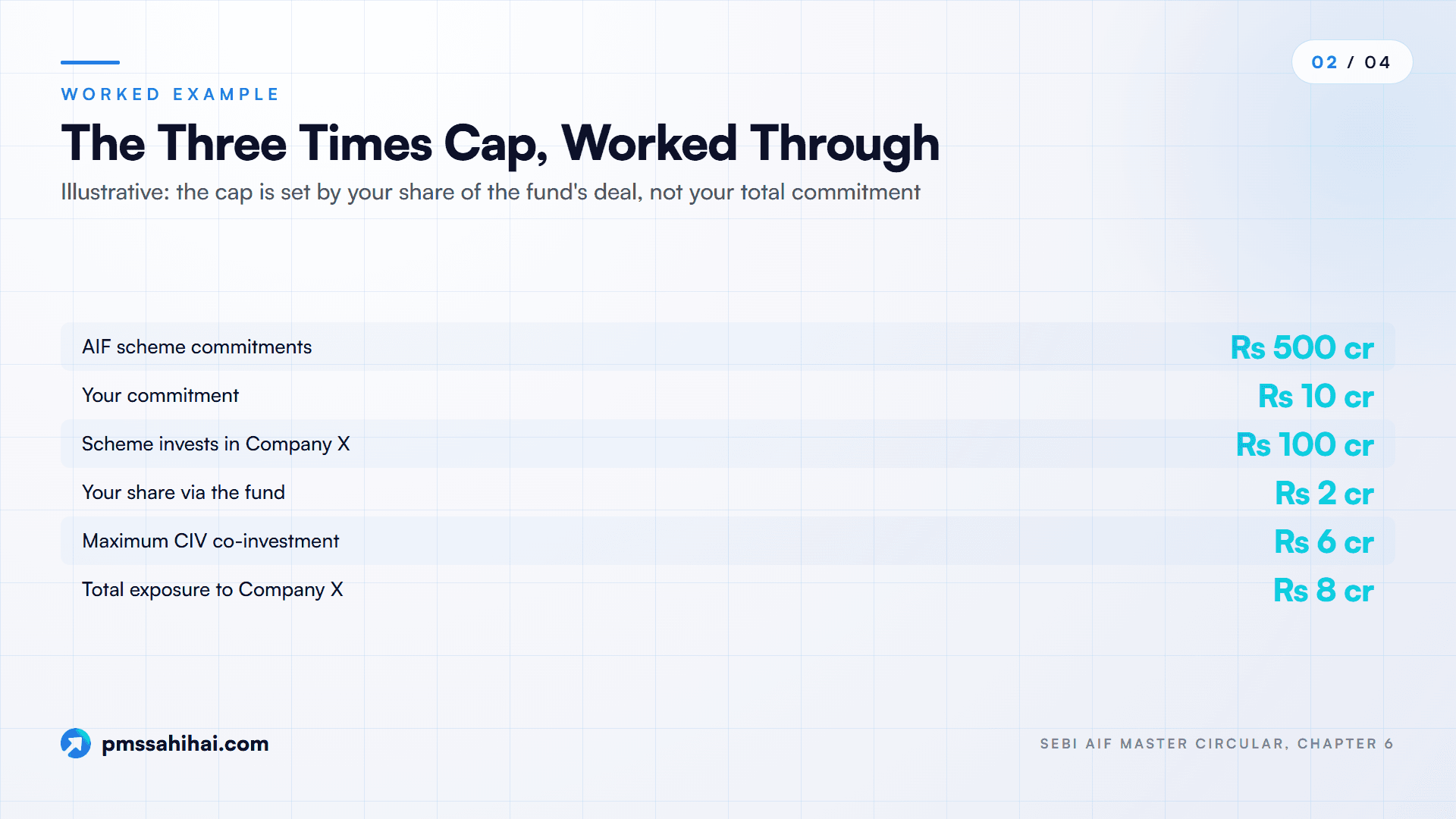
The cap is the rule most often misread, so it is worth doing the arithmetic. SEBI's rule, now in Chapter 6 of the AIF Master Circular, measures it against your contribution to the investment the main scheme makes in that specific company, not against your total commitment to the fund.
Suppose:
- An AIF scheme has total commitments of Rs 500 crore.
- You have committed Rs 10 crore, so you own 2% of the scheme.
- The scheme invests Rs 100 crore in Company X.
Your contribution to the Company X investment through the main scheme is 2% of Rs 100 crore, or Rs 2 crore. Your co-investment in Company X across all CIV schemes therefore cannot exceed Rs 6 crore. Your total exposure to Company X would then be Rs 8 crore: Rs 2 crore through the fund and Rs 6 crore through CIV schemes.
Now change one fact. If you were excused from the Company X deal because of a conflict, your contribution to that investment is zero, and under the circular you cannot co-invest in Company X at all.
The cap does not apply to multilateral or bilateral development financial institutions, State Industrial Development Corporations, and entities owned or controlled by the Central Government, a State Government or a foreign government, including central banks and sovereign wealth funds.
Why such a specific limit? SEBI's Board note records the misuse feared: an investor could commit a small amount to a blind pool and then cherry-pick one deal with a much larger cheque, or use the vehicle to get around sector caps and pricing rules. The cap ties your co-investment to your genuine participation in the fund's deal.
The Co-Investment Portfolio Manager Route Under PMS Rules
Before the CIV scheme existed, the only regulated way for AIF investors to co-invest was through a co-investment portfolio manager, introduced by the PMS (Fourth Amendment) Regulations 2021 with effect from 8 December 2021. This route still exists, and SEBI kept it on purpose.
A co-investment portfolio manager is a portfolio manager that is also the manager of a Category I or II AIF, serves only investors of that AIF, and invests only in unlisted securities of companies that AIF invests in. Investors of other Category I or II AIFs run by the same manager and sponsored by the same sponsor can also be served.
The PMS Regulations 2020 bend several normal PMS rules for this purpose:
- 100% unlisted. The co-investment portfolio manager must invest all assets under management in unlisted securities of the AIF's investee companies, while an ordinary discretionary PMS cannot hold unlisted shares at all.
- No Rs 50 lakh minimum. The normal PMS minimum does not apply, because the client has already met the AIF minimum.
- No custodian requirement and no requirement to maintain the PMS net worth during registration.
- Same terms, same exit. Terms cannot be more favourable than the AIF's, the exit including its timing must be identical, and early withdrawal is allowed only to the extent the AIF has exited that company.
The big structural difference: under the PMS route the shares sit in your own name, through a portfolio management account, rather than in a pooled vehicle. That is why SEBI kept the route. Its Board note explains that because PMS-route investments are made in the co-investor's name, the investor's identity is visible to the company and to regulators by construction, so the route needs less oversight. It also lets managers offer co-investment to a wider group: non-accredited investors of the scheme, investors of other schemes of the same AIF, and investors of other AIFs with the same sponsor and manager.
What Changes When the 2026 PMS Regulations Start
The SEBI (Portfolio Managers) Regulations 2026 were notified in October 2026 and take effect on 1 April 2027. Until then, the 2020 Regulations apply. The new rulebook gathers the co-investment provisions into a dedicated Chapter IV and keeps their substance: 100% unlisted investment in the AIF's investee companies, terms no better than the AIF's, identical exit, and early withdrawal only as the AIF exits. Regulation 13 switches off the Rs 50 lakh client minimum, the Rs 5 crore net worth requirement and the custodian requirement for co-investment portfolio managers, and a member of the manager's key investment team can act as principal officer. For investors, the route looks the same on both sides of April 2027.
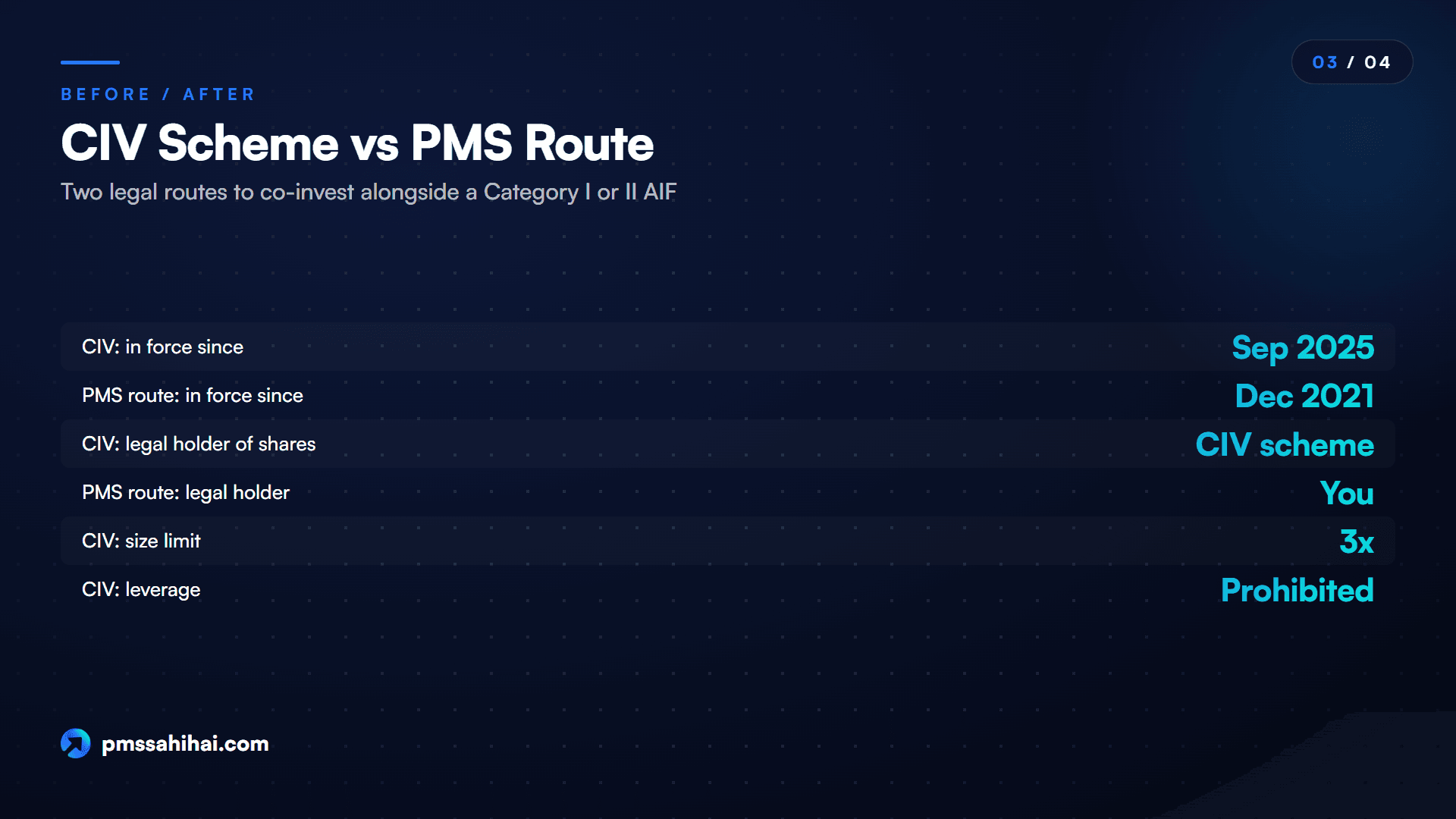
CIV Scheme vs PMS Route Side by Side
| Feature | CIV scheme (AIF Regulations, reg. 17A) | Co-investment portfolio manager (PMS Regulations) |
|---|---|---|
| In force since | 9 September 2025 | 8 December 2021 |
| Who can invest | Accredited investors of the specific AIF scheme | Investors of the manager's Category I/II AIFs with the same sponsor, accredited or not |
| Legal holder of the shares | The CIV scheme | You, through a PMS account |
| Investee company's cap table | One vehicle | Each co-investor appears |
| Size limit | 3x your contribution to the main scheme's investment in that company | No equivalent statutory multiple |
| Minimum investment | None prescribed for the CIV scheme | Rs 50 lakh PMS minimum switched off |
| Leverage | Prohibited | Not applicable |
| Exit | Same time as the main scheme's exit; scheme wound up | Identical to AIF's exit; withdrawal only as AIF exits |
| Manager registration | Uses existing AIF registration plus shelf PPM | Separate PMS registration required |
| Offer document | Shelf placement memorandum filed with SEBI | PMS agreement and disclosures |
Neither route is better in every case. The CIV route is cleaner for investee companies and does not need a second licence, the two problems SEBI's working group on ease of doing business raised about the PMS route. The PMS route suits a manager who wants to include investors who are not accredited, or whose co-investors prefer to hold shares directly.
Who Qualifies as an Accredited Investor in October 2026
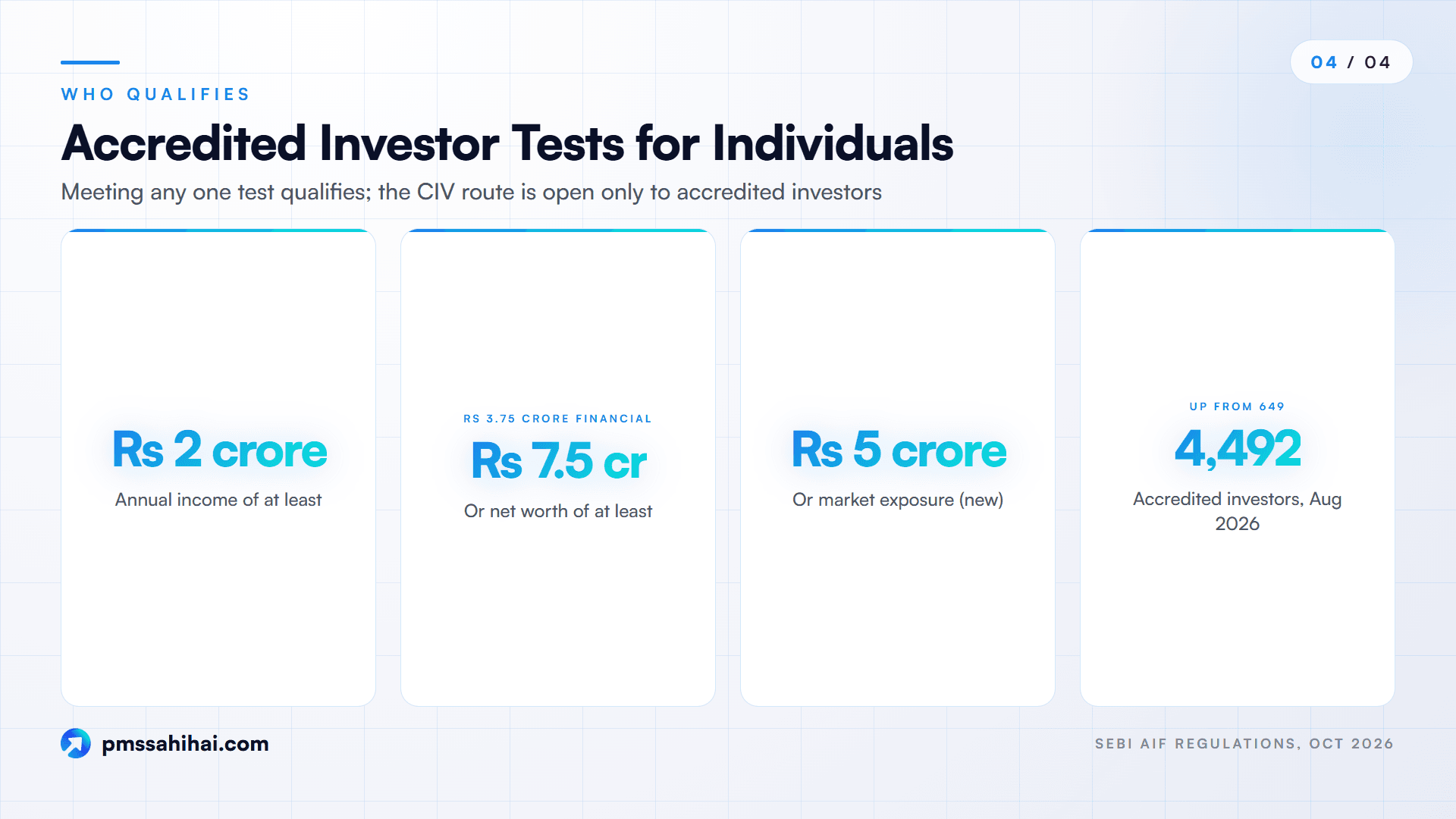
Because the CIV route is restricted to accredited investors, the definition decides who can use it. It changed on 15 October 2026, when the AIF (Third Amendment) Regulations 2026 took effect.
| Investor type | Accreditation criteria (any one) |
|---|---|
| Individual, HUF, family trust, sole proprietorship | Annual income of at least Rs 2 crore; or net worth of at least Rs 7.5 crore, with at least Rs 3.75 crore in financial assets; or annual income of at least Rs 1 crore plus net worth of at least Rs 5 crore, with at least Rs 2.5 crore in financial assets; or (new) securities market exposure of at least Rs 5 crore, as SEBI specifies |
| Body corporate, trust (other than family trust) | Net worth of at least Rs 50 crore, or (new) securities market exposure of at least Rs 20 crore |
| LLP | Net worth of at least Rs 50 crore, or securities market exposure of at least Rs 20 crore, or each partner qualifies independently |
| Deemed accredited | Central and State Governments, their developmental agencies and funds, qualified institutional buyers, multilateral agencies and (new) persons resident outside India |
The amendment also lets a specified SEBI-registered or regulated entity accredit an investor, alongside the existing accreditation agencies. The new securities market exposure test and the manager-led route depend on modalities SEBI has said it will specify; as of 27 October 2026 we found no operating circular yet on SEBI's circulars page, so check with your manager before assuming you qualify under the new limbs.
The pool is still small. SEBI's figures show 4,492 accredited investors as of 28 August 2026, up from 649 on 29 May 2025, and they held AIF units worth roughly Rs 2.31 lakh crore at par value, nearly a third of all AIF investments. Accredited investors are also exempt from the Rs 1 crore AIF minimum and the Rs 50 lakh PMS minimum, which makes accreditation useful well beyond co-investment.
How Co-Investment Opportunities Reach an Investor
Co-investment is not a product you buy off a shelf. It reaches you through the fund you already hold, usually in four steps.
- Rights at commitment. When you subscribe to the AIF, the placement memorandum explains whether the manager offers co-investment and how it allocates opportunities. Larger investors sometimes negotiate priority in a side letter.
- The shelf document. For the CIV route, the manager files a shelf placement memorandum with SEBI before making any offer. SEBI's shelf template covers eligibility, governance, management fee ranges, hurdle rate and carried interest for CIV units, and the investor signs an acknowledgement that the investment suits only those willing to stay for the whole tenure.
- The deal notice. When the main scheme commits to a company, the manager tells eligible investors how much co-investment is available, the price, the timeline and the fees. Windows are often short, because the company's round has a closing date.
- Your decision and funding. You decide, sign, and fund either the CIV scheme or your co-investment PMS account. From that point you ride along with the fund until it exits.
SEBI's Board note acknowledges that offers are at the manager's discretion, based on factors such as the size of your commitment and your strategic value. Sponsors also tend to favour co-investors who can move quickly.
Co-Investment Economics: Fees, Carry, Costs and Tax
The economic case for co-investment is usually about fees. In global private equity, co-investments are often offered on a "no fee, no carry" basis or with reduced management fees and carried interest, and sometimes with a one-time transaction fee instead. Indian rules do not prescribe a fee level either way. The shelf placement memorandum template expects the manager to disclose the management fee range, hurdle rate and carried interest for CIV units, and the circular expressly allows carry to be shared with the sponsor, manager or team. Read the actual numbers before assuming the deal is fee-free.
Even if headline fees are low, you still bear:
- Deal expenses — legal, diligence and stamp costs, shared between the main scheme and the CIV scheme in proportion to their investments.
- Vehicle costs — each CIV scheme needs its own bank account, demat account and audit, and the manager pays a Rs 1 lakh fee to file each shelf document.
- GST — management and performance fees attract GST at 18%.
Tax. The routes differ:
- CIV route. A CIV scheme is a scheme of a Category I or II AIF, so it is expected to sit within the pass-through regime for such funds under section 224 of the Income-tax Act 2025 (old section 115UB), where income other than business income is taxed in the investor's hands. SEBI's Board note, however, recorded the industry's request to confirm pass-through status for CIVs as a point to clarify with the CBDT, so confirm the position for your specific scheme.
- PMS route. The shares are yours, so gains are taxed as your own capital gains when the manager sells. Long-term gains on unlisted shares are taxed at 12.5% under section 197 (holding period above 24 months); short-term gains are taxed at your slab rate.
Treatment depends on your residence and each scheme's structure, so consult a qualified tax adviser before investing.
Advantages of Co-Investing Alongside an AIF
- Concentrated conviction. You can add exposure to the one company the manager believes in most, instead of only your pro-rata slice.
- Price and exit protection by law. Your terms cannot be worse than the fund's, and you exit together.
- Potentially lower blended fees. If the co-investment carries lower fees than the main fund, your average fee drag falls.
- No extra minimum. Co-investment portfolio manager clients face no PMS minimum, and accredited investors face no AIF minimum.
- Cleaner holding under the CIV route. One SEBI-registered vehicle sits on the company's cap table, so you do not negotiate shareholder documents alone.
- Choice. Unlike the blind pool, you can decline any co-investment opportunity without affecting your fund holding.
- Professional sourcing. The manager finds, negotiates and monitors the deal, so you co-invest alongside AIF expertise rather than on your own research.
How PMS Sahi Hai Helps You Judge the AIF Behind a Co-Investment
A co-investment offer only ever comes through a fund you already hold, so the most important decision is made earlier: which Category I or II AIF to commit to, and whether its manager is one you would back with a second, concentrated cheque. PMS Sahi Hai is built for that earlier step. Here is what the platform offers, and where it stops.
What you can do on the site
- Put the fund in context. The AIF comparison page lists AIFs across Category I, II and III and lets you filter by category and compare funds side by side. Use the Category I and II filters to see how a private equity or venture fund that promises co-investment rights stacks up against peers on strategy, vintage and disclosed track record.
- Ask Nyra the structural questions. Nyra, the platform's AI research analyst, answers from primary sources and cites them. Use it to frame questions before a manager meeting: how the CIV route differs from the PMS route, what the three times cap means for your commitment, or which category fits your horizon.
- Read scores for what they are. Nyra rates strategies on five pillars under a published methodology, and anything with under 12 months of track record is "Not Rated". A score describes the fund's disclosed performance; it does not grade an individual co-investment deal or a manager's allocation policy.
- Go deeper on the building blocks. Our guide to how AIFs work in India covers units, NAV, lock-in and commitment calls, and Is AIF Tax Free? walks through the pass-through rules that a CIV scheme is expected to follow. The AIF minimum investment guide explains the original accreditation tests; it was written before the 15 October 2026 amendment was notified, so use the table above for the current definition.
What it does not do
The site does not, from what its pages show, list live co-investment deals, file shelf placement memoranda or issue accredited investor certificates; those come from your manager and from SEBI-recognised accreditation agencies or entities. Nyra describes itself as an analytical tool, not a SEBI-registered investment adviser, so treat its answers as research, not a recommendation.
Risks and Limitations of AIF Co-Investment
Adverse Selection and Concentration
Not every deal is offered for co-investment, and why a deal is offered matters. Some are simply too large for the fund; others may be harder to place. Ask why this one is on the table. Co-investment also concentrates risk: a fund spreads your capital across many companies, a co-investment does not, and one write-off can erase years of fee savings.
Watch the conflict too: the manager earns fees and carry and decides who gets offered what. Ask whether the allocation policy is written down.
Liquidity, Exit Timing and Paperwork
You cannot exit before the fund does. The CIV scheme exits with the main scheme, and PMS-route withdrawals are allowed only as the AIF exits. If the fund's tenure is extended, your money stays locked too. Legal commentators have also flagged open questions, such as what happens to a linked CIV holding if your main-scheme units are transferred, and how the expense-sharing wording works in practice.
Process can drag too. Each CIV scheme needs its own accounts and filings, which observers say may make smaller deals uneconomic or slow closings, and short decision windows can push you to commit before you are comfortable. Eligibility is narrow: without accreditation the CIV route is closed, and the PMS route depends on your manager holding that registration.
Is AIF Co-Investment Right for Your Portfolio
AIF co-investment suits an investor who already holds a Category I or II AIF, trusts the manager's process, has enough wealth that a single illiquid position will not hurt, and can decide within a deal window. It is not a cheaper way into private equity without the fund, because the offer only comes through the fund.
Cap total co-investment exposure as a share of your private-market allocation, ask for the allocation policy, compare fees with the main fund's, and treat each offer as a fresh investment decision, not a perk. Before any of that, choose the fund well: shortlisting Category I and II AIFs on PMS Sahi Hai and asking Nyra to explain how their structures differ is a sensible first filter.
Compare AIFs Before You Commit to a Co-Investment
Co-investment rights are only as good as the fund that grants them. Before you commit to an AIF partly for its co-investment opportunities, compare its strategy, track record, fees and manager quality against peers, and ask how co-investments are allocated. Start with the fund, then decide whether any single deal deserves more of your money.
On PMS Sahi Hai you can compare AIFs side by side, ask Nyra to explain a category, a score or a structural term in plain English, or talk to the team before your next commitment. This article is general information, not investment or tax advice; check the current SEBI rules and consult a qualified adviser before you co-invest.
PMS Sahi Hai is a distributor of Portfolio Management Services and Alternative Investment Funds, APMI-registered (Registration No. APRN08358). This article is for education only and is not investment advice, a recommendation, or an offer to buy or sell any security. Investments in securities markets are subject to market risks; read all scheme-related documents carefully. Past performance is not indicative of future results. Consult your advisor before investing.
Ishaan founded PMS Sahi Hai to make India's PMS, AIF and GIFT City markets legible to serious investors, comparing every SEBI-registered manager on the same comparative basis, with no shelf products and no commission bias.
Frequently asked
What is co-investment in an AIF?
Co-investment is an extra, deal-specific investment in an unlisted company your Category I or II AIF is investing in, on terms no better than the fund's and with the same exit timing. Only investors of that fund are offered it, at the manager's discretion, through a CIV scheme or a co-investment portfolio manager.
Do I need to be an accredited investor to co-invest?
For the CIV scheme route, yes: regulation 17A allows only accredited investors of the AIF to invest. The co-investment portfolio manager route under the PMS Regulations does not require accreditation, but you must be an investor in one of the manager's Category I or II AIFs with the same sponsor. Whether your manager offers that route depends on whether it holds a PMS registration.
What is the three times limit in a CIV scheme?
Your co-investment in one company across CIV schemes cannot exceed three times your contribution to the main scheme's investment in that company. If your share of a Rs 100 crore fund investment is Rs 2 crore, your co-investment is capped at Rs 6 crore. Development financial institutions, government-owned entities, central banks and sovereign wealth funds are exempt.
Can I exit a co-investment before the AIF exits?
No. Under the CIV route, the timing of exit must be identical to the main scheme's exit, and the CIV scheme is wound up afterwards. Under the PMS route, early withdrawal is allowed only to the extent the AIF has already exited that company. Plan co-investments with money you can leave untouched for the fund's full remaining life.
Is there a minimum investment for co-investment?
SEBI prescribes no separate minimum for a CIV scheme, and the Rs 50 lakh PMS minimum does not apply to co-investment portfolio manager clients. In practice the size is set by the deal, the manager's allocation and, for the CIV route, the three times cap. You must already be an investor in the fund.
Do co-investments charge management fees and carried interest?
They can. Globally, co-investments are often offered with no or reduced fees and carry, but Indian rules leave this to the manager. SEBI's shelf document template requires disclosure of the management fee range, hurdle rate and carried interest for CIV units. You also share deal expenses in proportion to your investment, and GST at 18% applies to fees.
Can angel funds or Category III AIFs offer co-investment?
No. Regulation 17A expressly bars angel funds from launching a co-investment scheme, and the CIV framework applies only to Category I and Category II AIFs investing in unlisted securities. Category III funds, which mainly trade listed securities, cannot use the CIV scheme route, and listed shares cannot be bought through a CIV scheme.
How is co-investment taxed in India?
Through the PMS route, you own the shares, so gains are taxed as your own capital gains, for example 12.5% on long-term gains from unlisted shares held over 24 months. A CIV scheme is a Category I or II AIF scheme and is expected to get pass-through treatment, though SEBI flagged this for CBDT clarification. Consult a tax adviser.
Keep reading
All articles
What Is a Hybrid SIF? The Fixed-Income Alternative Nobody Explains
What a hybrid SIF is, how hybrid long-short funds earn from debt, arbitrage and options, how they are taxed, and the risks versus FDs and debt funds.

What Is a Hedge Fund in India? Why SEBI Calls It a Category III AIF
What a hedge fund in India is, why SEBI registers it as a Category III AIF, the strategies used, the 2x leverage cap and the Rs 1 crore entry rule.

What Is a Fund of Funds? How Layered Investing Works for HNIs
What a fund of funds is, how mutual fund and AIF FoFs work in India, SEBI's 2026 cost caps, the double fee layer, tax, and when HNIs should use one.
Read it. Now pressure-test it.
Ask Nyra how this applies to your portfolio, or talk to our team, no pitch, no pressure.