
What Is MF-Based PMS? SEBI’s PRIM Route From ₹25 Lakh Explained
MF-based PMS explained: what SEBI's PRIM rules say, the ₹25 lakh minimum, the 1% fee cap awaiting a circular, tax on switches and the April 2027 start.

An MF-based PMS is a portfolio management service that may invest your money only in direct plans of Indian mutual funds, including index funds, ETFs and specialised investment funds. SEBI calls it PRIM, short for the Portfolio Management Service Route for Investment in Mutual Fund units. It was written into the SEBI (Portfolio Managers) Regulations, 2026, notified on 7 October 2026, and opens on 1 April 2027 with a ₹25 lakh minimum per client, half the ₹50 lakh needed for a regular PMS. The 1% cap on fixed fees, the exit-load waiver and the 25% limit on in-house funds were announced by SEBI's Board but are not in the notified text, so they await a SEBI circular. Every switch your manager makes is a taxable redemption in your name.
MF-Based PMS in Plain Terms: What the PRIM Route Is
Many investors reach ₹25 lakh in mutual funds one SIP at a time, ending up with a dozen overlapping schemes, some in regular plans that pay a distributor every year, and nobody responsible for the whole picture. An MF-based PMS is SEBI's answer to that problem.
In a regular portfolio management service, a SEBI-registered portfolio manager runs a separate portfolio for each client, usually buying shares directly. In an MF-based PMS, the manager does the same job one level up. It does not pick stocks. It picks mutual fund schemes, decides how much goes into each, and rebalances when the mix drifts. The fund managers inside each scheme still choose the stocks and bonds.
SEBI's formal name for this is PRIM, the "Portfolio Management Service Route for Investment in Mutual Fund units" in the notified regulations (the board press release says "Portfolio Managers Route for Investing in Mutual Fund units"). Searches for SEBI PRIM, the PRIM route or a mutual fund PMS all lead to the same thing: an investment approach that meets Chapter VI of the new regulations. The July 2026 consultation paper called it an "MF only PMS", so older articles still use the MF-only PMS label.
Four facts define the PRIM route:
- What it can buy: only direct plans of Indian mutual funds, including index funds, ETFs and specialised investment funds (SIFs).
- Minimum ticket: ₹25 lakh per client.
- Start date: 1 April 2027, when the SEBI (Portfolio Managers) Regulations, 2026 take effect. Until then the 2020 regulations apply and no manager can open a PRIM account.
- Who runs it: a SEBI-registered portfolio manager, either a firm registered only for PRIM or an existing manager offering it as a separate investment approach.
It is still a PMS: you sign a portfolio management agreement, the holdings sit in your name in a segregated account, and the manager owes you a fiduciary duty. That separates a mutual fund PMS from a model portfolio, a robo-advisory app or a fund of funds.
How SEBI Built the PRIM Route From Direct Plans to 2026
The PRIM route looks new, but it rests on three earlier decisions about how investors pay for fund advice and management.
Direct Plans in 2013 and the 2020 Direct-Plan Rule for PMS
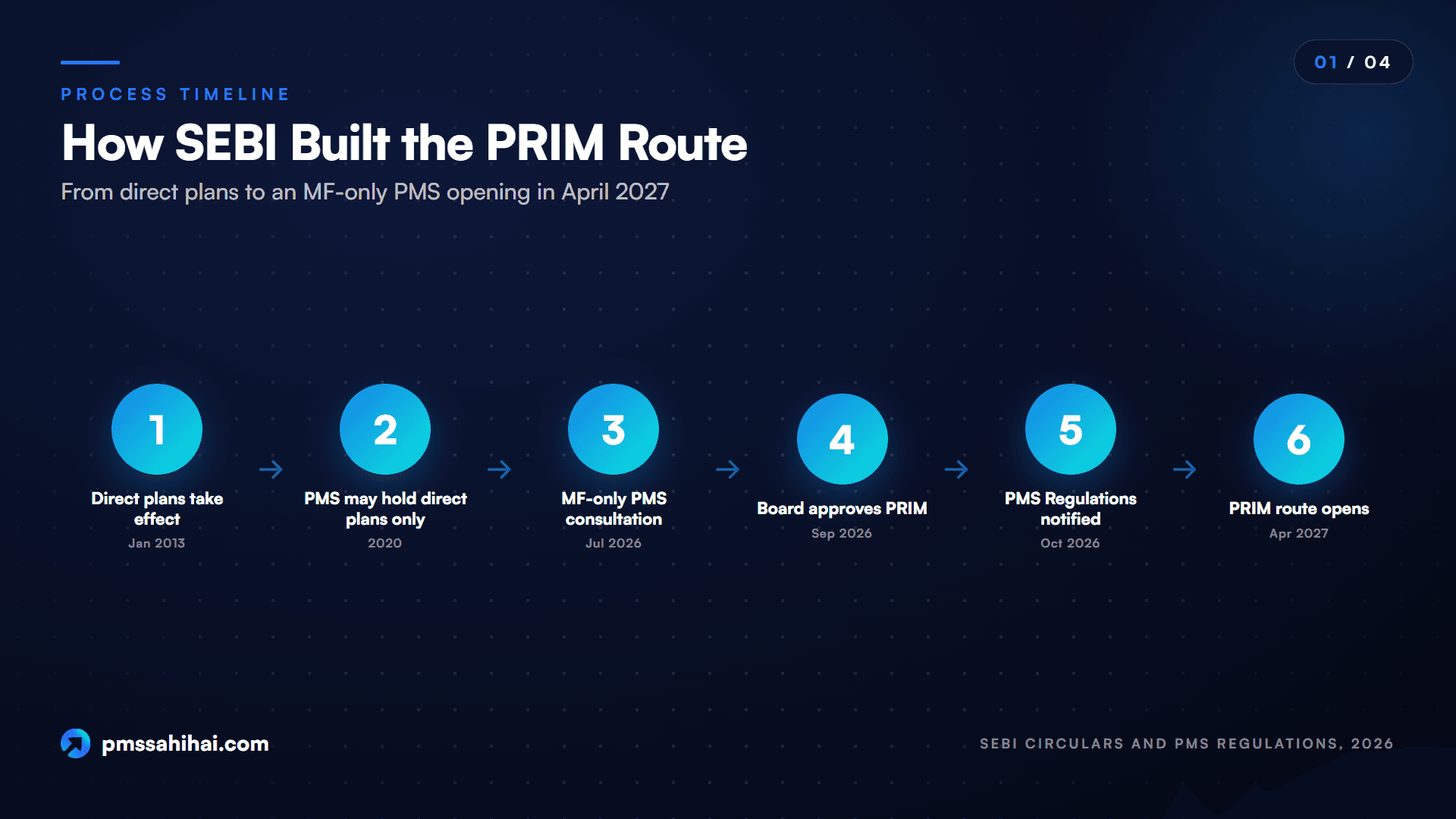
Portfolio managers have been regulated in India since the first Portfolio Managers Regulations were notified on 7 January 1993. The first building block for PRIM, though, came from the mutual fund side. On 13 September 2012, SEBI told every mutual fund to offer a separate plan for investments not routed through a distributor. These direct plans, effective from 1 January 2013, carry a lower expense ratio because they exclude distribution expenses and commission, and they have their own NAV. The cost of advice became visible as the gap between two NAVs.
The second building block came in the 2020 Portfolio Managers Regulations. Regulation 24(5) said portfolio managers "may invest in units of Mutual Funds only through direct plan", and regulation 24(6) barred them from charging distribution-related fees on those units. So a PMS has held direct mutual fund plans for years, but only inside a ₹50 lakh mandate.
From the 2.5% MF-PMS Proposal to the 1% Board Decision
The third step was a deliberate product. On 23 July 2026, SEBI published a consultation paper on a comprehensive review of the 2020 regulations. It said industry stakeholders had asked for "a simplified 'Mutual Fund-only' PMS framework with lowered entry barriers" to serve "mass-affluent investors" who want professional management of their fund holdings.
The paper proposed:
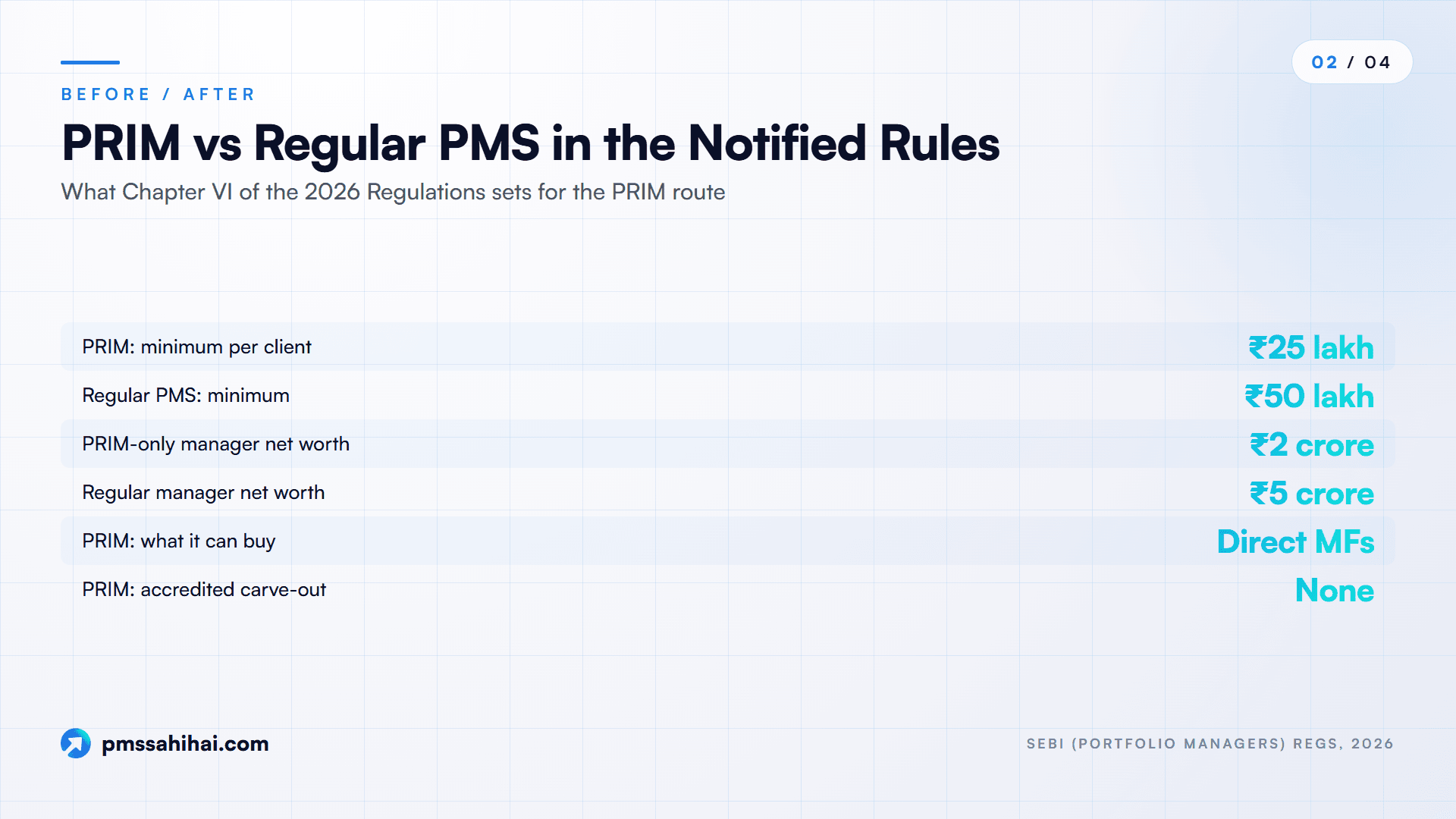
- a minimum ticket cut from ₹50 lakh to ₹25 lakh;
- a net worth requirement for these managers cut from ₹5 crore to ₹2 crore;
- lighter staffing, an optional dealing room and a simpler disclosure document;
- no PMS exit loads, "to protect clients from double-charging of exit loads";
- a fixed management fee capped at 2.5% of assets, with performance fees allowed with explicit consent;
- strict separation between a firm's mutual fund distribution business and its MF-PMS business.
It also asked a pointed question: should a manager that only selects schemes, while the fund managers pick the stocks, be allowed to charge a performance fee at all? Comments closed on 13 August 2026.
On 24 September 2026, SEBI's Board approved the new regulations. Its press release renamed the product PRIM and tightened the fee proposal from 2.5% to a 1% cap on the fixed management fee, while still permitting a performance-based fee. It added a 25% prudential cap on schemes of affiliated, group or associate AMCs, and confirmed the exit-load waiver and the distributor segregation, with an exception for accredited investors.
On 7 October 2026, SEBI notified the SEBI (Portfolio Managers) Regulations, 2026, published in the Gazette the next day. They take effect on 1 April 2027 and repeal the 2020 regulations from that date. The numbers explain the timing: SEBI's consultation paper put PMS assets at ₹42.61 lakh crore across 2.19 lakh clients and 515 managers on 31 May 2026, while the mutual fund industry managed ₹82.64 lakh crore with 10.06 crore active SIP accounts in September 2026, according to AMFI's monthly note for September 2026. The PRIM route is built to reach the large group in between.
What the Notified PRIM Regulations Actually Say
Most coverage of SEBI PRIM repeats the board press release. The binding text, Chapter VI of the 2026 Regulations (regulations 29 to 34), is shorter and in places different.
Only Direct Plans, Including Index Funds, ETFs and SIFs
Regulation 32 of the notified Gazette text is one sentence: the portfolio manager "shall invest funds of the client only in direct plans of mutual funds in India including index funds, exchange traded funds and specialized investment funds."
That wording settles several questions:
- No shares, bonds or AIFs. A PRIM manager cannot buy individual securities, even a single stock to round off a portfolio.
- Direct plans only. Regular plans, which carry distributor commission, are out.
- Indian funds only. "Mutual funds in India" excludes overseas funds and foreign-listed ETFs. Indian schemes that themselves invest abroad are still Indian mutual funds.
- Passive and specialised products are in. Index funds, ETFs and SIFs are named expressly.
The ₹25 Lakh Minimum and the Renewal Rule
Regulation 33(1) says the manager "shall not accept funds or securities or a combination thereof worth less than twenty-five lakh rupees from a client." Three points follow.
First, you can start with existing fund units, not only cash, as long as the total is at least ₹25 lakh. Whether a given manager accepts transfers of your existing direct-plan units, or asks you to redeem and reinvest, is an operational question to ask before you sign, because redeeming can trigger tax.
Second, regulation 33(2) says any renewal of the portfolio when the initial agreement period ends "shall be deemed as a fresh investment." Read literally, a portfolio that has fallen below ₹25 lakh at renewal would need topping up. SEBI has not yet explained how this will work in practice.
Third, regulation 33 has no accredited-investor carve-out written into it. Regulation 16(4) waives the ₹50 lakh regular-PMS minimum for accredited investors, but PRIM has its own minimum in its own chapter.
The ₹50 lakh rule in regulation 16(3) still governs every other PMS. PRIM is a second door, not a lower threshold for all PMS.
Who Can Offer PRIM and What They Need
Regulation 30 allows two routes. A new applicant can register to offer PRIM only, "subject to conditions specified by the Board". An existing portfolio manager can offer PRIM "under segregated investment approaches", keeping it separate from its stock-picking strategies.
For a PRIM-only manager, regulation 31 sets the bar:
- Net worth of at least ₹2 crore at all times, against ₹5 crore for a regular portfolio manager, with at least 10% of that minimum in unencumbered liquid assets.
- A principal officer and a compliance officer.
- A principal officer with a graduation degree (or CFA, CA, CS or CMA qualification), the relevant NISM certification and at least two years' securities-market experience, which can include work as a mutual fund distributor.
That last detail matters. SEBI has opened the door for experienced mutual fund distributors to become portfolio managers, which is why distributor segregation features so prominently in the board decision.
General PMS Rules Switched Off for PRIM
Regulation 29(2) applies the rest of the 2026 Regulations to PRIM, except a list of provisions "unless the context otherwise requires." The exclusions include:
- the regular-PMS eligibility, infrastructure, staffing and ₹5 crore net-worth requirements;
- Chapters III and IV, which cover eligible fund managers and co-investment portfolio managers;
- regulation 16(3), the ₹50 lakh minimum;
- regulation 16(17), the investment valuation norms;
- regulation 16(20), the performance benchmarking framework;
- most investment rules in regulation 17(1), including those on permitted, foreign and unlisted securities and derivatives.
The PRIM route keeps the core client protections, including the fiduciary duty in regulation 16(7), segregated holdings in 16(8), the bar on borrowing for clients in 16(12) and the 21-day grievance timeline in 16(14). But the general rules on valuation and on benchmarking performance have been switched off for PRIM. Regulation 34 lets SEBI specify "additional conditions including segregation of clients, maintenance of records, fees, limits on investment in associates". Until SEBI does so, nobody can say how a PRIM manager's returns will be benchmarked and reported.
PRIM Fees, Exit Loads and Conflict Limits Awaiting a Circular
The headline numbers are real decisions of SEBI's Board. They are simply not yet law.
Notified Rules vs Announced Conditions at a Glance
| Condition | Where it stands on 27 October 2026 |
|---|---|
| Direct plans only, incl. index funds, ETFs, SIFs | In the notified regulations (reg 32) |
| ₹25 lakh minimum per client; renewal is a fresh investment | In the notified regulations (reg 33) |
| ₹2 crore net worth for PRIM-only managers | In the notified regulations (reg 31) |
| Existing managers via segregated investment approaches | In the notified regulations (reg 30(2)) |
| Fixed fee capped at 1% of client AUM; performance fee permitted | Announced in SEBI's Press Release 59/2026; awaiting a SEBI circular under reg 34 |
| Waiver of PMS exit-load provisions | Announced; awaiting a circular |
| 25% cap on schemes of affiliated, group or associate AMCs | Announced; awaiting a circular |
| Segregation of MFD and PRIM activities and clients, except accredited investors | Announced; awaiting a circular |
SEBI's circular list up to 23 October 2026 shows no PRIM circular yet. Expect the conditions close to the announced form, but check the final circular before relying on any figure. In the meantime, the general fee rule in regulation 15(3) applies: a portfolio manager may charge a fixed fee, a return-based fee or both, may not guarantee returns and may not charge any upfront fee.
The PRIM fee cap applies to the fixed fee only. A performance fee sits outside the 1%. SEBI has not yet said whether PRIM performance fees must follow the high-water-mark method that regular PMS use, so ask any manager how its performance fee is calculated.
The exit-load waiver concerns the PMS layer. Regular PMS may charge exit loads of up to 3%, 2% and 1% in the first three years under SEBI's master circular for portfolio managers. The consultation paper proposed to switch these off for PRIM to avoid double charging. Exit loads set by the individual mutual fund schemes are a separate matter, so a manager selling a fund early can still incur a scheme exit load inside your portfolio.
What ₹25 Lakh Could Cost Each Year
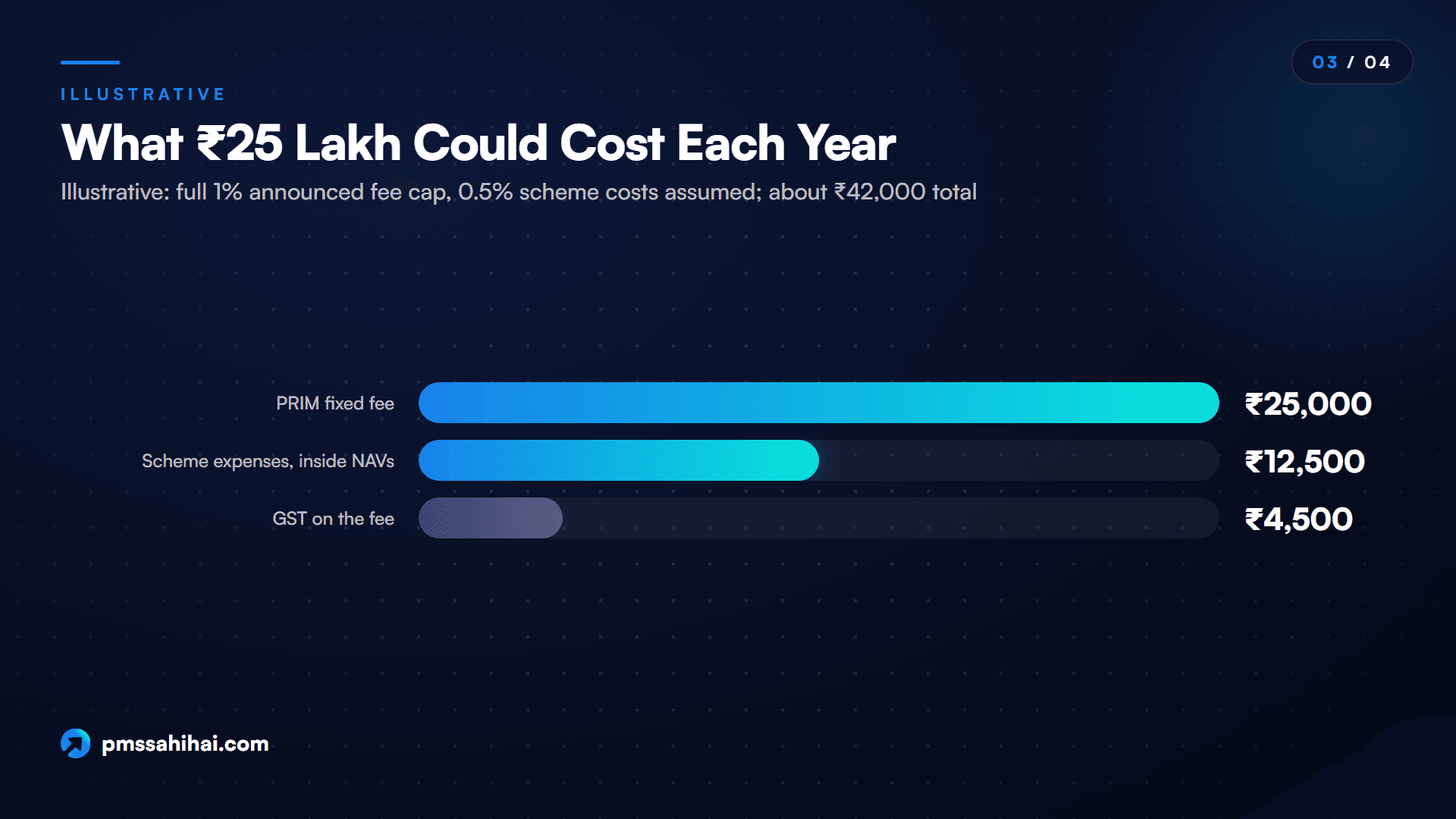
Here is a simple illustration of the cost layers, assuming the announced 1% cap applies and that the manager charges the full cap with no performance fee:
| Cost layer | Basis | Annual cost on ₹25 lakh |
|---|---|---|
| PRIM fixed fee | 1% of assets (announced cap) | ₹25,000 |
| GST on the fee | 18% of ₹25,000 | ₹4,500 |
| Scheme expenses | Assumed 0.5% weighted direct-plan expense ratio (illustrative only) | ₹12,500 (deducted inside NAVs) |
| Total | About ₹42,000, or roughly 1.7% |
The 0.5% scheme figure is an assumption to show the arithmetic, not a market average. An index-fund-heavy portfolio may cost less, and an active or SIF-heavy one more. The point is that the PRIM fee cap is not an all-in cost cap. Ask for a written estimate of the weighted expense ratio of the funds the manager actually uses.
How an MF-Based PMS Account Works Day to Day
An MF-based PMS account works like any discretionary PMS, except that the building blocks are fund units.
- Onboarding. You complete KYC, receive the disclosure document and sign a portfolio management agreement that sets out the fee, the investment approach and the terms for exit.
- Funding. You transfer at least ₹25 lakh in money or eligible securities. Check whether your existing direct-plan units can move across.
- Portfolio construction. The manager chooses schemes, such as a large-cap index fund, a flexi-cap fund, a short-duration debt fund or a gold ETF, according to the agreed approach.
- Holding. Units are held in your name. Regulation 16(8) requires each client's holdings to be kept in separate accounts, and regulation 16(1) requires the manager to manage each client individually "in a manner which does not partake character of a Mutual Fund."
- Rebalancing. When markets move the mix away from target, the manager sells some schemes and buys others. Each sale is a redemption in your name.
- Reporting and exit. You receive statements, can raise grievances with a 21-day resolution timeline, and can exit under the agreement's terms.
That is what you pay for: one accountable party for the whole fund portfolio, with a legal duty to act in your interest.
Using SIFs Inside a ₹25 Lakh Portfolio
SIFs can run strategies such as long-short equity that ordinary mutual funds cannot, but they come with their own entry rule. Under SEBI's SIF framework of 27 February 2025, an investor must put in at least ₹10 lakh across all the strategies of a SIF, measured at PAN level, unless the investor is accredited.
In a ₹25 lakh PRIM portfolio, that means a single SIF position could take 40% of the money, and SIFs from two fund houses would take 80%. SEBI has not said whether the PAN-level test is applied to the PRIM client individually; on the plain wording it would be. In practice, SIFs are likely to appear only in larger PRIM portfolios.
How Mutual Fund Switches Inside PRIM Are Taxed
Since the units are yours, the tax is yours. The PRIM route does not change how mutual funds are taxed. The Income-tax Act, 2025, in force from 1 April 2026, replaced the 1961 Act and renumbered the sections, but kept the capital gains rates set from 23 July 2024.
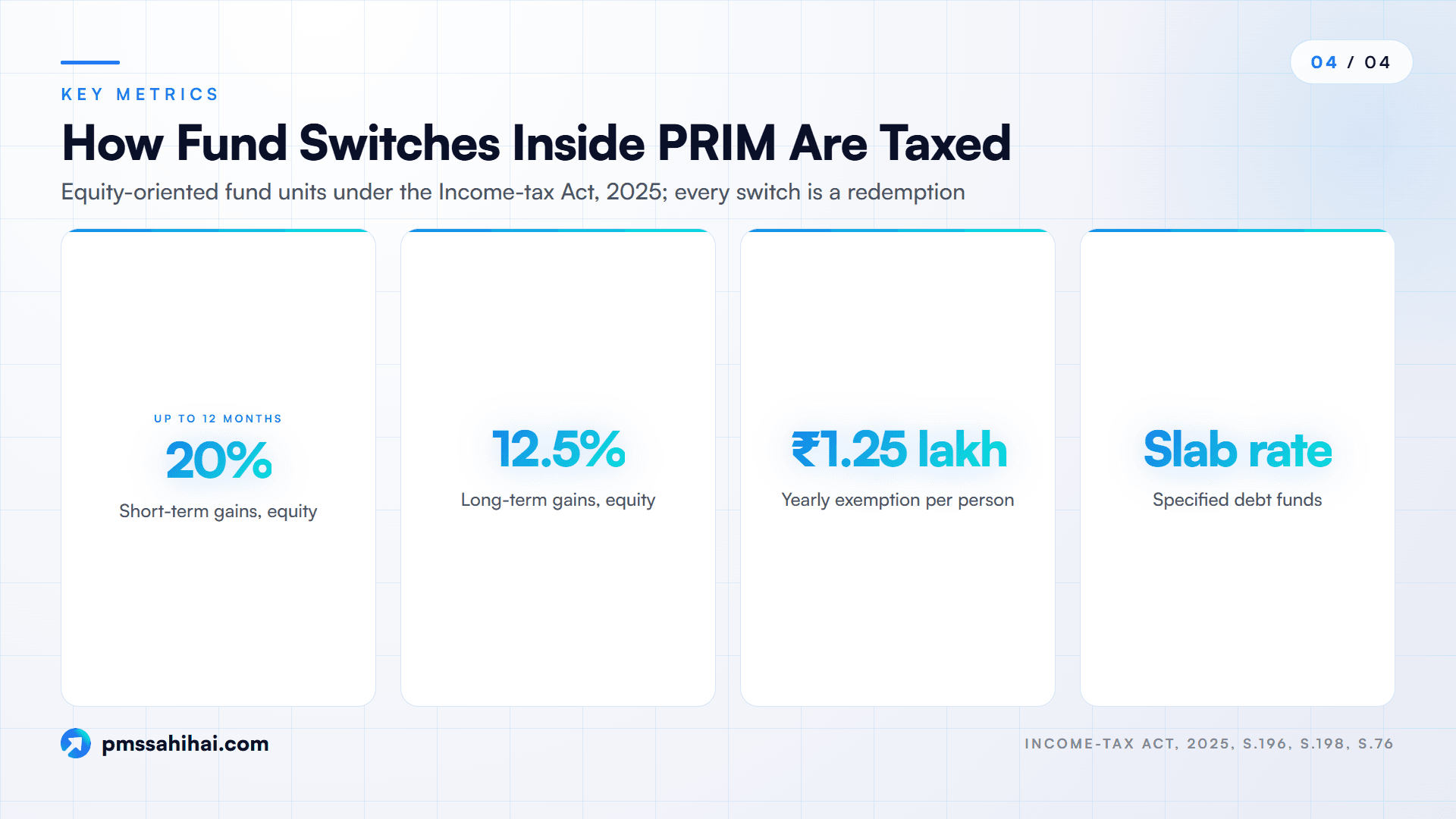
- Equity-oriented funds (at least 65% in Indian listed equity): short-term gains on units held up to 12 months are taxed at 20% (section 196 of the 2025 Act, formerly section 111A). Long-term gains are taxed at 12.5% on the amount above ₹1.25 lakh a year (section 198, formerly section 112A).
- Specified mutual funds, broadly debt funds with more than 65% in debt and money market instruments: gains are treated as short-term whatever the holding period and taxed at your slab rate (section 76, formerly section 50AA).
- Other funds, such as some hybrid, gold or international funds, follow different holding periods and rates depending on their structure.
Surcharge and cess apply on top. Three practical consequences follow for an MF-based PMS:
- Rebalancing creates tax. Selling a fund held for less than a year to buy another turns a potential 12.5% gain into a 20% one.
- The ₹1.25 lakh exemption is per person, per year, across all your equity holdings, not per portfolio.
- Fees may not be deductible. Whether PMS fees can be set against capital gains is a long-disputed question, and fees cannot be set against dividends.
Ask any PRIM manager for its turnover policy and whether it considers your holding periods before switching. Tax rules change and individual situations differ, so consult a qualified tax adviser before acting on this summary.
Where the PRIM Route Sits Among Mutual Fund Options
The PRIM route is one of five ways to own a fund portfolio. This short map shows who decides and how each is paid.
| Route | Who decides | Plan type | How the intermediary is paid | Regulatory minimum |
|---|---|---|---|---|
| Do it yourself | You | Direct | No one | None |
| Mutual fund distributor | You, on the distributor's suggestion | Regular | Commission inside the scheme's expense ratio | None |
| Registered investment adviser | You, on the adviser's advice | Direct | Advisory fee paid by you | None |
| PRIM manager | The manager, under your agreement | Direct only | PMS fee paid by you (fixed fee cap 1% announced) | ₹25 lakh |
| Regular PMS | The manager | Shares, bonds and direct MF plans | PMS fee | ₹50 lakh |
The key difference is discretion. A distributor or adviser recommends, and you act. A PRIM manager acts for you within the agreed approach, which is why it carries the fiduciary duty and the reporting obligations of a portfolio manager.
The segregation rule is what keeps the routes apart. Under the board decision of 24 September 2026, a firm that is both a distributor and a PRIM manager must keep those activities, and its clients, separate, except for accredited investors. A distributor cannot earn trail commission on your regular-plan funds and a PRIM fee on the same money.
Advantages of an MF-Based PMS for ₹25 Lakh Investors
For the right investor, an MF-based PMS solves real problems:
- Half the entry ticket. ₹25 lakh instead of ₹50 lakh brings discretionary portfolio management within reach of many long-time SIP investors.
- No commission inside the funds. Direct plans only means the cost of management is a visible fee rather than a hidden part of a regular-plan expense ratio.
- A cap on the fixed fee. If the announced 1% cap is confirmed, it is a hard ceiling on what a manager can charge as a fixed fee, unlike a regular PMS where the fee is whatever the agreement says.
- A limit on in-house funds. The announced 25% cap on affiliated AMC schemes stops a manager owned by a fund house from filling your portfolio with its own funds.
- One accountable manager. Selection, allocation, rebalancing and cleanup of overlapping funds become one fiduciary's job.
- The full fund toolkit. Index funds, ETFs, active funds and SIFs can sit in one mandate.
- Regulatory protections carried over. Segregated holdings, grievance timelines and the ban on upfront fees apply to PRIM as to any PMS.
How PMS Sahi Hai Helps You Read the Inner Clause of an MF-Based PMS
The PRIM route is still about five months away, and no PRIM strategy can be listed anywhere until managers register under the new rules and publish disclosure documents. PMS Sahi Hai's tools today cover the regular PMS and AIF universe, so use them to sharpen the questions you will put to an MF-based PMS manager, not as a PRIM shortlist.
- Benchmark the ₹50 lakh alternative. The PMS Sahi Hai compare page lets you filter PMS strategies by category, fund house, benchmark, AUM size and style, and line up to four side by side with their fee terms. If you are close to ₹50 lakh, see what a regular PMS charges before assuming the PRIM route is cheaper.
- Ask Nyra about overlap and fee drag. Nyra, the platform's AI research tool, is built to review "overlap, drift & fee drag across your holdings". That is exactly the mess an MF-based PMS promises to clean up, so run the diagnosis on your current funds first. Nyra is an analytical tool, not a SEBI-registered investment adviser.
- Know how a new manager will be scored. The Nyra methodology rates a strategy only after 12 months of track record and gives 30% of the score to excess return over the stated benchmark. A new PRIM approach would start "Not Rated", and with SEBI's general benchmarking provision switched off for PRIM, the benchmark each manager chooses deserves a hard look.
- Check the fee mechanics PRIM inherits. Our explainers on the PMS fee structure SEBI allows, GST on PMS and AIF fees and PMS exit loads by fund house show the rules the PRIM route will partly inherit and partly replace.
- Understand SIFs before a manager buys them. Our guide to specialised investment funds explains the ₹10 lakh product a PRIM portfolio may hold.
A note on independence: PMS Sahi Hai is a distributor and, as its published insights disclose, earns trail commission from asset managers. Under the board decision, a distributor that also runs PRIM must keep the two businesses and their clients apart, so always ask an intermediary which role it is playing for you.
Limitations and Open Questions Before April 2027
An MF-based PMS is not automatically better than what you have now. Weigh these honestly:
- It does not exist yet. No PRIM account can open before 1 April 2027; until then the 2020 regulations govern any PMS agreement you sign.
- The best protections are not yet law. The 1% cap, the exit-load waiver, the affiliated cap and distributor segregation all wait on a SEBI circular.
- Costs stack. You pay the PRIM fee, GST on the fee and each scheme's expense ratio. A performance fee, if charged, comes on top.
- Switching costs tax. An active manager can create short-term gains that a buy-and-hold investor would avoid.
- Benchmarking is undefined. With regulation 16(20) switched off for PRIM, there is no common yardstick yet for comparing PRIM managers.
- Manager skill is unproven. New PRIM-only managers will start with no track record under this route.
- SIFs are hard to fit. The ₹10 lakh SIF minimum crowds out diversification in small portfolios.
- The renewal rule is unclear. A portfolio that has fallen below ₹25 lakh at renewal may need topping up.
Is an MF-Based PMS Right for Your Portfolio?
An MF-based PMS makes most sense for an investor who has at least ₹25 lakh in funds, does not want to manage them personally, and values one accountable manager enough to pay a fee for it. It makes least sense for a disciplined investor who already holds three or four low-cost index funds and rebalances once a year; that investor is likely to pay more for little extra.
Between those poles, it depends on what you pay today. If your money sits in regular plans, part of your cost already goes to a distributor; moving to direct mutual fund plans under a capped PRIM fee may cost about the same and buy a manager with a legal duty to you. If you already hold direct plans, the PRIM route adds a new cost that the manager must earn through better selection, discipline and tax care.
A Pre-Signing Checklist for PRIM Managers
Before you sign with any PRIM manager after April 2027, ask for answers in writing, and put any you cannot interpret to Nyra on PMS Sahi Hai:
- Is the firm registered for PRIM, or offering it as a segregated investment approach of an existing PMS licence?
- What is the fixed fee, is there a performance fee, and how is it calculated?
- What is the weighted expense ratio of the funds you would hold?
- How much of the portfolio may go into funds of affiliated AMCs?
- Can I transfer my existing direct-plan units in, and what happens at renewal if my portfolio is below ₹25 lakh?
- What was the turnover of similar portfolios, and how do you manage short-term capital gains?
- Which benchmark will you report against, and how?
- If you are also my distributor, how are the two relationships kept separate?
Compare Your Options Before the PRIM Route Opens
The PRIM route opens on 1 April 2027, and the circular fixing its fees and conflict rules is still to come. Use the time: list every fund you own, flag the regular plans, total what you pay today, and decide whether you want advice, management or neither. When MF-based PMS managers publish disclosure documents, compare fees, fund choices, turnover and benchmarks side by side before you commit money.
Until then, PMS Sahi Hai can help you prepare. Line up regular PMS strategies on the compare page, run your current fund list past Nyra for overlap and fee drag, or book a 15-minute conversation with the team to talk through whether the PRIM route, a regular PMS or your own direct mutual fund plans fit your money best.
PMS Sahi Hai is a distributor of Portfolio Management Services and Alternative Investment Funds, APMI-registered (Registration No. APRN08358). This article is for education only and is not investment advice, a recommendation, or an offer to buy or sell any security. Investments in securities markets are subject to market risks; read all scheme-related documents carefully. Past performance is not indicative of future results. Consult your advisor before investing.
Ishaan founded PMS Sahi Hai to make India's PMS, AIF and GIFT City markets legible to serious investors, comparing every SEBI-registered manager on the same comparative basis, with no shelf products and no commission bias.
Frequently asked
What is PRIM in SEBI's new PMS rules?
PRIM is the Portfolio Management Service Route for Investment in Mutual Fund units, created by Chapter VI of the SEBI (Portfolio Managers) Regulations, 2026. Under it, a SEBI-registered portfolio manager may invest client money only in direct plans of Indian mutual funds, including index funds, ETFs and SIFs. It takes effect on 1 April 2027 with a ₹25 lakh minimum per client.
What is the minimum investment for an MF-based PMS?
Regulation 33 sets a minimum of ₹25 lakh per client, in money, securities or both. That is half the ₹50 lakh that still applies to every other PMS under regulation 16(3). A renewal at the end of the initial agreement period counts as a fresh investment, so a portfolio below ₹25 lakh at renewal may need topping up.
When does the PRIM route start?
The SEBI (Portfolio Managers) Regulations, 2026 were notified on 7 October 2026 and take effect on 1 April 2027. Until then, the 2020 regulations apply and no portfolio manager can offer a PRIM account. Conditions such as the fee cap are expected through a SEBI circular, which had not been issued by 27 October 2026.
How much can a PRIM manager charge?
SEBI's Board announced a cap of 1% of client assets on the fixed management fee, with performance-based fees also permitted. That cap is not in the notified regulations; regulation 34 leaves fees to a SEBI circular. GST at 18% applies on the fee, and the funds' own expense ratios are charged separately inside their NAVs.
Can a PRIM portfolio hold ETFs, index funds and SIFs?
Yes. Regulation 32 allows only direct plans of mutual funds in India "including index funds, exchange traded funds and specialized investment funds." Shares, bonds, AIFs and foreign funds are not allowed. SIFs carry their own ₹10 lakh minimum per investor at PAN level, which limits how many can fit in a small portfolio.
How is an MF-based PMS taxed?
The units are held in your name, so every switch is a redemption taxed in your hands. Equity-oriented fund gains are taxed at 20% if short-term and 12.5% above ₹1.25 lakh if held over 12 months, under sections 196 and 198 of the Income-tax Act, 2025. Debt-heavy specified funds are taxed at slab rates. Consult a tax adviser.
Can a mutual fund distributor offer PRIM?
A distributor can set up or join a registered PRIM manager. Regulation 31 even counts distribution experience towards the principal officer's two years. The Board decision requires the distribution business and the PRIM business, and their clients, to be kept separate, except for accredited investors, so the same firm cannot earn commission and a PRIM fee on your money.
Is PRIM better than buying direct mutual funds myself?
Not automatically. Buying direct plans yourself costs only the schemes' expense ratios. PRIM adds a fee and GST in exchange for discretionary management, rebalancing and a fiduciary duty. It suits investors who will not manage their funds themselves, or who now pay distributor commission through regular plans, more than disciplined index-fund investors.
Keep reading
All articles
What Is Factor Investing? Momentum, Quality and Value for PMS Investors
What factor investing means for PMS investors: momentum, quality, value and low volatility, Indian factor index data, cycles, costs and tax.
What Is a Private Trust? How HNIs Use Trusts to Protect Wealth
What a private trust is under Indian law, revocable vs discretionary choices, 2025 Act tax rules, and how family trusts hold PMS and AIF portfolios.

What Is an HUF, and Can It Invest in PMS and AIFs?
Can an HUF invest in PMS or AIFs? SEBI eligibility, karta KYC documents, the accredited investor route and HUF tax under the 2025 Act.
Read it. Now pressure-test it.
Ask Nyra how this applies to your portfolio, or talk to our team, no pitch, no pressure.