
What Is a Private Trust? How HNIs Use Trusts to Protect Wealth
What a private trust is under Indian law, revocable vs discretionary choices, 2025 Act tax rules, and how family trusts hold PMS and AIF portfolios.

A private trust is an arrangement under the Indian Trusts Act, 1882, in which a settlor hands assets to trustees who hold and manage them for named family beneficiaries. HNIs use a family trust to keep wealth in one pool across generations, ring-fence it from business and personal risks, and provide for minors or vulnerable heirs. Two design choices decide almost everything: revocable or irrevocable, and specific or discretionary. Under the Income-tax Act, 2025, a discretionary trust's income is generally taxed at the maximum marginal rate, while a specific trust is taxed broadly as its beneficiaries would be. A family trust can hold PMS and AIF investments if its deed allows it, and it qualifies as an accredited investor on the same tests as an individual. Speak to a lawyer and a tax adviser before you settle anything.
Why Wealthy Indian Families Are Turning to the Private Trust
India is in the middle of a large handover of wealth. An HSBC survey of family businesses released in May 2025 cited Hurun estimates of a $1.5 trillion intergenerational transfer, more than a third of GDP, and found that only 7% of Indian heirs feel obliged to take over the family firm. Money is moving to a generation that may not want to run the business and may live in three countries.
A will decides who gets what on the day it takes effect, and then its job is done. It cannot manage a portfolio for a 14-year-old grandchild, keep a son's creditors away from his share, or hold a promoter stake together. A private trust can, because it is an ongoing relationship rather than a one-time transfer: someone holds legal title to the assets and must use them, under written rules, for the people the founder chose.
That is why trusts have become a standard tool for business families and founders. They are also easy to get wrong: a badly drafted deed can cost more in tax than it saves.
This guide explains what a private trust is under Indian law, the two design choices that shape it, how trust taxation works under the Income-tax Act, 2025, and how a family trust can hold PMS and AIF portfolios. It is a starting point for a conversation with your lawyer and tax adviser, not a substitute for one. Wills versus trusts versus nominations, HUFs and family offices each have their own guide in this series.
What a Private Trust Means Under the Indian Trusts Act
Section 3 of the Indian Trusts Act, 1882 defines a trust as an obligation attached to the ownership of property, arising out of a confidence placed in and accepted by the owner, for the benefit of another person (or of another and the owner). In plain terms: you transfer property to someone you trust, and that person agrees to hold it for the people you name, on the terms you set.
A private trust is created for specific, identifiable people, usually family members. A public trust serves the public or a charitable or religious purpose. Section 1 of the Indian Trusts Act says it does not apply to religious or charitable endowments, which fall under state public-trust laws such as the Bombay Public Trust Act, 1950, and under separate tax rules.
The Three Parties: Settlor, Trustee and Beneficiary
- Settlor (the "author of the trust") — creates the trust and transfers assets into it; in a family trust, usually the patriarch, matriarch or promoter.
- Trustee — accepts the confidence, becomes legal owner of the trust property and must manage it for the beneficiaries. Anyone capable of holding property can be a trustee, but a trustee exercising discretion must be competent to contract.
- Beneficiary — the person for whose benefit the trust exists. Any person capable of holding property can be one, including a minor.
Many family trusts add an optional protector or advisory board, often a long-time adviser who can guide trustees, approve key decisions or replace a trustee. The Act does not require one; it exists only if the deed creates it. One person can hold more than one role, though a settlor who is also a beneficiary faces tax consequences explained later.
What a Valid Private Trust Needs
Section 6 says a trust is created when the settlor shows, with reasonable certainty, an intention to create a trust, its purpose, the beneficiaries and the trust property, and (unless the settlor is the trustee or the trust is made by will) transfers the property to the trustee.
Formalities depend on the asset. Under section 5, a trust over immovable property is valid only if declared by a signed and registered written instrument, or by a will. A trust over movable property such as shares or units needs a written declaration or an actual transfer of ownership to the trustee. In practice, every serious family trust uses a stamped trust deed and registers it whenever land or buildings are involved.
Section 7 lets anyone competent to contract create a trust, and a minor only with a principal civil court's permission. Section 4 makes a trust void if its purpose is fraudulent, defeats any law or injures another person, which matters for asset protection.
How the Private Trust Evolved From English Uses to Indian Law
The trust began in medieval England as the "use". Landowners conveyed land to a friend to hold for someone else, for instance for friars who could not own property. Common-law courts did not enforce these promises, so beneficiaries petitioned the Lord Chancellor, whose Court of Chancery enforced them as a matter of conscience. Uses became so popular for sidestepping feudal dues that Henry VIII pushed through the Statute of Uses in 1535. Courts later held that where the holder had active duties, the arrangement survived, and those holders came to be called trustees.
The idea travelled to India with English equity. The Indian Trusts Act came into force on 1 March 1882 as Act No. 2 of 1882, codifying the law of private trusts and trustees. It is an enabling law: it sets duties, rights and remedies, but leaves the shape of each trust to the deed. The Transfer of Property Act of the same year added the rule against perpetuity, which stops an interest from vesting beyond the lifetimes of people living at the transfer plus the minority of a person then in existence.
Indian families once used trusts partly to manage death taxes. Estate duty applied from 1953 until its abolition in 1985, and wealth tax was abolished in 2015. Today's reasons are different: keeping businesses intact, protecting heirs and managing financial portfolios. Section 20 of the Act, which restricts where trustees may invest money, was amended in 2016 to allow securities authorised by the trust deed or notified by the Central Government, making it far easier for a family trust to hold modern financial assets. On 1 April 2026, the Income-tax Act, 2025 replaced the 1961 Act, and the familiar trust sections 160 to 164 moved to sections 303 to 307.
Revocable vs Irrevocable Trust: The First Design Choice
The first question every settlor faces is whether they can take the assets back.
A revocable trust reserves to the settlor the power to cancel the trust or reclaim the property. It organises and manages assets during the settlor's life, but because the settlor can pull the assets back, it offers little protection from the settlor's creditors, and tax law treats its income as the settlor's own.
An irrevocable trust gives up that power. Once assets are settled, they belong to the trustee for the beneficiaries. That loss of control is the price of the main benefits: real separation of assets, better protection and, in the right structure, tax neutrality on settlement.
Indian law is strict about revocation. Section 78 says a trust not created by will can be revoked only:
- with the consent of all beneficiaries, if all are competent to contract;
- under a power of revocation expressly reserved in the deed; or
- for a trust to pay the settlor's debts, if not yet communicated to the creditors.
So an irrevocable trust with even one minor beneficiary cannot simply be unwound by family agreement. Under section 77 a trust also ends when its purpose is fulfilled, becomes unlawful or becomes impossible, so good deeds set clear termination events, such as the youngest grandchild turning 25. Most HNIs seeking succession or protection choose an irrevocable structure.
Specific vs Discretionary Trust: Who Decides the Shares
The second choice is about who decides how much each beneficiary gets.
In a specific trust (also called a determinate trust), the deed fixes each beneficiary's share, for example 40% of income to one child and 60% to the other. The trustee administers but cannot change the proportions.
In a discretionary trust, the deed names a class of beneficiaries, such as "my children and their descendants", and lets the trustee decide who receives what, and when: more for a grandchild's education this year, nothing for a beneficiary going through a divorce. Practitioners observe that most Indian family trusts are discretionary, precisely for this flexibility.
The trade-off is tax. The Income-tax Act, 2025 treats a share as determinate only if it is expressly stated and ascertainable in the deed; otherwise the trust's income is generally taxed at the maximum marginal rate.
Four Combinations Compared
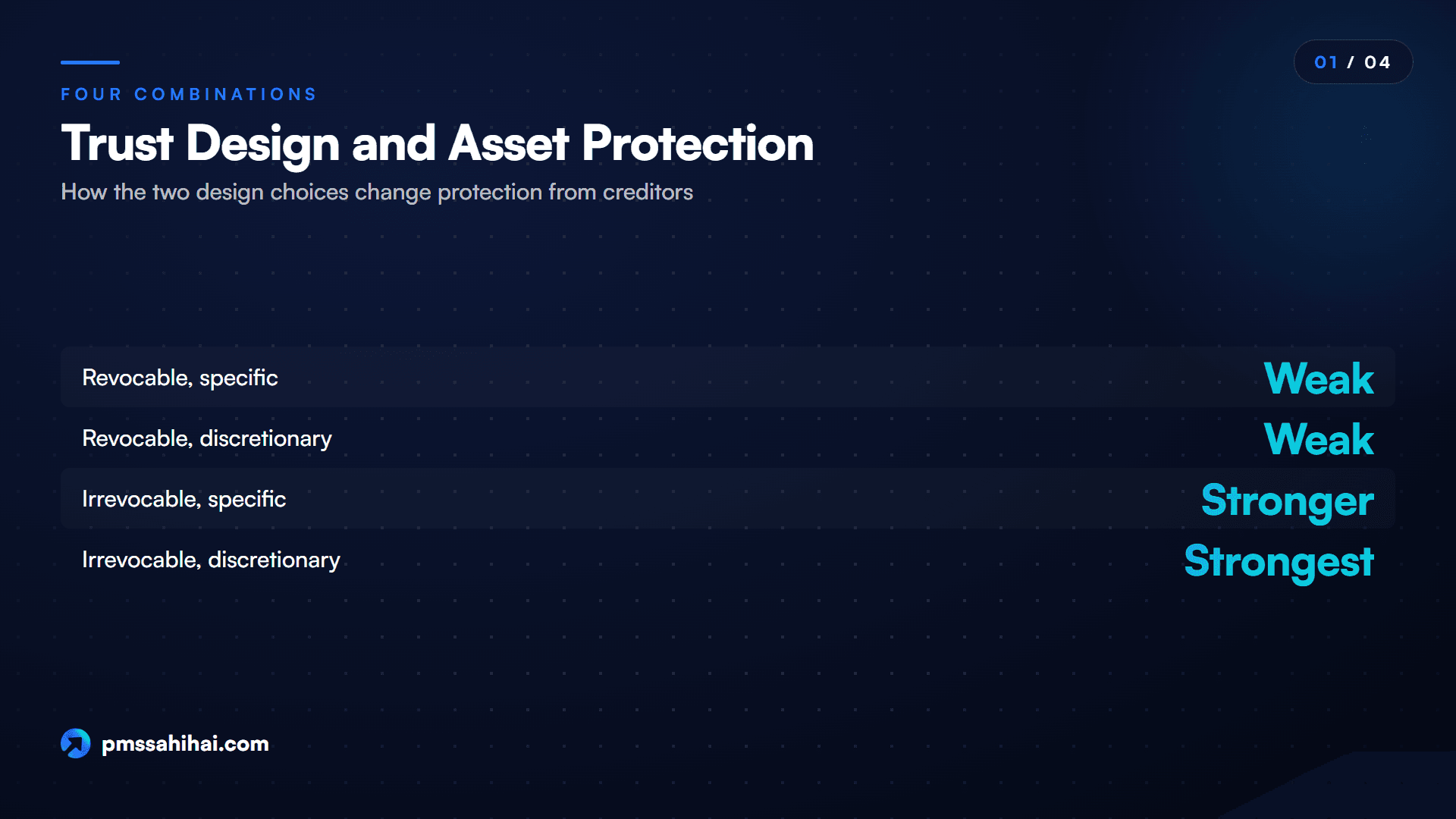
| Type | Control kept by settlor | Asset protection | Income tax (broadly) |
|---|---|---|---|
| Revocable, specific | High | Weak | Taxed on the settlor |
| Revocable, discretionary | High | Weak | Taxed on the settlor |
| Irrevocable, specific | Low | Stronger | As the beneficiaries would be taxed, through the trustee |
| Irrevocable, discretionary | Lowest (trustee decides) | Strongest | Generally the maximum marginal rate, limited exceptions |
Some families split the difference, for instance fixed shares of income with discretion over capital, or one trust per family branch. Such hybrids need careful drafting to avoid being treated as discretionary for tax.
How HNIs Use a Family Trust to Protect and Pass On Wealth
A trust is a container shaped to a family's problem. Four uses come up most often.
Succession Without Fragmentation
When wealth passes by will or intestacy, it is usually split. A promoter's 51% stake divided among four children becomes four 12.75% holdings, each a potential bargaining chip. A private family trust keeps the stake in one name, the trustee's, while benefits flow to the family under agreed rules. Decisions on voting, sale or reinvestment are taken once, by trustees.
A trust also works while the settlor is alive, so the settlor can watch trustees operate and correct course, which a will never allows. And because the trustee already owns the assets, the settlor's death does not interrupt their management.
Ring-Fencing Family Wealth From Business Risk
Promoters often sign personal guarantees for company loans. Assets settled into an irrevocable trust well before any trouble belong to the trustee, not the settlor, so in principle they sit outside the settlor's personal estate. Commentators also point to protection against matrimonial claims and creditors of an individual beneficiary, because in a discretionary trust no beneficiary owns a fixed share.
The protection has firm limits. It does not apply to a revocable trust, it covers only assets actually transferred, and a transfer of immovable property made to defeat or delay creditors is voidable at the creditor's option under section 53 of the Transfer of Property Act. Timing and genuineness matter more than wording.
Caring for Minors and Vulnerable Heirs
A trust can pay school fees for a grandchild until 25 and then release capital in stages, provide for a child with a disability for life without handing over assets they cannot manage, or tie distributions to sensible milestones. These are cases where a trust does something a will cannot.
Keeping a Portfolio Under One Mandate
For families whose wealth is mostly financial, a trust lets one set of trustees run one investment policy: equity, debt and alternatives can sit with a few PMS managers and AIFs instead of being split across many individual accounts. Trustees can hire professional managers, follow an allocation set in the deed and report to beneficiaries once a year.
Compared with an HUF, a trust is open to anyone regardless of religion and is shaped by its deed rather than by personal law.
How Private Trust Taxation Works Under the Income-tax Act, 2025
Trust taxation has two moments: when assets go in, and every year after. References are to the Income-tax Act, 2025, in force from 1 April 2026, with old 1961 Act numbers in brackets. Some points are litigated, so treat this as orientation and confirm your structure with a tax adviser.
Tax When You Settle Assets Into the Trust
Three provisions usually make settlement tax-neutral for a well-drafted family trust:
- No capital gains for the settlor. Section 70(1)(b) (old 47(iii)) says a transfer of a capital asset by an individual or HUF under a gift, will or irrevocable trust is not a transfer for capital gains. It names irrevocable trusts only.
- No gift tax if the trust is for relatives. Section 92(2)(m) taxes property received without adequate consideration, but section 92(3)(h) excludes property received from an individual by a trust created solely for the benefit of the individual's relatives. A deed letting trustees add non-relatives risks this exclusion: a 2024 Bengaluru tribunal ruling on a ₹669 crore settlement took that view before being recalled for a fresh hearing in January 2025.
- Cost carries over. Under section 73(1), an asset received under a transfer to a revocable or irrevocable trust takes the previous owner's cost, so tax arises only when the trust later sells.
Stamp duty on the deed and on any property transfer is a state subject and varies widely. There is no statutory minimum corpus.
Tax on the Trust's Yearly Income
The trustee files returns and pays tax as a representative assessee under section 303(1)(d) (old 160), and under section 304 (old 161) is taxed in the same manner and to the same extent as the beneficiary would be. The result depends on the type of trust:
- Revocable trust: Section 97 (old 61–63) taxes income from a revocable transfer in the settlor's hands. Section 98 treats a transfer as revocable if it allows any re-transfer to the settlor or any right to re-assume power. Even an irrevocable trust's income is taxed on the settlor if the settlor derives a direct or indirect benefit, which is why settlors are often advised not to be beneficiaries.
- Specific trust: Income is taxed as if received by each beneficiary for their share, so each beneficiary's own slab position broadly governs. Section 307(5) counts shares as determinate only if expressly stated in the instrument of trust and ascertainable on its date.
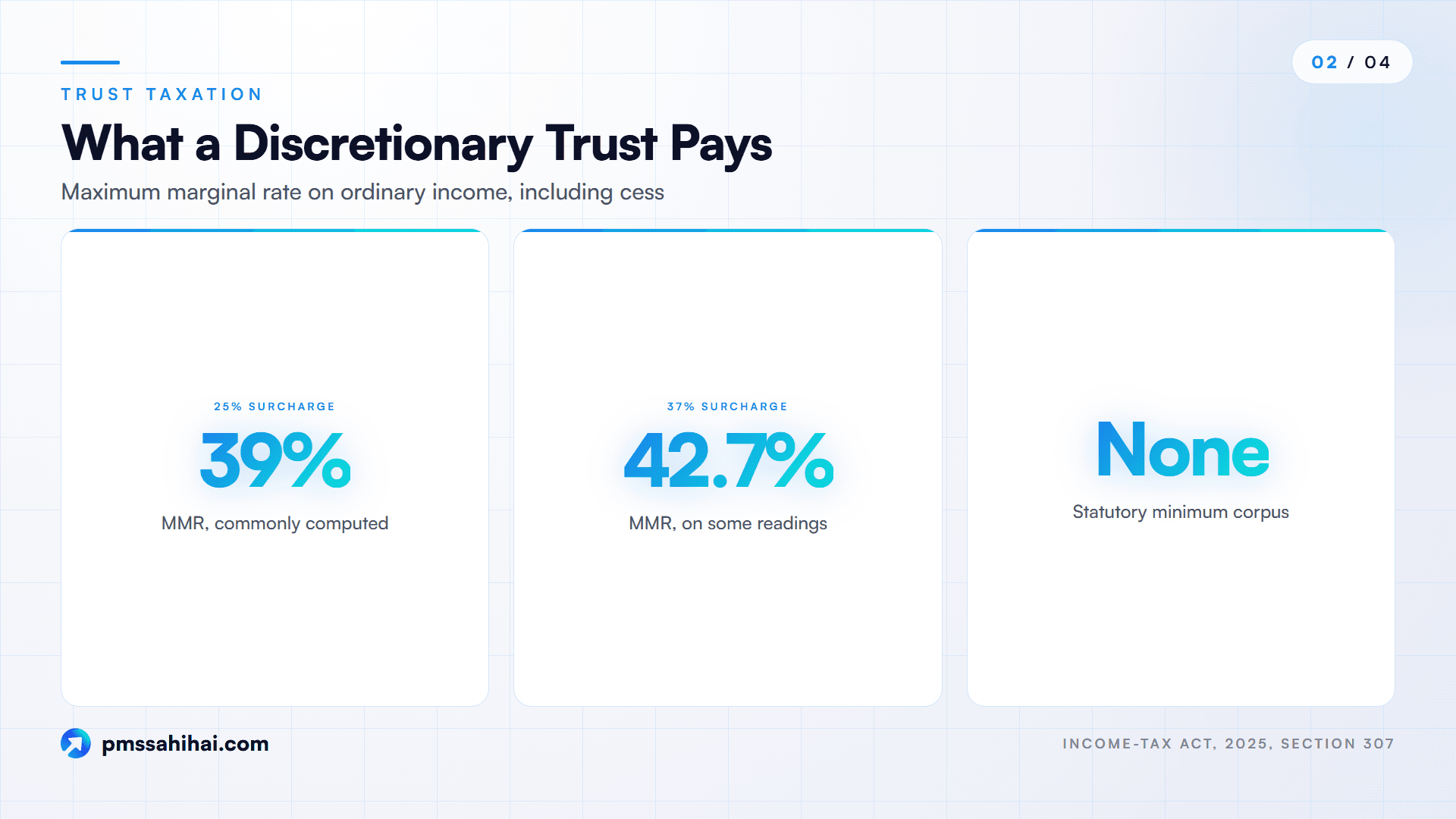
- Discretionary trust: Section 307(1) of the Gazette text (old 164) taxes the income at the maximum marginal rate (MMR) where it is not specifically receivable for one person or the shares are indeterminate. The Act defines MMR as the rate, including surcharge, on the highest slab for an individual or association of persons. On ordinary income that is commonly computed at roughly 39% (25% surcharge) and, on some readings, about 42.7% (37% surcharge), including cess. How MMR applies to special-rate capital gains, such as listed-equity gains, is a point practitioners differ on.
Section 307(2) allows the lower association-of-persons rate in a few cases: no beneficiary has other taxable income above the exemption limit and none benefits under another trust; the trust is the only one created by the settlor's will; certain pre-1970 family trusts; and employee benefit funds. Business income of a discretionary trust is taxed at MMR under section 307(3), with a narrow exception for a will-based trust for a dependent relative.
So families who want flexibility accept MMR and plan investments with income type in mind, while families who want lower tax on income choose fixed shares. Model trust taxation before a deed is signed.
Old and New Section Numbers at a Glance
| Topic | Income-tax Act, 1961 | Income-tax Act, 2025 |
|---|---|---|
| Trustee as representative assessee | s.160 | s.303 |
| Liability of representative assessee | s.161 | s.304 |
| Right to recover tax paid | s.162 | s.305 |
| Discretionary trust at MMR | s.164 | s.307 |
| Revocable transfers taxed on settlor | ss.61–63 | ss.97–98 |
| Settlement to irrevocable trust not a transfer | s.47(iii) | s.70(1)(b) |
| Gift exclusion for trust for relatives | s.56(2)(x) proviso | s.92(3)(h) |
Can a Family Trust Invest in PMS and AIFs?
Yes, and many do, once three gates are cleared: the deed, KYC and the product minimums.
Check the Trustee's Investment Powers First
Section 20 of the Indian Trusts Act says that trust money not needed immediately must be invested in securities expressly authorised by the instrument of trust, or notified by the Central Government. Where an adult beneficiary is entitled to the income for life, investments need that person's written consent.
So the deed should expressly authorise the classes of investment the trustees will use, such as listed and unlisted equity, mutual funds, portfolio management services, AIF units and bonds, and let trustees appoint and pay professional managers. Section 51 bars trustees from using trust property for their own profit, and section 60 says a trust that receives and holds money should normally have at least two trustees.
KYC and Beneficial Ownership for Trust Accounts
A PMS or AIF account for a trust is opened in the trust's name and operated by its trustees. Under anti-money-laundering rules as amended on 7 March 2023, the intermediary must identify the trust's beneficial owners: the settlor, the trustees, beneficiaries with a 10% or greater interest and anyone exercising ultimate effective control. Expect to provide the trust deed, the trust's PAN, a trustee resolution and KYC for each trustee and beneficial owner. Ask each manager for its trust onboarding checklist early.
Minimums and the Accredited Investor Route
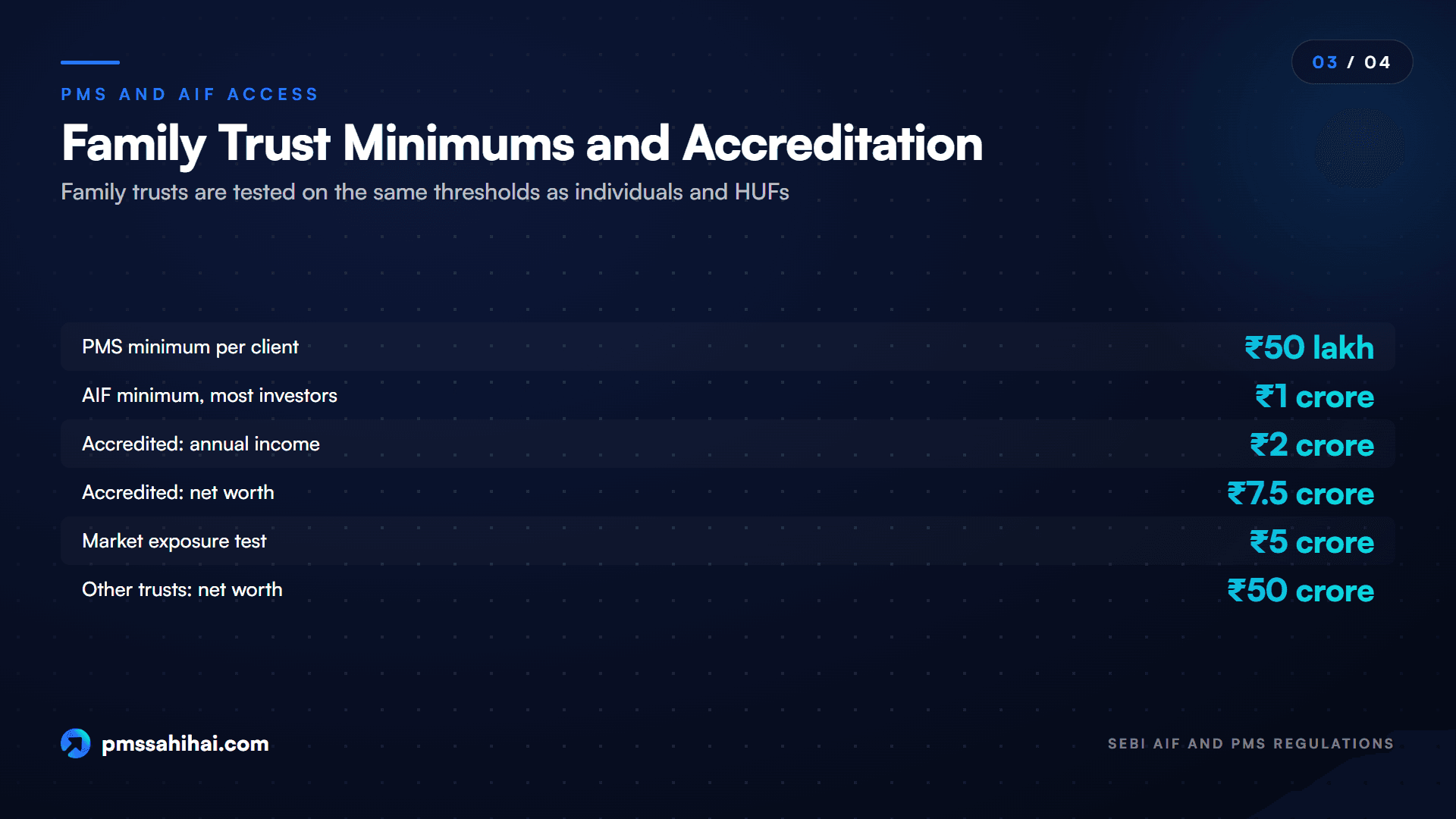
Ordinary minimums apply: ₹50 lakh per client for a PMS under the SEBI (Portfolio Managers) Regulations, 2020, and ₹1 crore for most AIF investors. The SEBI (Portfolio Managers) Regulations, 2026 take effect on 1 April 2027 and keep the ₹50 lakh threshold.
A family trust gets one advantage. SEBI's accredited investor definition tests family trusts on the same thresholds as individuals and HUFs: annual income of at least ₹2 crore; or net worth of at least ₹7.5 crore with at least ₹3.75 crore in financial assets; or ₹1 crore income plus ₹5 crore net worth with at least ₹2.5 crore in financial assets. Other trusts need ₹50 crore of net worth. SEBI has also moved to add a securities-market exposure test of ₹5 crore for family trusts (₹20 crore for other trusts); the AIF Regulations were amended on 15 October 2026, and the circular on the mechanics was not yet seen at the time of writing. Accredited investors can access ticket sizes and products not open to others.
Tax flows matter too. In a PMS the trust owns the securities directly, so every dividend, interest payment and realised gain is the trust's income in the year it arises. Category I and II AIFs pass most income through to the unit holder, here the trust; Category III AIFs pay tax at fund level. For a discretionary trust paying MMR on ordinary income, the income mix inside the portfolio directly affects post-tax returns.
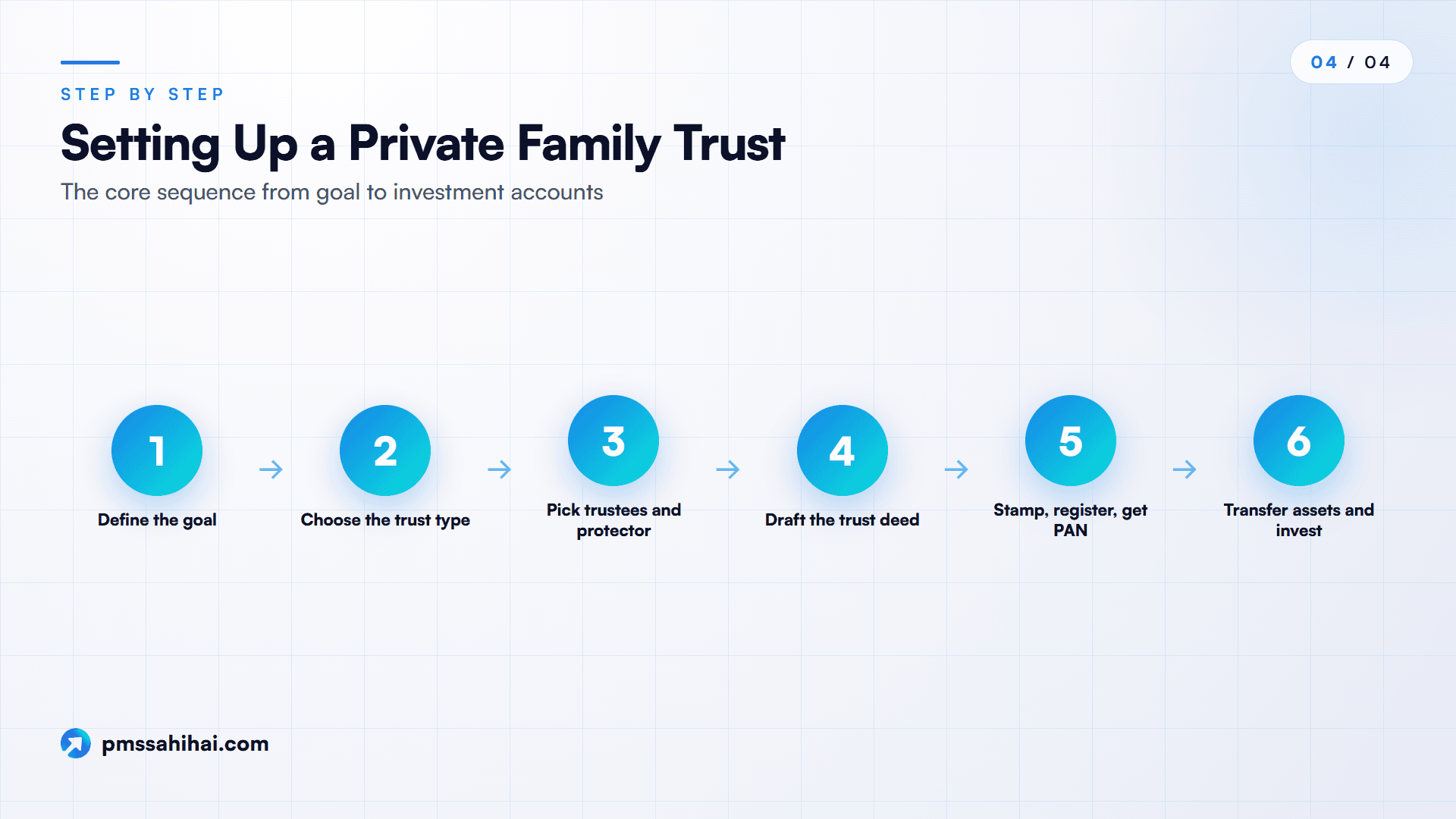
Setting Up a Private Family Trust Step by Step
- Define the goal. Business succession, protection from business risk, provision for a dependent, or a family investment pool.
- Choose the type. Revocable or irrevocable; specific or discretionary; one trust or several. Model the tax first.
- Pick trustees and, if wanted, a protector. Individuals, a professional trustee company or a mix, with a plan for replacing trustees.
- Draft the trust deed. Parties, property, purpose, beneficiaries, distribution rules, investment powers, trustee appointment and removal, termination and dispute resolution.
- Execute, stamp and register. Stamp as your state requires; register where immovable property is involved.
- Get the trust's PAN and a bank account. All trust money should flow through it.
- Transfer the assets. Shares and units by off-market transfer to the trust's demat account; property by registered conveyance.
- Open investment accounts. Complete trust KYC with each PMS, AIF or mutual fund house.
- Run it properly. Keep separate accounts, minute trustee decisions, file the trust's return every year and review the structure when the family or the law changes.
Costs cover drafting, stamp duty, registration, accounting and trustee fees; there is no standard national fee, so ask for written estimates.
How PMS Sahi Hai Helps Trustees Read the Inner Clauses of Trust Investing
A trust deed tells trustees what they may invest in. It does not tell them which PMS or AIF is worth the trust's money, or how each one's income will land in a trust that may be paying the maximum marginal rate. That is the gap PMS Sahi Hai is built for.
PMS Sahi Hai is a comparison platform for portfolio management services and alternative investment funds. Its comparison tool lets trustees shortlist strategies side by side by category, benchmark and track record, which is the evidence a prudent trustee should keep on file when choosing a manager. Before a trustee meeting, three published guides answer the questions a trust usually raises first: how the PMS minimum works, AIF minimum investment rules, including the accredited investor route, and who counts as an HNI investor.
Tax is where a trust differs most from an individual investor. Because a PMS holds securities directly while Category I and II AIFs pass income through and Category III funds pay tax at fund level, the same strategy can produce very different post-tax results inside a discretionary trust. Our explainers on AIF vs PMS taxation and the AIF pass-through rule help trustees frame the right questions for the trust's tax adviser.
Nyra, PMS Sahi Hai's AI-powered research tool, helps you frame those questions before you sit down with a manager or adviser, such as how a strategy has done against its stated benchmark and what its fees mean for the trust. Nyra's scoring methodology is published, and strategies with less than 12 months of record are not rated. Nyra is an analytical tool, not a SEBI-registered investment adviser, and it does not draft trust deeds or give legal or tax advice. The deed belongs with your lawyer and the tax structure with your tax adviser; PMS Sahi Hai helps trustees choose investments with clearer data once those are in place.
Limits and Risks of a Private Trust You Should Weigh
- High tax on flexible structures. A discretionary trust's ordinary income is generally taxed at MMR, often far above what beneficiaries would pay.
- Loss of control. An irrevocable trust is hard to unwind once beneficiaries include minors.
- Asset protection is not absolute. Revocable trusts protect little, and transfers made to defeat creditors can be set aside.
- Settlement exemptions can be lost. A beneficiary class that is too wide, or a settlor who keeps a benefit, can trigger gift-tax or clubbing provisions.
- Perpetuity limits. The rule against perpetuity limits how far ahead vesting can be postponed, so "forever" trusts are not possible.
- Cost and compliance. Stamp duty, accounts, returns, trustee fees and trust KYC continue every year.
- Family friction. Trustees with discretion can become targets of disputes, which often end up in court.
Is a Private Trust Right for Your Family?
A trust makes most sense when wealth is large enough to justify the costs, needs ongoing management rather than a one-time split, or when someone needs protection: a minor, a vulnerable heir, or a family exposed to business guarantees. It makes less sense for modest estates that a clear will and current nominations can handle.
Start with the purpose. Decide whether you need control, protection or flexibility most, then choose revocable or irrevocable, specific or discretionary, with the tax model in front of you. If the trust will hold investments, write the investment powers into the deed and plan the portfolio around how a trust is taxed. Involve a lawyer for the deed and a tax adviser for the structure before any asset moves. When the trustees are ready to choose managers, PMS Sahi Hai and Nyra can help them compare PMS and AIF options on evidence rather than on pitch decks.
Plan Your Family Trust's Portfolio With Clear Data
Once the deed is signed, the trust becomes an investor with its own tax profile, minimums and reporting duties. Use PMS Sahi Hai's comparison tool to shortlist PMS and AIF strategies on fees, benchmark and record, use Nyra to frame the questions on fees and income that matter for a trust, and take those findings to your lawyer and tax adviser before the trustees commit. If you would like to talk it through, book a 15-minute conversation with the PMS Sahi Hai team.
PMS Sahi Hai is a distributor of Portfolio Management Services and Alternative Investment Funds, APMI-registered (Registration No. APRN08358). This article is for education only and is not investment advice, a recommendation, or an offer to buy or sell any security. Investments in securities markets are subject to market risks; read all scheme-related documents carefully. Past performance is not indicative of future results. Consult your advisor before investing.
Ishaan founded PMS Sahi Hai to make India's PMS, AIF and GIFT City markets legible to serious investors, comparing every SEBI-registered manager on the same comparative basis, with no shelf products and no commission bias.
Frequently asked
What is a private trust in India?
A private trust is an arrangement under the Indian Trusts Act, 1882 in which a settlor transfers property to trustees, who hold and manage it for specific, identifiable beneficiaries such as family members. Unlike a public trust, it serves individuals rather than the public or charity. It is usually created by a written trust deed, stamped and, where immovable property is involved, registered.
Who can create a family trust?
Any person competent to contract can create a family trust under section 7 of the Indian Trusts Act; a minor can do so only with a principal civil court's permission. Unlike an HUF, a trust is open to people of any religion. The settlor must show clear intention, purpose, beneficiaries and property, and transfer the property to the trustees.
Can an irrevocable trust be revoked in India?
Generally no. Under section 78 of the Indian Trusts Act, a trust not created by will can be revoked only with the consent of all beneficiaries, if all are competent to contract; under a revocation power expressly reserved in the deed; or, for a trust to pay the settlor's debts, before it is communicated to creditors. Minor beneficiaries make it very hard to unwind.
How is a discretionary trust taxed in India?
Under section 307 of the Income-tax Act, 2025 (old section 164), a discretionary trust's income is generally taxed at the maximum marginal rate, because beneficiaries' shares are not fixed in the deed. Limited exceptions allow the association-of-persons rate, for example where no beneficiary has other taxable income above the exemption limit. Treatment of capital gains is debated, so confirm with a tax adviser.
Is transferring assets to a private trust taxable?
Usually not, if structured correctly. Section 70(1)(b) of the Income-tax Act, 2025 says a transfer by an individual or HUF to an irrevocable trust is not a transfer for capital gains, and section 92(3)(h) excludes property received by a trust created solely for the settlor's relatives from the gift charge. State stamp duty still applies.
Can a family trust invest in PMS or AIFs?
Yes, if the trust deed authorises such investments, as section 20 of the Indian Trusts Act requires. The account is opened in the trust's name, trustees sign, and the manager identifies beneficial owners under anti-money-laundering rules. Standard minimums of ₹50 lakh for PMS and ₹1 crore for most AIFs under the SEBI AIF Regulations apply unless the trust qualifies as an accredited investor.
Can a family trust be an accredited investor?
Yes. SEBI tests a family trust on the same thresholds as an individual: annual income of ₹2 crore, or net worth of ₹7.5 crore with half in financial assets, or ₹1 crore income plus ₹5 crore net worth with half in financial assets. Trusts other than family trusts need ₹50 crore of net worth. Accreditation is certified, not self-declared.
Keep reading
All articles
What Is Factor Investing? Momentum, Quality and Value for PMS Investors
What factor investing means for PMS investors: momentum, quality, value and low volatility, Indian factor index data, cycles, costs and tax.
What Is an HUF, and Can It Invest in PMS and AIFs?
Can an HUF invest in PMS or AIFs? SEBI eligibility, karta KYC documents, the accredited investor route and HUF tax under the 2025 Act.
What Is MF-Based PMS? SEBI’s PRIM Route From ₹25 Lakh Explained
MF-based PMS explained: what SEBI's PRIM rules say, the ₹25 lakh minimum, the 1% fee cap awaiting a circular, tax on switches and the April 2027 start.
Read it. Now pressure-test it.
Ask Nyra how this applies to your portfolio, or talk to our team, no pitch, no pressure.