
What Is an HUF, and Can It Invest in PMS and AIFs?
Can an HUF invest in PMS or AIFs? SEBI eligibility, karta KYC documents, the accredited investor route and HUF tax under the 2025 Act.


A Hindu Undivided Family (HUF) is a separate taxpayer with its own PAN, run by its karta, and yes, it can invest in both portfolio management services (PMS) and alternative investment funds (AIFs). SEBI's AIF rules name the HUF directly in the accredited investor definition, and nothing in the PMS rules shuts it out. The HUF counts as one client, so it needs Rs 50 lakh for a PMS and Rs 1 crore for an AIF unless it is accredited. Gains are taxed in the HUF's own hands under the Income-tax Act, 2025, but money a member throws into the family pool can be taxed back to that member, so plan how the HUF is funded before the karta signs anything.
Why Families Ask Whether an HUF Can Invest in PMS and AIFs
Many families have an HUF that has sat quietly for years with a PAN, a bank account, some fixed deposits or ancestral shares. Then the corpus crosses Rs 50 lakh or Rs 1 crore, and someone asks: can the HUF itself sign up with a portfolio manager or commit to an AIF, or must the money move into someone's personal name first?
The short answer is that the HUF can invest in its own name. The longer answer matters more, because HUF investment in PMS and AIFs touches three separate rulebooks. SEBI decides who may invest and how much. The KYC framework decides what documents the karta must produce. The Income-tax Act, 2025 decides whose income the gains become, and that last point can undo the whole plan if the corpus came from the wrong place.
This guide stays narrow: eligibility, onboarding and tax for an HUF that wants a PMS mandate or AIF units, with the rule text and dates behind each answer. Whether forming an HUF is worth it at all, including partition and coparcenary rights, is a separate subject.
What Is an HUF Under Hindu Law and the Income-tax Act
So, what is an HUF? It is a family unit recognised by Hindu personal law: persons lineally descended from a common ancestor, together with their wives and unmarried daughters. Nobody creates it by contract. It arises from the family relationship itself, which is why tax writers describe it as a creature of status rather than of statute. Jain, Sikh and Buddhist families are treated the same way for tax purposes.
Karta, Coparceners and Members
Three roles matter for an investment account.
- Karta: the manager of the HUF, traditionally the senior-most coparcener. The karta signs on the family's behalf, operates the bank account, completes KYC and verifies the tax return.
- Coparceners: members who hold a birthright interest in the joint family property and can demand partition. Since the Hindu Succession Act was amended in 2005, daughters are coparceners by birth as well.
- Members: others in the family, such as wives of coparceners, who belong to the HUF but are not coparceners.
A portfolio manager, an AIF and a depository all deal with the karta, not with the family as a committee.
Why the HUF Counts as a Separate Investor
The Income-tax Act, 2025, which applies from 1 April 2026, lists "a Hindu undivided family" as a separate "person" in section 2(77)(b) of the Act as published in the Gazette. That single line is what makes the HUF an investor in its own right. It gets its own PAN, files its own return, pays tax at its own slab rates and holds its own demat account. In the PAN itself, the fourth character "H" marks the holder as an HUF.
Residence is decided differently from an individual. Under section 6(9), an HUF is resident in India unless its control and management is wholly outside India. Whether it is "not ordinarily resident" depends on the residence history of its manager, the karta, under section 6(13)(a). A family whose karta has moved abroad therefore needs to check its residential status before investing.
How the HUF Became a Taxpayer and a Market Investor
The joint Hindu family is far older than any tax law. Classical Hindu law, through the Mitakshara and Dayabhaga schools, governed how joint family property was held and divided, and the Income-tax Act, 1961 treated the HUF as a separate "person". The 2025 Act, which replaced the 1961 Act from 1 April 2026, keeps the same treatment with new section numbers.
Over the decades the HUF moved from land and family businesses into bank accounts, mutual funds and demat accounts. Recent milestones:
- 2005: the Hindu Succession Act amendment made daughters coparceners, widening who can be counted in the HUF's deed of declaration.
- August 2021: SEBI introduced the accredited investor framework and listed HUFs alongside individuals, family trusts and sole proprietorships.
- 26 August 2022: SEBI fixed who replaces the karta on an HUF demat account when the karta dies.
- 17 April 2026: NSDL clarified that an HUF demat account can be opened with one coparcener acting as karta and at least one other member, such as a wife, mother or widow.
- 15 October 2026: the AIF accredited investor definition gained a fourth test, a securities market exposure of at least Rs 5 crore, which applies to HUFs too.
Can an HUF Invest in PMS? What SEBI's Rules Actually Say
Yes. The SEBI (Portfolio Managers) Regulations, 2020 do not define a "client" in a way that excludes any type of person. A portfolio manager may take any client that passes KYC, suitability and the minimum investment rule, and SEBI's KYC framework has a dedicated document list for HUFs.
In practice, HUF investment in PMS works like an individual's mandate with three differences: the karta signs the agreement on the HUF's behalf, the bank and demat accounts are in the HUF's name and PAN, and the securities, gains and losses belong to the HUF, not the karta.
The Rs 50 Lakh Minimum Applies to the HUF as One Client
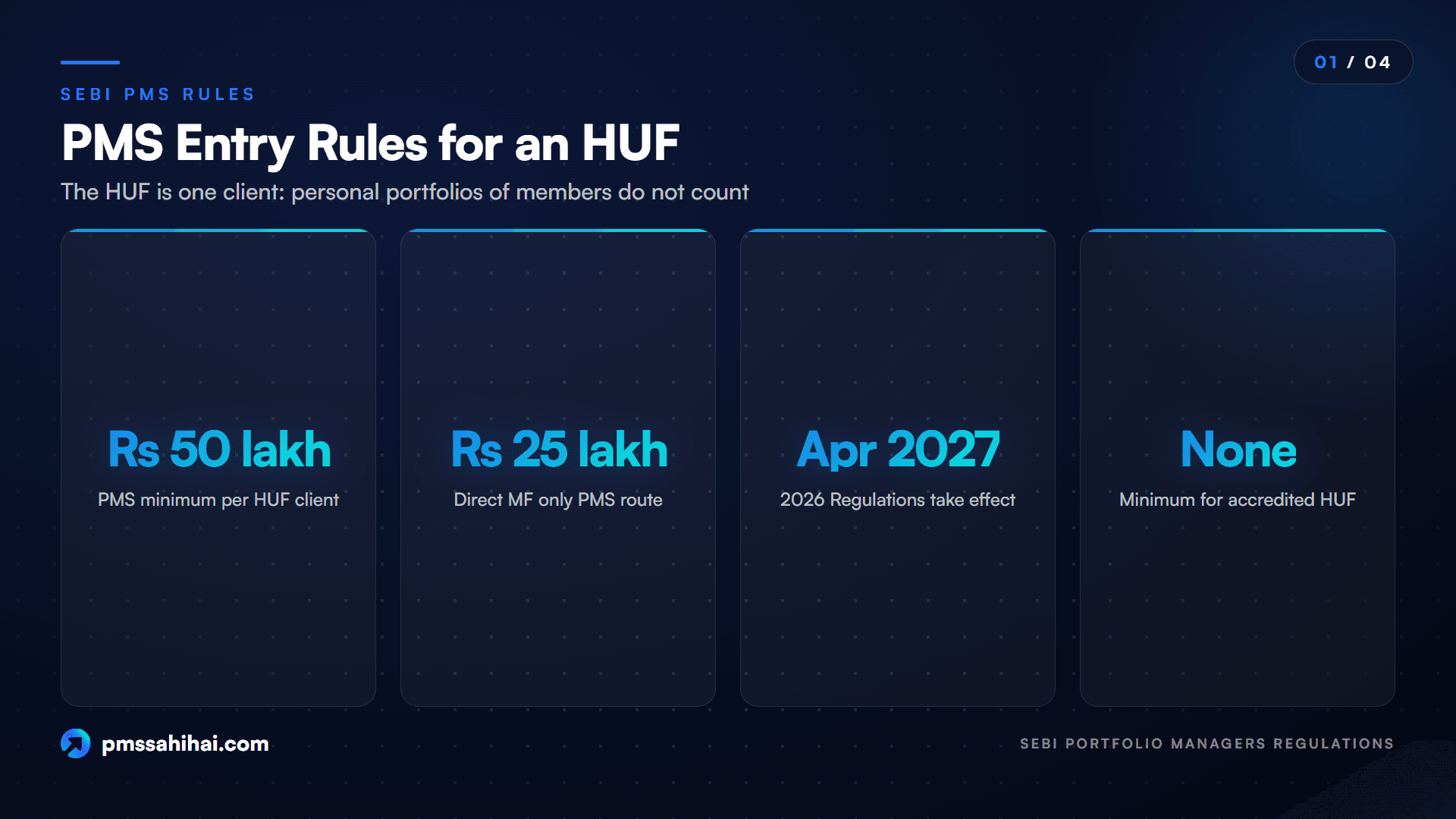
Regulation 23(2) of the 2020 Regulations says a portfolio manager "shall not accept from the client, funds or securities worth less than fifty lakh rupees". The HUF is one client. Its corpus cannot be topped up by counting the karta's personal portfolio or a coparcener's savings, because those belong to different persons with different PANs.
The minimum can be met with cash, with securities transferred from the HUF's existing demat account, or with a mix of both. The same regulation exempts an accredited investor from the minimum, subject to disclosures and the terms agreed with the manager. An HUF that holds an accreditation certificate can therefore open a PMS mandate below Rs 50 lakh, if a manager offers one.
How the threshold is measured for top-ups and withdrawals is covered in our guide to how the Rs 50 lakh threshold is measured. For an HUF the point is simpler: the money must already sit in the HUF before the mandate starts.
What Changes Under the Portfolio Managers Regulations 2026
SEBI notified the SEBI (Portfolio Managers) Regulations, 2026 on 7 October 2026, and they take effect on 1 April 2027. Until then the 2020 Regulations and the July 2025 Master Circular for Portfolio Managers apply. The new text keeps the Rs 50 lakh minimum per client in regulation 16(3) and the accredited investor exemption in regulation 16(4). It also creates a route for portfolio managers investing only in direct mutual fund plans with a Rs 25 lakh minimum. Nothing in the 2026 text singles out HUFs, so an HUF should be able to use the new route on the same footing as any other client once it opens.
Can an HUF Invest in AIFs? Minimums, Categories and Accreditation
Yes, and here the rule text is explicit. Regulation 10(a) of the SEBI (Alternative Investment Funds) Regulations, 2012 lets an AIF raise funds from any investor, whether Indian, foreign or non-resident. The accredited investor definition in regulation 2(1)(ab)(i) names "an individual, Hindu Undivided Family, family trust or sole proprietorship" as the first group. So the answer to "can HUF invest in AIF" is not a matter of interpretation.
All three categories are open to an HUF: Category I (venture capital, infrastructure), Category II (private equity, private credit, real estate) and Category III (listed-market strategies that may use leverage). The category changes how the HUF is taxed, covered below.
The Rs 1 Crore Rule and the Accredited Investor Route
Regulation 10(c) says an AIF "shall not accept from an investor, an investment of value less than one crore rupees". The relaxations are narrow: Rs 25 lakh for employees or directors of the AIF or its manager, Rs 1,000 for certain social impact funds, and no minimum at all for an accredited investor. For an HUF, the only realistic way below Rs 1 crore is accreditation.
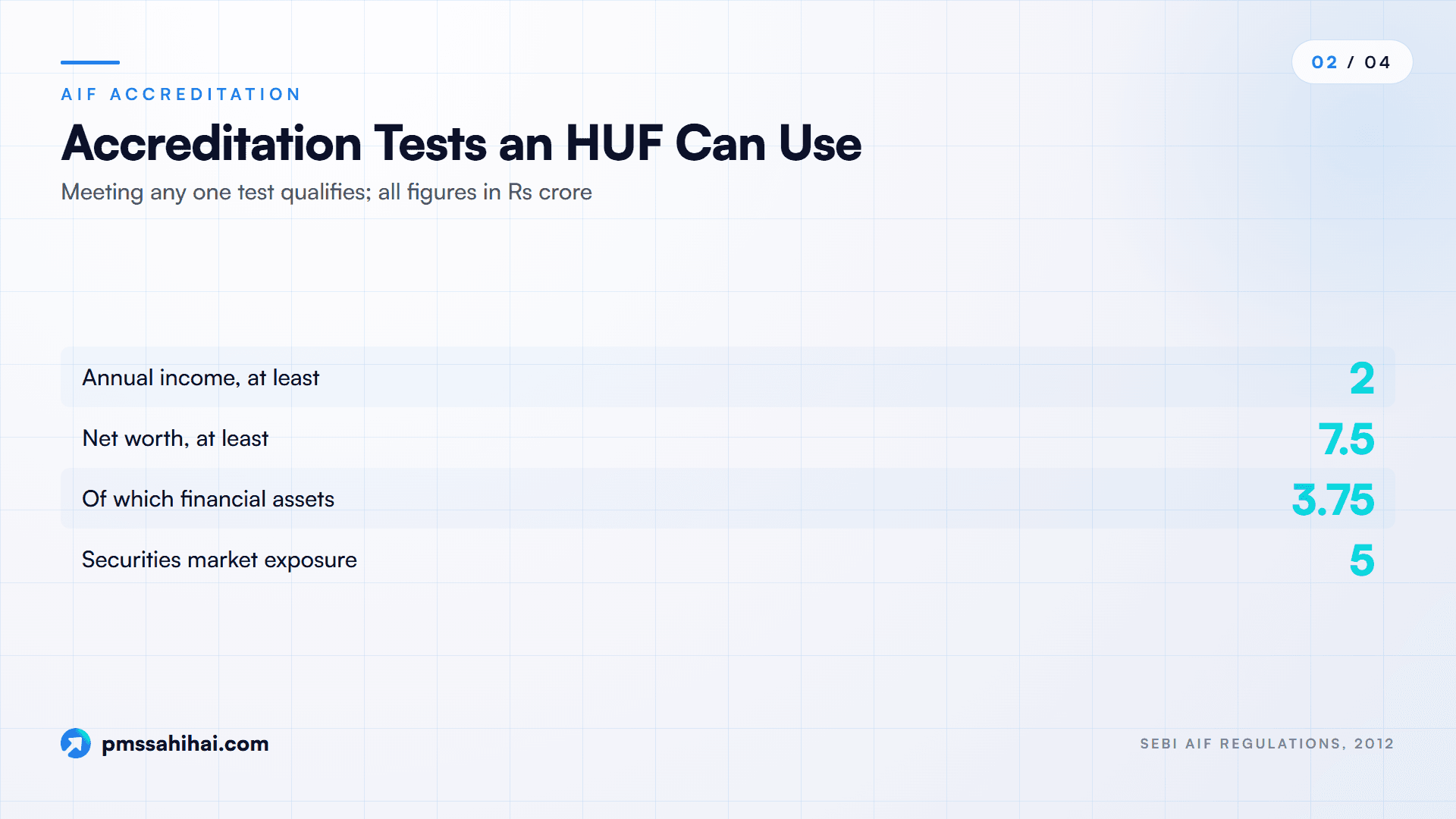
An HUF qualifies as an accredited investor if it meets any one of these tests:
| Test | Threshold for an HUF |
|---|---|
| Annual income | At least Rs 2 crore |
| Net worth | At least Rs 7.5 crore, of which at least Rs 3.75 crore in financial assets |
| Income plus net worth | At least Rs 1 crore income and Rs 5 crore net worth, of which at least Rs 2.5 crore in financial assets |
| Securities market exposure | At least Rs 5 crore, as specified by SEBI (from 15 October 2026) |
SEBI's AIF Master Circular of June 2026 adds one HUF-specific detail: the value of the primary residence of the karta is not counted when calculating the HUF's net worth.
Accreditation also opens accredited-investors-only funds and large value funds, where the ticket is Rs 25 crore.
The Securities Market Exposure Test Added in October 2026
The SEBI (AIF) (Third Amendment) Regulations, 2026 took effect on 15 October 2026. They added clause (D), "securities market exposure of at least five crore rupees, as specified by the Board", to the list that applies to individuals, HUFs, family trusts and sole proprietorships. The same amendment lets specified SEBI-registered or regulated entities grant accreditation, in addition to accreditation agencies.
For an HUF with a large equity and mutual fund portfolio but modest income, this is the most practical route. But "as specified by the Board" matters: as of 27 October 2026 we could not find the implementing circular on SEBI's website explaining how exposure is measured or which entities may accredit. Treat the test as law on paper, with the mechanics pending.
How Accreditation Works for an HUFAccreditation is not a self-declaration. The HUF applies to an accreditation agency, which issues a certificate carrying a unique number, the agency's name, the HUF's PAN and the validity dates. SEBI's Master Circular lists the documents: the HUF's PAN, an officially valid document, and either income tax returns or a net worth certificate from a practising chartered accountant that is not older than six months. The certificate is valid for two years if the criteria were met in the preceding financial year, or three years if they were met in each of the two preceding financial years.
Opening an HUF PMS Account: KYC, Karta and Demat Steps
Opening an HUF PMS account or an AIF folio is mostly paperwork. Every intermediary follows the same SEBI list for HUF KYC and then adds its own requirements.
Documents SEBI Requires for HUF KYC
SEBI's Master Circular on KYC norms for the securities market, dated 12 October 2023, treats an HUF as a non-individual. Paragraph 31(iv) asks for three additional items:
- a deed of declaration of the HUF, or a list of coparceners;
- a bank passbook or bank statement in the name of the HUF; and
- the photograph, proof of identity, proof of address and PAN of the karta.
On top of this, every intermediary asks for the HUF's own PAN, and most ask the karta to sign every page under the HUF's rubber stamp. Broker checklists show the variations: Zerodha asks for an HUF bank statement no older than two months, coparceners' photographs and signatures, and a notarised death certificate if the previous karta has died. Groww asks for an HUF deed and an extra declaration when the karta is a woman. Zerodha also says an HUF account must be opened offline if the karta is an NRI.
Step-by-Step Onboarding for a PMS or AIF
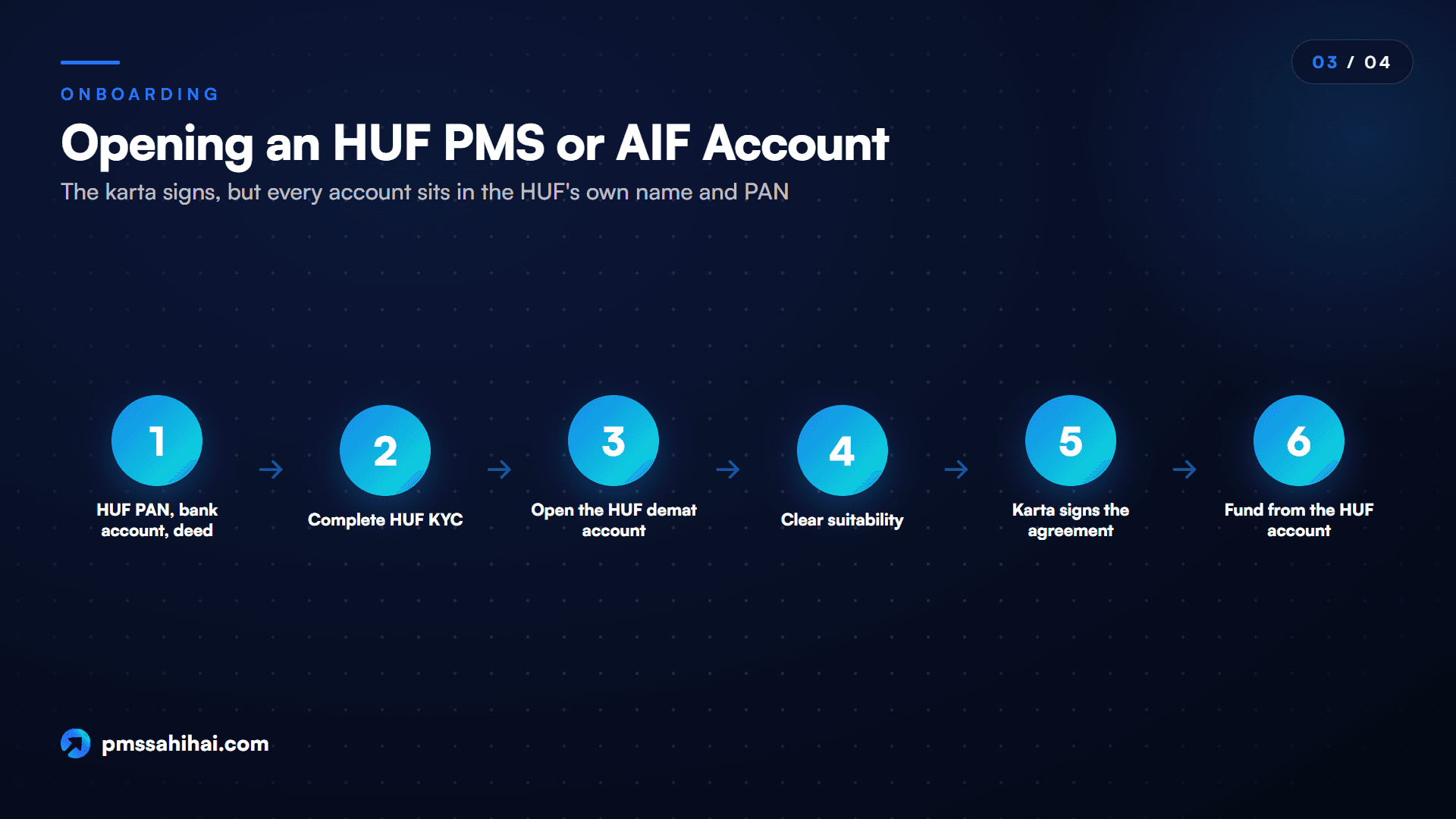
- Get the HUF basics in order. The HUF needs its PAN, a bank account in its own name and a signed deed of declaration listing the karta, coparceners and members.
- Complete HUF KYC. KYC is done once through a KYC registration agency and then reused by the portfolio manager, AIF and broker.
- Open or confirm the HUF demat account. A PMS buys securities into a demat account in the client's name, and AIF units are issued in dematerialised form. Our understanding from broker FAQs is that HUF demat accounts at CDSL-based brokers cannot carry a nominee, because CDSL allows nomination only for individual accounts.
- Clear suitability. The karta answers the risk-profile questions, but for the family's needs, not personal ones.
- Sign the agreement. The karta signs the PMS agreement or the AIF contribution agreement on behalf of the HUF. Some managers also ask adult coparceners to sign a no-objection, though this comes from their own policy rather than a SEBI rule.
- Fund from the HUF's own account. Payments from the karta's personal account create a KYC problem and, as explained below, a tax problem.
- Keep AIF drawdowns funded. Category I and II funds call capital over several years, so the HUF bank account needs liquidity for each call.
What Happens When the Karta Dies
SEBI's circular of 26 August 2022 on HUF demat accounts says the deceased karta's name in the beneficial owner account "shall be replaced by the new Karta of the HUF", who is either the eldest coparcener or a coparcener appointed as karta by agreement among all coparceners. The HUF continues, and the securities do not pass to anyone's estate because they never belonged to the karta personally. Expect requests for the death certificate, the new karta's KYC and a fresh declaration of coparceners.
How PMS Gains and AIF Income Are Taxed in an HUF
HUF taxation follows one principle: the income belongs to the HUF and is taxed in its return, verified by the karta. Members do not pay tax on what the HUF later distributes to them out of its income, because Schedule III, serial 1 of the 2025 Act excludes such sums from a member's income. These rules apply from tax year 2026-27. Treat this section as a map and confirm figures with a tax adviser.
PMS Capital Gains, Dividends and Interest
For HUF taxation, the key fact is that a PMS is not a pooled fund. The HUF owns every share in its demat account, so every sale by the manager is a sale by the HUF.
| Income from the PMS | How the HUF is taxed |
|---|---|
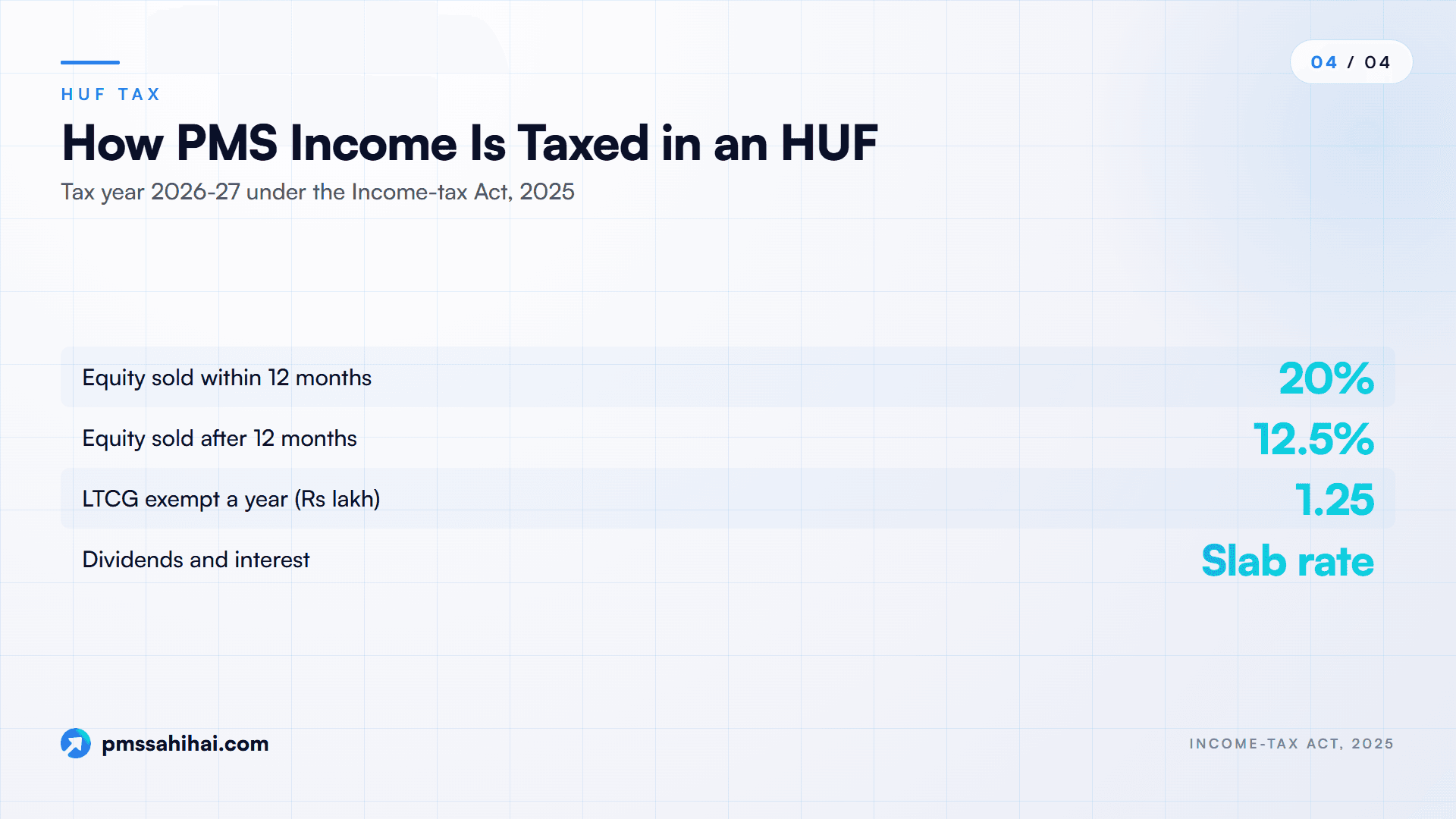
| Listed equity sold within 12 months | 20% under section 196 (old 111A) |
| Listed equity sold after 12 months | 12.5% above Rs 1.25 lakh a year under section 198 (old 112A) |
| Dividends and interest | Added to income and taxed at the HUF's slab rate |
| Frequent trading treated as business | Slab rates, if the facts show trading rather than investment |
A resident HUF gets one useful relief. Under sections 196(2) and 198(3), if the HUF's other income is below the basic exemption limit, the shortfall is set off against its short-term or long-term gains before the special rate applies. An HUF with little other income can pay less on its PMS gains than a karta in the top slab.
AIF Income by Category
- Category I and II AIFs: these are pass-through for most income. Under section 224(1), income the HUF earns through the fund is taxed as if the HUF had made the investments directly. The fund deducts tax at source when it distributes or credits income, and the HUF claims credit in its return; our Category II AIF tax walkthrough shows the forms line by line. Business income, if any, is taxed at the fund level.
- Category III AIFs: there is no statutory pass-through. The fund pays tax as a trust at the top rates, and the HUF typically receives post-tax returns. Whether redemption gains are taxed again in the investor's hands is not settled.
New Regime Default and No Rebate
Under section 202, the new tax regime is the default for HUFs, as it is for individuals. The slabs are nil up to Rs 4 lakh, then 5%, 10%, 15%, 20% and 25% in Rs 4 lakh steps, and 30% above Rs 24 lakh, plus surcharge and 4% cess. An HUF can opt for the old regime instead; for tax year 2026-27 the option is exercised in the return itself.
Two traps catch first-time HUF investors. First, the section 156 rebate is limited to "an individual resident in India", so an HUF does not get it. Second, the old regime's Rs 1.5 lakh deduction under section 123 (old 80C) is available to an HUF only if it chooses the old regime.
Funding the HUF Corpus Without Triggering Clubbing
This is where most HUF plans go wrong. The HUF must hold Rs 50 lakh or Rs 1 crore before it can invest, but where that money comes from decides whose income the PMS gains will be.
Money a member throws into the pool. Section 99(3) of the 2025 Act (old section 64(2)) covers property an individual converts into HUF property without adequate consideration, whether by impressing it with the family's character, throwing it into the common stock or transferring it to the family. The income from that property "shall be deemed to be income of the individual". If the karta moves Rs 60 lakh of personal savings into the HUF and the HUF hands it to a portfolio manager, the PMS gains are taxed in the karta's return, not the HUF's. The HUF gains nothing for tax purposes.
Gifts from outsiders. Section 92(2)(m) taxes gifts of money or property above Rs 50,000 a year in the recipient's hands. The exemption for gifts from a "relative" helps less than people expect, because for an HUF, section 92(5) defines "relative" as any member of the HUF. A gift from a maternal grandparent, an uncle by marriage or a family friend, none of whom are members, can therefore be taxable income of the HUF in the year it is received.
Sources that usually work. Ancestral property and its income, assets received on partition of a larger HUF, property inherited under a will in the HUF's name, gifts from non-members within the limits, and the HUF's own accumulated income generally do not attract clubbing. Inheritance and gifts in contemplation of death are exempt under section 92(3).
Trace the corpus before choosing the investor: if it came from one member's savings, open the PMS in that member's name.
Where an HUF Structure Helps a PMS or AIF Investor
When the HUF already holds genuine family wealth, HUF investment in PMS or AIFs has real advantages.
- A second tax slab. PMS gains, dividends and AIF income are assessed in the HUF's return rather than piled on top of the karta's personal income.
- Basic exemption against gains. A resident HUF with little other income can use the shortfall below the exemption limit against its capital gains under sections 196(2) and 198(3).
- Accreditation in its own right. HUFs are named in the accredited investor definition, so a well-capitalised HUF can access accredited-only AIFs, large value funds and below-minimum PMS mandates on its own merits.
- One decision-maker. The karta signs agreements and approves drawdowns without collecting every member's signature.
- Continuity on the karta's death. The holdings stay with the HUF, and SEBI's rule replaces the karta on the demat account without the securities passing through anyone's estate.
How PMS Sahi Hai Helps an HUF Read the Inner Clause of a PMS or AIF
PMS Sahi Hai does not have a dedicated HUF product or HUF filter, and we would rather say so than pretend otherwise. What it offers is the same research layer any investor gets, and for HUF investment in PMS that layer matters because the karta is choosing for the whole family.
- Shortlist strategies before the paperwork starts. The PMS listing can be filtered by category label and benchmark, and each strategy page shows trailing returns beside the stated benchmark. The AIF comparison page lists funds across Category I, II and III with strategy, vintage, lock-in and a Nyra score, so a Rs 1 crore commitment from the HUF is weighed against real alternatives.
- Ask Nyra the HUF-shaped questions. Nyra, the platform's AI research tool, can help the karta frame questions for a manager: how the strategy's turnover affects short-term gains that the HUF will pay tax on, how long an AIF's drawdowns will run, and what the exit terms are if the family later partitions. Its published methodology scores strategies on five weighted pillars and shows a strategy with under 12 months of track record as "Not Rated", so check whether a score exists before relying on it.
- Go deeper on tax without repeating it here. Our guides explain how PMS gains are taxed in your own hands, why AIFs are not simply tax-free and how Category III AIF income is taxed at the fund level. Every one of them applies to an HUF, with the HUF's own slab and basic exemption in place of an individual's.
What the platform cannot do is decide whether the HUF should be the investor at all. That turns on where the corpus came from and on the family's plans, which is a conversation for the karta, the coparceners and a tax adviser.
Limits and Risks of Investing Through an HUF
HUF investment in PMS and AIFs also has costs that rarely appear in HUF marketing.
- The minimum is per HUF, not per family. The HUF needs Rs 50 lakh for a PMS and Rs 1 crore for an AIF in its own name, unless it is accredited.
- Clubbing can cancel the benefit. Money thrown into the pool by a member is taxed back to that member under section 99(3).
- No rebate and few deductions. The section 156 rebate is not available, and the new regime default switches off most deductions.
- Gift limits are tight. Only members count as relatives, so gifts from the wider family can be taxable.
- No nominee on many demat accounts. Succession depends on the karta-replacement rule and the family's agreement, not on a nominee.
- Exit is hard. The Income-tax Act does not recognise partial partitions made after 31 December 1978 (section 315(8)). Breaking a PMS or a locked-in AIF commitment out of the HUF usually means a total partition, which is a family and legal decision, not just a redemption.
- Karta concentration. One person controls the account; if the karta moves abroad, residential status and KYC can change.
Deciding Whether the HUF Should Hold the Mandate
HUF investment in PMS and AIFs is clearly allowed. The harder question is whether the HUF is the right owner. Start with three checks. Does the HUF already hold at least Rs 50 lakh, or Rs 1 crore for an AIF, from sources that will not be clubbed back to a member? Does its tax position, after the default regime and the missing rebate, actually beat the karta's personal slab? And is the family comfortable that this money will stay joint for the life of the PMS mandate or the AIF's tenure?
If all three answers are yes, the HUF is a sensible investor, and accreditation may widen its options. If the corpus would have to be created from a member's savings, the tax case largely disappears and investing in that member's name is simpler. Either way, involve a tax adviser before the first rupee moves. Tools such as PMS Sahi Hai and Nyra can narrow the list of managers and funds, but the ownership decision belongs to the family.
Take the Next Step With Your Family's PMS or AIF Shortlist
If your HUF already holds a genuine family corpus, the next step is to choose the right strategy and check the paperwork before the karta signs. Use the PMS Sahi Hai comparison tool to shortlist portfolio managers by benchmark and record, scan the AIF comparison page if the HUF is weighing a Rs 1 crore commitment, and ask Nyra to help frame your questions on fees, lock-ins and tax. Confirm your HUF KYC and HUF demat account are in order, speak to a tax adviser about where the corpus came from, or book a 15-minute conversation with the PMS Sahi Hai team. That way, the HUF invests with its eyes open.
PMS Sahi Hai is a distributor of Portfolio Management Services and Alternative Investment Funds, APMI-registered (Registration No. APRN08358). This article is for education only and is not investment advice, a recommendation, or an offer to buy or sell any security. Investments in securities markets are subject to market risks; read all scheme-related documents carefully. Past performance is not indicative of future results. Consult your advisor before investing.
Ishaan founded PMS Sahi Hai to make India's PMS, AIF and GIFT City markets legible to serious investors, comparing every SEBI-registered manager on the same comparative basis, with no shelf products and no commission bias.
Frequently asked
Can an HUF invest in PMS?
Yes. The SEBI (Portfolio Managers) Regulations, 2020 do not exclude HUFs, and SEBI's KYC rules include a document list for them. The HUF is one client, so it must invest at least Rs 50 lakh in cash or securities unless it is an accredited investor. The karta signs, and the bank and demat accounts must be in the HUF's name.
Can HUF invest in AIF schemes of every category?
Yes. AIFs may raise money from any investor, and the AIF Regulations name the Hindu Undivided Family in the accredited investor definition. An HUF can invest in Category I, II or III funds. The minimum commitment is Rs 1 crore unless the HUF is accredited, and the category decides tax: Categories I and II are largely pass-through, while Category III pays tax at the fund level.
Who signs the PMS agreement for an HUF?
The karta signs the PMS or AIF agreement on behalf of the HUF, usually under the HUF's stamp, and also completes KYC and verifies the HUF's tax return. Some managers ask adult coparceners for a no-objection letter as internal policy, but SEBI's KYC list only requires the karta's identity documents and a list of coparceners.
What documents does an HUF need for KYC?
SEBI's KYC master circular asks an HUF for a deed of declaration or list of coparceners, a bank passbook or statement in the HUF's name, and the karta's photograph, proof of identity, proof of address and PAN. Intermediaries also ask for the HUF's own PAN, and brokers add items such as a recent bank statement or coparceners' signatures.
Can an HUF be an accredited investor?
Yes. An HUF qualifies with annual income of Rs 2 crore, or net worth of Rs 7.5 crore with Rs 3.75 crore in financial assets, or Rs 1 crore income plus Rs 5 crore net worth. Since 15 October 2026 there is also a Rs 5 crore securities market exposure test, though SEBI's implementing circular was still awaited. The karta's primary residence is excluded from net worth.
How is PMS income of an HUF taxed?
Under HUF taxation rules, PMS gains are taxed in the HUF's own return because the HUF owns the shares. Listed equity gains are taxed at 20% if held up to 12 months and 12.5% above Rs 1.25 lakh if held longer, while dividends and interest are taxed at the HUF's slab rate. A resident HUF can use any unused basic exemption against these gains. Confirm your position with a tax adviser.
Does an HUF get the tax rebate available to individuals?
No. The section 156 rebate under the Income-tax Act, 2025 (old section 87A) is available only to an individual resident in India. An HUF with modest income may therefore pay tax that an individual with the same income would not. The new regime is the HUF's default, and the old regime remains an option exercised through the return.
What happens to an HUF demat account when the karta dies?
Under SEBI's circular of 26 August 2022, the deceased karta's name is replaced on the demat account by the new karta, who is the eldest coparcener or a coparcener chosen by agreement of all coparceners. The securities stay with the HUF. The portfolio manager or AIF will ask for the death certificate and the new karta's KYC before processing instructions.
Keep reading
All articles
What Is Factor Investing? Momentum, Quality and Value for PMS Investors
What factor investing means for PMS investors: momentum, quality, value and low volatility, Indian factor index data, cycles, costs and tax.

What Is a Private Trust? How HNIs Use Trusts to Protect Wealth
What a private trust is under Indian law, revocable vs discretionary choices, 2025 Act tax rules, and how family trusts hold PMS and AIF portfolios.
What Is MF-Based PMS? SEBI’s PRIM Route From ₹25 Lakh Explained
MF-based PMS explained: what SEBI's PRIM rules say, the ₹25 lakh minimum, the 1% fee cap awaiting a circular, tax on switches and the April 2027 start.
Read it. Now pressure-test it.
Ask Nyra how this applies to your portfolio, or talk to our team, no pitch, no pressure.