
Passive Management in PMS: Can a Portfolio Manager Just Track an Index?
Can a PMS be passive? Index replication, direct indexing, rule-based models, SEBI's rules and what a passive PMS costs against a 0.04% ETF.

Passive management in PMS means a portfolio manager tries to match an index rather than beat it. SEBI's rules do not ban it, but they require a discretionary manager to run each client's account individually, so a passive PMS is a collection of separate, index-like portfolios rather than a pooled fund. It can be built by full index replication, by sampling, by mechanical rules or by copying one model portfolio. Its real advantages are direct indexing benefits: tax-loss harvesting on single stocks and exclusions an index fund cannot offer. Against a Nifty 50 ETF costing 0.04% a year, those advantages have to pay for a PMS fee, 18% GST and a ₹50 lakh minimum.
Why Passive Management in PMS Sounds Like a Contradiction
A portfolio management service is usually sold as the opposite of passive investing. You hand ₹50 lakh or more to a SEBI-registered manager because you want judgment: a concentrated book, sector views, a willingness to look different. Passive investing buys the index and accepts the market's return minus a small cost.
So can a PMS be passive at all? The short answer is yes, but not in the way a mutual fund is passive, and rarely in a form that is cheaper than one. Passive management in PMS is possible in four forms: holding every stock of an index in your own demat account, holding a sample of it, following a published rulebook, or copying one model portfolio across many accounts. Each comes with different costs, tax effects and degrees of real passivity.
The broad active-versus-passive debate across mutual funds, ETFs and PMS, and the styles of active PMS management, have their own explainers. Here we stay on one question: what happens when a PMS tries not to be active.
What Passive Portfolio Management Means and Where It Came From
Passive portfolio management is an approach that aims to match the return of a chosen index, such as the Nifty 50, by holding its constituents in roughly their index weights, rather than trying to beat it. The manager's job shifts from choosing stocks to following the index closely and cheaply.
Passive does not mean doing nothing. Indices change their constituents, companies issue bonus shares, merge or demerge, dividends arrive as cash and new money comes in. A passive manager still trades, but only to stay aligned with the index, not to express a view.
From Wells Fargo's 1973 Index Fund to Nifty BeES
The idea took shape in the United States in the early 1970s:
- 1973: Wells Fargo and American National Bank set up the first index funds on the S&P Composite, open only to institutions.
- 1974: John Bogle founded Vanguard.
- 31 December 1975: Vanguard's First Index Investment Trust, tracking the S&P 500, began with about $11 million. By 2000, as the Vanguard 500, it had overtaken Fidelity's Magellan Fund in size.
India followed through exchange-traded and index funds rather than separate accounts:
- 22 April 1996: NSE launched the Nifty 50.
- 28 December 2001: Nifty BeES, India's first ETF, was launched. It is now run by Nippon India Mutual Fund.
- 7 October 2026: SEBI notified the Portfolio Managers Regulations, 2026, which take effect on 1 April 2027 and add a mutual-fund-only PMS route, discussed below.
How Big Passive Investing Has Become in India
Passive money in India sits mostly in mutual fund structures. According to AMFI's monthly data for September 2026, there were 376 index funds with net assets of about ₹3.20 lakh crore and 359 ETFs with about ₹11.50 lakh crore on 30 September 2026. Together that is roughly ₹14.7 lakh crore, or close to 18% of the industry's ₹82.64 lakh crore in assets, on our calculation.
Inside the PMS industry, passive approaches are rare. SEBI has no "passive PMS" category, and listed strategies are overwhelmingly stock-picking ones.
Can a PMS Be Passive Under SEBI's Rules?
Nothing in the regulations bans a passive investment approach. But two rules shape what a passive PMS can look like.
The "Does Not Partake Character of a Mutual Fund" Test
Regulation 23(1) of the SEBI (Portfolio Managers) Regulations, 2020 says the discretionary portfolio manager "shall individually and independently manage the funds of each client in accordance with the needs of the client, in a manner which does not partake character of a Mutual Fund." The same wording appears in regulation 16(1) of the 2026 Regulations notified on 7 October 2026.
This is the heart of the matter. A mutual fund pools everyone's money, issues units and holds one portfolio. A PMS may not do that. Each client's securities sit in a separate account in the client's own name, and the 2026 text repeats the requirement that holdings be segregated client by client.
So a passive PMS cannot be "an index fund with a higher minimum." It is a set of individual portfolios, each with its own cost basis and tax history. That is a burden, and also the source of every genuine advantage a passive PMS has.
Discretionary, Non-Discretionary and Advisory Routes
- Discretionary PMS: the manager "exercises or may exercise, complete discretion" over investments, so staying passive is the manager's choice, not a guarantee.
- Non-discretionary PMS: the manager acts "in accordance with the direction of the client", so a client could, in principle, direct an index-tracking portfolio.
- Advisory: the manager advises, and the client decides and executes.
The minimum is ₹50 lakh per client under the 2020 Regulations, a figure the 2026 Regulations keep; accredited investors can be exempted.
Benchmarks Are Mandatory, Passive Labels Are Not
Since SEBI's performance benchmarking circular of 16 December 2022, now part of the July 2025 Master Circular for Portfolio Managers, every investment approach must be tagged to one broad strategy (Equity, Debt, Hybrid or Multi Asset) and must report against one benchmark chosen from a short list that APMI prescribes for that strategy. Performance has to be shown as a time-weighted rate of return beside the benchmark's trailing return.
That lets you see how closely a passive PMS tracks its benchmark. But no label tells you a strategy is passive. Names such as "smart beta" or "index plus" are marketing words, not regulatory categories, so read the disclosure document's investment approach.
Four Ways a PMS Can Run Money Passively
The four routes sit on a spectrum from strictly passive to systematic-but-active.
Full Index Replication in Your Own Demat Account
Full replication means holding every index constituent at its index weight. For the Nifty 50 that means 50 stocks; for the Nifty 500, five hundred.
Full replication tracks most closely but works best when an index has few, liquid constituents. The Nifty 50 fits: every constituent must be eligible for futures and options trading and trade at low impact cost, according to NSE's Nifty 50 factsheet. A broad index like the Nifty 500 is much harder to replicate fully in one client account.
Sampled and Optimised Replication
When full replication is impractical, a manager can hold a subset of the index:
- Stratified sampling splits the index into cells, usually by sector and size, and buys the most liquid stocks in each cell so that the portfolio's sector and size profile matches the index.
- Optimisation uses software to pick the combination of stocks that minimises expected tracking error against the index, subject to constraints such as a maximum number of holdings or excluded sectors. Its weakness is that it relies on historical correlations, which can break down.
- A blended approach fully replicates the largest, most liquid stocks and samples the tail.
J.P. Morgan Asset Management, for instance, describes approximating the S&P 500 with about 350 of its 500 stocks in direct-indexing accounts. Sampling cuts trading cost but adds deliberate deviation.
Rule-Based and Factor Models: Systematic Is Not Passive
A rule-based PMS screens a universe, scores stocks on traits such as value, momentum, quality or low volatility, and rebalances on a schedule. Because no human picks stocks, these are sometimes called passive.
They are better described as systematic active management. A rulebook that picks 25 momentum stocks out of 500 and replaces half of them every quarter makes active bets, just mechanically, usually with active-style turnover and fees. Our explainer on how quant PMS works covers these strategies in detail, and factor indices sold as index funds and ETFs are a separate topic.
The test is simple: if the strategy's rules are designed to beat the benchmark, it is not passive, however automated it is.
Model Portfolios: One Rulebook Copied Across Many Accounts
Almost every PMS strategy runs a model portfolio: a master list of holdings and weights copied into each client's account, as our explainer on model portfolios in PMS describes. Because the rules require separate accounts, the model is how a manager runs hundreds of portfolios consistently.
For a passive strategy the model portfolio is simply the index, or a sample of it. But your account will never match it exactly, because:
- you joined on a different day and bought at different prices;
- your capital size forces rounding to whole shares;
- you may hold legacy shares transferred in or have exclusions;
- top-ups and withdrawals change your weights.
SEBI recognises this. The PMS Master Circular's performance reporting rules bar portfolio managers from mentioning or implying model portfolio returns in performance reporting, and requires them to show each investor's own return alongside the minimum, maximum and median returns across all investors in that approach. When you assess a passive PMS, ask for that spread: in a truly index-tracking strategy, the gap between the best and worst client should be small.
A fifth route, using ETFs and index funds as building blocks, is covered in our separate guide to ETF-based PMS strategies, where the manager's role is allocation rather than replication.
Replicating the Nifty 50 in a ₹50 Lakh PMS: A Worked Example
Here is what index replication looks like at the SEBI minimum. On NSE's Nifty 50 factsheet dated 30 October 2026, the ten largest constituents carry these weights:
| Constituent | Index weight | Target in a ₹50 lakh account |
|---|---|---|
| HDFC Bank | 9.95% | ₹4,97,500 |
| ICICI Bank | 9.39% | ₹4,69,500 |
| Reliance Industries | 7.30% | ₹3,65,000 |
| Bharti Airtel | 5.63% | ₹2,81,500 |
| Larsen & Toubro | 4.25% | ₹2,12,500 |
| Infosys | 3.92% | ₹1,96,000 |
| State Bank of India | 3.73% | ₹1,86,500 |
| Axis Bank | 3.28% | ₹1,64,000 |
| Kotak Mahindra Bank | 3.19% | ₹1,59,500 |
| Bajaj Finance | 2.40% | ₹1,20,000 |
| Top 10 total | 53.04% | ₹26,52,000 |
Financial services alone make up 37.13% of the index. These large positions need dozens or hundreds of shares, so rounding barely moves their weights.
The Rounding Problem
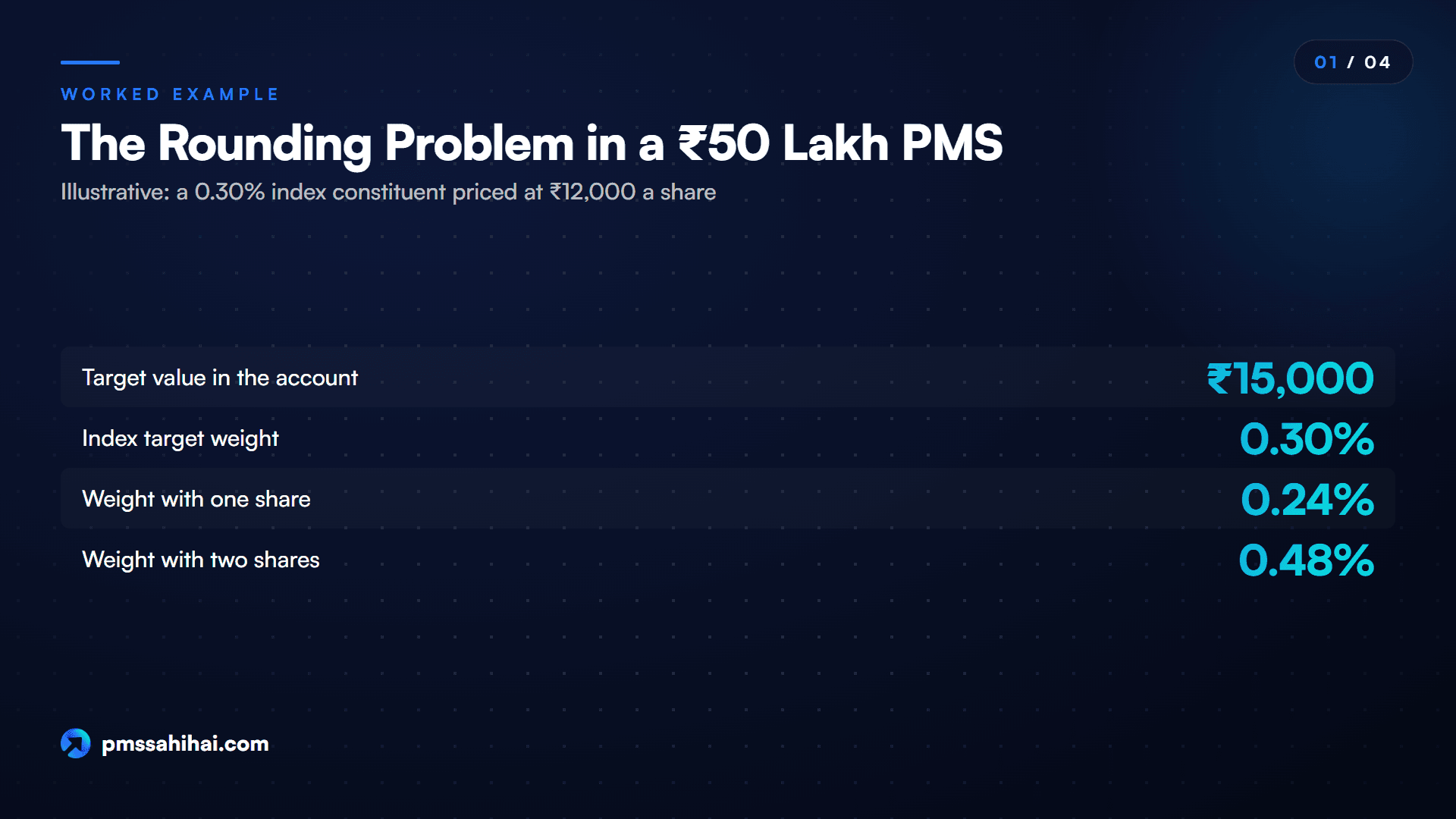
The trouble is at the bottom of the index. Take a hypothetical constituent with an index weight of 0.30% and a share price of ₹12,000. Its target in a ₹50 lakh account is ₹15,000. The manager can buy:
- one share (₹12,000, a weight of 0.24%), or
- two shares (₹24,000, a weight of 0.48%).
Neither matches the index. Across the smaller names, these gaps add up and some cash is left uninvested. At ₹5 crore, the same stock needs 12 or 13 shares, and the error is small.
There is no simple fix. The Companies Act, 2013 does not provide for fractional shares in listed trading. A Company Law Committee report in 2022 recommended enabling them in demat form, but we found no evidence that this has been implemented. A small account therefore tracks a broad index less precisely than a large one.
Rebalancing, Corporate Actions and Cash
The Nifty 50 is reviewed semi-annually, using data to 31 January and 31 July, with four weeks' notice of changes. Each change means a sale and a purchase in every client account.
Index mutual funds work under a clear standard. SEBI's Master Circular for Mutual Funds requires an equity index fund or ETF to rebalance within seven calendar days of an index constituent change, caps its tracking error at 2% (barring force majeure) and requires it to publish tracking error daily. A PMS has no equivalent tracking-error cap, so ask the manager:
- How many days after an index change are client accounts rebalanced?
- How are dividends reinvested, and how much cash is held?
- What is the realised tracking difference against the Nifty 50 TRI, net of fees?
Direct Indexing: The Strongest Case for a Passive PMS
If a passive PMS tracks less precisely than an index fund and costs more, why choose it? The answer is direct indexing: owning the index's stocks individually, so taxes and preferences can be managed stock by stock. The separate accounts SEBI requires make this possible.
Tax-Loss Harvesting Under Indian Loss Rules
In an index fund you own units, so you cannot use the losses on its weakest stocks. In a directly held index portfolio, some stocks are down even when the index is up, and those losses are yours to use.
Under the Income-tax Act, 2025, which applies from 1 April 2026, a short-term capital loss can be set off against any capital gain, short-term or long-term, under section 108 (formerly section 70). A long-term capital loss can be set off only against long-term gains. Unused losses can be carried forward for eight tax years under section 111 (formerly section 74), provided the return is filed on time.
A simple illustration, with hypothetical numbers:
- During the year, an investor books ₹4 lakh of short-term gains elsewhere, taxable at 20% on listed equity.
- In the direct-indexing account, three stocks are down a combined ₹4 lakh, all held for under 12 months.
- The manager sells them and buys similar stocks from the same sectors to keep the index exposure close.
- The ₹4 lakh loss offsets the ₹4 lakh gain, saving about ₹80,000 of tax this year, before surcharge and cess.
Two caveats matter. Harvesting usually defers tax rather than eliminating it, because the replacement stocks have a lower cost base. And whether you can buy back the same stock quickly without the loss being questioned is a question for your tax adviser, not your portfolio manager. Consult a qualified tax adviser before relying on any harvesting strategy.
Exclusions and Personal Tilts
The second advantage is customisation. A directly held index can:
- exclude your employer's stock if you already hold a large amount through ESOPs;
- exclude a sector or company for ethical reasons;
- avoid stocks that would breach a compliance restriction if you are an insider;
- accept shares you already own as part of the portfolio, rather than selling them.
An index fund cannot do any of this, though each exclusion moves you away from the index.
Where Direct Indexing Stands in India Today
In the United States, direct indexing is a mature business run by large asset managers. In India it is early-stage. A January 2024 overview by Equirus Wealth described only a handful of platforms offering it, at minimums well above an index fund's, and pointed to the lack of fractional shares as a constraint. Our own searches found no widely reported Indian PMS launch built around direct indexing since then.
The practical choices are a PMS manager willing to run an index-based approach with harvesting rules, a non-discretionary arrangement in which you direct index-like holdings, or a do-it-yourself basket of index stocks.
Passive PMS Fees Compared With Index Funds and ETFs
Cost is where passive management in PMS is hardest to defend. An index portfolio delivers roughly the index return by design, so every rupee of fee comes straight out of it.
The benchmarks are low:
- Nippon India ETF Nifty 50 BeES lists an expense ratio of 0.04%, according to its Business Today fund page.
- Under the SEBI (Mutual Funds) Regulations, 2026, the maximum base expense ratio for an index fund or ETF is 0.90% of daily net assets. That is a ceiling, not a typical figure.
- PMS fixed fees typically run from 1% to 2.5% a year, according to our published fee guide, and GST at 18% applies on top.
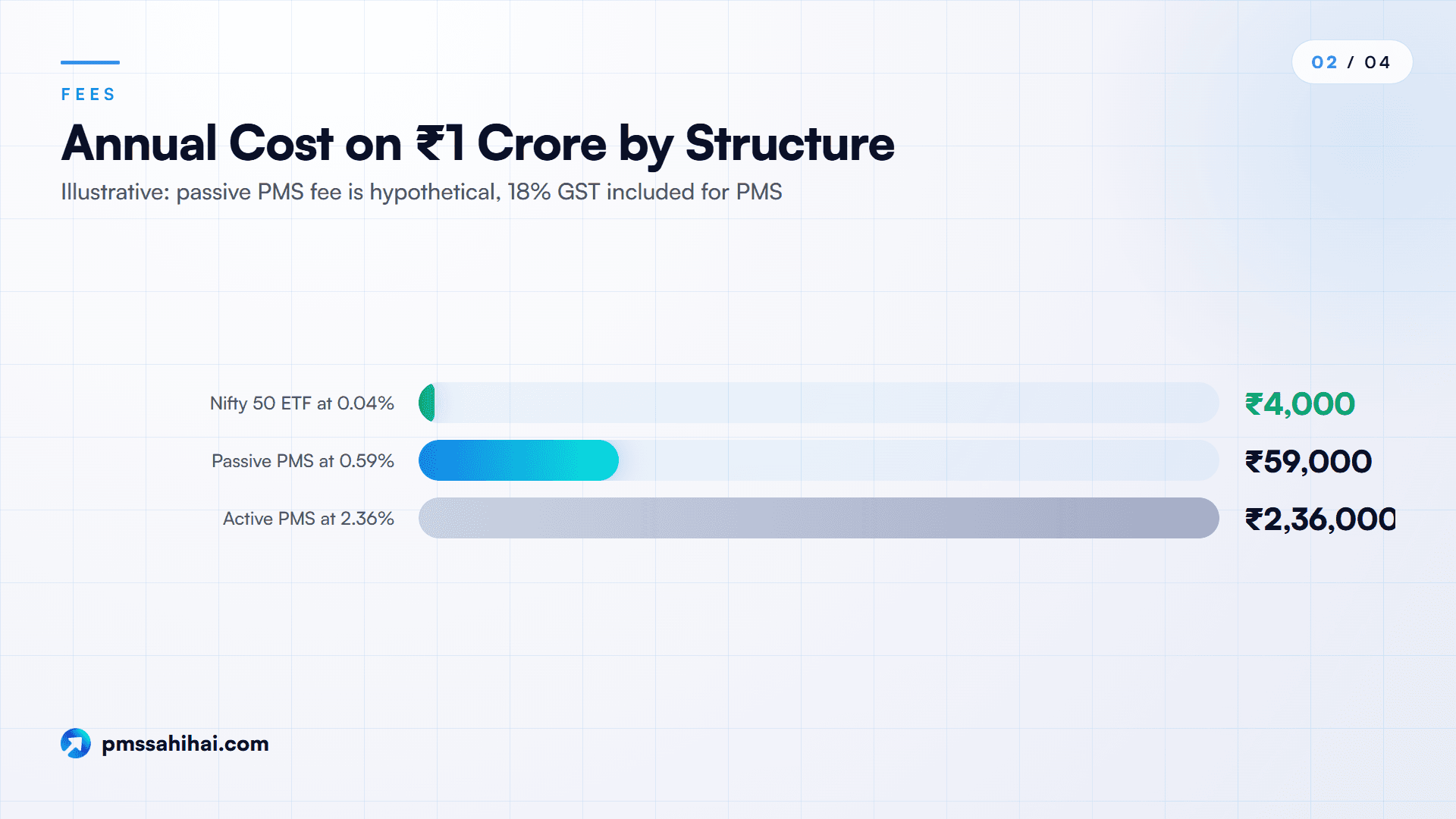
A Worked Cost Comparison on ₹1 Crore
Here is an illustrative comparison. The passive PMS fee of 0.50% is hypothetical; the ETF and active PMS fees reflect published figures.
| Option | Annual cost on ₹1 crore | Approximate value after 20 years at an 11% gross return |
|---|---|---|
| Nifty 50 ETF at 0.04% | ₹4,000 | ₹8.00 crore |
| Hypothetical passive PMS at 0.50% + 18% GST (0.59%) | ₹59,000 | ₹7.25 crore |
| Active PMS at 2% fixed + 18% GST (2.36%) | ₹2,36,000 | ₹5.25 crore |
The values deduct each cost from an assumed 11% gross return and ignore taxes, brokerage and tracking differences. Even at a modest fee, the passive PMS gives up about ₹75 lakh over 20 years against the ETF. Its tax-loss harvesting and customisation have to be worth more than about 0.55% a year before it beats the ETF. For some high-bracket investors with large realised gains elsewhere, that may be reachable; for most, it is not.
The opposite trap is worse: an active PMS charging 2% or more while holding something close to the index. Our guide to active versus passive PMS fees covers that debate in depth.
What the PRIM Route Changes From April 2027
The 2026 Regulations create what may become the cheapest passive route inside a PMS wrapper. The Portfolio Management Service Route for Investment in Mutual Fund units (PRIM) lets a portfolio manager invest "only in direct plans of mutual funds in India including index funds, exchange traded funds and specialized investment funds" (regulation 32), with a minimum of ₹25 lakh per client (regulation 33).
SEBI's board also announced a 1% cap on the fixed management fee for PRIM, but that cap is not in the notified regulations. Regulation 34 leaves fees to SEBI, so treat it as announced and awaiting a circular. Until 1 April 2027, the 2020 Regulations and the July 2025 Master Circular apply.
PRIM portfolios hold fund units, not stocks, so they cannot offer direct indexing; they are closer to the ETF-based PMS model than to index replication.
How Taxes Work in a Passive PMS Versus an Index Fund
Inside an index fund, the fund itself buys and sells stocks when the index changes. A SEBI-registered mutual fund is exempt from tax on its own income under the Income-tax Act, 2025 (Schedule VII; formerly section 10(23D)). You pay tax only when you sell or redeem your units.
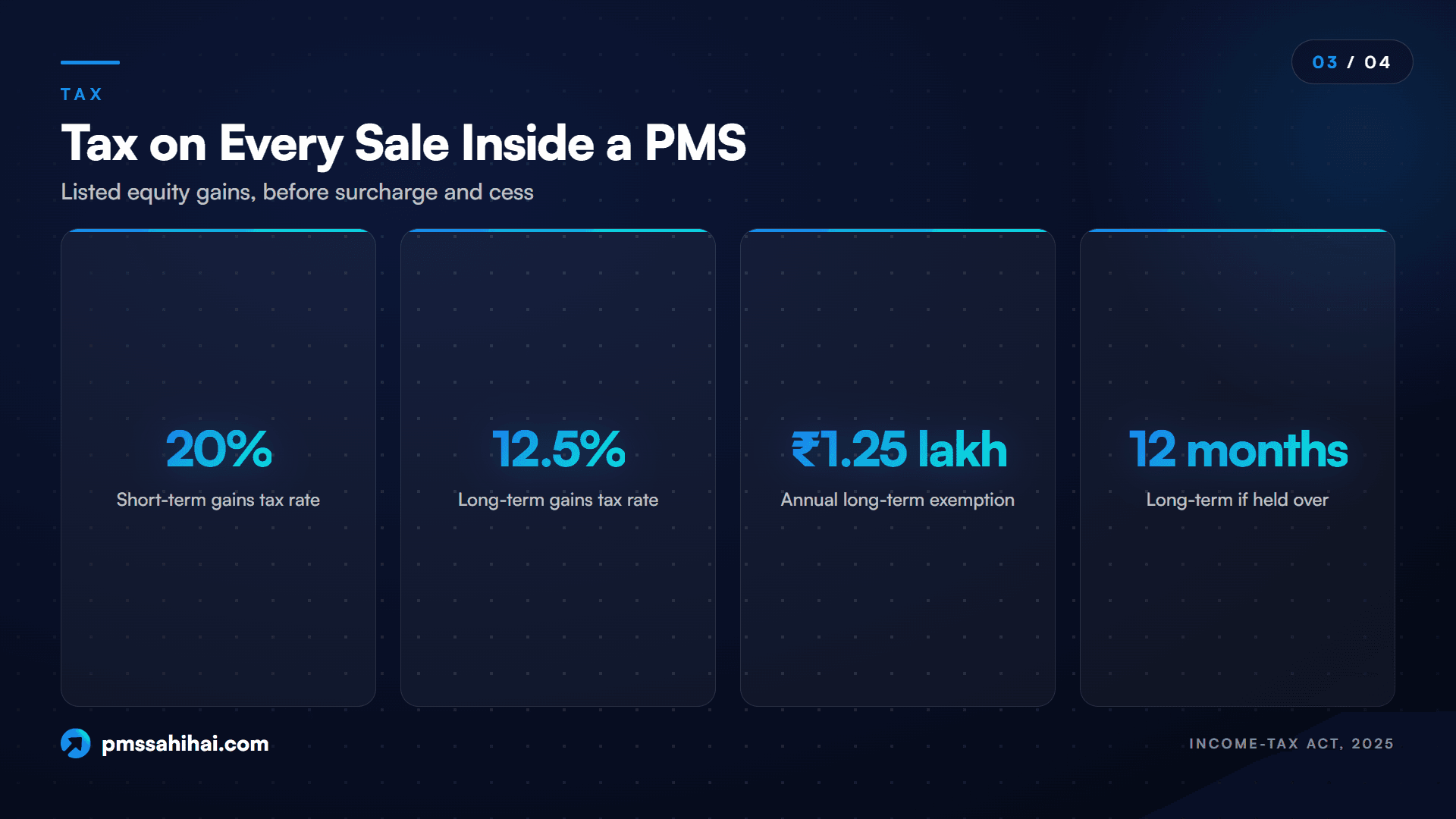
Inside a PMS, every sale is yours. When the manager sells a stock that leaves the index, you realise a capital gain or loss in that year. Under the Income-tax Act, 2025:
- listed equity held for 12 months or less is taxed at 20% on gains (section 196; formerly section 111A);
- listed equity held for more than 12 months is taxed at 12.5% on gains above ₹1.25 lakh a year (section 198; formerly section 112A);
- surcharge and cess apply on top.
For a low-turnover index portfolio these costs are modest; for a rule-based strategy that rebalances monthly or quarterly, they can be large. Our explainer on how PMS gains are taxed in your own hands covers the mechanics. Consult a tax adviser for your own position.
Advantages of Passive Management in PMS
For the right investor, passive management in PMS offers real benefits.
- Direct ownership. Every share sits in your demat account, so you can see each holding and its cost.
- Tax-loss harvesting. Losses on individual stocks can be used against gains elsewhere, which an index fund cannot offer.
- Customisation. Exclusions for employer stock, ethics or insider restrictions, and the ability to fold in shares you already own.
- Low turnover. A replication strategy trades only when the index changes, keeping trading costs and tax events low.
- No stock-picking risk. You get the market's return, not a manager's bad year.
- A cheaper route ahead. From April 2027, PRIM allows index fund and ETF portfolios from ₹25 lakh.
How PMS Sahi Hai Helps You Tell Passive From Closet-Passive PMS
A strategy that calls itself passive, rule-based or "index plus" is easy to describe and hard to verify from a brochure. Here is how PMS Sahi Hai helps, and where its help stops.
Put the strategy beside its benchmark. The PMS Sahi Hai comparison tool filters strategies by category, fund house, benchmark, AUM size and style, and each strategy page shows trailing returns beside the stated benchmark, from one month to five years and since inception. For a genuinely passive approach, the gap to the benchmark TRI should be small and steady, slightly negative after fees. A large gap in either direction means the portfolio is not tracking the index, whatever its name. Our guide to gross versus net TWRR explains which figure to compare.
Read the label against the facts. Names can mislead. On PMS Sahi Hai, the Abans Smart Beta Portfolio is listed as an Equity: Mid Cap strategy holding about 10 stocks with a 2.50% fixed fee plus a performance fee, and the Citrus Index plus Fund as an Equity: Flexi Cap strategy benchmarked to the Nifty 50 TRI with a 1.50% fixed fee. Neither page describes index replication. That is not a criticism of either manager; it is a reminder to judge the investment approach, not the name.
Ask Nyra the structural questions. Nyra, PMS Sahi Hai's AI-powered research tool, can help you frame what to ask a manager: how accounts are rebalanced after an index change, whether losses are harvested, and what the all-in fee is once 18% GST is added. Its published methodology puts 30% of the Nyra Score on excess return over the stated benchmark across one, three and five years, and shows strategies with under 12 months of record as Not Rated. A true index tracker would earn little on that pillar by design, so read the score as a description, not a verdict; the site itself says it is not a recommendation.
Scan what you already own. The portfolio scan scores existing PMS, AIF, mutual fund and direct-equity holdings and reviews their full fee load, which helps you spot index-like holdings carrying active-style fees.
One limit is worth stating plainly: the platform has no "passive" or direct-indexing category, and we found no listed strategy page describing full index replication. PMS Sahi Hai is an APMI-registered distributor of PMS and AIF products, and Nyra is an analytical tool, not a SEBI-registered investment adviser. The disclosure document and your own tax adviser have the final word.
Limitations of Running a PMS Passively
- High minimum. Outside PRIM, you need ₹50 lakh; an index fund needs a few hundred rupees.
- Fee drag. A PMS fee plus 18% GST is charged on a return that is, by design, close to the index. Unless harvesting and customisation earn it back, you are paying for nothing.
- Imperfect tracking. Rounding, cash and rebalancing delays create tracking gaps, especially in smaller accounts. There is no PMS equivalent of the 2% tracking-error cap that applies to index funds.
- Few products. Passive PMS strategies are rare in India, and direct indexing is early-stage.
- Label risk. "Smart beta", "quant" and "index plus" can describe concentrated, active strategies with active fees.
Passive PMS vs Index Fund vs Active PMS: Side-by-Side
| Feature | Index fund or ETF | Passive PMS (direct index) | PRIM portfolio (from 1 Apr 2027) | Active PMS |
|---|---|---|---|---|
| What you own | Fund units | Individual index stocks | Units of index funds, ETFs, other MFs | Individual stocks chosen by the manager |
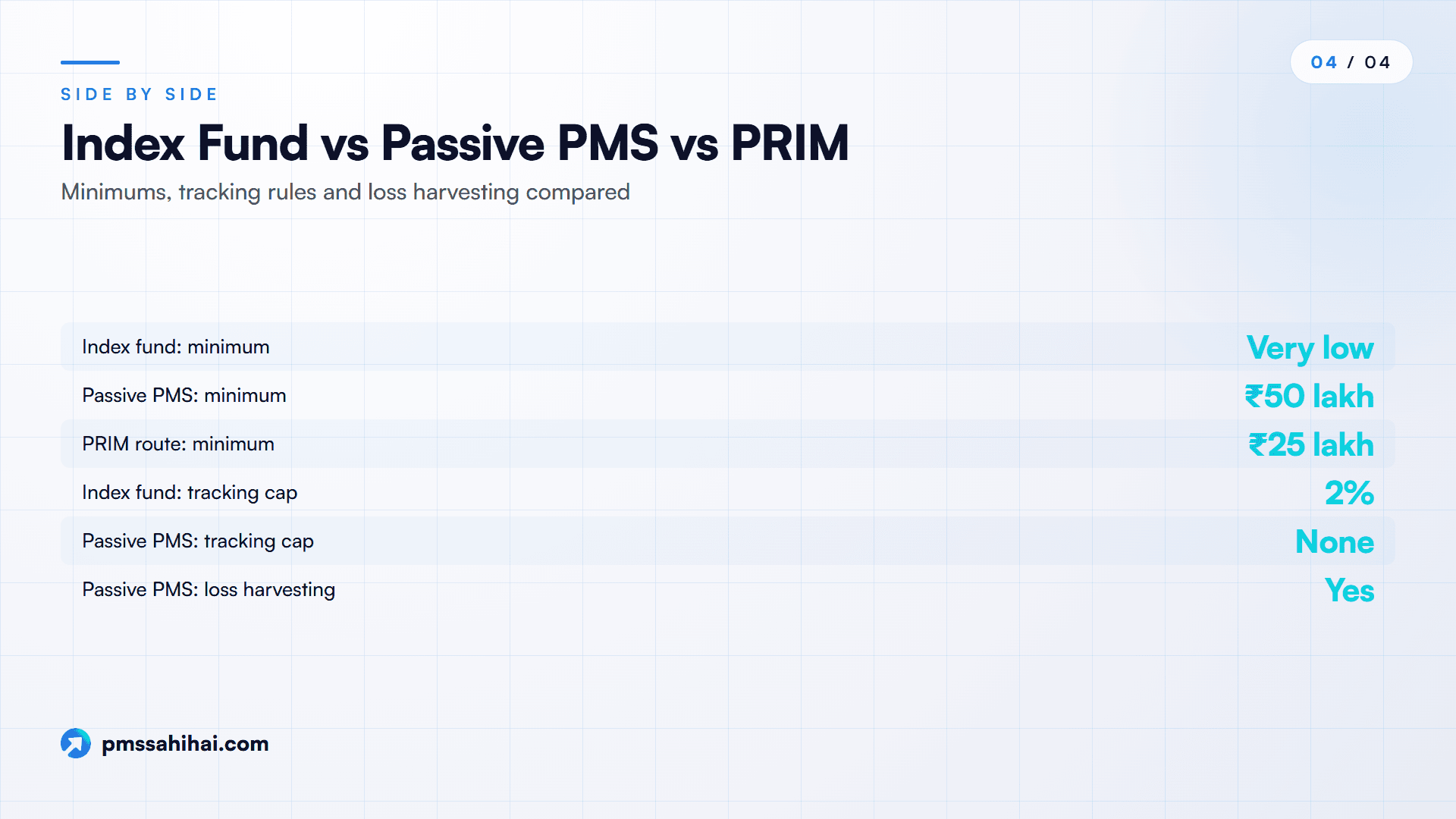
| Minimum | Very low | ₹50 lakh | ₹25 lakh | ₹50 lakh |
| Typical cost | 0.04%–0.90% TER | PMS fee + 18% GST | PMS fee + GST + fund TERs (1% fixed-fee cap announced) | Often 1%–2.5% fixed + GST, sometimes a profit share |
| Tax on rebalancing | None for you until you sell | Each sale is yours | Each switch is yours | Each sale is yours |
| Tax-loss harvesting | No | Yes, stock by stock | Limited, fund by fund | Possible, but not the aim |
| Customisation | None | Exclusions and tilts | Choice of funds | Manager's choice |
| Tracking-error rules | Capped at 2% and disclosed daily | None specific | Depends on funds used | Not applicable |
Deciding Whether a Passive PMS Fits Your Portfolio
Passive management in PMS is legitimate, and in a few cases sensible, but rarely the cheapest way to own the market. It can fit if you:
- have a large portfolio and regular realised capital gains elsewhere that harvesting can offset;
- need exclusions, such as a concentrated ESOP holding or insider restrictions, that an index fund cannot handle;
- want to fold existing shareholdings into an index-like core without selling them first;
It probably does not fit if you:
- simply want the market's return at the lowest cost, which a 0.04% ETF already delivers;
- have less than ₹50 lakh to commit, or would be stretching to reach it;
- are being offered "passive-like" returns at an active fee.
Before signing, ask five questions. Is the strategy replicating, sampling, following factor rules or copying a model? What is the all-in fee, including GST? What is the realised tracking difference against the benchmark TRI, net of fees? What is the spread between the best and worst client returns? And does the manager run tax-loss harvesting, and on what rules? Line up the answers for two or three strategies on PMS Sahi Hai and put the open points to Nyra before you meet any manager.
Take the Next Step Toward a Lower-Cost PMS Shortlist
Passive management in PMS is worth paying for only when the separate-account features, tax-loss harvesting and exclusions, are worth more than the fee. Check whether a strategy that calls itself passive or rule-based really tracks an index, compare its net-of-fee record with the benchmark TRI, and price it against a low-cost ETF. Use the PMS Sahi Hai comparison tool to shortlist strategies by benchmark, ask Nyra to frame your questions on tracking, fees and tax, or book a conversation with the team. Then read each disclosure document and speak to your tax adviser before you commit.
PMS Sahi Hai is a distributor of Portfolio Management Services and Alternative Investment Funds, APMI-registered (Registration No. APRN08358). This article is for education only and is not investment advice, a recommendation, or an offer to buy or sell any security. Investments in securities markets are subject to market risks; read all scheme-related documents carefully. Past performance is not indicative of future results. Consult your advisor before investing.
Ishaan founded PMS Sahi Hai to make India's PMS, AIF and GIFT City markets legible to serious investors, comparing every SEBI-registered manager on the same comparative basis, with no shelf products and no commission bias.
Frequently asked
What is passive management in PMS?
It is a portfolio management approach in which the manager aims to match an index, such as the Nifty 50, rather than beat it. Because SEBI requires each client's account to be managed individually, a passive PMS holds the index's stocks, or a sample of them, separately in each client's demat account instead of in a pooled fund.
Does SEBI allow a passive PMS?
Yes. The regulations do not ban a passive investment approach. They require a discretionary manager to manage each client individually, in a manner that does not take on the character of a mutual fund, and to report against a benchmark from APMI's prescribed list. There is no separate passive category, so read the disclosure document carefully.
Is a rule-based or quant PMS passive?
Usually not. A rule-based PMS follows a fixed process, but if its rules select a subset of stocks to beat the benchmark, it is making active bets mechanically. Its returns, turnover and fees typically look active. A strategy is passive only if its rules aim to track an index, not outperform it.
Why does my PMS return differ from the model portfolio?
Your account was built on a different date, at different prices and in whole shares, and your top-ups, withdrawals and any legacy holdings change your weights. That is why SEBI bars managers from quoting model portfolio returns and requires them to show the minimum, maximum and median returns across all investors in an approach.
What is direct indexing, and is it available in India?
Direct indexing means owning an index's stocks individually rather than through a fund, so losses can be harvested and stocks excluded. It is widespread in the United States but early-stage in India, where few platforms offer it and fractional shares are not available. A PMS or a do-it-yourself basket can approximate it.
Is a passive PMS cheaper than an index fund?
Almost never. A large Nifty 50 ETF charges 0.04% a year, while any PMS fee plus 18% GST is a multiple of that. A passive PMS can only come out ahead if tax-loss harvesting and customisation save more than the extra cost, which needs a large account and regular gains to offset.
Is every rebalance in a passive PMS taxable?
Yes. The shares are held in your name, so every sale the manager makes, including those triggered by index changes, is a capital gain or loss for you in that year. Inside an index fund, rebalancing is not taxed in your hands until you redeem. Consult a tax adviser for your situation.
Can the PRIM route be used for passive investing?
Yes, in a fund-of-funds sense. From 1 April 2027, PRIM portfolios may invest only in direct plans of Indian mutual funds, including index funds and ETFs, with a ₹25 lakh minimum. A 1% fixed-fee cap has been announced but awaits a SEBI circular. PRIM cannot hold individual stocks, so it offers no direct indexing.
Keep reading
All articles
What Is Market Capitalization? Formula, SEBI Cap Bands and PMS Use
Market capitalization explained: the formula, SEBI's large, mid and small cap ranks, AMFI's June 2026 cut-offs and why it matters for PMS investors.
What Are Trailing Returns? How the As-of Date Changes the Number
Trailing returns explained: how they are calculated, why the as-of date moves the number, and how to read 1Y, 3Y and 5Y figures in a factsheet.
Free Float Market Capitalisation: How NSE’s IWF Sets Index Weights
How free float market capitalisation is calculated with NSE's investible weight factor, which shares are excluded, and why Nifty and Sensex use it.
Read it. Now pressure-test it.
Ask Nyra how this applies to your portfolio, or talk to our team, no pitch, no pressure.