
Passive vs Active Management: Mutual Funds, ETFs and PMS Compared
Passive vs active management in India: 2026 cost caps, SPIVA evidence, tracking error, and when index funds, active funds or PMS fit.

Passive vs active management comes down to one trade-off: a passive fund promises the index return minus a small, predictable cost, while an active manager charges more for a chance to beat the index. In India, index funds and ETFs held about 17.8% of mutual fund assets at 30 September 2026, and the SEBI (Mutual Funds) Regulations, 2026 cap their base expense ratio at 0.90%, against 2.10% for the first Rs 500 crore of an active equity scheme. SPIVA India data, as reported in October 2025, showed 73% of active large-cap funds trailing their benchmark over ten years, though critics question the benchmarks used. Passive tends to win in efficient, large-cap segments; active management, whether through a mutual fund or a PMS, has a better case where markets are less efficient or where you need customisation, and most investors end up blending the two.
Why Passive vs Active Management Is Really a Question About Costs
Every equity investor in India now faces the same fork. You can buy the market through an index fund or exchange traded fund (ETF), or you can pay a professional to try to do better than the market, through an active mutual fund, a portfolio management service (PMS) or an alternative investment fund. The debate over passive vs active management is usually framed as "which gives higher returns", but that framing hides the real mechanics.
Passive management means holding the securities of an index in the same proportions as the index. The manager makes almost no decisions; the index provider does. Your return is the index return minus costs and a small slippage called tracking difference.
Active management means a manager decides what to own, how much, and when to sell, in the hope of beating a benchmark. Your return is the benchmark return, plus or minus the manager's skill (or luck), minus a larger cost.
Put that way, active vs passive investing is a bet on whether the manager's skill will exceed the extra cost. That is why this guide spends as much time on costs and evidence as on definitions. It also covers the three vehicles Indian investors actually use, because the same label behaves differently in each:
- Index funds and ETFs, the main passive mutual fund formats.
- Active mutual funds, the default choice for most Indian SIP investors.
- PMS, where a SEBI-registered portfolio manager runs a portfolio in your own demat account (our PMS vs mutual fund comparison covers the structural differences), with a Rs 50 lakh minimum under SEBI's portfolio manager rules.
If your question is narrower, such as whether a PMS fee is worth paying against a cheap index fund, our earlier analysis, Active vs Passive: Does a PMS Fee Even Make Sense in 2026?, goes into the fee maths in detail. Here we take the wider view: how each approach works, what it costs, what the data says, and where each one fits.
How Passive and Active Management Evolved From 1970 to 2026
Active management is as old as investing itself. For most of the twentieth century, buying a fund meant paying someone to pick stocks. Passive management is the newcomer, and its rise is one of the biggest shifts in modern finance.
The milestones are well documented:
- 1960: two University of Chicago students, Edward Renshaw and Paul Feldstein, proposed an "unmanaged investment company". It went nowhere at first.
- 1970: the Qualidex Fund became the first open-end index mutual fund for retail investors, tracking the Dow Jones Industrial Average.
- 1973: Wells Fargo and American National Bank in Chicago set up the first S&P Composite index funds, for institutions only.
- 31 December 1975: John Bogle, who had founded Vanguard in 1974, launched the First Index Investment Trust, later renamed the Vanguard 500 Index Fund. Bogle credited Paul Samuelson's 1974 essay "Challenge to Judgment" as one of his influences.
- 1990 and 1993: the first index-tracking exchange-traded products appeared, in Toronto in 1990 and in the US with the SPDR in January 1993.
- 2008: the first actively managed ETF began trading in the US on 25 March 2008, a reminder that "ETF" describes a wrapper, not a strategy.
The Academic Case: Efficient Markets and Sharpe's Arithmetic
Two ideas gave passive investing its intellectual backing. The first is market efficiency: the more quickly prices absorb public information, the harder it is for any manager to find mispriced stocks consistently.
The second is simpler and does not depend on efficiency at all. In 1991, Nobel laureate William Sharpe published "The Arithmetic of Active Management" in the Financial Analysts Journal. His argument fits in two lines. Before costs, the return on the average actively managed rupee must equal the return on the average passively managed rupee, because together they make up the whole market. After costs, the average active rupee must therefore earn less, because active management costs more. Sharpe's own summary: "Nothing else is required."
This does not say no active manager can win. Sharpe was explicit that some can beat passive alternatives after costs. It says that winners must be a minority of active money, and that the average investor in active funds will trail the average investor in index funds. Choosing active management is a bet that you can pick from that minority in advance.
India's Path From Nifty BeES to a Rs 14 Lakh Crore Passive Market
India came to passive investing later. Nifty BeES, now run by Nippon India Mutual Fund, was allotted on 28 December 2001, so the ETF route has existed here for a quarter of a century. For most of that time, though, passive products were a niche used mainly by institutions.
That has changed. According to AMFI's monthly report for September 2026, at 30 September 2026 index funds held about Rs 3.20 lakh crore across 376 schemes and ETFs about Rs 11.50 lakh crore across 359 schemes. Together that is roughly Rs 14.70 lakh crore, or about 17.8% of the industry's Rs 82.64 lakh crore. The ETF figure includes large gold and silver ETFs, so the equity share is smaller, but the direction is clear. Active equity categories still dominate, with about Rs 37.5 lakh crore in 583 open-ended schemes.
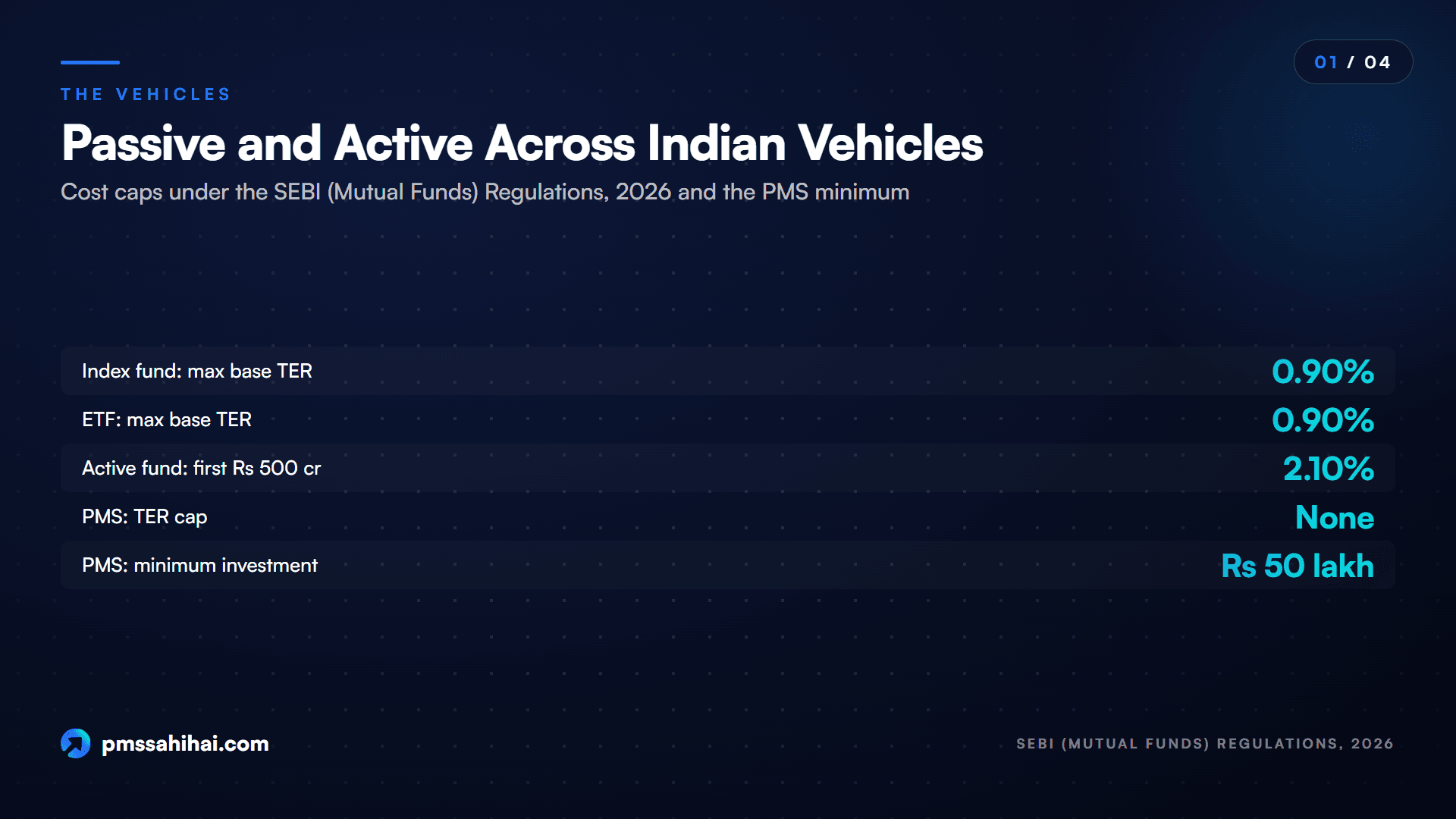
Regulation has tilted the field too. The SEBI (Mutual Funds) Regulations, 2026, in force from 1 April 2026, cut the maximum base expense ratio for index funds and ETFs to 0.90% from the earlier 1.00% cap. The rules also exclude statutory levies from that base figure, so the headline cost is now cleaner to compare.
How Active and Passive Strategies Work Inside Each Vehicle
The words "active" and "passive" mean slightly different things depending on the wrapper. Here is how each vehicle works in practice.
| Feature | Index fund | ETF | Active mutual fund | PMS |
|---|---|---|---|---|
| What you own | Units of a pooled scheme | Units, traded on an exchange | Units of a pooled scheme | Shares in your own demat account |
| Who decides holdings | The index | The index | Fund manager | Portfolio manager |
| Minimum investment | Set by AMC, often a few hundred rupees | Price of one unit plus a demat account | Set by AMC, often a few hundred rupees | Rs 50 lakh (SEBI) |
| Maximum base expense ratio (2026 rules) | 0.90% | 0.90% | 2.10% on the first Rs 500 crore, falling with size | No TER cap; fixed and/or performance fee agreed with you |
| How tax works | On redemption | On sale of units | On redemption | Each sale inside the portfolio is your taxable event |
| Customisation | None | None | None | Possible, such as excluding stocks |
Index Funds and ETFs: Replication, Tracking Error and Tracking Difference
Under the SEBI (Mutual Funds) Regulations, 2026, an index fund is a scheme that invests in securities "in the same proportion of an index", and an ETF does the same but must be listed and traded on a stock exchange. The practical difference is how you buy. You buy index fund units from the fund house at the day's NAV, which suits SIPs. You buy ETF units on an exchange through a broker, at a market price that can sit slightly above or below NAV.
Index funds and ETFs do not deliver the index return exactly. Two measures tell you how close they get:
- Tracking error is, in SEBI's investor-education definition, the standard deviation of the difference between a fund's returns and its benchmark's returns. It measures how erratically the fund drifts. Scheme documents for Indian index products commit that, under normal market conditions, tracking error on past one-year rolling data will not exceed 2%.
- Tracking difference is the plain gap in return over a period. It captures the real cost to you: expenses, cash drag, and timing of rebalancing.
A real example shows why tracking difference matters. Nifty BeES's scheme information document reported a since-inception return of 15.94% a year to 31 May 2024, against 16.31% for its benchmark. That gap of about 0.37 percentage points a year, compounded over more than two decades, is the price of "passive". It is small next to active fees, but it is not zero.
When an index changes its constituents, passive funds must follow. Scheme documents cite a SEBI circular of 19 May 2023 requiring rebalancing within seven days, which is why index additions can see heavy buying around the effective date.
Active Mutual Funds: Benchmarks, Categories and Mandates
Active mutual funds work within SEBI's 2017 categorisation, which defines large caps as the top 100 companies by market capitalisation, mid caps as 101 to 250, and small caps as 251 onwards. A large-cap fund must hold a minimum share of its assets in that band, so its manager has freedom of selection but not unlimited freedom of universe.
Each scheme declares a benchmark, and its success is judged against that benchmark's total return index. Active management in a mutual fund therefore has a defined scorecard: did the scheme beat its stated index after expenses, over meaningful periods?
Active funds also pay brokerage on their trading. The 2026 Regulations allow brokerage over the base expense ratio up to 0.06% of trade value in the cash market and 0.02% in derivatives, and they now permit performance-linked expense structures, subject to conditions SEBI specifies.
PMS: Separately Managed Portfolios in Your Own Demat Account
A PMS is not a pooled fund. A SEBI-registered portfolio manager runs a portfolio held directly in your name, so you see every stock and every trade. The SEBI (Portfolio Managers) Regulations, 2020 and SEBI's Master Circular of 16 July 2025 apply today; the new SEBI (Portfolio Managers) Regulations, 2026 were notified in October 2026 and take effect on 1 April 2027. Both keep the Rs 50 lakh minimum per client.
Fees are agreed with each client rather than capped as a ratio: a fixed fee, a performance fee above a hurdle on a high-water-mark basis, or a mix. Because you own the shares, every sale the manager makes is a taxable event for you in that year, unlike a mutual fund, where trading inside the scheme does not create a tax bill for unitholders until they redeem.
Can a PMS Be Passive?Almost every PMS is actively managed, since the structure exists to deliver a manager's judgement. Some managers run rule-based or index-like model portfolios, and some build portfolios from ETFs. Whether those designs make sense against a cheap index fund is a separate question, and the trade-offs deserve their own discussion.
What the Indian Evidence Says: SPIVA and Its Critics
The most quoted evidence in the active vs passive funds debate is the SPIVA India scorecard, published twice a year by S&P Dow Jones Indices. It compares active mutual funds in each category with an S&P benchmark and, importantly, counts funds that were merged or closed during the period, which corrects for survivorship bias.
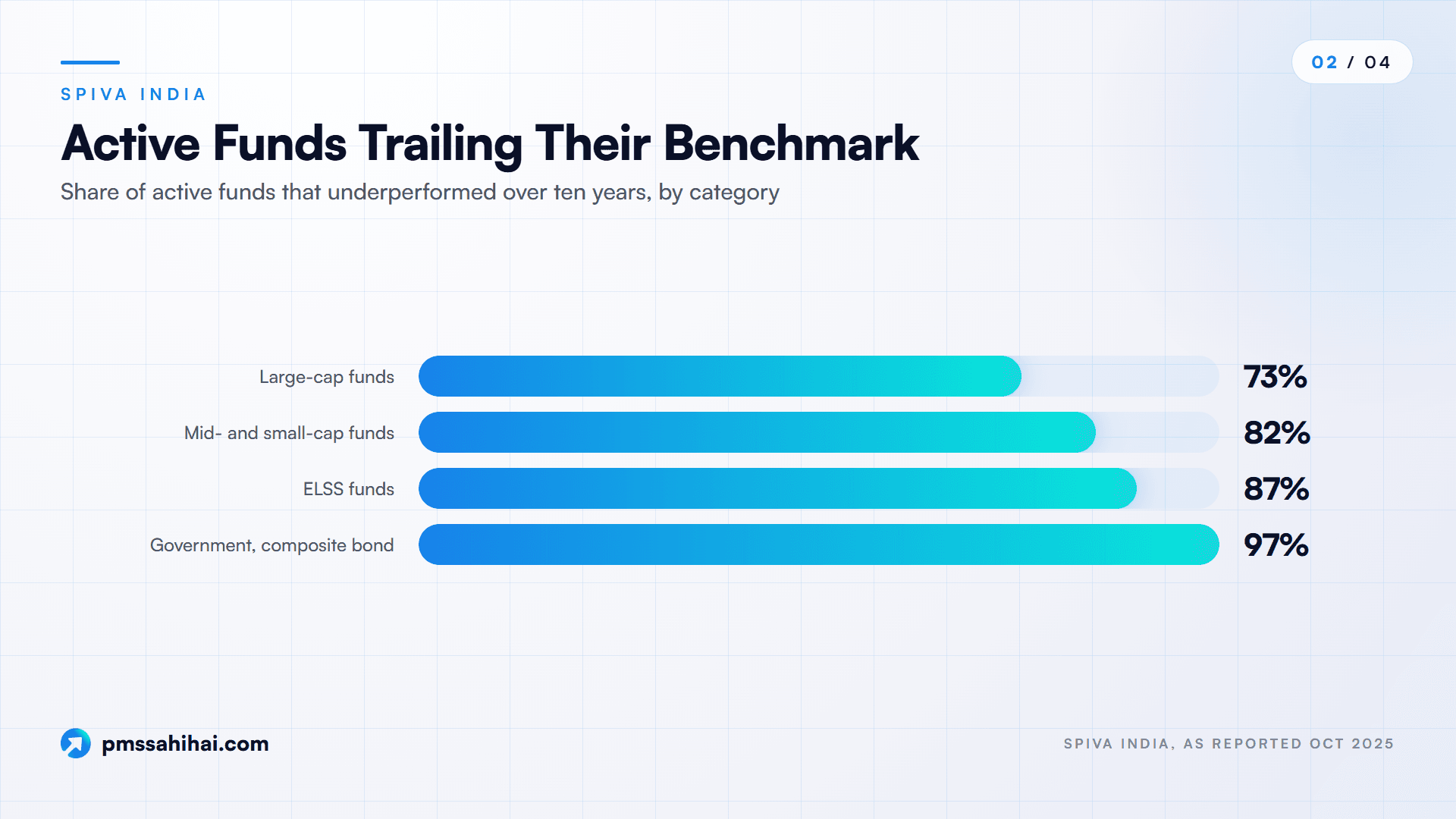
As reported in October 2025 by Indian financial media, the SPIVA India scorecard found that:
- 73% of active large-cap funds underperformed their benchmark over ten years, and close to 90% over five years.
- 82% of active mid- and small-cap funds underperformed over ten years.
- 87% of ELSS (tax-saving) funds underperformed over ten years.
- Government and composite bond funds fared worst, with 97% underperforming over ten years.
On the headline numbers, the case for index funds in Indian large caps looks strong.
The critics deserve a hearing, though. After S&P's index joint venture with BSE ended in 2024, the SPIVA India report moved to S&P India benchmarks. Commentators such as BasuNivesh and Holistic Investment argue that:
- large-cap funds are now measured against an S&P India LargeMidCap index that includes mid caps a large-cap fund cannot fully hold;
- mid-cap and small-cap funds are grouped and measured against a small-cap index;
- the ten-year series is stitched from two benchmark families; and
- the new benchmarks are not directly investable through a low-cost Indian index fund.
These are fair methodological points, and they suggest the gap may be somewhat different against the Nifty indices that Indian index funds actually track. They do not overturn Sharpe's arithmetic, and none of the critics shows that a majority of large-cap funds beat a matched, investable index after costs. The sensible reading is that active vs passive investing evidence is strongest against active large-cap funds and weaker, or more contested, in mid caps, small caps and less-researched segments.
One more caution: SPIVA covers mutual funds. There is no equivalent independent scorecard for PMS strategies, which report returns under SEBI's PMS benchmarking framework. That makes it harder, not easier, to judge whether a PMS is adding value.
The Cost Gap in Numbers Under the 2026 Mutual Fund Rules
Cost is where passive management has its most reliable edge, because cost is certain while outperformance is not. The 2026 Regulations, which cut the index fund and ETF cap from 1.0% to 0.9%, set these ceilings on the base expense ratio, which excludes statutory levies, brokerage within limits and transaction costs:
| Scheme type (open-ended) | Maximum base expense ratio |
|---|---|
| Index fund or ETF | 0.90% |
| Fund of funds in index funds, ETFs or liquid schemes | 0.90% |
| Active equity-oriented scheme, first Rs 500 crore | 2.10% |
| Next Rs 250 crore | 1.90% |
| Next Rs 1,250 crore | 1.60% |
| Next Rs 3,000 crore | 1.50% |
| Next Rs 5,000 crore | 1.40% |
| Next Rs 40,000 crore | Falls 0.05% for every Rs 5,000 crore |
| Balance above that | 0.95% |
These are caps, not typical charges. Large index funds and direct plans of large active funds usually charge well below them. Direct plans exclude distributor commission, so the gap between a direct active fund and a direct index fund is smaller than the caps suggest, and the gap to a regular active plan is larger.
A Worked Example on Rs 10 Lakh Over 15 Years
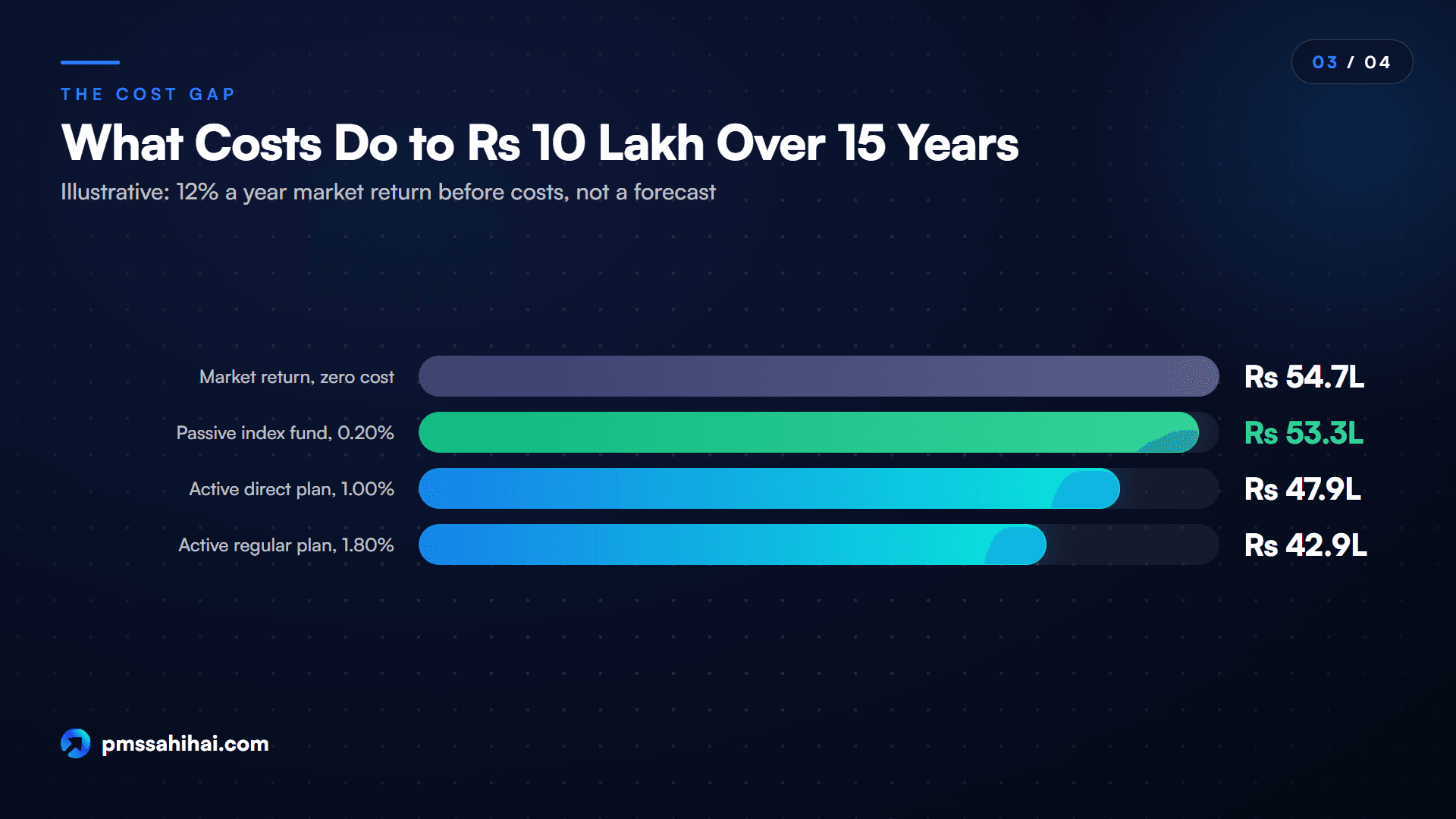
Assume the market delivers 12% a year before costs for 15 years. These are illustrative assumptions, not forecasts or actual fund charges:
| Option | Assumed annual cost | Value of Rs 10 lakh after 15 years |
|---|---|---|
| Market return with zero cost | 0.00% | Rs 54.7 lakh |
| Passive index fund | 0.20% | Rs 53.3 lakh |
| Active fund, direct plan, matching the market before costs | 1.00% | Rs 47.9 lakh |
| Active fund, regular plan, matching the market before costs | 1.80% | Rs 42.9 lakh |
An active manager who merely matches the market before costs leaves you Rs 5 lakh to Rs 10 lakh behind the index fund. To break even, the direct-plan manager must beat the market by about 0.8 percentage points every year, and the regular-plan manager by about 1.6 points, for fifteen years. Some managers do; SPIVA suggests most do not.
In a PMS, fees are usually higher still, and the tax on internal trading adds a further drag. That calculation is specific to each fee structure, so check the agreement rather than assuming.
Where Each Approach Earns Its Place in a Portfolio
Neither approach is universally better. Each has real strengths.
The advantages of passive investing:
- Low, capped costs. A 0.90% ceiling, and actual charges often far lower, keep more of the market return in your pocket.
- Predictability. You know you will get roughly the index return. You will never badly lag the market because of a manager's mistake.
- Transparency. Holdings mirror a published index, so there are no surprises in what you own.
- No manager risk. A star manager leaving, a style drifting, or a fund house's culture changing does not affect an index fund.
- Behavioural discipline. With nothing to chase, investors are less tempted to switch funds after a bad year.
- Low turnover. Index funds trade only when the index changes, which keeps trading costs low.
The advantages of active management:
- Escape from index concentration. An index weights its biggest stocks most. An active manager can underweight a sector that looks expensive or overcrowded.
- Room in less efficient segments. Mid caps, small caps and thinly researched stocks offer more mispricing for skilled managers, which matches the more contested SPIVA evidence there.
- Downside management. An active manager can hold cash or rotate defensively. In the correction from 27 September 2024 to 28 February 2025, data compiled by Upstox from Moneycontrol showed active mid- and small-cap categories falling several percentage points less than comparable passive funds from their peaks.
- Customisation in a PMS. Because you own the shares, a portfolio manager can exclude stocks you already hold through your employer or business, or sectors you prefer to avoid.
- Access to strategies an index cannot replicate, such as concentrated, high-conviction portfolios.
How PMS Sahi Hai Helps You Test Whether Active Management Earns Its Fee
Everything above points to one discipline: before you pay for active management, check what it has delivered against the right benchmark, after fees. That is the part of the passive vs active management decision PMS Sahi Hai is built for. To be clear about scope, the platform covers the active side of the market, PMS, AIF and GIFT City strategies, and does not list index funds or ETFs. The passive alternative is the yardstick you bring to it.
Here is how the pieces fit:
- Benchmark-first comparison. The PMS Sahi Hai comparison pages let you filter strategies by category, fund house, benchmark, AUM size and style, and shortlist up to four side by side. Seeing the stated benchmark next to each strategy is the first step in judging whether its returns are genuine outperformance.
- Nyra's scoring is benchmark-relative. Nyra's published methodology uses five pillars at fixed weights. The largest, Return Performance at 30%, measures excess return over the strategy's stated benchmark across one, three and five years; Consistency, at 15%, looks at how often the strategy beat that benchmark. Strategies with under 12 months of track record are Not Rated. That is the kind of evidence this guide says to demand before paying for active management.
- A scan of what you already own. The portfolio scan scores existing PMS, AIF, mutual fund or direct equity holdings on the same pillars and highlights the cost drag you are paying, a quick way to spot an active holding that is not earning its keep.
- Plain-English groundwork. The site's guide to reading PMS risk and returns explains why a total return index is the right yardstick and why alpha should be measured net of all fees, while our analysis of whether PMS returns include fees shows how to read a factsheet.
Because SPIVA does not cover PMS, our data review of which PMS categories beat their benchmark is a useful complement to the mutual fund evidence above. Nyra is an AI research tool, not a SEBI-registered investment adviser, so treat its output as structured research to discuss with your adviser, not as a recommendation.
Choosing Between Passive and Active: A Practical Framework
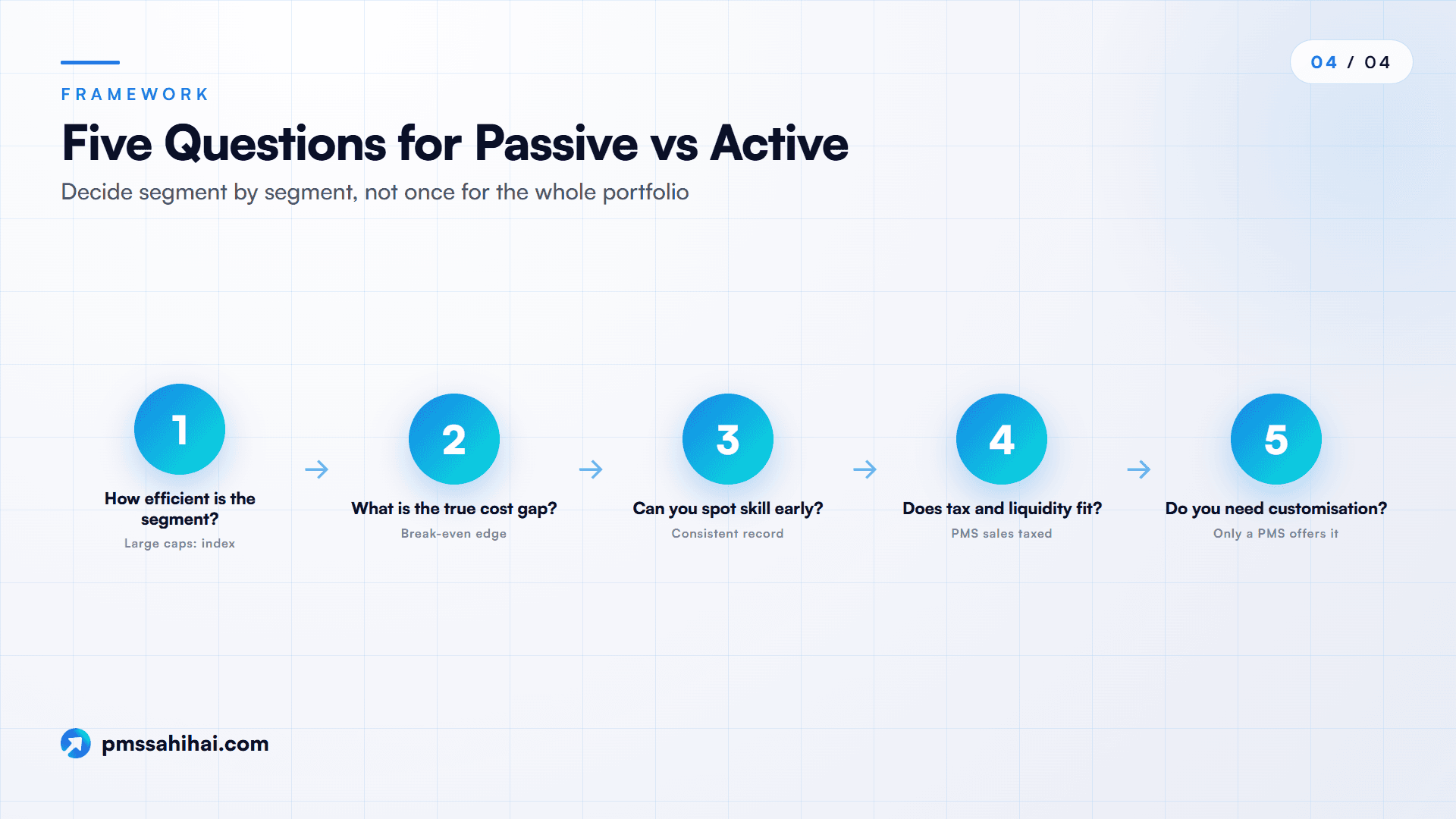
A good decision in passive vs active management is made segment by segment, not once for your whole portfolio. Ask five questions:
- How efficient is this segment? For large Indian companies, where analyst coverage is heavy and SPIVA evidence is strongest, index funds are a hard default to beat. In small caps or specialised themes, active management has a stronger, though not guaranteed, case.
- What is the true cost gap? Compare direct-plan expense ratios, or for a PMS the full fee schedule including GST, and work out the outperformance needed to break even.
- Can you identify skill in advance? Look for a long, consistent record against an appropriate total return index, rolling returns rather than a single good period, and a stable manager and process. If you cannot judge this, passive is the safer choice.
- Does the structure suit your tax and liquidity? Mutual funds defer tax until you redeem. In a PMS, each sale is taxable in your hands in the year it happens: under the Income-tax Act, 2025, listed-equity short-term gains are taxed at 20% (section 196, old section 111A) and long-term gains at 12.5% above Rs 1.25 lakh a year (section 198, old section 112A). Tax rules change and personal situations differ, so consult a tax adviser before acting.
- Do you need customisation? If you hold a large employer stock or want specific exclusions, only a separately managed portfolio such as a PMS offers that.
A rough rule that falls out of these questions: use passive for the efficient core of the market, and pay for active management only where the segment, the manager and the structure all justify the extra cost.
Honest Limitations of Both Approaches
Both camps tend to oversell. Here are the limits each side tends to skip over.
Limitations of passive management:
- You own the whole fall. An index fund has no defensive option. In sharp corrections, passive funds have at times fallen more than active peers, as the 2024–25 data above shows.
- Concentration risk. Market-cap weighting means the biggest stocks and sectors dominate. If they are overvalued, an index fund buys more of them.
- Tracking difference is real. Expenses, cash and rebalancing mean you receive slightly less than the index, as the Nifty BeES example showed.
- Index choice is an active decision. Picking Nifty 50 over Nifty 500, or a factor index over a broad one, is itself a judgement call. A smart-beta or thematic index fund can behave very differently from the market.
- ETF liquidity varies. The creation and redemption mechanism usually keeps prices near NAV, but thinly traded ETFs can still trade away from it, so check volumes and spreads.
Limitations of active management:
- The arithmetic is against the average. After costs, the average active rupee must trail the average passive rupee.
- Manager-selection risk. Even if skilled managers exist, picking them in advance is hard, and a strong past record may not persist.
- Higher and more varied costs. Expense ratios in mutual funds, and fixed plus performance fees in a PMS, are certain; outperformance is not.
- Style drift and capacity. As assets grow, a successful manager may struggle to keep investing the same way, especially in small caps.
- For PMS: higher entry and tax friction. The Rs 50 lakh minimum and per-trade taxation make PMS suitable only for some investors.
Blending Active and Passive Into One Plan
Most experienced investors end up using both. The common structure is core and satellite: a low-cost passive core, such as a broad index fund, carries most of the equity allocation, while smaller satellite holdings go to active managers where you believe they can add value.
A practical blend might look like this, purely as an illustration:
- Core (passive): a Nifty 50 or broad-market index fund or ETF for large-cap exposure.
- Satellites (active): a mid- or small-cap active fund, or, for investors with Rs 50 lakh or more to allocate, a PMS with a distinct strategy that does not simply replicate the core.
- Review: compare each active holding against its total return benchmark, net of all fees, at least once a year. If a satellite has trailed for a full market cycle without a clear reason, consider replacing it with the passive option.
Blending also limits regret: if active management has a bad stretch, the core keeps you close to the market.
For the satellite review, a benchmark-relative score such as Nyra's on PMS Sahi Hai is one input; your own net-of-fee comparison with the index option is the other.
The point of the active vs passive funds debate is not to pick a winner forever. It is to decide, for each part of your portfolio, whether paying for judgement is likely to be worth it, and to measure honestly whether it was.
Compare Active and Passive Options Before You Commit
The choice between passive and active management is not a one-time verdict. It is a series of smaller decisions: which segment, which vehicle, what cost, and how you will judge the result. Start with a low-cost passive core, insist on net-of-fee, benchmark-relative evidence before paying for active management, and remember that the structure, whether mutual fund, ETF or PMS, changes your tax and liquidity as much as your returns.
Before you add an active fund or a PMS to your portfolio, line it up against the index option it has to beat, and ask whether its edge is large enough, and repeatable enough, to justify the cost.
When the active option on the table is a PMS, AIF or GIFT City strategy, PMS Sahi Hai can help with that check. Ask Nyra to compare strategies on their benchmark-relative record, run your current holdings through the portfolio scan, or book a private consultation with the team to talk through where active management belongs in your plan, and where a plain index fund will do the job for less.
PMS Sahi Hai is a distributor of Portfolio Management Services and Alternative Investment Funds, APMI-registered (Registration No. APRN08358). This article is for education only and is not investment advice, a recommendation, or an offer to buy or sell any security. Investments in securities markets are subject to market risks; read all scheme-related documents carefully. Past performance is not indicative of future results. Consult your advisor before investing.
Ishaan founded PMS Sahi Hai to make India's PMS, AIF and GIFT City markets legible to serious investors, comparing every SEBI-registered manager on the same comparative basis, with no shelf products and no commission bias.
Frequently asked
What is the difference between passive and active management?
Passive management holds the securities of an index in the same proportions, aiming to match its return at low cost. Active management relies on a manager choosing stocks, weights and timing to beat a benchmark, at higher cost. In India, index funds and ETFs are the main passive vehicles, while active mutual funds and almost all PMS strategies are active. The real difference is whether you pay for a manager's judgement.
Is passive investing better than active investing in India?
For large-cap Indian equities, the evidence favours passive investing: SPIVA India data reported in October 2025 showed 73% of active large-cap funds trailing their benchmark over ten years. In mid caps, small caps and specialised segments, the evidence is more mixed and the benchmarks are contested. Many investors therefore use index funds for the large-cap core and selected active funds elsewhere.
Why do most active funds underperform their index?
William Sharpe showed in 1991 that before costs the average active rupee must earn the market return, because active and passive investors together own the market. Active funds charge more and trade more, so after costs the average active fund must trail. Individual managers can still win, but they are a minority, and identifying them in advance is difficult.
What is tracking error in an index fund?
Tracking error is the standard deviation of the difference between a fund's returns and its index's returns, a measure of how erratically it drifts. Indian index fund and ETF scheme documents commit to keeping it within 2% on one-year rolling data in normal markets. Also check tracking difference, the actual return gap, which shows what the fund really costs you.
Should I choose an index fund or an ETF?
Both track an index, and under SEBI's 2026 rules both have the same 0.90% maximum base expense ratio. Index funds are bought from the fund house at NAV and suit SIPs without a demat account. ETFs trade on an exchange, need a demat and broking account, and can trade slightly away from NAV, so check liquidity and bid-ask spreads before buying.
Can a PMS be passive?
Almost all PMS strategies are actively managed, because the structure exists to deliver a portfolio manager's judgement in your own demat account. A few managers run rule-based or ETF-built portfolios. Before choosing one, compare its total fees and tax drag with a plain index fund, since a PMS carries a Rs 50 lakh minimum and every internal sale is taxable to you.
How does tax differ between mutual funds and a PMS?
In a mutual fund, trading inside the scheme does not create a tax bill for unitholders; you pay capital gains tax when you redeem. In a PMS you own the shares, so each sale is a taxable event in your hands that year. Listed-equity rates under the Income-tax Act, 2025 are 20% short-term and 12.5% long-term above Rs 1.25 lakh. Consult a tax adviser.
Should I mix active and passive funds?
Yes, for most investors a blend works well. A core and satellite approach puts the bulk of equity money in low-cost index funds and uses active managers only where you have reason to expect them to add value, such as mid caps, small caps or a distinct PMS strategy. Review each active holding against its benchmark, net of fees, at least yearly.
Keep reading
All articles
Information Ratio vs Sharpe Ratio: Which One to Trust, and When
Information ratio vs Sharpe ratio: benchmark-relative vs risk-free-relative, when each misleads, and how PMS investors should read both together.
Information Ratio vs Alpha: Size of the Edge or Its Reliability?
Alpha shows the size of a PMS manager's edge; the information ratio shows how reliable it is. See four worked strategies and how to read both.
Portfolio Manager vs Fund Manager vs Wealth Manager: Who Does What
Portfolio manager, fund manager or wealth manager? Their SEBI licences, duties and pay in India, and how to check which one is handling your money.
Read it. Now pressure-test it.
Ask Nyra how this applies to your portfolio, or talk to our team, no pitch, no pressure.