
Portfolio Manager vs Fund Manager vs Wealth Manager: Who Does What
Portfolio manager, fund manager or wealth manager? Their SEBI licences, duties and pay in India, and how to check which one is handling your money.

A portfolio manager in India is a SEBI-registered firm that runs your money in your own account, led by a named principal officer. A fund manager is the person who invests a pooled scheme for thousands of unit holders and never meets most of them. A wealth manager is a job title with no licence of its own, so the same words can describe a commission-paid distributor or a fee-only adviser. The practical test is simple: ask which registration the person holds and who pays them.
Why Three Manager Titles Cause So Much Confusion
Say you hold Rs 2 crore across a PMS, three mutual funds and a bank relationship. Your bank contact's card reads "Wealth Manager". The PMS factsheet names a "Fund Manager". The agreement you signed names a "Portfolio Manager". You may reasonably assume three specialists are looking after you, each with a clear job.
The reality is less tidy. The agreement's portfolio manager is a company. The factsheet's fund manager works for that company and may never speak to you. The person on the card may not hold any investment licence personally, and may earn more when you buy one product than another.
That is why the search for portfolio manager vs fund manager vs wealth manager rarely ends with a satisfying answer. Most comparisons describe activities: one picks stocks, one runs a fund, one plans your finances. Those descriptions are fair, but they skip what matters when something goes wrong: which person holds which duty, under which regulation, and who pays them.
This guide looks at the people. Our separate post on PMS vs wealth management vs RIA compares the services and how to choose between them. Here the focus is the job behind each title: what the rules require of the person, what they do all day, and how the money reaches them.
Three points will come up repeatedly:
- One title can be a legal term. "Portfolio manager" is defined in SEBI's regulations and "fund manager" appears throughout them.
- One title is not. "Wealth manager" does not appear in the regulations we checked.
- The titles overlap. The person running your PMS is usually called a fund manager too, which explains much of the muddle.
How Indian Rules Created Three Different Jobs
These roles were not designed together. Each grew out of a separate piece of regulation, written for a different problem.
Portfolio management got its own SEBI regulations in 1993, covering firms that manage an individual client's securities under a contract. The current version dates from 2020 and has been amended many times. A replacement, the SEBI (Portfolio Managers) Regulations, 2026, was notified in October 2026 and takes effect on 1 April 2027. Until then the 2020 text applies.
The fund manager's job took shape around pooled schemes. The Mutual Funds Regulations of 1996 governed that world for three decades, and the SEBI (Mutual Funds) Regulations, 2026 replaced them from 1 April 2026. A second pooled route opened in 2012 with the Alternative Investment Funds Regulations, which brought private pools for larger investors under SEBI's rules. In April 2021 SEBI also began requiring key staff at asset management companies to take 20% of their pay in units, a rule since revised.
The wealth manager has the least formal history. The title spread through banks, brokerages and distribution firms as a description of a service to affluent families. SEBI's response came from the side. The Investment Advisers Regulations of 2013 created a registered category for anyone paid for advice. Then, with effect from 30 September 2020, SEBI barred people dealing in the distribution of securities from calling themselves an "Independent Financial Adviser", "IFA" or "Wealth Adviser" unless registered as investment advisers. The same amendment required advisory and distribution services to be kept apart at client level.
So the current position is a patchwork. Two titles sit inside dedicated rulebooks. The third floats above several of them, and its meaning depends on who is using it.
Portfolio Manager: The Registered Firm and Its Principal Officer
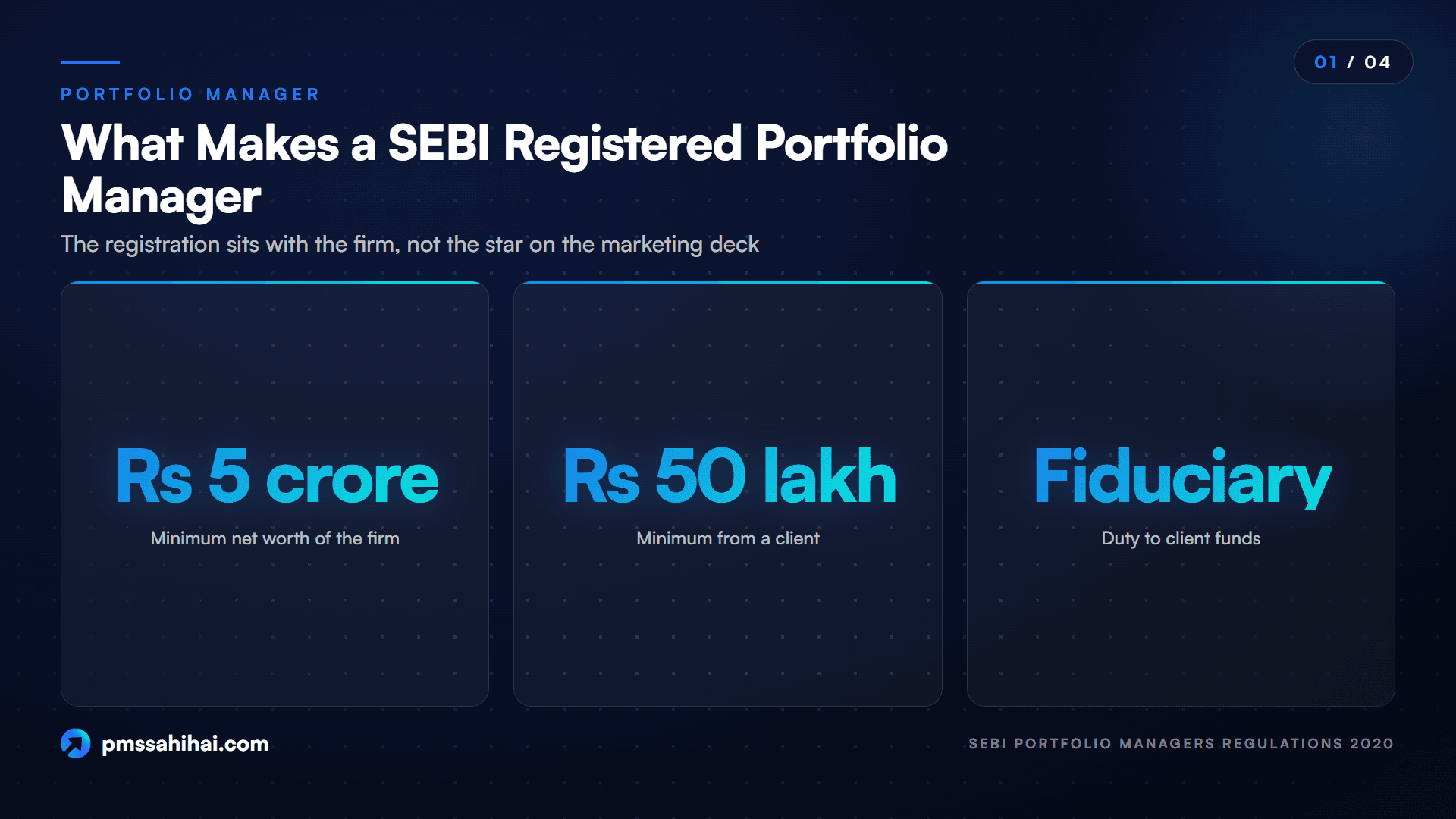
Under the 2020 Regulations, a portfolio manager is not a person at all. It is a body corporate that, under a contract with a client, advises, directs or undertakes the management of the client's portfolio. A SEBI registered portfolio manager must hold a certificate and keep a net worth of at least Rs 5 crore. It cannot accept less than Rs 50 lakh from a client, with a carve-out for accredited investors.
International usage is looser, and many articles describe a portfolio manager as an individual "licensed investment professional". In India, the registration sits with the firm. That matters because the firm, not the star on the marketing deck, is the entity you have a contract with.
The People Inside a Portfolio Management Firm
Three people or groups matter most inside the firm:
- The principal officer. This employee is designated by the firm and is responsible for the decisions made in managing client portfolios and for all other operations. The principal officer needs a professional qualification in finance, law, accountancy or business management (or a CFA charter, or a one-year NISM postgraduate programme). They also need at least five years' experience in securities-market activities, two of them in portfolio management, advisory or fund management, plus the relevant NISM certification.
- Anyone with fund-management decision authority. The Regulations hold such a person to the same qualification, experience and certification bar as the principal officer. This is the "fund manager" named on many PMS factsheets.
- The compliance officer and at least one further employee. The further employee must be a graduate with at least two years of relevant experience.
The NISM Series XXI-B exam sets a common minimum knowledge benchmark for principal officers and other PMS staff.
The Duty a Portfolio Manager Owes You
The Regulations say the portfolio manager acts in a fiduciary capacity with regard to the client's funds. Each client's holdings sit in separate accounts, and the firm ordinarily trades separately for each client. A discretionary manager decides what to buy and sell. A non-discretionary manager acts on the client's directions. Either way, the securities are held for you and not pooled with those of other clients.
A change arrives in April 2027. The 2026 Regulations introduce the Independent Fund Manager, someone who manages client portfolios in affiliation with a registered portfolio manager, on terms SEBI will specify. That person must meet the same qualification bar as a principal officer. So the question "who is actually running my money?" may soon have a new answer: a person who is not an employee of the firm you signed with.
Fund Manager: The Person Running a Pooled Scheme
A fund manager invests a common pool in line with a scheme's stated objective. Unit holders own units, not the underlying shares, and the manager makes one set of decisions for everyone. There is no conversation about your goals or your other holdings. This is the clearest difference in the fund manager vs portfolio manager comparison: one portfolio for many investors, against many portfolios built individually.
What the Rules Ask of a Mutual Fund Manager
The Mutual Funds Regulations 2026 place duties on the person directly. Fund managers, "whatever be the designation including chief investment officer", must ensure scheme money is invested to achieve the scheme's objectives and in the interest of unit holders. They must follow a code of conduct and give the trustees a quarterly self-certification confirming compliance or listing exceptions.
Oversight is layered. The asset management company must send the trustees the bio-data of key personnel, including fund managers, covering education and securities-market experience, within 15 calendar days of appointment. Dealers, who place the orders, are named separately and must seek the best available terms. Trustees can ask for details of key personnel's securities transactions.
One point surprised us. The 2026 Regulations name no specific NISM certificate for the manager of an ordinary mutual fund scheme. Such managers are instead held to fit-and-proper tests and the bio-data route. SEBI can still set requirements through circulars, so treat this as a statement about the Regulations only.
Fund Managers in AIFs and Specialised Investment Funds
The title stretches further. The manager of a Specialized Investment Fund must hold the relevant NISM certification. An AIF's key investment team must include someone with relevant certification, unless the fund is only for accredited investors. It must also include someone with a professional qualification, such as a finance degree or a CFA charter. Those two can be the same person.
The label also travels into PMS firms, as noted above. So a "fund manager" may be an employee of a mutual fund, an AIF manager or a PMS firm. The title tells you the activity, not the rulebook.
Wealth Manager: A Job Title Without Its Own SEBI Licence
We searched the current Investment Advisers, Portfolio Managers, Mutual Funds and AIF Regulations, along with the master circulars for advisers and mutual funds, for the phrase "wealth manager". It does not appear. There is no wealth manager registration to look up, and no exam that grants the title.
That does not make wealth managers unregulated. It means the rules apply to what they do and to the entity they work for. A wealth manager typically spans investment recommendations, asset allocation across products, coordination with tax and legal advisers, reporting, and being the first call when a family has a money question. Each of those tasks can fall under a different rulebook, or none.
The Licences That Can Sit Behind the Title
A person with this title usually works under one of these arrangements:
- Mutual fund distributor. The distributor holds an AMFI registration number, and sales staff need NISM certification. Advice "incidental to its primary activity" does not require adviser registration.
- Investment adviser. The individual or principal officer needs a graduate degree or CFA charter plus NISM certification, at all times. Advisers act in a fiduciary capacity. A group cannot offer the same client both advice and distribution.
- Portfolio manager. The firm is registered as above, and may give incidental advice to its clients.
- Bank or broker relationship staff. Their rules depend on the activities the employer is registered for.
The 2020 naming bar covers "Wealth Adviser" and "any other similar name" for people dealing in distribution. The Regulations do not spell out whether "wealth manager" counts as a similar name, so we would not treat the title itself as proof of anything. If you are unsure about a legal position in your own case, consult a lawyer.
The wealth manager vs fund manager contrast is therefore sharp. A fund manager has a defined regulatory job and no relationship with you. A wealth manager has a relationship with you and may have no defined regulatory job under that name.
Portfolio Manager vs Fund Manager vs Wealth Manager Side by Side
| Question | Portfolio manager | Fund manager | Wealth manager |
|---|---|---|---|
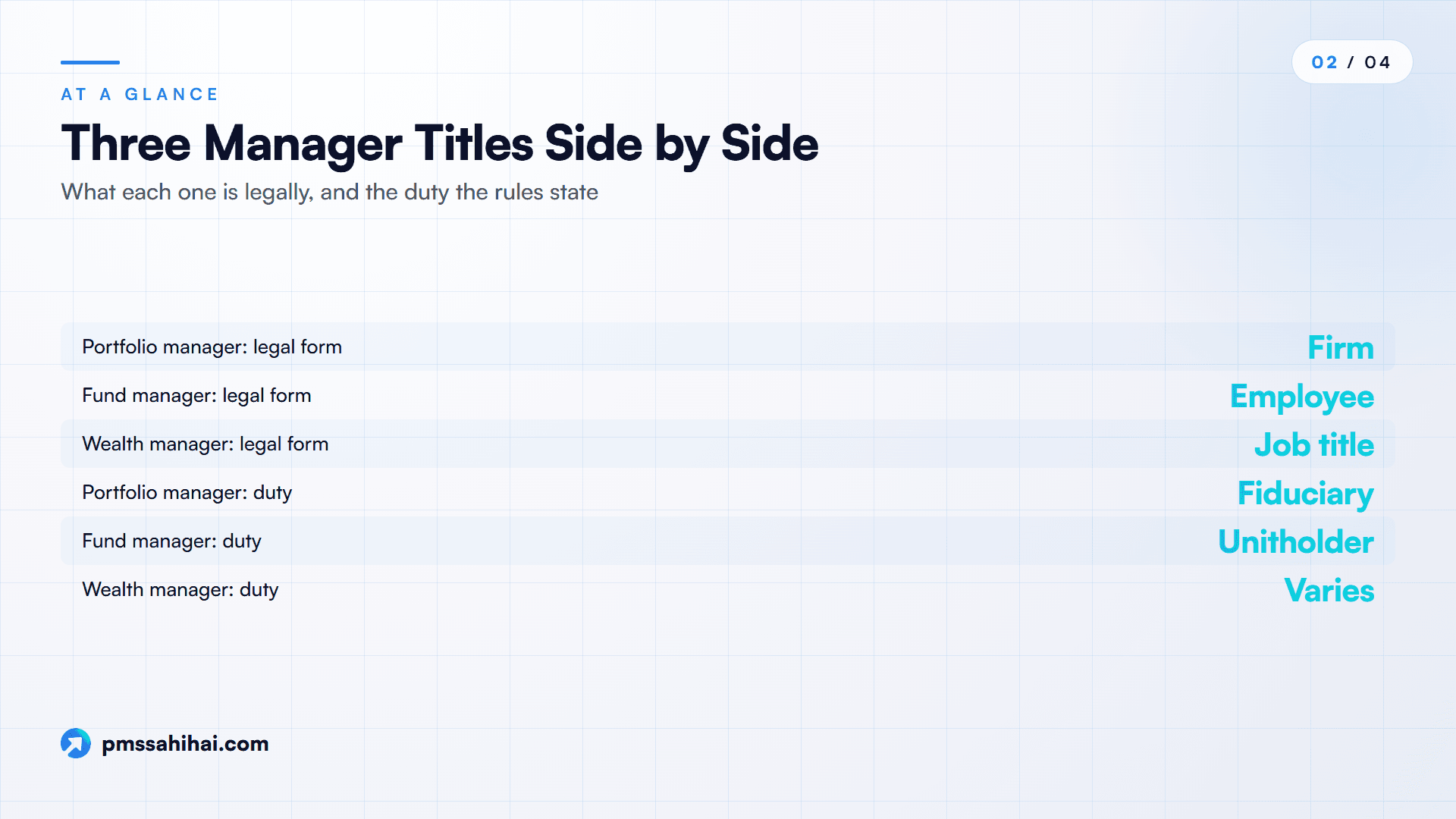
| What is it legally? | A SEBI-registered body corporate | An employee or key person at an AMC, AIF manager or PMS firm | A job title, with no separate registration |
| Rulebook | Portfolio Managers Regulations 2020 (2026 text from 1 April 2027) | Mutual Funds Regulations 2026, AIF Regulations 2012, or PMS rules | Depends on the licence held |
| Whose money? | Each client's, in separate accounts | A pool shared by all investors | Advises across a client's holdings |
| Personal contact? | Some, often via a relationship team | Rare | Yes, that is the job |
| Personal qualification named in rules? | Yes, for the principal officer and decision makers | Certification for SIF and some AIF staff; bio-data route for mutual funds | Only through the licence held |
| Stated duty | Fiduciary capacity | Interest of unit holders | Fiduciary only if a registered adviser or PMS |
| Typical entry point | Rs 50 lakh | Low for mutual funds; Rs 1 crore for most AIFs | Varies by firm |
How Each Manager Gets Paid and Who Pays Them
Pay is where these roles differ most for investors, because it shapes behaviour. It helps to separate what the firm collects from what the individual earns.
How a Portfolio Manager Earns Its Fee
The firm charges clients a fixed fee, a performance fee or both, and fee illustrations must reflect the high watermark principle. An illustration, using assumed rates: on a Rs 1 crore account with a 1.5% fixed fee and a 15% performance fee above a 10% hurdle, a year with an 18% return costs roughly Rs 1.5 lakh plus Rs 1.2 lakh, before GST of 18%. That money goes to the firm. How the principal officer or named manager shares in it is a private matter, and some are also founders or shareholders.
If a distributor brought you in, the distributor can be paid only on a trail basis, only from the manager's fees, and you must be told the amount. Our post on PMS direct vs regular covers what that costs.
How a Fund Manager's Pay Is Tied to the Scheme
A mutual fund manager is a salaried employee of the AMC, which earns its income from scheme fees. The interesting part is the rule on where part of that pay goes.
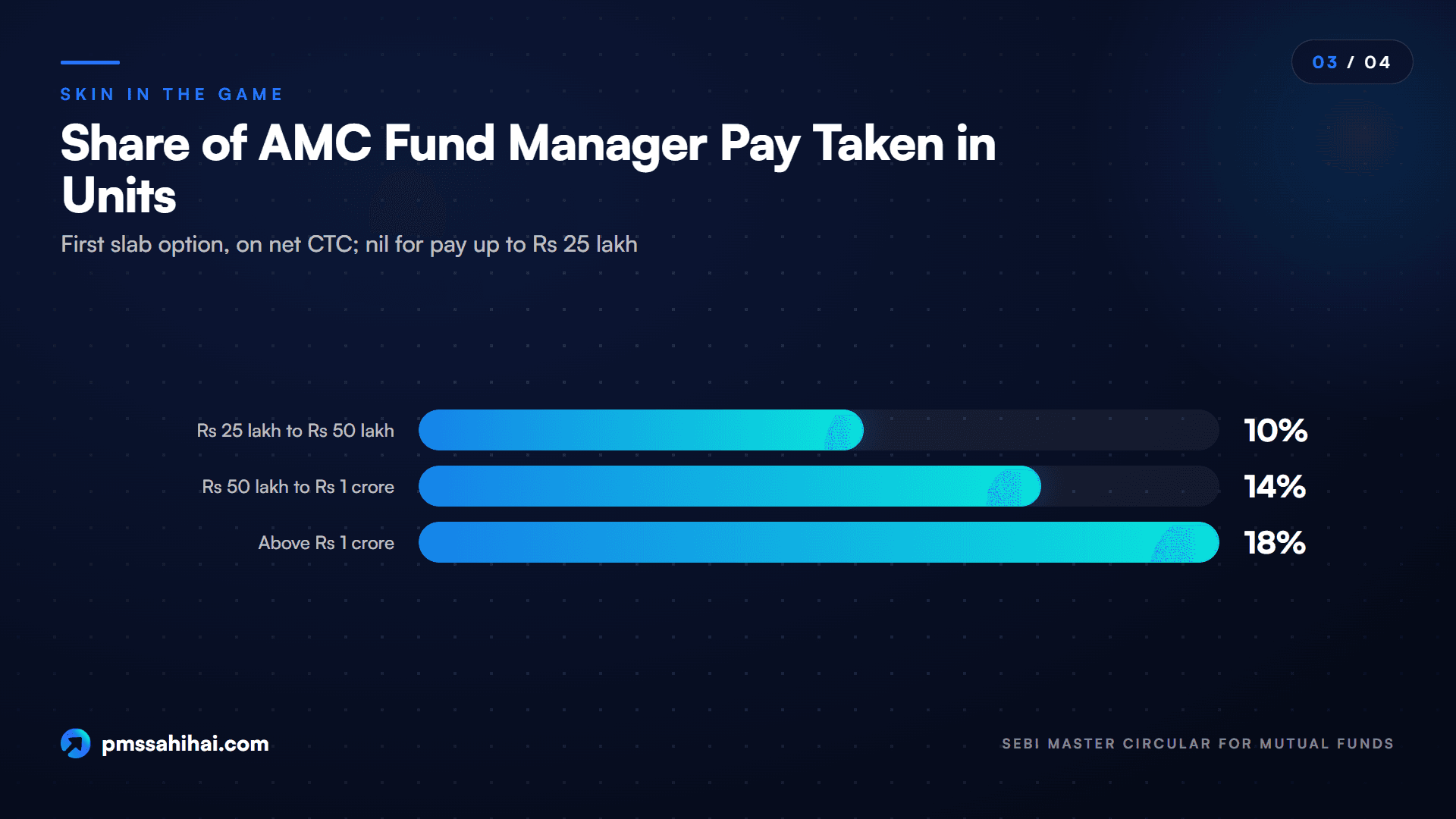
Since 1 July 2021, SEBI has required key AMC staff to take part of their pay in units. A March 2025 circular replaced the original flat 20% with slabs set out in the master circular. Fund managers, chief investment officers and research teams fall in the group whose slab follows their actual pay:
| Gross annual CTC | Minimum in units (including ESOPs) | Minimum in units (excluding ESOPs) |
|---|---|---|
| Up to Rs 25 lakh | Nil | Nil |
| Above Rs 25 lakh to Rs 50 lakh | 10% | 12.5% |
| Above Rs 50 lakh to Rs 1 crore | 14% | 17.5% |
| Above Rs 1 crore | 18% | 22.5% |
The percentages apply to CTC net of income tax and statutory contributions. So a manager on Rs 2 crore with an assumed Rs 1.3 crore after tax and contributions would put about Rs 23.4 lakh into units under the first option. Those units are locked in for three years or the scheme's tenure, if shorter, and can be clawed back for fraud, gross negligence or code violations. Each scheme's aggregate figure is disclosed quarterly on stock exchange websites.
As for a fund manager salary figure, we found no reliable public benchmark for India, so we will not quote one. Portal numbers mix very different jobs.
We did not find an equivalent units-style mandate in the Portfolio Managers Regulations. A PMS manager may well invest alongside clients, but you should ask rather than assume.
How a Wealth Manager Gets Paid
This depends entirely on the licence:
- Distribution route: trail commission paid by the product maker, not invoiced to you, so it is easy to overlook.
- Adviser route: fees paid by you. For individual and HUF clients the limit is Rs 1,51,000 a year per family in fixed-fee mode, or 2.5% of assets under advice per family. Some online pages still quote the older Rs 1,25,000 figure.
- Employee route: salary, commonly with a variable component linked to the revenue or assets they bring in.
Individual pay data is patchy. Salary.com reported an average of about Rs 14.4 lakh for a wealth manager in India in April 2025, with a middle range from about Rs 9.9 lakh to Rs 29.3 lakh. A May 2026 Masai School career guide, written to promote a degree programme, suggests Rs 12-20 lakh for relationship managers with 5-10 years' experience and Rs 25-50 lakh or more for senior ones. Treat these as rough indications only.
How Technology Is Changing These Three Roles
Technology has changed the tools more than the responsibilities. For a PMS, SEBI requires an audit trail of fund management activity, including time stamps on order placement, execution and allocation. For a mutual fund, dealing rooms and back offices sit under the AMC's systems obligations, and funds must report their use of AI and machine learning systems to SEBI.
Rule-based portfolios and screening software now do much of the first-pass research that analysts once did by hand. That can raise a manager's capacity. It does not move the duty. A quant PMS still has a principal officer answering for its decisions, and a mutual fund's AI model does not sign the quarterly self-certification. People do.
For wealth managers, aggregation tools have made it easier to see holdings across accounts, which was once a large part of the service. That shifts the value towards judgement: tax timing, family decisions and saying no to products. It also makes the sales-versus-advice question easier to test, because you can now compare what you were sold with what else was available.
What Each Role Does Well for Investors
Each of these roles can make your financial life simpler in a different way.
A portfolio manager gives you direct ownership and someone contractually bound to manage it. Your holdings sit in your name, you can see each stock, and the firm's fiduciary capacity is written into the Regulations. For investors above the Rs 50 lakh line who want a concentrated approach and one accountable firm, that clarity is useful.
A fund manager lets you buy skill at a small ticket. You do not need to meet or monitor the person directly, because trustees, a code of conduct and unit-linked pay do part of that work. The daily price and standard disclosures also reduce your admin load considerably.
A wealth manager saves time and reduces fragmentation. A good one knows that your PMS and your mutual funds own the same 15 stocks, or that your family's next big expense is three years away. No fund manager will tell you that, because no fund manager can see it. Coordination across products, advisers and generations is the real value here.
The three roles also fit together. A single family can sensibly use all three, as long as each person's job and pay are clear. Trouble starts when one person is assumed to be doing another's job, as when a family believes its bank contact is monitoring the PMS manager's process when in fact no one is.
How PMS Sahi Hai Helps You Check Who Runs Your Money
Titles are hard to compare. Named people, tenures and fee terms are easier. That is the part of this problem PMS Sahi Hai is built to help with, and it covers the PMS and AIF side rather than every role in this article.
The manager and the terms, on one page. Strategy pages in the compare tool list the named fund manager and their tenure alongside fees and the exit load for each year. So you can look past a firm's brand and see who is making decisions today and what you are paying for them. AIF strategies have a separate comparison tool.
A check on what you already hold. The portfolio score asks you to share your holdings and then has Nyra, the platform's AI research tool, scan them. One of the things it looks at is manager tenure, described as "how long the actual decision-maker has run the strategy". That is a useful follow-up to the principal officer question earlier in this article.
A scoring method you can read. Nyra's published methodology has five pillars covering returns, risk-adjusted returns, downside protection, consistency and structure. Our explainer on how Nyra scores a PMS walks through it, and evaluating a fund manager beyond returns covers the judgement that sits on top.
Two limits are worth stating. The tools described here cover PMS and AIF strategies, not wealth managers or individual advisers, so checking your own contact's licence and pay stays with you. And Nyra is a research tool: it can organise the facts about a strategy, but it does not give personalised investment advice or tell you whether a particular relationship is right for your family.
Limits and Conflicts Each Role Still Carries
None of these roles is free of drawbacks, and each has its own weak spot.
Portfolio manager. The Rs 50 lakh minimum excludes many investors. Concentrated strategies depend heavily on a few people, so a departure can change what you own. Performance fees can reward risk-taking, even with a high watermark. Our post on PMS fund manager exits looks at what manager churn costs.
Fund manager. Nobody is managing your overall position. The manager may be doing the job well while the fund is still wrong for you. Size can also limit flexibility, and a scheme's star manager can leave with little warning. Unit-linked pay aligns the manager with unit holders in general, not with you in particular.
Wealth manager. The title reveals nothing about duty or pay. A commission-paid contact may recommend well, but the incentive points towards products that pay trail. Coverage may also be thin: relationship staff can move, and the next person inherits your file without your history. The Regulations allow incidental advice without registration, so a confident recommendation does not tell you that a fiduciary stands behind it.
There is also a shared limit. No title guarantees returns, and registration with SEBI is not an endorsement of skill. These checks tell you who is accountable, not who will outperform.
How to Find Out Who You Are Actually Dealing With
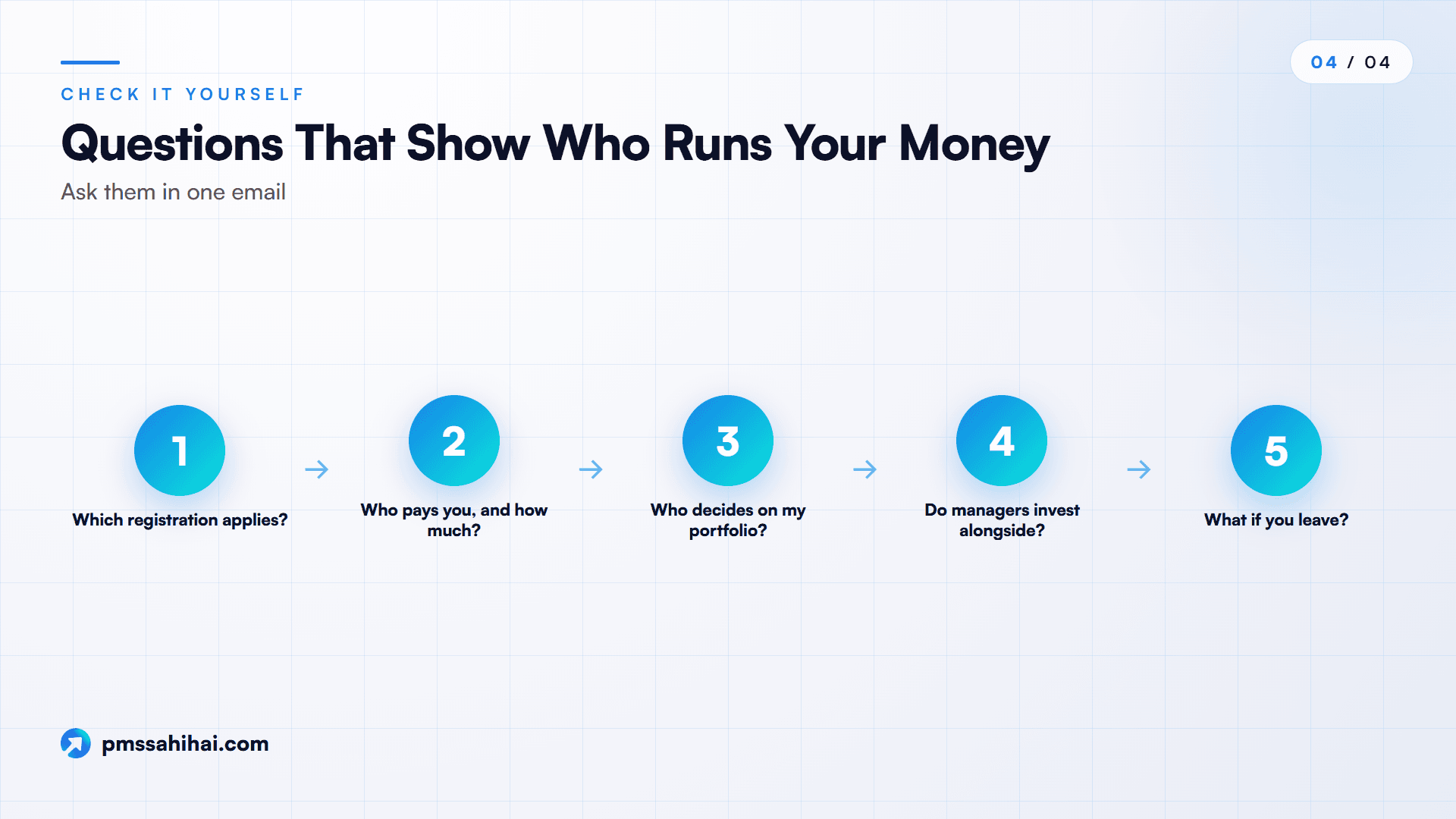
Five quick questions settle most of this. You can ask them in one email.
- "Which SEBI registration or AMFI number applies to this advice?" Investment advisers can be checked on SEBI's adviser register, and distributors through AMFI's distributor search. Portfolio managers appear on SEBI's list of registered intermediaries.
- "Are you paid by me, by the product, or by your employer on a target?" Ask for the amount in rupees for your holdings.
- "Who is the principal officer, and who makes the decisions on my portfolio?" These may be different people. The disclosure document should tell you.
- "Do the people managing this invest their own money in it?" For mutual funds, the disclosure exists. For a PMS, ask directly.
- "What happens to my account if you leave?" A good answer names a process, not a promise.
Watch for answers that avoid the question, such as "we are a full-service platform". Also watch for a "free" review when you cannot find out how the person gets paid. A clear answer does not make someone good, but a vague one is worth noting.
The One Question That Separates These Three Roles
The cleanest way to settle portfolio manager vs fund manager vs wealth manager is to ask one question: whose interests must this person legally consider, and in what capacity?
A portfolio manager is a registered firm acting in a fiduciary capacity for you, under a contract, through a principal officer who meets stated requirements. A fund manager is a person who must act in the interest of all unit holders together, with pay partly locked into the funds they run. A wealth manager is whatever their licence says, so you have to find out. Once you know that, the title stops mattering, and you can judge the person on their work. Tools such as Nyra on PMS Sahi Hai can help with the research on a strategy and its named manager, but the question of who is paid by whom is still yours to ask.
Put a Name and a Registration Number on Your Money
Start with one thing today: write down each person who touches your investments, with their registration number and how they are paid. If you cannot fill in a line, that is your first question to them. The answers will tell you more about your setup than any title on a business card.
To see the named manager, tenure and fees behind a PMS, use the PMS Sahi Hai compare tool. To have Nyra look at what you already hold, try the Nyra portfolio score, or book a consultation to talk it through. Nyra is a research tool and does not give personalised investment advice.
PMS Sahi Hai is a distributor of Portfolio Management Services and Alternative Investment Funds, APMI-registered (Registration No. APRN08358). This article is for education only and is not investment advice, a recommendation, or an offer to buy or sell any security. Investments in securities markets are subject to market risks; read all scheme-related documents carefully. Past performance is not indicative of future results. Consult your advisor before investing.
Ishaan founded PMS Sahi Hai to make India's PMS, AIF and GIFT City markets legible to serious investors, comparing every SEBI-registered manager on the same comparative basis, with no shelf products and no commission bias.
Frequently asked
Is a fund manager the same as a portfolio manager?
Not in Indian regulation. A portfolio manager is a SEBI-registered company that manages individual clients' portfolios under contract. A fund manager is a person who makes investment decisions, usually for a pooled scheme. The confusion arises because PMS firms also call their decision-makers fund managers, and those people must meet the same requirements as the firm's principal officer.
Does a wealth manager need SEBI registration?
The title itself carries no registration, because the phrase does not appear in the SEBI regulations we checked. What matters is the activity. Paid investment advice generally requires adviser registration, distributing mutual funds requires AMFI registration, and managing portfolios requires a portfolio manager certificate. Ask which of these applies to the person you deal with.
What qualifications does a PMS principal officer need?
The principal officer needs a professional qualification in finance, law, accountancy or business management, or a CFA charter, or a one-year NISM postgraduate programme. They also need five years of relevant securities-market experience, including two years in portfolio management, advisory or fund management. A valid NISM certification is required and must be renewed before it expires.
Do mutual fund managers invest in their own schemes?
Yes, SEBI requires it. Fund managers on pay above Rs 25 lakh must take a slab-based share of their net compensation, from 10% to 22.5%, in units of schemes they oversee. Those units are locked in for three years or the scheme's tenure, if shorter, and can be clawed back for fraud, gross negligence or code violations.
How much does a wealth manager earn in India?
Published figures vary widely and are only rough guides. Salary.com reported an average near Rs 14.4 lakh in April 2025, with a middle range of about Rs 9.9 lakh to Rs 29.3 lakh. Senior relationship roles at private banks can be higher, and variable pay linked to revenue is common. The more useful question is how that variable pay is earned.
Can a wealth manager manage my PMS?
The mandate runs under your agreement with the registered portfolio manager, so that firm makes or executes the portfolio decisions. A wealth manager elsewhere can recommend a PMS, monitor it and report on it across your holdings. Check whether they earn a trail from the PMS they recommended.
Do I need a wealth manager if I already have a PMS?
Not necessarily. A PMS manages one strategy and generally does not look at your other investments, tax planning or estate matters. If your holdings are simple, you may not need more. If you have several accounts, a business or a family transition ahead, a fee-paid adviser or wealth manager can fill the coordination gap.
Keep reading
All articles
Information Ratio vs Alpha: Size of the Edge or Its Reliability?
Alpha shows the size of a PMS manager's edge; the information ratio shows how reliable it is. See four worked strategies and how to read both.
Private Banker vs Financial Product Distributor: Which Do You Have?
Private banker or distributor? Compare APMI and AMFI registration, legal duty and cost in India, and run seven checks to see who you are dealing with.
Asset Management vs Portfolio Management: AMC and PMS Explained
How AMCs and PMS firms differ in India: SEBI licences, net worth rules, scale, fees and pooled vs individual portfolios, with 2026 data.
Read it. Now pressure-test it.
Ask Nyra how this applies to your portfolio, or talk to our team, no pitch, no pressure.