
Private Banker vs Financial Product Distributor: Which Do You Have?
Private banker or distributor? Compare APMI and AMFI registration, legal duty and cost in India, and run seven checks to see who you are dealing with.


The private banker vs financial product distributor comparison is less a choice between two people than a question of what capacity someone is acting in for each product. A private banker works for a bank, and when that bank sells a third-party PMS or mutual fund, the bank is usually acting as the distributor. Anyone distributing PMS must be registered with APMI, and mutual fund sellers hold an AMFI registration, while neither carries the fiduciary duty SEBI imposes on a registered investment adviser. From 1 January 2027, RBI's directions add suitability checks, a ban on provider incentives to bank staff and a refund remedy. Ask for the registration number, the commission and the direct fee in writing, and you will know who you are dealing with.
Why the Private Banker vs Financial Product Distributor Question Misleads Investors
Search for the private banker vs financial product distributor difference and you will mostly find a tidy story. The banker offers counsel at a large institution, and the distributor is an agent on commission.
A title is not a legal capacity. A private banker can be selling you a third-party portfolio management service one morning and arranging a loan against securities that afternoon. In the first conversation, the bank is acting as a distributor. In the second, it is acting as a lender. The rules, the pay and the duty differ.
Most ranking guides compare a distributor with a registered investment adviser, or private banking with wealth management. Our own guide to PMS, wealth management and RIAs compares the services themselves. This article answers a narrower question: when someone recommends an investment to you, what are they registered as, who pays them, what do they legally owe you, and how can you check?
Three points frame everything that follows:
- "Private banker" describes a job. We found no SEBI or RBI registration category with that name in the rules we reviewed. The word describes where a person works and whom they serve.
- "Financial product distributor" describes an activity. It is regulated product by product, with separate registration routes for mutual funds and PMS.
- The two overlap constantly. A bank's relationship manager who sells a mutual fund or PMS sits inside a distribution arrangement, so the comparison often has to be run one product at a time.
Commission mechanics belong to a separate article, PMS direct vs regular, so we cover them briefly here and focus on identity, duty and proof.
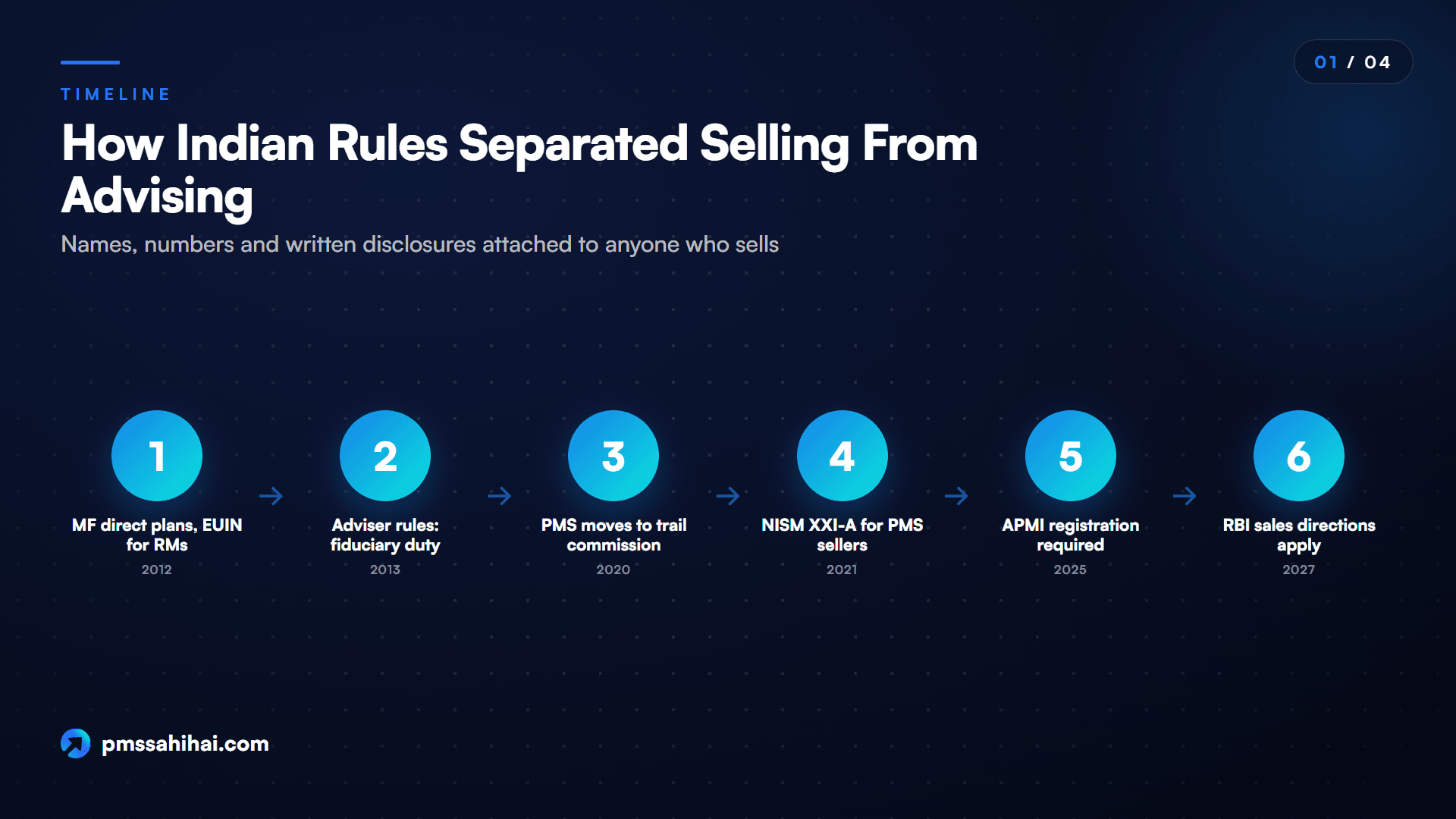
How Indian Rules Came to Separate Selling From Advising
The line between selling and advising was drawn in stages, which explains why protections differ by product.
- 13 September 2012. A SEBI circular told mutual funds to offer a separate plan for direct investments, with a lower expense ratio and no commission. The same circular asked AMFI to create a unique identity number for "the employee/ relationship manager/ sales person" of the distributor, alongside the distributor's ARN.
- 2013. The SEBI (Investment Advisers) Regulations arrived, creating a registered class of adviser with a stated fiduciary duty.
- 2019. A SEBI working group on PMS recorded that any person or entity could refer a client to a portfolio manager in return for commission, and that the regulations were silent on distribution. Morningstar India reported at the time that upfront PMS commissions went up to 7%.
- 2020. SEBI moved PMS distributors to trail commission paid from the manager's own fees, and required a direct onboarding option. From 30 September 2020, the adviser rules also required client-level separation of advice and distribution across a corporate group.
- September 2021. A certification rule required associated persons distributing PMS to pass the NISM-Series-XXI-A examination.
- 1 January 2025. Any person or entity distributing PMS had to obtain APMI registration from the Association of Portfolio Managers in India, following a circular of 2 May 2024.
- 15 June 2026. RBI issued directions on advertising, marketing and sale of financial products, covering banks' own and third-party products. They take effect on 1 January 2027.
- October 2026. The SEBI (Portfolio Managers) Regulations, 2026 were notified, effective 1 April 2027. Until then the 2020 Regulations and the July 2025 Master Circular apply, and paragraph references below may change when the new framework starts.
Regulators have been attaching names, numbers and written disclosures to anyone who sells, whatever their job title.
Technology has quietly helped. AMFI renewals of ARN and EUIN are now mandatory online, and APMI's distributor portal runs automated checks on applications, including certification and bank account validation. RBI's 2026 directions extend the same logic to digital sales: they address dark patterns and require explicit consent for each product on a multi-product digital form.
What a Private Banker Actually Does Inside a Bank
A private banker, often titled a relationship manager, looks after a bank's wealthier clients. The job has a wider scope than investing:
- Banking. Accounts, deposits, payments, foreign exchange and priority service.
- Credit. Loans against securities or property, usually coordinated with the bank's lending teams.
- Investments. Introducing mutual funds, PMS, AIFs, bonds and insurance from the bank's approved list.
- Coordination. Bringing in specialists for tax, estates or business needs, often through partners.
Entry is by relationship size. Thresholds change and vary by bank: iVentures Wealth, a SEBI-registered adviser, quoted about ₹1 crore for one bank's programme and ₹5 crore for others' private banking tiers in a June 2026 comparison. Treat those as indicative and confirm them with the bank.
Pay is the part you rarely see. Private bankers are typically paid a salary and performance-linked rewards by the bank, but banks do not generally publish these plans, so you cannot assume how yours is structured. What can be said is that the bank, as an institution, may earn from lending spreads, deposits, foreign exchange and commissions on third-party products, and any of those can shape what a banker is encouraged to raise.
RBI's new directions reach directly into this. From 1 January 2027, under paragraph 85U of RBI's directions, a bank must ensure its policies do not create incentives for mis-selling, and that no incentive is received, directly or indirectly, by bank employees from a third-party product provider for selling its products. Note what that rule does and does not do. It stops the fund house or PMS manager from rewarding the employee. It does not stop the bank earning commission as an institution, and it does not by itself ban internal targets, provided they do not encourage mis-selling.
What a Financial Product Distributor Is Registered to Do
A financial product distributor sells or arranges investment products made by someone else and is usually paid by the manufacturer. It can be an individual, a firm, a broker, a wealth company, a platform or a bank. Registration depends on the product.
Mutual Fund Distributors and the ARN
A mutual fund distributor holds an AMFI Registration Number. Individual distributors and employees of distributors must keep NISM certification current, by passing NISM-Series-V-A or attending a continuing education programme, and then renew online. Staff who deal with investors get an Employee Unique Identification Number, or EUIN. Firms must keep at least one valid EUIN under their ARN. AMFI also asks distributors for an annual self-certification of compliance with its code of conduct, and its guidance for distributors says ARN holders are not eligible for commission on business canvassed while the ARN is invalid.
PMS Distributors and the APRN
A PMS distributor has two separate requirements. The first is certification: NISM-Series-XXI-A, valid for three years, with an exemption for people who held a valid ARN or NISM-Series-V-A at the time of the notification, while that remains valid. The second is APMI registration, which produces an APMI Registration Number, or APRN.
APMI's registration document describes how this works in practice. Individuals receive an identity card with an APRN and a validity period. Companies receive a registration letter. Employees involved in marketing and selling PMS receive an EUIN card, and the EUIN stays the same if they change employer. A distributor must then be empanelled with a portfolio manager before selling its services.
SEBI's circular on APMI registration has no exception by job title: it covers "any person or entity involved in the distribution of portfolio management services". The manager must also ensure that anyone it engages holds this registration. That makes the APMI registration check useful, because it works for a bank, a boutique and a platform in the same way.
AIF Placement and Other Products
AIF distribution has its own rules. Every AIF scheme must offer a direct plan carrying no distribution fee, and distribution fees must be disclosed at onboarding. Category III funds pay distributors on an equal trail basis only, while Category I and II funds may pay up to one-third upfront and the rest over the fund's tenure.
What a Distributor May Not Call Itself
Regulation 3(3) of the adviser rules says no one dealing in distribution of securities may use the name "Independent Financial Adviser or IFA or Wealth Adviser or any other similar name" unless registered with SEBI as an investment adviser. Regulation 4(d) lets a registered mutual fund distributor give advice incidental to its primary activity. SEBI's FAQ on the adviser rules describes that as basic advice limited to mutual fund products. Broader advice across other securities needs adviser registration.
Registration, Duty, Cost and Scope Compared Side by Side
| Dimension | Private banker | Financial product distributor |
|---|---|---|
| What it is | A job inside a bank | An activity, by an individual or an entity |
| Main regulator | RBI for the bank's conduct; SEBI and AMFI or APMI for securities products it sells | SEBI rules, through AMFI or APMI registration |
| Personal ID for investments | EUIN, where selling mutual funds or PMS | ARN or APRN, or EUIN if an employee |
| Scope | Banking, credit and investments | The products it is registered and empanelled to sell |
| Standard for sales | Suitability and appropriateness from 2027; code of conduct when distributing PMS | PMS or AMFI code of conduct, including suitability |
| Statutory fiduciary wording | None found in RBI's directions | None in the PMS code; fiduciary wording sits with registered advisers |
| Who pays | Bank pays the employee; manufacturer may pay the bank | Manufacturer pays the distributor |
| Main complaint route | Bank, then RBI's ombudsman process, and SEBI's for securities products | Manufacturer or distributor, then SEBI |
| Shelf limits | Bank's approved list | Firm's empanelments |
Real arrangements vary. A wealth company can look like a private bank without being one, so the checks later in this guide matter more than the labels.
When Your Private Banker Is Also Your Distributor
Here is the situation most comparison articles skip. RBI defines a third-party product or service as one a bank offers on behalf of a third-party provider after entering into an agency business or referral arrangement. A PMS or mutual fund sold by your bank falls naturally into that description. In that moment, the bank is doing the same job as any other distributor.
This has three practical consequences.
First, the registrations follow the activity. SEBI's APMI rule covers "any person or entity", with no bank exemption in the circular's text, so we would expect a bank selling PMS to hold an APRN and its relationship manager an EUIN. On mutual funds, SEBI's 2012 circular specifically names the "relationship manager". Ask for both numbers.
Second, both sets of rules can apply at once. The PMS code of conduct applies to "all persons involved in the distribution" of PMS. RBI's directions apply to the bank's sale of third-party products. RBI's suitability paragraph also says that where a financial sector regulator has prescribed its own suitability assessment, the bank must follow it.
Third, the bank has to say what it is doing. Under paragraph 85J, a bank must not market a third-party product as its own, and must clarify its role when giving a provider's details. That gives you a very simple opening line from 2027: "Please confirm in writing what role the bank plays on this product."
There is one more combination to watch. Some banking groups also hold SEBI investment adviser registrations. Regulation 22 of the adviser rules forbids offering the same client both advisory and distribution services within the group. You are either an advisory client, with no distributor payment at group level, or a distribution client, with no advisory fee at group level. If someone says they are advising you for a fee and also earning commission on the same relationship, ask which registration applies and how the group complies with this rule.
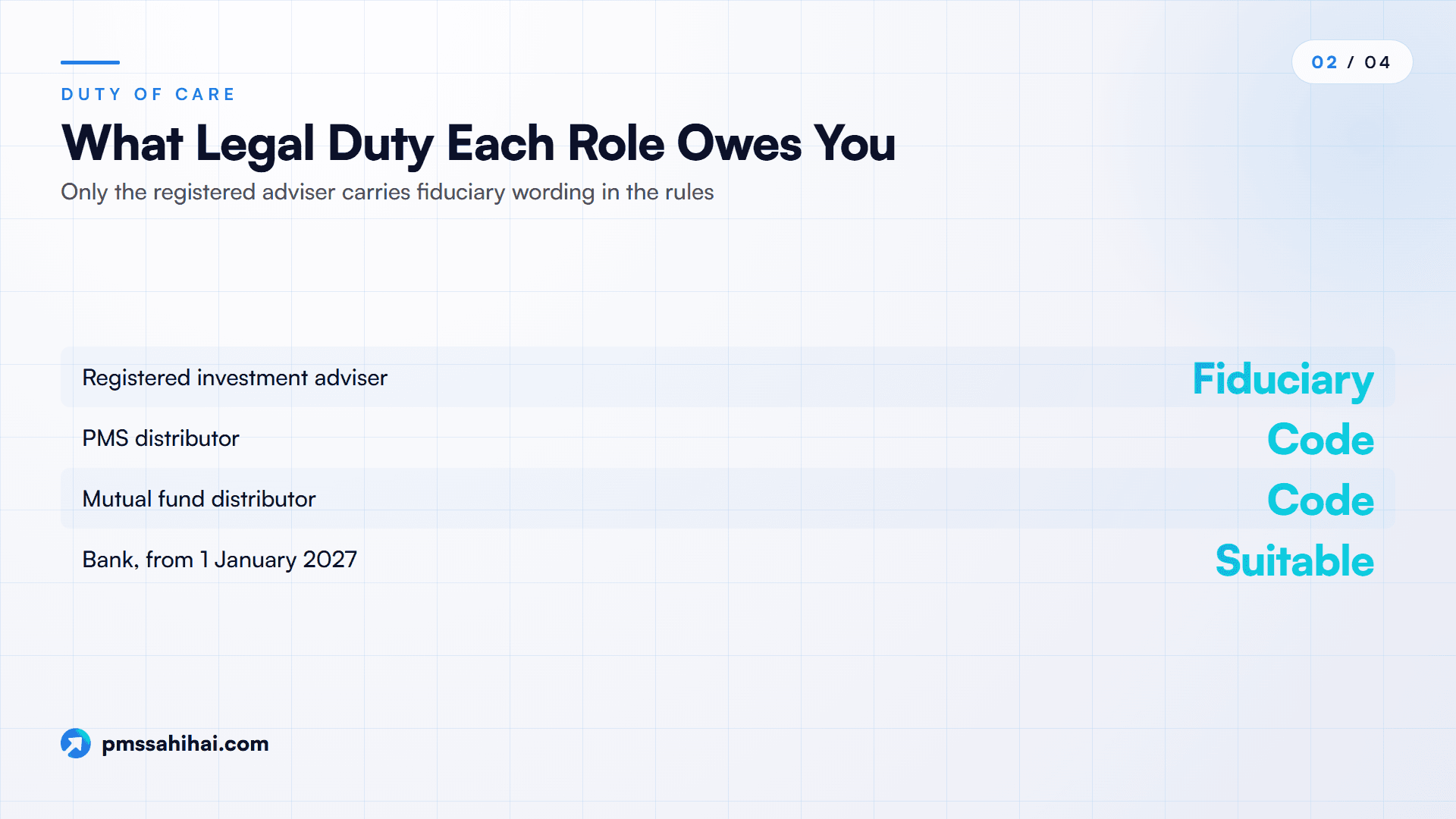
What Legal Duty Each Role Owes You
A registered investment adviser. Regulation 15(1) requires an adviser to "act in a fiduciary capacity towards its clients" and disclose conflicts. Regulation 15(2) bars it from receiving consideration from anyone other than the client for the underlying products it advises on.
A PMS distributor. Annexure 2B of the Master Circular sets out the code of conduct. Distributors must consider "investor's interest, risk profiling and suitability", take steps to protect the client's interest, and disclose commission details. One line matters most: they must "ensure that commission or incentive shall never form the basis for recommending" a PMS. These are real obligations, and the manager must verify compliance and collect an annual self-certification. They still fall short of the word "fiduciary", and the distributor can be paid by the manager.
A mutual fund distributor. AMFI maintains a code of conduct for intermediaries, with annual self-certification. Advice must stay incidental to distribution unless the person registers as an adviser.
A private banker's bank. From 1 January 2027, RBI's paragraph 85P requires a bank to determine suitability and appropriateness before selling a financial product to an individual, considering risk-return, time horizon, complexity and fees against the customer's age, income, financial literacy and risk tolerance. Paragraph 4(20A) treats an unsuitable sale as mis-selling "notwithstanding her / his explicit consent". Signing the form does not cure a bad recommendation.
Three observations from our reading of RBI's text, which you should test against your own situation and, where stakes are high, with a lawyer:
- The word "fiduciary" does not appear in the directions.
- We found no carve-out for private banking clients. The suitability rule speaks of individual customers, and is not limited by wealth.
- The directions we read cover commercial banks. RBI issued parallel versions for other regulated entities, so a wealth company outside the banking system may be under different rules.
This article explains the framework only. Take any particular dispute to a qualified lawyer.
What Each Route Costs You in Rupees
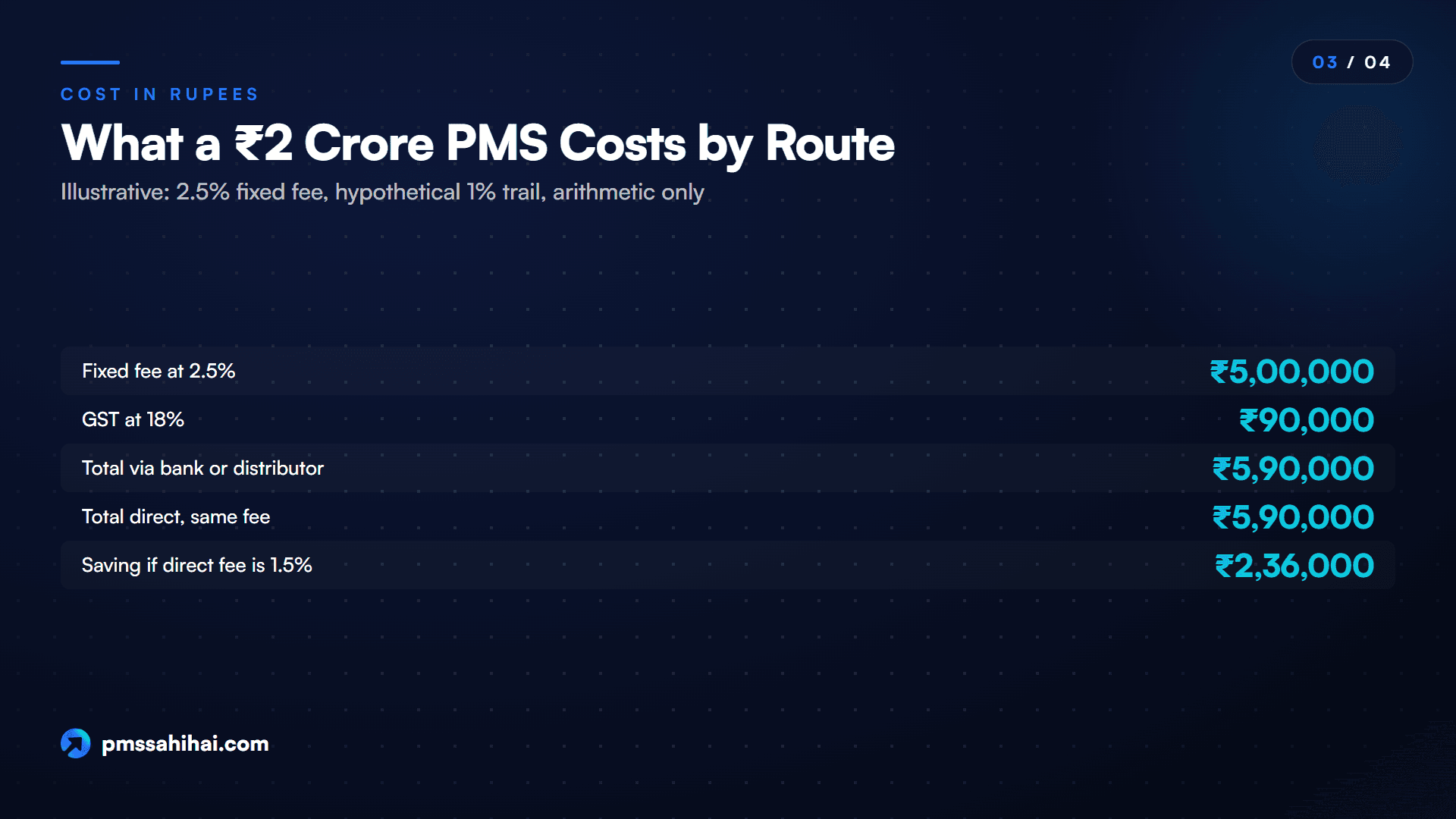
The route itself does not set the price. The product's fee and the manager's direct fee do. Here is a purely hypothetical example for arithmetic only, not a market rate.
You invest ₹2 crore in a PMS with a 2.5% fixed fee. The manager pays a hypothetical 1% trail to whoever introduced you.
- Fixed fee: ₹5,00,000 a year
- GST at 18%: ₹90,000
- Total: ₹5,90,000
- Portion passed on as trail: ₹2,00,000, paid by the manager out of its fee
Now change one thing at a time:
- Bank instead of independent distributor, same fee. Your cost is unchanged at ₹5,90,000. Only the recipient of the trail differs.
- Direct, same fee. Your cost is still ₹5,90,000. SEBI guarantees a direct route with no charges beyond statutory ones, but it does not require a cheaper PMS price.
- Direct, and the manager cuts the fee to 1.5%. The fee falls to ₹3,00,000, plus ₹54,000 GST. You save ₹2,36,000 a year before compounding.
So the useful question to any seller is the direct fee. The PMS direct vs regular guide works through this over longer periods, along with published trail ranges and how to read them.
Other products work differently. A mutual fund's direct plan has its own lower expense ratio and NAV, so the cost of distribution is visible in the gap. An AIF's direct plan carries no distribution fee.
Bank relationships add a second layer. A private banker might waive a service charge, price a loan attractively or offer a better foreign exchange rate. Ask for the all-in picture rather than judging any single line.
How to Tell Which One You Have in Seven Checks
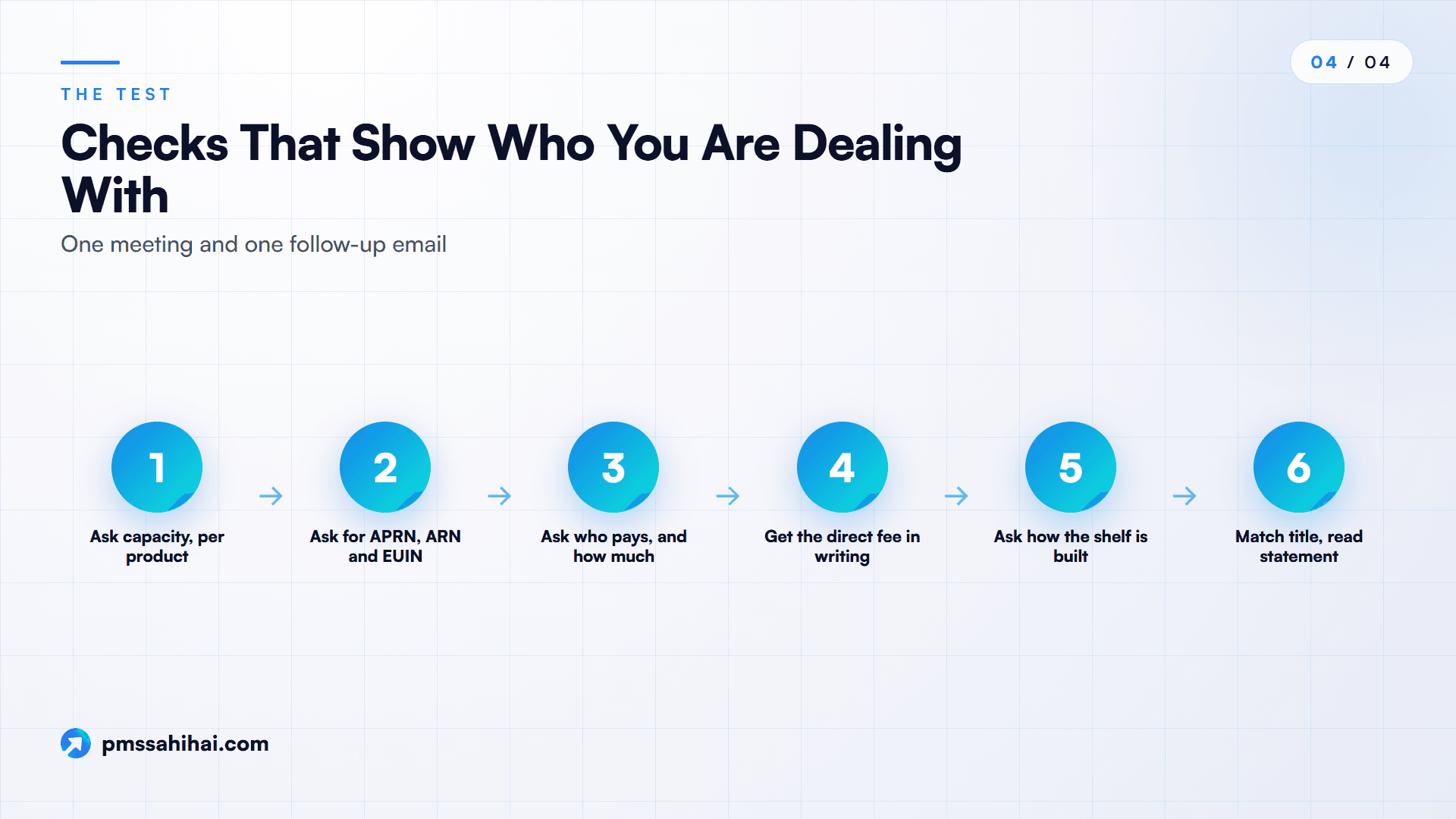
This test takes one meeting and one follow-up email.
- Ask what capacity they act in, for each product. "On this PMS, are you acting as a distributor, an adviser or something else?" Ask for the reply in writing.
- Ask for the numbers. For PMS, the APRN and the EUIN. For mutual funds, the ARN and EUIN. For adviser services, the SEBI investment adviser registration number. APMI issues identity cards and letters showing validity dates, so asking to see one is reasonable.
- Ask who pays, how much and for how long. PMS managers must ensure prospective clients are told the commission for each investment approach. It is not a favour.
- Ask for the direct fee in writing. Every PMS must offer direct onboarding, except co-investment services. Ask the manager, not only the seller.
- Ask how the shelf is built. How many managers does the firm work with, who decides, and is any product from a group company? Ask whether any manager on the list pays nothing.
- Check the title against the registration. A distributor calling itself an "IFA" or "Wealth Adviser" without adviser registration is a red flag under Regulation 3(3).
- Read the statement afterwards. SEBI's FAQ on portfolio managers lists details of commission paid to distributors for the particular client among the items in a portfolio manager's periodic report. If the number differs from what you were told, ask why.
Answers that should make you pause include "we don't charge anything", "the bank's research team picked this" with no mention of commission, and any reluctance to put the answer in writing. None proves wrongdoing, but each is a reason to slow down.
Where Each Model Genuinely Helps Investors
Where a private banker can help:
- One relationship across needs. Banking, credit and investments can be seen together, which helps a business owner or a family with lumpy liquidity.
- Credit next to the portfolio. Borrowing against assets can avoid a forced sale, though it brings its own risks.
- Institutional accountability. From 2027, a bank must refund the full amount paid and compensate for losses as per its policy where mis-selling is established.
Where a financial product distributor can help:
- A focused shelf. A specialist may know PMS and AIF structures better than a generalist who also handles deposits and loans.
- Comparison across firms. A distributor empanelled with many managers can show alternatives, though it is still paid by those it sells.
- Practical help. The PMS code expects support with KYC, documents and timely receipt of statements.
- Disclosed economics. The commission must be stated for PMS, and that is easy to compare across sellers.
How does all this make life easier? Once you can place a person in the right column, you know which rulebook to hold them to and which regulator to approach if something goes wrong.
Where PMS Sahi Hai Sits in This Comparison
Let's be plain about our own side of the table. PMS Sahi Hai is on the distributor side of this comparison, so read this section with the same seven checks in hand, and please don't take it as a neutral referee's view.
Its About page says it is run by Nyra Capital Partners Consultancy and is an APMI-registered distributor (APRN08358), and that "AMCs pay distribution fees" when you invest through it. Nyra, its AI research tool, describes itself as "an analytical tool, not a SEBI-registered Investment Adviser". Here is how the platform's published statements line up against the checks above:
- Who pays, and how much. The fees page describes a trail paid by the asset manager, with ₹0 upfront commission and no advisory, platform or onboarding fee. It says "The exact rate for each strategy is shared with you in writing, before you invest."
- The direct question. The same page says "If a direct plan genuinely beats going through us, we tell you up front." The About page invites you to "Ask us what we earn on any product, and we will tell you." Confirm the direct fee with the manager as well.
- How the shelf is ranked. The About page says "Zero paid placements in any ranking. Ever." and that Nyra's scores "are computed from disclosed data before commercials are ever discussed". The firm's six commitments to investors add "No One Pays Us to Push a Fund." These are the firm's own statements, and they don't remove the fact that it earns from the products it distributes.
- The research layer. Nyra matches strategies from "900+ tracked offerings by risk, fees & returns" and reviews an existing portfolio for "Overlap, drift & fee drag". Its output is described as "structural and informational, not personalised investment advice". That makes it a way to question a recommendation from any banker or distributor, and not a replacement for advice.
What the platform doesn't do matters too. It is not a bank, so it offers no deposits or lending relationship, and we found nothing in its finished content that rates individual private bankers or checks a seller's registration for you. If you want a practical next step, compare PMS strategies side by side and take the differences back to whoever is advising you to buy.
The Limits of Both Models and of the Rules
- Neither is a fiduciary by the wording of the rules we read. Code-of-conduct and suitability duties are meaningful, but they do not match Regulation 15. If you want advice without product payments, a registered adviser is the structure designed for that, and it charges you directly.
- Commission is still commission. A ban on commission driving recommendations is hard to police from the outside. Uneven payouts across products remain a live temptation for any seller.
- Shelf limits are invisible. You rarely see what was left out. Both a bank's approved list and a distributor's empanelments are narrower than the market.
- People move. A relationship can reset when a banker leaves. For distributors, trail arrangements and service can change hands too.
- The 2027 remedy is untested. Paragraph 85Z promises a refund of the entire amount paid where mis-selling is established. How that will work for a market-linked PMS, and how it sits alongside SEBI's complaint routes, is not yet known.
- The framework is moving. The SEBI (Portfolio Managers) Regulations, 2026 start on 1 April 2027, so check any paragraph reference after that date.
- The certificate is not an endorsement. Registration means a person cleared the requirements, and NISM certificates need revalidating every three years. It says nothing about the quality of their judgment.
Choosing Between a Banker and a Distributor With Open Eyes
The private banker vs financial product distributor question has a less dramatic answer than the marketing suggests. Many investors will use both, and some will add a registered adviser for an independent view. What matters is knowing which hat is being worn, product by product.
Choose a private banker when banking, credit and investing really need to sit together and you value the institution behind them. Choose a specialist distributor when you want deeper product comparison and are comfortable that it is paid by the manufacturers. Add a fee-paid adviser when the decision is large enough that you want an opinion from someone barred from taking product money. Whichever you pick, ask for the registration number, the commission and the direct fee in writing, before you sign. That includes PMS Sahi Hai, which is itself a distributor, and any shortlist you build with Nyra.
Ask Who Pays Before You Invest Your Next Rupee
Before your next meeting, write three questions at the top of the page: what capacity are you acting in, what is your registration number, and who pays you how much on this product? Then ask the portfolio manager for the direct fee. The answers will tell you more about your relationship than any title on a business card.
If you want to test a recommendation against the alternatives, compare strategies on PMS Sahi Hai, put your questions to Nyra, and read what PMS Sahi Hai says it earns. It is a distributor paid by asset managers, so hold it to the same seven checks. For the fee itself, read PMS Fees Explained.
PMS Sahi Hai is a distributor of Portfolio Management Services and Alternative Investment Funds, APMI-registered (Registration No. APRN08358). This article is for education only and is not investment advice, a recommendation, or an offer to buy or sell any security. Investments in securities markets are subject to market risks; read all scheme-related documents carefully. Past performance is not indicative of future results. Consult your advisor before investing.
Ishaan founded PMS Sahi Hai to make India's PMS, AIF and GIFT City markets legible to serious investors, comparing every SEBI-registered manager on the same comparative basis, with no shelf products and no commission bias.
Frequently asked
What is the difference between a private banker and a financial product distributor?
A private banker is a bank employee who manages a wealthy client's overall relationship, including banking, credit and investments. A financial product distributor is any person or entity registered to sell products made by others and paid by those manufacturers. The two can overlap: when a bank sells a third-party PMS or mutual fund, the bank acts as a distributor and its banker as the seller.
Is a private banker a financial adviser?
Not automatically. In India, acting as an investment adviser requires SEBI registration, and registered advisers must act in a fiduciary capacity and cannot take product payments from others. A private banker may recommend products, but unless the entity holds that registration and you are an advisory client, the relationship is usually one of sale and service. Ask which capacity applies, product by product.
Do private bankers earn commission on the products they sell?
The bank may earn commission from the provider, while the banker is typically paid by the bank through salary and performance rewards. Banks generally do not publish these plans. From 1 January 2027, RBI's directions bar bank employees from receiving incentives, direct or indirect, from third-party product providers. The bank itself can still earn from such sales, so ask what it receives.
Does a bank need APMI registration to sell PMS?
SEBI's circular of 2 May 2024 says "any person or entity" involved in distributing portfolio management services must register with APMI, effective 1 January 2025, and we found no bank exception in its text. Portfolio managers must ensure this for anyone they engage. Employees involved in selling receive an EUIN. Ask your bank for its APRN and your relationship manager's EUIN.
Does a distributor owe me a fiduciary duty in India?
The fiduciary wording sits in the Investment Advisers Regulations, not in the PMS distributor code. A PMS distributor must consider your interest and suitability, disclose commissions, and never let commission be the basis of a recommendation. Those are binding standards enforced through the portfolio manager, but they are not expressed as a fiduciary duty. For legal questions on a specific case, consult a lawyer.
Can I invest in a PMS without a distributor or a private banker?
Yes. SEBI requires portfolio managers to offer direct onboarding and to disclose it prominently, with no charges beyond statutory ones, except for co-investment services. SEBI does not require a lower direct fee, however, so saving money depends on what the manager agrees. Ask for the direct fee and the distributor-route fee in writing and compare them before deciding.
Can I get my money back if my bank mis-sold a product?
From 1 January 2027, RBI's directions say that where mis-selling is established, the bank must refund the entire amount paid and compensate for loss as per its approved policy. You complain within the timeline set by the product's regulator or, if none exists, within 30 days of receiving the signed terms. How this applies to market-linked products is untested, so consult a lawyer on disputes.
Keep reading
All articles
Asset Management vs Portfolio Management: AMC and PMS Explained
How AMCs and PMS firms differ in India: SEBI licences, net worth rules, scale, fees and pooled vs individual portfolios, with 2026 data.

Estate Planning vs Succession Planning: What Each One Actually Decides
Estate planning decides who owns your assets. Succession planning decides who runs the business. See where they differ and collide in India.
Long-Short SIF vs Hybrid SIF: Rules, Limits, Tax and Who Each Suits
Long-short SIF vs hybrid SIF: compare SEBI rules on equity floors, the 25% short cap, redemption, listing, tax tests and who each suits.
Read it. Now pressure-test it.
Ask Nyra how this applies to your portfolio, or talk to our team, no pitch, no pressure.