
Asset Management vs Portfolio Management: AMC and PMS Explained
How AMCs and PMS firms differ in India: SEBI licences, net worth rules, scale, fees and pooled vs individual portfolios, with 2026 data.

In Indian investing, asset management vs portfolio management is mostly a question of two different SEBI licences. An asset management company runs pooled mutual fund schemes under a trust, while a portfolio manager runs a separate portfolio for each client under a contract. An AMC needs at least Rs 50 crore of net worth, a portfolio manager Rs 5 crore, and the two serve very different ticket sizes. Headline PMS assets look huge, but about 78% of the discretionary and non-discretionary pile is provident fund money. Pick the structure by ticket size, the control you want and the tax work you can handle.
Why Asset Management vs Portfolio Management Confuses Investors
Search for asset management vs portfolio management and you will meet three different answers. Some pages say asset management covers physical things such as property and machinery, while portfolio management covers financial securities. Some career sites describe two job titles. Others treat one as a subset of the other. None of these is wrong in its own context, which is exactly why the phrase confuses people.
An Indian investor deciding where to put money needs a narrower question answered. In India's regulated market, the useful distinction is between two kinds of business, each holding a different licence from the Securities and Exchange Board of India.
- An asset management company, or AMC, manages mutual fund schemes. Many investors' money goes into one pool, and each investor holds units of that pool.
- A portfolio manager, the business behind portfolio management services (PMS), manages money under a contract with each client. Every client has a separate portfolio.
That is the frame for this guide: the businesses, their licences, their scale and how they earn. It does not try to pick a winner on returns. If you want that product-level comparison, our guide on PMS vs mutual fund returns, tax and fees covers it. The separate question of which person does what, among fund managers and wealth managers, belongs to a different article.
One caution on vocabulary before we start. In real estate and corporate finance, "asset management" can mean looking after buildings, machinery and equipment. In this guide it means managing investments for others, because that is what the phrase means on an AMC's licence. Also, many brokers' explainers list PMS as a "type of AMC". In everyday speech that is harmless. In regulation it is wrong: the two are registered under separate rulebooks.
How India's AMC and PMS Businesses Came to Exist
The pooled model came first, and by a long way. India's first mutual fund arrived in 1963 with the Unit Trust of India, set up by an Act of Parliament. For more than two decades UTI had the field to itself. In 1987 the government allowed public sector banks and financial institutions to sponsor mutual funds, which ended that monopoly.
The modern AMC framework then took shape under SEBI. The SEBI (Mutual Funds) Regulations, 1996 governed the industry for three decades, and UTI itself was split in 2003 into a SEBI-regulated mutual fund and a separate government-controlled undertaking. On 1 April 2026 the 1996 rulebook gave way to the SEBI (Mutual Funds) Regulations, 2026, which are the rules in force today and were last amended on 10 October 2026.
Portfolio management has a shorter regulated history. Broker Tradejini's guide dates the first SEBI portfolio manager regulations to January 1993. The present rulebook is the SEBI (Portfolio Managers) Regulations, 2020, under which the minimum ticket stands at Rs 50 lakh, up from the earlier Rs 25 lakh. A new rulebook is already notified: the SEBI (Portfolio Managers) Regulations, 2026 take effect on 1 April 2027. Until then, the 2020 Regulations apply.
The two histories explain the two designs. Mutual funds were built as a mass savings product, so the rules focus on protecting a large number of small investors through a trust. Portfolio management grew as a service for wealthier clients and institutions, so the rules focus on the contract, on disclosure and on keeping each client's assets separate.
How SEBI Licenses an AMC Versus a Portfolio Manager
Here is where the difference between the two businesses is sharpest. They do not merely have different licences. They have different legal architectures.
The Mutual Fund Structure: Sponsor, Trustee and AMC
A mutual fund in India must be set up as a trust. Under the Mutual Funds Regulations, 2026, the sponsor executes a registered trust deed in favour of trustees, and the AMC is then appointed to run the schemes. Each party has a separate job.
- The sponsor sets up the fund and must meet SEBI's eligibility tests. There are two routes to registration, and both carry capital requirements.
- The trustee supervises on behalf of unitholders. At least two-thirds of a trustee company's board must be independent, and trustees must meet at least once a quarter.
- The AMC runs the schemes and is approved by SEBI.
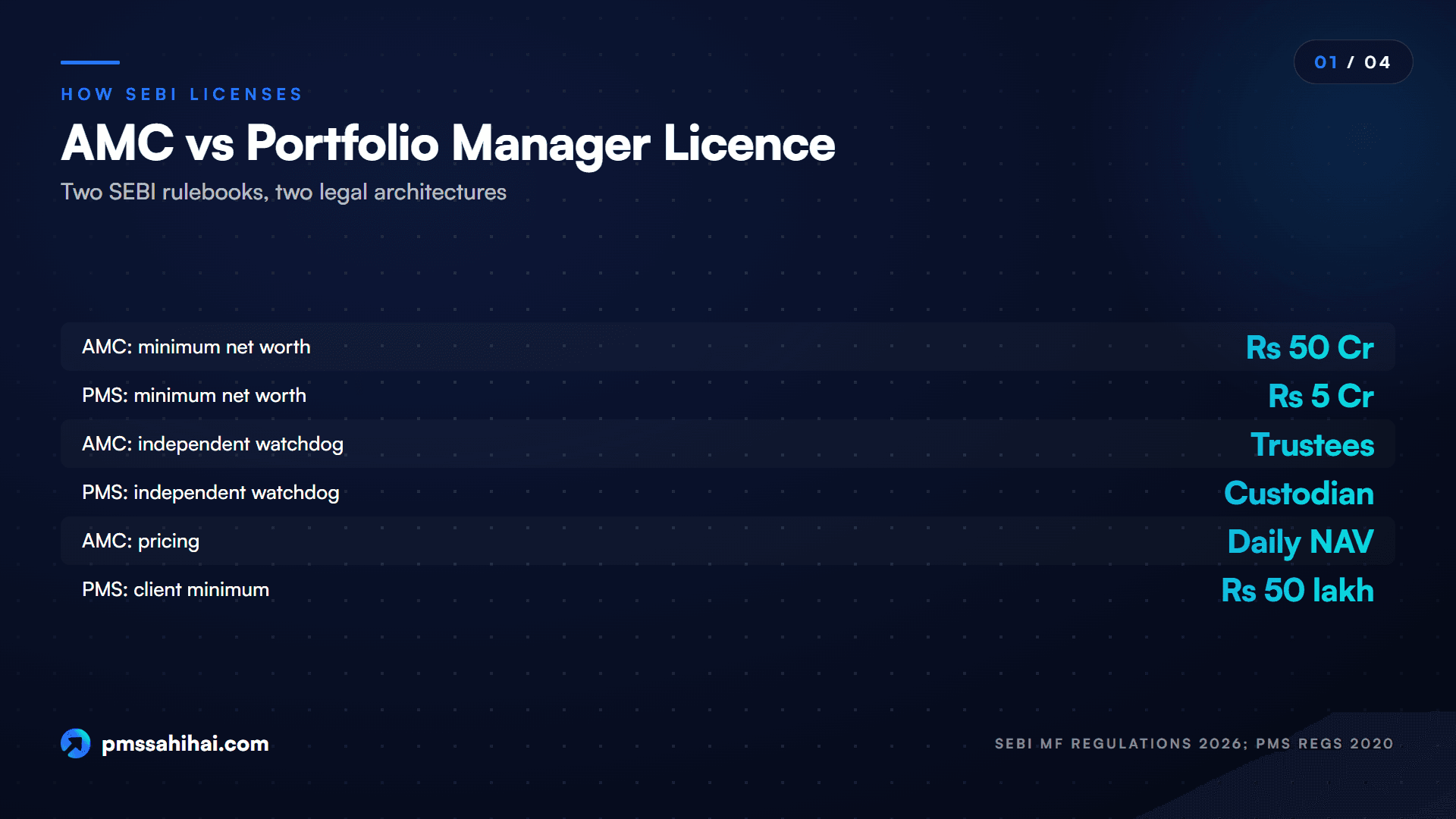
On capital, the rules are demanding. Under Route 1, the sponsor must ensure the asset management company has a net worth of at least Rs 50 crore at all times. Under Route 2, which has no profitability criteria, the AMC needs Rs 150 crore at registration and must keep at least Rs 100 crore after that. That falls to Rs 50 crore once it has made profits for five consecutive years. Summaries of this rule online sometimes disagree, so the regulation text and SEBI's informal guidance letter of 20 April 2026 are the reliable places to check.
The Portfolio Manager Structure: A Contract With You
There is no trust and no unitholder here. A portfolio manager is defined in the 2020 Regulations as a body corporate that, under a contract with a client, advises, directs or undertakes the management of that client's portfolio. Individuals cannot hold this licence.
SEBI registration as a portfolio manager carries a net worth requirement of Rs 5 crore. The new 2026 Regulations keep that figure. Instead of a trustee, investor protection works through different tools: a written agreement that sets out rights and liabilities, a disclosure document, a mandatory custodian, and a periodic report to the client at least every three months.
A portfolio manager can work in three main ways. A discretionary portfolio manager makes the decisions. A non-discretionary one acts on the client's directions. An advisory one only advises, and the client executes. SEBI's monthly data reports each type separately, and co-investment is a further small category.
Side-by-Side AMC vs PMS Licence Comparison
| Point | Asset management company | Portfolio manager |
|---|---|---|
| Rulebook today | SEBI (Mutual Funds) Regulations, 2026 | SEBI (Portfolio Managers) Regulations, 2020; 2026 version from 1 April 2027 |
| Legal form | Company, appointed under a mutual fund trust | Body corporate, under contract with each client |
| Minimum net worth | Rs 50 crore on Route 1; Rs 150 crore at registration on Route 2 | Rs 5 crore |
| Independent watchdog | Trustees, two-thirds independent | Custodian, audit and disclosures; no trustee |
| Investor's minimum | No regulatory Rs 50 lakh style floor; set per scheme | Rs 50 lakh per client, accredited investors exempt |
| Pricing and reporting | Daily net asset value for each scheme | Client report at least every three months |
| Investor holds | Units of a pooled scheme | Securities in a separate portfolio |
This AMC vs PMS table explains why the two are not interchangeable labels. A firm that holds only a portfolio manager licence cannot launch a mutual fund scheme, and a mutual fund scheme cannot give you a personal portfolio.
Pooled vs Individual: What You Actually Own
The pooled vs individual distinction changes what you legally own, and so how the investment feels to hold.
In a mutual fund scheme, you own units. The trust deed gives unitholders a beneficial interest in the trust property to the extent of their holding in that scheme. You do not own the shares of the companies the scheme buys. As AMFI puts it, a mutual fund is a collective vehicle that pools money from many investors. The AMC computes the net asset value of each scheme every day, by dividing net assets by units outstanding, and you buy or redeem units on prices tied to that figure.
In a PMS, the securities are yours. The rules are unusually direct about this. A discretionary portfolio manager must "individually and independently" manage each client's funds, in a manner that does not take on the character of a mutual fund. The same regulation stops the manager holding the securities in its own name on behalf of clients. Trades are ordinarily placed separately for each client, and where orders are aggregated for economy, they must be allocated pro rata at the weighted average price of the day.
Three practical consequences follow.
Tax falls at different levels. When a mutual fund scheme sells a stock, you do not have a capital-gains event at that point. You generally deal with tax when you sell or redeem your units. In a PMS, each sale in your portfolio is your own transaction, and its gain or loss is yours to report. Rates and treatment depend on your facts, so please consult a tax adviser.
Customisation is possible only in one model. A PMS can, by agreement, exclude a stock you dislike or take in shares you already own, because the portfolio is yours. A scheme cannot do this for one unitholder. Every investor in a scheme has the same exposure, in proportion to their units.
Other investors' behaviour reaches you differently. In a pooled scheme, heavy redemptions by other investors can force the manager to sell holdings, and the effect is shared by those who stayed. In a separate account, your portfolio does not need to fund someone else's exit. The catch is that a PMS strategy applied across clients can still trade the same stocks in the same direction, so your individual account does not make you immune to crowded selling in the market.
AMC vs PMS Scale: What SEBI and AMFI Data Show
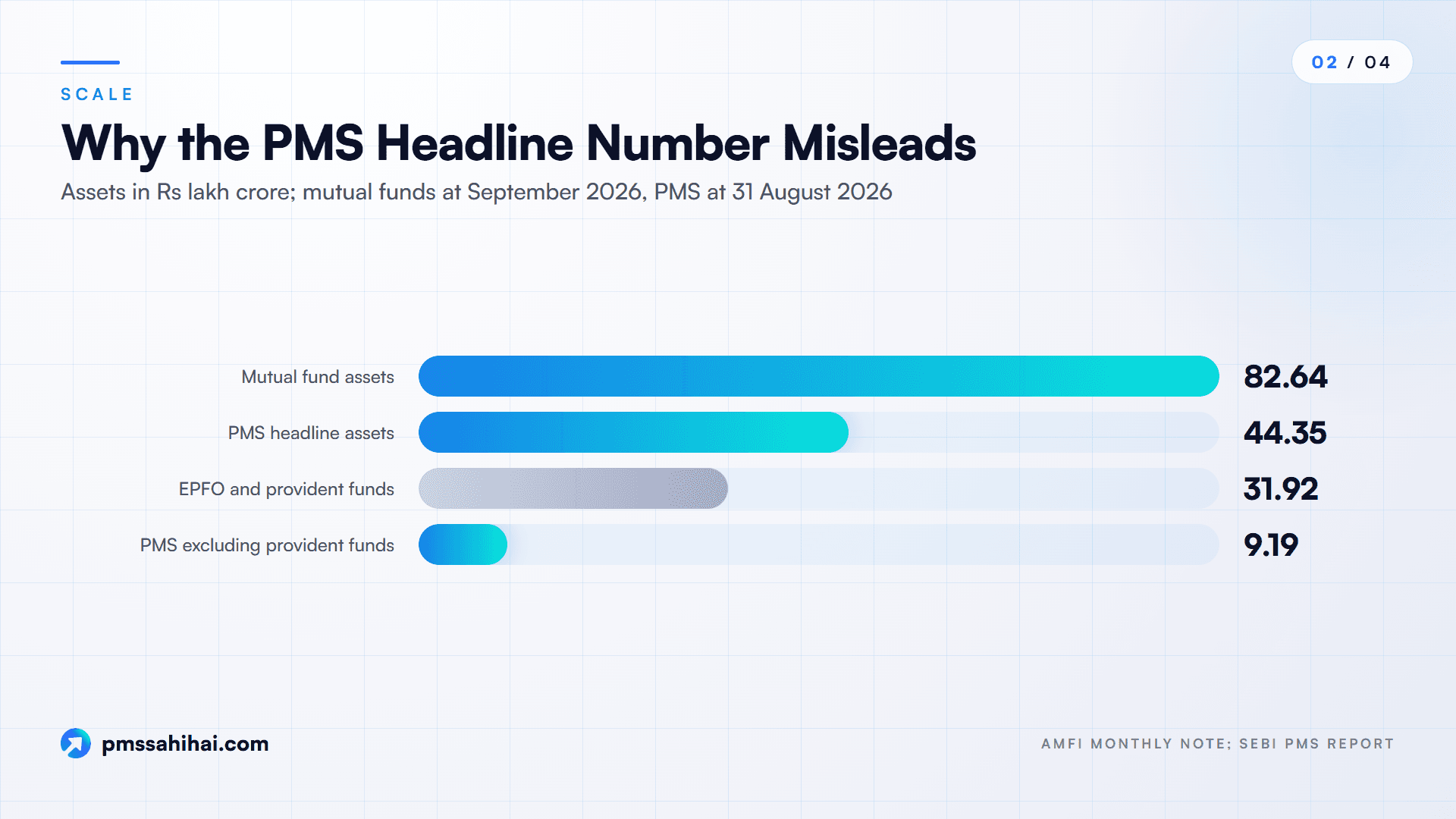
Now to the numbers, which also hold a trap. According to AMFI's monthly note, mutual fund assets stood at Rs 82.64 lakh crore at the end of September 2026, across 28.62 crore folios. SEBI's report on portfolio managers shows Rs 44.35 lakh crore as on 31 August 2026, reported by 511 managers. Read together, those figures suggest PMS is more than half the size of the mutual fund industry. It is not, in any sense that matters to a retail or HNI investor.
Why the PMS Headline Number Misleads
The SEBI table breaks that Rs 44.35 lakh crore into its parts.
| PMS category, 31 August 2026 | Clients | Assets (Rs crore) |
|---|---|---|
| Discretionary | 2,15,697 | 37,55,457 |
| Non-discretionary | 7,993 | 3,54,814 |
| Advisory | 1,306 | 3,17,477 |
| Co-investment | 837 | 6,845 |
SEBI then separates out the money of EPFO and provident funds. That single group accounts for about Rs 31.92 lakh crore. By our arithmetic, that is roughly 78% of the Rs 41.10 lakh crore held in discretionary and non-discretionary mandates. Strip it out and the non-provident-fund figure falls to about Rs 9.19 lakh crore, about one-ninth of mutual fund assets. The dates differ by a month, so treat that ratio as a rough size comparison and nothing more.
The client counts tell a similar story. Mutual funds report over 1,200 folios for every discretionary and non-discretionary PMS client. A folio is not a person, since one investor can hold many, so this too is a rough measure. It still shows the difference between a mass-market business and a concentrated one.
Average sizes make the same point from the other direction. Mutual fund assets per folio work out to about Rs 2.89 lakh. Discretionary PMS money excluding provident funds works out to roughly Rs 2.73 crore per discretionary client, though that divides by a client count which includes the provident fund mandates themselves. These are our calculations from published totals, not figures SEBI or AMFI publish.
So when you see a claim that PMS is a Rs 44 lakh crore industry, ask how much of that is a provident fund mandate. An institutional mandate tells you very little about what a Rs 50 lakh equity PMS client experiences.
How Each Business Earns Money and Charges You
Both businesses charge a percentage of assets at their core, but the rules around it differ sharply.
An AMC recovers its costs from the scheme, inside the daily net asset value, so you never receive a bill. The 2026 Regulations cap the base expense ratio on a sliding scale. For open-ended equity-oriented schemes, the limit is 2.10% on the first Rs 500 crore of daily net assets, and it falls by slab after that: 1.90% on the next Rs 250 crore, 1.60% on the next Rs 1,250 crore, and lower beyond. Statutory levies and transaction costs sit outside these limits, and anything above the limit must be borne by the AMC, trustees or sponsor. The design rewards scale, because as a scheme grows, the permitted percentage falls while the rupee revenue still rises.
A portfolio manager sets its fee by contract. Fees can be fixed, performance-based or a mix of the two, and SEBI's Master Circular of 16 July 2025 sets guardrails rather than a price list. No upfront fee may be charged. Brokerage is charged at actuals. Other operating expenses cannot exceed 0.50% a year of the client's average daily assets. Any performance fee follows the high water mark principle, so a client does not pay it twice for the same gain. Charges paid through the manager's own group for services such as broking or custody are capped at 20% by value per associate. Our guide to the PMS fee structure goes through these in detail.
The economics follow the design. An AMC profits from gathering a very large pool at a thin, capped margin. A portfolio manager typically earns more per rupee, on far fewer clients, with more of its pay at risk if it uses performance fees.
A Worked Fee Illustration on Rs 1 Crore
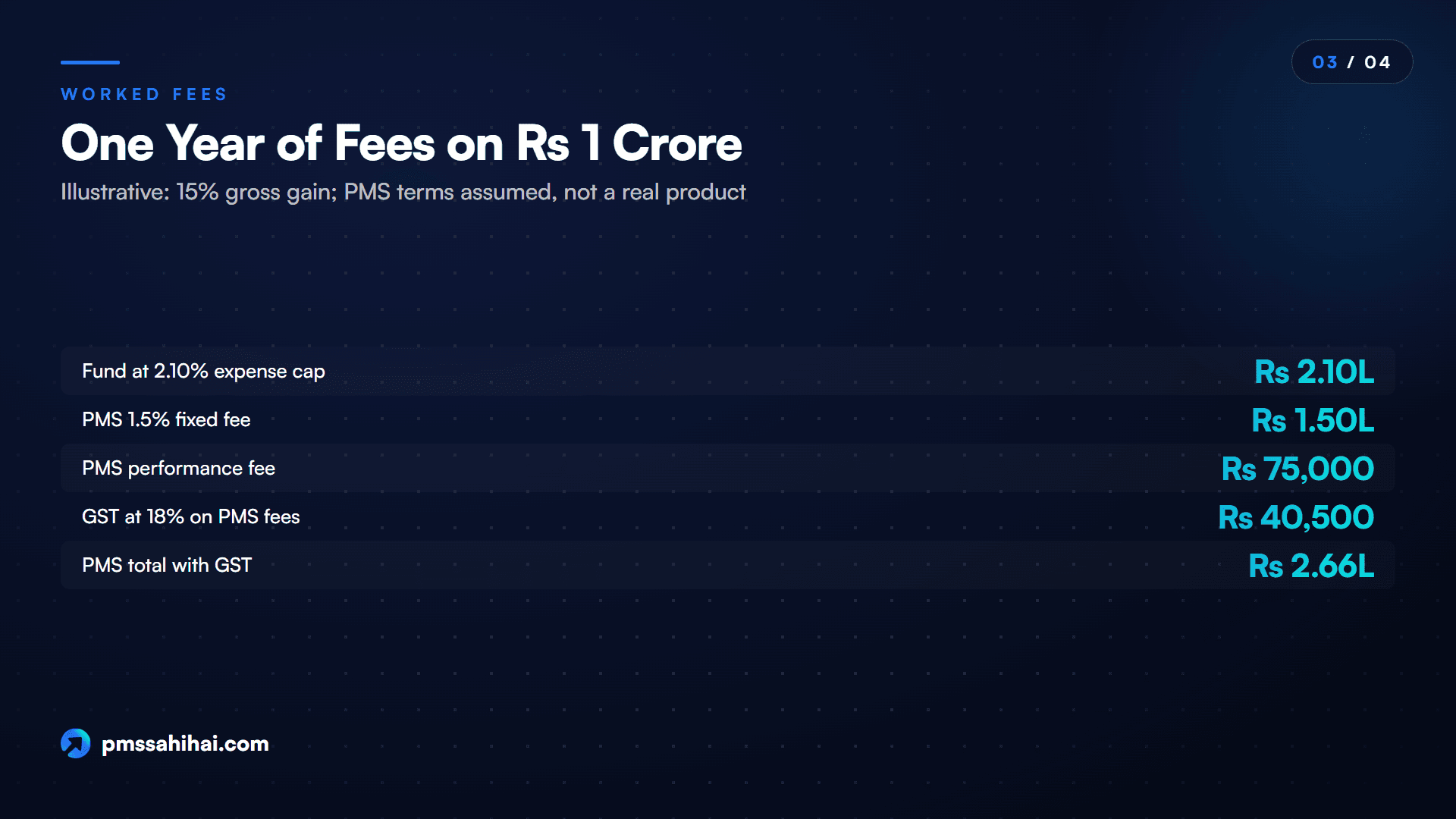
Here is a simple illustration for one year on Rs 1 crore with a 15% gross gain. The PMS terms are assumed for arithmetic only, and do not describe any real product.
- Mutual fund scheme: a small open-ended equity scheme at the top regulatory limit of 2.10% costs about Rs 2.10 lakh, before statutory levies and transaction costs. Larger schemes must charge less, since the limit falls by slab.
- PMS, assumed terms: a 1.5% fixed fee is Rs 1.50 lakh, and a 15% performance fee over a 10% hurdle on the Rs 5 lakh of excess gain is Rs 75,000. That is Rs 2.25 lakh. GST at 18% adds Rs 40,500, giving Rs 2.66 lakh. Operating expenses could add up to Rs 50,000 at the 0.50% cap, before brokerage.
The point is not which number is lower, as real terms vary widely. The point is that a PMS bill moves with performance and is visible on your statement, whereas the fund's cost is capped by rule and hidden inside the NAV. Also note that this ignores the gap in tax timing between the two.
Where the Two Businesses Overlap Today
The tidy picture of two separate worlds is getting less tidy.
An AMC can run a PMS. Regulation 21 of the Mutual Funds Regulations bars an AMC from acting as a trustee and limits its other business to management and advisory services for pooled assets, such as offshore, insurance, pension and provident funds. A further proviso then allows an AMC, itself or through subsidiaries, to offer portfolio management services and advisory services for other than broad-based funds, until SEBI directs otherwise. A broad-based fund is one with at least 20 investors and no single investor above 25% of the corpus.
Conditions apply. Key personnel, systems, back office, bank and securities accounts must be segregated activity-wise, with systems that block access to inside information. Capital adequacy must be met separately for each activity. Simultaneous buying and selling of the same equity across products must go through the market and a written trade order management system.
So a brand name is not enough to tell you which business you are dealing with. Always check which entity and which licence sits behind your specific product. SEBI consulted in July 2025 on easing some of these limits, but what counts today is what the regulation says, as amended.
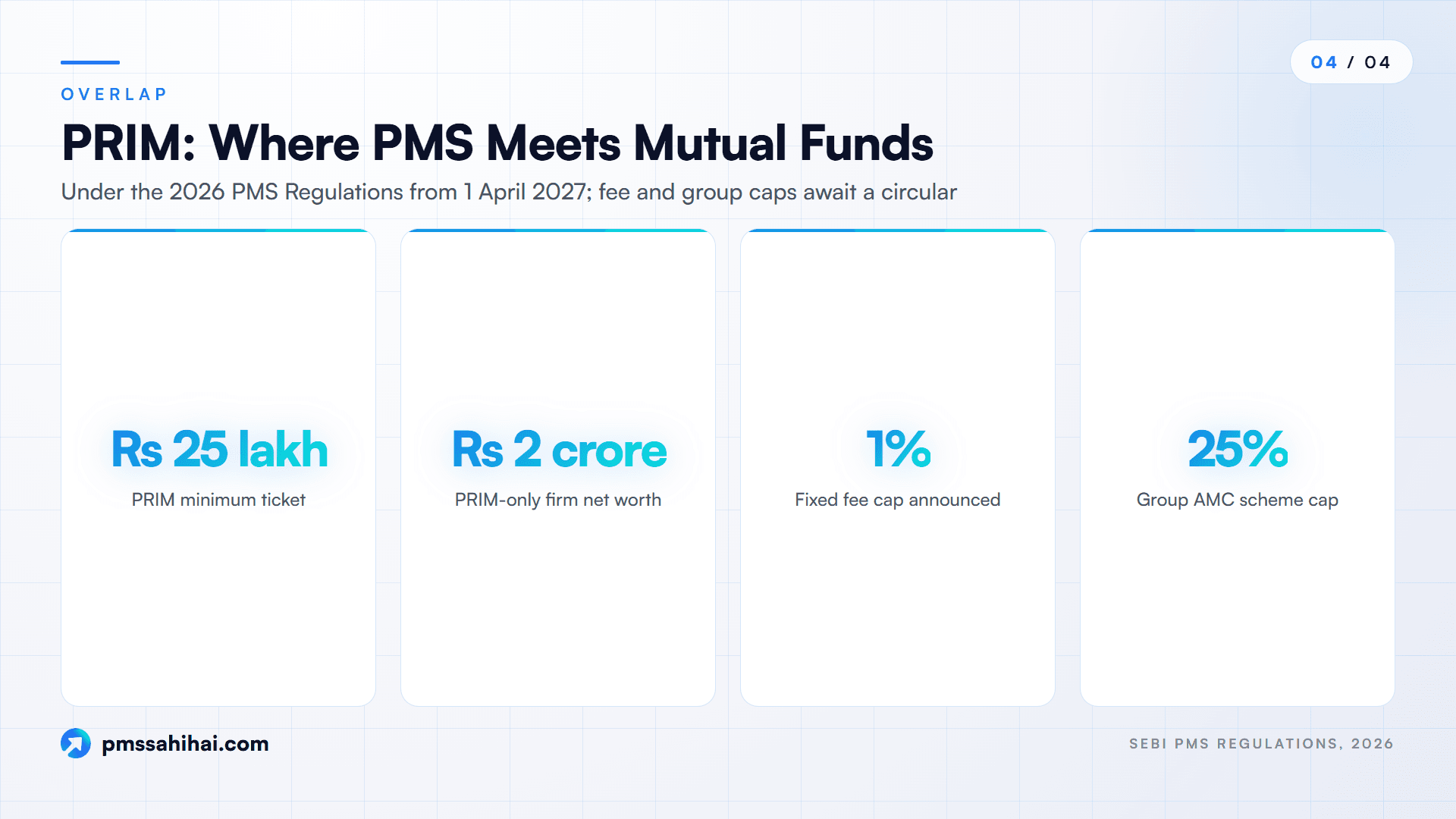
A PMS can buy AMC products. SEBI's August 2026 data shows mutual fund units worth about Rs 1.95 lakh crore inside discretionary and non-discretionary portfolios. The new rulebook takes this further with PRIM, the Portfolio Managers Route for Investing in Mutual Fund units. Under the 2026 Regulations, effective 1 April 2027, a manager may offer a direct-plan mutual fund portfolio from a Rs 25 lakh minimum, and a PRIM-only firm needs Rs 2 crore of net worth rather than Rs 5 crore. SEBI's Board also announced a 1% cap on the fixed fee and a 25% cap on investments in group AMC schemes, and those two items await a circular.
Technology has narrowed the service gap. Daily NAV computation and rule-based trade order systems are now routine for AMCs, and portfolio managers file data through SEBI's SI Portal, which feeds the public report. PMS clients can also be on-boarded directly, without a distributor, since SEBI requires managers to offer that option. Better data has made both models easier to check, though it has not removed the difference in what you own.
Practical Advantages of Each Business Model
Each model solves a different problem, which is why both have grown.
What the AMC model does well
- Low entry. You do not need Rs 50 lakh, so regular small savings can reach a professionally managed portfolio.
- Independent oversight. The trustee layer gives you a second set of eyes, with a majority of independent directors.
- Easy pricing. A daily NAV makes it simple to check what you own and what it is worth.
- Written cost limits. You can check an expense ratio against a regulatory slab.
- Less admin. Trades inside the scheme do not land on your tax return one by one.
What the portfolio manager model does well
- Direct ownership. Securities are held for you, and the manager cannot hold them in its own name.
- Tailoring. The contract can reflect your restrictions, existing holdings and goals.
- Visibility. You see every holding and transaction in your own account, rather than a monthly snapshot of a shared pool.
- Insulation from other clients' redemptions. Your account does not fund anyone else's exit, subject to the crowding point above.
- Aligned pay, where chosen. A performance fee with a high water mark means the manager's reward depends on your account's gains.
How PMS Sahi Hai Helps You Compare Both Models
Knowing the licence is the first step. Comparing real managers is the second, and that is where PMS Sahi Hai fits, with one honest boundary up front. The platform is built around PMS, AIF and GIFT City strategies. Our published guides do not describe a mutual fund scheme screener, so use AMFI and the fund houses' own documents for the pooled side of this decision, and use PMS Sahi Hai for the portfolio manager side.
- Screen portfolio managers side by side. The PMS comparison tool lists PMS strategies with returns, AUM, minimum ticket, style and fee structure. This is the practical follow-up to the fee section above, because it puts contract terms from different managers next to each other.
- Line up different structures. The compare page covers PMS, AIF and GIFT City strategies, with filters for product class, category, fund house and benchmark. You can place up to four strategies together, which helps when one firm runs more than one vehicle.
- Ask Nyra the structural question. Nyra is the platform's AI research tool. You describe a goal in plain English, and it ranks matching funds or helps you frame questions before a manager meeting. It works best when you ask something specific, such as what a given manager charges after the performance hurdle, rather than asking which product is best.
- Read how the scores are built. A score is only as useful as the method behind it. The Nyra methodology sets out five pillars, and strategies with under 12 months of track record show as Not Rated. Our explainer on how Nyra scores a PMS walks through that logic.
A sensible way to use all this is to start with the licence questions from this guide. Confirm that the firm is a SEBI-registered portfolio manager, note whether it sits inside an AMC group, and then compare its fees and record with peers. If your amount or goal points to a pooled scheme instead, that is a useful result too. A tool that helps you say no to a PMS is doing its job.
Honest Limitations of AMCs and Portfolio Managers
Neither structure is a free lunch, and each has its own weak points.
Limits of the AMC model. You have no control over individual holdings, tax timing inside the scheme, or who else invests alongside you. A very large scheme may find it harder to take meaningful positions in smaller companies. Fees within the NAV are easy to overlook because you never write a cheque for them. Regular plans can also carry distribution costs that direct plans do not.
Limits of the portfolio manager model. The Rs 50 lakh minimum rules out most savers, except accredited investors who are exempt. The firm's regulatory capital can be as low as Rs 5 crore, which is a fraction of an AMC's. That does not mean your securities are at risk, as they are not held in the manager's name, but it does mean you should look harder at the firm's staying power and the depth of its team. There is no trustee between you and the manager.
Costs can also stack up: fixed fee, performance fee, brokerage, operating expenses and GST. Every sale may trigger tax in your own hands. And "individually managed" often means one model portfolio applied across many clients, so ask how much tailoring you will really receive. Finally, what happens if a manager shuts down or a key person leaves deserves a question before you sign, not after.
Rules are also moving. The 2020 Regulations give way to the 2026 version on 1 April 2027, and some Board-announced PMS limits still await SEBI circulars. Anything you read about either model, this article included, should be checked against the current SEBI text.
Choosing the Model That Fits Your Money
The comparison of asset management vs portfolio management becomes easier when you ask four plain questions.
- How much are you investing? Below Rs 50 lakh, a traditional PMS is not available unless you are accredited, so a mutual fund scheme is the natural route. From 1 April 2027, PRIM may add a Rs 25 lakh option limited to mutual fund portfolios.
- Do you want to own the shares? If direct ownership and the ability to exclude stocks matter to you, the PMS structure is the only one of the two that offers them. If not, you may be paying for a feature you will not use.
- Can you handle the tax paperwork? A PMS generates many reportable transactions. If this sounds like a burden, weigh that against any benefit. Your tax adviser can help you model the difference.
- Whom do you want watching the manager? With a scheme you get a trustee board. With a PMS you get a custodian, audit and a contract, and more of the checking falls to you.
Many larger portfolios do not choose at all. They use low-cost schemes for core exposure and a PMS for a concentrated sleeve. The sensible test for any such split is whether the second layer of fees earns its keep after tax. For a deeper discussion of combining the two, read our piece on whether to hold PMS as well as mutual funds.
The core lesson is simple. Treat AMC and PMS as two businesses with two licences rather than two flavours of the same thing, then check which entity holds your money and under which rulebook. If the portfolio manager route is the one left standing, PMS Sahi Hai and Nyra can help you compare the managers on your shortlist, while the licence check stays with you.
Compare Your AMC and PMS Options Next
Now that you know the licence behind each label, look at actual products with that lens. Use the PMS comparison tool on PMS Sahi Hai, ask Nyra to frame your shortlist, or contact the team with your questions. Start with the amount you plan to invest, decide whether you want a pooled scheme or your own portfolio, and then compare managers' fees, track record and approach. Talk to a SEBI-registered adviser and a tax adviser before you commit, as this guide is general information and not investment advice.
PMS Sahi Hai is a distributor of Portfolio Management Services and Alternative Investment Funds, APMI-registered (Registration No. APRN08358). This article is for education only and is not investment advice, a recommendation, or an offer to buy or sell any security. Investments in securities markets are subject to market risks; read all scheme-related documents carefully. Past performance is not indicative of future results. Consult your advisor before investing.
Ishaan founded PMS Sahi Hai to make India's PMS, AIF and GIFT City markets legible to serious investors, comparing every SEBI-registered manager on the same comparative basis, with no shelf products and no commission bias.
Frequently asked
What is the difference between asset management and portfolio management?
In Indian investing, asset management usually refers to AMCs running pooled mutual fund schemes under a trust. Portfolio management refers to SEBI-registered firms managing a separate portfolio for each client under a contract. Outside finance, asset management can also mean looking after physical assets such as buildings and machinery, which is a different meaning altogether.
Is a PMS an asset management company?
No, not in regulatory terms. A portfolio manager is registered under the SEBI (Portfolio Managers) Regulations, while an AMC is approved under the SEBI (Mutual Funds) Regulations. Some explainers call PMS a type of AMC, which is loose language. An AMC may also run a PMS, but it must then meet the separate conditions for that activity.
Can a mutual fund house run a PMS in India?
Yes, subject to conditions. Regulation 21 of the Mutual Funds Regulations, 2026 lets an AMC, itself or through subsidiaries, offer portfolio management services for other than broad-based funds until SEBI directs otherwise. Key staff, systems and accounts must be segregated activity-wise, and capital adequacy must be met separately for each activity. Always check the specific entity on your agreement.
How much net worth does an AMC need compared with a portfolio manager?
A portfolio manager needs at least Rs 5 crore. An AMC needs at least Rs 50 crore under Route 1. Under Route 2 it needs Rs 150 crore at registration, then at least Rs 100 crore, falling to Rs 50 crore after five consecutive profitable years. These figures come from the current SEBI regulations and may change, so check the latest text.
Is the PMS industry nearly as big as mutual funds?
No, despite the headline. SEBI showed Rs 44.35 lakh crore under portfolio managers on 31 August 2026, against Rs 82.64 lakh crore for mutual funds in September. But about Rs 31.92 lakh crore of that PMS figure belongs to EPFO and provident funds. Without those mandates, about Rs 9.19 lakh crore remains, roughly one-ninth of mutual fund assets.
Do I own the shares in a mutual fund or a PMS?
In a mutual fund you own units, which give you a beneficial interest in the scheme's assets, not the underlying shares. In a PMS the securities belong to you, and the regulations bar the manager from holding them in its own name on your behalf. This is why tax and customisation work differently in the two models, so check details with your adviser.
Which is better for me, an AMC scheme or a PMS?
It depends on your ticket size, wish for direct ownership and tolerance for tax paperwork. Below Rs 50 lakh, a scheme is usually the only choice unless you are an accredited investor. Above it, compare after-fee, after-tax outcomes rather than headline returns. Neither is automatically better, and a tax adviser can help you model your own numbers.
Who regulates AMCs and portfolio managers in India?
SEBI regulates both, under separate rulebooks. AMCs and mutual funds fall under the SEBI (Mutual Funds) Regulations, 2026. Portfolio managers fall under the SEBI (Portfolio Managers) Regulations, 2020, which the 2026 version replaces from 1 April 2027. Both types of firm must also meet disclosure duties, and complaints can be raised through SEBI's grievance channels such as SCORES.
Keep reading
All articles
Private Banker vs Financial Product Distributor: Which Do You Have?
Private banker or distributor? Compare APMI and AMFI registration, legal duty and cost in India, and run seven checks to see who you are dealing with.

Estate Planning vs Succession Planning: What Each One Actually Decides
Estate planning decides who owns your assets. Succession planning decides who runs the business. See where they differ and collide in India.
Long-Short SIF vs Hybrid SIF: Rules, Limits, Tax and Who Each Suits
Long-short SIF vs hybrid SIF: compare SEBI rules on equity floors, the 25% short cap, redemption, listing, tax tests and who each suits.
Read it. Now pressure-test it.
Ask Nyra how this applies to your portfolio, or talk to our team, no pitch, no pressure.