
POA in a Demat Account: What You Signed and What DDPI Changed
What a POA in a demat account lets a broker do, how SEBI's DDPI limits it, why old POAs stay valid until revoked, and how to check and cancel yours.

A POA in a demat account is a standing authority that lets your stock broker or depository participant move or pledge your securities without asking each time. SEBI has made it optional since 2010, and since 1 September 2022 a narrower document, the Demat Debit and Pledge Instruction (DDPI), does the settlement and margin jobs for new mandates. A POA signed before that date stays valid until you revoke it, so many older accounts still carry one. You can sell without either, using an electronic or paper delivery slip. Check which paper your account holds, read it, and cancel what you do not need.
Why Brokers Ask You to Sign a Mandate
Most investors meet this document in the middle of an account-opening form. A page asks for a signature or an e-sign, the screen moves on, and the paper is forgotten for years. That is exactly the habit SEBI objected to. In its August 2020 circular, the regulator said a PoA was "invariably obtained" from investors as part of KYC and account opening, and that such PoAs had been misused.
The reason brokers want this authority is practical. When you sell shares, those shares must leave your demat account and reach the clearing system in time to settle the trade. Someone has to instruct the depository to debit them. Either you do it yourself for each sale, or you authorise your broker to do it for you.
A POA in a demat account was the old answer to that problem. Today it is mostly a legacy document, replaced for new settlement and margin mandates by the DDPI. Yet it still matters, for two reasons. It may still be active on your account, and the DDPI that replaced it is, in substance, a tightly drawn version of the same idea. The depository CDSL even calls it the "DDPI POA" in its own operating notes.
This guide explains what the document authorises, what it never could, how the rules changed and on which dates, and how to check and cancel yours. It is general information about SEBI's framework, not legal advice. If a large holding, an elderly parent's account or a dispute with a broker is involved, consult a lawyer.
What a Power of Attorney Means in a Demat Account
A power of attorney is a written authorisation that lets one person, the agent, act on behalf of another, the principal. In India the agency relationship sits under the Indian Contract Act, 1872, and the same general idea applies whether the subject is a house or a shareholding.
In the demat setting, the principal is you, the beneficial owner of the securities. The agent is the stock broker, or the stock broker and depository participant if the same firm plays both roles. The power of attorney in a demat account tells the depository that instructions from that named entity, within stated limits, should be treated as instructions from you.
Three points are often muddled.
First, it does not transfer ownership. Your shares remain yours and stay in your beneficial owner account. What you have handed over is a right to give certain instructions on that account, not title to what is in it.
Second, it is not the same as a trading order. A broker POA deals with the movement of securities after a trade. It was never meant to let a broker decide what to buy or sell. SEBI's norms state that a PoA must not let a broker execute trades in a client's name without the client's consent.
Third, the demat POA is different from other powers of attorney you may have heard of. A portfolio manager under a PMS agreement typically holds a limited PoA of its own, covering a discretionary mandate, and that arrangement is a separate subject with its own rules. Equally, a family member holding your general power of attorney for property or banking is a different arrangement from the broker mandate discussed here. If you want a relative to operate your demat account, ask your depository participant what it requires, and take a lawyer's advice on the drafting.
What SEBI's Norms Let a Broker Do and Not Do
The base rulebook is SEBI's circular of 23 April 2010. It came after the regulator noted that clients were being compelled to give irrevocable powers of attorney over demat and bank accounts, and that some documents even allowed a broker to open and close accounts and trade without the client's consent.
What the 2010 norms permitted
On the securities side, the norms allowed a PoA to cover three things:
- Transferring securities to meet margin or delivery obligations from trades done through the same broker.
- Pledging securities in favour of the broker for margin on those trades.
- Applying for products such as mutual funds, public issues, rights and open offers, on the client's instructions, with an audit trail.
On the funds side, a PoA could allow transfers from the client's bank account for settlement and margin on the same broker's trades, for dues arising from trading, for products bought through the broker, and for fees and charges.
What the 2010 norms required
A valid mandate had to name the demat and bank accounts the broker could operate, and list where funds and securities could go, which had to be accounts of related parties only. It had to be in the name of the SEBI-registered entity, not an employee. It could not be assigned. It had to be stamped according to local law, and all joint holders had to execute it. If the account's constitution changed, a new one was needed. The client had to receive a certified copy, and the mandate had to be revocable at any time, without notice.
What a POA could never do
SEBI listed prohibited uses, and they are worth reading against your own document. A POA must not facilitate:
- Transfers of securities for off-market trades.
- Transfers of funds for trades done through another broker.
- Opening a trading or demat account in your name.
- Executing trades without your consent.
- Stopping you from receiving delivery instruction slips or operating your own account.
- Merging balances across accounts to cancel a debit elsewhere.
- Opening an email account on your behalf to receive statements.
- Disclaiming liability for funds blocked in error.
SEBI repeated this list in August 2020 because it had found brokers taking authorisation for these very activities.
How Misuse Pushed SEBI Towards a Narrower Mandate
The clearest reminder of what a misused mandate can do is the Karvy Stock Broking case. On 22 November 2019 SEBI passed an interim order barring the broker from taking new clients, after a preliminary report from NSE. According to press reports of the order, it also directed NSDL and CDSL not to act on instructions given by the broker under its clients' powers of attorney.
When SEBI later cancelled Karvy's registration, Business Today reported that it had raised Rs 2,032.67 crore in loans by pledging client shares valued at Rs 2,700 crore. NSE declared the firm a defaulter on 23 November 2020, and SEBI was still extending the deadline for investor claims in December 2025, to 31 March 2026 at that release. Six years on, the case was not fully closed for its investors.
SEBI's circulars do not name Karvy when they explain the DDPI. They talk about misuse in general terms. But the direction of travel is plain. Margin rules were rewritten so that securities given as margin stay in the client's account under a formal margin pledge, confirmed by the client. Transfers to a broker's account as margin, known as title transfer collateral, were prohibited. The rules also state that merely holding a POA does not count as collecting margin. Then came the mandate itself.
How DDPI Arrived: The Dates That Actually Applied
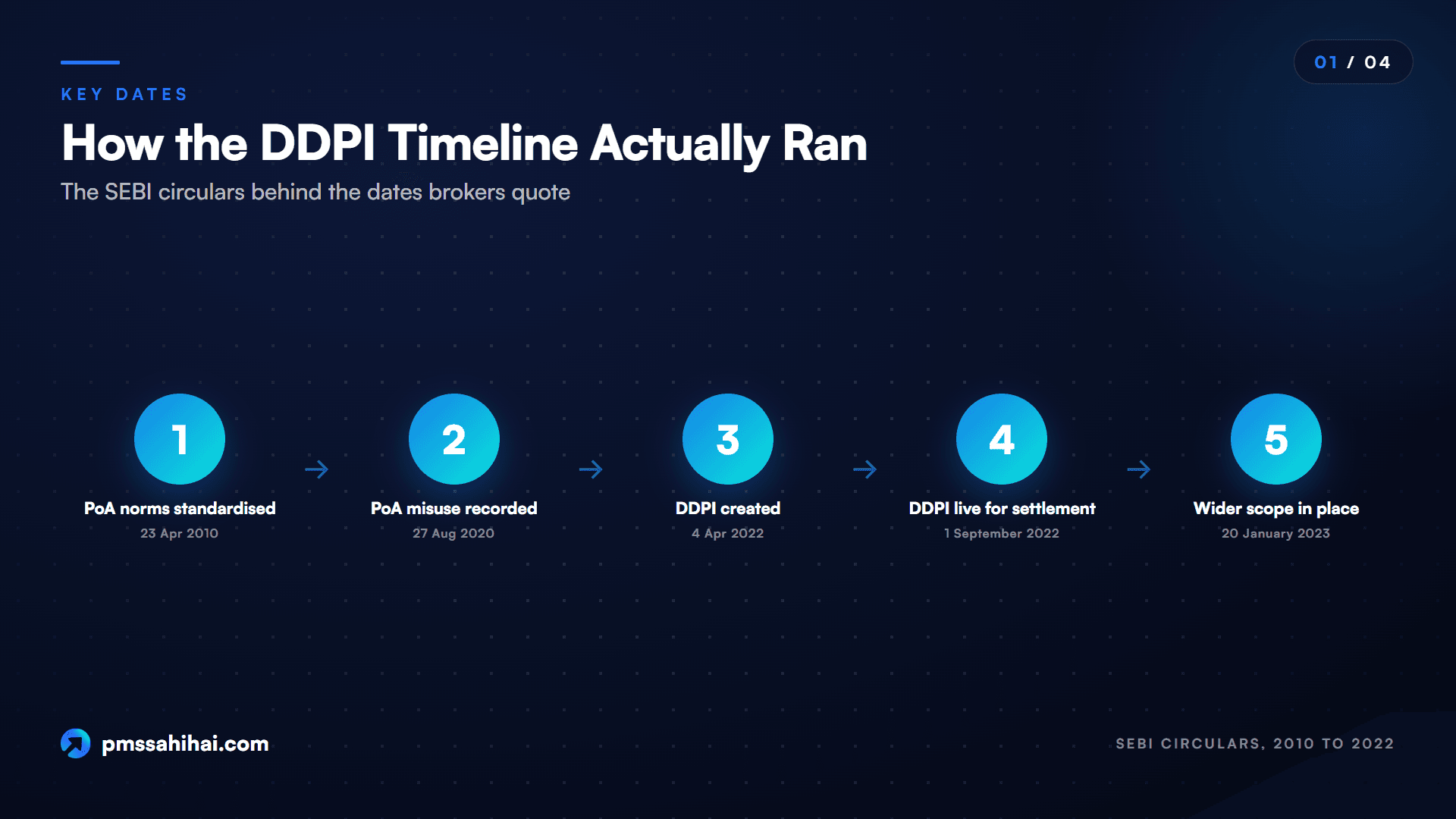
Broker explainers disagree on DDPI's start date, with several quoting 1 July 2022 and others late 2022. The circulars show why, because the timetable moved twice.
| Date | SEBI action | What it did |
|---|---|---|
| 23 Apr 2010 | Circular CIR/MRD/DMS/13/2010 | Standardised PoA norms; made PoA optional |
| 27 Aug 2020 | Circular SEBI/HO/MIRSD/DOP/CIR/P/2020/158 | Reiterated PoA was optional and limited; recorded misuse |
| 4 Apr 2022 | Circular SEBI/HO/MIRSD/DoP/P/CIR/2022/44 | Created the DDPI, effective 1 July 2022 |
| 30 Jun 2022 | Circular SEBI/HO/MIRSD/DoP/P/CIR/2022/91 | Moved implementation to 1 September 2022 |
| 6 Oct 2022 | Circular SEBI/HO/MIRSD/MIRSD-PoD-1/P/CIR/2022/137 | Added mutual fund and open offer transactions, effective 18 November 2022 |
| 25 Nov 2022 | Circular SEBI/HO/MIRSD/DoP/P/CIR/2022/162 | Moved the October changes to "on or before January 20, 2023"; set pay-in validation for 27 January 2023 |
So the working answer is this: DDPI went live for settlement and margin on 1 September 2022, and its wider scope was to be in place by 20 January 2023. Any date you read should be checked against this list.
The Stock Brokers Regulations were themselves replaced by a new set in January 2026. BSE's master circular updated to 31 March 2026 still carries the DDPI provisions described here, but rules change, so confirm the current position with your broker or on SEBI's website before relying on a detail.
The Four Purposes a DDPI Can Cover
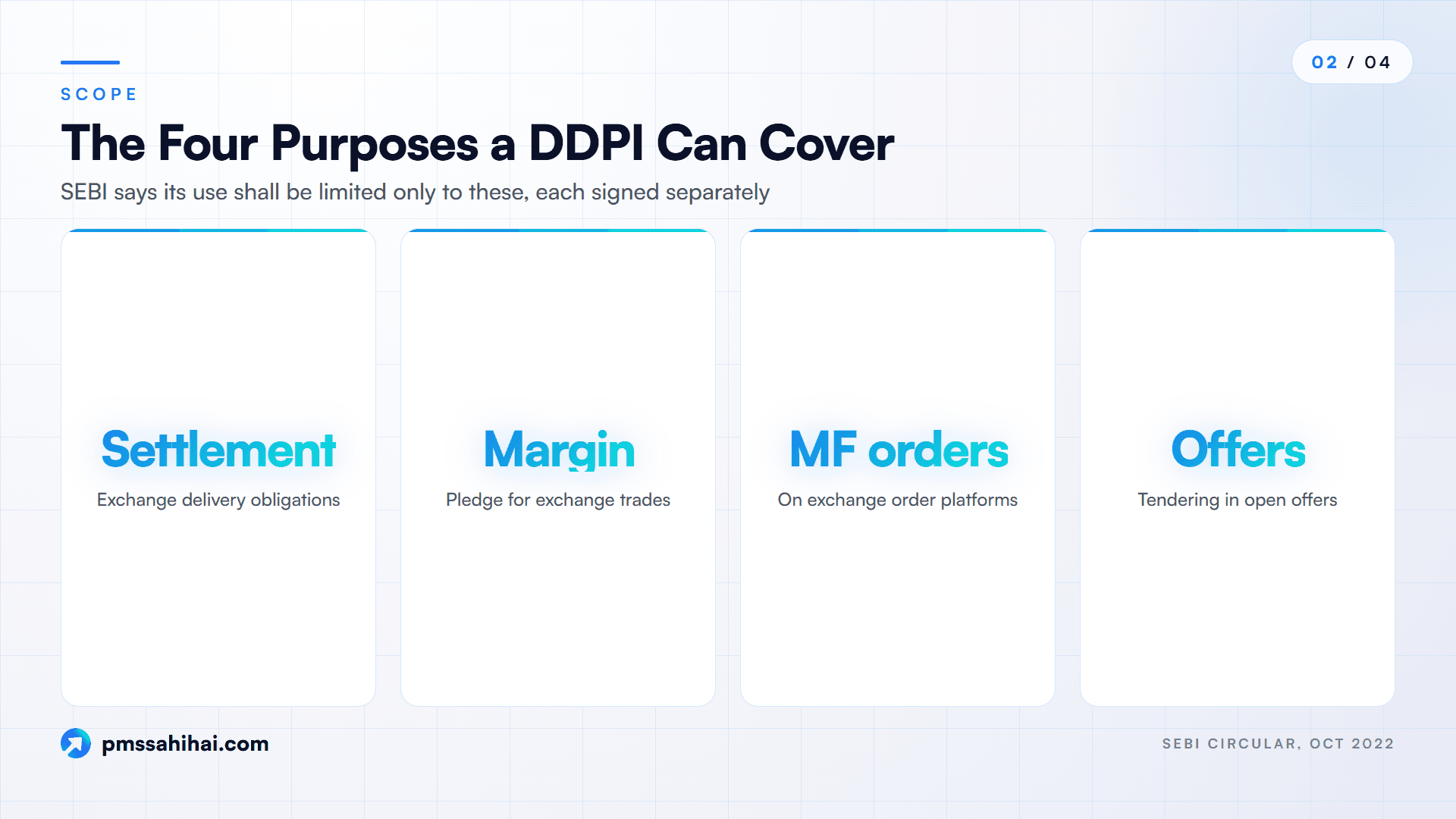
The Demat Debit and Pledge Instruction is limited to four purposes:
- Settlement. Transferring securities from your account towards exchange delivery or settlement obligations, from trades you executed through the same broker.
- Margin. Pledging or re-pledging securities in favour of the trading member or clearing member, to meet margin requirements on your exchange trades.
- Mutual fund orders. Mutual fund transactions executed on stock exchange order entry platforms.
- Open offers. Tendering shares in open offers through stock exchange platforms.
SEBI says the use of the DDPI "shall be limited only" to these purposes. That is a useful test, because some broker pages list buybacks, delistings or offers for sale under DDPI. Those items do not appear in the SEBI text read for this article. If a broker tells you a DDPI covers something else, ask where the permission comes from.
The form is built to make you think about each power. The annexure has a separate signature against each purpose, and if you e-sign, you must be given the option of choosing specific purposes. CDSL's guidance also has clauses signed separately. You can therefore authorise settlement but not pledging, if your broker offers that choice.
A DDPI also has to be adequately stamped, can be signed digitally, and needs your explicit consent, including for internet-based trading.
POA vs DDPI: The Differences That Matter
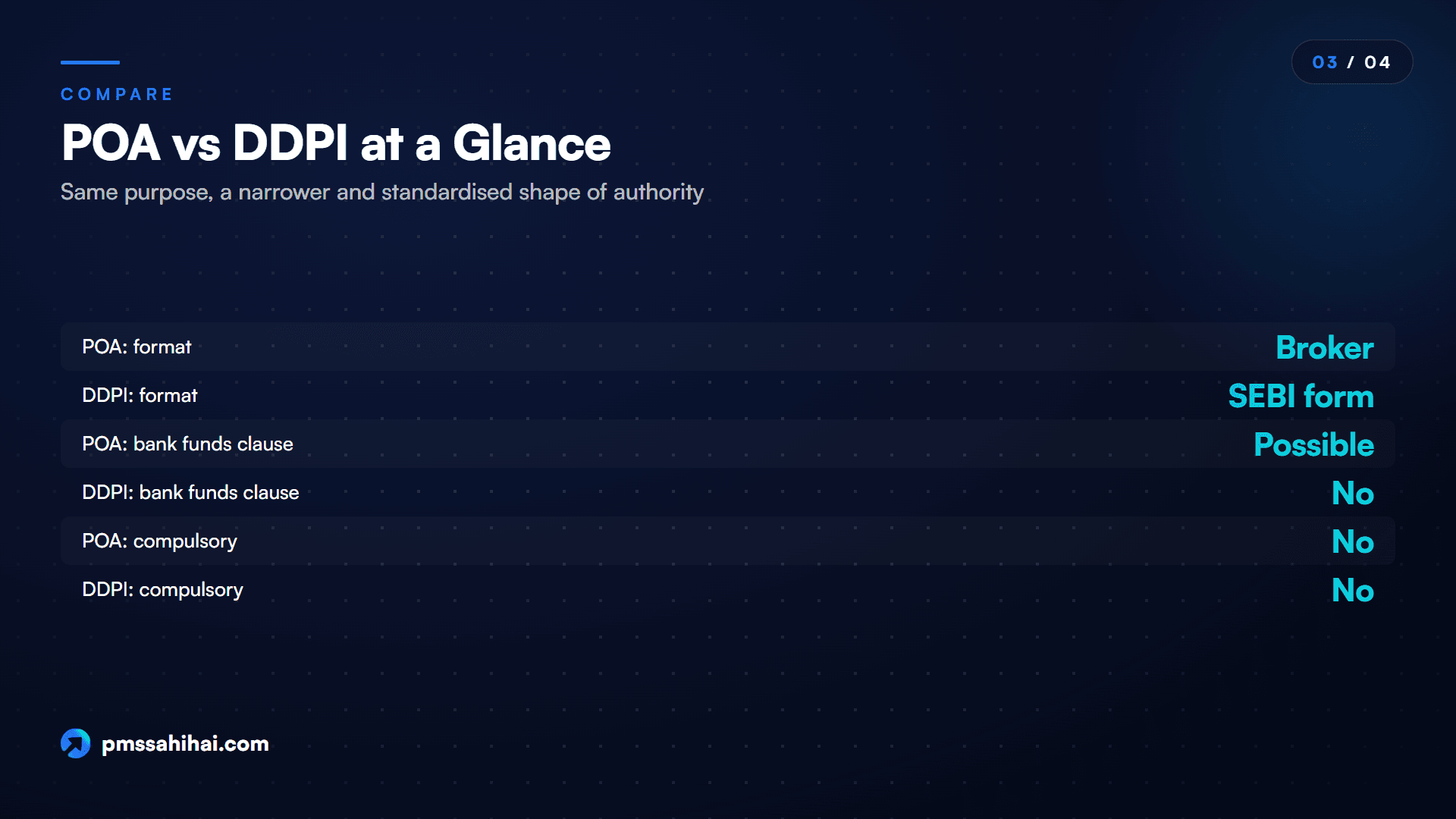
Many pages describe POA vs DDPI as "old unsafe paper versus new safe paper". The truth is narrower. SEBI itself says the DDPI "shall serve the same purpose of PoA". What changed is the shape of the authority.
| Point | Pre-September 2022 POA | DDPI |
|---|---|---|
| Purpose limit | Set by the 2010 and 2020 norms, but the document can be wider in wording | Four named purposes in a SEBI format |
| Format | Broker-drafted within the norms | Standard annexure prescribed by SEBI |
| Bank account authority | Could include funds transfers | Not one of the four purposes |
| Sign-off | A signature on the document | Separate signature per purpose, or an e-sign with a choice of purposes |
| New execution | No longer executed for the DDPI purposes | Current route for those purposes |
| Compulsory? | No | No |
| Revocable? | Yes, at any time, without notice | Yes; brokers must enable it |
The funds line deserves attention. The DDPI covers securities in your beneficial owner account, and nothing in its four purposes authorises a debit from your bank. Other provisions of the PoA circulars continue to apply, so the arrival of DDPI did not by itself end every PoA for every purpose. It ended PoAs for the listed DDPI purposes. An older document, however, may contain a funds clause. That is one more reason to read yours rather than assume.
Why an Existing POA May Still Be Live on Your Account
Here is the point most explainers pass over in a sentence. BSE's master circular says PoAs executed before 1 September 2022 "shall continue to remain valid till the time client revokes the same".
No expiry applies and no automatic conversion happens. If you opened an account in 2016 and signed a broker POA, you may still have it today, even if you trade through an app and have heard of DDPI. CDSL's guidance confirms the same point from the system side: an existing settlement POA linked to a demat account can go on being used until it is revoked by delinking its master ID. NSDL's guidance adds that if you revoke the old POA and give a DDPI, the settlement and margin transactions then run on DDPI only.
This creates three practical situations:
- You have an old POA only. It still works, within its wording and the norms. You have not lost anything, but you may be carrying broader language than a DDPI would contain.
- You have both. CDSL's guidance addresses the case where a DDPI is linked to an account that already holds a settlement POA, so ask your participant which mandate is being used, and consider cancelling the older one.
- You have neither. That is allowed. You simply approve each debit yourself.
A dormant account deserves extra attention. An account at a broker you stopped using years ago may still carry a mandate in that broker's favour. The risk may be small, but the fix is a single request, and a broker you no longer use has no reason to retain the authority.
Advantages of a Standing Demat Mandate
A standing authority exists because it does solve real problems. Used deliberately, it offers:
- Fewer steps for active sellers. You do not have to authorise each debit with a code, which matters if you sell often or sell from a device or network that is unreliable.
- Lower risk of a failed delivery. Missing the approval window on a sale can leave you short on delivery. Standing authority takes that manual step out.
- Simple margin operations. Your broker can initiate a margin pledge for you, though you still confirm it. On its own this is a real saving for derivatives traders who pledge often.
- Single-instruction coverage. One mandate can cover settlement, pledging, exchange-platform mutual fund orders and open offer tenders, if you choose all four.
- A clear, limited scope. With a DDPI, the scope is fixed by the regulator's format, so you do not have to analyse drafted legal language.
How Modern Systems Make Selling Easier
Fifteen years ago, investors without a mandate typically filled a paper delivery instruction slip. Today the alternative is electronic. The e-DIS route lets you approve a sale online, typically with a depository TPIN and an OTP, and SEBI's text explicitly preserves it: a client may use the DDPI or opt to complete settlement through a physical or electronic delivery instruction slip.
Picture a sale of 100 shares under each route.
- e-DIS with TPIN. You place the sell order, then authorise the debit for those shares when prompted. The approval is specific to that sale. If you skip it, the shares are not debited, and your broker's process for a short delivery applies.
- DDPI. You place the sell order and the broker arranges the debit under your standing mandate. There is no separate approval, but the transfer must match your actual obligation.
- Old POA. The experience looks much like DDPI, governed by your document and the same system checks.
Those system checks are where the plumbing has genuinely improved. Depositories must match transfers against each client's net delivery obligation, and securities moved under a DDPI go to specified settlement accounts rather than wherever a broker chooses. A separate pay-in validation circular took effect on 27 January 2023. On the way back, the exchanges have run direct payout of securities into client demat accounts in phases from 14 October 2024, so bought shares go straight to you rather than through a broker's pool account. A margin pledge stays pending until you confirm it by OTP or a similar mechanism.
For the investor, the combined effect is simple. The approval can be one tap, and a mandate has less room to wander than it once had.
How PMS Sahi Hai Helps You Read the Fine Print Beyond a Demat Mandate
PMS Sahi Hai is a platform for comparing PMS and AIF strategies, and it does not offer a service that checks, files or revokes a broker POA. Your broker and depository participant do that. Where the platform helps is one step further on, once your authorisations are in order and you are weighing whether to hand a professional a much larger mandate.
The mental habit carries over directly. A demat mandate teaches you to ask three questions of any authority you grant: who can act, on what, and how you take it back. The same questions apply when a portfolio manager operates your money under a PMS agreement. A portfolio manager's PoA is a separate document with a different purpose, but the discipline of reading before signing does not change.
Our published guide on why your manager can't touch your money explains how a custodian and a limited PoA fit together in a PMS. Our walk-through of how to read a PMS disclosure document is the natural next read before you commit. If you are still deciding whether a mandate makes sense at all, PMS vs direct equity sets out the trade-off between doing it yourself and delegating.
For the comparison itself, the PMS and AIF comparison tool helps you shortlist strategies by category, benchmark and record. Nyra, our AI-powered research tool, can help you frame questions about a strategy. Nyra is an analytical tool and not a SEBI-registered investment adviser, so treat its output as a starting point for your own diligence. Neither tool tells you anything about the mandate on your own demat account, and neither replaces legal advice on what you sign.
The Limits and Risks You Should Accept Knowingly
A DDPI is safer than the old broad mandate, but it is still a standing authority. Be clear on its limits:
- It remains a live instruction. It stays on the account until you revoke it. The per-sale check you give up is a real check, and an OTP you must approve is a form of early warning.
- System checks reduce misuse but do not eliminate it. Matching a debit to an obligation helps only if the trade itself is genuine. An unauthorised sale creates a real obligation, and it would be a separate wrong to pursue. Check contract notes and statements.
- Rules did not save Karvy's clients in time. The norms against misuse existed for years before 2019. Regulation sets the boundary, while enforcement often arrives after the damage.
- Old paper may read wider than the rule. A prohibited clause should have no effect, but disputing it is harder than never having it on file.
- Joint and changed accounts need care. All joint holders must execute a PoA and a change in the account's constitution calls for a new one.
- Incapacity and death are not solved by it. Under section 201 of the Indian Contract Act, agency ends on the principal's death or unsoundness of mind. A broker mandate is not an estate planning tool, so nomination and transmission rules take over after death.
- Fees vary. Some brokers charge to activate a DDPI. Groww's page cites Rs 100 plus GST, Kotak Neo's calls that typical, and m.Stock's says most brokers offer it free. These are broker statements, not regulated charges, so check your schedule.
How to Check and Revoke a POA or DDPI
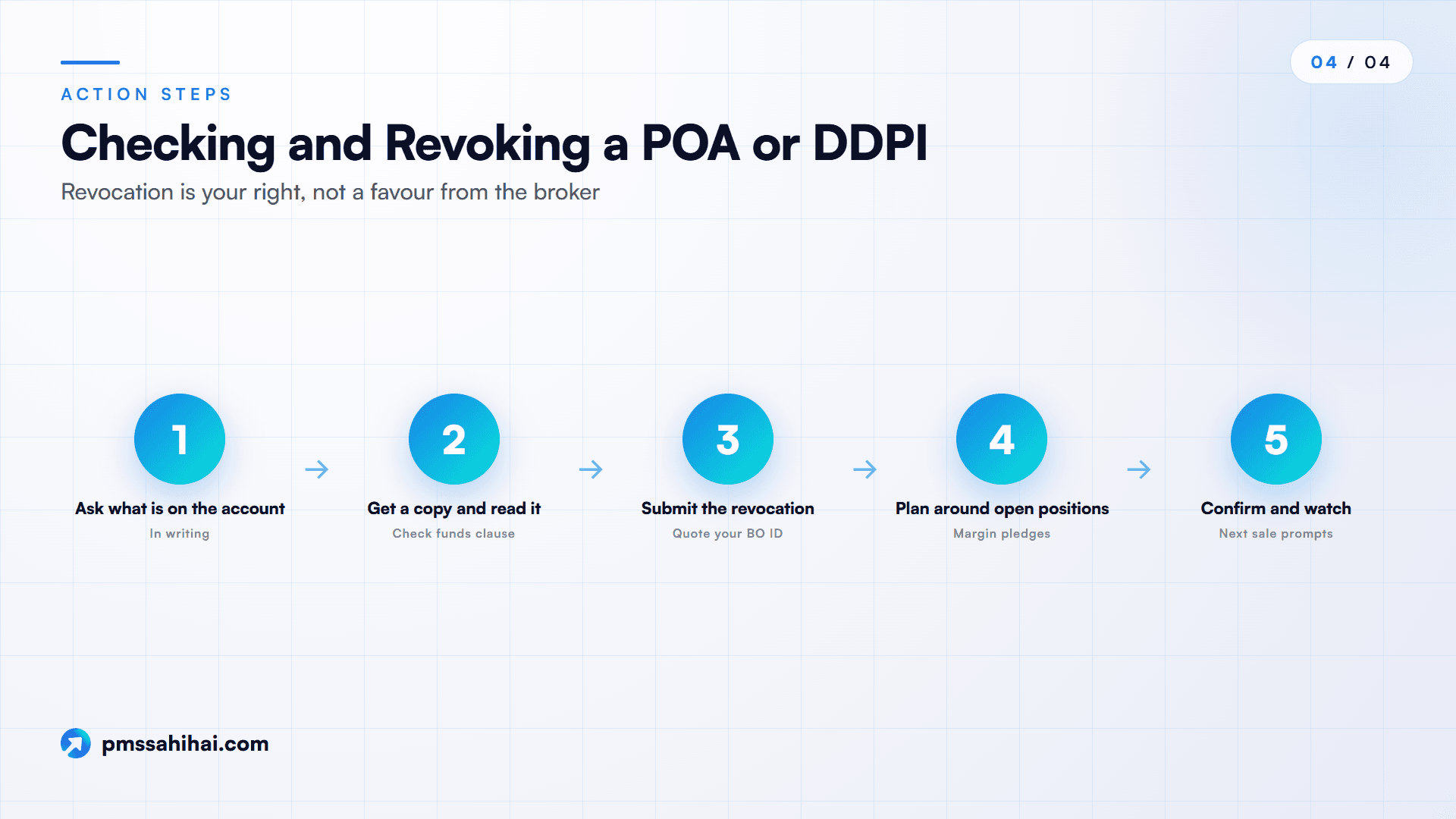
Revocation is your right. SEBI's 2010 norms require a PoA to be revocable at any time without notice, and its October 2022 circular tells exchanges and depositories to ensure brokers let clients revoke or cancel a DDPI. It is not a favour. Here is a sensible sequence.
Find out what is on the account
Ask your broker or depository participant in writing: "Is a POA or DDPI linked to my demat account? On what date, in whose favour, and for which purposes?" Many broker apps show this in profile or account settings, and Zerodha, for example, has a help article on checking whether a POA or DDPI is active. Your account's records with the depository are the final authority, so ask your participant to confirm.
Get a copy and read it
You are entitled to a duplicate or certified copy of a PoA under the 2010 norms. Read it against the prohibited list above. Look specifically for a funds clause, the accounts money or securities can move to, and any right to assign.
Submit the revocation
The process is broker-specific. 5paisa asks for an email with the subject line "REVOKE/REMOVE DDPI/POA". IIFL describes an e-signed revocation form. Other brokers use an in-app option. Quote your BO ID, name the document, and keep the acknowledgement. If you plan to switch to a DDPI, say so, and ask how the order of the two steps affects your open positions.
Allow for timing and open positions
The circulars reviewed for this article prescribe no timeline. Broker pages quote about 48 hours at 5paisa, subject to the depository's response, and 2 to 3 working days at Kotak Neo and InCred. Plan around open margin pledges and pending sales, because removing the mandate changes how the next ones are processed.
Confirm and watch
After revocation, get written confirmation and check that the mandate has been removed. Your next sale should prompt for approval, which is the simplest test. Keep reading your depository statements for debits and pledges you do not recognise, and complain first to the broker and then through the exchange or SEBI's grievance channels if it goes unresolved.
If your broker refuses service because you decline a mandate, note that the rights and obligations document says a broker "shall not directly / indirectly compel" you to execute one or deny you services for refusing.
Choosing Between DDPI and Approving Each Sale
There is no universally correct answer. It depends on how you use the account.
| Your situation | Sensible default |
|---|---|
| Buy-and-hold, sell rarely | No mandate; use e-DIS |
| Frequent delivery seller | DDPI for settlement only |
| Derivatives trader pledging holdings | DDPI for settlement and margin |
| Buys mutual funds on the exchange platform often | Add the mutual fund purpose |
| Older parent with a large holding | No mandate; involve family in monitoring and take legal advice |
| Dormant account at a former broker | Revoke, then consider closing |
| Old POA still on file | Read it; replace with DDPI or cancel |
The question to ask is not "is DDPI safe?" but "what would I lose by approving each debit myself?" If the answer is a few seconds, a few times a year, keep the check. If it is a missed delivery on a busy trading day, the mandate may earn its place. Sign only the purposes you use.
What to Do About Your Demat Mandate Now
A POA in a demat account was a shortcut that became a standard form, and then a risk regulators spent over a decade fencing in. SEBI's current position is straightforward: the mandate is optional, the DDPI is limited to four purposes, older documents continue until you act, and you can cancel at any time.
Most of the protection comes from one short action, which is finding out what your account actually holds. Ask the question this week, for every demat account you own, including any that are dormant. Replace or remove what you do not need, and check your statements after that. If your next step is a professional mandate, PMS Sahi Hai and Nyra can help you compare the strategies, and the same habit of reading before signing applies there too.
Take Control of What You Have Authorised
Start with the document, not the app. Ask your broker or depository participant today which mandate is linked to your demat account, and get the answer in writing. If you hold more than one account, repeat the question for each. Cancel what you do not use, and sign only the purposes you need.
When you are ready to look at portfolio managers, compare PMS and AIF strategies on PMS Sahi Hai, put your questions to Nyra, or book a conversation with the team.
PMS Sahi Hai is a distributor of Portfolio Management Services and Alternative Investment Funds, APMI-registered (Registration No. APRN08358). This article is for education only and is not investment advice, a recommendation, or an offer to buy or sell any security. Investments in securities markets are subject to market risks; read all scheme-related documents carefully. Past performance is not indicative of future results. Consult your advisor before investing.
Ishaan founded PMS Sahi Hai to make India's PMS, AIF and GIFT City markets legible to serious investors, comparing every SEBI-registered manager on the same comparative basis, with no shelf products and no commission bias.
Frequently asked
What is a POA in a demat account?
It is a written authority that lets your stock broker or depository participant give certain instructions on your demat account, such as debiting shares you sold or pledging them for margin. You remain the owner. SEBI's norms bar uses such as off-market transfers and trades without your consent. Since 1 September 2022, new mandates for these jobs use a DDPI.
Is a POA compulsory to open a demat account?
No. SEBI has treated a PoA as optional since its April 2010 circular and repeated the point in 2020 and 2022. A broker or depository participant must not compel you to sign a PoA or DDPI, directly or indirectly, or deny you services if you refuse. You can settle sales with an electronic or physical delivery instruction slip instead.
Is my old POA still valid after DDPI?
Yes, if you signed it before 1 September 2022 and have not revoked it. Exchange rules say existing PoAs continue to remain valid until the client revokes them. There is no automatic expiry or conversion to a DDPI. Ask your depository participant whether one is linked to your account and in whose favour, then decide whether to keep or cancel it.
Is DDPI the same as a POA?
It serves the same purpose but is narrower. SEBI limits a DDPI to four uses: settlement deliveries, margin pledges, mutual fund transactions on exchange platforms, and open offer tenders. It follows a standard format with a separate signature per purpose, or a choice of purposes in e-sign. An old POA is a separately drafted document and may contain other clauses, including funds transfers.
Does a DDPI give my broker access to my bank account?
No. The four DDPI purposes concern securities in your beneficial owner account, and none authorises a debit from your bank account. Older powers of attorney could include a funds clause under SEBI's 2010 norms, though, so it is worth reading any earlier document you signed. Payment arrangements with your broker are governed by separate authorisations and rules.
Can I sell shares without a POA or DDPI?
Yes. SEBI's framework lets you complete settlement yourself by issuing a physical or electronic delivery instruction slip. In practice most online investors use e-DIS, approving each sale with a depository TPIN and OTP when prompted. You must complete that approval in time, or the sale may not be delivered, and your broker's short-delivery process would then apply.
How do I revoke a POA from my demat account?
Write to your broker or depository participant quoting your BO ID, and ask them to revoke the mandate and confirm in writing. Some brokers use email, some an e-signed form, and some an in-app option. SEBI's norms make a PoA revocable at any time without notice. Broker pages quote roughly two to three working days for processing.
What happens to a POA when the account holder dies?
Under section 201 of the Indian Contract Act, an agency ends on the principal's death or unsoundness of mind. The mandate should not be used after death, and securities pass through SEBI's nomination and transmission process. Inform the depository participant promptly. Consult a lawyer on estate questions, because a broker mandate does not determine who ultimately receives the assets.
Keep reading
All articles
Highest Capture Ratio Mutual Funds as of 30 Sep 2026: A Data Screen
A computed screen of 27 large cap funds by capture ratio as of 30 Sep 2026: method, limits and rank shifts. Not advice. Market risks apply.
How to Read Upside and Downside Capture Ratios in a PMS Factsheet
Read upside and downside capture ratios in a PMS factsheet: the formula, real examples, beta checks, fee effects and five questions for your manager.

What Is Estate Planning? Why Nomination Alone Doesn’t Transfer Wealth
Estate planning in India explained: why a nominee only receives assets, and how a will, trust and joint holding decide who finally owns your wealth.
Read it. Now pressure-test it.
Ask Nyra how this applies to your portfolio, or talk to our team, no pitch, no pressure.