
What Is Estate Planning? Why Nomination Alone Doesn’t Transfer Wealth
Estate planning in India explained: why a nominee only receives assets, and how a will, trust and joint holding decide who finally owns your wealth.


Estate planning is deciding, while you are alive and well, who receives your assets, who carries out your wishes, and who looks after your dependants. Most Indian families stop at the nomination form, but a nominee generally receives an asset for the people legally entitled to it and does not become its owner. The Supreme Court said so for shares in December 2023, and both RBI and SEBI now describe nominees as trustees for the legal heirs. Ownership is decided by a will, by succession law if there is no will, or by a trust set up in your lifetime. This guide explains how those pieces fit together across personal assets; it is general information as of 30 October 2026, so consult a lawyer before signing anything and a tax adviser on the tax points.
Why Estate Planning Is About More Than Filling a Form
Ask an Indian investor whether their affairs are in order and you will often hear, "Yes, I've added my wife as nominee." It feels complete.
That one form does useful work, but less than people assume. It tells an institution whom to hand the money to. It usually does not settle who keeps the money. When the nominee and the people entitled under the law are different, the family gets a gap between possession and ownership, and that gap is where many inheritance disputes begin.
There is a second problem: plenty of people have not filled even that form. In a sample SEBI published in its March 2026 consultation paper, between 70.7% and 82.5% of demat accounts opened each month in 2025 had opted out of nomination. So a large share of new investors have neither a nominee nor, quite possibly, a will.
Estate planning closes both gaps. It is not a product and it is not only for the very rich. If you own a home, a demat account, mutual funds, a term policy and a bank locker, you already have an estate, and each of those assets follows different rules when you die.
This article stays with personal assets and the general legal position. If you run a family business, ownership and control raise separate questions, and a side-by-side comparison of a will, trust and nomination for a specific portfolio is a different exercise.
What Is Estate Planning, in Plain Terms?
Estate planning is the process of arranging your assets, liabilities and instructions so that the right people receive the right things, at the right time, with as little friction and conflict as possible. Your "estate" is simply everything you own minus everything you owe at death.
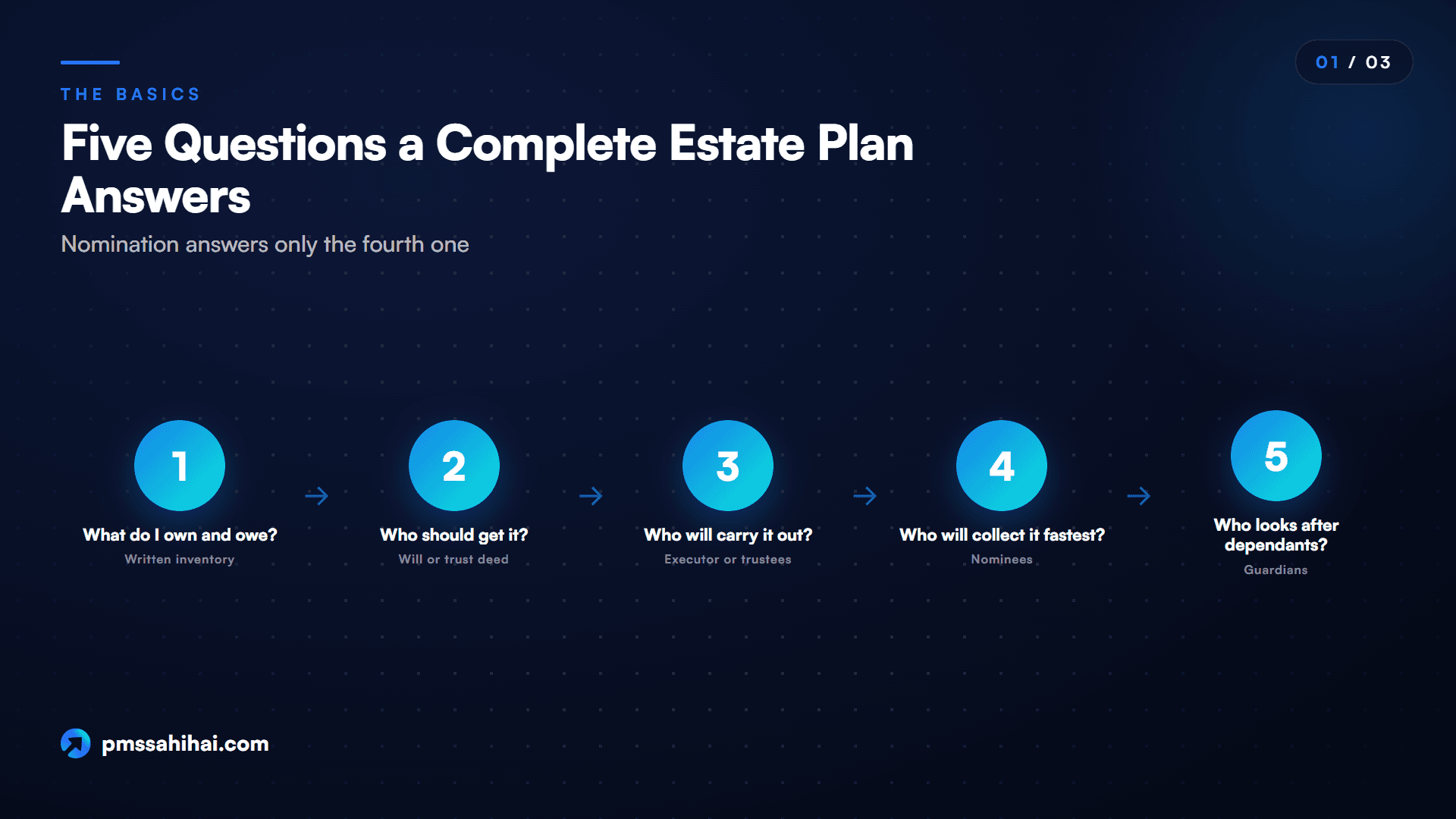
A complete estate plan answers five questions:
- What do I own and owe? A written inventory of property, accounts, investments, insurance, loans and digital records.
- Who should get it? Your wishes, recorded in a valid will, a trust deed, or both.
- Who will carry it out? An executor under a will, or trustees under a trust.
- Who will collect it fastest? Nominees and joint holders who can reach assets quickly, ideally the same people your will names.
- Who looks after people who can't look after themselves? Guardians for minor children and arrangements for dependants who need long-term support.
Notice where nomination sits. It answers only question four. That is the central idea of this guide: nomination is a delivery instruction, while a will or trust is the ownership instruction. A good estate plan needs both, and they should agree with each other.
Estate planning in India also differs from the version you may read about in American or British articles. India has no estate tax today, so the case for planning here rests mostly on clarity, speed and avoiding disputes rather than on saving a death duty.
How Estate Planning in India Evolved Over 140 Years
India's rules grew in layers, which partly explains why they feel fragmented.
| Date | Milestone | Why it matters |
|---|---|---|
| 1882 | Indian Trusts Act | Created the framework for private trusts |
| 1925 | Indian Succession Act | Governs wills and probate, and intestacy for those outside personal succession laws |
| 1953 to 1985 | Estate tax in force, then ended | Removed death duty from the planning equation |
| 1956 | Hindu Succession Act | Set out heirs for Hindus, Buddhists, Jains and Sikhs |
| 1984 | Sarbati Devi ruling | Supreme Court held a life-insurance nomination is subject to heirs' claims |
| 1999 | Nomination added for company shares | Sections 109A and 109B of the Companies Act, 1956 eased paperwork after a shareholder's death |
| 2005 | Hindu Succession Act amended | Gave daughters equal coparcenary rights |
| 14 Dec 2023 | Shakti Yezdani ruling | Supreme Court held nominees of shares do not become owners |
| 1 Nov 2025 | Bank nomination reform | Up to four nominees for deposits, simultaneous or successive |
| Dec 2025 | Section 213 of the Indian Succession Act omitted | Mandatory probate in the old presidency towns ended |
| 2026 | SEBI nomination and transmission rules | Up to three demat nominees from 1 September; a standard transmission framework from July |
Nomination was introduced to make life easier for institutions and families. It was never designed as a way of writing a will. Each time people argued that it was one, courts pushed back.
Why Nomination Alone Doesn't Transfer Wealth
What the Supreme Court Has Said
The leading case for securities is Shakti Yezdani v Jayanand Jayant Salgaonkar, decided on 14 December 2023. Nominees argued that the word "vesting" in company and depository law made them owners. The court disagreed. Its reasoning is short and clear:
- "Nomination process therefore does not override the succession laws."
- There is "no third mode of succession" that the scheme of the Companies Act aims to provide.
- Discharging the institution once a nominee is in the picture is distinct from giving nominees ownership in place of the legal heirs.
In plain words, succession happens in two recognised ways: by will or by law. A nomination is not a third way. It gives the institution a safe person to pay, and the institution is then off the hook. The nominee's own position is a separate question.
The ruling draws on older cases. In Sarbati Devi (1984), a life-insurance nomination was held to be subject to the claims of heirs under succession law. In Ram Chander Talwar, as the 2023 judgment records, a bank nominee was held not to become the owner of deposits.
Co-operative housing is similar in result, though the mechanics differ. In Indrani Wahi (Supreme Court, 10 March 2016), a society was directed to transfer a deceased member's interest to the nominee, while other family members stayed free to pursue succession claims.
Regulators Now Use the Same Word: Trustee
Two regulators have now written the same idea into their rules.
The RBI directions on settling claims of deceased bank customers, issued on 26 September 2025 and since consolidated into a wider set of directions, say a bank must tell the nominee or survivor in writing that they are "receiving the payment from the bank as a trustee of the legal heirs of the deceased depositor(s)." The payment does not affect any claim another person may have against that nominee or survivor.
SEBI's framework for transmission of securities, issued on 23 July 2026, says nominees "shall receive the assets of deceased sole holder / joint holders as trustee on behalf of legal heir(s) of deceased holder(s)." The regulated entity is fully discharged once it transmits the assets.
Trustee is a heavy word. It means holding something for the benefit of someone else. Naming your spouse as nominee can therefore hand them a legal responsibility toward your children and parents.
A Worked Example of the Nominee vs Legal Heir Gap
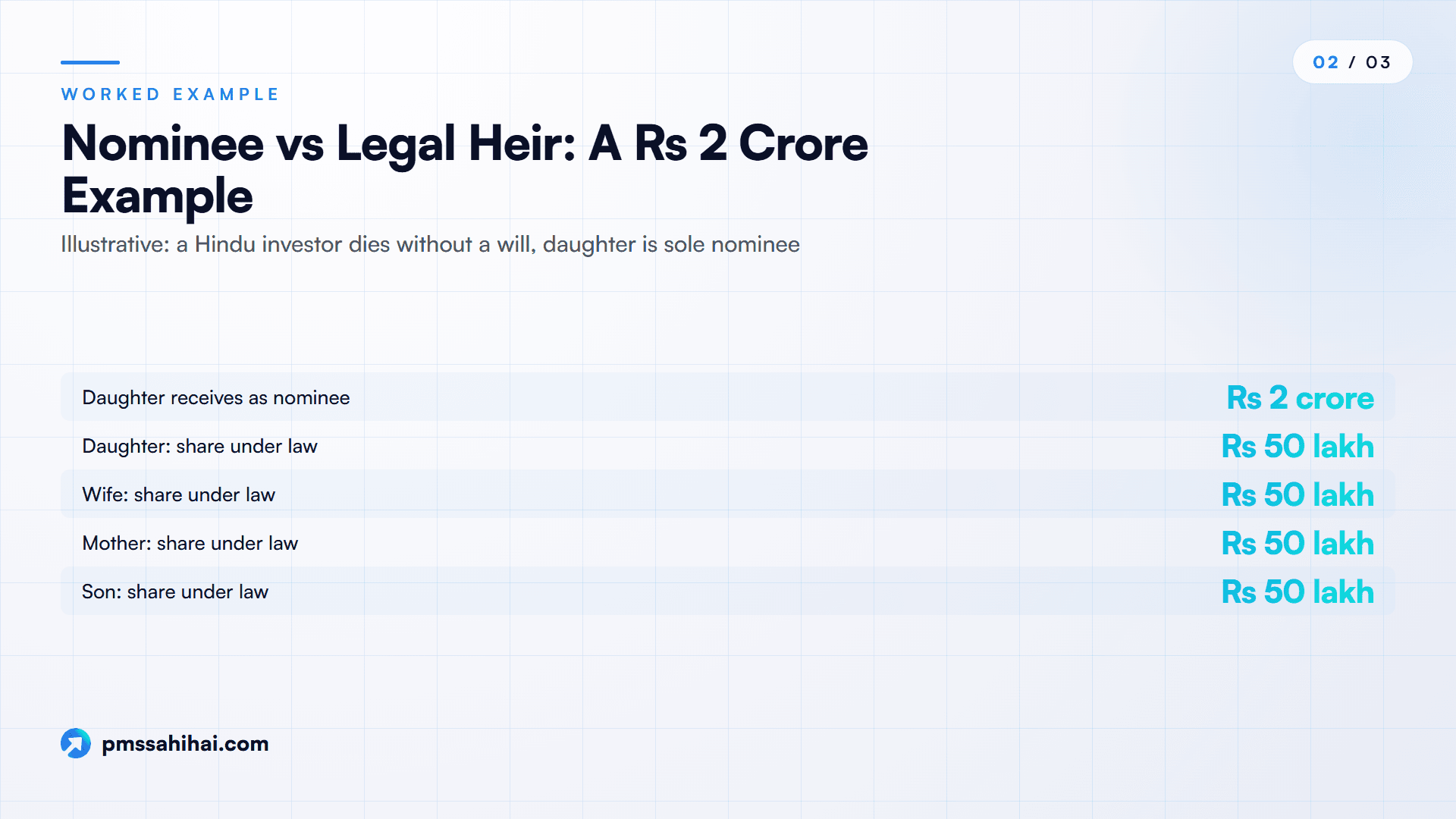
Take a hypothetical investor, Rajesh, a Hindu man who dies without a will. He leaves self-acquired demat holdings and mutual funds worth Rs 2 crore. He has a wife, a mother, a son and a daughter. Years ago, he named his daughter as sole nominee because she handled his paperwork.
| Person | Under the nomination | Under succession law | Gap |
|---|---|---|---|
| Daughter | Receives Rs 2 crore | Rs 50 lakh | Holds Rs 1.5 crore for others |
| Wife | Nil | Rs 50 lakh | Must claim from daughter |
| Mother | Nil | Rs 50 lakh | Must claim from daughter |
| Son | Nil | Rs 50 lakh | Must claim from daughter |
Under the Hindu Succession Act, a widow, mother and each child are Class I heirs and here take equal shares. The depository's job ends when it transmits to the daughter. The family's problem begins there. If they agree, she transfers the shares. If they do not, the matter goes to court, and the simplified regulatory route no longer helps because it excludes disputed claims.
A will naming the daughter would have changed the result, and so would nominating all four in the right proportions, at least on the question of speed. The point is that the nominee vs legal heir gap is created by inattention, not by the law being harsh. Your own numbers will differ, so have a lawyer check them.
Who Really Decides Each Asset: An Asset-by-Asset Map
Different assets answer to different statutes. This table is a simplified starting point, not legal advice, and exceptions exist.
| Asset | What the nominee or survivor gets | What decides final ownership | Practical note |
|---|---|---|---|
| Demat shares, mutual funds | Assets as trustee for legal heirs | Will or succession law | Up to three nominees from 1 Sep 2026 |
| Bank deposits | Payment as trustee for legal heirs | Will or succession law | Up to four nominees |
| Bank lockers | Access, with liberty to remove contents | Will or succession law | Bank inventories the contents |
| Life insurance | Payment; close family may be beneficial nominees | Depends on who the nominee is | Insurance Act rules differ |
| EPF | Strong statutory weight for nominee | Scheme rules first | Check with a lawyer |
| Land, house | No general nomination route | Title deed, will, succession law | Often the largest asset |
| Co-operative society flat | Society membership | Will or succession law | Indrani Wahi logic |
| AIF units, unlisted shares | Issuer or fund process | Will or succession law | Outside the scope of SEBI's listed-securities framework |
| Digital records | Nothing automatic | Practical access plus will | Keep a secure list |
Three rows deserve a closer look.
Insurance is the partial exception. Commentators consistently describe section 39(7) of the Insurance Act, 1938, as amended in 2015, as treating a spouse, parent or child named as nominee as beneficially entitled, subject to conditions in the section. A friend or sibling named as nominee does not get that treatment. This summary rests on secondary sources, so check the current wording with your lawyer or insurer.
EPF has its own statute. Commentators describe a valid EPF nomination as carrying more weight than a bank or demat nomination. Ask a lawyer if your EPF nominee differs from your heirs.
Real estate is where nomination helps least. There is no general nominee route for land or a house. A will, a registered transfer or succession law does the work. For many families this is the most valuable asset, and it is the one a nomination-only plan misses.
You cannot complete estate planning at one counter. Each institution sees only its own slice, so somebody has to look at the whole picture.
The Tools That Actually Pass Ownership
A Will Decides Who Owns What
A will is your written instruction on who receives what after death. Under the Indian Succession Act, it generally needs your signature and two attesting witnesses. Registration is optional, and it can be changed or revoked until you die, which makes it the cheapest serious estate planning tool available.
A few practical rules:
- Name an executor to collect assets, settle debts and distribute the rest.
- Do not use a beneficiary as a witness, because that can put their gift at risk.
- Describe assets by category, so later purchases are covered.
- Name a guardian for minor children, subject to your personal law.
Probate is the court's certification that a will is genuine. Until December 2025, section 213 of the Indian Succession Act effectively made it compulsory for certain communities in matters connected with Mumbai, Kolkata and Chennai. The Repealing and Amending Act, 2025, which received assent on 20 December 2025, removed the section, and the government described the aim as "eliminating community-based disparities in probate requirements." SEBI then dropped its mandatory probate requirement for transmission of securities.
Probate is still available, however, and voluntary probate can still make sense for disputed wills, complex estates and foreign assets. Institutions also have their own requirements. RBI's bank directions, which predate the omission, speak of settling will-based claims on probate, or without it if the will is undisputed and the bank is satisfied it is genuine. Pending matters have their own savings clause, so ask your lawyer.
Succession Law Fills the Gap When There Is No Will
Dying without a will is called dying intestate, and succession law then writes your will for you. Which law depends largely on religion. The Hindu Succession Act, 1956 covers Hindus, Buddhists, Jains and Sikhs; the Indian Succession Act, 1925 covers Christians and has special rules for Parsis; and Muslim personal law has its own shares. Under Muslim law, a will can generally dispose of only a limited portion, commonly described as one-third, without the heirs' consent.
These default rules do not know your family. They will not provide for an unmarried partner, a favourite nephew or a charity, and they may divide a home among people who cannot agree on selling it.
Heirs also face more paperwork. Without a nominee, SEBI's route for demat holdings above Rs 30 lakh asks for an affidavit-cum-NOC from all legal heirs plus a will copy or heirship certificate, or a court document. One unwilling legal heir can hold up the rest.
A Private Trust Moves Ownership While You Are Alive
A private trust, under the Indian Trusts Act, 1882, works differently. You, the settlor, transfer assets to trustees, who hold them for beneficiaries under a trust deed. Because ownership moves in your lifetime, those assets generally do not pass under your will.
Trusts suit specific needs: a child with special needs, staged payouts to young adults, a large asset you want kept whole, or a family with several generations to provide for. A trust of immovable property needs a registered instrument or a will, and stamp duty varies by state.
A will and trust often work together: the trust holds selected assets, and the will sweeps up the rest.
Joint Holding Gives Access, Not Necessarily Title
People often assume the survivor of a joint holding simply owns everything. The rules are more careful than that.
For bank accounts, RBI's directions treat a survivor exactly like a nominee: the money is received as a trustee for the legal heirs. In a joint account with a survivorship clause, the survivor can operate it, and a nominee's right arises only after all depositors have died.
For securities, SEBI's framework says shares are transmitted to the surviving joint holder on a death certificate alone. That is a rule about who the records show, and the framework does not itself say the survivor becomes the beneficial owner of the deceased's share. Commentators describe joint holding as continuity of access rather than automatic inheritance, and this is an area to take specific advice on.
For property, the title deed and each person's contribution usually matter, and the deceased's share passes under will or succession law.
Planning for Incapacity, Not Only Death
Wills and nominations work only after death. If you have a stroke or develop dementia, neither helps. A power of attorney can cover some of that ground, but under section 201 of the Indian Contract Act, 1872, agency ends if the principal becomes of unsound mind. Foreign-style durable arrangements therefore do not simply carry over. A lawyer can advise on alternatives such as a trust or court-appointed guardianship.
How Digital Rails Are Changing Estate Planning Today
The legal documents still matter, but much of the surrounding plumbing of estate planning is now digital.
One report of death can reach many institutions. Under a SEBI circular dated 3 October 2023, in force from 1 January 2024, a death can be reported to one regulated entity and passed through KYC registration agencies to others, which block debits.
Nomination has moved online. SEBI's circular of 29 May 2026 lets investors nominate, change or cancel nominations any number of times, with online validation. New single-holder accounts must nominate or formally opt out, and joint accounts need all holders' consent to change a nominee.
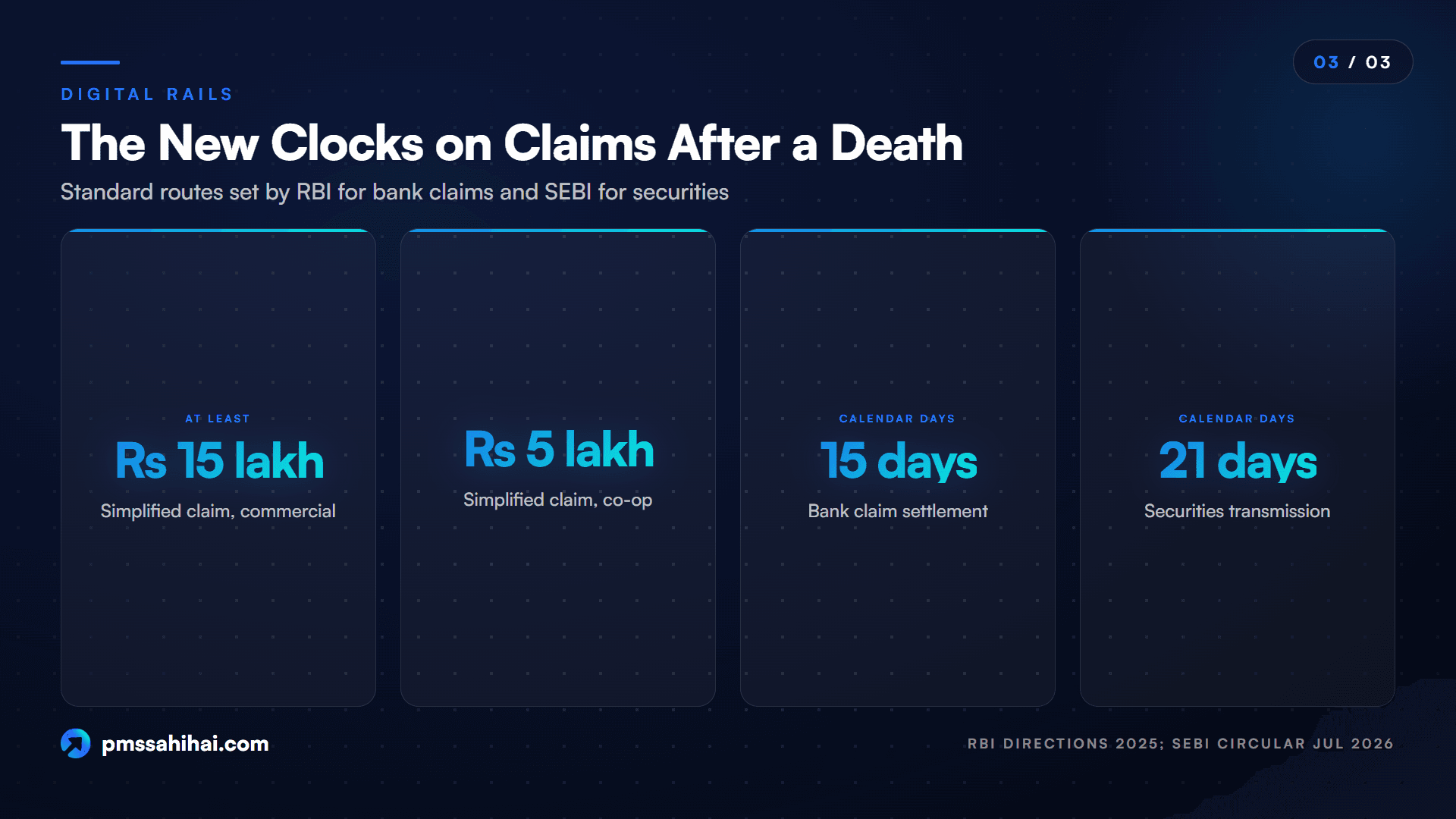
Bank claims are more standard. The RBI directions, now consolidated, set out uniform documents, a simplified route for claims up to at least Rs 15 lakh at commercial banks and Rs 5 lakh at co-operative banks, and settlement within 15 calendar days of complete documents. Compensation applies for delay.
Securities claims have a clock too. SEBI's July 2026 framework requires entities to process complete transmission claims within 21 calendar days, and a low-value quick route exists for immediate relatives.
Technology has not changed the underlying law, though. It delivers assets to the named person faster, which makes mismatches take effect faster too. Apps also create a new estate planning job: keeping a secure list of accounts, policies and logins, so your family knows what exists. Unclaimed money usually begins with a family that did not know about an account.
What Good Estate Planning Makes Easier for a Family
When the pieces line up, the benefits are concrete:
- Your wishes decide the outcome. A will or trust replaces default rules with your own choices.
- Cash arrives when it is needed. A registered nominee follows a shorter route, so a surviving spouse is less likely to be stuck while household bills fall due.
- Fewer family fights. When the nominee, the will and the legal heir all point the same way, there is little left to argue about.
- Less paperwork. A nominee route needs far fewer documents than affidavits from every heir or court papers.
- Dependants are protected. Guardians, trustees and staged payouts look after people who cannot manage money alone.
- Nothing gets lost. An inventory reduces the chance that an account, policy or locker is forgotten.
The biggest benefit is hard to measure: at a terrible moment, your family has clear instructions rather than a puzzle.
How Tax Fits Into Estate Planning in India
Tax is a smaller driver here than many foreign articles suggest. India had an estate tax from 1953 to 1985, and none today. Under the Income-tax Act, 2025, which applies from 1 April 2026:
- Property received under a will or by way of inheritance is not taxed as income in the recipient's hands (section 92(3)(c), formerly part of section 56(2)(x)).
- A transfer under a will or gift, or to an irrevocable trust, is not treated as a transfer for capital gains (section 70(1)(b), formerly section 47(iii)).
- When an heir later sells, the original owner's cost and holding period carry over (section 73(1) and section 2(101)(c)). Inheriting is tax-free, but selling may not be.
- Income from a revocable transfer stays taxable in the settlor's hands (section 97, formerly sections 61 to 63).
- Income of a trust with indeterminate shares can be taxed at the maximum marginal rate (section 307, formerly section 164).
So a trust is usually not a tax-saving device on its own, and a discretionary one can cost more in tax. NRIs and those with foreign assets face further rules. Treat this as a summary and consult a tax adviser before moving anything.
How PMS Sahi Hai Helps You Understand Your Investments Before You Plan Them
Let's be plain about what PMS Sahi Hai is not. It does not draft wills or trust deeds, it does not file claims, and it is not a law firm. The site has no dedicated guide to estate planning, and this article does not pretend otherwise. What the platform does cover is the investment slice of your estate, which is often the hardest part for a family to read.
- See who actually holds your investments. Heirs deal with intermediaries, not with brand names. The guide to what a custodian does explains how PMS and AIF assets are held and recorded, which helps when you write your inventory.
- Understand moving shares without selling. The explainer on in-specie transfers covers how securities can move in kind, a useful concept for anyone who may one day receive a portfolio.
- Know what an exit involves. An heir may not want the strategy they receive. The PMS exit process guide sets out the mechanics.
- Compare before deciding. The compare page lines up PMS and AIF strategies side by side, so a family can judge what they hold against alternatives.
- Ask Nyra the plain questions. Nyra, the platform's AI research tool, answers plain-English questions on investment products. It is described on the platform as an analytical tool and not a SEBI-registered investment adviser, so use it for research and take legal questions to a lawyer.
The practical workflow is short: use PMS Sahi Hai to make sense of the investments, then give your lawyer a clean list.
Honest Limits and Costs of Estate Planning
Estate planning is useful, but it has real limits:
- It costs money and attention. A simple will is inexpensive; trusts need legal drafting, stamp duty, a PAN, accounts, filings and willing trustees year after year.
- Documents can go stale. A nominee who died before you, a former spouse, or a will from before a child was born can each cause trouble. Under SEBI's rules, a dead nominee's share goes pro rata to the surviving nominees, which may not be what you wanted.
- Wills can be challenged. Claims of forgery, undue influence or lack of capacity are possible, and SEBI's simplified framework does not apply to disputed claims.
- Personal law limits freedom. Muslim law restricts bequests; ancestral or coparcenary property may not be yours alone to dispose of. Check this first.
- Trustees and executors are people. They can be slow, conflicted or unwilling, so name backups.
- It cannot fix a family. Paperwork reduces conflict but does not remove it.
- Coverage is patchy. Simplified regulatory routes apply to particular assets, and institutions may still ask for more, especially for large or unusual claims.
Building an Estate Plan That Actually Transfers Wealth
Nomination is worth doing well, but it answers a different question from the one families think it answers. The nominee collects, while a will, a trust or succession law decides who keeps. Once you see that split, estate planning becomes a fairly short to-do list:
- List everything. Assets, liabilities, account numbers, policy numbers and where originals are kept.
- Check your personal law. Find out what is truly yours to give away and who your legal heir would be by default.
- Write a will. Use a lawyer if your affairs are anything other than simple, and name an executor and a backup.
- Align every nomination. Match names and proportions to the will across demat accounts, mutual funds, banks, insurance and EPF.
- Review joint holdings. Decide whether each one reflects real co-ownership or is only there for convenience.
- Consider a trust if you have minors, dependants with special needs, or a large asset that should be kept whole.
- Tell someone. Your executor and spouse should know where everything is.
- Review after any life event such as a marriage, divorce, birth, death, major purchase or move abroad.
Do steps one and four this weekend. They are free, and they fix the most common failures. Then book the lawyer for the rest, and a tax adviser if trusts or foreign assets are involved. If your inventory includes PMS or AIF holdings, PMS Sahi Hai and Nyra can help you understand them before that meeting.
Map Your Investments With PMS Sahi Hai and Nyra
Open your latest demat statement, bank passbook and insurance policy tonight. Write down who is named on each and compare those names with whom you actually want to receive the money. If you have no will, book time with a lawyer. To make sense of the investment part of the list, compare your PMS or AIF strategies on PMS Sahi Hai, put your questions to Nyra, or talk to the team. This article is general information as of 30 October 2026, not legal, tax or investment advice.
PMS Sahi Hai is a distributor of Portfolio Management Services and Alternative Investment Funds, APMI-registered (Registration No. APRN08358). This article is for education only and is not investment advice, a recommendation, or an offer to buy or sell any security. Investments in securities markets are subject to market risks; read all scheme-related documents carefully. Past performance is not indicative of future results. Consult your advisor before investing.
Ishaan founded PMS Sahi Hai to make India's PMS, AIF and GIFT City markets legible to serious investors, comparing every SEBI-registered manager on the same comparative basis, with no shelf products and no commission bias.
Frequently asked
What is estate planning in simple words?
Estate planning means deciding what happens to your assets, liabilities and dependants when you die or can no longer manage your affairs. It usually involves an inventory, a will, nominations that match the will, and sometimes a trust. The aim is that the right people get the right assets quickly, with as little dispute as possible. Consult a lawyer for your own situation.
Does a nominee become the owner of my assets?
Generally, no. The Supreme Court held in December 2023 that a nomination for shares does not override succession law, and RBI and SEBI both describe nominees as receiving assets as trustees for legal heirs. Insurance nominees who are close family, and EPF nominees, are treated differently under their own statutes. Check each asset with a lawyer.
Does a will override a nomination in India?
For ownership, generally yes. A valid will decides who finally owns the asset, while the nomination decides whom the institution pays or transfers it to first. The nominee then holds it for the beneficiaries under the will. Avoid the conflict by naming the same people, in the same proportions, in both documents wherever the rules allow.
Who gets my assets if I die without a will in India?
Your legal heirs, under the succession law that applies to you, which depends mainly on religion. For a Hindu man's separate property, Class I heirs such as the widow, mother and children share first. Christians, Parsis and Muslims follow different rules. A nominee may receive assets first but generally holds them for those heirs.
Is probate mandatory in India now?
Not as a general legal requirement. The Repealing and Amending Act, 2025 omitted section 213 of the Indian Succession Act, and SEBI's July 2026 framework removed mandatory probate for transmission of securities. Probate remains available and is still sensible for disputed wills or complex estates. Banks and other institutions may ask for it in some cases, so check.
Does a joint account holder automatically own the money?
Not automatically. Under RBI's 2025 directions, a surviving joint holder of a bank account receives the money as a trustee for the deceased's legal heirs, and other people can still make claims against them. The survivor's own share is a separate matter. For shares and property, get advice on how joint ownership is recorded and funded.
Is there inheritance tax in India?
No. India had an estate tax from 1953 to 1985, and it has none today. Under the Income-tax Act, 2025, property received under a will or by inheritance is not taxed as income in the recipient's hands. When the heir later sells, capital gains tax may apply using the original owner's cost. Consult a tax adviser.
Do I need a trust as well as a will?
Usually only for specific reasons, such as minor children, a dependant with special needs, staged payouts, or a large asset you want kept whole. A will suits most people and costs less. Trusts bring drafting, stamp duty, trustees and annual compliance, and some trust income can be taxed at the maximum marginal rate. Discuss the trade-off with a lawyer.
Keep reading
All articles
Highest Capture Ratio Mutual Funds as of 30 Sep 2026: A Data Screen
A computed screen of 27 large cap funds by capture ratio as of 30 Sep 2026: method, limits and rank shifts. Not advice. Market risks apply.

How to Read Upside and Downside Capture Ratios in a PMS Factsheet
Read upside and downside capture ratios in a PMS factsheet: the formula, real examples, beta checks, fee effects and five questions for your manager.

POA in a Demat Account: What You Signed and What DDPI Changed
What a POA in a demat account lets a broker do, how SEBI's DDPI limits it, why old POAs stay valid until revoked, and how to check and cancel yours.
Read it. Now pressure-test it.
Ask Nyra how this applies to your portfolio, or talk to our team, no pitch, no pressure.