
What Is Smart Beta? Rule-Based Indexing for Indian Investors
How smart beta indices are built, what equal-weight, low-volatility and momentum funds cost in India, and the SEBI rules on tracking error.


Smart beta is a way of building an index with published rules instead of plain market-cap weights, so a fund can tilt toward equal weights, low volatility, value, momentum or quality while still being run passively. In India these indices come from NSE and BSE and are sold as index funds and ETFs. SEBI caps their base expense ratio at 0.90%, limits tracking error to 2% and requires daily disclosure. The trade-off is real: factor tilts are cyclical, much of their history is back-tested, and some tilts swing harder than the Nifty 50. Use smart beta as a deliberate exposure, not as a promise of higher returns.
Why Smart Beta Matters to Indian Index Investors in 2026
Most Indian investors meet index investing through the Nifty 50. It is simple, cheap and liquid, but it carries one design choice that few people stop to question: the bigger a company's free-float market value, the more of your money goes into it. On 30 September 2026, financial services alone made up 37.45% of the Nifty 50, according to NSE Indices' factsheet. Buy the index and you buy that tilt, whether you wanted it or not.
Smart beta starts from a different question. What if the weights were set by a rule you chose deliberately, such as "give every stock the same weight", "hold the 30 least volatile large caps" or "favour stocks with strong six- and twelve-month price trends"? The fund is still passive. No manager decides on Monday morning what to buy. But the index itself has been engineered to deliver a particular kind of exposure.
That idea has moved from academic journals into the Indian market over the last decade. NSE and BSE now publish a long list of strategy indices, and asset management companies offer index funds and ETFs that track them. The products sit in the same "Other Schemes — Index Funds/ETFs" bucket as a Nifty 50 fund, so on a mutual fund platform they can look interchangeable. They are not.
This guide explains what the approach is, how a rule-based index is actually put together, what the main methods look like in India, what the current numbers say, and what SEBI's rules mean for the costs and tracking error you will live with. Factor theory itself (why value or momentum might earn a premium) is covered only briefly here; our sister guide on factor investing goes deeper into the evidence.
What Smart Beta Means: Rules That Replace Market-Cap Weights
The word "beta" in smart beta refers to market exposure: the return you get simply for holding the market. A traditional index fund gives you that exposure in proportion to market capitalisation. Smart beta keeps the passive, rules-based delivery but changes how stocks are selected and weighted.
A useful working definition is this: smart beta is long-only, rule-based indexing that selects or weights stocks using criteria other than market capitalisation alone, with every rule published in advance. Three features follow from that definition.
- The rules are fixed and public. NSE publishes a methodology document for each index, covering eligible stocks, scoring formulas, weight caps and the review calendar.
- The portfolio is replicated, not managed. An index fund or ETF holds what the index holds, in the same proportions, and changes only when the index changes.
- The tilt is the product. You are buying a specific exposure, such as lower volatility or stronger momentum, not a manager's judgement.
Morningstar prefers the label "strategic beta", and critics note that "smart" implies a superiority no rule can guarantee. In India the market uses "smart beta", "factor index" and "strategy index" almost interchangeably, so you will see all three on fund factsheets.
Smart Beta vs Factor Investing: Where the Line Sits
Factor investing is the broader idea that certain stock characteristics, such as value, momentum, quality, low volatility and size, have historically explained differences in returns. Smart beta is one way to put that idea into a product: you turn a factor into an index rule and then track the index cheaply. A factor exposure can also be delivered by an active quant fund or a quant PMS that changes its model whenever it likes. Smart beta cannot do that; its rules change only through a published methodology revision. Equal weighting is also usually counted as smart beta even though it is not a factor at all. It is simply a different weighting rule.
How Rule-Based Indices Grew From an Academic Idea Into Indian ETFs
Market-cap weighting has a strong theoretical case. If markets are efficient, the cap-weighted market portfolio is the natural one to hold. NSE's own 2017 white paper on equal weighting describes the opposing school of thought: markets may not be fully efficient, especially among smaller companies, which leaves room to "make the index beta smarter".
The milestones are worth knowing because they explain the products you see today.
| Year | Milestone |
|---|---|
| 2003 | First equal-weight ETF and first factor-based ETF launched globally |
| 2005 | Arnott, Hsu and Moore publish "Fundamental Indexation" in the Financial Analysts Journal, weighting by sales, book value and other non-price measures |
| 2006 | The term "smart beta" is generally credited to consultancy Willis Towers Watson |
| 2015 | NSE announces it will list India's first smart beta ETF, based on the NV20 value index |
| 2016 | Nifty100 Low Volatility 30 launched |
| 2017 | Nifty50 Equal Weight launched, along with NSE's multi-factor series |
| 2020 | Nifty200 Momentum 30 launched |
| 2024 | Nifty200 Value 30 launched |
| 2026 | SEBI (Mutual Funds) Regulations 2026 take effect on 1 April |
The Indian story began with value. NSE's June 2015 press release on India's first smart beta ETF described NV20 as 20 liquid "value blue chip" companies from the Nifty, chosen on return on capital employed, price-to-earnings, price-to-book and dividend yield. Low-volatility, equal-weight, quality, alpha and momentum indices followed. Today the list of NSE indices on any factsheet includes Nifty Alpha 50, Nifty100 Quality 30, Nifty Low Volatility 50, Nifty50 Value 20 and Nifty100 Equal Weight alongside the familiar benchmarks. BSE, through its index subsidiary, publishes its own factor family, and products such as a BSE Enhanced Value ETF trade on the exchanges.
How a Rule-Based Index Is Built, Step by Step
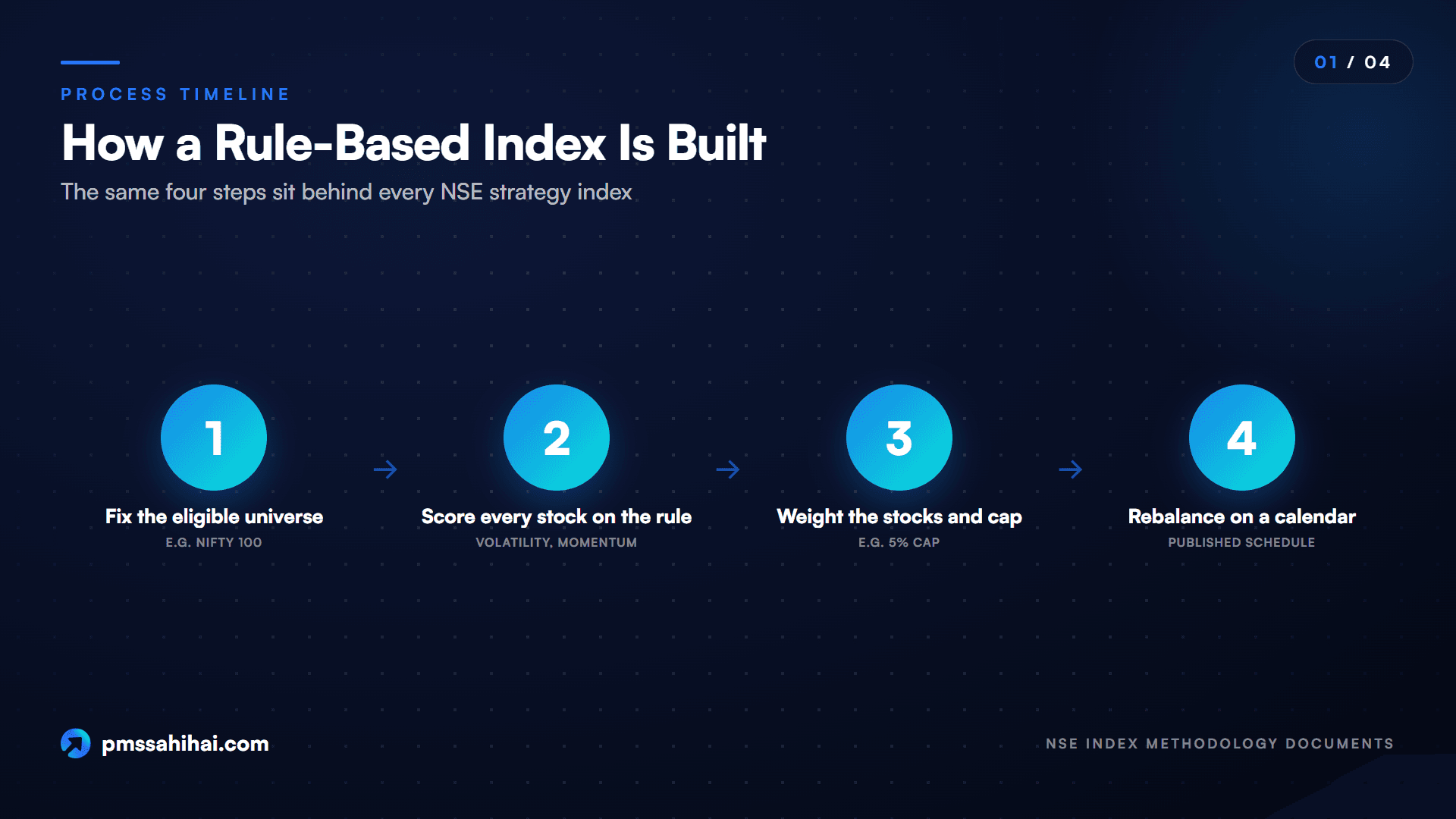
Every strategy index, however exotic its name, is built in the same four steps. Understanding them is the fastest way to read any factsheet.
Step 1: Fix the Eligible Universe
The index starts from a parent universe. Nifty100 Low Volatility 30 picks only from Nifty 100 stocks that trade in the futures and options segment, as its NSE methodology document sets out. Nifty200 Momentum 30 picks from the Nifty 200. NSE's multi-factor indices draw from the Nifty 100 plus the Nifty Midcap 50. The universe sets the size profile: a "200" parent means some mid caps will enter, which changes risk.
Step 2: Score Every Stock on the Rule
Each eligible stock gets a score. The scoring rules are mechanical:
- Low volatility: standard deviation of daily price returns over the last year.
- Momentum: six-month and twelve-month price return, each adjusted for the stock's volatility, combined into a "normalised momentum score".
- Value (Nifty200 Value 30): earnings-to-price, book-to-price, sales-to-price and dividend yield.
- Quality (NSE multi-factor framework): high return on equity, low debt-to-equity and stable profit growth.
- Alpha: high Jensen's alpha over the previous year.
The top-ranked stocks, often 30, are selected. Some indices add buffers so a stock is not dropped the moment it slips a rank. Nifty100 Low Volatility 30, for instance, keeps an existing member if it still ranks within the top 60.
Step 3: Weight the Stocks and Apply Caps
Selection is only half the rule. Weighting is where methods really differ:
- Equal weight: every stock gets the same share at each reset, so 50 stocks get 2% each.
- Score-based weight: Nifty100 Low Volatility 30 weights by volatility, so calmer stocks get more.
- Factor tilt: Nifty200 Momentum 30 multiplies free-float market cap by the momentum score, so big stocks with strong trends get the most.
Caps stop any one stock from dominating. Momentum 30 caps each stock at the lower of 5% or five times its plain market-cap weight. Low Volatility 30 caps thinly traded stocks at 3% so that funds can actually buy them. Those caps sit on top of SEBI's own limits for any equity index that an ETF or index fund tracks, covered below.
Step 4: Rebalance on a Published Calendar
Finally, the index is reviewed on a timetable. Nifty100 Low Volatility 30 is rebalanced quarterly; Nifty200 Momentum 30 and Nifty200 Value 30 semi-annually. Equal-weight indices drift as prices move, so they must be reset. NSE's 2017 white paper specified a quarterly reset back to equal weights for Nifty50 Equal Weight, while the September 2026 factsheet lists semi-annual rebalancing, so check the current methodology before assuming a frequency. Every rebalance means trading, and trading means cost, which matters later.
The Main Weighting Methods Used by Indian Strategy Indices
Each method answers a different investor question. Here is how the main ones work in practice.
Equal Weight: Spreading the Bet Evenly
Equal weighting holds the same stocks as the parent index but gives each the same slice. NSE's launch paper showed the effect on concentration: at 31 March 2017 the top 10 Nifty 50 stocks made up about 52.8% of the index, against 20% in the equal weight index. The trade-off is a quiet size tilt, because smaller members get more weight than market cap would give them. An equal weight index is also not automatically safer. A 2025 PrimeInvestor analysis found the Nifty 50 Equal Weight trailed its parent by 0.53% on average over five-year rolling periods, with higher volatility.
Low Volatility: Owning the Calmer Stocks
A low volatility index holds the stocks whose prices have moved least. NSE's multi-factor index white paper noted that the low-volatility portfolio historically leaned toward FMCG, pharma and IT companies with steadier demand. In the 2008 crash its back-tested portfolio fell 44.60% against 51.79% for the Nifty 50. Lower volatility does not mean no losses; it means smaller swings on average.
Value: Buying Cheaper Earnings and Assets
Value indices favour stocks that look cheap on earnings, book value, sales or dividends. The tilt can be dramatic: on 30 September 2026 the Nifty200 Value 30 traded at a price-to-earnings ratio of 8.86, and oil, gas and metals stocks made up a large share of it. Value can lead strongly in recoveries. NSE's back-test shows a value portfolio up 166.41% in 2009, against 75.76% for the Nifty 50. It can also lag for long stretches.
Momentum: Riding Recent Winners
Momentum indices buy stocks with the strongest recent price trends. They tend to do well in sustained rallies and badly when leadership reverses. NSE's back-tested alpha portfolio, a close cousin, fell 66.96% in 2008. Momentum indices also turn over faster, because last year's winners change.
Quality and Multi-Factor Blends
Quality indices favour profitable, low-debt companies with steady earnings. Multi-factor indices, such as Nifty Alpha Low-Volatility 30 or Nifty Alpha Quality Value Low-Volatility 30, combine two to four factors with fixed weights, aiming to soften the cyclicality of any single factor index.
| Method | What decides weight | Typical tilt | Main risk |
|---|---|---|---|
| Equal weight | Same weight for every stock | Toward smaller members | Lags when giants lead |
| Low volatility | Inverse of volatility | Defensive sectors | Lags in sharp rallies |
| Value | Value score × market cap | Cheap, cyclical sectors | Long "value traps" |
| Momentum | Momentum score × market cap | Recent winners | Sharp reversals, high turnover |
| Quality | Quality score × market cap | Profitable, low-debt firms | Expensive valuations |
| Multi-factor | Blend of factor scores | Mixed | Complexity, diluted tilt |
What the Data Shows: NSE Strategy Indices vs the Nifty 50
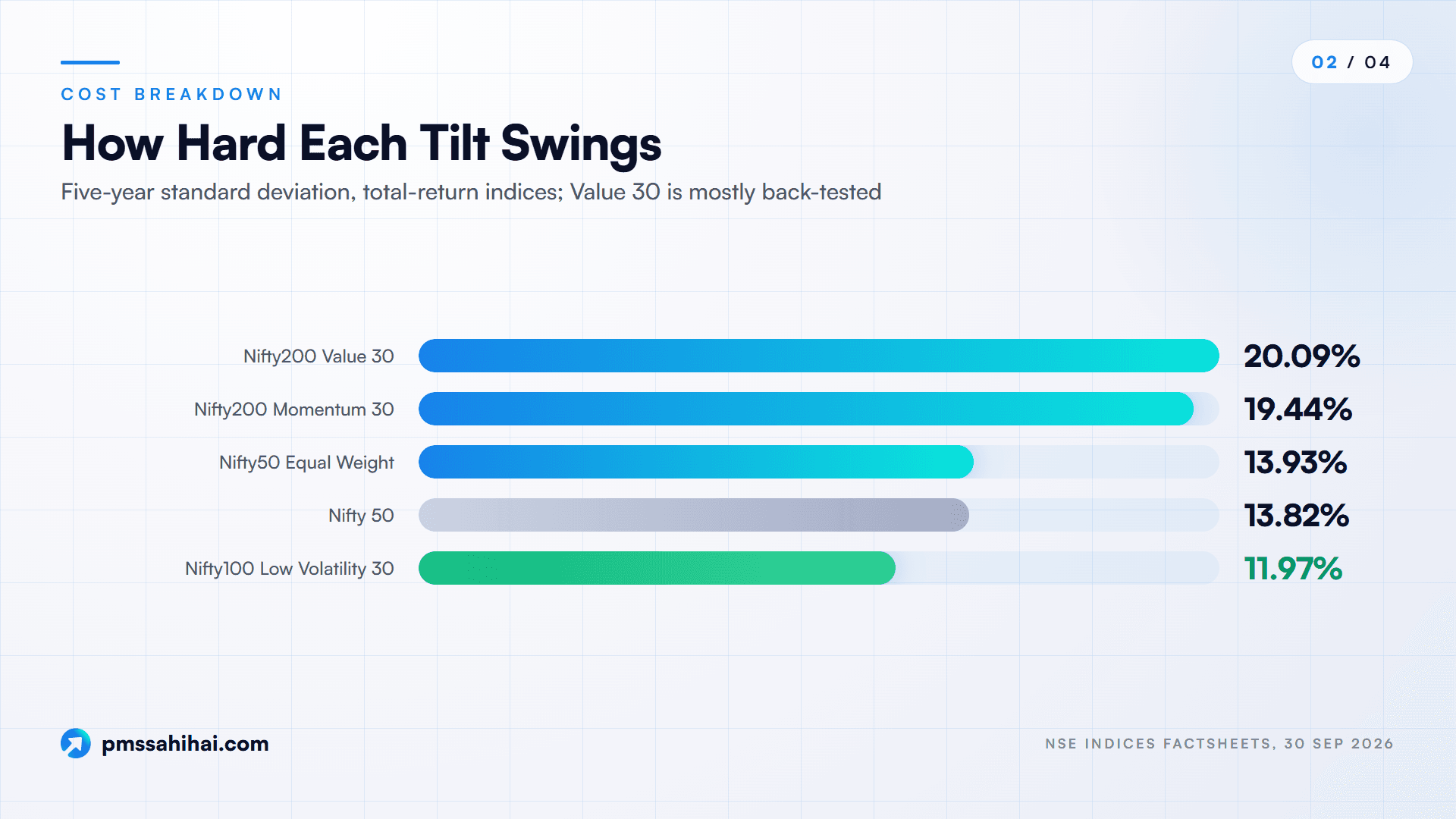
Numbers make the trade-offs concrete. The table below uses NSE Indices factsheets dated 30 September 2026. Returns are total-return index figures; five-year returns are annualised.
| Index (launch date) | 1-year return | 5-year return (CAGR) | 5-year std. deviation | 5-year beta vs Nifty 50 |
|---|---|---|---|---|
| Nifty 50 (1996) | -7.09% | 6.38% | 13.82% | 1.00 |
| Nifty50 Equal Weight (2017) | -1.08% | 10.71% | 13.93% | 0.97 |
| Nifty100 Low Volatility 30 (2016) | -4.68% | 8.12% | 11.97% | 0.79 |
| Nifty200 Momentum 30 (2020) | -0.47% | 9.28% | 19.44% | 1.18 |
| Nifty200 Value 30 (2024) | 7.89% | 22.91% | 20.09% | 1.12 |
Four lessons stand out.
- Every tilt behaved differently. Over the latest five years each of these indices beat the Nifty 50, but by very different amounts and with very different risk.
- Risk differed sharply. Low Volatility 30 had the lowest standard deviation and a beta of 0.79. Momentum 30 and Value 30 swung harder than the market.
- Launch dates matter. Nifty200 Value 30 was launched in June 2024, so most of its five-year figure is a back-test. Momentum 30's base date is April 2005, but it went live only in August 2020.
- Short windows mislead. NSE's own 2017 paper showed equal weight beating the Nifty 50 by 180, 230 and 90 basis points a year over 20, 15 and 10 years, yet lagging by 160 basis points a year over the five years to March 2017. It outperformed in only 11 of 21 fiscal years.
Index returns are not fund returns. A fund also pays its expense ratio and suffers tracking error, so your result will be lower than the index figure.
Buying Smart Beta in India: Index Funds, ETFs and SEBI's Rulebook
In India, smart beta reaches investors through two mutual fund wrappers. An index fund is bought and redeemed with the AMC at the day's NAV, and SIPs are easy. An ETF is listed on the exchange and traded through a demat account at market prices, which may sit above or below the fund's NAV.
Both are regulated as mutual fund schemes. The key rules in force on 27 October 2026 are:
- SEBI (Mutual Funds) Regulations, 2026 took effect on 1 April 2026, replacing the 1996 rules. They define an index fund and an ETF as schemes that invest "in the same proportion of an index of securities", and every ETF must be listed on a recognised stock exchange.
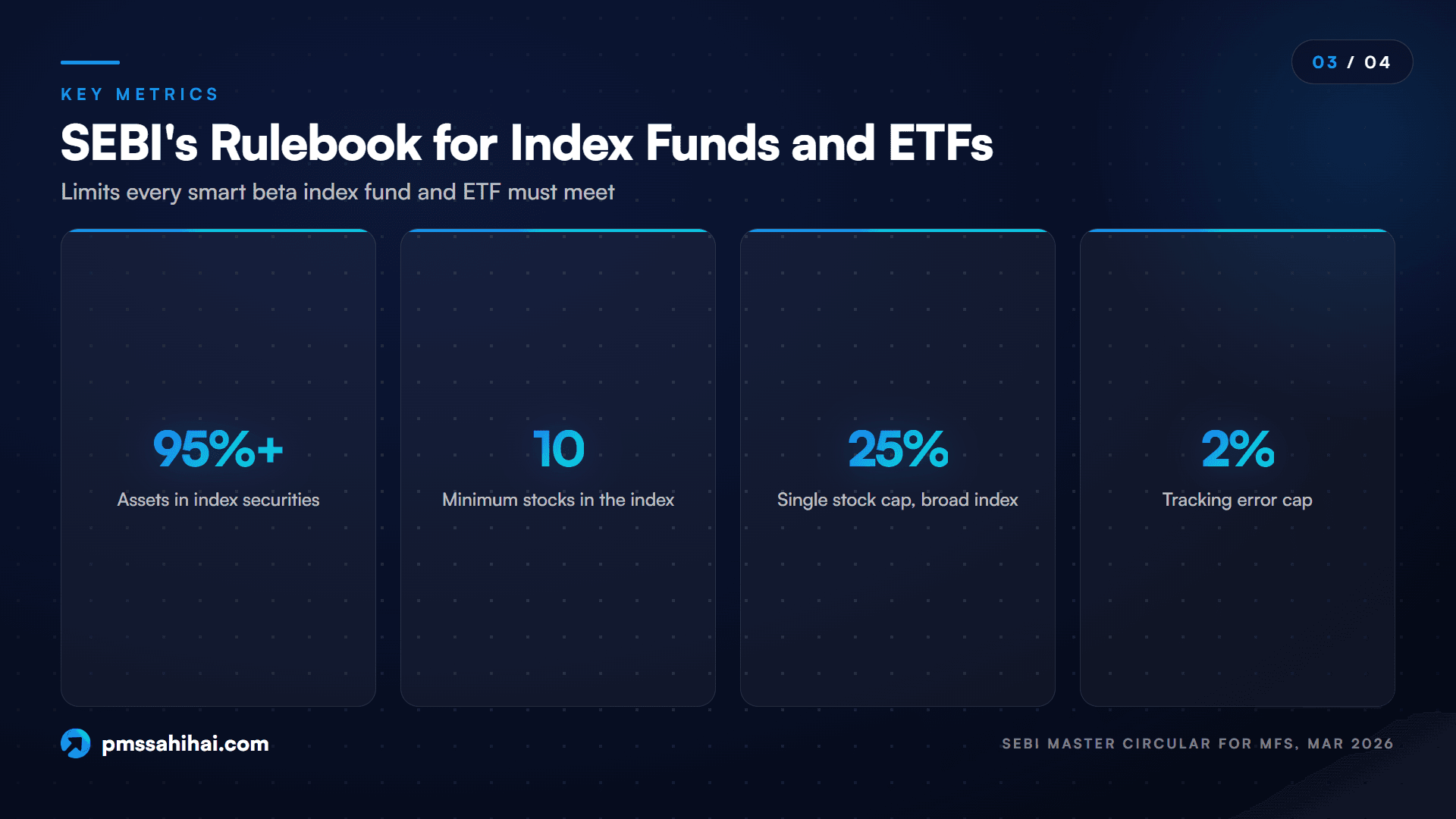
- The 95% rule. SEBI's 26 February 2026 categorisation circular requires index funds and ETFs to invest at least 95% of total assets in the securities of the index they track.
- Index construction limits. Under SEBI's Master Circular for Mutual Funds dated 20 March 2026, an equity index used by an ETF or index fund must have at least 10 stocks; no single stock may exceed 25% of a broad index (35% for sectoral or thematic indices); the top three may not exceed 65%; and each constituent needs a trading frequency of at least 80% and an average impact cost of 1% or less over the previous six months.
- Tracking error cap. For equity ETFs and index funds, tracking error may not exceed 2% except in force majeure situations, which must be reported to trustees.
These rules mean a strategy index cannot be built from illiquid micro caps or concentrated into a handful of names. They do not mean every such fund trades easily. ETFs on niche indices can see thin volumes, and investors buying on the exchange should check the bid-ask spread before placing an order.
What Tilted Index Funds Really Cost: TER, Turnover and Lag
Cost is where a tilt has to justify itself, because the plain Nifty 50 alternative is very cheap.
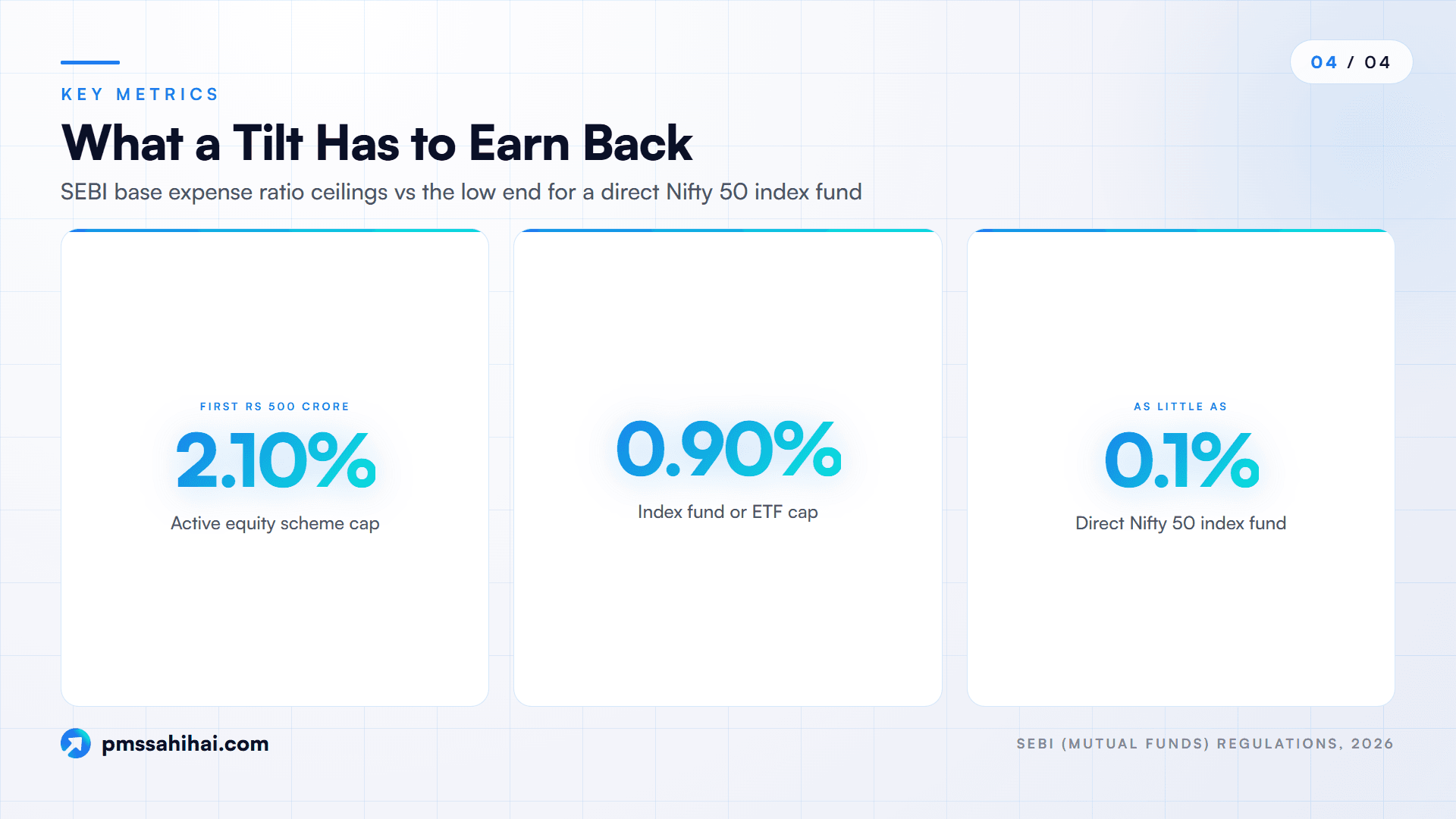
Expense ratio. Under the SEBI (Mutual Funds) Regulations, 2026, the maximum base expense ratio for an open-ended index fund or ETF is 0.90% of daily net assets, excluding statutory levies and transaction costs. That is a ceiling, not a typical figure. One industry estimate puts most smart beta funds at roughly 0.4–0.8% a year, against as little as 0.1% for a direct-plan Nifty 50 index fund. Direct plans cost less than regular plans because no distributor commission is built in.
Tracking error. SEBI defines tracking error as the annualised standard deviation of the difference in daily returns between the index and the fund's NAV, using one year of rolling data. Every ETF and index fund must publish it daily on its own website and on AMFI's. Tracking error tells you how consistently the fund follows the index, not how far behind it ends up.
Tracking difference. That second question is answered by tracking difference, the annualised gap between index and fund returns. SEBI requires monthly disclosure for one, three, five and ten years and since launch. A fund with low tracking error can still lag by its full expense ratio every year, so read both numbers.
Turnover. Smart beta indices rebalance more often and more heavily than a cap-weighted index. A momentum index can replace a large share of its holdings at each review, and every trade adds brokerage, impact cost and, for ETFs, spread. These costs show up inside tracking difference rather than as a separate line.
A practical rule: compare a tilted fund's tracking difference with that of the cheapest Nifty 50 fund. The tilt has to earn back that gap before it adds anything.
How Smart Beta Funds Are Taxed Under the Income-tax Act 2025
From 1 April 2026, mutual fund gains are taxed under the Income-tax Act, 2025. Section 198(8) defines an "equity oriented fund" as one investing at least 65% of its proceeds in equity shares of listed domestic companies, with a separate 90% test for funds that invest in units of another exchange-traded fund. A smart beta index fund or ETF tracking an Indian equity index holds at least 95% in index stocks, so it normally qualifies.
For such funds, gains on units held for more than 12 months are long-term and taxed at 12.5% on gains above Rs 1,25,000 a year under section 198 (formerly section 112A). Short-term gains are taxed at 20% under section 196 (formerly section 111A). Because the fund rebalances inside its own structure, you are not taxed on each index rebalance. You pay only when you sell or redeem units. A fund tracking an overseas or debt index would fall outside the equity definition and be taxed differently.
Tax rules change and individual circumstances differ, so treat this as general information and consult a tax adviser before acting.
Where Smart Beta Helps Indian Investors
Used with care, rule-based tilts solve real problems.
- It lets you choose your exposure. If the Nifty 50's heavy financial-services weight worries you, an equal weight or low volatility index gives a different mix without hiring a manager.
- It is transparent. The rules, constituents and weights are published, so you always know what you own and why.
- It removes manager risk. No star manager can leave, drift in style or make an emotional call during a crash.
- It is cheaper than most active funds. SEBI's 0.90% ceiling on base expense ratios for index funds and ETFs compares with up to 2.10% on the first Rs 500 crore for open-ended active equity schemes.
- It is disciplined by design. Rebalancing forces the index to trim winners and add laggards (equal weight) or to cut fading stocks (momentum) without hesitation.
- It makes a useful benchmark. If an active fund or PMS claims to run a quality or low-volatility style, the matching rule-based index is a fair, cheap yardstick.
How PMS Sahi Hai Helps You Test Managers Against Smart Beta Rules
PMS Sahi Hai is a comparison platform for portfolio management services and AIFs. It does not list or sell smart beta index funds or ETFs, and nothing on the platform is dedicated to smart beta. Where it earns its place is the step that comes next: once you know what a cheap, published rule can deliver, you can ask whether a PMS manager charging far more is doing anything a rule could not.
Set the rule as the bar. The PMS listing on PMS Sahi Hai can be filtered by category, fund house, benchmark and style, and each strategy page shows trailing returns beside the stated benchmark, from one month to five years and since inception. Most strategies benchmark to broad indices such as the Nifty 50 or Nifty 500 TRI. If a strategy describes itself as quality-, momentum- or low-volatility-driven, pull the matching NSE strategy index factsheet and set its returns beside the PMS record. A manager who cannot beat the rule after fees is selling a tilt you could buy for well under 1%.
Ask Nyra the uncomfortable question. Nyra is PMS Sahi Hai's AI-powered research tool. Use it to frame questions such as: is this quant PMS mostly a factor tilt, how concentrated is it, and what would its return look like against a factor benchmark rather than the Nifty 50? Nyra's published scoring methodology gives 30% of the Nyra Score to excess return over the stated benchmark across one, three and five years, and a strategy needs at least 12 months of record to be rated. The score is an analytical aid, not a recommendation.
Read the rule-based investing guides. Our explainer on how quant PMS works and the comparison of quant PMS vs discretionary PMS cover the active side of rules. The guide to alpha and beta in PMS explains how to separate market exposure from skill, and the piece on PMS benchmark selection shows how the wrong yardstick can hide weak results.
PMS Sahi Hai is an APMI-registered distributor of PMS and AIF products, and Nyra is an analytical tool, not a SEBI-registered investment adviser. Fund documents and your own adviser have the final word.
Limitations Every Rule-Based Investor Should Weigh
The limitations are just as concrete.
- Factors are cyclical. NSE's own research shows single-factor portfolios leading in some years and lagging badly in others. Equal weight beat the Nifty 50 in only 11 of 21 fiscal years to 2017.
- Back-tests flatter. Most Indian strategy indices have base dates of 2005 but launch dates years later. Any index designer can show a good back-test; the live record is what counts. A widely cited 2020 study, "The Smart Beta Mirage", found that US smart beta ETFs underperformed comparable benchmarks by about 1% a year on average after launch.
- Some tilts are riskier, not smarter. Momentum 30 had a five-year beta of 1.18 and standard deviation of 19.44%, well above the Nifty 50's 13.82%.
- Costs are higher than plain indexing. Higher expense ratios plus higher turnover make the hurdle real.
- Liquidity can be thin. Some smart beta ETFs trade in small volumes, which widens spreads.
- Crowding and timing risk. Investors often buy a factor after a strong run, just before it cools.
Smart Beta vs Plain Index Funds vs Active Funds vs Quant PMS
| Feature | Plain index fund | Smart beta fund | Active mutual fund | Quant PMS |
|---|---|---|---|---|
| Who decides holdings | Market-cap rule | Published factor or weighting rule | Fund manager | Manager's proprietary model |
| Rules public? | Yes | Yes | No | Partly, in disclosure document |
| Regulator's cost cap | 0.90% base TER ceiling | 0.90% base TER ceiling | Up to 2.10% base TER on first Rs 500 crore | Fees agreed with manager, plus GST |
| Minimum investment | Low | Low | Low | Rs 50 lakh |
| Tracking error disclosure | Daily | Daily | Not applicable | Not applicable |
| Tax on rebalancing | Inside fund | Inside fund | Inside fund | In investor's own hands |
The comparison shows where smart beta sits. It is closer to an index fund in cost and transparency, and closer to an active strategy in intent. A quant PMS can use far more complex models and change them, but it costs more, needs Rs 50 lakh and makes every trade a taxable event in your own account.
Choosing Whether a Factor Tilt Belongs in Your Portfolio
Smart beta is best seen as a deliberate tilt layered on a broad core. Ask four questions before you buy.
- What exposure do I want, and why? "Less concentration" points to equal weight; "smaller drawdowns" to low volatility; "a bet on trends" to momentum.
- How long is the live record? Separate the back-test from the years since launch.
- What does the fund really cost? Read the expense ratio, tracking error and tracking difference, and compare them with a plain Nifty 50 fund.
- Can I hold through a bad patch? Every factor has multi-year spells of underperformance. If you will sell after one, the strategy will cost you money.
For many investors the answer is a modest allocation beside a cap-weighted core, reviewed once a year rather than chased. If you also hold or are considering a PMS, use PMS Sahi Hai and Nyra to check whether its record beats the matching rule-based index after fees. Rule-based indexing works best when the investor is as disciplined as the rules.
Next Steps Before You Buy a Strategy Index Fund
Start with the index, not the fund: read its methodology, launch date and factsheet, and decide which tilt you actually want. Then compare funds tracking that index on expense ratio, tracking error and tracking difference, and set them against a plain Nifty 50 fund. Decide your allocation and holding period before you invest, write them down, and review once a year. If a PMS is part of the plan, use the PMS Sahi Hai comparison tool to set its record beside its benchmark, ask Nyra to help frame your questions on factor exposure and fees, or book a 15-minute conversation with the team.
PMS Sahi Hai is a distributor of Portfolio Management Services and Alternative Investment Funds, APMI-registered (Registration No. APRN08358). This article is for education only and is not investment advice, a recommendation, or an offer to buy or sell any security. Investments in securities markets are subject to market risks; read all scheme-related documents carefully. Past performance is not indicative of future results. Consult your advisor before investing.
Ishaan founded PMS Sahi Hai to make India's PMS, AIF and GIFT City markets legible to serious investors, comparing every SEBI-registered manager on the same comparative basis, with no shelf products and no commission bias.
Frequently asked
What is smart beta in simple terms?
Smart beta is a passive investing approach where an index chooses and weights stocks using published rules other than market capitalisation alone, such as equal weights, low volatility, value or momentum. An index fund or ETF then copies that index. You get a deliberate tilt at close to index-fund cost, without relying on a fund manager's day-to-day judgement.
Is smart beta active or passive investing?
It is passive in execution and active in design. The fund simply replicates its index, and SEBI regulates it as an index fund or ETF. But choosing the index rules is an active decision, because the rules deliberately depart from market-cap weights. That is why some practitioners call it a hybrid, or "strategic beta".
Are smart beta funds better than Nifty 50 index funds?
Not automatically. Over the five years to 30 September 2026, several NSE strategy indices beat the Nifty 50, but NSE's own research shows long stretches when equal weight and single-factor indices lagged. Smart beta funds also cost more. They suit investors who want a specific tilt and can hold through cycles, not those seeking a guaranteed edge.
What is tracking error in a smart beta fund?
Tracking error is the annualised standard deviation of the daily return difference between the fund's NAV and its index over the past year. SEBI caps it at 2% for equity ETFs and index funds and requires daily disclosure on AMC and AMFI websites. Read it with tracking difference, which shows how far the fund actually lags.
How often are smart beta indices rebalanced?
It depends on the index. On NSE, Nifty100 Low Volatility 30 is rebalanced quarterly, while Nifty200 Momentum 30 and Nifty200 Value 30 are rebalanced semi-annually. Equal-weight indices must be reset periodically because prices drift. The methodology document and factsheet for each index state its current review calendar.
How are smart beta funds taxed in India?
A smart beta index fund or ETF tracking an Indian equity index normally qualifies as an equity-oriented fund under section 198(8) of the Income-tax Act, 2025. Long-term gains after 12 months are taxed at 12.5% above Rs 1,25,000 a year, and short-term gains at 20%. Rebalancing inside the fund is not taxed in your hands. Consult a tax adviser.
Is smart beta the same as factor investing?
Not quite. Factor investing is the broad idea that traits such as value, momentum, quality and low volatility explain returns. Smart beta is one way to deliver it: a fixed, published index rule tracked by a low-cost fund. Factor exposure can also come from active quant funds. Equal weighting counts as smart beta though it is not a factor.
Are smart beta ETFs liquid in India?
Liquidity varies. SEBI requires each index constituent to trade frequently and with low impact cost, so the underlying stocks are usually liquid. The ETF units themselves may trade thinly on the exchange, which can widen the gap between price and NAV. Check volumes and spreads, or use the index-fund version if you are investing through SIPs.
Keep reading
All articles
What Is a Long-Short SIF? How Equity SIFs Hedge and Short Stocks
How equity long-short SIFs work: the three SEBI strategies, the 25% unhedged short, hedging rules and scenario analysis, explained with 2026 data.

What Is a Long-Only Fund? Why Most Equity PMS and AIFs Never Short
What a long-only fund is, the SEBI rules that keep PMS and Category I/II AIFs from shorting, who can short, and what changes for PMS in April 2027.

HUF Advantages and Disadvantages: Is a Family PAN Still Worth It?
HUF advantages and disadvantages under the Income-tax Act, 2025: separate slabs, no rebate, clubbing, daughters' rights, partition and exit.
Read it. Now pressure-test it.
Ask Nyra how this applies to your portfolio, or talk to our team, no pitch, no pressure.