
HUF Advantages and Disadvantages: Is a Family PAN Still Worth It?
HUF advantages and disadvantages under the Income-tax Act, 2025: separate slabs, no rebate, clubbing, daughters' rights, partition and exit.

A Hindu Undivided Family (HUF) is a separate taxpayer with its own PAN and its own slabs, which is why families still use it to hold ancestral wealth, run a family business or spread investment income. The Income-tax Act, 2025 kept the structure, but HUFs get no section 156 rebate, so their tax-free band under the default new regime is Rs 4 lakh, not the effective Rs 12 lakh individuals enjoy. Clubbing rules cancel the benefit whenever members fund the HUF from their own money. Since 2005 daughters are coparceners by birth, and only a total partition ends an HUF for tax, so the exit is slow. Weigh the HUF advantages and disadvantages below with a tax adviser before creating, keeping or closing one.
Why the HUF Question Matters Again in 2026
For decades, the advice in Indian family WhatsApp groups was simple: "Open an HUF, get one more PAN, save tax." Three changes have made that advice incomplete.
First, the Income-tax Act, 2025 replaced the 1961 Act from 1 April 2026. The HUF survived as a separate taxpayer, but every familiar section number moved. Second, the HUF new tax regime position has changed: the new regime is now the default, and its biggest sweetener, the rebate that makes income up to Rs 12 lakh effectively tax-free, is not available to HUFs because it is meant only for resident individuals. Third, family law has moved too: daughters have been coparceners by birth since 2005, the Supreme Court settled the last doubts in 2020, and courts have accepted women as karta.
So the honest answer to "should we have an HUF?" now depends on where the family's money comes from, who will control it, and how the family will eventually split it. This guide weighs the HUF advantages and disadvantages as they stand in October 2026: what still works, what has quietly shrunk, and what most families discover only when they try to close one.
A note on scope: whether and how an HUF can invest in PMS or AIFs (PAN, KYC, the karta's signature, minimums) is covered in our separate guide on HUF investing; here we only note that an HUF is an eligible client type and faces the same Rs 50 lakh PMS and Rs 1 crore AIF minimums as anyone else.
Nothing here is tax or legal advice. HUF rules turn on facts such as the source of each asset, so confirm your position with a chartered accountant or lawyer.
How the Hindu Undivided Family Became a Tax Entity
The Hindu Undivided Family is not a creation of tax law. It is a creation of Hindu personal law that tax law chose to recognise.
Mitakshara, Dayabhaga and the Right by Birth
Classical Hindu law came down through two main schools. The Mitakshara, a commentary by the jurist Vijnaneshvara on the Yajnavalkya Smriti, is best known for its theory of inheritance by birth: a son acquired an interest in ancestral property the moment he was born. The Dayabhaga school held sway in Bengal, Assam and parts of Odisha and Bihar, while the Mitakshara governed most of the rest of India.
That idea of a birthright is the root of the coparcenary: the inner circle of family members who own the joint property and can demand its division. Around them sits the wider family, the members, who are entitled to maintenance but not to a share.
From the 1961 Act to the Income-tax Act, 2025
The Income-tax Act, 1961 treated the HUF as a "person" under section 2(31), assessed separately from its members. That single line is the source of every HUF tax benefit: a separate person gets a separate PAN, separate slabs and separate exemptions.
Tax law also learned to police the structure. Partial partitions effected after 31 December 1978 are not recognised for tax purposes, which stopped families from peeling off assets one by one to cut tax. And the government closed the "convert your salary into HUF property" route through clubbing rules.
Two state and national milestones changed the family-law side:
- Kerala abolished the joint family system through the Kerala Joint Hindu Family System (Abolition) Act, 1975, which is why HUFs are recognised throughout India except Kerala.
- The Hindu Succession (Amendment) Act, 2005 substituted section 6 of the Hindu Succession Act, 1956 with effect from 9 September 2005, making daughters coparceners by birth with the same rights and liabilities as sons.
Then came the 2026 rewrite. The Income-tax Act, 2025 took effect on 1 April 2026, and the Hindu Undivided Family remains a separately assessed taxpayer under it. The new regime, previously in section 115BAC, now sits in section 202 and remains the default for HUFs, as it has been since assessment year 2024-25. Income earned up to 31 March 2026 (assessment year 2026-27) is still governed by the old Act; income from tax year 2026-27 onward falls under the new one.
How an HUF Works Today: Karta, Coparceners and Members
Before weighing the benefits of HUF ownership, it helps to be precise about who does what.
- Karta: the manager, traditionally the senior-most coparcener. The karta runs the bank account, signs documents, files the return and represents the HUF.
- Coparceners: those with a birthright in the joint property, today sons and daughters (and their descendants) of a coparcener. They can demand partition.
- Members: everyone in the family, including wives who join by marriage. Wives are members, not coparceners, in their husband's family.
HUF property belongs to the family, not to the karta personally. That one fact explains most of the disadvantages of HUF structures discussed later.
Who Can Form an HUF
An HUF can be formed by Hindu, Jain, Sikh and Buddhist families, which the Hindu Succession Act treats alike. It needs at least two members, typically a karta and one coparcener, and it needs a common ancestor. Contrary to what some listicles say, an HUF is not useful merely because a couple marries; what matters for tax is that it has a corpus of its own. Families in Kerala cannot use the structure at all.
Setting One Up: Deed, PAN, Bank Account and Return
The practical steps are simple:
- Execute an HUF deed or declaration on stamp paper naming the karta, coparceners and members.
- Apply for a PAN in the HUF's name, made by the karta.
- Open a bank account in the HUF's name, operated by the karta.
- Bring in a corpus: ancestral property, an inheritance, gifts or business capital.
- File returns every year. The e-filing portal lists ITR-2 for HUFs without business income, ITR-3 for HUFs with business or professional income, and ITR-4 for resident HUFs with presumptive business income up to Rs 50 lakh.
Step 4 is where most HUFs succeed or fail. An HUF with no clean source of capital is just paperwork.
The Real Benefits of HUF Under the 2025 Act
The core benefits of HUF ownership all flow from one idea: a second taxpayer inside the family. Here is what that still buys in 2026.
A Separate Taxpayer With Its Own Slabs
Under section 202 of the Income-tax Act, 2025, the default new regime slabs for an HUF in tax year 2026-27 are shown below; as a Business Today explainer from January 2026 notes, the Rs 4 lakh zero-tax slab applies to the HUF separately from its members.
| Total income | Rate |
|---|---|
| Up to Rs 4 lakh | Nil |
| Rs 4–8 lakh | 5% |
| Rs 8–12 lakh | 10% |
| Rs 12–16 lakh | 15% |
| Rs 16–20 lakh | 20% |
| Rs 20–24 lakh | 25% |
| Above Rs 24 lakh | 30% |
Surcharge and 4% health and education cess apply on top. If the HUF has no business or professional income, it can instead choose the old regime for a given year while filing its return; the old regime gives a Rs 2.5 lakh nil band, then 5% to Rs 5 lakh, 20% to Rs 10 lakh and 30% above, but keeps deductions such as the old section 80C and 80D equivalents. The choice is made inside the return under Rule 136 of the Income-tax Rules, 2026; Form 10-IEA belongs to the old Act. An HUF with business income has less freedom: once it opts for the old regime, it can come back to the new regime only once.
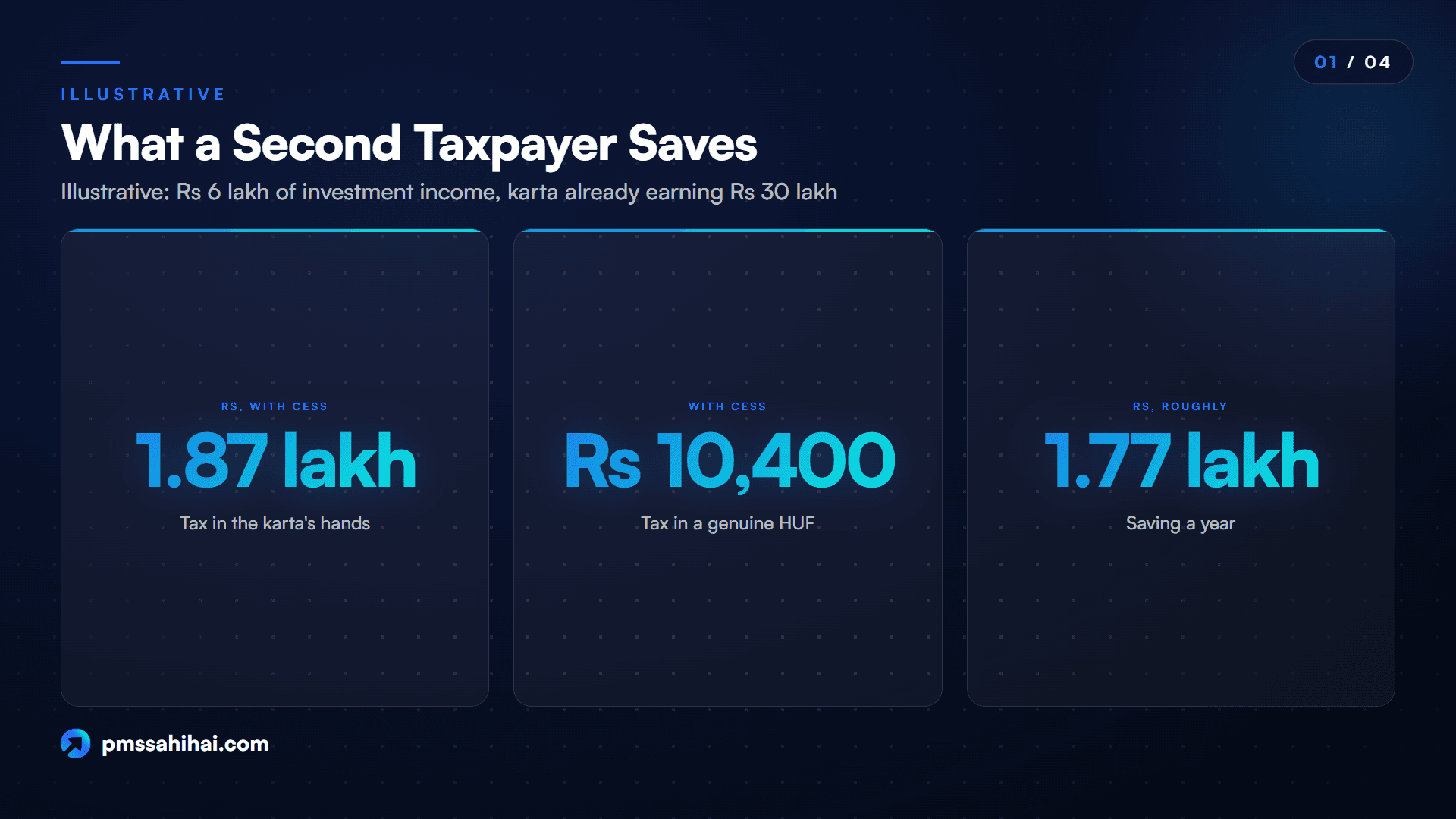
Worked Example: Rs 6 Lakh of Investment IncomeSuppose a family holds an inherited corpus that earns Rs 6 lakh a year in interest and dividends, and the karta already earns Rs 30 lakh as an individual.
- Taxed in the karta's hands, the Rs 6 lakh sits entirely in the 30% band: about Rs 1.87 lakh with cess.
- Taxed in a properly constituted HUF, the first Rs 4 lakh is nil and the next Rs 2 lakh is taxed at 5%: Rs 10,000, or Rs 10,400 with cess.
That difference of roughly Rs 1.77 lakh a year is the real, legal face of HUF tax benefits. It exists only because the corpus genuinely belongs to the HUF, which is the condition the rest of this article keeps returning to.
Its Own Capital Gains Thresholds and Rollovers
Because the HUF is a separate assessee, it gets its own capital gains computation. Long-term gains on listed equity are taxed at 12.5% above an annual Rs 1.25 lakh threshold (section 198 of the 2025 Act, formerly 112A), and short-term gains at 20% (section 196, formerly 111A); an HUF with its own equity portfolio gets its own Rs 1.25 lakh threshold. The residential-house rollover, now section 82 (formerly section 54), is available to individuals and HUFs alike, so an HUF that sells a house can reinvest in another and claim relief in its own name.
A Natural Home for Ancestral and Inherited Wealth
The Hindu Undivided Family works best for money that never belonged to any one member, and this is where the HUF tax benefits are cleanest. Ancestral property, assets inherited by the HUF, or a bequest made to the HUF under a will can sit in the HUF's books without triggering clubbing. Gifts from members are exempt in the HUF's hands on receipt (members count as "relatives" of the HUF), while gifts from non-members above Rs 50,000 in a year are taxable. One practical nuance flagged by advisers: property a person inherits directly from his father is usually his individual property under the 1956 Act, not HUF property, so families should not assume every inheritance is "ancestral."
How an HUF Makes Family Money Easier to Run
Beyond the HUF tax benefits, the structure solves several everyday problems for joint families.
One pot, one manager. A family business, a rental building or an inherited share portfolio can be run from one account under one manager, instead of being split across five siblings' names. The karta can sign, renew deposits and file returns without collecting signatures every time.
Continuity across generations. An HUF does not die with its karta. When the karta passes away, the HUF continues and the next senior coparcener takes over management, so family assets do not freeze while probate or succession certificates are sorted out for every asset.
A business vehicle. An HUF can carry on a business and pay salaries to working members for real work, with the remaining profit taxed in the HUF. For trading families this has long been the default structure for a shop or a small firm.
Clean records. A separate PAN and bank account create a paper trail that separates family capital from personal money. That trail is exactly what the tax department looks for when it tests whether income should be clubbed, and it makes any future HUF partition far easier to document.
Room for daughters. Since 2005, daughters inherit coparcenary rights by birth. An HUF can therefore become a vehicle for equal treatment of children, something many families now actively want.
How PMS Sahi Hai Helps an HUF Read the Inner Clause of Its Investments
PMS Sahi Hai is a research and comparison platform for portfolio management services and alternative investment funds. It does not set up HUFs, draft deeds or give tax advice, and it has no tool built specifically for HUFs, so take the structural decision to your chartered accountant. Where it helps is the step after that decision: once a Hindu Undivided Family has a genuine corpus, the karta still has to decide where that money goes, and that is the job the platform is built for.
Start with what the HUF can actually buy. An HUF is an eligible client type for PMS and AIFs, and the entry rules are the same as for anyone else: our guides to PMS eligibility under SEBI rules and the Rs 1 crore AIF minimum and its exceptions set out the thresholds. The detailed HUF account-opening process is covered in our companion guide on HUF investing in PMS and AIFs.
Remember whose tax it is. In a PMS, the securities sit in the client's own demat account, so PMS gains are taxed in the investor's own hands. For an HUF client, that means the HUF's return, the HUF's slabs and the HUF's Rs 1.25 lakh equity threshold, which links the investment choice directly to the HUF tax benefits discussed above.
Compare before you commit. The PMS Sahi Hai comparison tool lets the karta shortlist strategies by category and stated benchmark and see trailing returns beside that benchmark. Coparceners who want a say can review the same shortlist, which makes family consent easier to document.
Use Nyra to frame the questions. Nyra is PMS Sahi Hai's AI-powered research tool. Its published methodology weights excess return over the stated benchmark heavily and does not rate strategies with less than 12 months of record; the score is described as not a recommendation. A karta can ask Nyra how a strategy's turnover might affect the HUF's tax bill or what to ask a manager about fees, then check the answers in the disclosure document.
Know the paperwork. Our PMS onboarding guide walks through KYC, documents and timelines, which for an HUF are signed by the karta on the HUF's behalf.
The Disadvantages of HUF Most Families Find Late
The disadvantages of HUF structures are less visible on day one and more expensive later.
No Rebate, So the Tax-Free Band Is Smaller
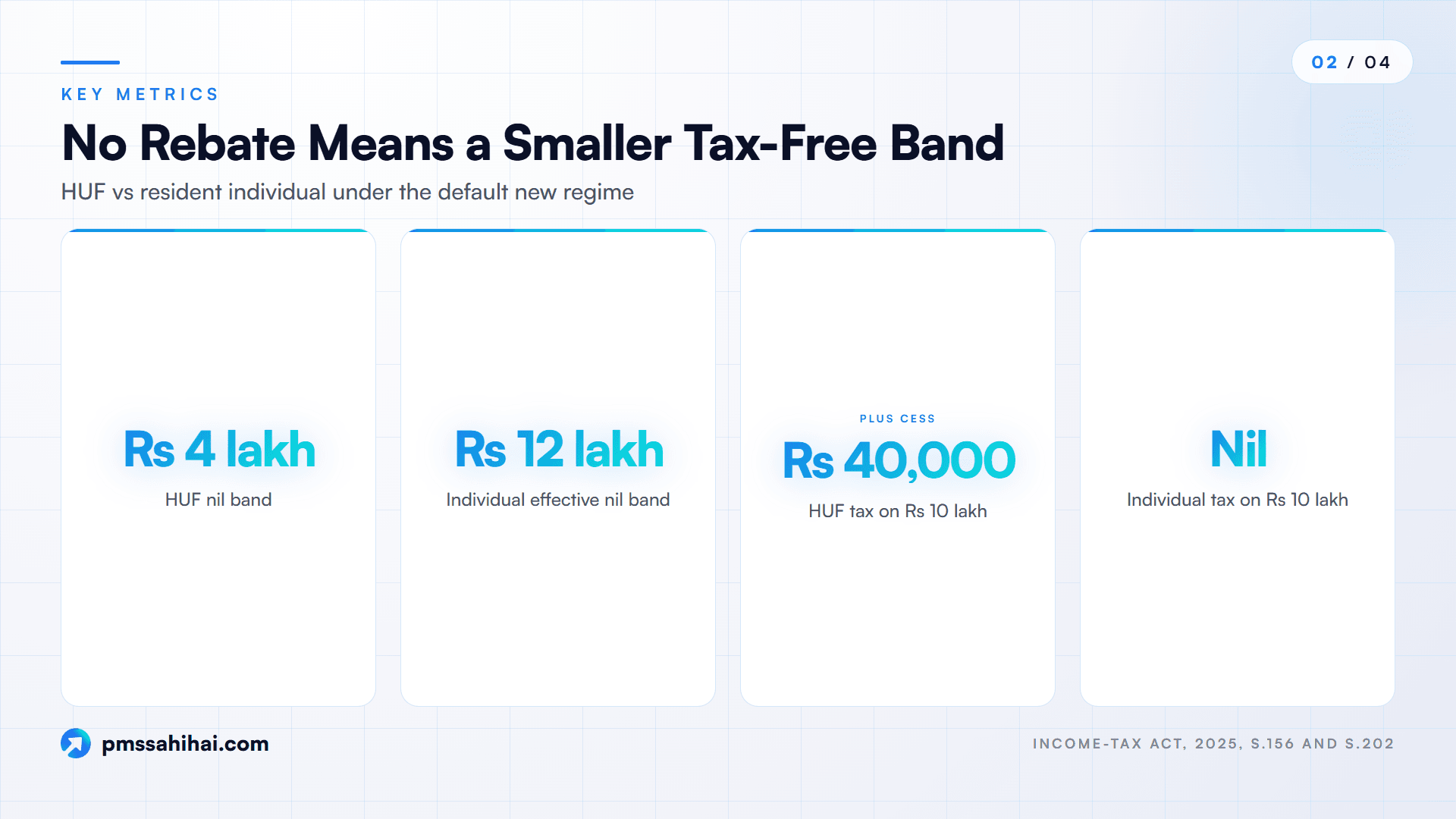
Under the new regime, a resident individual whose income is up to Rs 12 lakh effectively pays no tax because of the section 156 rebate (formerly 87A). An HUF gets no such rebate. An HUF with Rs 10 lakh of ordinary income pays Rs 40,000 plus cess (about Rs 41,600), while an individual with the same income pays nothing. In other words, under the HUF new tax regime, the extra PAN is worth far less than it was when the comparison was Rs 2.5 lakh against Rs 2.5 lakh. For many middle-income families, routing modest income through an HUF now saves little or nothing compared with simply spreading investments across spouses and adult children in their own names.
Clubbing Kills the Gift-Your-Salary Trick
The single biggest myth is that you can "gift" your salary or savings to your own HUF and have the income taxed there. You cannot. When a member transfers his own property to the HUF without adequate consideration, or converts it into HUF property, the income from that property is taxed in the member's hands, not the HUF's. This rule sits in section 99 of the Income-tax Act, 2025 (formerly section 64(2)); Business Today's worked cases show how salary gifted to an HUF simply comes back to the donor's return under clubbing. The gift itself may be exempt in the HUF's hands, but the income it earns comes straight back to the donor's return. Routing the money through parents or relatives does not automatically help, because indirect transfers are also caught. Only income earned on reinvested income, the second layer, is generally taxed in the HUF.
Shared Ownership and the Karta's Wide Powers
HUF property belongs to all coparceners. A coparcener cannot gift his undivided share while alive, though he can leave it by will. Selling a joint asset in practice needs the family's agreement, and disputes are common once cousins and in-laws enter the picture. At the same time the karta has wide day-to-day control, which can feel unfair to younger coparceners who have rights but no say until they ask for partition.
Compliance and Platform Friction
An HUF is one more PAN to file for, one more bank account to reconcile and one more set of KYC documents to refresh. Many fintech apps and investment platforms still do not support HUF onboarding, so the karta often ends up using offline forms. NRIs can be members, but adding non-resident coparceners complicates both FEMA and tax compliance.
Coparcenary Rights for Daughters and the Karta Question
Coparcenary rights decide who owns the HUF, who can break it up and who can run it, so they belong in any honest list of HUF advantages and disadvantages.
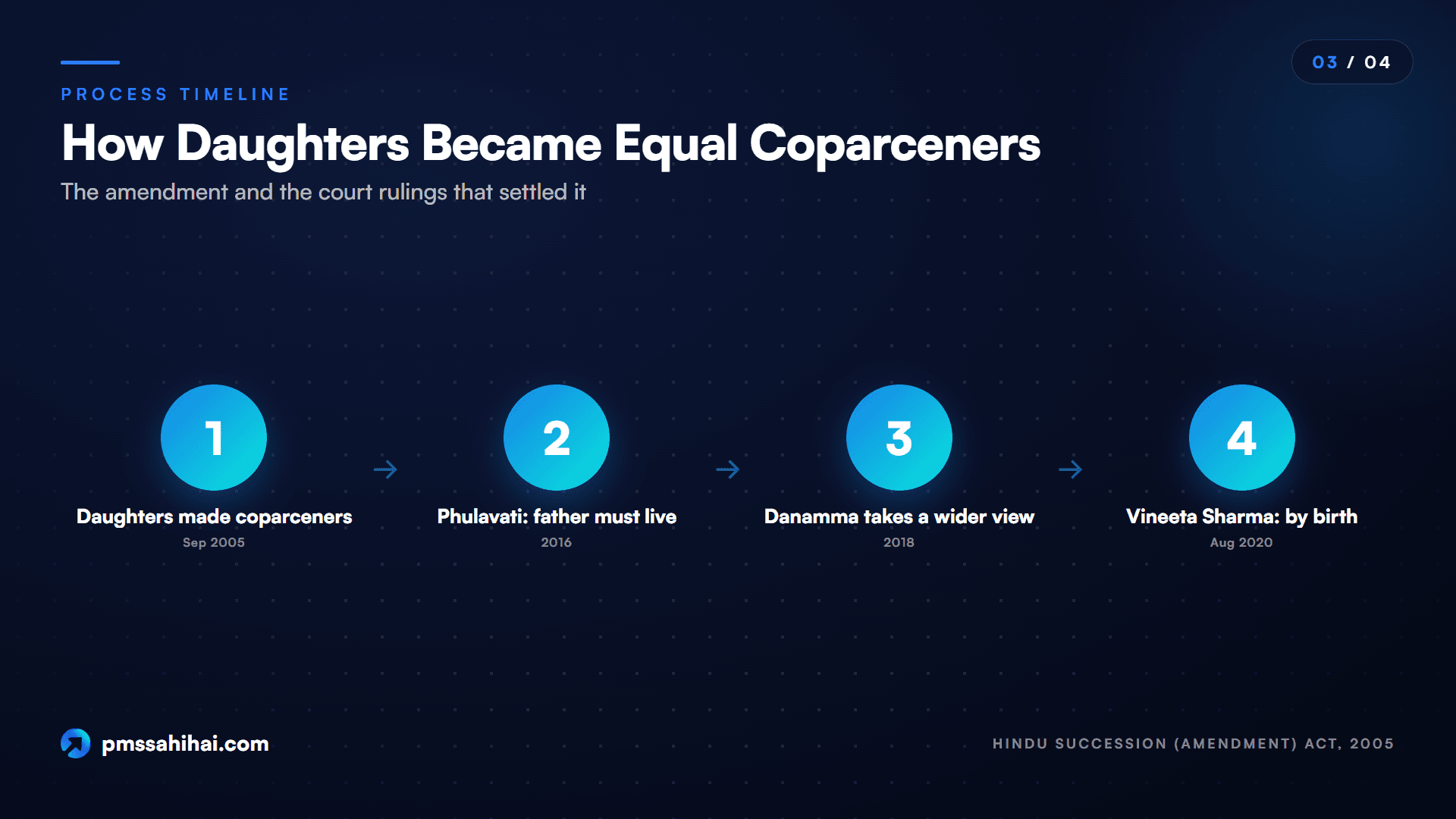
The 2005 amendment. The substituted section 6 of the Hindu Succession Act, effective 9 September 2005, makes the daughter of a coparcener a coparcener by birth in her own right, with the same rights and liabilities as a son. A proviso protects dispositions, alienations and partitions completed before 20 December 2004.
The 2020 judgment. Supreme Court benches disagreed for years on whether the father had to be alive on 9 September 2005. In Prakash v Phulavati (2016) the Supreme Court said both father and daughter had to be living on that date; in Danamma v Amar (2018) another bench took a wider view. A three-judge bench headed by Justice Arun Mishra resolved the conflict in Vineeta Sharma v Rakesh Sharma on 11 August 2020, ruling that daughters have equal rights to property in a joint Hindu family. It held that:
- a daughter's coparcenary rights arise by birth, so it does not matter whether her father was alive in 2005;
- Phulavati was overruled and Danamma partly overruled;
- a plea of oral partition is accepted only in exceptional cases backed by public documents; the law contemplates a registered deed or a court decree.
Married daughters. Marriage does not take a daughter's rights away. She remains a coparcener in her father's HUF and becomes a member, not a coparcener, of her husband's.
Death of a coparcener. Before 2005, a deceased coparcener's interest passed to the surviving coparceners by survivorship. Now it passes to his or her legal heirs under the Hindu Succession Act, which can bring new people into the family's financial affairs.
Can a woman be karta? A 2016 Delhi High Court ruling held that the eldest female member of an HUF can be its karta, reasoning that the 2005 amendment did not restrict women's management rights. The principle follows naturally from equal coparcenary, though tax forms and bank processes sometimes still assume a male karta.
For families, the practical effect is twofold. The advantage is fairness: every child has an equal stake. The disadvantage is dilution of control: more coparceners means more people who can demand partition and more consent needed for big decisions.
HUF Partition and Dissolution: Why the Exit Is Hard
Creating an HUF takes an afternoon. Ending one can take years, which is the most underrated of the disadvantages of HUF ownership. HUF partition is governed by both family law and tax law, and the two do not always move together.
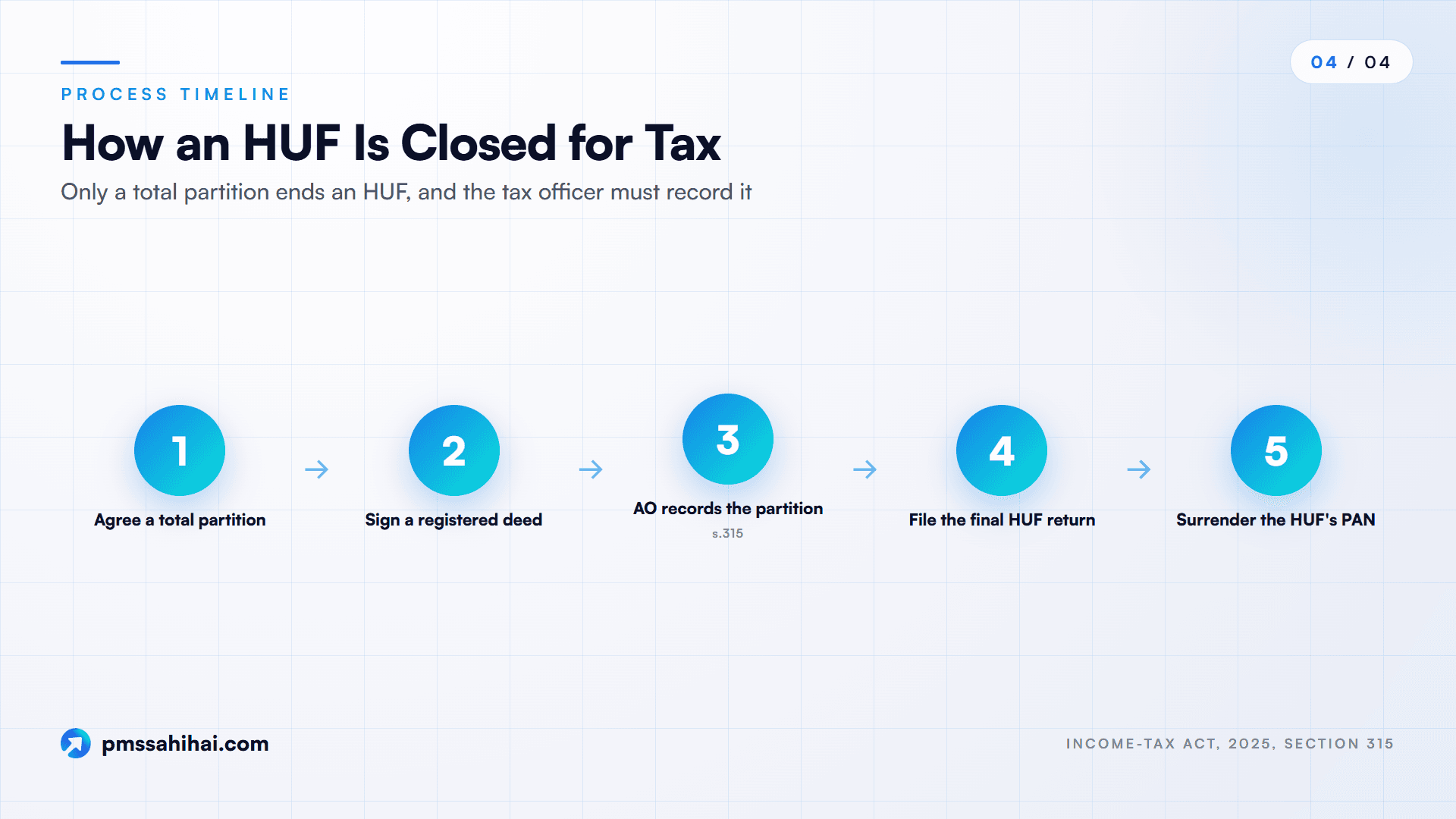
Only total partition counts for tax. Partial partitions effected after 31 December 1978, whether of some assets or some members, are ignored. The family keeps being assessed as an HUF until a total partition is recognised.
The tax officer must record it. An HUF that has been assessed as such is treated as continuing until the Assessing Officer, after giving notice to members and holding an inquiry, records a finding that a total partition has taken place. Under the 1961 Act this was section 171; the 2025 Act carries it in section 315, "Assessment after partition of Hindu undivided family."
Members stay liable. Income up to the date of partition is taxed in the HUF. After partition, the members are jointly and severally liable for the HUF's earlier tax dues, generally in proportion to the assets each received.
Tax on the split itself. As tax expert Balwant Jain explained to Business Today, assets received by members on a genuine partition are not treated as income in their hands, and income from those assets is taxed individually from then on. Note that property originally converted into HUF property by a member can remain subject to clubbing even after partition in some cases, so the history of each asset matters.
Paperwork and stamp duty. Dissolution needs a partition deed, ideally registered, stamp duty that varies by state on immovable property, a final HUF return covering the period to partition, and surrender of the HUF's PAN once compliance is complete.
The human cost. Every HUF partition needs agreement on who gets what. Shares are equal by default, though all coparceners can agree to an unequal split. Families that never discussed this while the founding karta was alive often discover the disagreement at the worst possible time.
HUF Advantages and Disadvantages at a Glance
| Aspect | Advantage | Disadvantage |
|---|---|---|
| Tax identity | Separate PAN and slabs; nil band Rs 4 lakh (new regime) | No section 156 rebate, so far smaller than an individual's effective Rs 12 lakh |
| Regime choice | Old regime available each year if no business income | Business HUFs can switch back to the new regime only once |
| Source of capital | Ancestral, inherited and gifted-by-will assets taxed in the HUF | Members' own transfers clubbed back under section 99 |
| Capital gains | Own Rs 1.25 lakh equity LTCG threshold; house rollover under section 82 | Same rates as individuals; no special rate |
| Control | Single manager; continuity after karta's death | Karta's wide powers; consensus needed to sell |
| Family law | Daughters are equal coparceners since 2005 | More coparceners, more partition claims |
| Exit | Partition receipts not taxed as income | Only total partition recognised; AO finding needed; joint liability |
| Practicality | Clear paper trail | Extra compliance; patchy platform support; unavailable in Kerala |
Should Your Family Create, Keep or Close an HUF
Use these questions with your adviser:
- Does the HUF have its own money? If the only possible corpus is your salary, the HUF tax benefits largely disappear because of clubbing. If there is ancestral property, an inheritance or a will in the HUF's favour, the case is real.
- How much income will it earn? Below Rs 4 lakh a year, an HUF saves tax only against a high-bracket member. Compare the HUF's tax with what the same income would cost in the hands of a low-earning spouse or adult child.
- Does it need deductions? If the HUF pays a home loan or insurance premiums, run both regimes; the old regime may still beat the HUF new tax regime default.
- Who will be karta next, and do the coparceners agree? Write down succession and decision-making rules now, including the daughters' position.
- Is there a business? A business HUF faces tighter regime-switching rules and heavier compliance, but also gets the most value from a separate taxpayer.
- What is the exit plan? If the family expects to separate within a few years, the cost of a later HUF partition may outweigh a few years of savings.
- Would another structure fit better? Private trusts and wills solve succession questions that an HUF does not; those trade-offs are covered in our guides on private trusts and on wills, trusts and nomination.
Families whose Hindu Undivided Family has become an empty shell, with no meaningful income and a growing list of coparceners, should consider whether a recorded total partition now is cheaper than a disputed one later. Families whose HUF does hold real capital face the opposite question: how to invest it well. That is where a side-by-side comparison on PMS Sahi Hai and a few pointed questions to Nyra can sit alongside your adviser's view of the structure.
Plan Your Family's Next Step With PMS Sahi Hai
An HUF is a tool, not a strategy. Settle the structure first with a chartered accountant or lawyer: confirm where the corpus comes from, which regime suits it and how the family will handle a future partition. Once the HUF has genuine capital to invest, compare PMS and AIF strategies on PMS Sahi Hai, put your open questions to Nyra, and book a conversation with the team before the karta signs anything. Clear, sourced data makes the family's decision easier to explain to every coparcener.
PMS Sahi Hai is a distributor of Portfolio Management Services and Alternative Investment Funds, APMI-registered (Registration No. APRN08358). This article is for education only and is not investment advice, a recommendation, or an offer to buy or sell any security. Investments in securities markets are subject to market risks; read all scheme-related documents carefully. Past performance is not indicative of future results. Consult your advisor before investing.
Ishaan founded PMS Sahi Hai to make India's PMS, AIF and GIFT City markets legible to serious investors, comparing every SEBI-registered manager on the same comparative basis, with no shelf products and no commission bias.
Frequently asked
What are the main HUF advantages and disadvantages?
The main advantages are a separate PAN and slab structure, its own capital gains thresholds, a home for ancestral or inherited wealth, and continuity after the karta's death. The main disadvantages are no section 156 rebate, clubbing of income from members' own transfers, shared ownership, wide karta powers, extra compliance and a slow exit, because only a total partition recorded by the tax officer ends an HUF for tax purposes.
Is an HUF still beneficial under the new tax regime?
It can be, but the HUF tax benefits are smaller than before. An HUF's nil band under the default regime is Rs 4 lakh because it cannot claim the section 156 rebate that effectively makes income up to Rs 12 lakh tax-free for resident individuals. The benefit is meaningful mainly when the HUF holds its own corpus and the same income would otherwise be taxed in a high-bracket member's hands.
Can I gift my salary savings to my HUF to save tax?
The transfer itself may be exempt in the HUF's hands, but the income it earns will be taxed in your hands under the clubbing rule, now section 99 of the Income-tax Act, 2025 and formerly section 64(2). Only income on reinvested income is generally taxed in the HUF. So gifting your own savings to your HUF usually saves nothing.
Is a married daughter a coparcener in her father's HUF?
Yes. Since the 2005 amendment to section 6 of the Hindu Succession Act, a daughter is a coparcener by birth, and marriage does not change that. The Supreme Court confirmed in Vineeta Sharma (2020) that her right does not depend on her father being alive in 2005. In her husband's HUF she is a member, not a coparcener.
Can a woman be the karta of an HUF?
Yes, under the coparcenary rights now shared by daughters. A Delhi High Court ruling reported in 2016 held that the eldest female member of an HUF can be its karta, because the 2005 amendment gave daughters equal coparcenary rights without limiting management. In practice, the senior-most coparcener, male or female, is normally the karta. Banks and forms sometimes still assume a male karta, so keep the deed clear.
How is an HUF dissolved?
Through a total HUF partition. The family signs a partition deed, ideally registered, pays state stamp duty on immovable property, and asks the Assessing Officer to record the partition (section 315 of the 2025 Act, formerly section 171). The HUF files a final return to the partition date, members remain jointly liable for earlier dues, and the PAN is surrendered after compliance.
Is partition of an HUF taxable?
Assets received by members on a genuine total partition are not treated as income in their hands. Income from those assets is taxed in each member's own return after partition. Partial partitions effected after 31 December 1978 are ignored for tax, so the HUF keeps being assessed until a total partition is recorded.
Can an HUF be formed in Kerala?
Generally no. The Hindu Undivided Family is not recognised there: Kerala abolished the joint family system through the Kerala Joint Hindu Family System (Abolition) Act, 1975, and HUFs are recognised throughout India except Kerala. Anyone with mixed residence or ancestral property in Kerala should take specific legal advice.
Keep reading
All articles
What Is a Long-Short SIF? How Equity SIFs Hedge and Short Stocks
How equity long-short SIFs work: the three SEBI strategies, the 25% unhedged short, hedging rules and scenario analysis, explained with 2026 data.

What Is a Long-Only Fund? Why Most Equity PMS and AIFs Never Short
What a long-only fund is, the SEBI rules that keep PMS and Category I/II AIFs from shorting, who can short, and what changes for PMS in April 2027.

What Is Smart Beta? Rule-Based Indexing for Indian Investors
How smart beta indices are built, what equal-weight, low-volatility and momentum funds cost in India, and the SEBI rules on tracking error.
Read it. Now pressure-test it.
Ask Nyra how this applies to your portfolio, or talk to our team, no pitch, no pressure.