
What Is a Long-Short SIF? How Equity SIFs Hedge and Short Stocks
How equity long-short SIFs work: the three SEBI strategies, the 25% unhedged short, hedging rules and scenario analysis, explained with 2026 data.

A long-short SIF is a strategy run by a mutual fund house under SEBI's Specialised Investment Fund rules that holds mostly stocks but can also bet against stocks or sectors through exchange-traded derivatives. SEBI allows three equity versions: the Equity Long-Short Fund (at least 80% in equity), the Equity Ex-Top 100 Long-Short Fund (at least 65% outside India's 100 largest companies) and the Sector Rotation Long-Short Fund (at least 80% in no more than four sectors). In each, unhedged short exposure is capped at 25% of net assets, on top of whatever derivatives the manager uses purely to hedge, and total gross exposure cannot exceed 100% of net assets. On 30 September 2026 these 20 equity strategies managed about Rs 11,874 crore. Read the strategy's own document, especially its scenario analysis, before you invest.
Why Equity Long-Short SIFs Now Hold Rs 11,874 Crore
Eighteen months ago, an Indian investor who wanted a professionally run equity portfolio that could also short stocks had one realistic option: a Category III AIF with a Rs 1 crore ticket. Today the same idea is available inside a mutual fund house for Rs 10 lakh.
The numbers show how fast the shelf has filled. According to AMFI's SIF monthly report for September 2026, the three equity-oriented SIF categories held Rs 11,873.81 crore across 20 strategies and 84,786 folios on 30 September 2026:
| Equity SIF category | Strategies | Folios | AUM on 30 Sep 2026 |
|---|---|---|---|
| Equity Long-Short Fund | 12 | 29,856 | Rs 4,216.06 crore |
| Equity Ex-Top 100 Long-Short Fund | 7 | 53,942 | Rs 7,595.35 crore |
| Sector Rotation Long-Short Fund | 1 | 988 | Rs 62.40 crore |
| Equity sub-total | 20 | 84,786 | Rs 11,873.81 crore |
In September alone, investors put a net Rs 1,492 crore into the ex-top-100 category and Rs 895 crore into equity long-short.
Most explainers repeat "up to 25% short" without saying what that 25% covers, how SEBI measures it, or why the three equity categories behave very differently. This guide covers only those three equity strategies and the mechanics of their hedge. Hybrid SIFs, the fund-by-fund performance record and SIF taxation are separate topics.
What a Long-Short SIF Is and Where Equity Hedging Fits
A Specialised Investment Fund is a product category that SEBI created inside the mutual fund regulations, in force from 1 April 2025. A SIF is run by a registered mutual fund under its own brand, and each fund it offers is called an "investment strategy" rather than a scheme. The minimum is Rs 10 lakh per investor at PAN level, counted across all the strategies of one SIF; accredited investors are exempt. Our explainer on what a SIF is covers the wider framework.
A long-short SIF is any SIF strategy that combines a long portfolio with limited short positions. Seven categories exist: three equity, two debt and two hybrid. This article is about the equity three, where the core job of the short book is equity hedging: reducing the damage when stocks fall, or profiting from specific stocks or sectors the manager expects to do badly.
Three ideas carry through everything that follows.
- Long book. The shares and long derivative positions the manager expects to rise.
- Short book. Derivative positions that gain when a stock, sector or index falls.
- Net exposure. Long minus short, as a share of net assets. It tells you how much market direction you still carry. A fund 90% long and 25% short has net exposure of 65%.
The rules sit in SEBI's circular of 27 February 2025, now consolidated in Chapter 21 of SEBI's Master Circular for Mutual Funds dated 20 March 2026, which applies alongside the SEBI (Mutual Funds) Regulations, 2026 from 1 April 2026. The equity strategy rules did not change in the consolidation.
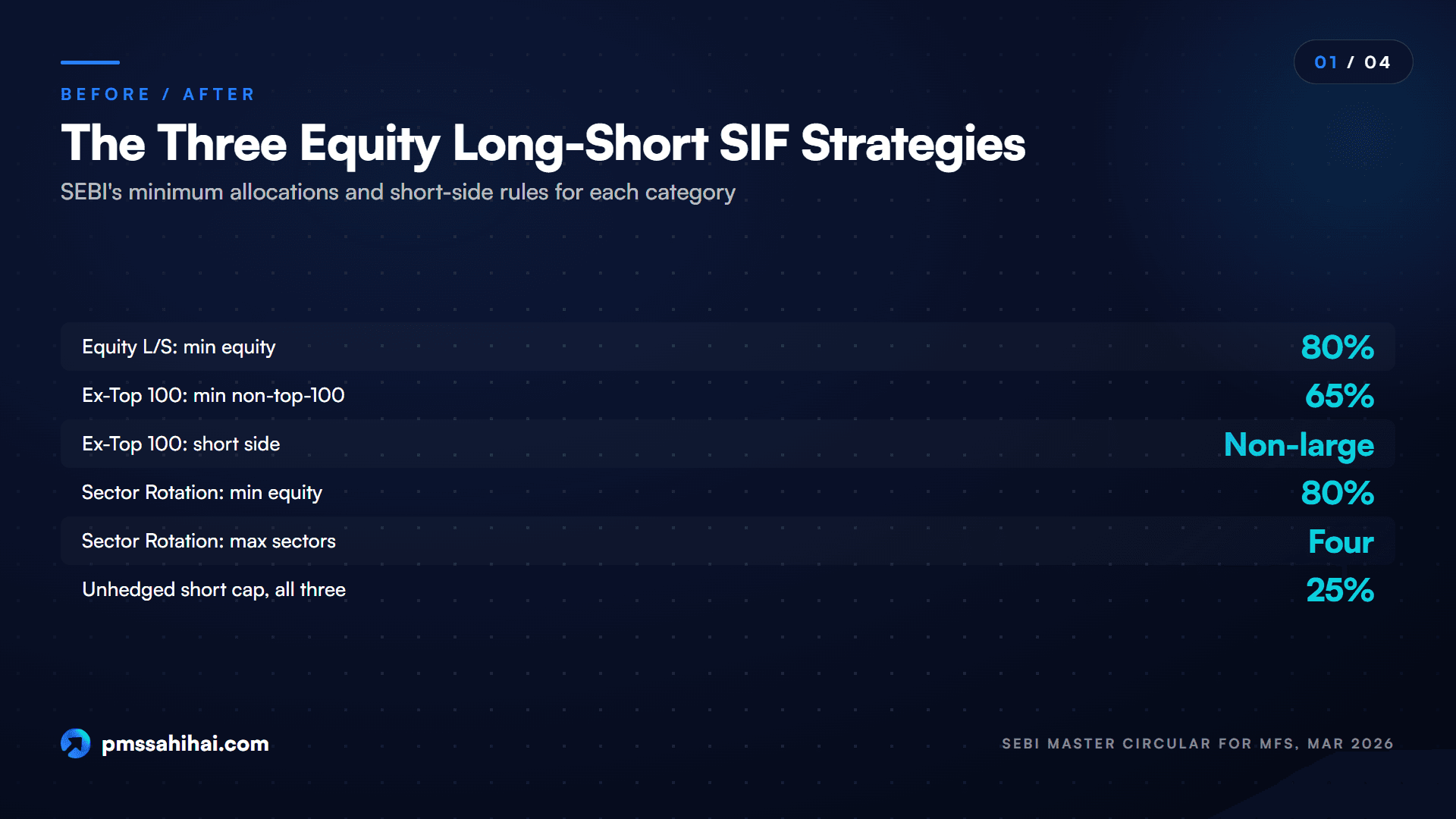
The Three Equity Long-Short SIF Strategies SEBI Allows
SEBI's table gives each equity category a minimum equity allocation, a description and a short-side limit. A SIF may launch only one strategy per category, so each fund house can offer at most one of each.
| Feature | Equity Long-Short Fund | Equity Ex-Top 100 Long-Short Fund | Sector Rotation Long-Short Fund |
|---|---|---|---|
| Minimum equity | 80% | 65% in stocks outside the top 100 by market cap | 80% in a maximum of four sectors |
| Unhedged short limit | 25% | 25%, only in stocks other than large caps | 25%, applied at sector level |
| Universe | All market caps | Mainly mid and small caps | Up to four sectors at a time |
| Redemption | Daily or less often | Daily or less often | Daily or less often |
| Strategies live (30 Sep 2026) | 12 | 7 | 1 |
Equity Long-Short Fund: The All-Cap 80% Mandate
The equity long-short fund is the broadest of the three. At least 80% of assets must be in equity and equity-related instruments, with no restriction on company size or sector. Up to 25% can be held as unhedged short positions through derivatives.
Because of the 80% floor, a typical portfolio looks like SEBI's own illustration: about 70% in shares, 25% short through stock or index futures and 5% in cash. That fund is 95% invested gross and about 45% net long. It behaves like a dampened equity fund, not a market-neutral one. SEBI's example does not spell out how the short futures count toward the 80% floor, so check the asset allocation table in each strategy document.
The all-cap universe matters for the short side. Most stocks with liquid exchange-traded derivatives are larger companies, and the broad index futures are the most liquid hedging tool in the market. An equity long-short fund can use all of them.
Equity Ex-Top 100 Long-Short Fund: Hedging Beyond the Large Caps
The ex-top 100 long-short category must keep at least 65% in companies that are not among India's 100 largest by market capitalisation. Under mutual fund rules, "large cap" means the 1st to 100th companies by full market capitalisation on a list AMFI publishes every six months, so in practice this is a mid and small cap strategy. The remaining 35% can go to large caps, debt, cash and other permitted assets, depending on the strategy document.
The short-side wording is narrower than in the other two categories. SEBI caps unhedged short exposure at 25% in "equity and equity related instruments of other than large cap stocks". On a plain reading, the unhedged short book must sit in non-large-cap names. That creates a practical squeeze: only stocks with exchange-traded derivatives can be shorted, and fewer mid and small caps qualify than large caps. Ask how the strategy classifies any index hedge against its large-cap or mid-cap holdings.
This is also the most popular equity category by money. With Rs 7,595 crore and 53,942 folios at the end of September 2026, it holds more than the other two equity categories combined. One fund house launching in this category in August 2026 told Business Today that the wider universe offers higher growth potential but greater price volatility, and that the long-short approach is meant to manage that risk.
Sector Rotation Long-Short Fund: Four Sectors and the All-or-Nothing Short
The sector rotation long-short category must invest at least 80% in equity of a maximum of four sectors. It is the most concentrated equity SIF by design.
Its short rule is unique. SEBI says the 25% short exposure "shall apply at the sector level, covering all stocks within that sector held in the portfolio", and gives the example that if the fund shorts the Auto sector, "all Auto sector stocks in the portfolio must be held as short positions".
Here is what that means in practice. A sector rotation strategy cannot own one carmaker and short another as a pair trade. Its view on each sector is either long or short. If the manager turns negative on Auto, every Auto stock in the portfolio has to sit on the short side, and the total remains inside the 25% limit.
Only one such strategy existed on 30 September 2026, with Rs 62.40 crore, and its AMFI summary document shows it was allotted on 15 May 2026. Its offer document, dated 22 April 2026, lists a universe of 12 sectors (including financial services, information technology, energy, healthcare, industrials and FMCG) from which it picks four.
How the 25% Unhedged Short Exposure Actually Works
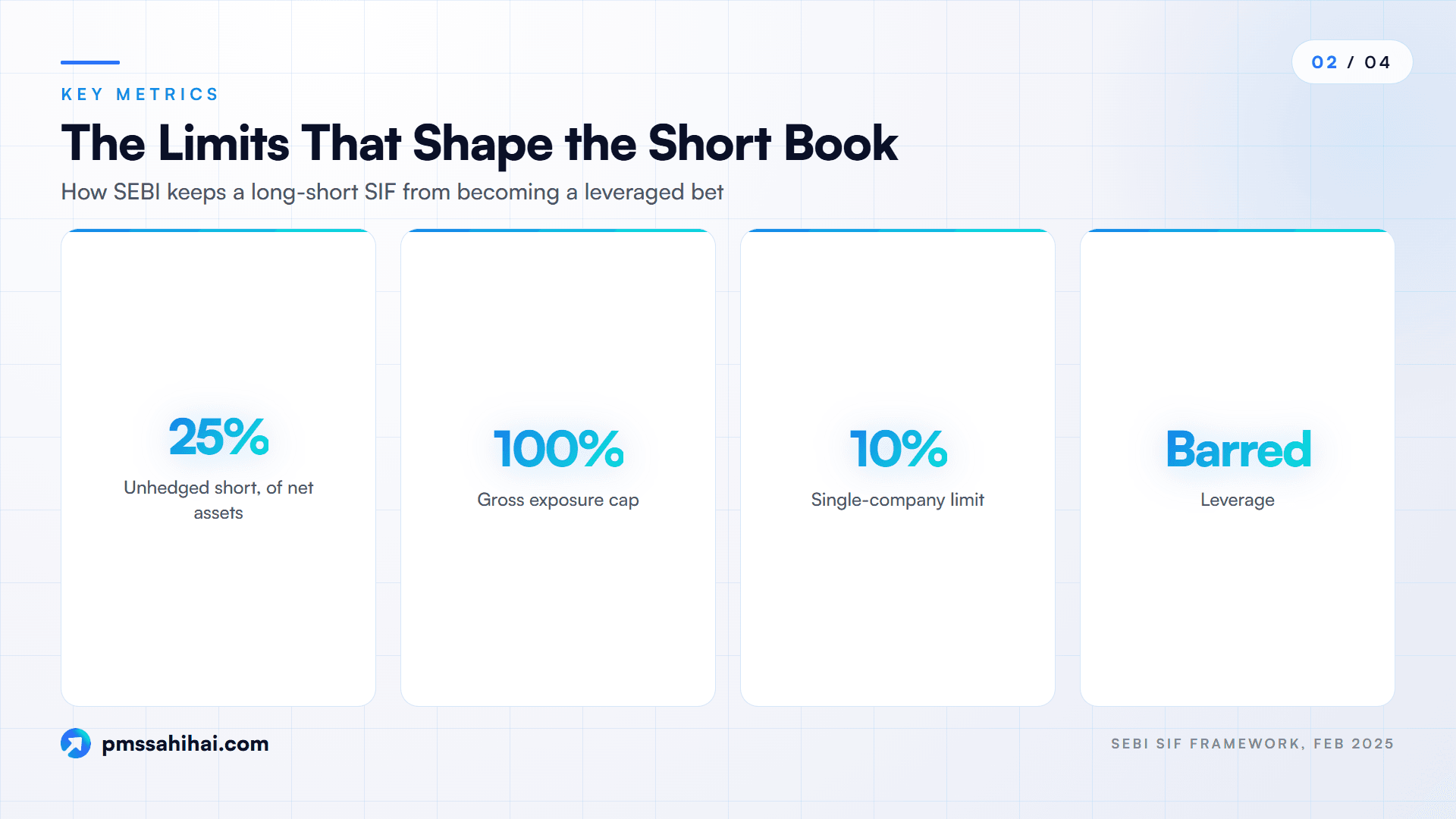
The phrase "25% short" is the most quoted and least explained number in the SIF framework. The exact rule has three parts.
Hedging Positions Versus Unhedged Shorts
SEBI's circular says a SIF strategy may take exposure of up to 25% of net assets in exchange-traded derivatives "specifically for purposes other than hedging and portfolio rebalancing". Its explanation adds that this allows unhedged short exposure of up to 25% of net assets "in addition to derivative exposure undertaken for hedging and portfolio rebalancing purposes".
So there are two buckets:
- The hedging bucket. Derivatives that protect existing holdings. Under the mutual fund definition SEBI applies, a hedging position must reduce possible losses on an existing position, use the same underlying security, and not exceed the quantity of the position it protects. You cannot hedge a derivative position with another derivative.
- The unhedged bucket. Short positions with nothing underneath them, such as shorting futures of a stock the fund does not own, or shorting a sector the manager dislikes. This is capped at 25%.
The hedging bucket is what lets a strategy cut market risk on stocks it owns. The unhedged bucket is what lets it express a negative view. One offer document we read describes its non-hedging derivative limits as long positions up to 50% and unhedged shorts up to 25%, with hedged positions permitted up to 100% of net assets.
How SEBI Measures Futures and Options Exposure
The 25% is measured with mutual fund exposure formulas:
| Position | How exposure is counted |
|---|---|
| Futures, long or short | Futures price x lot size x number of contracts |
| Options bought | Premium paid x lot size x number of contracts |
| Options sold | Market price of the underlying x lot size x number of contracts |
| Any other derivative | Notional market value of the contract |
The asymmetry is useful. A bought put option counts only at the premium paid, while a sold option counts at the full value of the underlying.
SEBI's worked example uses a Rs 100 crore strategy and a stock trading at Rs 2,500 with futures at Rs 2,525 and a lot size of 500. The strategy can short at most Rs 10 crore of that one stock's futures, which works out to 79 contracts, because single-stock exposure is capped at 10% of the strategy. Across all stocks together, its unhedged stock futures shorts can reach Rs 25 crore.
Offsetting, the 100% Gross Cap and the 10% Single-Stock Limit
Three more rules shape the short book.
- Gross exposure cap. The total of equity, debt, derivatives and other permitted assets cannot exceed 100% of net assets. SIFs cannot use leverage the way a Category III AIF can.
- Offsetting. Exposures can be netted only between cash and derivative positions on the same underlying, or between derivative positions on the same underlying with the same expiry. SEBI's table shows that a long stock plus a short future on that stock counts as the long stock only. A short future plus a bought put on the same stock does not offset; both count.
- Single-entity limit. A SIF strategy cannot hold more than 10% of its net asset value in the equity of any one company, and SEBI's illustration applies the same 10% ceiling to a single-stock short.
Together these limits stop the short book from turning into a leveraged bet. A long-short SIF is a constrained hedging tool, not an unconstrained hedge fund.
Six Ways an Equity SIF Can Build Its Hedge
The sector rotation strategy's offer document lists six portfolio constructions it may use. The list is a useful map of what any equity long-short strategy can do within the rules:
- Unhedged long-only portfolio. No shorts at all. The fund behaves like an ordinary equity fund.
- Partially hedged long-only portfolio. Part of the long book is protected with index or stock futures or options.
- Fully hedged portfolio. The whole long book is hedged, so market direction matters little and stock or sector selection is everything.
- Unhedged long-short portfolio with a 25% naked short. A long book plus a 25% short book using stock futures or options.
- Partially hedged long-short portfolio with a 25% naked short. Some hedging on the long book plus the 25% short.
- Fully hedged long book plus a 25% naked short. The most defensive construction listed.
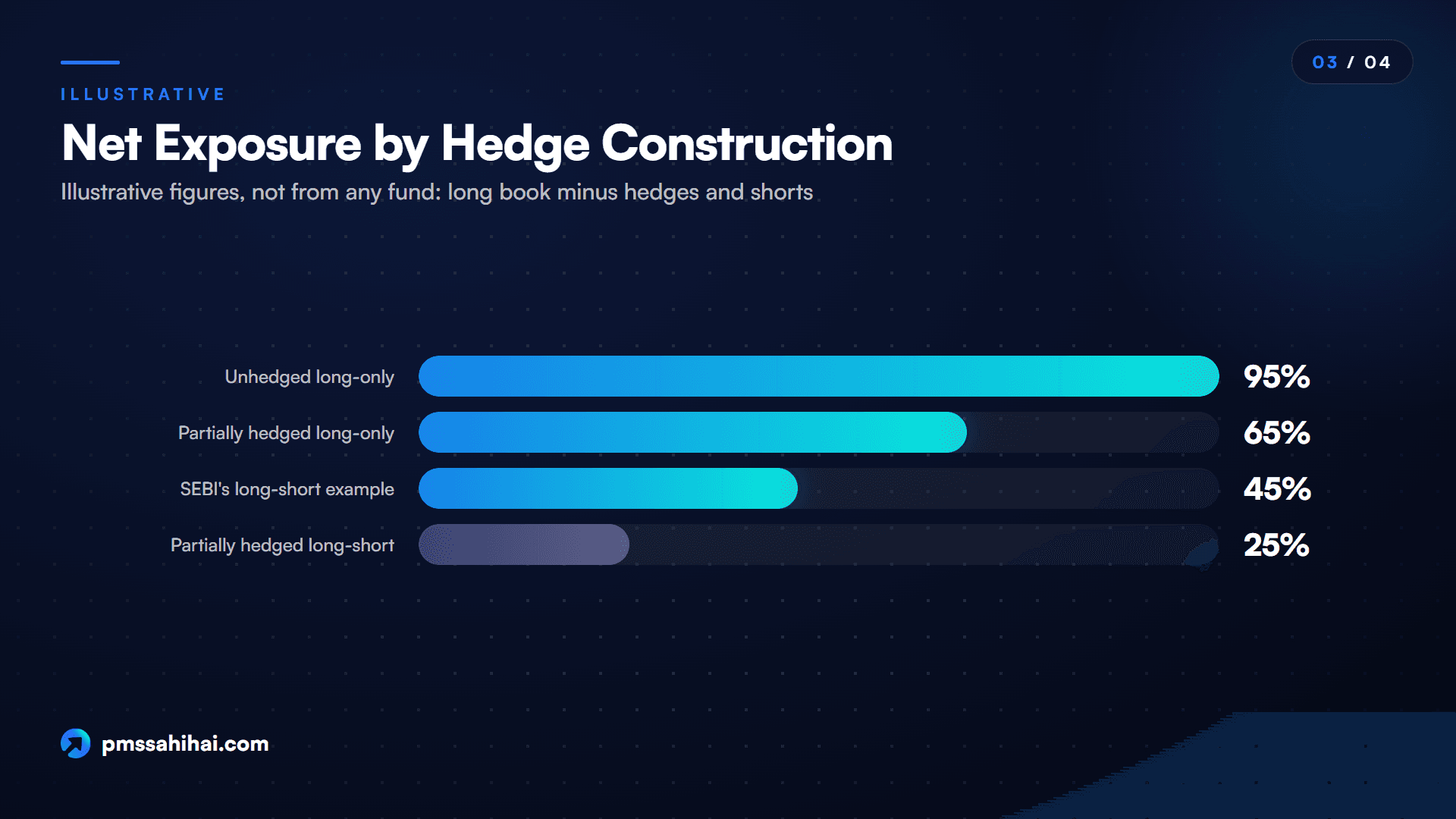
| Construction (illustrative) | Long | Hedge | Unhedged short | Net exposure |
|---|---|---|---|---|
| Unhedged long-only | 95% | 0% | 0% | 95% |
| Partially hedged long-only | 95% | 30% | 0% | 65% |
| SEBI's illustration (long-short) | 70% | 0% | 25% | 45% |
| Partially hedged long-short | 70% | 20% | 25% | 25% |
| Fully hedged long book plus short | 70% | 70% | 25% | Below zero on paper |
The figures are illustrative, not from any fund. The last row matters: because hedging positions sit outside the 25% cap, and the offer document says hedging exposure may be left out of the 100% gross limit, it permits a construction whose net exposure is negative. Whether a manager would ever run it, and whether the strategy's own limits allow it in practice, is a question for the fund house. The point for an investor is simple: the label tells you very little; the net exposure range tells you almost everything.
Reading the Scenario Analysis in a SIF Offer Document
Every SIF strategy must publish an Investment Strategy Information Document, or ISID, and SEBI requires it to include a scenario analysis showing the expected loss to investors from market movements, in a format AMFI prescribes.
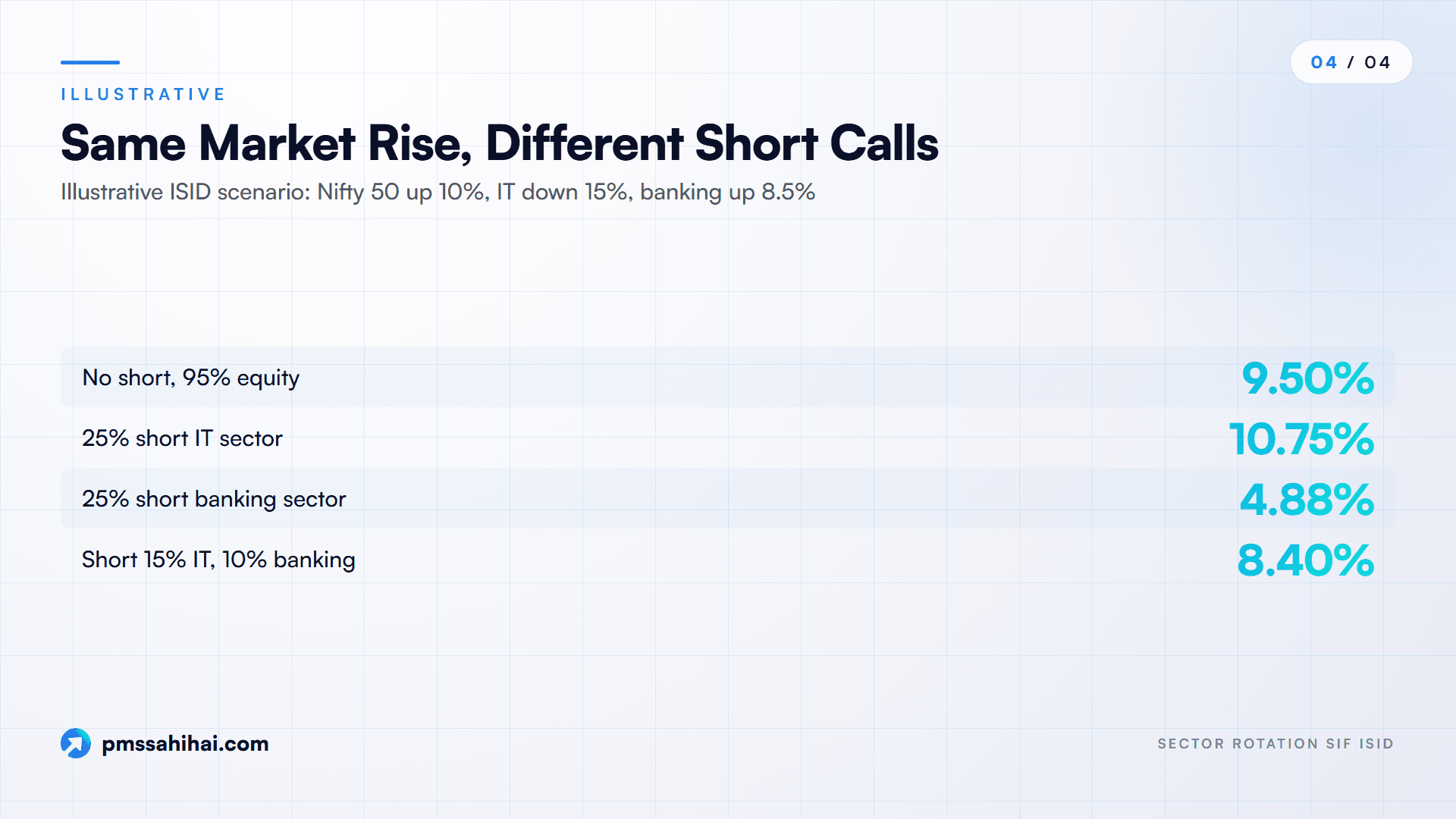
The equity version uses a simple setup: a Rs 10 crore strategy, the Nifty 50 rising 10%, the IT sector falling 15% and the banking sector rising 8.5%. Here is what the sector rotation ISID shows for a 10% market rise:
| Scenario | Portfolio | Return when Nifty rises 10% |
|---|---|---|
| 1 | 95% equity, 5% cash, no short | 9.50% |
| 2 | 70% equity, 25% short IT sector, 5% cash | 10.75% |
| 3 | 70% equity, 25% short banking sector, 5% cash | 4.88% |
| 4 | 70% equity, 15% short IT and 10% short banking, 5% cash | 8.40% |
The lesson is in the gap between scenarios 2 and 3. With the same long book, a correct sector short added 1.25 percentage points over the unhedged fund, even with less money in shares. A wrong sector short cost 4.62 percentage points. The short book is a source of return and a source of risk. It does not simply reduce risk.
When you read an ISID, look for three things alongside the scenario table: the stated range for unhedged short exposure, the list of permitted derivative strategies, and the risk band, which SIFs assign on a five-level scale and must re-evaluate every month. The scenario requirement itself is set out in the SIF framework's disclosure rules.
How Equity Hedging Reached Indian Mutual Fund Houses
Long-short investing is old. The approach of buying expected winners while shorting expected losers is credited to Alfred Winslow Jones, who created the first hedge fund structure in 1949. In its purest form, the long/short equity approach pairs a long and a short in similar companies so that broad market moves roughly cancel out. In India it lived for years inside Category III AIFs, which are open only to investors with Rs 1 crore.
| Date | Milestone |
|---|---|
| 16 Dec 2024 | SEBI amends the Mutual Funds Regulations to create Specialised Investment Funds |
| 27 Feb 2025 | SEBI issues the SIF framework, including three equity long-short categories |
| 1 Apr 2025 | Framework comes into force |
| 22 Jul 2025 | Business Standard reports at least 10 fund houses preparing long-short equity SIFs |
| 29 Jul 2025 | SEBI sets out how active breaches of the Rs 10 lakh minimum are handled |
| 20 Mar 2026 | SEBI's Master Circular for Mutual Funds consolidates SIF rules in Chapter 21 |
| 1 Apr 2026 | SEBI (Mutual Funds) Regulations, 2026 apply |
| 15 May 2026 | First sector rotation long-short strategy is allotted |
| 30 Sep 2026 | 20 equity SIF strategies manage Rs 11,873.81 crore |
To launch a SIF, a fund house must either have run a mutual fund for three years with average assets of at least Rs 10,000 crore, or appoint a SIF chief investment officer with at least 10 years of fund management and Rs 5,000 crore of average assets managed, plus a second fund manager. Either way, it must have a clean regulatory record for three years.
Technology and Disclosure Behind Equity Long-Short SIFs
A long-short SIF depends on market plumbing that did not exist when hedge funds began.
- Exchange-traded derivatives. Every short is a stock or index future or option, margined and marked to market daily. Losses on a short are paid in cash the same day.
- Real-time exposure tracking. Because exposure is calculated from live futures prices and lot sizes, the 25% and 100% limits move with the market and must be monitored continuously.
- Daily minimum-investment monitoring. AMFI coordinates exchanges, depositories and registrars to check the Rs 10 lakh threshold every day at PAN level. If an investor's own redemption or transfer pushes the total below it, the units are frozen and the investor gets 30 calendar days to fix it, after which the units are redeemed. A fall caused by NAV movement is a passive breach and is not a violation.
- Public disclosure. Each strategy publishes its full portfolio, including derivatives, every alternate month as a downloadable spreadsheet on the AMC and AMFI websites, and a daily NAV.
Advantages of Equity Hedging Through a Long-Short SIF
Used for the right purpose, an equity long-short strategy offers something a long-only fund cannot.
- Hedged equity at a lower ticket. Rs 10 lakh buys access to a strategy that can short, against Rs 1 crore for a Category III AIF.
- A rule-bound short book. The 25% unhedged cap, the 10% single-company limit and the 100% gross cap put hard limits on how far a manager can go.
- Daily liquidity in open-ended strategies. Most equity strategies offer daily subscriptions and redemptions, although exit loads apply in the early months.
- Transparency before you invest. The ISID, the scenario analysis and the alternate-month portfolio are public.
- A choice of three flavours. All-cap hedging, mid and small cap hedging, or sector calls.
- Profit from negative views. A long-only manager can express a dislike only by not owning a stock. A long-short manager can earn from it.
How PMS Sahi Hai Helps You Read the Fine Print of Long-Short SIFs
An equity long-short SIF is rarely the only way to get what you want. The same Rs 10 lakh or more could go into a long-only mid and small cap PMS, and at Rs 1 crore a Category III AIF can run a far more hedged book. The useful question is whether the SIF wrapper beats the alternatives for your goal.
PMS Sahi Hai is built for that comparison, with one limit to state first: SIFs are mutual fund products, and the platform's comparison shelf covers PMS, AIF and GIFT City strategies. It does not list or score SIFs, so for the SIF itself your primary sources stay the ISID, the alternate-month portfolio and AMFI data.
- Set the hedged AIF beside the SIF. The AIF comparison page lists Category I, II and III funds with strategy, vintage, lock-in and a Nyra score, so you can see what a long-short Category III fund offers that a 25% short cannot, and at what ticket. Our guide to Category III AIF taxation shows why the post-tax maths often favours the SIF.
- Set the unhedged PMS beside it too. The PMS listing can be filtered by category and benchmark, which helps if you are weighing an ex-top-100 long-short SIF against a long-only mid and small cap PMS.
- Ask Nyra the rule questions. Nyra, the platform's AI research analyst, is described as grounded in SEBI, AMC and IFSCA primary sources, citing its working and declining when it has no verifiable source. Ask it how hedging exposure is defined or how sold options count. It is an analytical tool, not a SEBI-registered Investment Adviser.
- Respect the track-record bar. Nyra's scoring methodology treats strategies with under 12 months of history as "Not Rated", a useful reminder that no sector rotation SIF has a year of history yet.
For the wrapper-level comparison, read our guide to long-short funds across AIFs and SIFs and the SIF vs PMS comparison.
Limitations and Risks of Equity Long-Short SIFs
The limitations are structural and should be weighed before the advantages.
- It cannot be market neutral in the classic sense. With an 80% or 65% equity floor and a 25% unhedged cap, most strategies will run meaningfully net long. If you want a genuinely market-neutral book, the SIF rules make that hard.
- Short losses have no ceiling. A stock you own can fall at most 100%. A stock you are short can keep rising.
- The short book can be wrong. As the scenario table shows, a bad sector short can wipe out most of a market rally.
- The shortable universe is limited. SEBI's short-selling framework bars naked short selling, so funds short through derivatives, and only stocks on the exchange's list of derivative underlyings can be shorted that way, which particularly narrows the short side of an ex-top-100 strategy.
- Sector rotation is concentrated. Four sectors and an all-or-nothing short per sector mean wide swings around the benchmark.
- Thin track records. The first SIF strategy opened in September 2025, and the only sector rotation strategy was allotted in May 2026.
- Costs and exit loads. Expense ratios and exit loads vary by strategy; check the ISID and the current factsheet rather than relying on launch-time articles.
- Tax is not automatic. Equity SIF strategies are taxed under mutual fund rules, but whether a strategy counts as equity-oriented depends on its actual portfolio. Consult a tax adviser before relying on equity treatment.
Choosing Between the Three Equity Long-Short SIF Types
Use the categories as answers to different questions.
- "I want my core equity to fall less." An equity long-short fund is the natural fit. It can use broad index futures and large-cap stock futures to hedge.
- "I want mid and small cap exposure with a seatbelt." The ex-top-100 category targets this, but remember the seatbelt is narrower because the unhedged short must be in non-large-cap stocks.
- "I want to back a manager's sector calls." Sector rotation is the only category built for that, and the most concentrated.
Then ask the fund house five questions:
- What is the target range for net exposure, and what has the average been since launch?
- How much of the short book is hedging and how much is unhedged?
- Which instruments are used for each: index futures, stock futures or options?
- What does the scenario analysis show, and what was the worst month so far?
- What are the actual expense ratio and current exit load for the plan I would buy?
If the answers are vague, treat that as a warning about the strategy.
Long-Short SIFs as a Hedged Equity Satellite: The Verdict
A long-short SIF is best understood as an equity fund with a regulated hedging toolkit. SEBI's three equity categories give you a choice of universe (all-cap, beyond the top 100, or four sectors), but the same core limits: a 25% unhedged short, a 100% gross cap and a 10% single-company ceiling. Within those limits, the manager's net exposure and short-book skill decide the outcome far more than the category name.
Treat these strategies as a satellite next to your core equity, sized so that a wrong short call does not hurt your plan. Read the ISID, insist on a net exposure answer, and give the strategy a full market cycle before judging it. Comparing it against a long-short AIF or a long-only PMS on PMS Sahi Hai, and asking Nyra the rule questions, will tell you whether the SIF wrapper is the right home for the money.
Read the ISID, Then Compare Your Options With Nyra
A hedged equity product is easy to buy and hard to judge. Before you sign the form, download the ISID of each strategy you are considering, read the asset allocation table and the scenario analysis, and write down the net exposure range in one sentence. If you cannot, ask the fund house until you can.
Then compare the strategy with what you already own and with the alternatives:
- Check whether a hedged satellite would simply duplicate your existing holdings, using our guide to portfolio overlap.
- Line up long-short Category III funds on the PMS Sahi Hai AIF comparison page and long-only strategies on the PMS listing.
- Ask Nyra to check the SEBI rule behind any feature you do not understand, with the source shown.
- Book a conversation with the PMS Sahi Hai team if you want a second pair of eyes before you sign.
This article is for information only and is not investment advice. Rules and figures are as of 27 October 2026. SIF strategies use derivatives and can lose capital. Read the offer documents and consult a SEBI-registered adviser and a tax adviser before investing.
PMS Sahi Hai is a distributor of Portfolio Management Services and Alternative Investment Funds, APMI-registered (Registration No. APRN08358). This article is for education only and is not investment advice, a recommendation, or an offer to buy or sell any security. Investments in securities markets are subject to market risks; read all scheme-related documents carefully. Past performance is not indicative of future results. Consult your advisor before investing.
Ishaan founded PMS Sahi Hai to make India's PMS, AIF and GIFT City markets legible to serious investors, comparing every SEBI-registered manager on the same comparative basis, with no shelf products and no commission bias.
Frequently asked
What is a long-short SIF in simple terms?
A long-short SIF is a strategy offered under SEBI's Specialised Investment Fund rules that buys stocks the manager expects to rise and uses exchange-traded derivatives to bet against stocks or sectors expected to fall. In the three equity categories, at least 65% or 80% stays in equity, and unhedged short exposure is capped at 25% of net assets.
How much can an equity long-short SIF short?
An equity SIF strategy can take unhedged short exposure of up to 25% of net assets through exchange-traded derivatives. This is in addition to derivatives used purely to hedge existing holdings or rebalance. Total gross exposure across all assets cannot exceed 100% of net assets, and SEBI's illustration caps a single-stock short at 10%.
What is the difference between an equity long-short fund and an ex-top 100 long-short fund?
An equity long-short fund must hold at least 80% in equity of any size. An ex-top 100 long-short fund must hold at least 65% in companies outside the 100 largest by market capitalisation, so it is mainly mid and small cap, and its unhedged short exposure must be in stocks other than large caps.
What does the sector-level short rule mean in a sector rotation long-short fund?
It means a sector rotation strategy takes one view per sector. If it shorts a sector, every stock from that sector in the portfolio must be held as a short position. It cannot own one company and short a rival in the same sector, and the total short exposure must stay within 25% of net assets.
Can a long-short SIF be market neutral?
Not in the usual sense. Equity long-short SIFs must keep at least 65% or 80% in equity and can add only 25% of unhedged shorts, so most run net long. Derivatives used for hedging sit outside the 25% limit, so exposure can be cut further, but a fully market-neutral book is far easier in a Category III AIF.
Is a long-short SIF safer than an equity mutual fund?
Not automatically. A well-run short book can reduce losses in a falling market, but a wrong short can cost money even when the market rises. The AMFI scenario format shows a wrong 25% sector short cutting a 9.50% gain to 4.88%. Safety depends on net exposure and the manager's skill.
What is the minimum investment in an equity long-short SIF?
The minimum is Rs 10 lakh per investor, counted at PAN level across all strategies of the same SIF. Accredited investors are exempt. If your own redemptions take you below the threshold, your units are frozen and you get 30 days to restore it before they are redeemed.
Where can I find a SIF strategy's net exposure and holdings?
Start with the Investment Strategy Information Document on the SIF's website or AMFI's SIF section, which states the asset allocation, derivative limits and scenario analysis. Each strategy also publishes its full portfolio, including derivatives, every alternate month. For current net exposure, ask the fund house for its latest factsheet.
Keep reading
All articles
What Is a Long-Only Fund? Why Most Equity PMS and AIFs Never Short
What a long-only fund is, the SEBI rules that keep PMS and Category I/II AIFs from shorting, who can short, and what changes for PMS in April 2027.

What Is Smart Beta? Rule-Based Indexing for Indian Investors
How smart beta indices are built, what equal-weight, low-volatility and momentum funds cost in India, and the SEBI rules on tracking error.
HUF Advantages and Disadvantages: Is a Family PAN Still Worth It?
HUF advantages and disadvantages under the Income-tax Act, 2025: separate slabs, no rebate, clubbing, daughters' rights, partition and exit.
Read it. Now pressure-test it.
Ask Nyra how this applies to your portfolio, or talk to our team, no pitch, no pressure.