
What Is a Long-Only Fund? Why Most Equity PMS and AIFs Never Short
What a long-only fund is, the SEBI rules that keep PMS and Category I/II AIFs from shorting, who can short, and what changes for PMS in April 2027.

A long-only fund buys securities and profits only when they rise; it never sells borrowed shares to bet on a fall. Almost every equity PMS and every Category I and II AIF in India works this way, partly by design and partly because SEBI's rules leave little room for anything else: a portfolio manager may not borrow money or shares for clients, derivative exposure is framed around hedging and capped at the client's own money, and Category I and II AIFs are barred from leverage. Only Category III AIFs (and, in a narrow way, SIFs) are built to short. That changes slightly for PMS from 1 April 2027, when new regulations allow more derivative use, though SEBI has yet to publish the limits.
Why the Long-Only Question Matters to PMS and AIF Investors
When markets fall, many investors in a portfolio management service ask the same question: why did my manager not protect me? The manager is a professional, charges a fee for active management and often talks about "risk management". Surely a professional can see a fall coming and bet against it?
In most cases the answer is no, and not because the manager lacks a view. Most equity PMS strategies and almost all Category I and II AIFs are long-only by structure. They can sell what they own, hold cash or rotate into defensive stocks. What they generally cannot do is take a position that gains when a share price falls.
That one design choice shapes everything an investor experiences: how much a portfolio drops in a crash, how fees compare, how tax works, and which wrapper you need if you genuinely want a hedge. It also explains why products such as long-short Category III AIFs and Specialised Investment Funds exist at all.
This guide explains what a long-only fund is, where the idea came from, the SEBI rules that keep PMS and Category I and II AIFs long-only, the practical economics that keep even unconstrained managers long-only, and what the PMS Regulations 2026 change from April 2027. It is not about how a long-short fund runs its book or which one to buy; those questions are covered in our guide to long-short funds in India.
What Is a Long-Only Fund? The Definition in Plain Terms
A long-only fund is a fund that holds only "long" positions. It buys shares, bonds or units, and it makes money when their prices go up and when they pay dividends or interest. It does not hold "short" positions, which are bets that a price will fall, usually made by selling a borrowed security or selling a futures contract.
The QuotedData glossary calls this a "traditional long only" strategy. Most mutual funds, index funds, ETFs and portfolio management strategies in India follow it, and globally the mutual fund was long-only for most of its history until 130/30-style funds added limited shorting.
How a long-only manager expresses a negative view
A long-only manager still forms negative opinions. The difference is in what they can do about them. If a manager dislikes a stock, the options are to not own it, or to own less of it than the benchmark does (an "underweight").
That creates an asymmetry. Suppose a stock is 2% of the Nifty 50 and the manager thinks it will halve. The most the manager can do is hold zero, a 2% underweight. A manager who likes a stock can hold 8% or 10% of the portfolio. A long-only strategy can act fully on optimism but only partially on pessimism.
Long-only, long-biased and long-short compared
The labels in the market are not always precise, so it helps to think in terms of net exposure: long positions minus short positions, as a share of the money invested.
| Style | Typical net equity exposure | Can it gain from a falling stock? | Typical Indian wrapper |
|---|---|---|---|
| Long-only | 0% to 100% (cash reduces it) | No | Equity PMS, equity mutual fund, Category I/II AIF, many Category III AIFs |
| Long-biased / 130/30 | Close to 100%, with some shorts | Yes, on part of the book | Some Category III AIFs; SIF strategies |
| Long-short | Anywhere from about 0% to 100% | Yes | Category III AIFs; equity long-short SIFs |
| Market-neutral | Close to 0% | Yes | Some Category III AIFs; arbitrage strategies |
A long-only fund can also use derivatives. Buying a put option or selling index futures against the portfolio is a hedge, not a standalone short bet. Whether that is allowed, and how much of it, depends on the wrapper.
How Long-Only Investing Became the Default in India
Long-only investing became the norm for simple reasons. Owning shares is how investors share in company growth, it is easy to explain, and the most an investor can lose is what they put in. Shorting needs borrowed shares, margin, daily cash settlement and a tolerance for losses that can exceed the original stake.
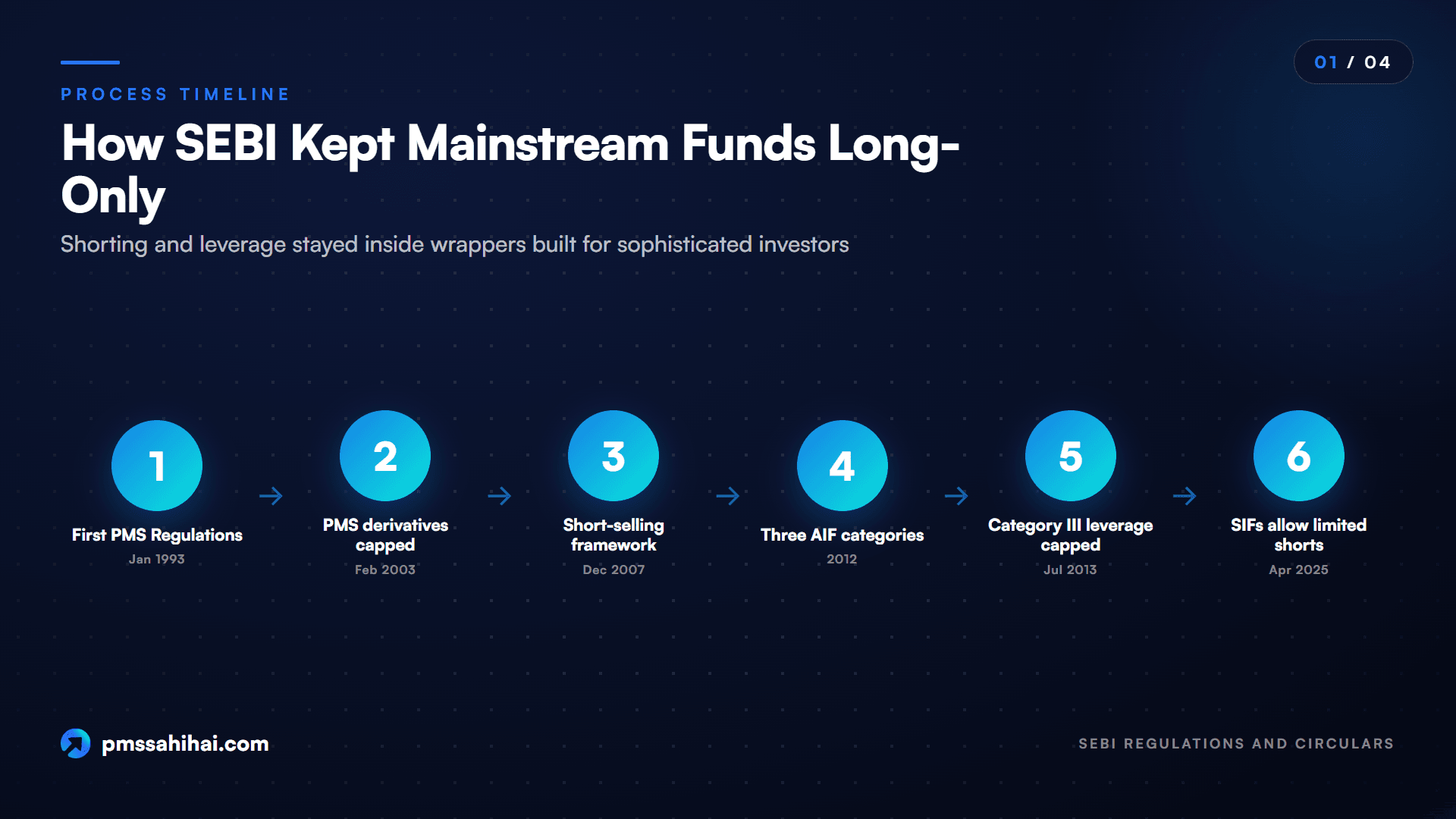
In India, regulation reinforced that habit at almost every step.
| Date | Milestone |
|---|---|
| 7 January 1993 | First SEBI Portfolio Managers Regulations notified |
| 31 December 2002 | SEBI clarifies "hedging and portfolio rebalancing" for mutual fund derivatives use |
| 5 February 2003 | SEBI permits portfolio managers to use exchange-traded derivatives, with exposure capped at the client's funds |
| 20 December 2007 | Short-selling framework issued: all investors may short, naked shorting barred |
| 2012 | AIF Regulations create three categories; only Category III may use leverage |
| 29 July 2013 | Category III leverage capped at two times NAV |
| 2020 | New PMS Regulations replace the 1993 rules; borrowing and leverage bans carried forward |
| 5 January 2024 | Short-selling framework restated |
| 1 April 2025 | SIF framework takes effect, allowing limited unhedged shorts in a mutual-fund-style wrapper |
| 16 July 2025 | Consolidated PMS Master Circular |
| 23 July 2026 | SEBI consults on a full PMS rewrite, including unhedged shorts |
| 7 October 2026 | PMS Regulations 2026 notified, in force from 1 April 2027 |
The pattern is consistent. SEBI has kept shorting and leverage inside specific wrappers built for sophisticated investors, with consent and reporting attached, and kept the mainstream wrappers long-only.
Why Most PMS Strategies Are Long-Only Under SEBI Rules
A portfolio management service is not a pooled fund. Each client has their own demat account, the manager trades in that account, and the client legally owns the securities. That structure is the root of why a long-only PMS is the norm. Three sets of rules in the PMS Regulations 2020 and the PMS Master Circular do most of the work.
No borrowing of money or shares for clients
Regulation 23(8) of the PMS Regulations 2020 says a portfolio manager "shall not borrow funds or securities on behalf of the client." The same wording is carried into the 2026 Regulations.
The second half of that sentence matters most. The classic way to short a share is to borrow it and sell it, hoping to buy it back cheaper. A manager who cannot borrow securities for a client cannot do that kind of cash-market short in a PMS account. A manager who cannot borrow money cannot lever up either.
Regulation 24(7) adds that the manager "shall not leverage the portfolio of its clients for investment in derivatives." Regulation 24(11) bars speculative transactions, meaning trades settled other than by delivery, with an exception only for derivatives.
The rules do allow the reverse trade. Under regulation 24(16) a manager may lend a client's shares through securities lending, with the client's written authorisation. A PMS can earn a fee by lending shares to short sellers; it cannot be the short seller by borrowing them.
Derivatives framed around hedging and rebalancing
PMS managers can trade futures and options, but within tight terms. The PMS Master Circular of 16 July 2025 says portfolio managers may invest in derivatives "including transactions for the purpose of hedging and portfolio rebalancing, through recognized stock exchanges." The client agreement must spell out the quantum, type and purpose of derivative use.
The key limit is in paragraph 3.2.3: total derivative exposure "should not exceed his portfolio funds placed with the Portfolio Manager", and the manager "should, in essence, invest and not borrow" on the client's behalf.
In practice, PMS managers use derivatives for hedging: selling index futures against a portfolio, buying puts, or using futures briefly while moving money between stocks. SEBI's own consultation paper of July 2026 treated "unhedged short exposure" in PMS as a new permission it was proposing. That is a fair reading of where the line has sat in practice: hedges yes, standalone bets on falls no.
Your liability stops at what you invest
The model client agreement in the PMS Regulations includes a clause restricting the client's liability "to the extent of his investment."
This is our reading rather than a SEBI statement, but it fits the long-only design. A short position has no natural loss limit. If a shorted stock doubles, the loss equals the full position, and it can keep rising. A product promising that a client cannot lose more than they invested sits awkwardly with open-ended short bets made with that client's money.
Why Category I and II AIFs Cannot Short Either
Alternative Investment Funds are pooled vehicles with a ₹1 crore minimum, so one might expect more freedom. For Categories I and II, the opposite is true. They are designed to invest patiently in businesses, not to trade, and the AIF Regulations make a long-only AIF the only practical design.
The leverage ban and its narrow exception
Category I covers venture capital, angel, social impact and infrastructure funds; Category II covers private equity, private credit and most real estate funds. Regulation 2(1)(b) of the AIF Regulations defines Category II as a fund that "does not undertake leverage or borrowing" other than as permitted.
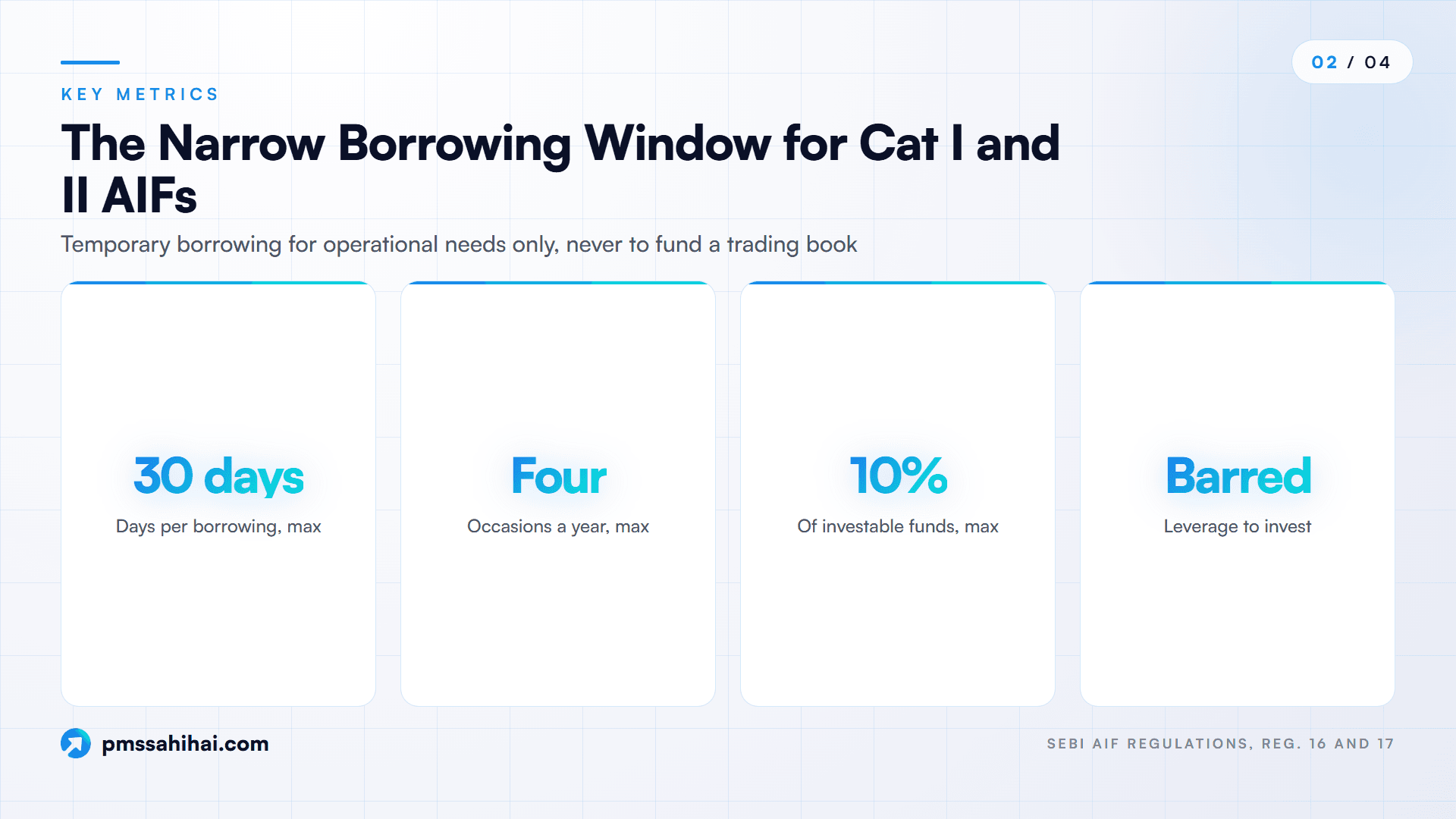
Regulations 16(1)(c) and 17(c) then say that Category I and II AIFs "shall not borrow funds directly or indirectly or engage in any leverage for the purpose of making investments or otherwise." The only exception is borrowing to meet temporary funding and day-to-day operational needs, for no more than 30 days, on no more than four occasions a year, and for no more than 10% of investable funds.
That exception exists to bridge gaps, for example when a deal closes before an investor's drawdown arrives. It cannot finance a trading book.
Hedging is allowed, directional bets are not the design
The regulations do allow hedging. Regulation 16(1)(aa) lets Category I funds "engage in hedging, including credit default swaps", and regulation 17(d) lets Category II funds hedge subject to SEBI guidelines. The AIF Master Circular adds that Category I and II AIFs may buy credit default swaps on their debt holdings "only for the purpose of hedging."
Category II funds also invest primarily in unlisted securities and lower-rated listed debt. Most of what they own has no futures contract to sell and no lending market to borrow from. A private equity fund that wanted to short could not find much to short, and the rules discourage it from trying.
Category III AIFs: The Only AIF Wrapper Built to Short
Category III is where SEBI put the trading strategies. Regulation 2(1)(c) defines a Category III AIF as a fund that "employs diverse or complex trading strategies and may employ leverage including through investment in listed or unlisted derivatives." The Explanation names hedge funds.
Regulation 18(a) lets these funds invest in listed or unlisted securities, derivatives and structured products, and regulation 18(c) lets them use leverage or borrow, with investors' consent and within a SEBI limit.
How the 2x NAV cap counts shorts
The AIF Master Circular (issued 3 June 2026, updated 7 September 2026) defines leverage as total exposure, longs plus shorts after permitted offsetting, divided by NAV. A Category III AIF's leverage "shall not exceed 2 times of the NAV." On a ₹100 crore fund, exposure can go up to ₹200 crore.
The circular treats a short sale through the securities lending and borrowing mechanism as short exposure, and a long put option as short exposure. Shorts are not a loophole; they count against the same cap.
Why many Category III funds still run long-only
Being allowed to short is not the same as shorting, and a long-only AIF in Category III is more common than many investors assume. A 2025 analysis by NISM authors found that at 31 March 2024 only 258 of 1,283 registered AIFs were Category III, and described most of them as long-biased. Many Category III funds are concentrated long-only equity portfolios that chose the AIF wrapper for pooling, flexibility on position sizes or the ability to hold some unlisted names.
That choice has a cost. A Category III AIF is taxed inside the trust, while a PMS client is taxed directly as the owner of the shares; our comparison of AIF vs PMS taxation sets out the difference. For a strategy that never shorts, investors should ask what the Category III wrapper adds. For long-short and hedged designs, the wrapper is essential; for long-only ones, it is a choice to examine.
A sibling route arrived in 2025. SEBI's Specialised Investment Funds let mutual funds run equity long-short strategies with up to 25% unhedged short exposure through derivatives, from a ₹10 lakh minimum.
How Short Selling Actually Works in Indian Markets
Understanding why a long-only fund avoids shorting starts with how short selling works here. SEBI's short-selling framework, restated in a circular dated 5 January 2024, makes five points that matter:
- Short selling means selling a stock you do not own at the time of the trade.
- All classes of investors, retail and institutional, may short sell.
- Naked short selling is not permitted. Every seller must deliver the shares at settlement, so a cash-market short needs borrowed shares.
- Institutional investors may not square off intraday; they must declare a short sale when placing the order.
- Only securities traded in the futures and options segment are eligible for short selling.
There are two practical routes. The first is to borrow shares through securities lending and borrowing and sell them in the cash market. The second, which most funds use, is to sell stock or index futures, or buy put options. Either way, positions are margined and marked to market daily, so a rising stock means cash going out the same day.
The shortable universe is also narrow. Only stocks in the futures and options segment qualify, which leaves out much of the mid-cap and almost all of the small-cap market where many PMS managers look for ideas. SEBI's chairman said in August 2026 that the securities lending and short-selling frameworks are under review to deepen the cash market, but no new rules have been issued.
The Practical Reasons Managers Stay Long-Only
Even where rules allow shorting, most managers choose not to. Six reasons come up repeatedly.
- Markets have historically risen over long periods. A short position fights the long-term upward drift of equities. Investopedia's guide to long-short equity notes that it has historically been harder to find profitable short ideas than long ones.
- Losses are asymmetric. A long position can lose at most 100%. A short can lose more than 100% if the price keeps rising, and it grows as a share of the portfolio exactly when it is going wrong.
- Shorting costs money. As Investopedia's short-selling explainer sets out, borrowed shares carry interest or a lending fee, futures must be rolled each month, and margin ties up cash. These costs are paid whether or not the view proves right.
- The skill is different. Finding a mispriced business to own for five years is not the same as timing a fall. NISM's authors observe that India has yet to develop a strong shorting culture and that most fund managers remain long-biased.
- Most stock ideas are not shortable. If a manager's edge is in mid- and small-caps, the F&O list rules out most of the names they know best.
- Investors buy for growth. Most clients choose an equity PMS to beat an index over years, not to earn bond-like returns with low market exposure. A long-only fund gives them what they asked for.
There is also a tax point. Gains on shares held through a PMS are generally capital gains in the investor's hands. Profits and losses from futures and options are not taxed like share capital gains. A hedging overlay can therefore complicate a client's tax return. Investors should consult a tax adviser before agreeing to derivative use.
What a Long-Only Fund Does Well for Investors
Long-only is not a second-best design. For most investors building wealth over years, it is the right default, for at least six reasons.
- Your loss is capped. You cannot lose more than you invested in a long-only portfolio.
- It captures the equity risk premium. Over long periods, owning businesses has been the main driver of equity wealth. A long-only portfolio keeps you fully exposed to it.
- It is cheaper to run. No borrowing fees, no futures roll and less margin. Fees still matter, but there is no extra cost layer.
- It is transparent. In a PMS you can see every share you own in your own demat account. There is no short book to understand.
- It scales. A long-only portfolio does not depend on how many shares are available to borrow.
- It fits the main wrappers. A long-only strategy works in a PMS, a mutual fund or a Category I or II AIF without leverage consents, extra risk reports or daily exposure limits.
There is also a behavioural benefit. Investors understand what they own. When the market falls, they know why their portfolio fell, and they are less likely to be surprised by a hedge that lost money in a rally.
How PMS Sahi Hai Helps You Read the Inner Clause of a Long-Only Mandate
Whether a strategy is long-only, lightly hedged or genuinely long-short is rarely the headline on a factsheet. It sits in the derivatives clause of a PMS disclosure document or the investment strategy section of an AIF placement memorandum. PMS Sahi Hai is built to get you to that clause faster, and to the right questions once you are there.
- Start with the listing, then read the benchmark. The PMS listing can be filtered by category label and by benchmark, and each strategy page shows trailing returns beside the stated benchmark, from one month to five years and since inception, with the difference shown as alpha. For a long-only PMS, that is the honest test: in the years the index fell, did the strategy fall less, or roughly the same?
- Put AIFs side by side by category. The AIF comparison page lists funds across Category I, II and III and lets you filter by category. That makes it quick to separate the patient, structurally long-only Category I and II funds from the Category III shelf, where you then need to check whether a fund actually shorts or simply uses the wrapper for a long-only strategy.
- Ask Nyra the questions a table cannot answer. Nyra is the platform's AI research assistant. Use it to frame questions such as "What does this manager's agreement allow on derivatives?", "Is this hedge protective or directional?" or "What will change for this strategy after 1 April 2027?" Nyra is an analytical tool, not a SEBI-registered investment adviser.
- Read the score for what it is. Nyra scores strategies across five pillars under a published scoring methodology, and strategies with under 12 months of record show as "Not Rated". A score is backward-looking and does not tell you whether a fund hedges, so use it as a filter, not a verdict.
One limit worth stating plainly: the strategy pages do not show holdings tables, so whether a manager has ever used index futures or puts must come from the disclosure document, the placement memorandum or the manager directly. If you want the hedged side of the market explained, our guides to long-short funds in India and Specialised Investment Funds pick up where this one stops.
Where the Long-Only Model Falls Short in a Downturn
The cost of a long-only design shows up in falling markets. In April 2020, Business Standard reported that the sharp hit to returns from long-only PMS and equity mutual fund products had pushed HNIs to move part of their allocations to long-short strategies.
A hypothetical 20% market fall
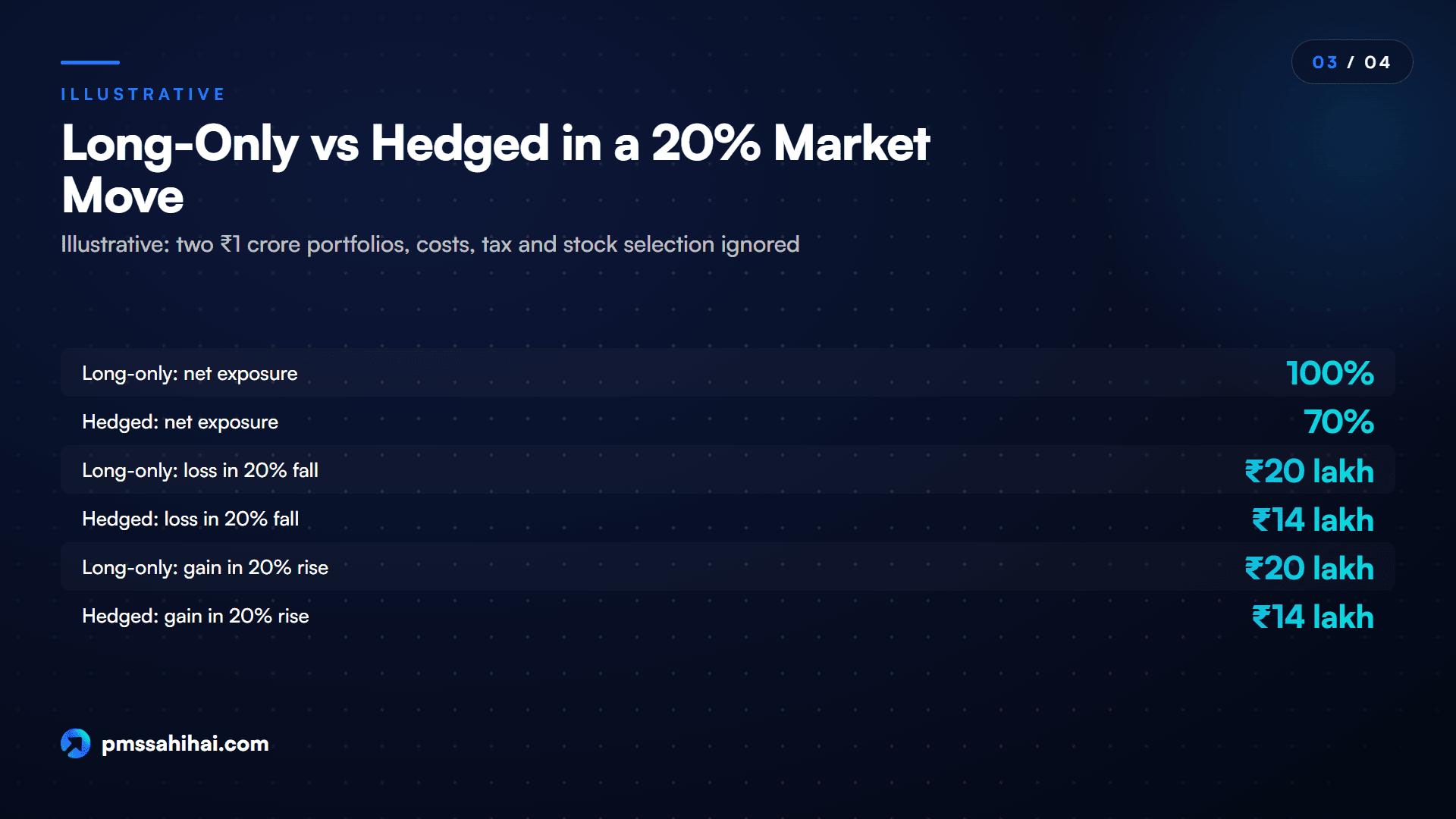
The table below is illustrative only. It assumes two ₹1 crore portfolios whose stocks move exactly with the market, ignores costs and tax, and ignores stock-selection gains or losses.
| Long-only fund | Hedged portfolio (100% long, 30% short via index futures) | |
|---|---|---|
| Net market exposure | 100% | 70% |
| Market falls 20% | Loss of ₹20 lakh | Loss of ₹20 lakh on longs, gain of ₹6 lakh on shorts = net loss of ₹14 lakh |
| Market rises 20% | Gain of ₹20 lakh | Gain of ₹20 lakh on longs, loss of ₹6 lakh on shorts = net gain of ₹14 lakh |
The hedge softens the fall and also gives up part of the rally. A long-short fund is not free downside protection; it is a trade-off, plus the costs of running the short book.
Other limits of the long-only model:
- Limited response to bad news. A manager who expects a sector to fall can sell to zero but cannot gain from the fall.
- Underweight ceiling. The largest bet against a stock equals its weight in the benchmark.
- Concentration amplifies falls. Concentrated long-only portfolios can fall harder than the index in bad years.
- Cash is a blunt tool. Raising cash reduces exposure, but timing it is hard and selling may trigger capital gains tax in a PMS.
What Changes for PMS Derivatives From April 2027
SEBI is loosening the PMS rules, though not as far as it first proposed.
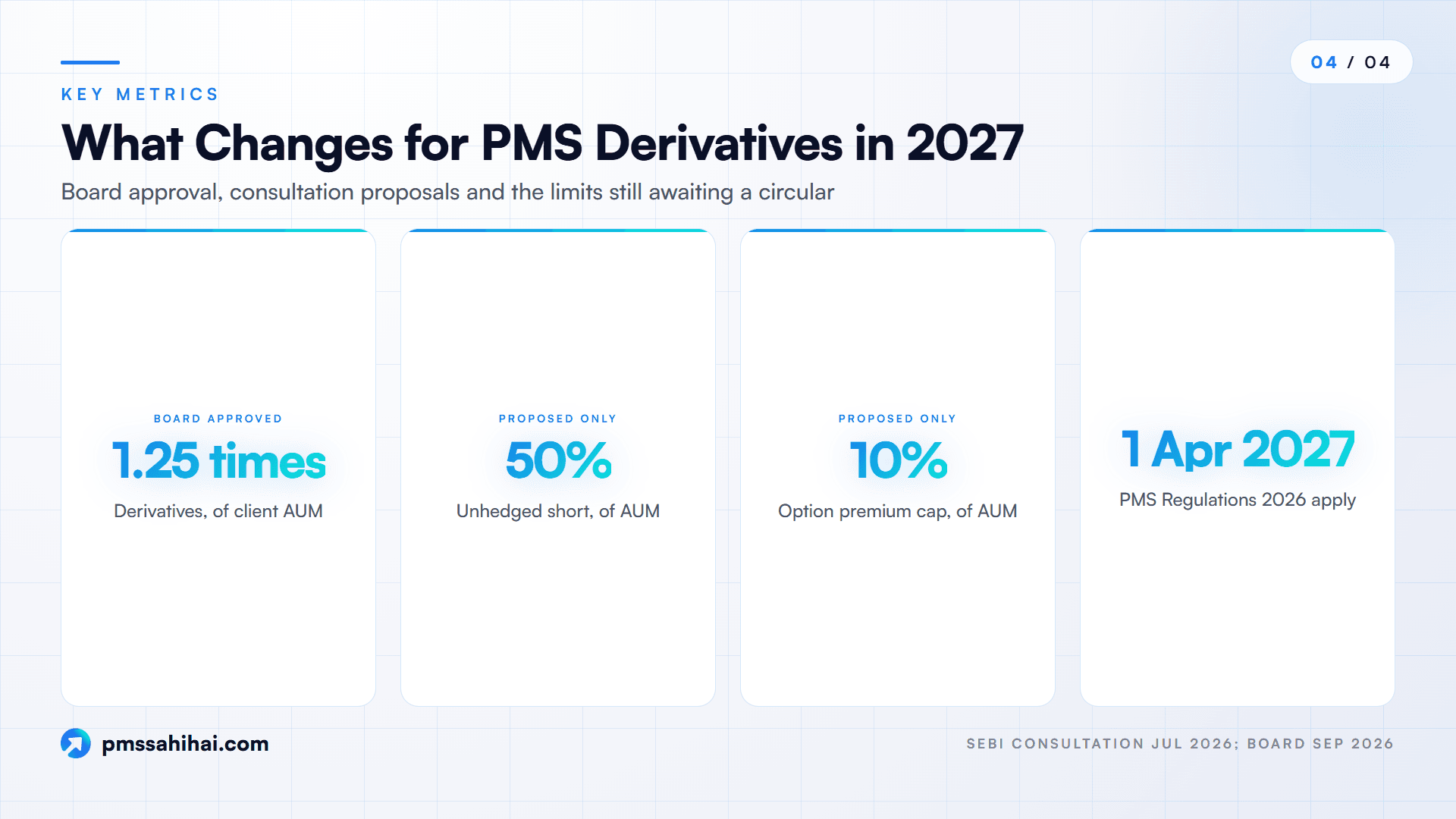
In its consultation paper of 23 July 2026, SEBI proposed that a portfolio manager could take total exposure of up to 1.25 times a client's AUM, including unhedged short exposure through equity exchange-traded derivatives of up to 50% of the client's AUM, in addition to hedging and rebalancing positions. Option premiums paid and received would be capped at 10% of AUM, and clients would have to give explicit consent.
At its meeting on 24 September 2026, SEBI's Board approved "greater flexibility for investment in Exchange traded Derivatives up to 1.25 times of client's AUM." The press release does not mention the 50% unhedged short limit.
The PMS Regulations 2026 were notified on 7 October 2026 and take effect on 1 April 2027. Regulation 17(1)(e) lets a portfolio manager invest in exchange-traded derivatives "subject to limits and conditions as may be specified by the Board." The ban on borrowing funds or securities for clients stays, in regulation 16(12). As of 27 October 2026, SEBI had not issued the circular setting the derivative limits.
What this means in practice:
- Nothing changes before 1 April 2027. The 2020 Regulations and the July 2025 Master Circular apply.
- Any shorting will be through exchange-traded derivatives, because borrowing shares stays barred.
- Expect consent requirements. The consultation proposed explicit positive consent from existing and new clients.
- Most PMS strategies will likely stay long-only. The economic reasons above do not change with a rule change. Some managers may launch hedged or long-short PMS approaches; investors will need to read the disclosure document carefully.
Is a Long-Only Fund Right for Your Portfolio?
For most investors, yes, as the core of an equity allocation. A long-only fund in a PMS, a mutual fund or a Category II AIF gives you direct exposure to business growth, a loss capped at your investment and a structure you can understand.
Three questions decide whether you need something else alongside it:
- Can you sit through a 30% to 40% fall without selling? If not, size your equity allocation down rather than hoping the manager will hedge.
- Do you need lower market exposure with equity-like upside? Then look at hedged wrappers, such as a Category III long-short AIF or an equity long-short SIF, and examine their costs and tax.
- Are you paying for a wrapper you do not use? A long-only strategy inside a Category III AIF, or a hedged label on a portfolio that rarely hedges, deserves a second look.
Diversification across asset classes, sensible equity sizing and patience do more for most portfolios than short selling. If you are weighing a long-only PMS against a hedged alternative, PMS Sahi Hai's comparison tools and Nyra can help you line the options up on the same basis before you commit.
Compare Long-Only PMS and AIF Strategies Before You Invest
Most equity PMS and AIF strategies you will be offered are long-only, and that is usually fine. What matters is knowing it before you invest. Check the disclosure document or placement memorandum for how the manager may use derivatives for hedging, ask what the portfolio did in the last major fall, and compare it with its benchmark. If you want genuine downside protection, look specifically at hedged wrappers and their costs.
On PMS Sahi Hai you can compare PMS strategies against their benchmarks, line up AIFs by category, ask Nyra to explain a derivatives clause in plain English, or talk to the team before you commit. This article is general information, not investment or tax advice; check current SEBI rules and consult a qualified adviser before investing.
PMS Sahi Hai is a distributor of Portfolio Management Services and Alternative Investment Funds, APMI-registered (Registration No. APRN08358). This article is for education only and is not investment advice, a recommendation, or an offer to buy or sell any security. Investments in securities markets are subject to market risks; read all scheme-related documents carefully. Past performance is not indicative of future results. Consult your advisor before investing.
Ishaan founded PMS Sahi Hai to make India's PMS, AIF and GIFT City markets legible to serious investors, comparing every SEBI-registered manager on the same comparative basis, with no shelf products and no commission bias.
Frequently asked
What is a long-only fund in simple terms?
A long-only fund only buys and holds securities, so it makes money when prices rise and from dividends or interest. It never sells borrowed shares or takes a position that gains when a price falls. If the manager dislikes a stock, they simply avoid it or hold less than the benchmark. Most mutual funds, equity PMS strategies and Category I and II AIFs in India are long-only.
Can a PMS short sell stocks in India?
Not in the usual sense. A portfolio manager may not borrow funds or securities for a client, and derivative exposure must stay within the client's own money. Derivatives are used mainly for hedging and rebalancing. The PMS Regulations 2026, effective 1 April 2027, allow more derivative use up to 1.25 times client AUM, but SEBI has not yet published the detailed limits.
Which AIF category can short sell in India?
Category III AIFs are the AIF category built for trading strategies, including short positions through derivatives, with leverage capped at two times NAV. Category I and II AIFs cannot borrow or use leverage except for short-term funding needs, and they may hedge only. Mutual-fund-sponsored SIFs can also hold up to 25% unhedged short exposure through derivatives.
Is long-only better than long-short?
Neither is better in all markets. A long-only fund usually does better in strong rising markets and costs less to run. A long-short fund aims to lose less in falls but gives up part of the upside and adds costs for borrowing, futures rolls and margin. The right choice depends on how much market risk you can hold and on the manager's skill.
Why don't fund managers short stocks more often?
Shorting fights the long-term upward drift of equities, has potentially unlimited losses, costs money to maintain and needs a different skill from stock picking. In India only F&O-eligible stocks can be shorted and naked shorting is banned. Most PMS and Category I and II AIFs are also restricted by SEBI rules, so long-only is the default.
Can a long-only fund use derivatives?
Yes, within its rules. A long-only PMS may use exchange-traded futures and options mainly for hedging and portfolio rebalancing, with total derivative exposure capped at the client's invested funds. Category I and II AIFs may hedge, including through credit default swaps on debt holdings. Using derivatives to hedge does not turn a fund into a long-short fund.
Is naked short selling allowed in India?
No. SEBI's short-selling framework allows all investors to short sell but bans naked short selling. Every seller must deliver shares at settlement, so a cash-market short needs shares borrowed through securities lending. Institutional investors cannot square off intraday and must declare a short sale when placing the order. Only F&O-segment stocks are eligible.
Will PMS strategies become long-short from April 2027?
Some may, but most are likely to stay long-only. The PMS Regulations 2026 permit exchange-traded derivatives up to limits SEBI will specify; the Board approved a total exposure of up to 1.25 times client AUM. The 50% unhedged short limit appeared only in the July 2026 consultation paper, and borrowing securities stays banned.
Keep reading
All articles
What Is a Long-Short SIF? How Equity SIFs Hedge and Short Stocks
How equity long-short SIFs work: the three SEBI strategies, the 25% unhedged short, hedging rules and scenario analysis, explained with 2026 data.

What Is Smart Beta? Rule-Based Indexing for Indian Investors
How smart beta indices are built, what equal-weight, low-volatility and momentum funds cost in India, and the SEBI rules on tracking error.
HUF Advantages and Disadvantages: Is a Family PAN Still Worth It?
HUF advantages and disadvantages under the Income-tax Act, 2025: separate slabs, no rebate, clubbing, daughters' rights, partition and exit.
Read it. Now pressure-test it.
Ask Nyra how this applies to your portfolio, or talk to our team, no pitch, no pressure.