
Key Functions of PoA in Portfolio Management: The Operating View
How a PMS PoA works day to day: trade execution, demat debit, bank mandates, corporate actions and fees, mapped to SEBI rules and limits.


The functions of PoA in portfolio management come down to five jobs: trade execution, demat debit, bank mandate operation, corporate actions, and the payment of PMS fees and charges. Most ranking pages stop at "you sign a PoA", yet the real question is what each power does on an ordinary working day and where SEBI's rules cap it. PoA forms can be worded more widely than the Regulations allow, so read the form next to the rules. Then test each function against your quarterly report. This is general information as of 30 October 2026, not legal or tax advice.
Why the Operating View of a PMS PoA Matters
You sign a PMS power of attorney once. It then works in the background for as long as the account runs: shares are bought on a Tuesday, dividends land on a Thursday, a fee leaves the account at the end of the quarter, and you sign nothing.
This article is about those working days. It assumes you already know what a PoA is and looks at the functions of PoA in portfolio management as an operations manual. For each function it asks three things. What does the wording usually authorise? Who actually carries it out? And where does SEBI draw the line?
Two documents sit behind the answers. The first is the regulatory text: the SEBI (Portfolio Managers) Regulations, 2020, as amended up to 3 September 2025, together with SEBI's Master Circular for Portfolio Managers dated 16 July 2025. The second is the form itself. PMS forms differ between firms, so we use one publicly posted form as a worked reference, the Marcellus Investment Managers PoA uploaded in 2020. It is one firm's document from one date and may have changed since. Yours will differ, and yours is the one that counts.
One oddity is worth knowing at the start. We searched the text of both the 2020 Regulations and the new 2026 Regulations, and the term "power of attorney" does not appear in either. The rules govern what a portfolio manager may do. The PoA is the private instrument through which you hand over the authority to do it. SEBI's Investor Charter still treats it as a routine step: franking and signing the PoA "to make investment decisions on behalf of the investor". So when a form and a rule seem to point in different directions, the rule limits the manager whatever the form says.
How the PMS Power of Attorney Evolved Since 1993
The PoA's operating role has been shaped less by rules about the document and more by rules about the conduct around it. A short timeline shows how each function acquired its limits.
- 1993: SEBI's first Portfolio Managers Regulations set up the regime. The 2020 Regulations later repealed them.
- 28 June 2006: SEBI noticed agreements and PoAs saying the manager's decision was "absolute and final" and could never be questioned. It told managers to change that wording, adding "in good faith" and exceptions for malafide, fraud, conflict of interest and gross negligence.
- 23 June 2009: SEBI set conditions for keeping client money in a single bank account run by the manager, including client-wise records and daily reconciliation.
- 5 October 2010: A circular brought more uniformity to fees and charges in client agreements.
- 16 January 2020: The current Regulations were notified. A circular of 13 February 2020 followed with direct on-boarding and fee rules, including no upfront fees.
- 30 September 2022: SEBI required written policies on order placement and trade allocation, and a dedicated dealing team.
- 2 May 2024: A circular addressed digital on-boarding and fee transparency.
- 16 July 2025: The current Master Circular consolidated these rules.
- 7 October 2026: SEBI notified the Portfolio Managers Regulations, 2026, which take effect on 1 April 2027. Until then, the 2020 Regulations and the Master Circular apply.
The 2026 text carries forward the operating duties this article relies on. Regulation 16 keeps the fiduciary duty, segregated holdings, the separate bank account, the ban on borrowing for clients, the limits on off-market transfers and pro rata allocation. Regulation numbers below refer to the 2020 Regulations, which are in force today.
The Function Map of a PMS Power of Attorney
Before going function by function, here is the whole picture. The clause numbers refer to the Marcellus form, as an example.
| Function | Example wording | Who carries it out | SEBI's main limit |
|---|---|---|---|
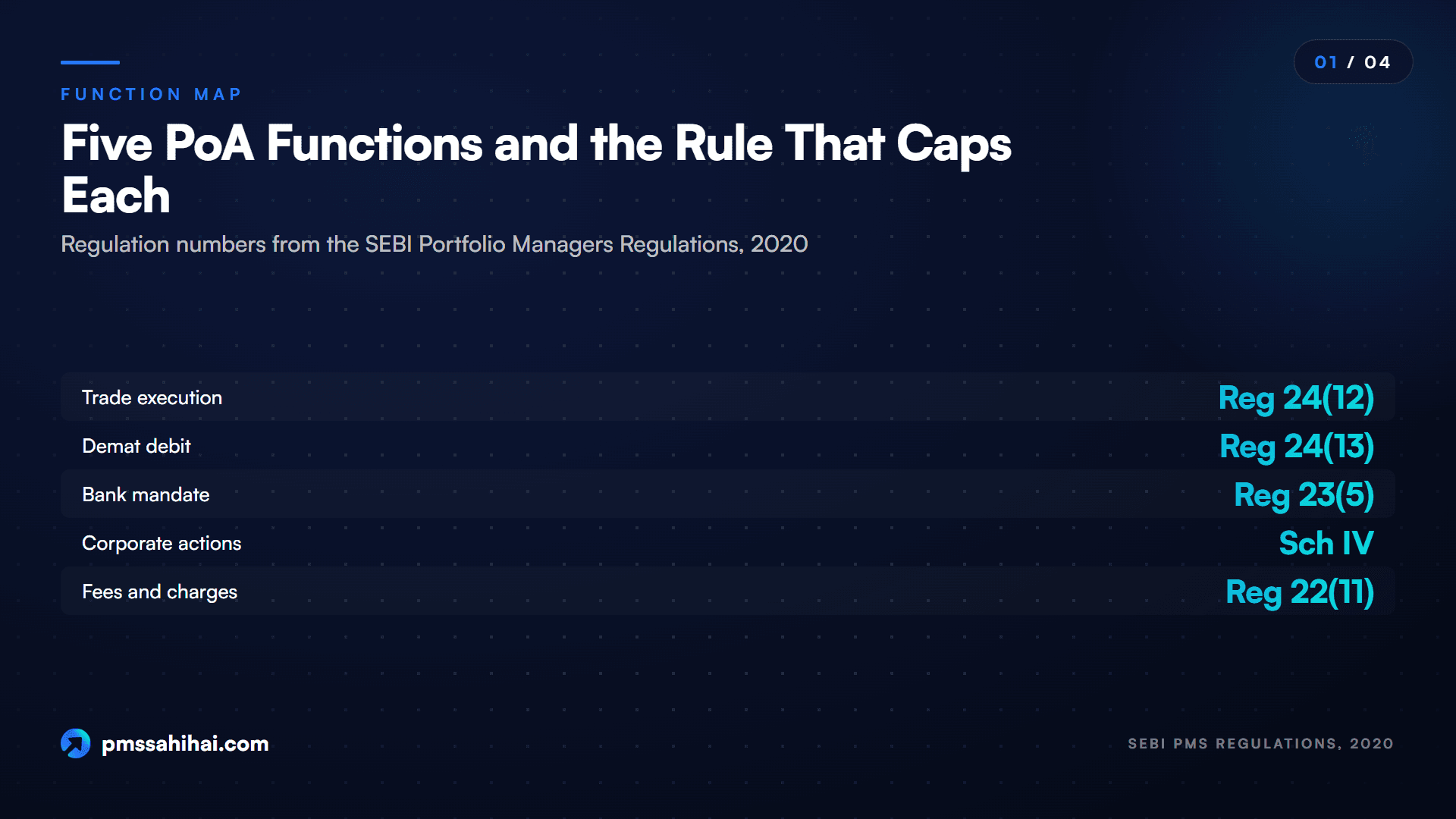
| Trade execution | Clauses 4, 6, 8, 14 | Dealing team, broker | Reg 24(1)(a), 24(12) |
| Demat debit | Clauses 10, 26 | Custodian, depository participant | Reg 24(13), 24(15), 24(16) |
| Bank mandate | Clauses 12, 13 | Manager's operations team, custodian | Reg 23(5), Master Circular 2.2 |
| Corporate actions | Clauses 7, 11, 29, 30 | Operations team, custodian | Schedule IV item 2, Reg 31(1)(c) |
| Fees and charges | Clauses 18, 19 | Operations and fund accounting | Reg 22(11), Master Circular 4.3 and 6.1.3 |
The type of service changes how much of this applies. Under Regulation 23(1), a discretionary manager manages each client's funds individually and independently, while a non-discretionary manager acts on the client's directions. Under an advisory service, SEBI's Investor Charter says the provider has no back-office responsibility for trade execution, custody or accounting. So the wide operating powers described below belong mainly to the discretionary mandate. If you are in a non-discretionary arrangement, the same machinery may run, but the decision to trade comes from you.
Function One: Trade Execution and Order Allocation
Trade execution is the function investors picture first, and it is the one most people think they understand.
What the Wording Usually Authorises
In the form we read, the manager can acquire securities by subscription or purchase, sell, redeem, deliver and transfer them, sign the paperwork involved, instruct the custodian, rebalance "as deemed fit", and negotiate terms and price. It can also appoint and instruct brokers. That is why no order reaches you for approval in a discretionary account.
What Actually Happens on a Trading Day
SEBI's Master Circular requires a dealing team responsible for placing and executing all orders under a written, board-approved policy. Its conversations must run only on dedicated recorded lines or authorised email ids. Settlement of funds and securities is then done by the custodian, according to the Investor Charter.
Regulation 24(12) says the manager should ordinarily buy or sell separately for each client. Where it aggregates orders for economy of scale, allocation must be pro rata at the weighted average price of the day's transactions, and no open allocation position may remain.
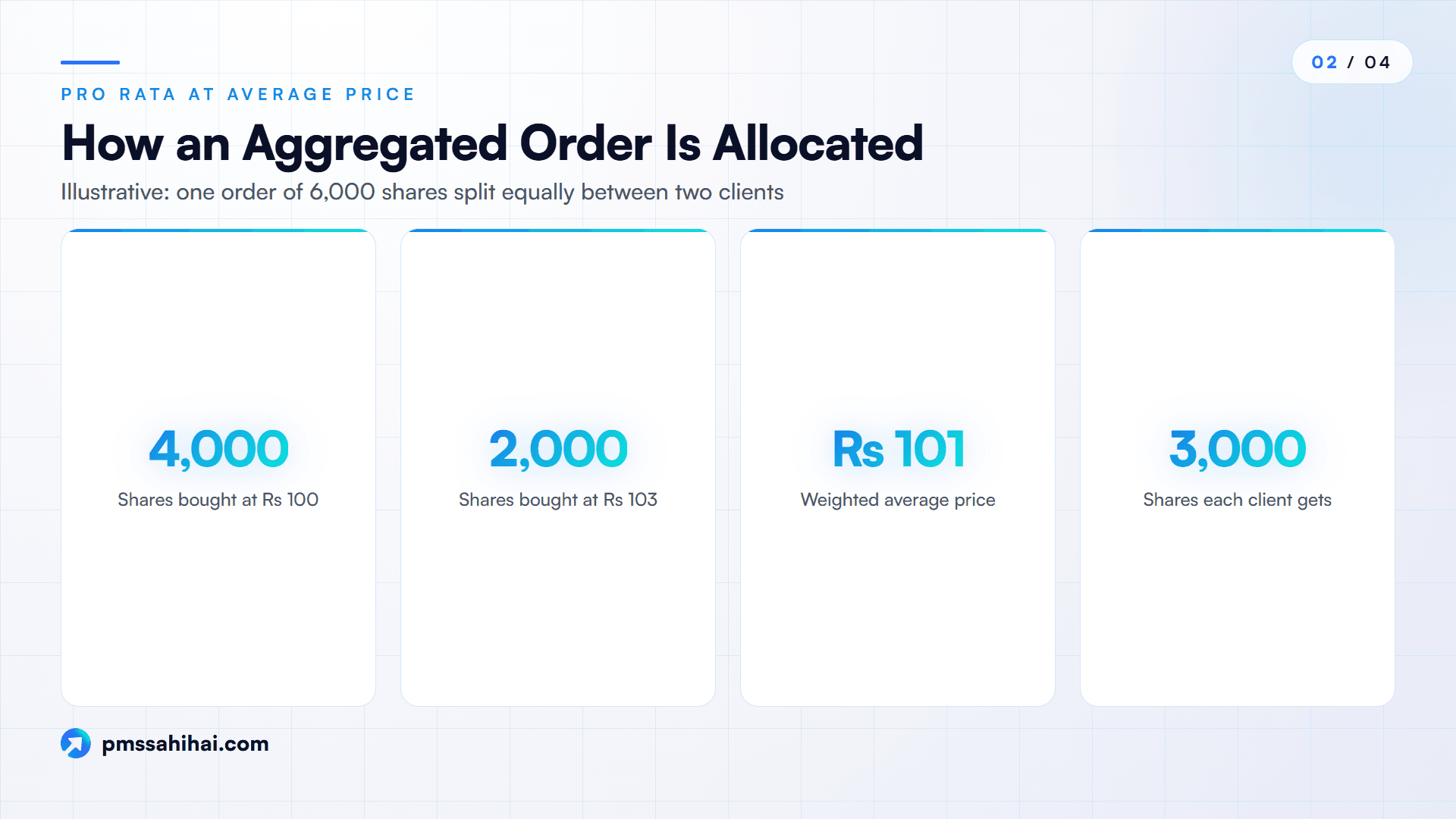
Here is an illustration with made-up numbers. A manager buys 6,000 shares for two clients in equal measure, getting 4,000 at Rs 100 and 2,000 at Rs 103. The weighted average price is Rs 101. Each client gets 3,000 shares at Rs 101, so neither gets the cheaper fill by favour.
Where SEBI Draws the Line
- Money and securities may be invested or managed only in terms of your agreement, under Regulation 24(1)(a).
- The manager must transact within limits you place, and the charter asks for your negative list of securities when you sign.
- Associate brokers are capped. Charges through the manager itself or any associate are limited to 20% by value per associate per service, and rates cannot exceed those paid to non-associates.
- The manager must not derive any direct or indirect benefit from your funds or securities, under Regulation 23(7).
So the question to ask is not "can the manager trade?" but "what does my negative list say, and which broker is used?"
Function Two: Demat Debit and Securities Movement
A sale does nothing until the shares leave your account. The demat debit function is what makes delivery possible without a signed slip from you each time.
What the Wording Usually Authorises
The clause we read is broad. It covers opening and operating a depository account, dematerialisation and rematerialisation, freezing, blocking or debiting the account, delivery and receipt instructions, pledge and pledge closure, lending and borrowing instructions, and even closing the account if deemed necessary.
Read on its own, that sounds alarming. Read beside the Regulations, it is much narrower.
Where SEBI Draws the Line
- Off-market transfers: Under Regulation 24(13), the manager cannot execute them in your account except to settle your own trades, to provide margin or collateral for your own positions, for dealing in unlisted securities under the rules, with your specific consent for each transaction, or for another reason SEBI specifies.
- Own name: Regulation 24(15) bars the manager from holding your portfolio's securities in its own name.
- Segregation: Regulations 23(4) and 24(14) require each client's securities to be kept separately and apart from the manager's own.
- Lending: Securities lending needs your written authorisation under Regulation 24(16), and Schedule IV requires the agreement to say so.
- Borrowing and leverage: Regulation 23(8) bars borrowing funds or securities on your behalf, and Regulation 24(7) bars leveraging your portfolio for derivatives.
The practical point is that the "lending and borrowing" wording in a form cannot override the ban on borrowing. If your form has such wording, ask how it squares with the Regulations.
The Broker Instrument Is a Different Thing
Do not confuse the PMS form with a broker's PoA. SEBI's broker PoA circulars of 2010 and 2020 are addressed to stock brokers and depository participants, and on 4 April 2022 SEBI brought in the Demat Debit and Pledge Instruction (DDPI) on the broker side. We found no sign in the 2010 circular's text that it covers PMS mandates. If you also hold a personal trading account, its authorisation is separate from your PMS paperwork.
Moving Securities In and Out
Demat debit also operates when you start and stop. The charter describes funding the account from your verified bank account or by transferring securities from your verified demat account. On termination, securities and funds go back to your verified accounts. That "verified" requirement matters because it narrows where the assets can travel at the end of the relationship.
Function Three: Bank Mandate and Cash Handling
Every sale creates cash, and every purchase needs it. The bank mandate covers that movement, and this is where PMS structures differ the most.
Two Models You Should Identify on Day One
The form we read authorises the manager to "operate one or more bank accounts as designated by the Client", and to collect sale proceeds, interest and dividends and reinvest them. That describes a bank account opened in your name and operated under the PoA.
The Regulations also allow the other model. Regulation 23(5) says the manager shall keep client funds in a separate account maintained by it in a scheduled commercial bank. The Master Circular clarifies the conditions: clear segregation in back-office records, no use of one client's money for another, a client-wise accounting system with statements at least monthly, and daily reconciliation.
| Question | Account in your name | Manager's separate account |
|---|---|---|
| Whose name is on the account? | Yours | The manager's |
| Who can see every entry directly? | You, through your bank | You see a client-wise statement |
| Where does your protection come from? | Your own bank records and the mandate | Records, reconciliation and SEBI's conditions |
| What should you ask for? | The mandate's scope and any limits | The monthly statement and the account details |
Neither model is automatically wrong. They simply give you different things to check. The charter says you should be told the details of the bank accounts where your funds are kept within 3 days of the PMS and demat account opening.
What Cash Does While It Waits
Pending investment, the form lets the manager place cash in units of mutual funds, deposits or similar instruments. The Master Circular allows short-term deployment in liquid mutual funds for cash management, on the same record-keeping conditions. So a cash line in your report may not be idle bank money. Regulation 24(8) separately bars bill discounting and badla financing with client funds.
What the Bank Mandate Is Not
A broad bank mandate is not a free hand. Regulation 24(14) keeps the manager responsible for safekeeping, and Regulation 23(3) makes it a fiduciary for client funds. If you withdraw, Regulation 24(2) lets funds or securities be withdrawn before maturity on voluntary or compulsory termination, whatever the agreement says.
Function Four: Corporate Actions and Shareholder Votes
No ranking page we read explains corporate actions under a PoA, yet they run through every portfolio. In a PMS, shares sit in an account linked to you, so companies' dividends, bonuses, splits, rights and meetings all reach the account.
Benefits That Arrive by Themselves
Schedule IV of the Regulations lists "keeping track of corporate benefits associated with the securities" within the services the agreement should cover. Regulation 30(1)(b) requires interest, dividend, bonus and other beneficial interests to be properly accounted for in your account. Regulation 31(1)(c) requires your report to show the beneficial interest received in the period, including dividends, bonus shares and rights shares.
So a dividend should appear twice: as cash in, and as a line in the report. If you find one and not the other, ask.
Rights Issues Need a Decision
Among corporate actions, rights are different because they need a choice. The form we read lets the manager apply for or renounce rights, bonds and debentures at its own discretion.
Take a made-up example. You hold 1,000 shares and the company offers 1 rights share for every 5 at Rs 200. Full subscription means 200 new shares and Rs 40,000 of cash. The manager can subscribe, using cash in your account or by selling something else, or renounce. Each choice shows up in your report and may have tax consequences, which fall on you because you own the securities.
Proxy Voting Is the Open Question
Here the wording matters most, and the rules say little. We found no use of "vote" or "proxy" in the Master Circular, and the 2020 Regulations mention voting rights only in unrelated contexts. We found no PMS-specific voting rule in those texts.
The form we read handles it in two clauses: the manager passes on meeting notices, and it may attend and vote or appoint a proxy "in accordance with our instructions". That is narrower than the discretion in its trading clauses. Other forms may read differently, so check whether your manager votes at all, on whose instructions, and whether you can see the record. If you care about governance votes, raise this before you sign.
Function Five: PMS Fees, Expenses and Tax Payments
Collecting PMS fees is the only function that takes money out with no investment on the other side. The form's clause lets the manager debit your account for service charges, fees, out-of-pocket expenses, franking and audit fees "in accordance with the PMS Agreement". So the debit power is tied to a document you signed.
What SEBI Allows to Be Debited
- No upfront fees: Regulation 22(11) bars them, directly or indirectly.
- Fee annexure: You must separately sign the annexure on fees and charges and add a note that you understood it. Master Circular paragraph 4.3.6 says nothing beyond that annexure may be levied.
- Brokerage: Charged at actuals.
- Operating expenses: Excluding brokerage, capped at 0.50% a year of your average daily assets under management.
- Performance fee: Calculated on the high water mark principle over the life of the investment.
- Exit load: Maximum of 3% in the first year, 2% in the second and 1% in the third.
For the full structure of PMS fees, read our guide to the PMS fee rules. This section only covers the debit.
A Worked Fee Debit
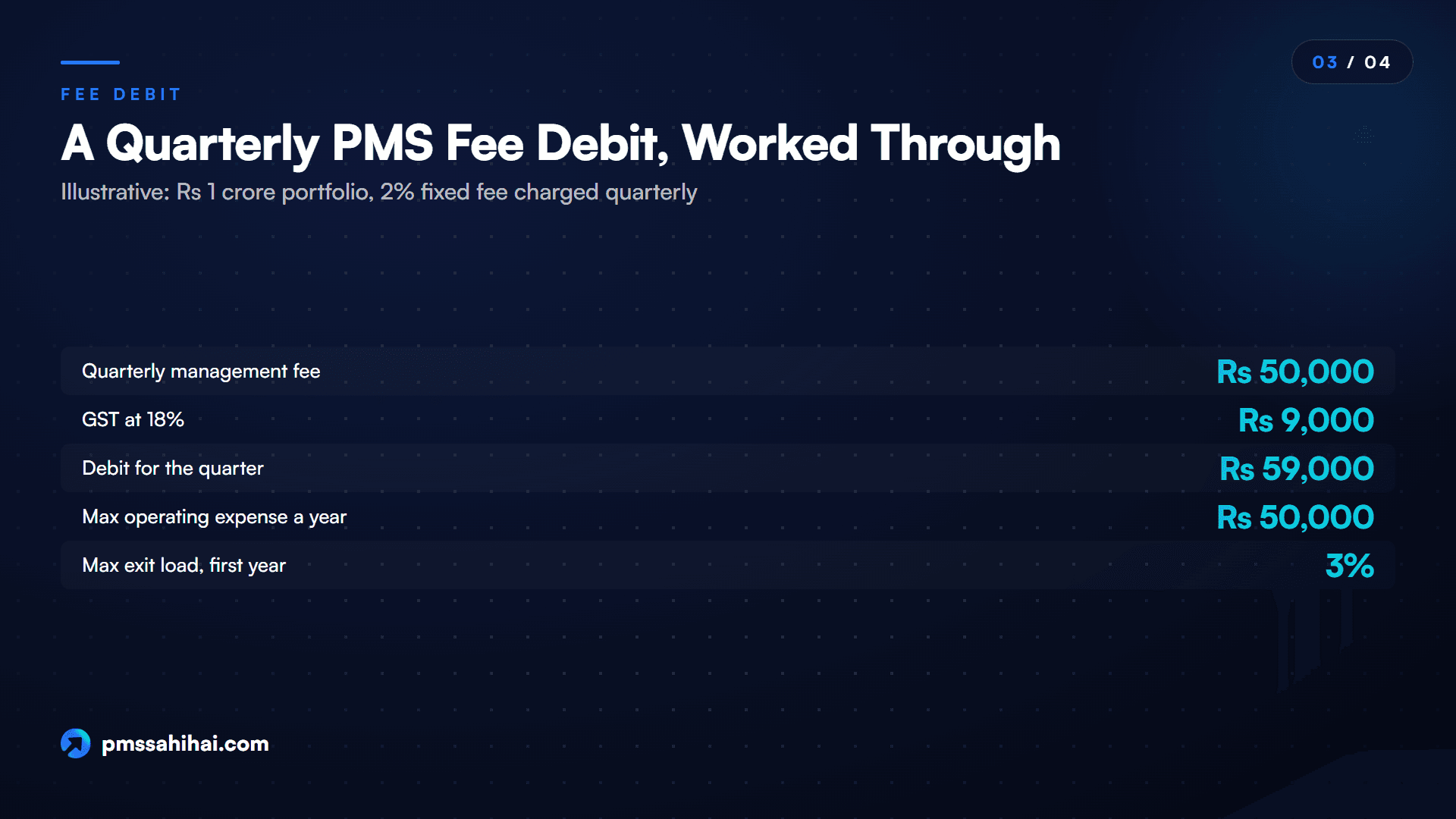
These numbers are illustrative and assume a flat portfolio value of Rs 1 crore and a 2% fixed fee charged quarterly.
| Line | Calculation | Amount |
|---|---|---|
| Quarterly management fee | Rs 1 crore x 2% / 4 | Rs 50,000 |
| GST at 18% | Rs 50,000 x 18% | Rs 9,000 |
| Debit for the quarter | Rs 59,000 | |
| Maximum operating expense, per year | Rs 1 crore x 0.50% | Rs 50,000 |
The GST rate is the one shown in SEBI's disclosure document format of September 2025.
Check three things when a debit appears: does the rate match the signed annexure, does the base match the valuation, and did the performance fee respect the high water mark?
Tax Payments Under the PoA
The form also lets the manager pay taxes, rates and charges due on the securities, and the Regulations require tax deducted at source to be recorded in the portfolio account. That is not the same as the manager handling your income tax. Capital gains from PMS trades are generally taxed in your own hands, so the tax return stays your job. Ask a tax adviser how this applies to you.
Supporting Powers Investors Often Skim Past
Beyond the five core functions of PoA in portfolio management, forms tend to carry a tail of supporting powers that deserve a slow read.
- Appointing agents: In the form we read, the manager can appoint brokers, custodians, depository participants, advisers, chartered accountants and advocates. Regulation 26 separately requires a custodian, and the charter says you should be told its name and demat account number within 3 days of opening.
- Substitutes and delegation: The form allows substitutes and delegation of the listed powers, and the attorney's agents or employees may exercise them. Ask who, in practice, signs.
- Regulatory filings and legal action: The form covers applications to regulators, appearing in legal proceedings, and representing you in a liquidation or insolvency. This is useful if a holding fails, and it is also wide.
- Irrevocability: The form states it is irrevocable during the tenure of the portfolio account. Whether that wording limits your exit is a question for your lawyer, but note that Regulation 24(2) preserves withdrawal on termination despite the agreement.
- Death of the client: The form continues for 30 days after the manager is told of the client's death or dissolution. Section 201 of the Indian Contract Act, 1872 generally ends an agency on the principal's death, so ask a lawyer how such a clause works in your case.
Under the Master Circular, a clause saying the manager's decisions can never be questioned must carry the good-faith qualifier described earlier. If your form uses the old wording, query it.
How Digital Rails Run PoA Functions Today
The legal authority dates back decades, but the plumbing is now mostly electronic.
- Digital on-boarding: The Master Circular provides for fee acknowledgements typed or written with a finger or stylus when clients are on-boarded digitally, and APMI has specified a standard procedure in consultation with SEBI.
- Recorded dealing: Dealing team conversations must run only on dedicated recorded lines or authorised emails.
- Reconciliation: Client-wise funds in a manager's separate account must be reconciled daily.
- Client reporting: Reports may be made available on the manager's website with restricted access for each client, under Regulation 31(2).
- Fee calculators: SEBI requires managers to provide a fee calculation tool to clients.
- Regulatory data: The Master Circular's annexures include structured electronic reports to SEBI, including client and pool-account fields.
None of this replaces the signed PoA. It does make each function easier to audit afterwards, provided you log in and look.
What a Well-Drafted PoA Makes Easier
When the wording matches the Regulations and the mandate, the arrangement solves real problems.
- Speed: Trade execution and delivery do not wait for your signature, which matters when a position must be changed in a moving market.
- Fair handling of bulk trades: Aggregated orders are allocated pro rata at a single average price.
- Less paperwork for corporate actions: Dividends and bonuses are tracked and shown in one report.
- Fewer missed decisions: Someone is responsible for a rights deadline even when you are travelling or living abroad.
- Predictable costs: PMS fees tie back to one signed annexure.
- Direct ownership stays intact: Securities cannot be held in the manager's own name, so the powers are about operating your assets, not owning them.
- A clean audit trail: Reports come at least every three months, and you may appoint your own chartered accountant under Regulation 30(4).
How PMS Sahi Hai Helps You Read the Inner Clauses of a PMS PoA
PMS Sahi Hai does not review or interpret your PoA, and at the time of writing it has no dedicated post on these five operating functions. What it does offer is the surrounding context, so that your questions are sharper when you sit down with a manager or a lawyer.
Follow the assets behind the form. The PoA tells you what the manager may instruct. Our explainer on what a custodian does and why a manager can't simply take your money looks at the same arrangement from the custodian's side. It pairs well with the demat debit and settlement sections above.
Line up fee debits against the rules. Before you check a quarterly debit, read how SEBI's PMS fee structure works and how GST applies to PMS and AIF fees. The first explains the rules, and the second explains the extra line on the invoice.
Know how the powers end. Function by function, the PoA matters most at the two ends of the relationship. Our guides on PMS onboarding, moving shares in specie and the PMS exit process cover what happens around those moments.
Compare the operating questions, not only the returns. The compare section lets you set up to four PMS, AIF or GIFT City strategies side by side, so you can build a shortlist and then put the same five questions to every name on it.
Use Nyra for research. Nyra is PMS Sahi Hai's AI research tool. You can ask it how a strategy works, and its methodology page sets out how its scores are built, including a "Not Rated" outcome for strategies with less than 12 months of track record. Nyra's output is informational, and PMS Sahi Hai's pages state it is not a SEBI-registered investment adviser. A score says nothing about your PoA's wording, so that part of the homework stays with you and your lawyer.
Know who you are talking to. PMS Sahi Hai is an APMI-registered distributor that earns trail commission from asset managers. It is fair to ask it, like anyone else, how it is paid. If you want a person to walk through these questions, you can talk to the team.
Limits and Risks in Daily PoA Operations
The same features carry costs, and none of them should be waved away.
- Wording can run wider than the rule. Clauses on borrowing, lending or account closure may sit in a form even though the Regulations restrict them. Rules bind the manager, but you only spot a conflict if you read both.
- You see most things after the event. In a discretionary account, transaction details may reach you only quarterly or on request. Ask for more frequent access if you want it.
- Delegation lengthens the chain. Every substitute, broker and agent adds a link where errors can occur.
- Pooled cash relies on records. Under a manager's separate account, your protection rests on back-office accuracy and daily reconciliation.
- Voting may be neglected. Without a clear PMS-specific rule, your voice at company meetings depends on the form and on the manager's practice.
- A fiduciary duty is not a guarantee. The rules restrict conduct and create accountability, but they do not remove market risk.
- Large-ticket exceptions exist. Schedule IV's contents do not apply to agreements with large value accredited investors, so those clients must negotiate protections for themselves.
Reading Your PoA as an Operating Manual
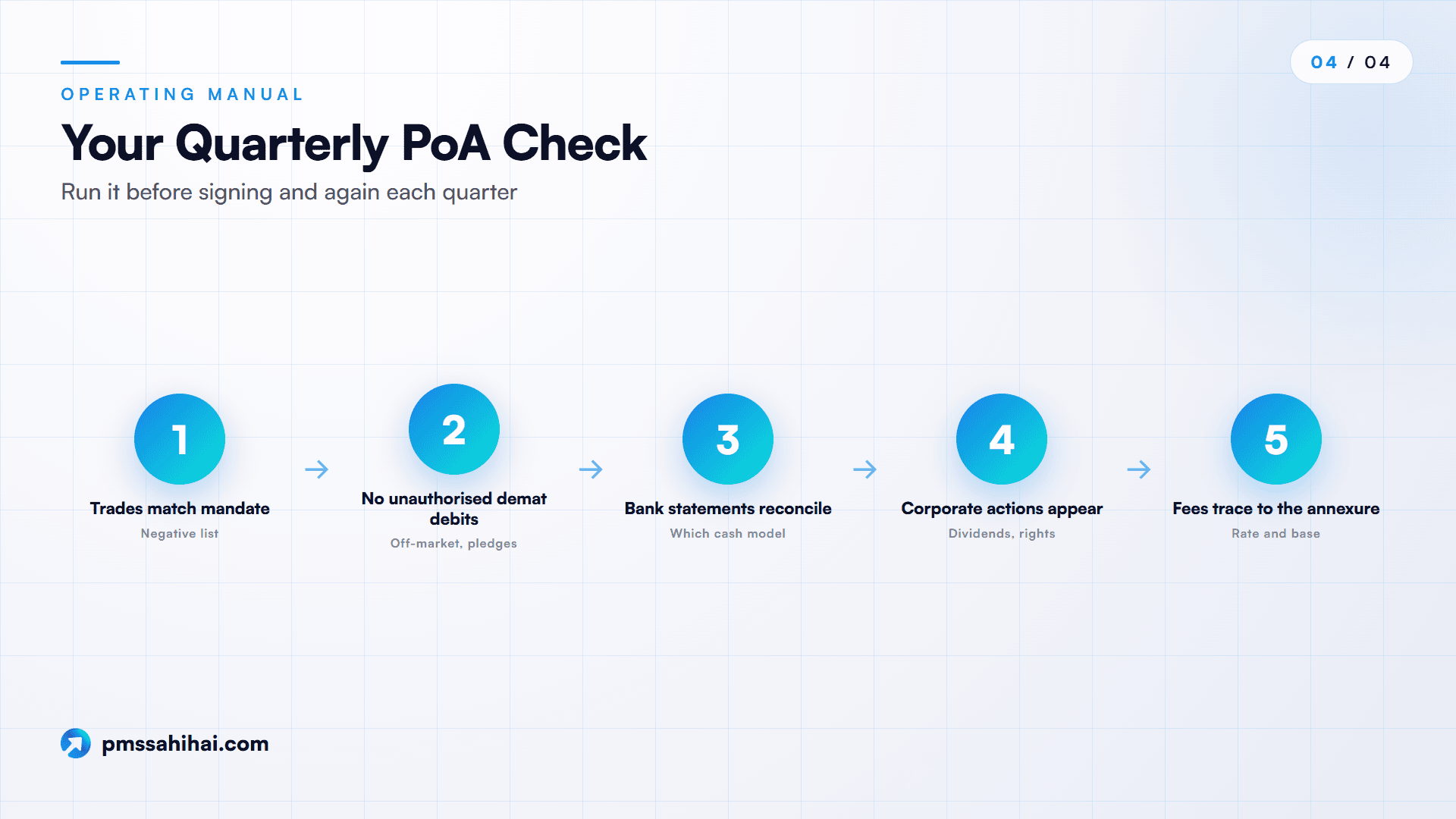
The functions of PoA in portfolio management are easier to judge when you stop treating the form as boilerplate. Run this check before signing and again each quarter.
- Trade execution: Does the report match your mandate and negative list? Which brokers were used?
- Demat debit: Were there any off-market entries, pledges or lending? Did you authorise them?
- Bank mandate: Which model applies, and do statements reconcile with reported cash?
- Corporate actions: Did each dividend and bonus appear, and how were rights and votes handled?
- PMS fees: Does each debit trace back to your signed annexure?
If anything fails, raise it with the manager in writing. Take the form to a lawyer before signing if you are unsure about clauses such as irrevocability or delegation, and to a tax adviser for anything on tax. To research the managers themselves, PMS Sahi Hai's comparison pages and Nyra can help you build the shortlist, but the reading of the form remains yours.
Compare PMS Managers With Your PoA Questions Ready
Ask every manager on your shortlist for a blank copy of the PoA and the agreement before you commit, and walk through the five functions with them. A manager who answers plainly about brokers, pooled accounts, voting and fee debits is showing you how the account will really run.
To build that shortlist, compare PMS strategies side by side on PMS Sahi Hai, ask Nyra how a strategy works, or book a conversation with the team. This article is general information as of 30 October 2026, not legal, tax or investment advice. Consult a lawyer about your PoA and a tax adviser about the tax points.
PMS Sahi Hai is a distributor of Portfolio Management Services and Alternative Investment Funds, APMI-registered (Registration No. APRN08358). This article is for education only and is not investment advice, a recommendation, or an offer to buy or sell any security. Investments in securities markets are subject to market risks; read all scheme-related documents carefully. Past performance is not indicative of future results. Consult your advisor before investing.
Ishaan founded PMS Sahi Hai to make India's PMS, AIF and GIFT City markets legible to serious investors, comparing every SEBI-registered manager on the same comparative basis, with no shelf products and no commission bias.
Frequently asked
Can a portfolio manager sell my shares without asking me?
In a discretionary PMS, usually yes, because the PMS power of attorney and agreement give the manager that authority. The sale must stay within your agreement and any negative list you gave. In a non-discretionary PMS, the manager acts on your directions under Regulation 23(1). Check which mandate you signed, because the answer turns on that document and not on the PoA's general wording.
Can a portfolio manager transfer my shares to someone else?
Not freely. Regulation 24(13) bars off-market transfers from your account except to settle your own trades, provide margin for your positions, deal in unlisted securities, act on your specific consent for that transaction, or for a reason SEBI specifies. The manager also cannot hold your portfolio's securities in its own name. Any unexplained off-market entry in your statement deserves an immediate written question.
Can a portfolio manager withdraw money from my bank account?
Within the mandate, it can move money for investments and agreed charges. It cannot use your funds for its own benefit, because Regulation 23(7) bars that and Regulation 23(3) makes it a fiduciary. First establish which model applies: an account in your name under a bank mandate, or the manager's separate client account. Ask for the scope in writing, and review statements regularly.
Who receives dividends and bonus shares in a PMS?
They belong to you. Regulation 30(1)(b) requires dividends, interest, bonus and other beneficial interests to be credited and accounted for in your client account. Regulation 31(1)(c) requires reports to show them. In practice, the manager's operations team and custodian track corporate actions, and the form may let the manager collect and reinvest the cash. Compare each report with what the company actually declared.
Who votes the shares held in a PMS account?
It depends on your documents. We found no PMS-specific voting rule in SEBI's Master Circular of July 2025 or the 2020 Regulations. One publicly posted form allows the manager to vote or appoint a proxy in accordance with the client's instructions. Other forms may differ. Ask whether your manager votes, on whose instructions, and whether you can see a record of the votes.
Are PMS fees debited automatically?
Usually they are debited under the PoA and agreement without a fresh approval each time, as the form we read shows. The amount is still limited by what you signed. SEBI requires a separately signed fee annexure and bars charges beyond it, along with any upfront fee. Operating expenses, excluding brokerage, are capped at 0.50% a year of average daily assets. Check every debit against the annexure.
Can a portfolio manager pledge or lend my shares?
Lending needs your written authorisation under Regulation 24(16). Margin or collateral for your own positions is one of the permitted off-market reasons under Regulation 24(13), and the manager must have a policy on segregating margins between clients. Borrowing on your behalf is barred by Regulation 23(8). A form's general wording on pledging does not change those limits, so ask your manager how it uses the power.
Do the PoA functions change when the 2026 Regulations start?
The 2026 Regulations take effect on 1 April 2027. Their Regulation 16 keeps the fiduciary duty, segregation, separate bank account, the off-market limits and pro rata allocation, so the core functions should look familiar. Regulation numbers will change, and detailed circulars may follow. Your existing form may need review then, so ask your manager when the transition begins and check SEBI's site for updates.
Keep reading
All articles
What Are Rolling Returns? How to Read the Range, Not the Average
Rolling returns explained: the formula, a worked example, which windows to use, and how to read the worst, median and hit rate before you invest.

What Is Succession Planning? A Wealth Guide for Indian Business Families
Succession planning for Indian business families: ownership, management, family constitution, holding structures and the wealth outside the business.

What Is a Private Banker? What They Do That a Distributor Doesn’t
What is a private banker? The bank role, the credit work a distributor can't do, how they are paid, and which conflicts to question.
Read it. Now pressure-test it.
Ask Nyra how this applies to your portfolio, or talk to our team, no pitch, no pressure.