
What Is a Private Banker? What They Do That a Distributor Doesn’t
What is a private banker? The bank role, the credit work a distributor can't do, how they are paid, and which conflicts to question.

A private banker is a bank employee who manages a wealthy client's whole relationship with that bank: deposits, credit, forex, investments and access to specialists. India has no separate licence for the job, and each bank sets its own entry bar. What a private banker can do that a distributor cannot is bring the bank's balance sheet and banking services into the conversation. On third-party investments such as a PMS or a mutual fund, though, the banker usually works as a distributor, with distributor rules and commission conflicts. Ask which hat is on before you act on any recommendation.
Why the Private Banker Title Deserves a Closer Look
Picture a founder who has just sold a stake in her company. Within a week, three people call. One is from her bank's private banking desk, one runs a wealth firm, and one is a mutual fund distributor she has known for years. All three suggest the same portfolio management service. All three sound like advisers. Only one of them can also extend her a loan the same afternoon, and that is the clue to what makes the role different.
So what is a private banker, exactly? The title suggests status, and the office often supports the impression: a named contact and a quiet meeting room. The label says little about what the person is allowed to do, who pays them, or whose product they are recommending.
This article looks at the private banker as a role. We cover what the job is, how it started, what a private banker does that an outside distributor cannot, and where the two jobs turn out to be the same job. Then we look at pay, conflicts and the questions worth asking. If you want a full side-by-side of the two roles on regulation, duty and cost, our companion comparison handles that. Here the focus stays on the person across the table from you at the bank.
What Is a Private Banker in Plain Terms
A private banker is the person a bank assigns to run its relationship with a wealthy client. Private banking is generally described as banking, investment and related services offered mainly to high-net-worth clients through a dedicated contact. In Investopedia's description, a relationship manager or private banker is assigned to each client and handles matters from the complicated to the routine, acting as a liaison with the bank's other departments.
Three points follow from that description.
- A private banker is an employee. The person works for an institution and is paid by it.
- A private banker is a job title, not a licence. We found no Indian regulation that creates a "private banker" category. The regulated activities the person carries out, such as selling a mutual fund or a PMS, carry their own requirements.
- The relationship belongs to the bank. If your banker moves on, your accounts and loans stay where they are, and the bank assigns someone new.
In most Indian banks, "private banking relationship manager" and "private banker" mean the same thing in practice, though titles vary. One bank may say partner, another relationship manager, another wealth manager.
Who Qualifies for Private Banking in India
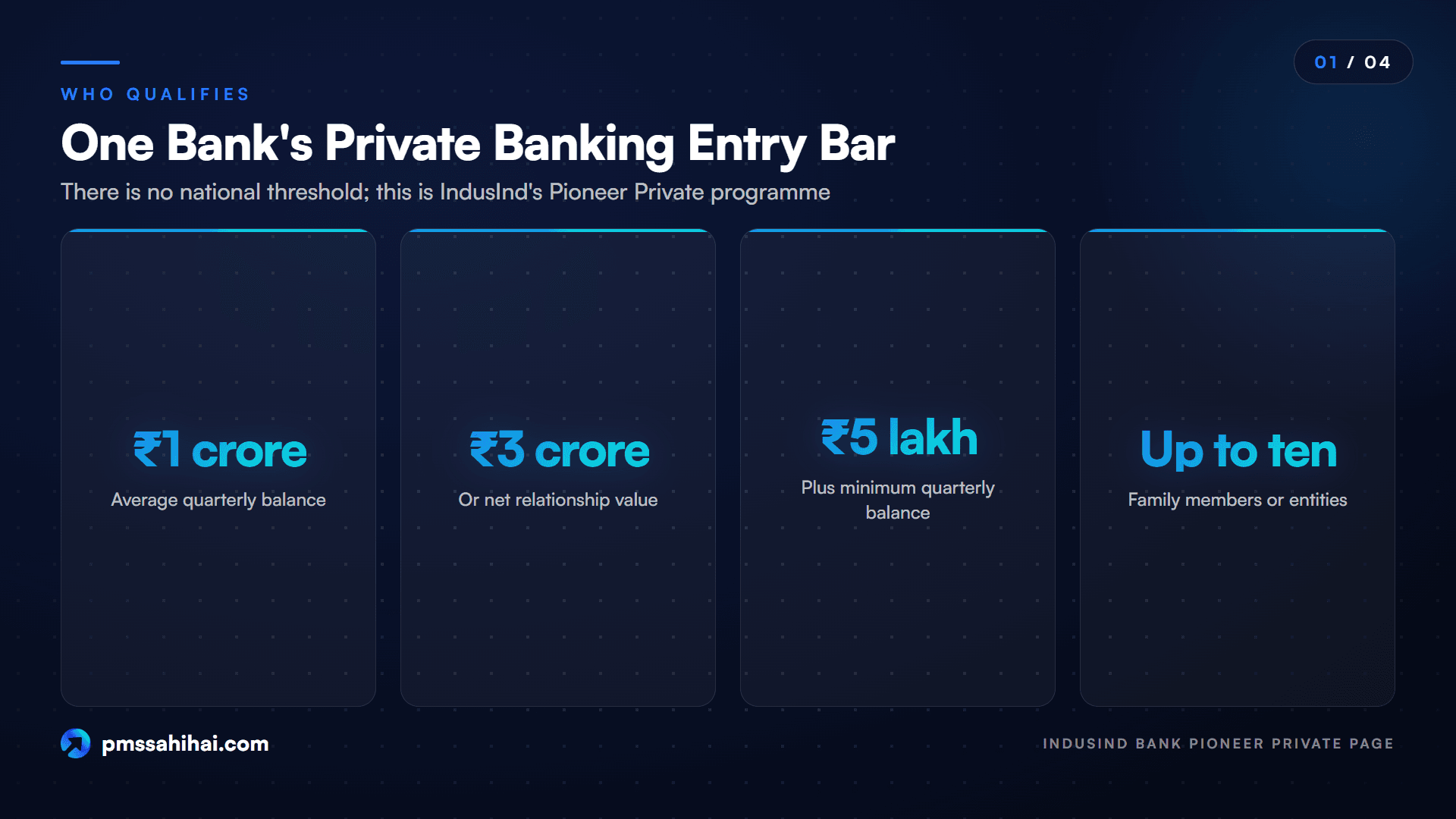
There is no national threshold. Private banking in India is defined by each bank's own programme, usually using a total relationship value that adds together balances, deposits and investments, sometimes across a family.
IndusInd Bank's Pioneer Private page gives a clear example. A group qualifies with either an average quarterly balance of ₹1 crore, or a net relationship value of ₹3 crore with a minimum average quarterly balance of ₹5 lakh. Up to ten family members or related business entities can be grouped. Third-party directories report higher bars elsewhere, such as ₹5 crore of relationship value at ICICI and ₹7.5 crore at Kotak Private. Those figures are not from the banks' own pages that we read, so confirm them directly, because banks change their terms.
The Team Behind the Name
The person you meet is usually the front of a small team. IndusInd, for example, names three groups: private banking partners who act as one point of contact, product specialists who support them with analytics and guidance on regulatory changes, and service relationship managers who handle day-to-day needs. Knowing this matters. When you ask a hard question about a product, the answer may come from a specialist you have never met.
How Private Banking Began and Reached Indian Rules
Private banking is old. Coutts was founded in 1692, and MeesPierson in 1720, serving royal and noble families in Britain and the Netherlands. Switzerland became a centre for private wealth during the upheavals of the twentieth century, as families moved assets across borders around the two World Wars. For most of this history the "private" in the name meant discretion and a personal relationship rather than any legal status.
In India, the regulatory story is more recent and is mostly about sales conduct. Banks began bundling third-party investments and fund management with ordinary banking, and complaints followed. In 2013, Business Standard reported on RBI guidelines that proposed separating core banking from investment advisory and wealth management to reduce conflicts of interest. The report noted RBI's view that customers expect more of a bank than they would of any other agent or product distributor. A FundsIndia article from the same month recalled the 2010–11 Citibank case, in which wealth clients were offered a fraudulent scheme.
The rules then built up in layers:
- SEBI's adviser framework. A bank that wants to offer investment advisory services needs RBI permission and registers through a subsidiary or a separately identifiable department or division. An adviser that also offers distribution must keep client-level segregation at group level.
- Distributor oversight. From 1 May 2020, PMS distributors could be paid on trail only, out of the manager's fee. From 1 January 2025, anyone distributing PMS must be registered with APMI, the portfolio managers' association.
- RBI's 2026 directions. On 15 June 2026, RBI issued the Commercial Banks Responsible Business Conduct Second Amendment Directions. They define mis-selling and take effect on 1 January 2027.
What a Private Banker Does Day to Day
Much of the job looks nothing like selling a fund. A typical week can include the following.
- Liquidity and cash. Arranging large transfers, fixed deposits, sweep arrangements and business current accounts.
- Credit. Bringing a loan against property or securities to the credit team, and chasing the sanction.
- Forex and cross-border work. Remittances, NRI accounts, and trade or forex support for clients with businesses. IndusInd lists trade and forex solutions and NRI accounts among its programme services.
- Portfolio conversations. Reviewing what you hold at the bank and proposing changes.
- Specialist introductions. Connecting you to estate, succession or tax colleagues, or to outside counsel. UMB in the US describes the private banker as a main contact who connects clients with internal specialists, and Indian programmes describe something similar.
- Service fixing. Getting a failed payment, a locker or a card limit sorted out without a call-centre queue.
Technology has changed the supporting cast, not the core job. Relationship values are calculated across linked accounts, and some banks offer a 3-in-1 account that joins savings, trading and demat. Mutual fund sales carry an ARN for the distributor firm and usually an EUIN for the person who advised you, so the sale can be traced to a name. RBI's new directions require banks to seek feedback within 30 days of a sale, through random call-backs or surveys, run by a department that does not sell. The banker's value still sits in judgement and in knowing whom to call.
What a Private Banker Does That a Distributor Doesn't
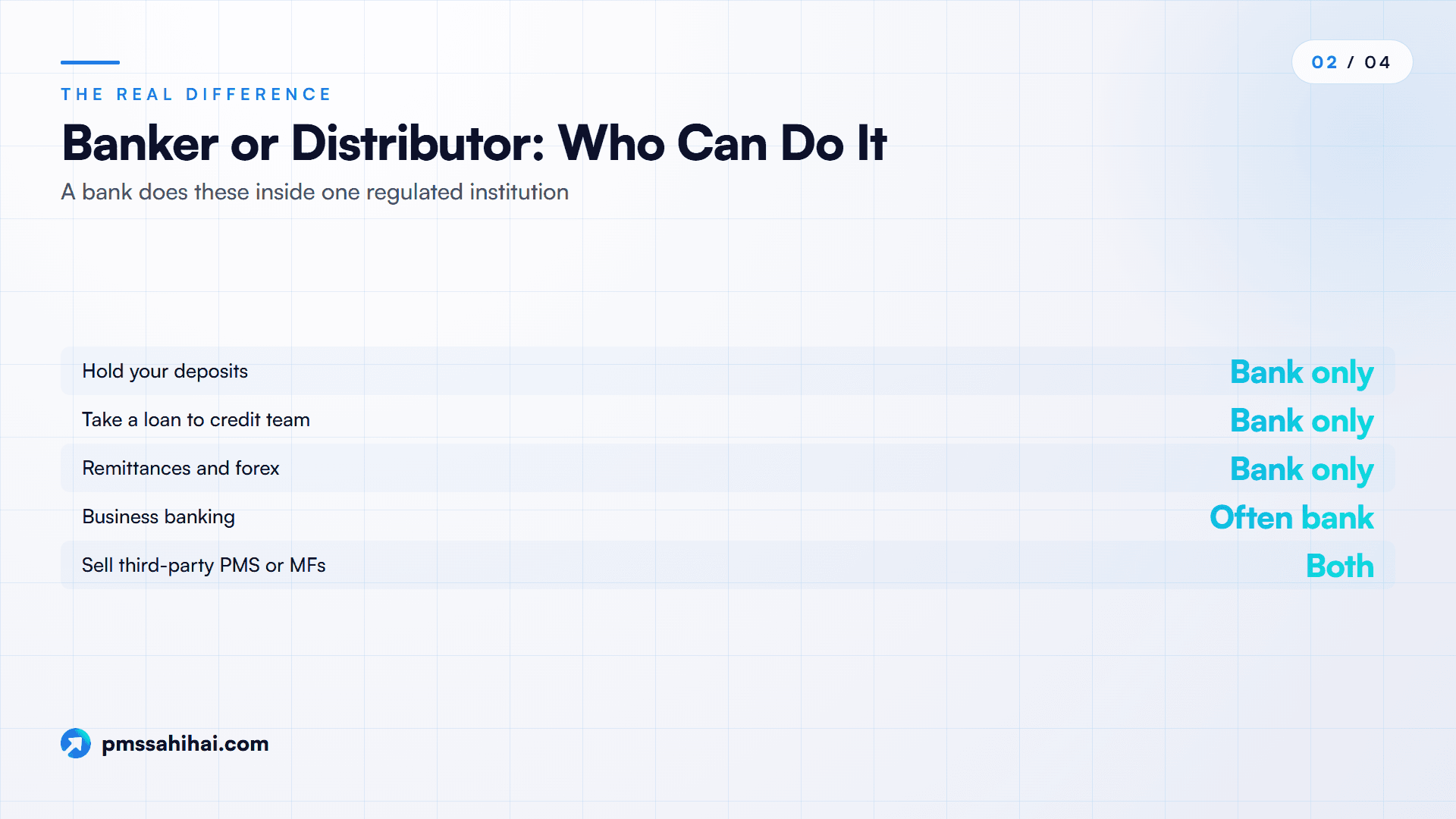
This is the real answer to the title. A distributor connects you to a product and earns from that connection. A private banker does that too, and also represents an institution that holds your money, lends to you and moves your funds.
| What you need | Private banker | Stand-alone distributor |
|---|---|---|
| Hold your deposits and current accounts | Yes, through the bank | No |
| Bring a loan to the lender's own credit team | Yes | No, can only refer you to a lender |
| Remittances and forex | Yes, through the bank | No |
| Business banking alongside personal wealth | Often | No |
| See your bank balances and loans together | Yes, within that bank | Only what you share |
| Sell third-party PMS or mutual funds | Yes, if the bank is registered | Yes |
Note the word "stand-alone." Some distribution firms belong to groups with a broker or NBFC, so a distributor's group may offer some of these services through another entity. The difference is that a bank does them inside one regulated institution.
Credit Against Your Assets
Credit is the clearest difference. A founder holding ₹10 crore in listed shares may not want to sell before a tax year ends. A private banker can take a loan against securities to the bank's credit team, or arrange a loan against property. A distributor can only suggest it and refer you elsewhere.
What a Lending Decision Depends OnThe banker rarely decides alone. Credit teams assess the request, and lending against securities is subject to RBI limits and bank policy, so ask for the current ceiling and the margin on your specific holdings. Leverage also cuts both ways. A falling market can trigger a margin call just when you least want to sell.
Banking Rails a Distributor Does Not Run
The other difference is plumbing. Your banker can see that a large fixed deposit matures next month, that your business account is short before a GST payment, or that an education remittance is coming due. Those facts sit inside the bank, so a good private banker can act on them early. A distributor sees them only if you tell them.
There is a small safety point here as well. A deposit at a bank is insured by DICGC only up to ₹5 lakh per depositor per bank, so a large balance is a bank-risk decision, and the warm relationship does not change that. Ask yourself whether you would hold that sum there if you had not met your banker.
Where a Private Banker Is Also a Distributor
Here is the part many clients miss. When a private banker recommends a mutual fund, a PMS or an AIF from another company, the bank is usually acting as a distributor of that product. Kotak's Privy League page, for one, says plainly in a footnote that its expert guidance "covers mutual fund distribution & referral of other third party products."
The rules treat it accordingly.
- Mutual funds. A mutual fund distributor registered with AMFI may give advice only incidental to that distribution. SEBI's FAQ on investment advisers says advice on securities beyond this, such as AIF units, bonds or structured products, needs investment adviser registration.
- PMS. Any person or entity distributing PMS needs APMI registration. Under the SEBI Master Circular for Portfolio Managers, a portfolio manager must pay distributors only on trail and only from its own fees, and must make sure prospective clients are told what the distributor will earn. These are the rules in force until the 2026 PM Regulations start on 1 April 2027. A code of conduct says commission or incentive "shall never form the basis" for recommending a PMS.
- The label. SEBI's FAQ also says no one dealing in distribution of securities may call themselves an independent financial adviser, wealth adviser or similar without being a registered investment adviser.
- Staff qualifications. RBI's directions require bank employees selling their own or third-party products to hold whatever certification the relevant regulator prescribes.
So there are two distinct jobs in one person. On deposits and loans, the private banker speaks for the bank as a lender and account holder. On a third-party PMS, the same person is a seller, and the bank earns from the sale.
That is not a scandal. A distributor's work can be valuable: shortlisting, paperwork, follow-up, an extra pair of eyes. The point is simply that the bank's badge does not make a distribution recommendation independent. Our existing post on PMS direct vs regular walks through what that distribution layer costs.
Some banks and their group companies also run fee-paying advisory or discretionary services. If you are in one of those, the rules on segregation apply differently, so ask which arrangement you are on. Do not assume.
How Private Bankers and Their Banks Get Paid
Knowing how private bankers are paid is the single most useful thing you can learn about them. There are two levels: what the bank earns from you, and what the bank pays the banker.
What the bank earns from you. The bank can earn from several sources at once:
- the spread on your deposits and interest on your loans;
- fees on forex, trade and other banking services;
- trail commission on third-party products it distributes;
- fees on any advisory or discretionary services, if it or a group company runs them.
You rarely write a cheque for the relationship itself, so private banking can feel free. It is not. The cost sits inside rates, spreads and product fees.
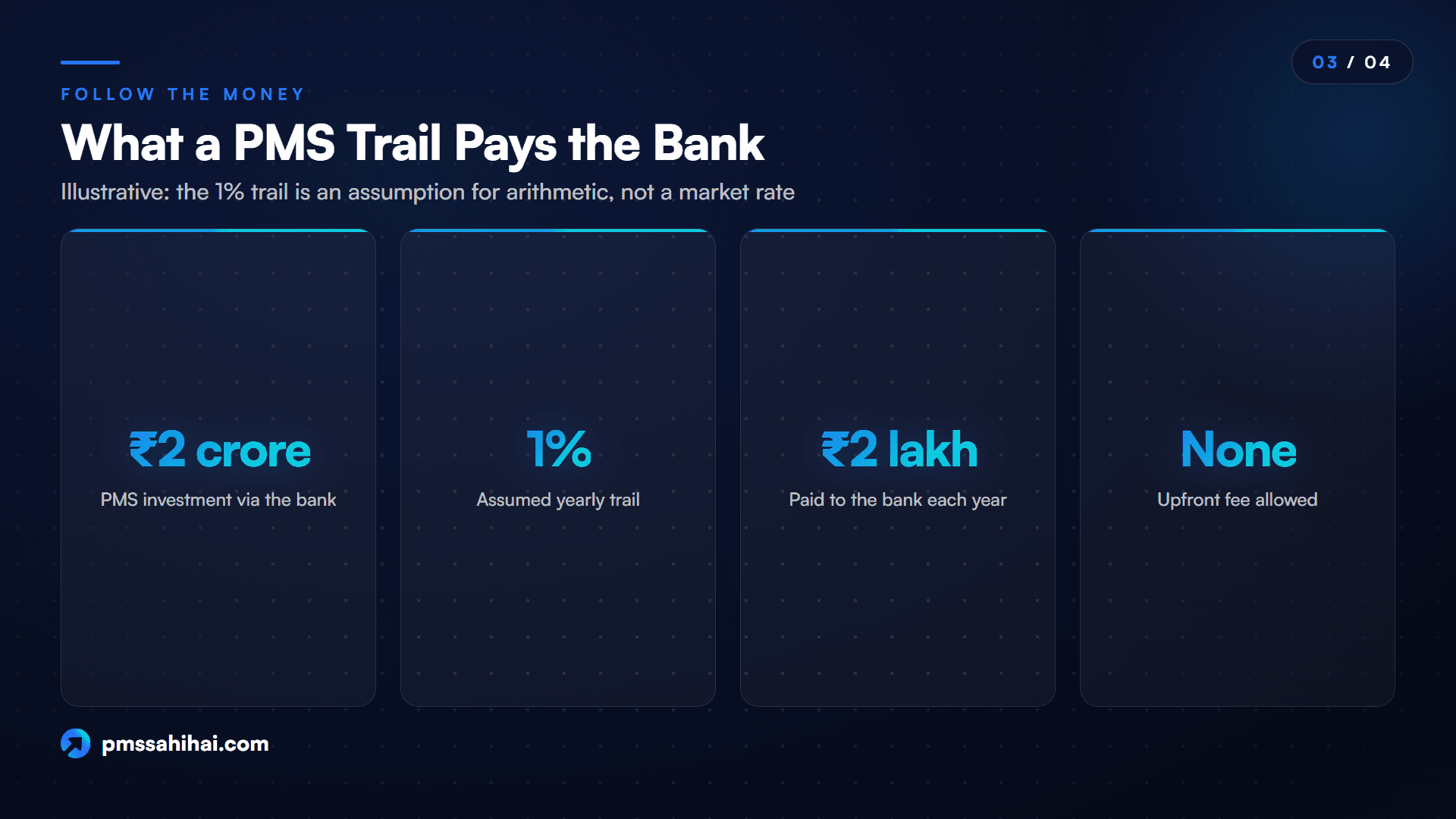
A simple PMS illustration. Suppose you put ₹2 crore into a PMS through the bank, and the manager pays an assumed 1% trail. That is about ₹2 lakh a year to the bank while you stay invested, paid from the fee the manager charges you. SEBI's FAQs on portfolio managers separately say no upfront fee may be charged to clients, directly or indirectly. The 1% is our assumption for arithmetic only, not a market rate. Your real number is whatever the bank must tell you before you sign.
What the bank pays the banker. Here public data is thin. Investopedia's general description is that the private banker "is compensated by the financial institution, not the client." In India, pay usually combines salary with variable pay, and salary aggregators offer samples too small to rely on. Bloomberg reported in July 2025 that India's wealth hiring boom was driving salary rises of up to 40% for experienced relationship managers, and that newer wealth firms were offering bankers 50% or more of the revenue they generate, according to a consultant at Aon. A revenue share makes the arithmetic personal, because what the banker earns can rise with what the client's products pay.
Banks do not publish individual scorecards, so you cannot see how your banker is measured unless you ask. It is worth asking.
Private Banker Conflict of Interest Points to Watch
A private banker conflict of interest does not make someone dishonest. It means the person's interests and yours can pull apart, so you should know where.
- Commission differences. Different products pay differently. A product with a higher payout may be easier to recommend, whichever one fits you best.
- The in-house shelf. A bank may lean toward its group's AMC, PMS or insurer. Investopedia flags limits to proprietary products as a general drawback of private banking.
- Credit tied to investing. If a loan funds an investment, the bank can earn on both ends. RBI's directions say a sanctioned loan cannot be used to fund a purchase without your explicit consent.
- Bundling pressure. The sense that a loan will go better if you also buy something. From January 2027, RBI bars compulsory bundling of a third-party product with the bank's own, and a required risk-mitigant product must be available from any provider.
- Assets that stay on the shelf. Your banker has little reason to tell you that a direct route costs less, or that money would do better outside the bank.
- Targets and turnover. A new banker may review your portfolio and suggest changes, some of which could reset commissions or charges.
What RBI's 2026 Directions Change
RBI's directions apply from 1 January 2027 to commercial banks other than small finance banks, payments banks, regional rural banks and local area banks. Four points matter most to a private banking client.
- A definition of mis-selling. It includes a sale that is unsuitable for your profile even with your explicit consent, a sale on incorrect, incomplete or misleading information, a sale without explicit consent, and compulsory bundling.
- An incentive rule. A bank's policies must not create incentives for mis-selling, and bank employees must not receive any incentive, directly or indirectly, from the third-party provider.
- A suitability duty. The bank must weigh a product's features, risk, horizon, complexity and fees against your age, income, financial literacy and risk tolerance, unless its policy deems the product suitable for all.
- A remedy. Where mis-selling is established, the bank must refund the full amount paid and compensate for resulting loss under its approved policy. Where no regulator has set a timeline, you have 30 days from receiving the signed agreement to complain.
These are real protections, with limits. The directions do not stop the bank itself from earning distribution commission, and "direct or indirect" incentive wording will be tested only in practice. Whether a bank's refund duty works smoothly for a market-linked PMS, where another regulator is also involved, remains to be seen. If you believe you have been mis-sold, get legal advice on your specific case.
How a Good Private Banker Makes Life Easier
None of this means you should avoid the role. Used well, a private banker saves real time.
- One call instead of six. A single contact for banking, credit and investing cuts down on repeat explanations.
- Speed on credit and cash. A banker who knows your file can push a time-sensitive loan or transfer.
- A family view. Grouping up to ten family members or entities, as at IndusInd, can make shared finances easier to follow and can help a family qualify for a programme.
- Access to specialists. Legacy planning and business succession teams are part of some programmes, which helps when the family's questions are bigger than the portfolio.
- Better terms, sometimes. Preferential rates on loans and lockers are a common feature. Always compare.
- An early warning. A banker who sees your balances may spot a maturing deposit or a cash shortfall before you do.
The strongest case for the role is a business family with mixed needs, where loans, forex, current accounts and investments all interact. An investor with only a ₹60 lakh PMS and no borrowing need gets far less from those banking rails.
How PMS Sahi Hai Helps You Check a Private Banker's Recommendation
Start with where we stand. PMS Sahi Hai is on the distributor side of this conversation, not the private banking side. Its About page, as our earlier posts record it, says the platform is run by Nyra Capital Partners Consultancy and is an APMI-registered distributor (APRN08358), with asset managers paying distribution fees. It does not take deposits or lend, so it cannot replace the banking half of a private banker's job. If you need a loan against securities, you still need a lender.
What it can do is help with the other half, where a banker's recommendation is a product recommendation. Three uses fit this article.
See what else exists before you say yes. A banker's shelf is one set of products. The PMS Sahi Hai compare directory lets you line up strategies side by side, so that one suggestion becomes one option among several.
Get a second reading from Nyra. Nyra, the platform's AI research tool, takes plain-English questions and has been described as reviewing an existing portfolio for overlap, drift and fee drag. Its published methodology rates strategies on five weighted pillars, and shows a strategy with under 12 months of record as "Not Rated." Treat the output as research, not personal advice. Nyra describes itself as informational.
Ask the same commission question of us. The fees page describes a trail paid by the asset manager and says the exact rate for each strategy is shared in writing before you invest. That is the standard to hold everyone to, including us and including your bank. Our guide to PMS fees explains the bill, and five questions for choosing a PMS gives you a first-meeting script.
You can also read how PMS, wealth management and RIAs differ if you are unsure which service you are being offered. Our site has no data on any bank's private banking programme, so for those terms you will need to ask the bank.
Honest Limits of the Private Banker Model
- Turnover. Banker turnover is common, and the 2025 hiring boom only raises the odds of a change. Your history can leave with the person.
- Limited view. The banker usually sees only what is held at that bank, so portfolio advice can miss what you hold elsewhere.
- Limited depth. Investopedia notes that a bank's in-house services may be less specialised than those of a dedicated professional. A generalist may struggle with the details of a long-short AIF.
- Limited independence. On third-party products, the recommendation is a distribution recommendation.
- Entry bars. Many investors do not meet the thresholds, and programmes can move a group to another tier if balances fall. IndusInd's page mentions 30 days' prior notice in that case.
- Hidden pricing. The cost is spread across rates and products, so you may never see one total. Ask for it.
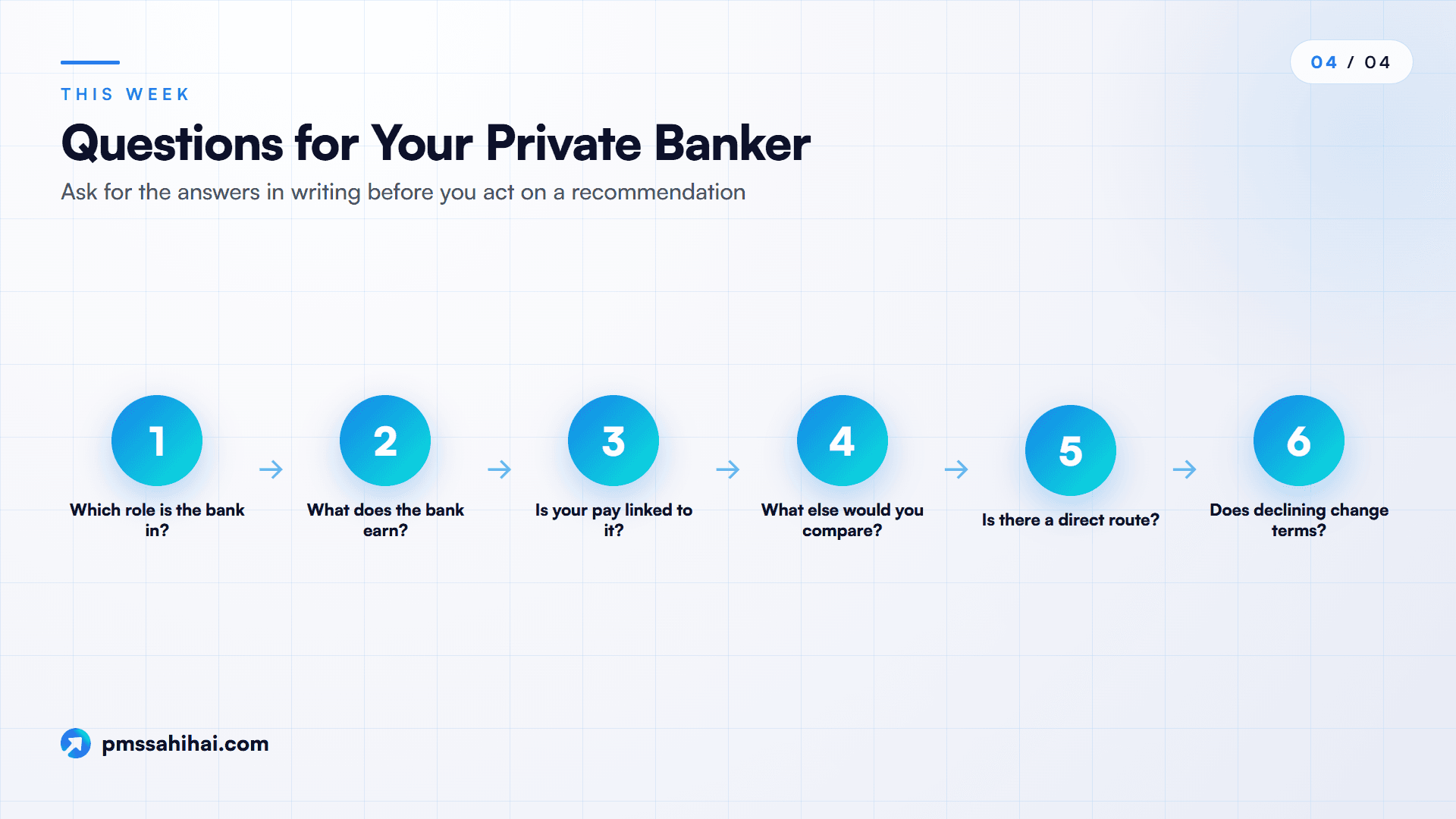
Questions to Ask Your Private Banker This Week
Print these or paste them into an email. A good banker will answer in writing without fuss.
- On this recommendation, is the bank acting as a distributor, an adviser or a discretionary manager?
- What exactly does the bank earn in the first year and each year after? In rupees, please.
- Is any of your own pay linked to this product or this category?
- Which other products on your shelf would you compare it with, and which are outside the shelf?
- Is there a direct route, and what would the fee be if I took it? PMS managers must offer direct onboarding, and AIF schemes must offer a direct plan.
- If I decline, does anything change about my loan or my account terms?
- Who answers my technical questions, and who covers me if you leave?
- What is the total I paid the bank last year, across fees and spreads?
If you already hold a PMS, check your statement. SEBI's client report format has a line called "Commission paid to Distributor." It tells you what the distribution layer actually costs.
The Bottom Line on Working With a Private Banker
A private banker is a bank's relationship lead for wealthy clients. What sets the role apart from a distributor is everything a bank can do: hold money, lend, move funds across borders and see your banking life in one place. On third-party investments, the role narrows into distribution, with commissions and conflicts to match, however polished the office. Value the banking work for what it is, and judge the investment recommendations on their own numbers, as you would from anyone else. A research tool like Nyra on PMS Sahi Hai can give you a second reading on the product, while the bank remains the place for the banking.
Test Your Private Banker's Next Pitch With Nyra
Your banker's next suggestion deserves the same scrutiny you would give any other pitch. Write down the product, the fee and the commission, and ask the questions above. Then compare it against what else is out there before you sign anything.
Compare PMS and AIF strategies on PMS Sahi Hai, ask Nyra to look at the fee and the fit, or book a private consultation and ask us what we would earn too. A good recommendation survives a second look, whoever makes it.
PMS Sahi Hai is a distributor of Portfolio Management Services and Alternative Investment Funds, APMI-registered (Registration No. APRN08358). This article is for education only and is not investment advice, a recommendation, or an offer to buy or sell any security. Investments in securities markets are subject to market risks; read all scheme-related documents carefully. Past performance is not indicative of future results. Consult your advisor before investing.
Ishaan founded PMS Sahi Hai to make India's PMS, AIF and GIFT City markets legible to serious investors, comparing every SEBI-registered manager on the same comparative basis, with no shelf products and no commission bias.
Frequently asked
What is a private banker in simple words?
A private banker is a bank employee who looks after a wealthy client's full relationship with that bank. They handle deposits, loans, forex, investments and introductions to specialists from one point of contact. In India, this is a job title, not a separate licence, and each bank sets its own entry criteria and its own name for the role.
Is a private banker the same as a relationship manager?
Usually, yes. A private banking relationship manager and a private banker tend to mean the same job, though bank titles vary from partner to wealth manager. A branch relationship manager serving ordinary customers may have a narrower scope. Ask what the title covers at your bank, and who stands behind the person you meet.
How do private bankers get paid?
Private bankers are paid by their employer, not by clients, usually through salary and variable pay. The bank earns from interest spreads, service fees and commissions on third-party products it sells, and banks rarely publish how bankers are measured. Bloomberg reported in 2025 that newer wealth firms were offering 50% or more of revenue generated. Ask your banker directly how this product affects their pay.
Is a private banker a distributor?
Often, for investments. When a banker recommends a third-party mutual fund, PMS or AIF, the bank usually acts as a distributor and earns commission from the provider. SEBI's PMS rules require anyone distributing PMS to register with APMI, and require clients to be told the commission. On deposits and loans, the same banker is acting for the bank in its own business.
What can a private banker do that a distributor cannot?
A private banker can draw on the bank itself. That means holding your deposits, taking a loan to the bank's own credit team, handling remittances and forex, and seeing your banking and investments together. A stand-alone distributor can only refer you for these services. On third-party investments, the two can sell the same products, so the difference there is much smaller.
Is a private banker a fiduciary in India?
Do not assume so. SEBI's FAQ says a registered investment adviser acts in a fiduciary capacity, and a bank's distribution work is treated separately. Distributors follow a code of conduct, and from January 2027 RBI's directions add suitability and refund duties for banks. If you want advice with no product commission, ask for a SEBI-registered investment adviser, and consult a lawyer on any specific dispute.
Who qualifies for private banking in India?
Each bank sets its own bar, usually through a relationship value combining deposits, balances and investments, sometimes across a family. IndusInd's Pioneer Private, for example, asks for a ₹1 crore average quarterly balance or a ₹3 crore net relationship value with a ₹5 lakh balance. Third-party directories report higher thresholds at some banks. Check the current terms with the bank directly.
What happens if a private banker mis-sells a product?
Complain first to the bank in writing, and keep the sale documents. Under RBI's directions effective 1 January 2027, a bank must refund the amount paid and compensate for losses under its policy where mis-selling is established. The default complaint window is 30 days from receiving the agreement unless the sector regulator sets another. Escalate through the RBI complaint portal or SEBI SCORES, and consult a lawyer.
Keep reading
All articles
Key Functions of PoA in Portfolio Management: The Operating View
How a PMS PoA works day to day: trade execution, demat debit, bank mandates, corporate actions and fees, mapped to SEBI rules and limits.

What Are Rolling Returns? How to Read the Range, Not the Average
Rolling returns explained: the formula, a worked example, which windows to use, and how to read the worst, median and hit rate before you invest.

What Is Succession Planning? A Wealth Guide for Indian Business Families
Succession planning for Indian business families: ownership, management, family constitution, holding structures and the wealth outside the business.
Read it. Now pressure-test it.
Ask Nyra how this applies to your portfolio, or talk to our team, no pitch, no pressure.