
What Is Succession Planning? A Wealth Guide for Indian Business Families
Succession planning for Indian business families: ownership, management, family constitution, holding structures and the wealth outside the business.

Succession planning is how a business family decides, in writing and in advance, who will own the business, who will run it, and how the wealth around it passes on. These are three separate handovers, and most family disputes start when they are treated as one. A family constitution sets the rules, but it binds no one until its key terms sit in articles, shareholder agreements or trust deeds. Holding companies and family trusts keep control together, at the cost of RBI, SEBI and tax questions. PwC's 2019 survey found 60% of Indian family businesses planned a handover while only 21% had a robust, documented plan. This is general information, so take legal and tax advice before acting.
Why Succession Planning Decides Who Controls Family Wealth
Most Indian founders worry less about who inherits their shares than about the morning after. Who signs the bank mandate? Who chairs the board? What does the daughter in Singapore get if she has no wish to join the business? And what happens to the portfolio that the founder built from twenty years of dividends, which only he understands?
Those questions are what succession planning exists to answer. For a salaried professional, the same exercise is mostly about a will and some nominations. For a business family it is about control, because the family's largest asset is an operating company that needs someone in charge every day.
The stakes are large. Lawyers writing for the European Corporate Governance Institute in October 2026 put family businesses at about 70% of India's GDP, and said roughly two-thirds of the top 500 listed companies by market capitalisation are family-led. CFA Society India quoted about 65% in 2020. Treat those as estimates, but the direction is clear: much of Indian private wealth sits inside companies that a family controls.
This guide covers the business-family view: ownership, management, family governance, holding structures and the wealth that sits outside the company. It does not walk through wills, trust deeds or nominations clause by clause; those belong in a separate estate plan.
What Succession Planning Means for an Indian Business Family
Succession planning is the process by which a family decides how ownership, leadership and wealth will move from one generation to the next, and then puts those decisions into documents and structures that will hold when the founder is no longer there to explain them.
Parthiv Kamdar of Deloitte India framed it neatly in an Outlook Business interview in 2024: succession "must be planned with two things in mind: business succession and wealth succession." We would go one step further and split business succession in two, because owning a company and running it are different jobs.
The Three Handovers Every Plan Must Cover
| Handover | The question it answers | Typical tools | What goes wrong without it |
|---|---|---|---|
| Ownership | Who holds the shares and votes? | Holding company, family trust, shareholder agreement | Shares fragment across branches and no one has a majority |
| Management | Who runs the business and who chooses them? | Family charter, board process, professional CEO | The eldest child gets the job by default |
| Wealth | Who gets the money outside the business, and who looks after it? | Portfolio mandates, trusts, wills, nominations | Liquid wealth freezes, or the passive heir is left with illiquid shares only |
A plan can make very different choices on each line. A family can keep all the shares and hire an outsider as CEO. It can give one child control and compensate the others from the liquid portfolio. Family business succession only becomes workable once these choices are made separately.
How Common Written Plans Really Are
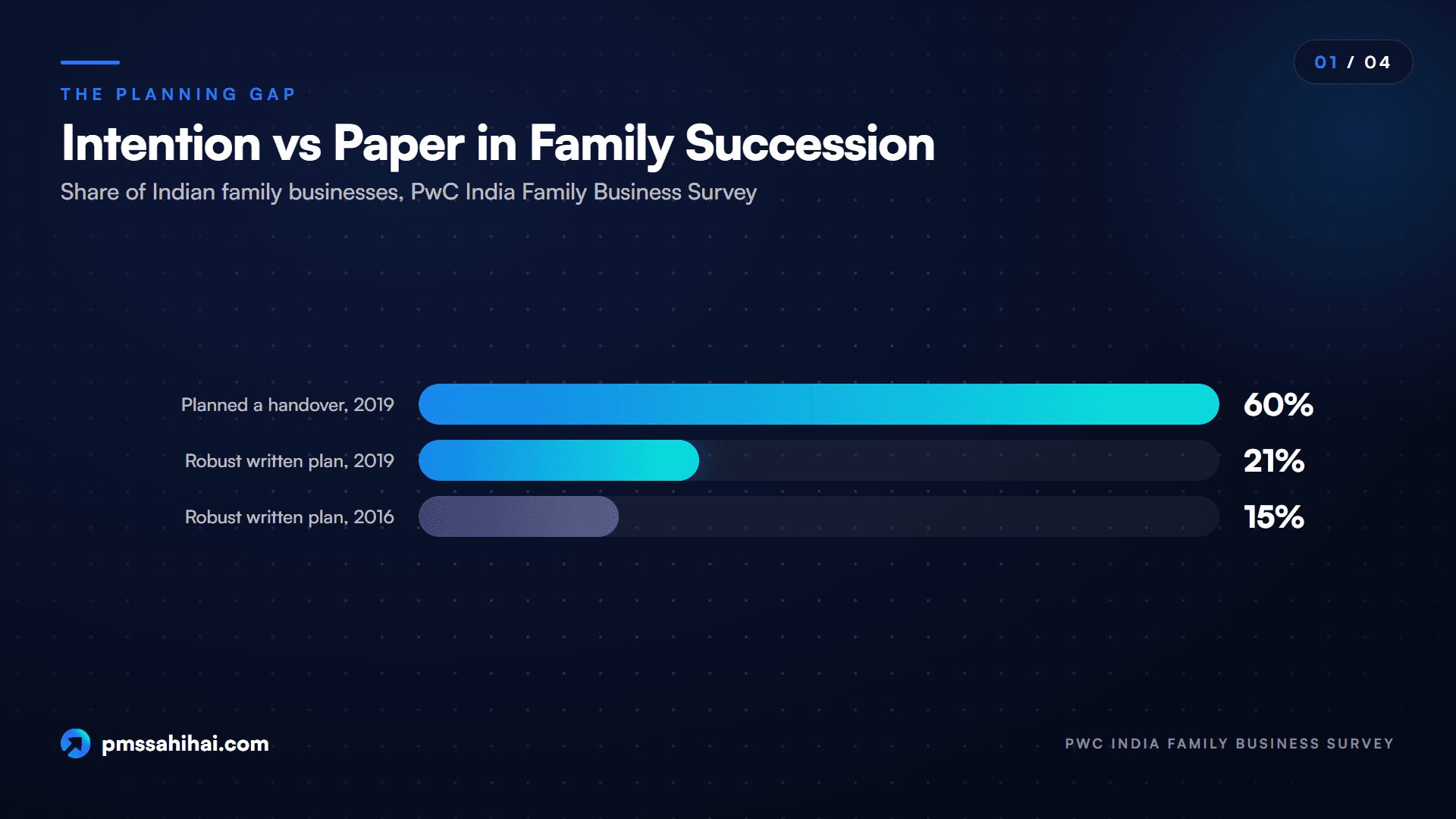
The gap between intention and paper is the most repeated finding in this field. PwC's India Family Business Survey 2019 reported that 60% of family businesses planned to pass on management or ownership to the next generation, but only 21% had a robust, documented and communicated succession plan. Its 2016 edition put that second figure at 15%. A 2025 HSBC report, cited by the ECGI authors, says nearly 80% of family businesses have family-oriented succession management plans.
Those numbers do not contradict each other so much as measure different things. "We know who takes over" is not the same as a document everyone has read. Be equally careful with the line that about 70% of family businesses fail to reach the third generation. It is repeated across adviser websites, but the Indian guides we reviewed quote it without naming a primary study, so treat it as folklore rather than data.
How Family Succession Evolved From Karta to Charter
For most of Indian commercial history, succession was not a plan. It was a default. In the Hindu joint family, a senior member called the Karta managed the family's economic affairs, and the business simply moved with the family's headship. The Hindu Undivided Family still exists as a tax and property concept, and a Delhi High Court ruling in 2016 confirmed that the eldest female member can also be Karta.
Three shifts ended the default.
The law changed who counts. The Hindu Succession Act, 1956 codified inheritance for Hindus, and the 2005 amendment made daughters coparceners with rights equal to sons. In Vineeta Sharma v. Rakesh Sharma (2020), a three-judge Supreme Court bench held that a daughter is a coparcener by birth, whether or not her father was alive on 9 September 2005. Any family whose plan assumes only sons will inherit is working from outdated law. Other communities follow different rules: Muslim personal law, and the Indian Succession Act, 1925 for others, so the plan must start from the family's own personal law.
Tax stopped being the driver. Estate duty applied from 1953 until it was abolished in 1985, and India has no separate inheritance tax today. That removed the old reason for restructuring and left the real one: keeping the business intact.
Very public disputes made the cost visible. Dhirubhai Ambani died on 6 July 2002, widely reported as without a will, and his sons divided Reliance in December 2005. The Godrej family took the opposite route: in April 2024 it announced a negotiated realignment into Godrej Enterprises Group and Godrej Industries Group. Rothschild & Co's India head notes that the GMR Group's family charter, one of the first publicly formalised in India, became a case study at Harvard and IIM Bangalore.
Regulation has followed. SEBI's listing rules now require boards of listed companies to satisfy themselves that plans are in place for orderly succession. And a new generation is arriving: a 2025 Barclays-Hurun report, as cited by the ECGI authors, found about three-quarters of the most valuable family firms are run by second-generation leaders.
Ownership and Management Are Two Different Handovers
The most useful idea in this subject is also the simplest: a child can inherit shares without inheriting the corner office, and a CEO can run a company without owning it.
PwC's 2016 survey showed families already thinking this way. About 35% planned to pass management to the next generation, while 48% planned to pass on ownership and bring in professional managers. Deloitte's Kamdar makes the same point: if heirs do not want an active role, the family can hire professional managers and keep ownership.
Separating the two forces a family to answer questions it usually avoids. Is joining the business a right or a job one has to qualify for? Who can remove a family member who is failing as a manager? Do those working in the business get salaries on top of dividends, and at what level?
A Worked Example of Active and Passive Heirs
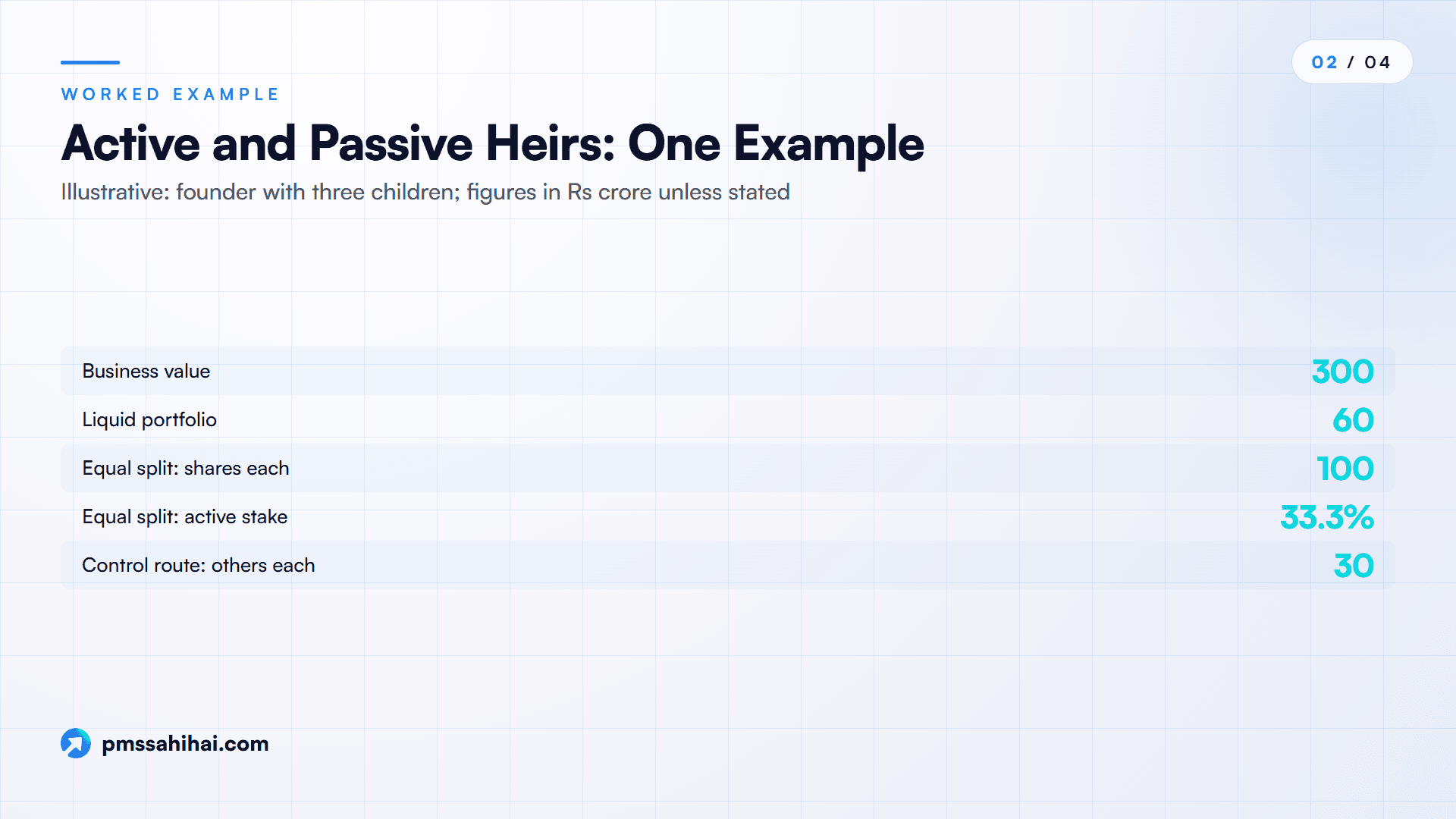
Here is an illustration with invented numbers. A founder owns 100% of an unlisted manufacturer valued at Rs 300 crore, and has Rs 60 crore in a liquid portfolio. He has three children. One runs the plant. One is a doctor. One lives abroad.
| Approach | What each child gets | What happens next |
|---|---|---|
| Equal split of everything | Rs 100 crore of shares and Rs 20 crore of portfolio each | The active child holds 33.3% and can be outvoted by two siblings who do not work there. Passive heirs want dividends; the business wants reinvestment |
| Control to the active child | Active child gets all shares; others get the portfolio | Rs 300 crore against Rs 30 crore each. The plan is simple but very unequal, and resentment is likely |
| Separate votes from value | Shares held through a family entity; active child controls votes, all three share economics, and a dividend and exit policy is agreed in advance | Value stays broadly equal and control stays in one place. Needs careful drafting, a valuation method and possibly a liquidity reserve |
There is no correct row. The third is what many advisers aim at, but it only works if the passive heirs can eventually get out at a fair price. That is why disagreements over valuation appear so often in adviser accounts of failed plans, and why a charter should set the valuation method years before anyone needs it.
How a Family Constitution and Family Council Work
If structures are the hardware of a succession plan, the family constitution is the operating system. It is a written agreement among family members on how they will behave as owners, and it goes by several names, including family charter.
What a Family Constitution Usually Covers
Practitioners describe similar contents. CFA Society India's 2020 session summary and a 2026 note by Dolce Vita Advisors on Legal 500 list most of the following:
- Values and vision: what the family wants the business to be, and what it will not do.
- Eligibility: who may work in the business, with what qualifications and at what level.
- Leadership: how the successor is chosen and how long a role lasts.
- Ownership: who may hold shares, including spouses and in-laws, and what happens on divorce or death.
- Money: dividend policy, family spending norms and the line between personal and family assets.
- Exit: how a member leaves and how shares are valued.
- Disputes: mediation first, then arbitration, with named steps.
- Amendment: how the document itself gets updated.
A family council is the body that runs all this. It is a forum of family members, separate from the board, that handles ownership policy, succession and conflict. CFA Society India's summary advises setting it up before the succession process starts. Treelife, a legal and advisory firm, says councils typically meet quarterly. The key discipline is keeping the council and the board apart: the council speaks for the owners, while the board governs the company.
Why a Family Constitution Alone Will Not Bind Anyone
This is the part that many families get wrong. A family constitution has no statutory standing in India. It is not a recognised instrument in the way a will or a trust deed is, and it cannot override mandatory law.
Indian courts have been consistent on the principle. In V.B. Rangaraj (1992), the Supreme Court declined to enforce share-transfer restrictions that were not in a company's articles. In Reliance Natural Resources v. Reliance Industries, a private family memorandum could not bind a listed company. Lawyers writing for ECGI add that in the Murugappa Group dispute, a tribunal held that a non-statutory constitution cannot override rights under the Companies Act and has to be embedded in the articles. That dispute ended in a confidential family settlement in August 2023.
The practical answer is layering. Keep values and intent in the constitution, which can stay non-binding, and write enforceable terms into the articles of association, shareholder agreements, trust deeds and wills. Courts have upheld genuine, good-faith family arrangements since Kale v. Deputy Director of Consolidation (1976), but property transfers can still raise registration and stamp duty questions. A lawyer should review which layer each clause belongs in.
Holding Structures That Keep Family Control Together
Without a structure, shares divide with every generation. Three children become nine grandchildren, and control fragments. A holding structure places the shares in a single entity, so individuals own an interest in that entity rather than the operating company.
| Structure | How it keeps control together | Main watch-out |
|---|---|---|
| Direct holding plus shareholder agreement | Family members agree on voting and transfer | Simple, but weakens as holders multiply and must reflect in the articles |
| Family holding company | Family owns the holding company; it owns the operating business | RBI's principal-business test, tax on two corporate layers |
| LLP | Partners set rights through the LLP agreement | Fits some businesses and asset classes but not all; take advice |
| Private family trust | Trustees hold shares for beneficiaries, so shares do not split on death | Discretionary trusts may be taxed at maximum marginal rate; listed-company conditions |
| HUF | The Karta manages joint family assets | Every coparcener, daughters included, can seek partition, so control can unravel |
Two points tend to be overlooked.
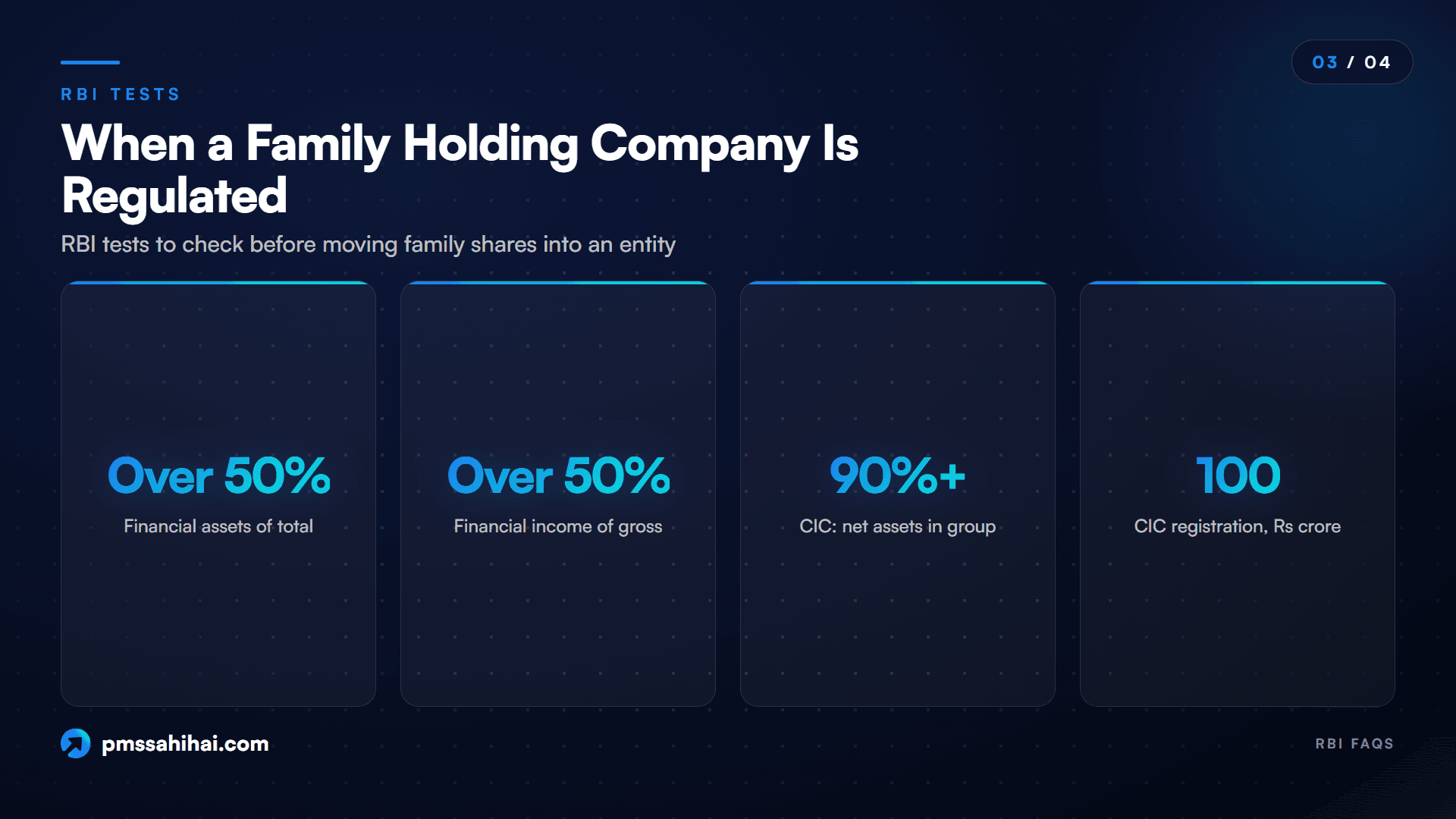
A family holding company can become a regulated entity by accident. Under the Reserve Bank of India's test, a company whose financial assets are more than 50% of total assets, and whose income from those assets is more than 50% of gross income, is treated as having financial activity as its principal business. RBI also has a separate category, the core investment company, for firms holding at least 90% of net assets in group companies, with a registration application due within three months of reaching Rs 100 crore, subject to other conditions. Have counsel check where your entity falls before moving shares in.
Tax is often simpler than families fear. Under the Income-tax Act, 2025, which replaced the 1961 Act from 1 April 2026, section 70(1)(b) (old 47(iii)) says a transfer by an individual or HUF under a gift, will or irrevocable trust is not a transfer for capital gains. Section 92 (old 56(2)(x)) taxes gifts above Rs 50,000 but excludes those from relatives under section 92(3)(a). Corporate-level transfers, dividends through layers and non-resident heirs are different matters, so take advice from a tax adviser for your facts. This is a summary, not a tax opinion.
What Changes When the Family Company Is Listed
Listed promoter families have one more audience: public shareholders. A plan that works for a private company can trigger an open offer or a disclosure failure.
The board has a duty. Regulation 17(4) of SEBI's listing regulations requires the board to satisfy itself that plans are in place for orderly succession to the board and senior management. A promoter's private plan does not discharge it.
Some transfers are exempt from an open offer. Regulation 10 of the takeover regulations exempts inter se transfers among immediate relatives, among persons named as promoters in the shareholding pattern for at least three years, and within certain holding-company groups, subject to stated conditions. Acquisition by transmission, succession or inheritance is also exempt.
Family trusts usually need a specific exemption. Moving promoter shares into a private trust typically goes through an application under regulation 11. SEBI's order of 3 July 2026 in the Waaree Energies matter sets out the conditions from its 2023 Master Circular. In short:
- The trust must be a mirror image of the promoters' holdings, with no change in ownership or control.
- Only individual promoters, their immediate relatives or lineal descendants may be trustees and beneficiaries.
- Beneficial interests cannot be transferred or pledged, and there can be no layering.
- Changes in trustees or beneficiaries must be disclosed within two days.
- An independent auditor must certify compliance every year.
- Transferors should have been disclosed as promoters for three years before the transfer, except for holdings on account of inheritance.
In that case, the three-year condition was not met, and the matter went to SEBI's Takeover Panel before the exemption was granted. Build this timing into the plan.
Exits need approval too. A member leaving the promoter group after a split must be reclassified under regulation 31A, which requires shareholder approval and other conditions. ECGI's authors point to promoter reclassifications in the Godrej settlement and a scheme of arrangement in the TVS Group demerger as examples of how the corporate side was handled.
Where Family Wealth Outside the Business Fits In
Most succession guides stop at the operating company. Yet the liquid portfolio often makes the plan work, because it is the one asset that divides cleanly.
That argues for planning the portfolio deliberately, not as leftovers:
- Decide who holds it. Individuals, an HUF, a holding company or a trust each face different tax and eligibility positions, and a portfolio manager or AIF will look at the investing entity, not at the family.
- Decide what it is for. Is the portfolio a reserve for buying out a sibling, an income source for passive heirs, or diversification away from a single business? Each purpose implies a different risk level.
- Check minimums for the entity. A portfolio management account has a Rs 50 lakh minimum per client under the current master circular, and most AIFs ask for Rs 1 crore. The SEBI (Portfolio Managers) Regulations, 2026 take effect on 1 April 2027.
- Avoid concentration twice over. Family wealth already depends on one company. A portfolio heavily weighted to the same sector does little to reduce that exposure.
- Plan for the signatory. Authority under a power of attorney ends when the principal dies or becomes of unsound mind under section 201 of the Indian Contract Act, 1872. If only the founder knows the accounts, the portfolio stalls exactly when the family needs it.
Technology has made some of this easier. SEBI has a centralised mechanism for reporting an investor's death through KYC registration agencies. Its 23 July 2026 transmission framework simplified paperwork for demat holdings up to Rs 30 lakh and set a 21-day claim timeline, and nomination rules allowing up to three nominees took effect on 1 September 2026. A nominee, however, receives assets as a trustee for the legal heirs rather than as owner, as the Supreme Court confirmed in Shakti Yezdani (2023). Consolidated reporting and online comparison tools also give a next generation a much faster way into a portfolio they did not build.
Benefits of Planning Succession Before You Must
Planning early does not remove conflict, but it changes when and how conflict happens. The benefits below are drawn from practitioner accounts, not from controlled studies.
- Disputes happen while the founder can settle them. Former BSE chairman Sethurathnam Ravi cites unclear transition planning as a leading cause of family disputes.
- Merit gets a real chance. Written eligibility rules let a family say no to an unqualified relative without it being personal.
- Successors get time. Treelife suggests a development programme starting five to ten years before transition.
- Capital gets easier to raise. Deloitte India's advisers argue that families should settle succession before seeking investors, since documented governance reassures them.
- Passive heirs have a path. A known exit and valuation method turns a potential fight into a process.
- The founder gets freedom. A founder with a plan can step back gradually rather than holding every decision until the end.
The day-to-day gain is simple: people refer to a document they all signed instead of reopening old arguments.
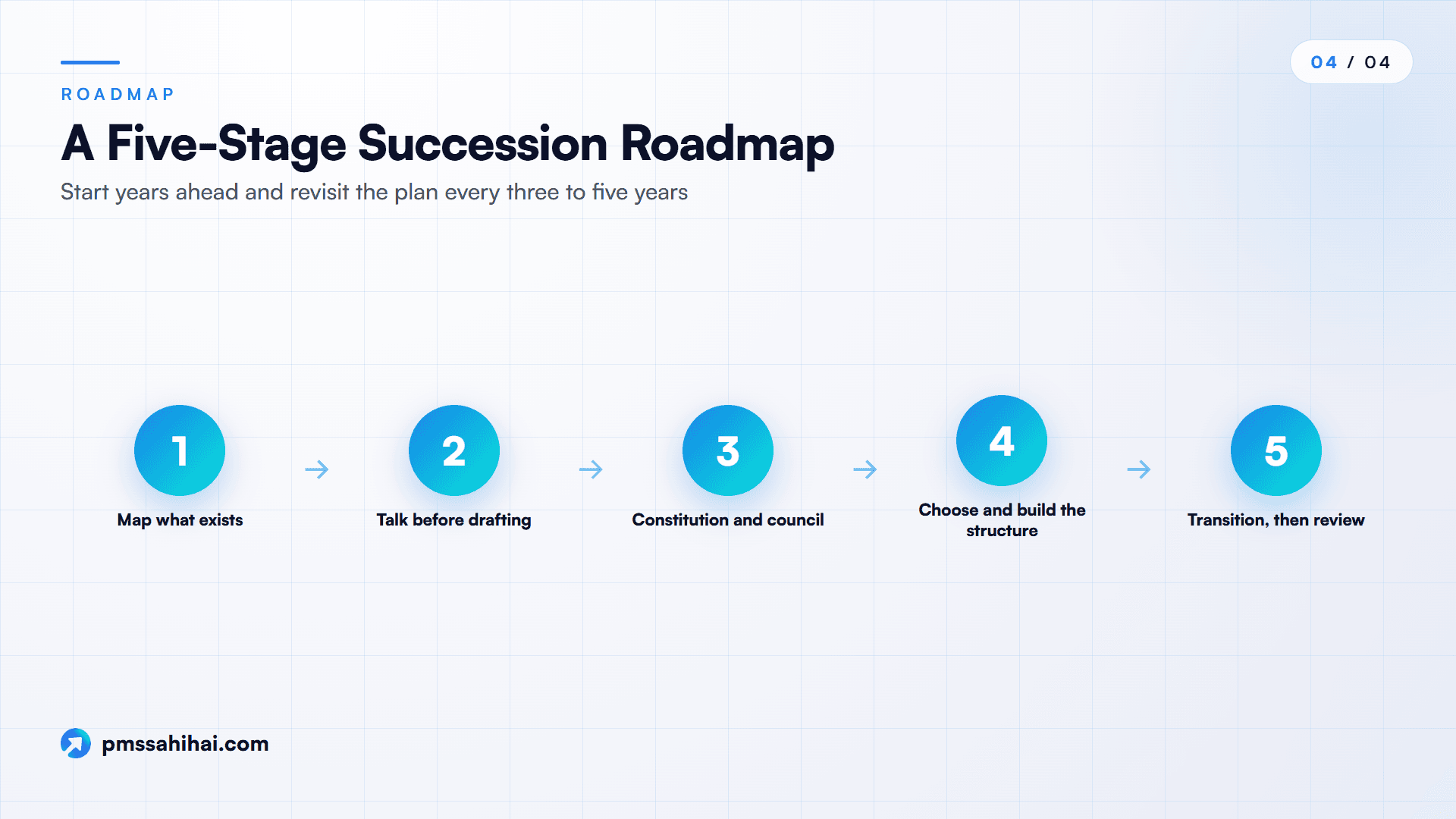
A Five-Stage Succession Planning Roadmap for Families
Timelines vary. PKC, a consulting firm, suggests starting 10 to 15 years ahead, which is sensible but not a rule. Late is still better than never.
- Map what exists. List every entity, shareholding, property and portfolio, plus who signs for each. Most families find surprises here.
- Talk before drafting. Ask each member what they actually want. Hubbis's interview with Shweta Shah puts mind-set first: the first generation must be willing to let go and the next must accept the responsibility.
- Write the family constitution and form the council. Agree on the rules for eligibility, leadership, dividends and exits. Use an outside facilitator, as both GMR and Godrej reportedly did with external advisers.
- Choose and build the structure. Pick the ownership vehicle with your lawyer and tax adviser, embed binding terms in articles and deeds, and check SEBI, RBI and FEMA positions. Non-resident heirs in particular need a review of FEMA and tax before any transfer.
- Transition, then review. Move roles in phases and let the successor run things while the founder is available. Revisit the plan every three to five years, and after any death, marriage, divorce, move abroad or large transaction.
How PMS Sahi Hai Helps Families Read the Inner Clauses of Succession Wealth
A plain statement first: PMS Sahi Hai does not offer succession planning. It does not draft family constitutions, set up trusts or holding companies, or give legal or tax advice. What it covers is one narrow part of this guide: the PMS and AIF portion of the portfolio a family will pass on, or use to fund a passive heir's share.
That matters because the next generation often inherits a set of mandates without the reasoning behind them. PMS Sahi Hai is a comparison platform for portfolio management services and alternative investment funds, and it helps a family turn that inheritance into questions it can ask:
- See what you hold, side by side. The PMS comparison tool and AIF comparison tool let a family line up strategies by category, benchmark and track record, so a new decision-maker is not relying on a founder's memory.
- Ask an analytical second opinion. Nyra, PMS Sahi Hai's AI-powered research tool, helps frame questions before a family sits down with a manager, such as how a strategy has done against its stated benchmark. Its scoring methodology is published, and strategies with under 12 months of record are not rated. Nyra is not a SEBI-registered investment adviser, and it cannot tell you who should own what.
- Learn the mechanics a successor will need. Published guides explain PMS eligibility rules, in-specie transfers and how a custodian keeps client assets apart from the manager.
Used this way, the data supports a family's plan. The plan itself stays with the family, its lawyer and its tax adviser.
Limits and Honest Risks of Family Succession Planning
- Documents do not create agreement. A constitution signed under pressure from a patriarch tends to fail after he is gone. Grant Thornton Bharat points to patriarchal authority, peace-keeping and deference as the reasons many families never have this conversation honestly.
- Enforceability is limited. As covered above, much of a constitution is only moral authority until it is written into binding documents, and those binding documents have to be consistent with each other.
- Structures carry running costs. Holding companies, LLPs and trusts bring filings, audits, trustee duties and potential regulatory status.
- Rigid plans age badly. A plan written for one business can fit poorly once the business, the laws or the family change.
- Trusts can reduce transparency. ECGI's authors point out that voting power exercised through trusts can be hard for public shareholders to see, and contested trusts can be slow to resolve.
- Disputes may still end in court. Some trust disputes may not be arbitrable, according to the cases cited in the Legal 500 note, so an arbitration clause is not a guarantee.
- Not every family needs a full apparatus. A small business with one child active may need only a good will, a shareholder agreement and a clear conversation.
Succession Planning Is a Control Decision Before a Tax One
Good succession planning starts with who owns, who runs, and what happens to the wealth around the business. Tax and structure follow from those answers, not the other way round. Keep the constitution for values and intent, put binding terms in documents that courts enforce, and treat the family portfolio as part of the plan.
Start while the founder can still settle disagreements. Take legal and tax advice before any transfer, since the right structure depends on your personal law, residency and business. When you reach the portfolio side, PMS Sahi Hai and Nyra can help the next generation read what the family holds, though neither replaces those advisers.
Compare the Portfolio Your Family Will Inherit
Once the family has agreed who owns and who runs the business, look next at the portfolio around it. List what you hold, who signs for it and what it is meant to do. Then use PMS Sahi Hai's comparison tool to see those strategies side by side, ask Nyra to frame your questions, and take the findings to your lawyer and tax adviser before making any change. If you would like to talk it through, book a conversation with the PMS Sahi Hai team.
PMS Sahi Hai is a distributor of Portfolio Management Services and Alternative Investment Funds, APMI-registered (Registration No. APRN08358). This article is for education only and is not investment advice, a recommendation, or an offer to buy or sell any security. Investments in securities markets are subject to market risks; read all scheme-related documents carefully. Past performance is not indicative of future results. Consult your advisor before investing.
Ishaan founded PMS Sahi Hai to make India's PMS, AIF and GIFT City markets legible to serious investors, comparing every SEBI-registered manager on the same comparative basis, with no shelf products and no commission bias.
Frequently asked
What is succession planning in simple words?
Succession planning is how a business family decides who will own the company, who will run it and how the wealth around it will pass to the next generation, then records those decisions in binding documents. It covers ownership, management and wealth as three separate handovers, and it is best done while the founder can still explain and settle them in person.
When should a family start succession planning?
There is no legal deadline, and advisers differ. Treelife suggests developing a successor five to ten years before transition, while PKC suggests starting ten to fifteen years ahead. The practical answer is to start before a health event, an outside investor or a family dispute forces the conversation. Revisit the plan every few years and after major family changes.
Is a family constitution legally binding in India?
Not by itself. A family constitution has no statutory standing in India and cannot override mandatory law. Its key terms become enforceable only when they are written into binding documents such as articles of association, shareholder agreements, trust deeds or wills. Keep values in the constitution, move operative clauses into those documents, and ask a lawyer to check that they are consistent.
What does a family council do?
A family council is a forum of family members, separate from the company's board, that represents the owners. It oversees the family constitution, handles ownership policy, employment of relatives and conflict, and prepares the family's views for the board. Treelife says councils typically meet quarterly. CFA Society India's session summary recommends setting one up before the succession process begins, not after disputes emerge.
Do transfers to a family trust trigger an open offer?
For listed companies, they can. Transfers among immediate relatives and long-standing promoters, and acquisitions by inheritance, have exemptions under regulation 10 of SEBI's takeover rules. A private family trust usually needs a specific exemption under regulation 11, with conditions such as being a mirror image of promoter holdings, no layering and annual auditor certification. Check timing with counsel.
Do daughters have a right in a family HUF business?
Yes, where Hindu law applies. Following the 2005 amendment to the Hindu Succession Act and the Supreme Court's 2020 ruling in Vineeta Sharma, a daughter is a coparcener by birth with rights equal to a son's in coparcenary property, whether or not her father was alive in 2005. Earlier completed partitions may stand, so take legal advice on your facts.
Is there inheritance tax in India?
India has no separate inheritance tax, as estate duty was abolished in 1985. Under the Income-tax Act, 2025, section 70(1)(b) says a transfer by an individual or HUF under a gift, will or irrevocable trust is not a capital-gains transfer. Heirs may still pay tax on later income or sale, and stamp duty can apply, so consult a tax adviser.
Does a family holding company need RBI registration?
It depends on its assets and income. RBI treats a company as having financial activity as its principal business if financial assets exceed 50% of total assets and income from them exceeds 50% of gross income. Core investment companies have a separate test and a Rs 100 crore trigger, subject to other conditions. Ask counsel to assess the entity before moving shares.
Keep reading
All articles
Key Functions of PoA in Portfolio Management: The Operating View
How a PMS PoA works day to day: trade execution, demat debit, bank mandates, corporate actions and fees, mapped to SEBI rules and limits.

What Are Rolling Returns? How to Read the Range, Not the Average
Rolling returns explained: the formula, a worked example, which windows to use, and how to read the worst, median and hit rate before you invest.

What Is a Private Banker? What They Do That a Distributor Doesn’t
What is a private banker? The bank role, the credit work a distributor can't do, how they are paid, and which conflicts to question.
Read it. Now pressure-test it.
Ask Nyra how this applies to your portfolio, or talk to our team, no pitch, no pressure.