
Special Situations Fund in India: How SSFs Invest in Distress
What a special situations fund buys, SEBI's ₹10 crore SSF rules, how stressed loans, ARC receipts and IBC deals work, returns and risks.

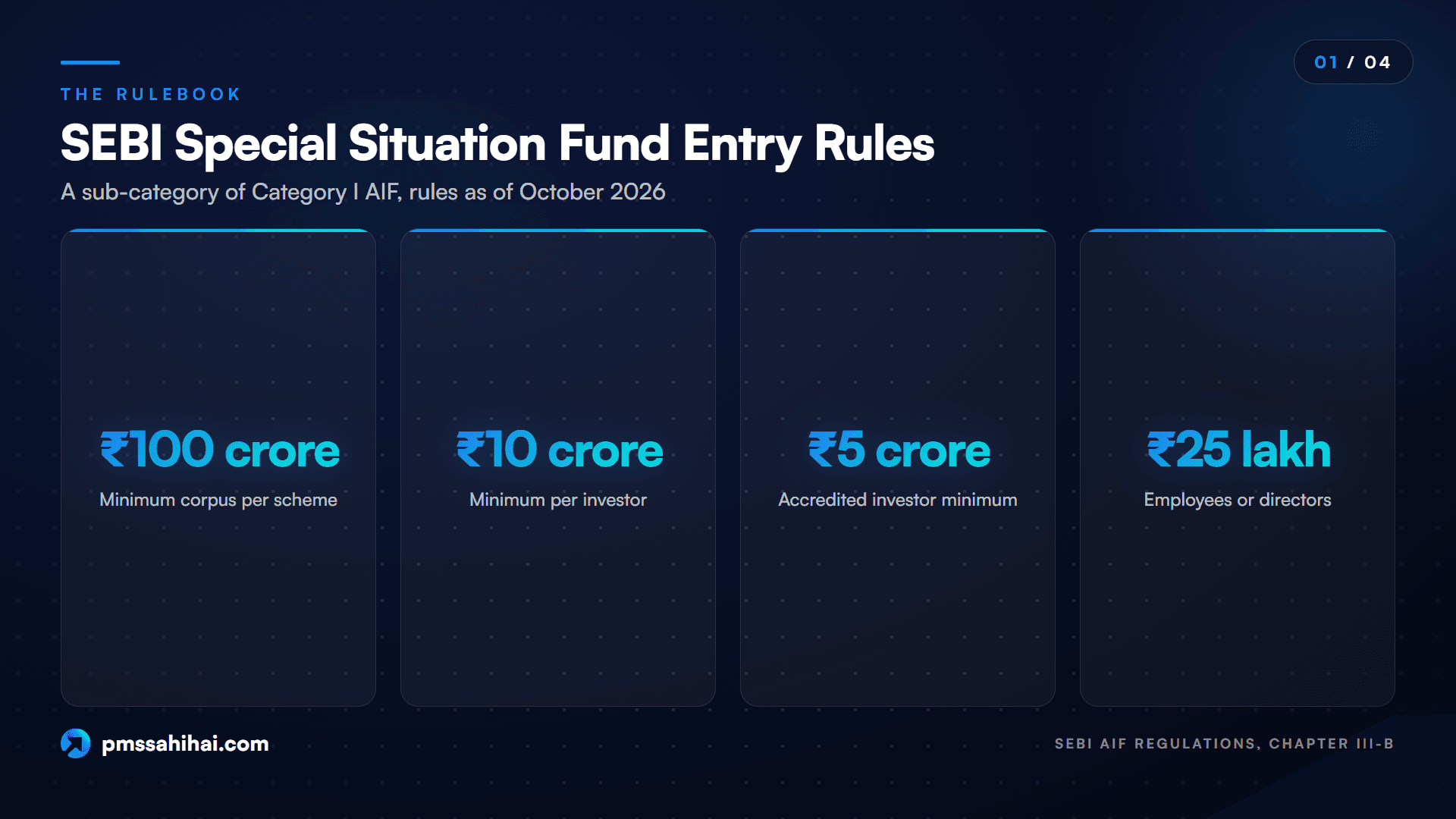
A special situations fund buys into companies at a turning point: a default, an insolvency, a restructuring, a demerger or a turnaround. In India the term also has a legal meaning. Since 24 January 2022, SEBI has allowed a special situation fund (SSF) to be registered as a sub-category of Category I AIF that may only buy special situation assets: stressed loans, security receipts issued by asset reconstruction companies, and securities of distressed companies. It may also bid for companies under the Insolvency and Bankruptcy Code. Each scheme needs a ₹100 crore corpus, and investors commit at least ₹10 crore (₹5 crore if accredited, ₹25 lakh for the manager's staff). Rules in this guide are as checked on 26 October 2026.
What a Special Situations Fund Actually Does
A special situations fund buys what is broken, being split up or being rescued, at a price that reflects the trouble, betting it pays less than the asset will be worth once the event is over.
Globally, "special situations" covers distressed debt, bankruptcies, restructurings, spin-offs, mergers and turnarounds: cases where an event, not normal trading, sets the price.
In India, the phrase has a second, narrower meaning. SEBI's AIF Regulations, as amended to 14 July 2026, define a special situation fund as a Category I AIF that invests in special situation assets and may act as a resolution applicant under the Insolvency and Bankruptcy Code (IBC). That definition is almost entirely about stressed assets and distressed assets: bad loans, the security receipts that asset reconstruction companies (ARCs) issue when they buy bad loans, and the shares or bonds of companies in default.
So when a manager in India markets a special situations fund, ask which one it is: a registered SSF under Category I, a Category II AIF running a distressed-credit strategy, a GIFT City vehicle, or an equity strategy hunting demergers and turnarounds. The rules, minimum ticket and risks differ for each.
This guide focuses on the SEBI special situation fund, then shows where spin-offs and turnarounds fit, what the data says and how to judge a manager. Performing private credit, lending to healthy companies, is a different strategy covered separately.
How Special Situation Funds Came Into Existence in India
India's bad-loan problem built the case for this fund type over two decades.
- 2002: the SARFAESI Act set up the framework for asset reconstruction companies and the security receipts they issue to fund bad-loan purchases. AIFs are now notified as qualified buyers under that Act.
- 1 December 2016: the corporate insolvency resolution process (CIRP) under the IBC came into force, giving creditors a court-supervised route to sell or rescue defaulting companies.
- 24 September 2021: RBI issued its Master Direction on transfer of loan exposures, with a dedicated clause (clause 58) on who could buy stressed loans.
- 28 December 2021: the SEBI Board approved a new special situation fund sub-category.
- 24 January 2022: SEBI inserted Chapter III-B into the AIF Regulations, creating the special situation fund.
- 27 January 2022: a SEBI circular introducing the SSF sub-category set the numbers: ₹100 crore corpus, ₹10 crore minimum investment, a six-month lock-in on stressed loans bought from lenders.
- 28 November 2023: SEBI consulted on tighter rules, including checks that no SSF investor is barred from bidding under section 29A of the IBC, a related-party ban and trade reporting.
- 28 November 2025: RBI replaced its loan-transfer rules with the Transfer and Distribution of Credit Risk Directions, 2025.
- 6 April 2026: the IBC (Amendment) Act, 2026 received assent; most of it took effect on 26 May 2026, with the new creditor-initiated process, group and cross-border insolvency left for later notification (as reported by the IBBI for April–June 2026).
- 3 June 2026: SEBI's new Master Circular for AIFs restated the SSF norms and pointed them to the 2025 RBI Directions.
The SSF was designed to sit next to the ARC, not replace it. And the 2023 proposals do not appear in the AIF Regulations as amended to 14 July 2026 or in the June 2026 Master Circular, so treat them as proposals until notified.
SEBI's Special Situation Fund Rules at a Glance
The SEBI special situation fund rules come from three places: Chapter III-B of the AIF Regulations (regulations 19I to 19M), the general rules for Category I funds that still apply, and Chapter 9 of the Master Circular for AIFs dated 3 June 2026. Here is the full picture as of October 2026.
| Rule | What it says for an SSF |
|---|---|
| Category | Sub-category of Category I AIF |
| What it may buy | Only special situation assets; may act as a resolution applicant under the IBC |
| Minimum corpus | ₹100 crore per scheme |
| Minimum investment | ₹10 crore per investor; ₹5 crore for an accredited investor; ₹25 lakh for employees or directors of the SSF or its manager |
| Investors it cannot take | Other AIFs, unless they are themselves SSFs |
| Concentration | The 25% single-investee cap for Category I and II AIFs does not apply |
| Geography | The general permission to invest outside India does not apply, so the SSF invests in India only |
| Prohibited investments | Its associates; units of other AIFs except SSFs; SSFs run by its own manager, sponsor or their associates |
| Stressed loans bought from lenders | Six-month minimum lock-in, except where the loan is recovered from the borrower |
| Investor due diligence | Same initial and continuing checks RBI requires for ARC investors, when buying stressed loans |
| Structure | Close-ended, minimum tenure of three years; extension of up to two years with two-thirds investor consent |
| Leverage | No borrowing to invest; only short-term borrowing for temporary needs |
| Manager's skin in the game | Continuing interest of 2.5% of corpus or ₹5 crore, whichever is lower |
The relaxations fit the job. A distressed deal is usually one large, complex company, so a fund capped at 25% per company could not lead a resolution. The higher ticket reflects how hard these assets are to value and exit. Most Category I AIF explainers mention SSFs in one line and skip this detail.
What Counts as a Special Situation Asset
Regulation 19I(2) lists four buckets of special situation assets. Each one works differently, so it is worth taking them one at a time.
Stressed Loans and the RBI Transferee Question
The first bucket is stressed loans that are available for acquisition under RBI's loan-transfer rules, or that form part of a resolution plan approved under the IBC, or under any other RBI or government policy. RBI defines a stressed loan as one classified as a non-performing asset (NPA) or a special mention account (SMA).
The catch most explainers skip: under RBI's Transfer and Distribution of Credit Risk Directions for commercial banks, updated as on 1 October 2026, banks may generally sell stressed loans only to "permitted transferees" (banks, all-India financial institutions, small finance banks and NBFCs) and to ARCs. A wider route exists when a transfer is part of a resolution plan in which all lenders exit: the loan may then go to any class of entities permitted by statute or by a financial regulator. RBI's explanation lists banks, all-India financial institutions, NBFCs, ARCs and certain companies, and says the list will be updated as regulators permit new classes.
SEBI's Master Circular says an SSF may buy stressed loans under these Directions "upon inclusion of SSF in the class of entities" RBI permits. We searched the RBI text as updated on 1 October 2026 and found no mention of special situation funds or AIFs. In plain terms: the direct pipe from bank balance sheets to SSFs that the 2022 framework anticipated is still waiting on RBI. Until that changes, SSFs reach stressed loans mainly through the other three buckets and through IBC resolution plans.
Security Receipts Issued by Asset Reconstruction Companies
The second bucket is security receipts (SRs). When an ARC buys a bad loan from a bank, it pays partly with money raised by issuing SRs from a trust. SR holders get the recoveries, after the ARC's fees, as the ARC restructures, settles or enforces the loan.
AIFs are notified as qualified buyers under the SARFAESI Act, so they may subscribe to SRs. RBI's Directions for asset reconstruction companies give SR investors some protection. The ARC must itself hold at least 15% of the transferors' investment in the SRs or 2.5% of the total SRs issued, whichever is higher. It must get the SRs rated by a SEBI-registered rating agency within six months and declare a net asset value. Recovery must be planned within five years, extendable by the ARC's board to a maximum of eight years from acquisition.
That ceiling matters: an SSF buying SRs late in its life can be left holding an unfinished recovery.
Securities of Distressed Companies and the "D" Rating Test
The third bucket is shares, bonds and other securities of companies in trouble. A company qualifies if its stressed loans are available for acquisition or part of an IBC plan, if an ARC has issued SRs against its borrowings, if it is in an insolvency process, or if it has disclosed defaults to banks or debt investors that have continued for at least 90 days. For the last two cases, the company's rating must also have been cut to "D" or equivalent.
This is where an SSF can take equity in a turnaround. If a resolution plan converts debt into shares, or a defaulting company needs fresh capital, the SSF can own the upside of the recovery, not just the loan.
Bidding as a Resolution Applicant Under the IBC
The fourth route is the most ambitious. An SSF may act as a resolution applicant under the IBC, which means it can submit a plan to buy and rescue a company in insolvency. SEBI requires an SSF that does this to meet the eligibility rules in the IBC, including section 29A of the Insolvency and Bankruptcy Code, which bars, among others, certain defaulting promoters and their connected persons from bidding.
That is why SEBI consulted on investor screening in 2023: a barred promoter could otherwise come back in through a fund. The proposal has not yet been notified.
How a Special Situations Deal Works From Purchase to Exit
The mechanics are easier to see in a simple example. The numbers below are purely illustrative, not taken from any real fund.
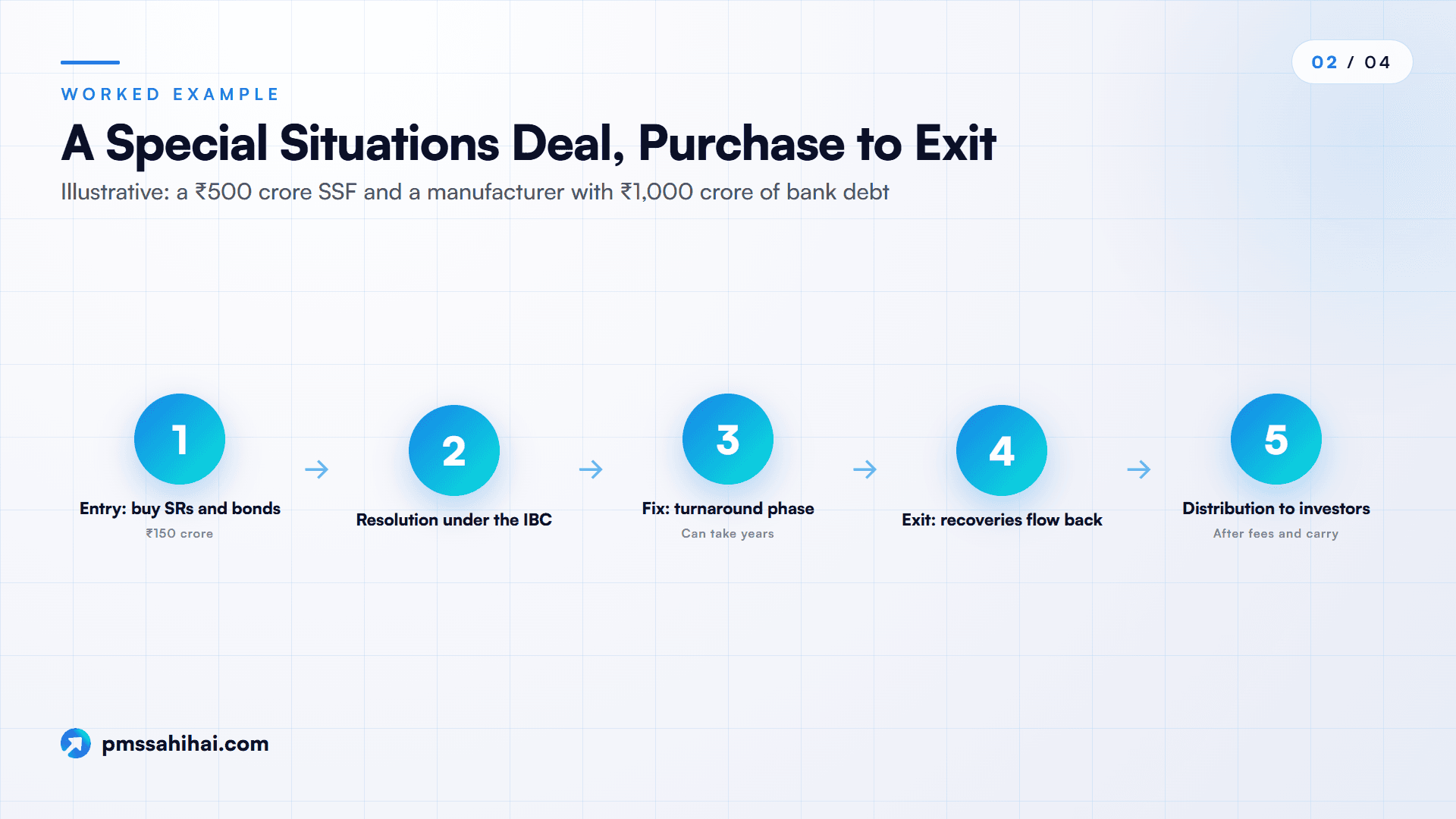
Imagine an SSF with a ₹500 crore corpus. A manufacturer has ₹1,000 crore of bank debt, in default for a year, mostly sold to an ARC that issued SRs.
- Entry. The SSF buys SRs and some listed bonds of the company for ₹150 crore, a price that reflects uncertain recovery.
- Resolution. The company enters the IBC. The SSF, working with the ARC, supports a resolution plan. Lenders take a haircut; part of the debt becomes equity.
- Fix. New management cuts costs, sells a non-core plant and restarts idle capacity. This turnaround phase can take years.
- Exit. Recoveries flow back as SR redemptions, bond repayments and, later, a sale of the equity stake.
- Distribution. The SSF returns cash to investors after fees and the manager's share of profits.
If the SSF eventually recovers ₹270 crore over four years, the gross multiple is 1.8 times. Stretch the same recovery to seven years and the annualised return falls sharply. In distressed investing, time is the hidden cost: the price paid matters, but so does how long it takes to get the money back.
Spin-Offs and Turnarounds Beyond SEBI's Definition
Outside India's legal definition, special situations investing also means event-driven equity. Two event types matter most.
A spin-off, which Indian law usually calls a demerger, splits one listed company into two or more. Shareholders receive shares of the new company in proportion to their holdings. Spin-offs can be mispriced when some holders sell the new shares for reasons unrelated to value, such as mandate limits. A recent Indian example is Tata Motors: its commercial vehicles business was separated and began trading on 12 November 2025, while the passenger vehicles, EV and Jaguar Land Rover businesses stayed in Tata Motors Passenger Vehicles Ltd.
A turnaround is a company recovering from poor results, too much debt or a failed strategy; many involve no default.
The key point: a SEBI-registered SSF can only buy special situation assets. A healthy company's spin-off is not one, and nor is a turnaround in a company that has not defaulted. To invest in those events, Indian investors use other vehicles: listed-equity strategies inside a PMS, Category III AIFs, or mutual funds with an opportunities or special situations theme. So when a fund calls itself a special situations fund, check whether its mandate is distressed credit, event-driven equity or both.
India's Stressed-Asset Market in Numbers
The data shows a small niche inside a large AIF industry, against a slow insolvency backdrop. The fund figures come from SEBI's quarterly AIF statistics and the insolvency figures from the IBBI quarterly newsletter for April–June 2026.
| Measure | Figure | As of |
|---|---|---|
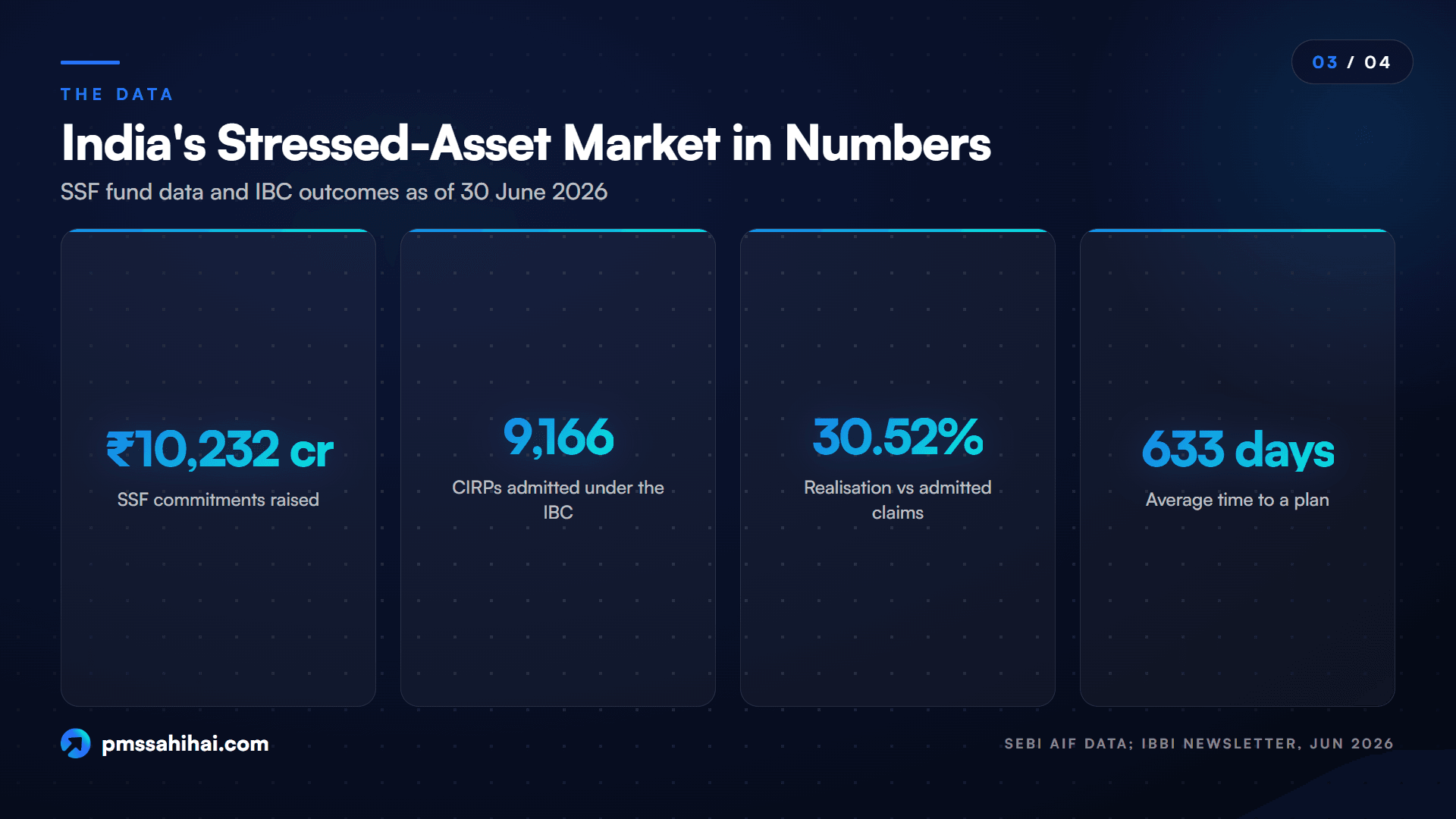
| SSF commitments raised (cumulative) | ₹10,232 crore | 30 June 2026 |
| SSF funds actually raised | ₹7,016 crore | 30 June 2026 |
| SSF investments made | ₹6,869 crore | 30 June 2026 |
| All Category I AIF commitments | ₹1,13,041 crore | 30 June 2026 |
| All AIF commitments | ₹17,53,070 crore | 30 June 2026 |
| CIRPs admitted under the IBC | 9,166 | 30 June 2026 |
| Resolution plans approved | 1,484 | 30 June 2026 |
| Recovered under resolution plans | ₹4.35 lakh crore | 30 June 2026 |
| Realisation vs admitted claims | 30.52% | 30 June 2026 |
| Realisation vs fair value | 94.72% | 30 June 2026 |
| Average time to conclude a CIRP that ended in a plan | 633 days | 30 June 2026 |
Three readings follow. SSFs hold under 1% of all AIF commitments and about 9% of Category I commitments, so this remains a specialist corner. Creditors under the IBC typically recover about 31 paise per rupee of claims, but close to fair value of the assets, which tells you the losses were mostly baked in before insolvency began. And processes run for roughly 21 months on average, before any turnaround work begins.
The IBBI also reports 3,074 liquidations, and that about 42% of companies rescued through plans had earlier been with the BIFR or were defunct: distress in India often runs deep before anyone acts.
How Technology and Data Shape Stressed-Asset Investing
Rules and data have pushed distressed investing towards more open markets.
- E-auctions. RBI lets banks sell loans through e-auction platforms. Where a bilateral deal involves lender exposure of ₹100 crore or more, it must be followed by a Swiss challenge auction, so other bidders can top the offer.
- Rated, valued receipts. ARCs must get SRs rated within six months and declare NAVs, giving SR investors a regular, if imperfect, valuation signal.
- Public outcome data. SEBI publishes quarterly AIF data by sub-category, including SSFs. The IBBI publishes quarterly data on admissions, timelines and recoveries.
- Performance benchmarking. SEBI's Master Circular requires AIFs to report valuation and cash-flow data to benchmarking agencies, which benchmark performance half-yearly.
- A stronger insolvency data trail. The IBBI says the 2026 IBC amendments strengthen the information utility framework and allow asset-wise or part-wise resolution, which can let buyers bid for parts of a company.
- Proposed trade reporting. SEBI's 2023 consultation suggested SSFs report stressed-loan deals to an RBI-notified trade-reporting platform. That is still a proposal.
Returns From Special Situations Funds and What Drives Them
We could find no public index of Indian special situation fund returns, and managers report their own numbers, so it pays to understand where returns come from.
Entry discount. Most of the return is made at purchase. Buying an SR or a defaulted bond well below the value that can realistically be recovered is the core of the strategy.
Recovery size and timing. The same recovery is a good return over three years and a poor one over eight. The IBC's 633-day average is only the legal phase; operational turnarounds take longer.
Control. Funds that lead a resolution plan shape the outcome; small SR holders depend on the ARC.
Equity upside. Converting debt to equity in a turnaround can multiply returns if the business recovers, and adds equity risk if it does not.
Fees and carry. Management fees and the manager's profit share sit between gross recovery and your net return.
Headlines need care. In May 2025, the manager of a GIFT City distressed fund reported exiting security receipts of Indian NPAs for "over six times" its USD 112 million investment, while the same report put net proceeds at about USD 600 million, which is closer to 5.4 times, and noted that borrowed money had been used to lift the IRR. Figures like these are self-reported and unaudited, and they describe one deal, not a fund's whole portfolio.
Expect returns to be lumpy and back-ended, with a J-curve in early years. Ask for net IRR and net multiples (DPI and TVPI) for every past fund, not the best single exit.
Advantages of Investing Through a Special Situation Fund
- A purpose-built rulebook. The exemption from the 25% concentration cap lets an SSF lead a single complex resolution, which a general fund could not.
- Access to IBC and ARC deals. An SSF can bid as a resolution applicant and buy SRs, routes most individual investors cannot use directly.
- Counter-cyclical opportunity. Legal commentators note that distressed debt opportunities are counter-cyclical; they tend to grow when the economy slows, which can diversify a growth-heavy portfolio.
- Pass-through taxation. As a Category I AIF, an SSF's non-business income is taxed in investors' hands, not twice.
- Manager alignment. The manager or sponsor must keep a continuing interest of 2.5% of corpus or ₹5 crore, whichever is lower.
- Lower ticket for qualified investors. Accredited investors can come in at ₹5 crore, half the general minimum.
- Transparent outcome data. IBBI and SEBI data let you test a manager's claims against market-wide recovery rates and timelines.
Minimum Investment, Eligibility and Tax for SSF Investors
Who Can Invest and How Much
The SSF minimum is ₹10 crore per investor, ten times the ₹1 crore floor for most AIFs. An accredited investor can invest ₹5 crore. Employees and directors of the SSF or its manager can invest ₹25 lakh. Another AIF can invest only if it is itself an SSF.
Individuals qualify as accredited with annual income of at least ₹2 crore, or net worth of at least ₹7.5 crore (₹3.75 crore in financial assets), or ₹1 crore income plus ₹5 crore net worth. An SSF buying stressed loans must also run RBI's ARC-investor due diligence on you, so expect deeper onboarding checks.
The commitment is usually drawn down over time rather than paid upfront, and the fund is close-ended with a minimum three-year life. Plan for the full term plus a possible two-year extension.
How SSF Income Is Taxed
A special situation fund is a Category I AIF, so the pass-through rules apply. Since the Income-tax Act, 2025 replaced the 1961 Act on 1 April 2026, they sit in section 224 (previously section 115UB). Income other than business income is taxed in the investors' hands as if they had earned it directly; business income is taxed at the fund level. The Finance Act, 2025 also treated securities held by Category I and II AIFs as capital assets, so gains on SRs, bonds and shares are capital gains.
Two grey areas remain. Loans bought outright are not obviously "securities", so how gains on purchased loans are characterised may be argued. And recoveries can arrive as interest, redemption or sale proceeds, each taxed differently. Rules are as of October 2026; consult a tax adviser before investing, especially if you are a non-resident.
How PMS Sahi Hai Helps You Read a Special Situations Fund
A special situations fund is hard to judge from a brochure. PMS Sahi Hai is built to make the comparison part easier, so here is exactly what it can and cannot do for this strategy.
- Compare the field. The AIF comparison page lists funds across Category I, II and III with strategy, vintage, AUM, one-year return, lock-in and a Nyra score. Use it to set a distressed or special situations offer against other Category I and II funds before you commit ₹10 crore.
- Line up different routes. The compare directory has PMS, AIF and GIFT City tabs and lets you shortlist up to four strategies side by side, useful when you are weighing an SSF against a GIFT City fund or a listed event-driven PMS.
- Ask Nyra the framing questions. Nyra, the platform's AI research tool, answers plain-English questions such as how an SSF differs from a Category II distressed fund. Its methodology scores strategies on five pillars and shows anything with under 12 months of track record as "Not Rated", which matters for young SSFs whose returns arrive late.
- Go deeper on the basics. Our guides to the AIF minimum investment rules and the pass-through tax rule cover what this post only summarises.
What it does not do: the site has no dedicated special situations screen, no IBC or ARC deal data, and no view into an SSF's security receipts. Scores look backwards, and Nyra says it is not a SEBI-registered investment adviser. Use the platform to build the shortlist and the question list, then take those questions to the placement memorandum and the manager.
Risks and Limitations of Special Situations Funds
- Recovery risk. Distressed assets are cheap for a reason. Creditors under the IBC have recovered about 30.52% of admitted claims on average. Buying cheaply is the only protection, and it can still fail.
- Time risk. CIRPs ending in a plan took 633 days on average, and ARC recoveries can run up to eight years. Delay erodes returns.
- Regulatory dependency. Direct purchase of bank stressed loans waits on RBI adding SSFs to its permitted list. The strategy may be narrower in practice than on paper.
- Concentration. Without the 25% cap, one failed resolution can dominate the fund's result.
- Illiquidity. Units are close-ended, the fund lasts at least three years, and there is no ready secondary market.
- Valuation uncertainty. NAVs of SRs and unlisted stakes rely on ratings and models, not trades.
- Litigation and legal risk. Promoters, operational creditors and other bidders can challenge plans, adding cost and delay.
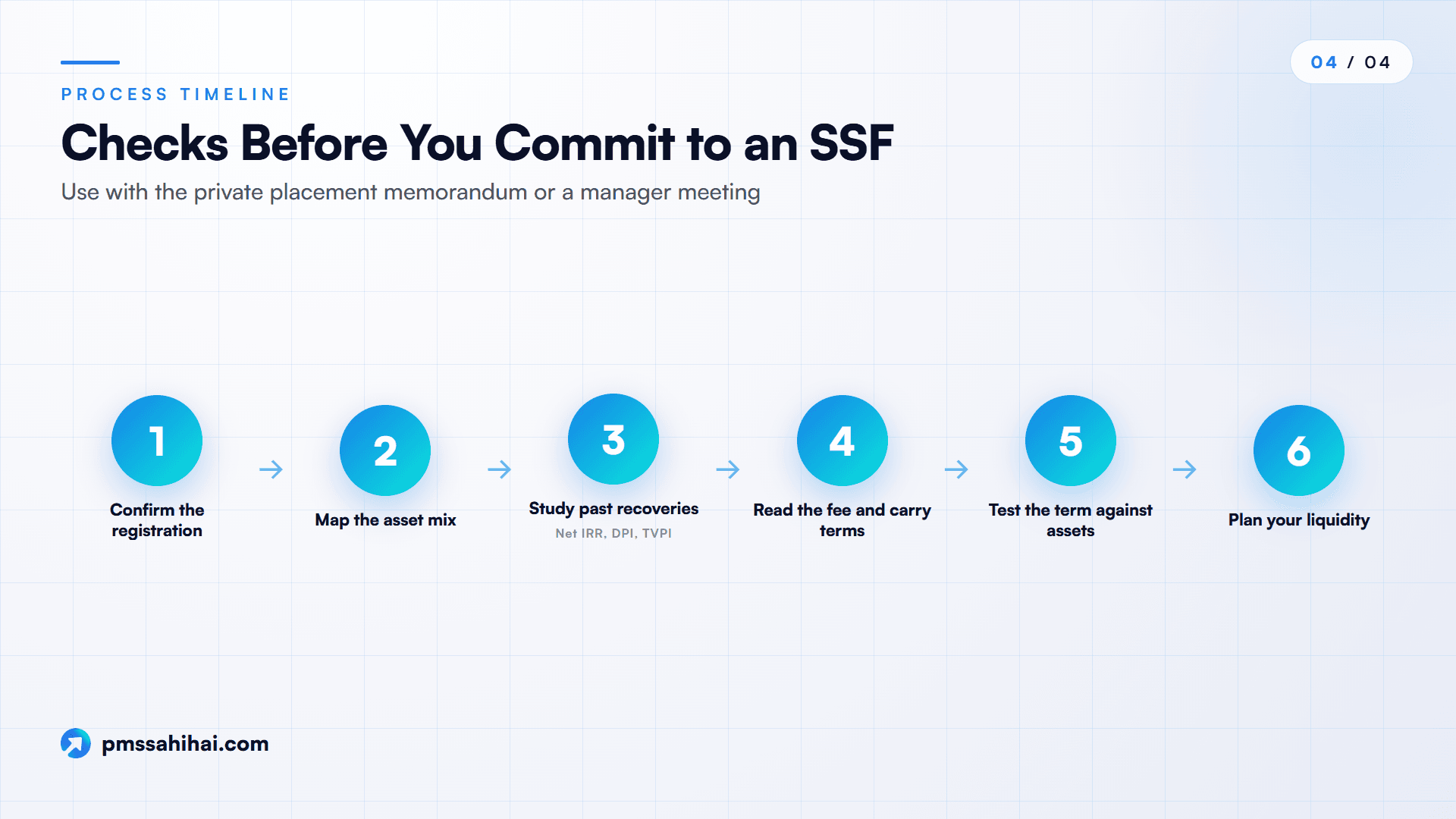
How to Evaluate a Special Situations Fund Before Committing
Use this checklist when you read a private placement memorandum or meet a manager.
- Confirm the registration. Is the scheme a registered Category I SSF, a Category II distressed fund, a Category III or GIFT City fund, or an equity event-driven strategy? Each has different rules.
- Map the asset mix. What share will go to SRs, IBC bids, defaulted bonds and equity? How will the fund buy stressed loans while RBI's list does not name SSFs?
- Study past recoveries. Ask for net IRR, DPI and TVPI for every earlier fund, including failed deals, and compare timelines with IBBI averages.
- Check the team's legal depth. Distressed outcomes are won in negotiations, committees of creditors and courts.
- Read the fee and carry terms. Look at the hurdle, catch-up and whether fees are on commitment or invested capital.
- Test the term against the assets. If the fund buys SRs with up to eight years to resolve, does its tenure fit?
- Look for conflicts. Ask how the manager handles ARC or lender relationships within its group.
- Plan your liquidity. Keep enough cash for drawdowns and assume nothing comes back for several years.
Is a Special Situations Fund Right for Your Portfolio
A special situations fund suits a narrow investor: one with ₹5 crore to ₹10 crore for a single illiquid strategy, a horizon of seven years or more, and patience for a J-curve. For that investor, a well-run SSF offers returns driven by legal and operational work rather than market mood.
For almost everyone else, the lesson is how distress is priced: IBC data shows losses are mostly locked in before insolvency starts, and buyers earn their return by paying the right price and moving quickly. For spin-offs and turnarounds without default risk, listed event-driven strategies are the realistic route.
Whatever you choose, read the mandate line by line: the label tells you little; the asset list, term and track record tell you almost everything. PMS Sahi Hai and Nyra can help you build that shortlist and question list, but the final read is yours.
Compare Special Situations Funds and Other AIFs Next
If a special situations fund is on your shortlist, compare it with the alternatives before committing ₹10 crore: a Category II distressed-credit fund, a listed event-driven strategy, or diversified Category I or II funds. Start on the PMS Sahi Hai AIF comparison page, put your questions to Nyra, then read the placement memorandum with the checklist above and get a tax adviser's view.
PMS Sahi Hai is a distributor of Portfolio Management Services and Alternative Investment Funds, APMI-registered (Registration No. APRN08358). This article is for education only and is not investment advice, a recommendation, or an offer to buy or sell any security. Investments in securities markets are subject to market risks; read all scheme-related documents carefully. Past performance is not indicative of future results. Consult your advisor before investing.
Ishaan founded PMS Sahi Hai to make India's PMS, AIF and GIFT City markets legible to serious investors, comparing every SEBI-registered manager on the same comparative basis, with no shelf products and no commission bias.
Frequently asked
What is a special situations fund?
A special situations fund invests in assets whose price is driven by an event such as default, insolvency, restructuring, a demerger or a turnaround. In India, SEBI also uses the term for a registered sub-category of Category I AIF that may buy only stressed loans, ARC security receipts and securities of distressed companies, and may bid for companies under the Insolvency and Bankruptcy Code.
What is the minimum investment in a special situation fund?
The minimum is ₹10 crore per investor. An accredited investor can invest ₹5 crore, and employees or directors of the fund or its manager can invest ₹25 lakh. Each scheme must also have a corpus of at least ₹100 crore. These figures come from SEBI's Master Circular for AIFs dated 3 June 2026.
Can a special situation fund buy bad loans directly from banks?
Only once RBI includes SSFs among the entities banks may sell stressed loans to. SEBI's rules allow it on that condition, but RBI's Directions as updated on 1 October 2026 do not name SSFs or AIFs. Today SSFs mainly use ARC security receipts, distressed securities and IBC resolution plans instead.
What are security receipts and can an AIF buy them?
Security receipts are instruments issued by an asset reconstruction company's trust to fund the purchase of bad loans; holders receive recoveries. AIFs are notified as qualified buyers under the SARFAESI Act, so they can subscribe. The ARC must hold at least 15% of the transferors' SR investment or 2.5% of the issue, whichever is higher.
Is there a lock-in on stressed loans bought by an SSF?
Yes. Stressed loans an SSF acquires from lenders under RBI's loan-transfer Directions carry a minimum lock-in of six months. The lock-in does not apply if the loan is recovered from the borrower. Separately, the fund itself is close-ended with a minimum three-year tenure, so your money is locked in for the fund's life.
How is a special situation fund taxed?
As a Category I AIF, an SSF gets pass-through treatment under section 224 of the Income-tax Act, 2025 (old section 115UB): income other than business income is taxed in investors' hands, while business income is taxed at the fund. Gains on securities it holds are capital gains. Consult a tax adviser for your case.
Is a special situation fund the same as a distressed debt fund?
Not exactly. An SSF is a specific SEBI-registered Category I sub-category with a ₹10 crore minimum and a fixed list of eligible assets. Many distressed debt or structured-credit strategies run as Category II AIFs or GIFT City funds under different rules. The strategy can look similar, but limits, investors and minimums differ.
Can a special situations fund invest in spin-offs?
A SEBI-registered SSF cannot buy a healthy company's spin-off shares, because those are not special situation assets. Spin-offs, demergers and non-distressed turnarounds are usually accessed through listed-equity strategies such as PMS, Category III AIFs or mutual funds with an opportunities theme. Check each fund's mandate.
Keep reading
All articles
What Is a Hybrid SIF? The Fixed-Income Alternative Nobody Explains
What a hybrid SIF is, how hybrid long-short funds earn from debt, arbitrage and options, how they are taxed, and the risks versus FDs and debt funds.

What Is a Hedge Fund in India? Why SEBI Calls It a Category III AIF
What a hedge fund in India is, why SEBI registers it as a Category III AIF, the strategies used, the 2x leverage cap and the Rs 1 crore entry rule.

What Is Co-Investment? How HNIs Invest Alongside AIFs in Single Deals
How AIF co-investment works in India: SEBI's CIV scheme vs the PMS route, accredited investor rules, the 3x cap, fees, tax and risks.
Read it. Now pressure-test it.
Ask Nyra how this applies to your portfolio, or talk to our team, no pitch, no pressure.