
Types of Power of Attorney for Property: What Holds Up in India
General, special and irrevocable power of attorney for property in India: registration, stamp duty and what Suraj Lamp means for GPA sales.


The main types of power of attorney for property in India are general, special and irrevocable, and each can be sorted further by the job it does, such as selling, managing or developing land. None of them transfers ownership: the Supreme Court said in Suraj Lamp (2011) that immovable property can be conveyed only by a registered deed. Registration and stamp duty depend heavily on the state, so a rate quoted online may not apply to you. A power of attorney also ordinarily ends when the owner dies, unless the agent holds a real interest in the property. Treat this as general information and have a property lawyer in the relevant state draft and check your document.
Why the Types of Power of Attorney for Property Matter
A son in Toronto needs to sell his late father's flat in Pune. A retired couple wants a nephew to collect rent and deal with the housing society. A landowner hands a plot to a builder. All three will hear the same advice: "Just give a power of attorney." They need three different documents.
A power of attorney is a written authority under which one person, the principal, lets another, the agent or attorney holder, act on their behalf. For property, the differences between documents are not technical trivia. They decide whether a sub-registrar will accept the paper, how much duty you pay, whether the authority survives a dispute, and whether a buyer ends up with good title.
Published guides often disagree on registration and stamp duty, and the old habit of "buying" flats through a general power of attorney survives long after the Supreme Court rejected it as a way to transfer ownership.
This guide sorts the types of power of attorney for property in India by what each one actually does. It stays with real estate: powers of attorney for securities and portfolios follow different rules.
Nothing here is legal advice. Property law in India changes from state to state, and the wording of your particular document matters more than its title. Consult a property lawyer before you sign, and a tax adviser if a sale is involved.
How Property Powers of Attorney Evolved in Indian Law
No single law governs the power of attorney for property in India. It sits at the meeting point of several old statutes, and each one answers a different question.
- 1872, the Indian Contract Act. Its agency chapter supplies the basic rules: how an agent's authority arises and how it ends. Sections 201 to 210 deal with termination.
- 1882, the Powers-of-Attorney Act. A short statute covering these instruments specifically.
- 1882, the Transfer of Property Act. This defines how immovable property is actually transferred, including sale under section 54 and the limited protection for part performance under section 53A.
- 1899, the Indian Stamp Act. It charges duty on instruments, and states set rates for many of them.
- 1908, the Registration Act. It says which documents must be registered, and sections 32 and 33 say who may present them and which powers of attorney the registering officer will recognise.
For decades, people in many cities "sold" property with an agreement to sell, a general power of attorney and a will, with no conveyance at all.
Then came three turning points. India joined the Apostille Convention, in force for India from 14 July 2005, which simplified use of documents signed abroad. On 11 October 2011 the Supreme Court decided Suraj Lamp and Industries v State of Haryana, which ended the idea that such a bundle could transfer title. And on 27 February 2025, in M.S. Ananthamurthy v J. Manjula (2025 INSC 273), the Court tightened the law on when a power of attorney can really be irrevocable.
The Main Types of Power of Attorney for Property Compared
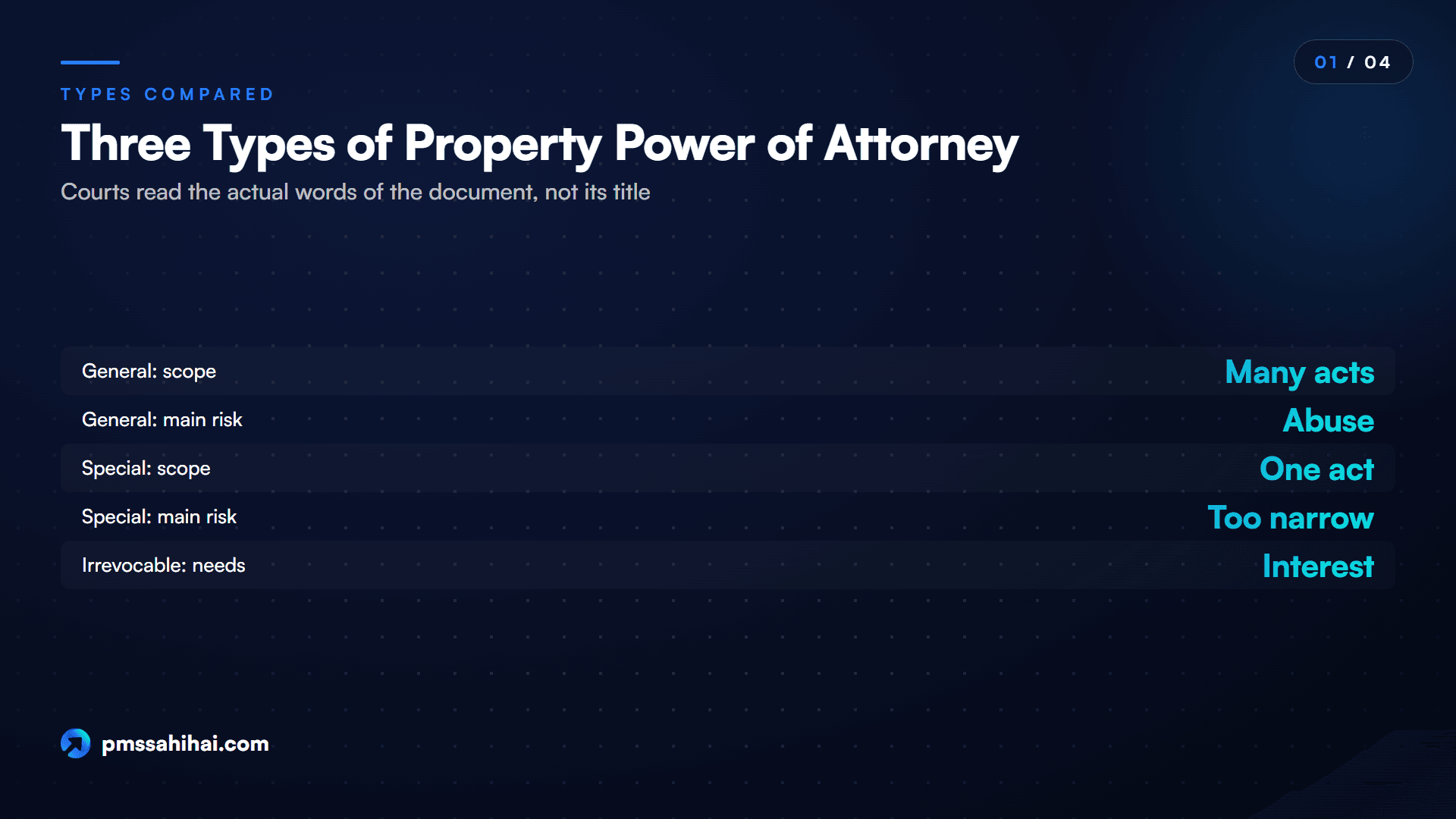
Indian law has no statutory menu of types. The categories are practical labels, and courts read the actual words, not the title.
| Type | What it covers | Typical property use | Key risk |
|---|---|---|---|
| General power of attorney | A range of acts over one or more properties | Managing an absent owner's estate | Broad authority, room for abuse |
| Special power of attorney | One named act or transaction | Signing one sale deed, one home loan, one registration | Too narrow if the deal changes |
| Irrevocable power of attorney | Authority protecting the agent's own interest | Securing a lender or developer | The word alone does nothing |
General Power of Attorney for Property
A general power of attorney gives the agent authority across a range of acts: collecting rent, paying dues, appearing before authorities, and, if it says so, selling. The word "general" does not mean unlimited. In K. Akbar Ali v K. Umar Khan (Supreme Court, 2021), as reported in legal commentary, a broad "all lawful acts" clause was held not to cover a sale. In Vijay Kumar v Kamlesh (Himachal Pradesh High Court, 2023), a power limited to litigation did not support a sale, so the agreement to sell the agent signed did not bind the owner.
If you want a sale power, write it out. If you are buying from an attorney holder, read the document, not the label. A general power of attorney also does not normally let the holder appoint someone else in his place: in A.C. Narayanan v State of Maharashtra (2013), the Supreme Court said delegation needs express permission.
Special Power of Attorney for One Deal
A special power of attorney names a specific act and ends when that act is done. It suits a one-off job: signing a particular sale deed, completing a registration, or handling a loan on a named flat. For most individuals with a single transaction, a special power of attorney is the safer starting point, since the agent's room to go beyond your instructions is small.
The drawback is rigidity. If the buyer changes, the price moves outside the stated terms, or the bank wants one more form, a tightly drafted special power may not stretch. Good drafting lists the connected acts: receiving the price, signing the deed, presenting it for registration, and getting the society's transfer done.
Irrevocable Power of Attorney Coupled With Interest
This is the most misunderstood type. Agency is normally revocable. Section 202 of the Contract Act makes one exception: where the agent himself has an interest in the property that forms the subject matter of the agency, the agency cannot be terminated to the prejudice of that interest, absent an express contract.
So an irrevocable power of attorney is a matter of substance, not wording. In Ananthamurthy the Supreme Court put it directly: "If the POA is not coupled with interest, no extraneous expression can make it irrevocable." In Seth Loon Karan Sethiya v Evan E. John (1969), by contrast, authority given to a bank to secure its liability could not be revoked, as reported in law-firm commentary.
The Ananthamurthy facts are a warning. In 1986 an owner gave a general power and an agreement to sell to the same person. He died in 1997. In 1998 the holder signed a registered sale deed in favour of her son. The Court held the power had ended on the owner's death and the deed failed with it. Signing the two papers together did not create an interest, and even if it could have, a transfer of that interest would have needed registration under section 17(1)(b) of the Registration Act.
Powers Sorted by the Job They Do
You can also sort the types of power of attorney for property by purpose. These are general or special powers drafted for a particular job, not separate legal categories.
- Sale power: authority to find a buyer or to complete with a named buyer, sign the deed, take the price, and appear for registration.
- Purchase power: common for non-residents buying a flat, covering the agreement, the home loan, possession and registration.
- Management power: rent, repairs, society dues, municipal tax and tenant dealings.
- Development power: the landowner authorises a builder to get approvals and deal with units. Suraj Lamp expressly treats development agreements as a genuine use.
- Litigation power: authority to file and defend property suits. It does not carry a right to sell.
Durable and Springing Labels in India
Some Indian guides list durable and springing powers as if they were standard options here. Be careful. These terms come mainly from other legal systems, where durable powers were developed because a power at common law ended on the principal's incapacity. In India, section 201 of the Contract Act ends agency on the principal's death or on becoming of unsound mind. Do not assume a foreign label keeps a power of attorney for property alive through incapacity, and ask your lawyer about alternatives.
Registration Rules for a Power of Attorney on Property
Separate three questions: must the document be registered, who must authenticate it, and what does registering it achieve?
Is a Registered Power of Attorney Compulsory?
Under the central Registration Act, 1908, law-firm commentary reads section 17 as not requiring a power of attorney to be registered, even for immovable property, because the power only authorises a future document. Section 18 permits voluntary registration. Other guides state flatly that registration is mandatory for any power involving a sale or lease. That overstates the central position, but it reflects a real practice concern, because states have changed the rule.
Kerala, Odisha, Gujarat and Rajasthan have, according to one law firm's review, amended section 17 for powers relating to immovable property, and Maharashtra is reported to require registration of an irrevocable power relating to transfer of immovable property. The exact scope differs, so do not rely on a list in any article, including this one. Ask the sub-registrar or your lawyer what applies where the land sits.
There is also the point from Ananthamurthy: if a holder claims a real interest in the property under the document, that interest needs registration under section 17(1)(b).
Even when optional, a registered power of attorney has practical value, since it leaves a public record that buyers and banks can check. A notarised document carries a presumption of due execution under the Evidence Act, but that is a presumption, not proof of authority to sell.
Registration also does not confirm title. In K. Gopi v Sub-Registrar (2025), the Supreme Court said the registering officer "is not concerned with the title held by the executant" and that a registered document transfers only those rights, if any, that the executant has. Registration does not cure a bad chain of title.
Who Must Authenticate the Document
Section 33 of the Registration Act matters when the attorney will present a document for registration. Broadly, for a principal living in India, the recognised power is one executed before and authenticated by the Registrar or Sub-Registrar of the area. For a principal abroad, it may be executed before and authenticated by a notary public, a court, judge, magistrate, Indian consul or vice-consul, or a representative of the Central Government.
Authenticating a power under section 33 is not the same as registering it, so confirm what the local office will accept.
The Open Question on Executants
In Rajni Tandon (2009), the Supreme Court said an agent who signs a deed as executant can present it under section 32(a), so section 33 does not come into play. In G. Kalawathi Bai v G. Shashikala (2025 INSC 851), a two-judge bench disagreed and referred the matter to a larger bench. As far as we could find, no larger-bench decision has been reported as of October 2026. A buyer relying on an attorney-signed deed should ask whether the power meets section 33 anyway.
Stamp Duty on Power of Attorney Differs by State
Stamp duty on power of attorney is where online figures are least reliable. States set rates for documents outside the Union list, so there is no national number. What can be said safely is how the duty tends to be structured.
- The more the document resembles a sale, the more it costs. A power of attorney for property that only manages rent normally costs far less than a power to sell for consideration.
- Family and consideration matter. Many states distinguish a power given to close relatives without payment from one given to outsiders or for money.
- Value can be the base. A power that works like a transfer may be charged on the value of the property, not at a flat rate.
Maharashtra illustrates this. A BCA Journal article from April 2015 lists a power given for consideration authorising a sale, and a power for development rights, among instruments charged on the higher of consideration or market value. Lawyers' answers on public forums report a Rs 500 duty for a sale power given free to close relatives there, and conveyance-level duty for others. Those reports are not an official schedule, and we could not confirm current rates from the department's published tables, so check before you rely on them.
We have left out a state-by-state rate table because the figures we found conflicted, with no official schedule to settle them. Use your state's current stamp schedule and the sub-registrar's office. Also ask whether duty paid on the power gets any credit against duty on the eventual sale deed, and keep the original and the stamp proof.
What the Suraj Lamp Ruling Means for a GPA Sale
The GPA sale is the Indian property shortcut the courts have closed. The Supreme Court's order of 11 October 2011 in Suraj Lamp and Industries (SLP (C) 13917 of 2009), by Justices R.V. Raveendran, A.K. Patnaik and H.L. Gokhale, addressed what the Court called SA/GPA/Will transactions: an agreement of sale, a general power and a will used together in place of a deed.
The Court listed why people used them, including avoiding restrictions on transfer, stamp duty and registration charges, and capital gains tax, and hiding unaccounted money. Business Today reported at the time that the Court also urged states to lower duty, since high rates encourage undervaluation.
The Three Holdings to Remember
- A power of attorney transfers nothing. "A power of attorney is not an instrument of transfer in regard to any right, title or interest" in immovable property. It creates agency, and it is generally revocable.
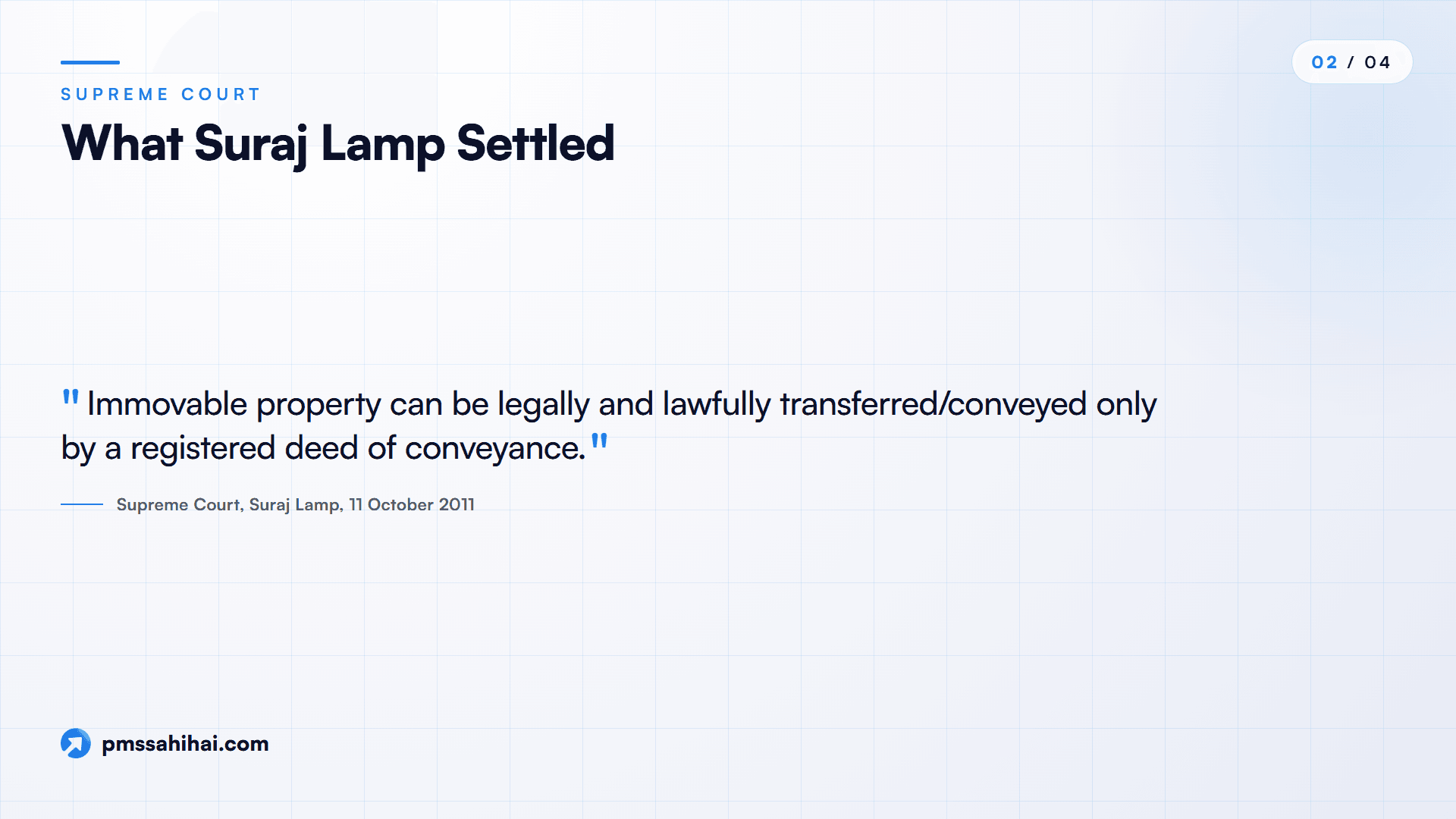
- Only a registered conveyance works. "Immovable property can be legally and lawfully transferred/conveyed only by a registered deed of conveyance."
- An agreement to sell is not a sale. It gives contractual rights and, within limits, protection under section 53A, but not title.
What the Court Did Not Ban
Headlines saying "GPA sales are illegal" miss the balance. Paragraph 19 says the observations are not meant to affect genuine transactions, and gives examples: a power to a spouse, son, daughter, brother, sister or relative to manage affairs or to execute a conveyance, and development agreements with a builder. An attorney may still sign a conveyance for an owner, and a registered sale deed signed under a valid power can transfer title.
The difference is this. A special power of attorney or general power of attorney used to carry out a registered sale by the true owner is fine. A power used instead of a registered sale does not give ownership.
What About Older GPA Purchases?
Paragraph 18 is the part older buyers should read closely. Parties asked for relief, and the Court said existing deals "can continue to be treated as existing agreement of sale" and that documents already acted on by development, municipal or revenue authorities need not be disturbed. It also left parties free to obtain registered deeds.
That is not the same as ownership. The Court continues to apply the rule, as in Ramesh Chand v Suresh Chand (2025 INSC 1059), where a power and agreement to sell did not confer title. If you hold a property through such papers, get a lawyer to look at regularising it through a registered deed, including whether the original owner or heirs can still sign. Do not wait for a dispute.
A related tax point arises as well. In Veerannagiri Gopal Reddy v ITO (2019), the Hyderabad bench of the Income Tax Appellate Tribunal held that capital gains arose in the hands of the owners and not the GPA holder. That was one tribunal ruling on its facts, so take it to a tax adviser.
Giving a Property Power of Attorney From Abroad
Non-residents are probably the heaviest users of a power of attorney for property. Here is the usual route, subject to your lawyer's advice and the local office's practice.
- Have the draft prepared in India. Use a lawyer who knows the state where the property is located, and describe the property and the acts in full.
- Sign abroad before the right authority. The usual choices are a notary followed by an apostille, or attestation at an Indian mission.
- Use an apostille where it applies. India has been a party to the Hague Apostille Convention since 2005. The Ministry of External Affairs lists powers of attorney among apostille documents and says no further attestation or legalisation should be required for a document apostilled by a member country. Countries outside the Convention need the consular route.
- Send the original to India and pay duty. An apostille does not pay your stamp duty. Guides commonly say a power executed abroad must be stamped or adjudicated within three months of being received in India, though sources differ on when that clock starts, so confirm the state rule. Late stamping can bring penalties.
- Register if your state requires it.
Two money points deserve attention for NRIs. First, RBI's FAQ (updated 16 January 2025) limits what a power of attorney holder can do on non-resident accounts: operations are restricted to withdrawals for permissible local payments, with remittance to the account holder through normal banking channels. A power of attorney for property does not by itself unlock your NRE or NRO account. Second, NRO balances are remittable up to USD 1 million per financial year, subject to conditions, which can matter when sale proceeds go through such an account. Sale proceeds also raise tax and TDS questions, so bring in a tax adviser before completion.

Where a Property Power of Attorney Makes Life Easier
Used for what it is meant to do, this is a very useful document.
- It removes travel. An owner abroad, or a senior citizen with mobility issues, can complete a deal without attending the sub-registrar's office.
- It lets you limit authority. A special power of attorney can give someone a narrow, time-bound job with less risk than a broad grant.
- It enables development deals. Landowners can let a builder deal with approvals and units, a use the Court also accepts as genuine.
- It can secure a real interest. Where the agent truly has an interest, as with a lender or developer, section 202 can protect it from withdrawal.
Technology helps at the edges. Jammu and Kashmir uses the National Generic Document Registration System, and Maharashtra's registration department refers to iSarita. Portals do not change the law, though. In August 2026 a High Court refused to let a missing portal category justify a sub-registrar sitting on a revocation deed. Software can speed up filing, but it cannot make a document valid.
How Far PMS Sahi Hai Is Relevant to a Property Power of Attorney
Plainly: PMS Sahi Hai does not deal in property. It is a PMS and AIF comparison platform. Nothing we reviewed on it lists real estate, values a flat, drafts or registers a power of attorney for property, or gives legal advice on one. If your question is whether a particular document is valid in your state, a property lawyer is the right person to ask, and neither the platform nor Nyra, its AI research analyst, replaces that advice.
The relevance is limited to three adjacent points.
- A different document with the same name. A PMS client usually signs a power of attorney so that the portfolio manager can act on the portfolio. That paper has nothing to do with land, and a power of attorney for property will not serve in its place. Our NRI PMS documents checklist shows where it sits among the contract papers.
- The same legalisation step for NRIs. That checklist also explains that a power signed abroad adds an apostille or consular step and stamping. If you are arranging both, ask your lawyer and the manager what each needs.
- What happens after a sale. If a property sale leaves you with capital to invest, that is where the platform comes in. You can compare PMS strategies or AIFs, and ask Nyra to explain a structure or a score. Nyra rates strategies on five pillars under a published methodology. It does not grade property titles or legal documents. PMS carries a Rs 50 lakh minimum and most AIFs Rs 1 crore, so these products suit only some investors, and selling a home to fund one is a decision to take slowly with a qualified adviser.
We would rather state this boundary than invent a link between property law and portfolio products.
Limits and Risks of a Property Power of Attorney
- It does not make the holder an owner. Anyone offering to "transfer" a flat to you through a power is offering rights far below title.
- It generally ends on death. Under section 201 of the Contract Act, agency ends on the principal's death or unsound mind. A deed signed after that, in ignorance or otherwise, is exposed, as Ananthamurthy shows. Buyers should check that the principal is alive when the deed is signed.
- The word "irrevocable" is weak protection. Without a real interest, the owner can usually revoke an irrevocable power of attorney, whatever the document says.
- Holders can overreach. The principal can end up in court because of a document signed years ago.
- Revocation takes effort. Section 208 ties the effect of revocation to knowledge of the agent and of third parties. According to law-firm commentary on Amar Nath v Gian Chand (2022), a revocation has to be communicated to the agent and third parties, or it may not be established.
- Rules vary. A template from another state can fail.
How to Revoke a Property Power Properly
Revoking is usually more than tearing up a paper. The usual steps are a written revocation deed, notice to the agent, notice to known third parties such as banks, society and the registering office, and, where appropriate, a public notice in a newspaper. If the original was registered, seek to register the revocation too.
A recent ruling helps here. In Muzaffar Hussain Rather v Union Territory of J&K (WP(C) 1375/2026, 14 August 2026), an owner tried to register the revocation of an "irrevocable" general power from 2009. The sub-registrar did not act, and told him to go to civil court. The High Court held that the sub-registrar's role is ministerial, that the label does not make a power irrevocable without an interest under section 202, and directed registration within seven days if no other legal impediment existed. That ruling comes from one High Court, so elsewhere it is persuasive at most. Yet its reasoning rests on Supreme Court authority.
If the agent has a real interest or has already acted, revocation may not be simple, and section 204 restricts revocation after authority has been partly exercised. Take legal advice in those situations.

Choosing the Right Property Power of Attorney With Your Lawyer
The types of power of attorney for property in India come down to scope, purpose and whether a real interest exists. Work through these questions with your lawyer.
- What exact job needs doing? If it is one sale, start with a special power of attorney. Choose a broader form only if there is an ongoing need.
- Are the sale acts spelled out? Receipt of price, signing, presenting for registration and any right to delegate should be written in.
- Does a real interest exist? If not, an irrevocable power of attorney gives no extra protection, so do not pay for one on that belief.
- What does the state require? Check registration, duty and authentication at the place where the land sits.
- Is it a deal or a substitute for a deed? If the paper is replacing a registered sale, walk away or restructure it.
Buyers need the reverse checklist: see the original, read the powers, confirm that the principal is alive and has not revoked, verify title separately, and finish with a registered conveyance.
PMS Sahi Hai and Nyra have no role in these checks, since a power of attorney for property is a legal document and the platform covers investment products only.
Your Next Step After the Property Paperwork
Pick the narrowest document that does the job, have a lawyer in the right state draft it, and finish every purchase or sale with a registered deed. That covers most of the risk described above.
Any investment decision that follows a sale is a separate matter with its own documents. When you reach that point, you can compare PMS and AIF options on PMS Sahi Hai, ask Nyra to explain what you are reading, or talk to the team. This article is general information, not legal, tax or investment advice. Consult a property lawyer on the power of attorney for property itself, and a tax adviser on any sale.
PMS Sahi Hai is a distributor of Portfolio Management Services and Alternative Investment Funds, APMI-registered (Registration No. APRN08358). This article is for education only and is not investment advice, a recommendation, or an offer to buy or sell any security. Investments in securities markets are subject to market risks; read all scheme-related documents carefully. Past performance is not indicative of future results. Consult your advisor before investing.
Ishaan founded PMS Sahi Hai to make India's PMS, AIF and GIFT City markets legible to serious investors, comparing every SEBI-registered manager on the same comparative basis, with no shelf products and no commission bias.
Frequently asked
What are the types of power of attorney for property in India?
The main forms are general, special and irrevocable. A general power covers a range of acts, a special power covers a named act or deal, and an irrevocable one protects an agent who has a real interest in the property. They can also be described by purpose, such as sale, management, development or litigation powers. Courts look at the document's actual wording, not its title.
Does a power of attorney transfer ownership of property?
No. In Suraj Lamp (2011), the Supreme Court said a power of attorney is not an instrument of transfer of any right, title or interest in immovable property. Ownership passes by a registered deed of conveyance. An attorney with valid authority may sign that deed for the owner, in which case the deed passes title, not the power itself.
Is a GPA sale valid in India?
A GPA sale does not transfer title. The Supreme Court held that agreement, general power and will combinations are not a valid mode of transfer, except for limited section 53A protection. Existing deals can be treated as agreements of sale. Genuine powers given to relatives or for development agreements remain valid. If you hold such papers, ask a lawyer about getting a registered deed.
Is registration compulsory for a power of attorney on property?
Under the central Registration Act, commentary reads section 17 as not requiring it, but several states have amended the rule for powers on immovable property. Law firms name Kerala, Odisha, Gujarat and Rajasthan, and Maharashtra reportedly requires it for irrevocable powers relating to transfer. Check the current position with the local sub-registrar or a property lawyer before you sign.
How much is stamp duty on a power of attorney for property?
There is no national figure, because states set the rates. Duty usually depends on what the document authorises, who receives it and whether consideration is paid. A sale power given to an outsider for money can attract duty on the property's value, while a management power normally costs much less. Confirm the amount from your state's current stamp schedule.
How can an NRI give a power of attorney for Indian property?
An NRI usually signs before a notary and obtains an apostille, or uses an Indian mission where appropriate, then sends the original to India. It must then be stamped, and guides commonly cite a three-month window after receipt. Registration depends on the state. A property lawyer in that state should draft it, and a tax adviser should review any sale.
Keep reading
All articles
Why Point-to-Point Returns Mislead PMS Investors: The Rolling Returns Test
One great year can lift a PMS's 1, 3 and 5-year returns at once. A worked example shows how rolling returns expose it, and what SEBI requires.

Special Power of Attorney (SPA): The One-Task Authority Explained
What a special power of attorney can and cannot do in India: scope, GPA contrast, stamp duty, NRI execution, revocation and risks, explained.

What Is a Durable Power of Attorney? The Position in India
India has no durable power of attorney. See what Section 201 does, why a POA ends on incapacity, and how guardianship and trusts fill the gap.
Read it. Now pressure-test it.
Ask Nyra how this applies to your portfolio, or talk to our team, no pitch, no pressure.