
What Is a Family Office? How India’s Wealthiest Families Manage Money
What a family office in India does, how it is structured and regulated, what it costs, and when your family's wealth actually justifies one.


A family office is a private organisation that runs a wealthy family's money as one system: investments, tax, legal structures, succession and reporting under a single roof. Indian family offices have grown from about 45 in 2018 to more than 300, according to EY–Julius Baer and PwC India, and EY–Julius Baer put their assets at roughly INR 70,000 crore in 2024. No Indian law defines a family office, and SEBI said in October 2025 that it was not examining a framework for them, but the moment an office advises or manages money for outsiders, SEBI rules apply. Running a dedicated office is expensive, so it suits only families with very large, complex wealth; everyone else can borrow its discipline without its overheads.
What Is a Family Office? A Plain-English Definition
So, what is a family office? It is a private organisation, owned by or working exclusively for one or a few wealthy families, whose job is to manage everything the family owns as a single portfolio. That covers investments, but also tax filings, trusts and holding companies, property, philanthropy, insurance, succession and the paperwork that ties them together.
Picture a typical wealthy family. A private bank holds cash and bonds, brokers hold listed shares, and there are portfolio management service (PMS) accounts, alternative investment fund (AIF) commitments, the family business, land, gold, a private trust and an HUF. Each provider sees only its own slice, and nobody is accountable for the whole.
A family office sits above all of them. It hires and fires providers, consolidates their reports, sets the investment policy and makes sure decisions follow a defined process.
A family office in India is not a product you buy or a SEBI licence category. It is an organisational choice: a team of thirty professionals in Mumbai, or a chief investment officer, an accountant and a lawyer inside the family business. What makes a family office in India distinct is the mandate: it works for the family, not for a bank's product shelf.
Family Office vs Wealth Manager vs Private Bank
The confusion between these three is common, so here is the difference in one table.
| Feature | Family office | Wealth manager | Private bank |
|---|---|---|---|
| Who it works for | One family (or a small group) | Many clients | Many clients |
| Who owns it | The family (single-family office) or partners (multi-family office) | A firm | A bank |
| Scope | Whole balance sheet: investments, tax, legal, succession, reporting | Mainly investments | Banking, lending, investments |
| Main incentive | Family's long-term outcome | Fees on assets or products | Banking relationship and product revenue |
| Typical client | Very large, complex fortunes | HNIs and UHNIs | HNIs and UHNIs |
The difference is that a family office decides which wealth managers and banks the family uses, and judges them against a policy the family has written. Our guide on PMS vs wealth management vs RIA explains those regulated roles, and retail vs HNI vs UHNI explains where the wealth labels come from.
How Family Offices Began: From Rockefeller's 1882 Office to India
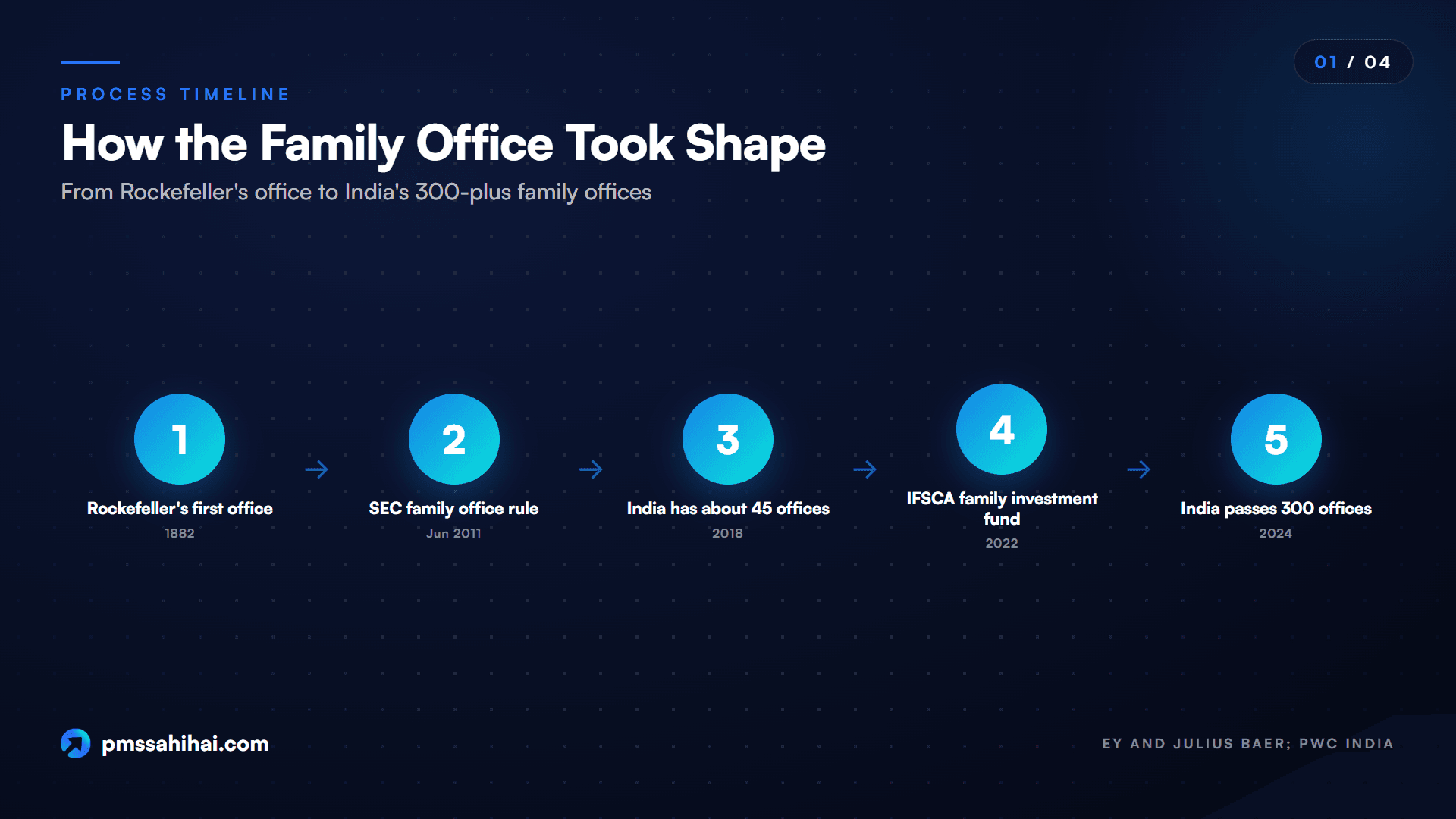
The modern family office is usually traced to the United States. Rockefeller Capital Management says John D. Rockefeller is widely credited with establishing the first full-service family office in the US in 1882, an office later known as Rockefeller & Co. that has served the family for seven generations. The idea was simple: once a fortune is large and spread across many businesses, the family needs its own staff to organise it.
For most of the twentieth century family offices were a quiet, mostly American and European phenomenon. Regulators largely left them alone because they managed only their own family's money. In the US, that position was written into law after the 2008 crisis: on 22 June 2011 the Securities and Exchange Commission adopted a family office rule that excludes qualifying family offices from the definition of "investment adviser", as long as they advise only family clients and do not hold themselves out to the public.
India's story is more recent. Business families have long managed money through the group finance team, the promoter's accountants and trusted bankers. What changed in the last decade is professionalisation: EY and Julius Baer estimate there were about 45 family offices in India in 2018, and by 2024 PwC India counted more than 300.
Three shifts drove the change. Liquidity events (stake sales, IPOs, startup exits) left promoters holding cash rather than business equity. Investment options multiplied: PMS, three categories of AIF, REITs, InvITs, global funds and GIFT City structures. And the next generation wanted institutional processes. Indian family offices are the result.
Regulation followed in places. The International Financial Services Centres Authority (IFSCA) created a "family investment fund" in GIFT City under its 2022 fund management regulations and kept it in the 2025 regulations. SEBI has chosen not to create a separate category.
Indian Family Offices Today: Numbers, Money and Drivers
The headline number is the one everyone repeats: Indian family offices have grown roughly sevenfold, from about 45 in 2018 to more than 300 by 2024–25. That figure appears in PwC India's July 2024 report "Creating Holistic Value for Family Businesses" and in EY–Julius Baer's June 2025 "Indian family office playbook".
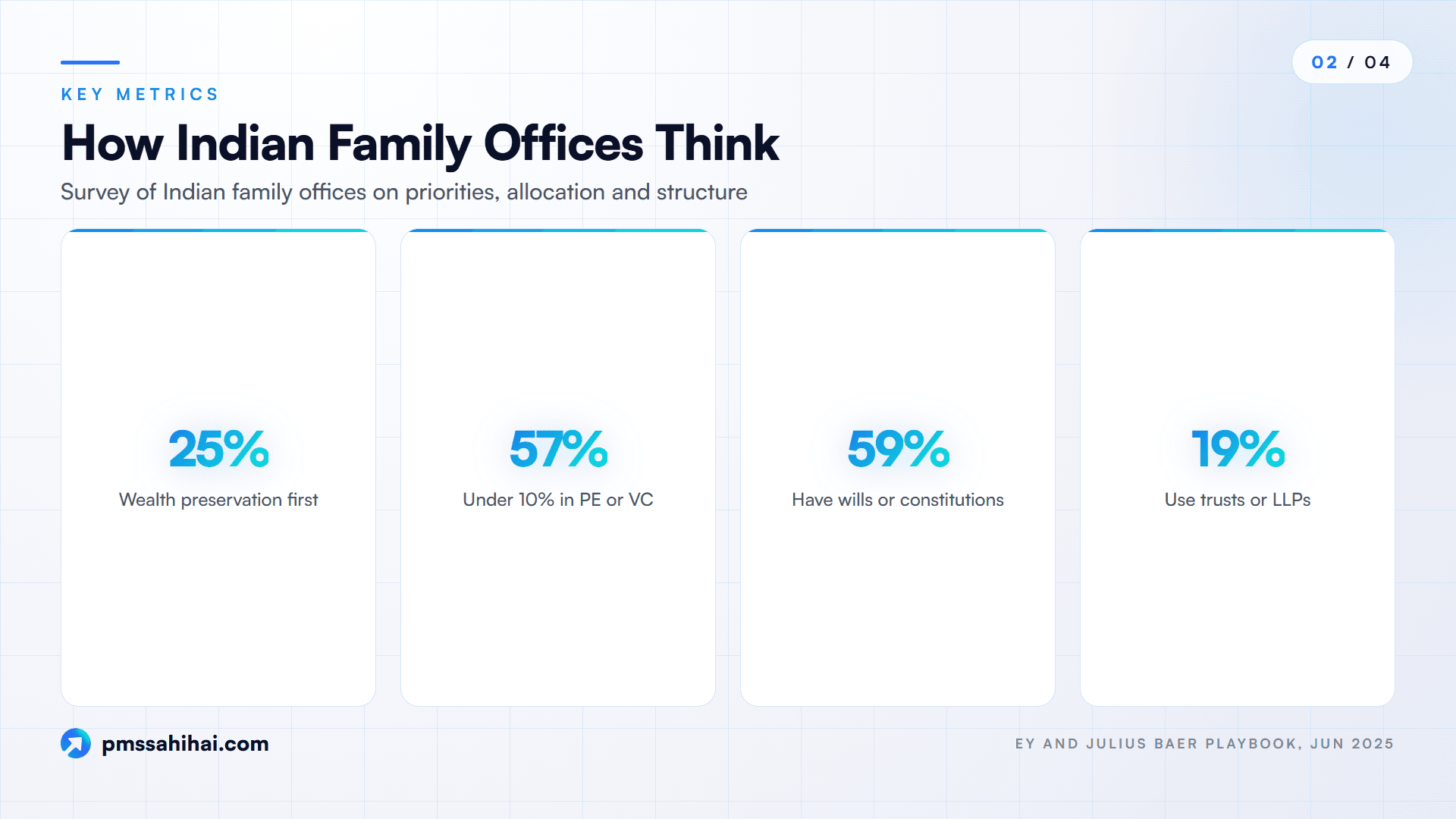
The EY–Julius Baer survey also gives a picture of how these offices think:
- 25% of Indian family offices list wealth preservation as their top priority.
- 57% allocate less than 10% of their portfolios to private equity or venture capital.
- 59% of families have wills or family constitutions in place.
- 19% have adopted structures such as trusts or LLPs.
- 48% flagged changing tax laws as a concern, and 37% cited cross-border complexity.
In August 2026, the follow-up report "Indian Family Office Playbook: Now, Next and Beyond" estimated that family office assets in India stood at about INR 70,000 crore in 2024 and were projected to grow 1.5 times over the next three years. It also counted more than 19,000 ultra-high-net-worth individuals in India, expected to exceed 25,000 by 2031, and an intergenerational wealth transfer of US$1.3–1.5 trillion over the next decade.
Why the Asset Estimates Disagree
Other reports quote "over US$30 billion" for Indian family offices, far more than INR 70,000 crore. The gap most likely comes from definitions: some studies count only assets run by a staffed office, others the wider wealth of families that have one. Neither number is audited, and no regulator counts Indian family offices because there is no registration category. Treat every number here, including the "300", as an informed estimate.
What Is Driving the Growth
Three forces stand out:
- Wealth creation outside the old business houses. PwC India expects the number of offices to keep rising as promoters build businesses in Tier 2 and Tier 3 cities.
- Generational transition. The US$1.3–1.5 trillion transfer estimate means thousands of families must decide who controls what, and a family office is the obvious place to put that process.
- More complex portfolios. EY–Julius Baer says 40–45% of allocations in many Indian family offices now go to alternatives such as private equity, venture capital, private credit, AIFs, REITs and InvITs. Managing that mix without dedicated staff is hard.
What Family Office Services Actually Cover
Family office services vary with the family, but most Indian family offices cover some or all of the following.
Investment management. Writing the investment policy, setting asset allocation, selecting and monitoring external managers (PMS, AIFs, mutual funds, global funds), evaluating direct deals and co-investments, and rebalancing.
Consolidated reporting. One view of everything the family owns, across custodians, fund statements, property and private holdings, measured on a consistent basis. It sounds mundane, yet it is often the biggest improvement a new office makes.
Tax and compliance. Coordinating returns for every member and entity, advance tax, TDS on fund distributions and foreign-asset disclosures, usually alongside the family's chartered accountants.
Legal structuring and succession. Setting up and administering private trusts, holding companies and LLPs; keeping wills, nominations and shareholder agreements consistent; and planning how control passes to the next generation.
Family governance. Drafting a family constitution, running family councils and investment committees, and educating younger members.
Philanthropy. Running the family foundation or charitable trust, and its grant-making.
Risk and administration. Insurance, cybersecurity, property management, and in some cases lifestyle and concierge services.
Not every office offers all these family office services. A lean office may focus on investments and reporting and buy the rest from advisers; the common thread is that it owns the coordination.
Single, Multi and Virtual Family Office Models in Brief
There are three common models, and the single-family vs multi-family choice deserves its own comparison. In brief:
- Single-family office (SFO): owned by one family and working only for it. Maximum control and privacy, maximum cost.
- Multi-family office (MFO): a firm that serves several families and spreads the cost of specialists across them. Less bespoke, far cheaper per family.
- Virtual family office: a small core team, sometimes one person, coordinating outsourced specialists.
In GIFT City there is also a regulated vehicle, the family investment fund, which is a fund structure for one family's money rather than a full office; it is covered in the regulation section.
How a Family Office Structure Is Built in India
There is no single legal form called a "family office" in India. Instead, a family office structure is assembled from ordinary legal entities, each chosen for a job.
Trust, LLP or Company: The Common Building Blocks
| Building block | Governing law | Typical job | Points to weigh |
|---|---|---|---|
| Private family trust | Indian Trusts Act, 1882 | Holds assets for beneficiaries; succession and protection | Discretionary trusts are often taxed at the maximum marginal rate; needs careful drafting |
| Private limited company | Companies Act, 2013 | Investment holding or operating company that employs staff | Corporate tax; board meetings, filings and statutory registers |
| LLP | LLP Act, 2008 | Investment or operating vehicle with flexible profit-sharing | Lighter compliance than a company; partner taxation rules apply |
| HUF | Hindu law plus tax law | Separate taxable unit for coparcenary property | Partition and coparcener rights complicate long-term planning |
A family office structure common among larger Indian family offices, described by law firm AK & Partners, puts a private trust at the top owning an LLP or company that employs the staff and runs the investments. The trust handles succession; the operating entity handles daily business.
Tax treatment differs by vehicle. Under the Income-tax Act, 2025, in force from 1 April 2026, trust provisions sit in sections 303 to 307 (formerly 160 to 164 of the 1961 Act). Clubbing rules can pull income from assets gifted to a spouse or minor child back to the donor, and structures without commercial substance can be challenged under GAAR. Take advice from a qualified tax adviser before you set up a family office vehicle; trust taxation deserves its own analysis.
Governance Documents That Hold It Together
Legal entities are the skeleton; governance documents are the nervous system. A well-run office usually has:
- An investment policy statement (IPS): objectives, risk tolerance, asset allocation ranges, liquidity needs and rules on concentration.
- An authority matrix: who can approve what, up to which amount.
- A related-party and conflict-of-interest policy: essential when the family business and the family office sit side by side.
- A family constitution: values, roles of family members, how disputes are resolved, and how the next generation enters the business or the office.
The EY–Julius Baer survey found 59% of families had wills or constitutions but only 19% had formal structures such as trusts or LLPs, so many Indian family offices are still at an early stage of family office structure.
Who Regulates a Family Office in India Today
This is where most explainers go vague, so let us be precise.
SEBI's October 2025 Clarification
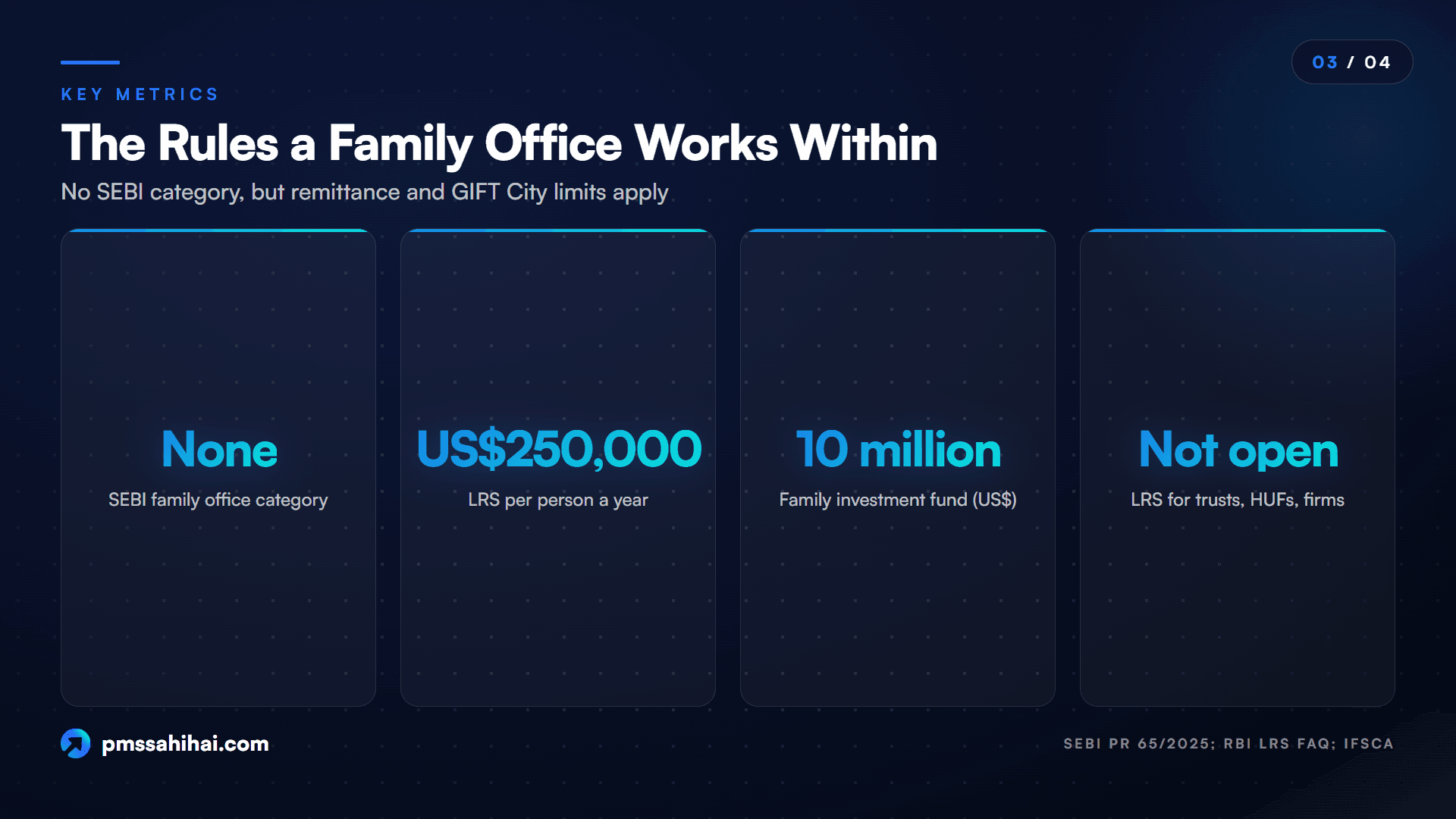
On 3 October 2025, SEBI issued press release No. 65/2025, "Clarification on Media Reports regarding Regulatory Oversight of Family Offices". Media reports had said SEBI was discussing disclosure rules and a separate category for family offices. SEBI called the reports factually incorrect and said it was not examining the matter at present. As of today there is no SEBI registration category for a family office, and no Indian statute defines the term.
When SEBI Registration Does Apply
That does not put a family office in India outside the law. A single-family office investing only the family's own money generally needs no SEBI licence of its own, but things change once it serves outsiders:
- Giving investment advice to other families for a fee generally requires registration as an investment adviser under the SEBI (Investment Advisers) Regulations, 2013.
- Managing portfolios for other clients on a discretionary basis requires registration as a portfolio manager.
- Pooling money from outsiders into a fund points to the AIF framework.
This is why multi-family offices usually hold one of these registrations. Every entity also goes through KYC and beneficial-owner checks when opening demat, bank, PMS or AIF accounts, so layered structures need clean documents.
FEMA, LRS and the GIFT City Family Investment Fund
Overseas investing is where Indian family offices hit limits. Under the Liberalised Remittance Scheme, resident individuals can remit up to US$250,000 per financial year, and the RBI's LRS FAQ says the scheme is not available to corporates, partnership firms, HUFs or trusts. A family company or trust must use the overseas investment rules instead.
GIFT City offers a dedicated route. Under Part C of the IFSCA (Fund Management) Regulations, 2025, as amended up to 10 September 2026:
- A family investment fund pools money only from a single family, defined as lineal descendants of a common ancestor with their spouses and children, plus entities they control and hold substantial economic interest in.
- It can be a company, a contributory trust or an LLP.
- It must reach a minimum investment of US$10 million within three years of registration.
- It can be open-ended or close-ended, may borrow under its risk policy, and can invest in listed and unlisted securities, fund units, derivatives and even physical assets such as real estate, bullion and art.
Money from resident family members still travels under LRS limits; our guide to GIFT City funds for resident Indians explains what residents can and cannot buy. Tax and FEMA treatment is detailed and changes often, so consult a tax and FEMA adviser first.
How Indian Family Offices Invest Their Money
The survey data is cautious but shifting. A quarter of offices put preservation first and most keep private equity and venture capital below 10%, yet the 2026 update says alternatives take 40–45% of allocations in many offices, and EY notes that some offices already hold more than 20% in private equity and venture capital. Both can be true: large offices are moving into private markets while newer ones stay conservative.
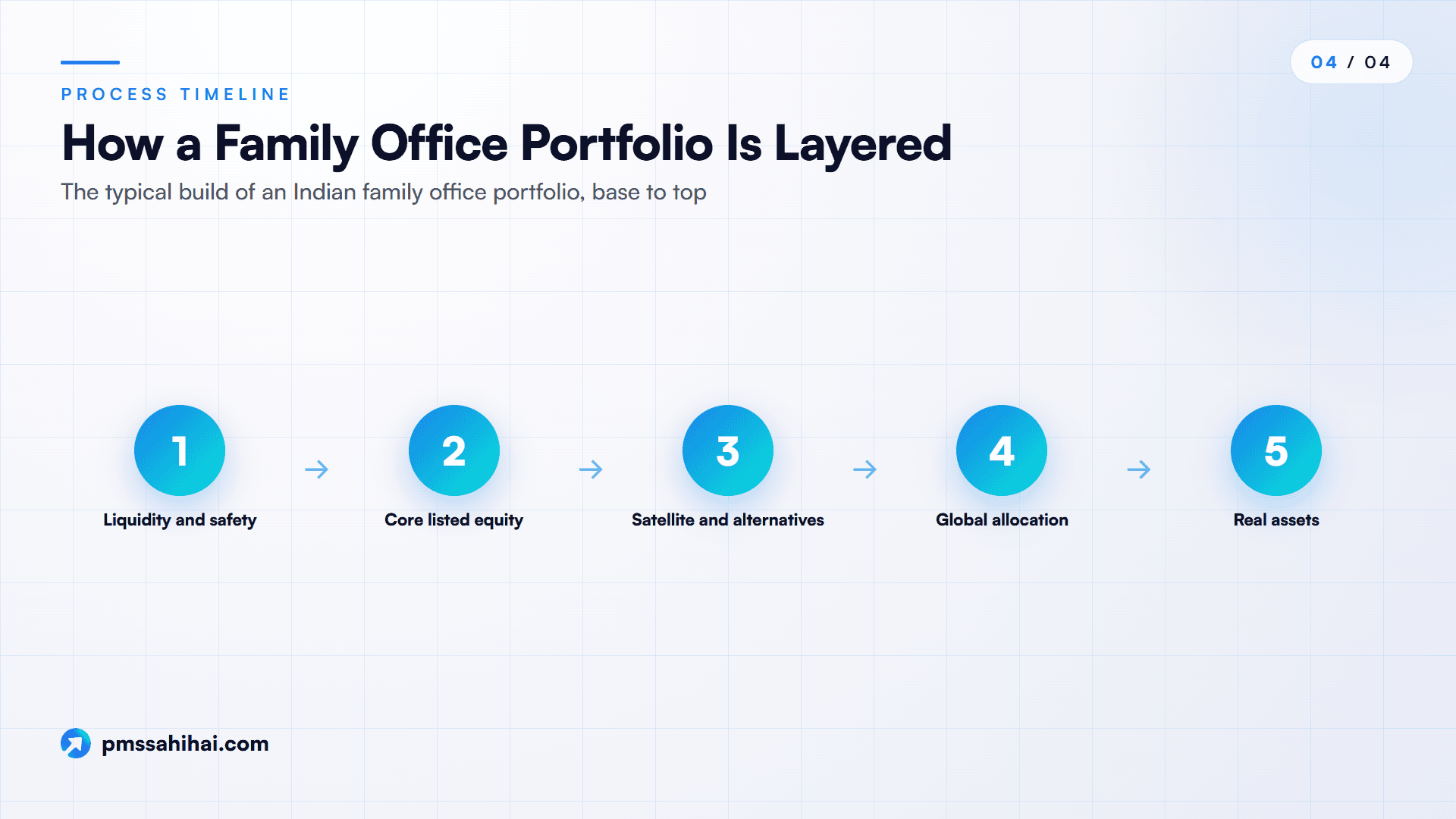
A typical portfolio for a family office in India is built in layers:
- Liquidity and safety: bank deposits, treasury bills, debt mutual funds and bonds that cover several years of family spending and business needs.
- Core listed equity: large and flexi-cap exposure through direct shares, mutual funds or PMS.
- Satellite and alternatives: AIFs (private equity, venture capital, private credit, long-short), REITs and InvITs, and direct or co-investments in private companies.
- Global allocation: overseas funds and equities via LRS or GIFT City routes.
- Real assets: land, commercial property and gold.
PwC India's 2024 report noted Indian family offices putting US$853.6 million into fintech in calendar 2023 alone.
Where PMS and AIFs Fit Into a Family Office Portfolio
For most Indian family offices, PMS and AIFs are the main route to professional managers in Indian markets.
- PMS gives the office a segregated account in its own name, with securities held directly. That transparency suits offices that want full look-through reporting and the option to transfer shares in kind. The SEBI minimum is Rs 50 lakh per client, a threshold the new SEBI (Portfolio Managers) Regulations, 2026 retain when they take effect on 1 April 2027.
- AIFs are pooled funds with a Rs 1 crore minimum commitment for most investors (see the Rs 1 crore rule and its exceptions). They are the main route into private equity, venture capital, private credit and hedge-fund-style Category III strategies, usually with lock-ins and drawdown schedules.
The real work is manager selection: comparing strategies like for like, reading disclosure documents and private placement memoranda, checking fees and benchmarks, and avoiding hidden overlap across several PMS accounts.
Technology Inside the Modern Family Office
Technology is where Indian family offices have changed fastest. The EY–Julius Baer 2026 update says offices are adopting AI-enabled analytics, integrated reporting platforms, cybersecurity and digital governance tools. PwC India's 2024 report also pointed to AI, machine learning and data analytics, while naming cybersecurity and privacy among the main risks.
In practice, technology does four jobs:
- Aggregation: pulling holdings from custodians, PMS statements and AIF capital accounts into one dataset.
- Analytics: measuring returns consistently (time-weighted for managers, money-weighted for the family's cash flows) and spotting overlap or concentration.
- Governance: approval trails, document vaults and investment committee packs.
- Security: a family office is a concentrated fraud target, so access controls and payment checks matter.
AI research tools speed up the first screen of strategies and documents; they do not replace due diligence.
What a Family Office Costs and When It Makes Sense
The family office cost question has no official answer, because nobody publishes audited figures. Industry estimates from Indian commercial sites put the family office cost of a dedicated single-family office at roughly Rs 2.5–5 crore a year. Globally, running one is commonly said to cost over US$1 million a year, which is why it is usually said to need US$50–100 million or more of investable assets.
Practitioners disagree on the minimum wealth: views in Indian articles range from a few hundred crore rupees to Rs 2,000 crore or more for a single-family office, with multi-family offices serving families from about Rs 50–100 crore. The right threshold depends on complexity, not just size.
The main cost drivers are:
| Cost driver | What pushes it up |
|---|---|
| People | A CIO, analysts, accountants, legal and compliance staff |
| Advice | External tax, legal and audit fees across many entities |
| Technology | Aggregation, reporting and security systems |
| Entity compliance | Filings, audits and board processes for each trust, company and LLP |
| Investment fees | Fees to external PMS and AIF managers, which the office does not remove |
A rule of thumb: if the total family office cost is a large fraction of the extra return or savings it can realistically produce, a multi-family office or a well-chosen set of advisers is the better answer.
A Five-Question Self-Check Before You Set Up a Family Office
- Is the wealth complex, not just large? Multiple entities, several generations, overseas assets and private holdings justify an office far more than a large but simple portfolio.
- Is there a liquidity event behind you or ahead? A sale or IPO creates a pool of capital that needs a policy from day one.
- Does the family agree on governance? An office cannot fix a family that will not agree on who decides.
- Can you hire and keep the right people? A weak CIO is worse than a good external adviser.
- Can the cost be carried comfortably for decades? An office is a permanent commitment, not a project.
If you answer "no" to two or more, do not set up a family office yet; start smaller.
Benefits of a Family Office for Wealthy Indian Families
When the scale is right, the benefits are real.
- One view of the whole balance sheet. As one multi-family office founder put it in a 2024 interview, banks typically see only their share of a client's wallet; the office sees all of it.
- Better decisions through process. An investment policy and committee replace ad hoc calls and one-off pitches.
- Continuity across generations. "Individuals are impermanent but an entity or an office is permanent," as the same interview put it.
- Access to alternatives and deals. Scale and a professional team open doors to AIFs, co-investments and direct deals.
- Negotiating power. A single counterpart representing the whole family can negotiate fees and terms with managers and banks.
- Privacy and control. A single-family office managing its own money is not a regulated intermediary, so the family keeps control over strategy and information.
- Succession built in. Trusts, constitutions and governance live inside the office rather than in a drawer.
How PMS Sahi Hai Helps a Family Office Compare PMS and AIF Managers
First, a plain statement: PMS Sahi Hai is not a family office, and its pages do not offer family office services such as trust administration, tax filing or succession planning. What it does cover is the part of a family office's work that takes the most analyst hours, which is comparing the PMS and AIF strategies the family holds or is considering.
Here is how that maps onto the job.
- One shelf for manager research. The compare directory has PMS, AIF and GIFT City tabs, lets you filter strategies by category, fund house, benchmark and size, and puts up to four side by side. That is the first cut an investment committee needs before any manager meeting.
- AIF screening by category. The AIF comparison page lets you filter Category I, II and III funds and see strategy, vintage, AUM, one-year return, lock-in and a Nyra score together, which helps when a family office is building the alternatives sleeve described above.
- Nyra for sourced answers. Nyra is the platform's AI research analyst. Ask it, in plain English, how a strategy's benchmark compares with its category, what a lock-in means for liquidity, or how two managers differ, and it points to the source behind its answer. Nyra is an analytical tool, not a SEBI-registered investment adviser, so treat its output as research input for your committee.
- A transparent scoring method. The Nyra methodology scores strategies from 0 to 10 across five pillars, and strategies with less than 12 months of track record are shown as "Not Rated" rather than guessed at.
- Context without the jargon. Published guides such as PMS vs AIF vs SIF vs mutual fund help next-generation family members get up to speed on the wrappers before they sit on an investment committee.
PMS Sahi Hai describes itself as an APMI-registered distributor of PMS and AIF products. For a family office, the sensible way to use it is the way you would use any research desk: to narrow the field and sharpen the questions, then do your own diligence on the disclosure document, the PPM and the manager.
Risks and Limitations of the Family Office Model
The honest side matters as much.
- Cost and drag. The overhead is fixed, while returns are not. A bad year plus a large cost base hurts.
- Talent risk. PwC India lists attracting and retaining talent as a core challenge; small offices depend heavily on one or two people.
- Family conflict. PwC India and AZB & Partners' Anand Shah both flag diverging family interests and reluctance to hand control to professionals as major obstacles.
- Light oversight cuts both ways. Without a regulator watching, controls depend on the family. Fraud by trusted insiders is a documented risk globally.
- Tax and regulatory change. Nearly half the surveyed offices worry about changing tax laws, and cross-border rules add complexity.
- Concentration on the family business. Many offices remain heavily tied to the group's own fortunes, which defeats diversification.
- Illiquidity. Rising allocations to private equity, venture capital and private credit mean more money is locked up for years.
Is a Family Office Right for Your Family's Wealth
A family office in India is a powerful tool for a narrow group of families: those with very large, multi-generational and multi-entity wealth, a willingness to write things down, and the budget to employ good people for decades. For them, it converts scattered relationships into one disciplined system.
For most HNI and many UHNI families, the better answer is to borrow the discipline rather than build the building: write an investment policy, consolidate reporting, use a multi-family office or independent adviser where needed, and compare PMS and AIF managers on facts rather than pitches. The structure can grow later, once the wealth and complexity justify it. In the meantime, PMS Sahi Hai's comparison pages and Nyra can carry part of the manager-research load without the overhead of an office.
Start Your Family's Investment Shortlist the Smart Way
Whether you run a full family office or are simply bringing order to your family's investments, the core task is the same: decide on a policy, then choose managers that fit it on evidence. Start by listing every account, entity and product the family holds today and what each is supposed to do.
Then put the strategies side by side. Use the PMS Sahi Hai compare directory to line up PMS, AIF and GIFT City options against their benchmarks, fees and track records, ask Nyra to explain anything that does not add up, and book a conversation with the team if you want a second pair of eyes before your family's investment committee signs off. For tax and structuring decisions, bring in a qualified tax adviser.
PMS Sahi Hai is a distributor of Portfolio Management Services and Alternative Investment Funds, APMI-registered (Registration No. APRN08358). This article is for education only and is not investment advice, a recommendation, or an offer to buy or sell any security. Investments in securities markets are subject to market risks; read all scheme-related documents carefully. Past performance is not indicative of future results. Consult your advisor before investing.
Ishaan founded PMS Sahi Hai to make India's PMS, AIF and GIFT City markets legible to serious investors, comparing every SEBI-registered manager on the same comparative basis, with no shelf products and no commission bias.
Frequently asked
What is a family office in simple terms?
What is a family office? It is a private organisation that manages a wealthy family's money and affairs as one system: investments, reporting, tax coordination, legal structures, succession and sometimes philanthropy. It works for the family rather than a product provider, and oversees the outside managers the family uses, such as PMS providers, AIFs and private banks.
How many family offices are there in India?
Estimates put Indian family offices at more than 300, up from about 45 in 2018, according to PwC India (2024) and EY–Julius Baer (2025). No regulator publishes a count because a family office in India is not a registration category, so these are survey-based estimates. Asset estimates differ even more.
Is a family office regulated by SEBI?
There is no SEBI registration category for family offices. In October 2025, SEBI said reports that it was planning oversight were factually incorrect and that it was not examining the matter. However, an office that advises other families for a fee or manages their portfolios generally needs SEBI registration as an investment adviser or portfolio manager.
How much wealth do you need to set up a family office?
There is no legal minimum to set up a family office in India. Practitioner views range from a few hundred crore rupees to Rs 2,000 crore or more for a single-family office, with an estimated family office cost of Rs 2.5–5 crore a year. Smaller families usually get better value from a multi-family office or independent advisers.
What legal structure does a family office use in India?
A family office structure in India uses ordinary entities: private trusts under the Indian Trusts Act, 1882, private limited companies, LLPs and sometimes HUFs. A common pattern is a trust at the top holding a company or LLP that employs staff and holds investments. Each vehicle is taxed differently, so consult a tax adviser first.
Can a family office invest in PMS and AIFs?
Yes. Family members, family trusts, companies and LLPs can invest in PMS and AIFs if they meet KYC and eligibility rules. The SEBI minimum is Rs 50 lakh per PMS client and Rs 1 crore for most AIF investors. Many family offices use PMS for transparent listed-equity mandates and AIFs for private equity, private credit and other alternatives.
What is a family investment fund in GIFT City?
It is a fund registered with IFSCA that pools money only from a single family. Under the IFSCA (Fund Management) Regulations, 2025, it can be a company, contributory trust or LLP and must reach US$10 million within three years of registration. Resident family members still invest through LRS limits, so FEMA and tax advice is essential.
What is the difference between a family office and a wealth manager?
A wealth manager serves many clients and focuses mainly on investments and products. Family office services cover one family's whole balance sheet: investments, tax coordination, legal structures, succession and reporting. A family office typically selects and monitors wealth managers, banks and fund managers rather than competing with them.
Keep reading
All articles
What Is a Long-Short SIF? How Equity SIFs Hedge and Short Stocks
How equity long-short SIFs work: the three SEBI strategies, the 25% unhedged short, hedging rules and scenario analysis, explained with 2026 data.

What Is a Long-Only Fund? Why Most Equity PMS and AIFs Never Short
What a long-only fund is, the SEBI rules that keep PMS and Category I/II AIFs from shorting, who can short, and what changes for PMS in April 2027.

What Is Smart Beta? Rule-Based Indexing for Indian Investors
How smart beta indices are built, what equal-weight, low-volatility and momentum funds cost in India, and the SEBI rules on tracking error.
Read it. Now pressure-test it.
Ask Nyra how this applies to your portfolio, or talk to our team, no pitch, no pressure.