
Power of Attorney in PMS: What You Authorise and What You Don’t
What a power of attorney in PMS lets your portfolio manager do, what SEBI rules still bar, how to revoke it, and what changes on 1 April 2027.


A power of attorney in PMS lets your portfolio manager act in your name, mainly to run your demat, trading and bank accounts for the mandate you agreed. It does not let the manager borrow for you, hold your shares in its own name, or benefit from your money. SEBI's own consultation paper calls the POA an operating model adopted by the industry, not a stand-alone rule, and from 1 April 2027 demat and trading authority moves into a standard agreement while the bank POA stays. Read the wording before you sign, because we found no standard format in use today. You can end the authority, but the notice has to reach everyone who relies on it.
Why Your PMS Power of Attorney Matters More Than It Looks
Most PMS clients sign the PMS power of attorney between the KYC form and the first cheque. It usually gets less attention than the fee schedule, yet it is the document that lets someone else act in your name on a portfolio that usually starts at Rs 50 lakh.
In general terms, a power of attorney is a written authority to act for someone else. The person granting it is the principal, and the person receiving it is the agent, who owes the principal honesty and loyalty. India's Powers-of-Attorney Act, 1882 describes it as an instrument that empowers a specified person to act for and in the name of the person who signs it.
That phrase, "in the name of", is the point. Under a PMS, the shares stay yours. They sit in a demat account in your name, and you remain the beneficial owner. The POA does not transfer ownership. It transfers the ability to operate.
So two questions matter more than any other:
- What can the manager now do in my name?
- What can it still not do, whatever the paper says?
One caveat runs through this article. We could not find a public specimen of a PMS power of attorney, and the SEBI documents we read do not prescribe a format today. What follows describes what SEBI says the document is for and which limits apply regardless. Your own document decides the rest, so consult a lawyer on anything specific.
How the POA Sits Beside the PMS Agreement
People often treat the power of attorney and the PMS agreement as one thing. They do different jobs.
The PMS agreement is the contract that the rules require. Regulation 22 of the SEBI (Portfolio Managers) Regulations, 2020 says a portfolio manager must, before taking up an assignment, enter into a written agreement that sets out the mutual rights, liabilities and obligations. Schedule IV lists what must be in it, including scope of services, fees, risk, termination, access to information and liability. Regulation 24(1) adds that client money and securities can be invested or managed only in terms of that agreement.
The power of attorney is the instrument that lets the manager carry out that contract with outside parties such as banks, custodians and brokers. The words "power of attorney" do not appear anywhere in the 2020 Regulations. SEBI's July 2026 consultation paper describes the POA as "an operational model adopted by the PMS industry", obtained "in addition to client agreement".
It is not an optional extra in practice, though. SEBI's Investor Charter in the Master Circular lists "franking and signing the Power of Attorney" as an onboarding step, and SEBI's inspection data format asks whether a power of attorney was executed in the manager's favour.
| Point | PMS agreement | Power of attorney |
|---|---|---|
| What it does | Sets the deal: mandate, fees, risk, exit | Lets the manager act in your name |
| Source | Regulation 22 and Schedule IV | Industry practice, general agency law |
| Format | Minimum contents prescribed | No prescribed format today |
| If the two conflict | Regulation 24(1) ties management to the agreement | Ask a lawyer; do not assume the wider wording wins |
Think of the agreement as the job description and the POA as the set of keys. Keys do not widen the job. A broad power of attorney does not override the regulations.
The mandate type shapes how the keys get used. A discretionary manager manages each client's funds individually and independently, and in SEBI's words the final decision rests with the manager. A non-discretionary manager must follow the client's directions, so the POA exists to "facilitate transactions that are expressly consented" by the client, as a 2026 SEBI letter records. The same document can carry quite different freedom.
How Power of Attorney Rules Evolved in Indian PMS
The legal base is old. The Indian Contract Act, 1872 sets the rules of agency, and the Powers-of-Attorney Act followed in 1882. Portfolio management came much later, with SEBI's 1993 Regulations, later repealed by the 2020 Regulations.
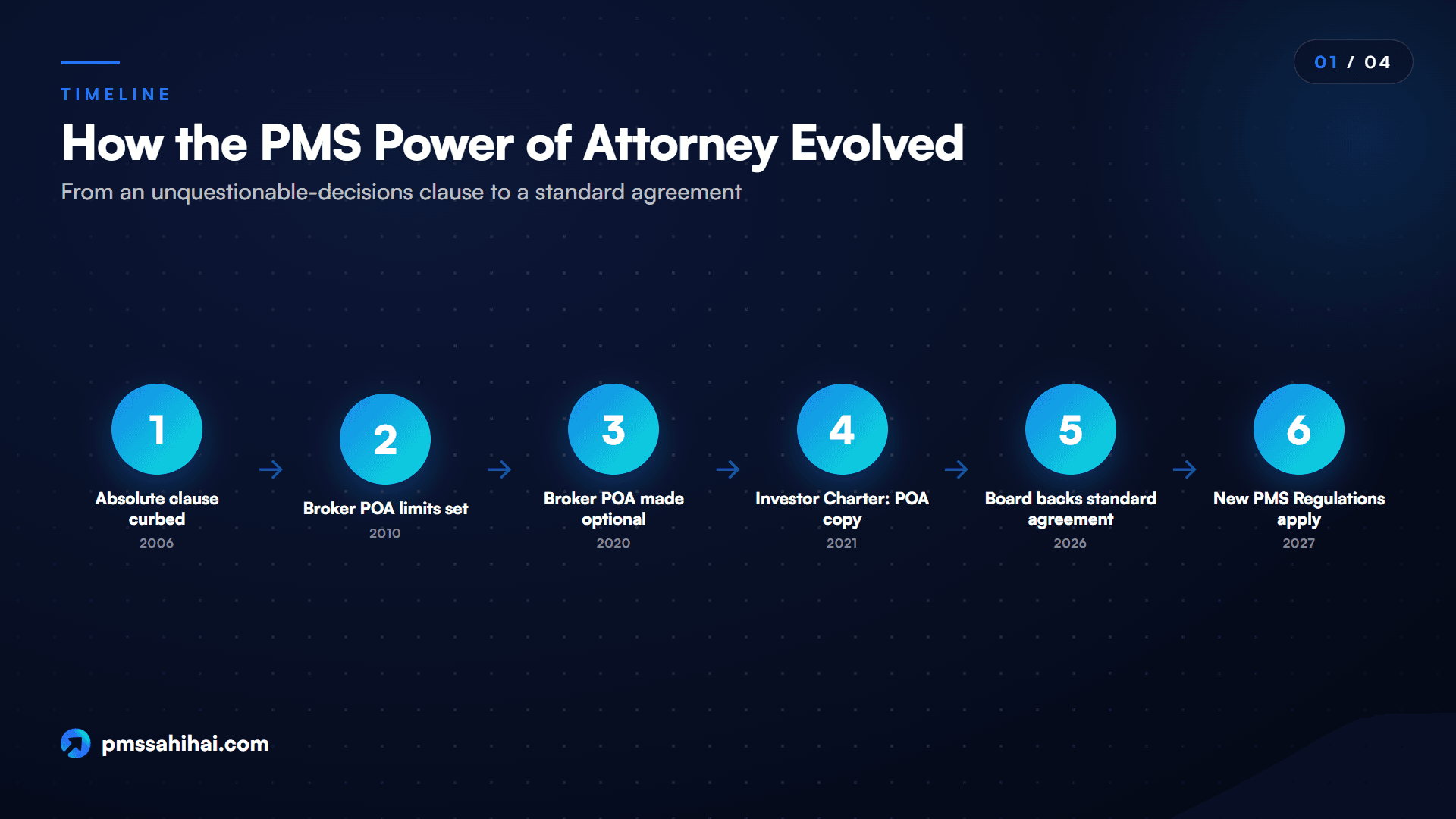
Four moments shaped how the POA works today.
- 28 June 2006: the "absolute and final" clause. SEBI noticed that managers were writing into disclosure documents, agreements and POAs a clause saying their decisions could never be questioned. SEBI said every client should have the prerogative to question the manager, and required the clause to carve out mala fide action, fraud, conflict of interest and gross negligence.
- 23 April 2010 and 27 August 2020: broker POAs. SEBI limited what a POA to a stockbroker or depository participant could do, then made that POA optional. These circulars do not cover portfolio managers, but they show how SEBI thinks about overreach.
- 10 December 2021: the Investor Charter. SEBI's circular required managers to give clients a copy of the POA within 3 days of request and to tell them, at signing, what transactions the manager can do using it. The Master Circular of 16 July 2025 carries both.
- 2026: the rethink. SEBI's 23 July consultation paper asked whether the POA could be relaxed, and its Board decided the question on 24 September. We cover that outcome further down.
What You Authorise Your Portfolio Manager to Do
Because wording is not standard, the fair question is what a PMS power of attorney is there to enable. SEBI's documents point to these functions. Check each against your own paper.
Investing and Trading in Your Name
The core purpose is execution. The Investor Charter describes the power of attorney as being "to make investment decisions on behalf of the investor". SEBI's consultation paper describes it as allowing managers "to undertake transaction on their behalf". Practically, this means placing buy and sell orders within the agreed investment approach, through the manager's empanelled brokers.
Operating the Demat and Custody Link
Your securities are held in your name in a demat account linked to the custodian. Trades settle through that account, and the power of attorney is part of how the manager instructs that movement. SEBI's Board note speaks of "authority to operate demat/trading account" as the thing being moved into the agreement, which tells you what the power of attorney currently does.
Operating the Bank Account
Where a client-level bank account is used, the manager needs bank-side authority too, and banks set their own documentation. SEBI's Board said the POA requirement for bank accounts "as mandated by RBI" would continue. Not every structure works this way, because SEBI also allows a manager to keep client funds in one separate bank account, with client-wise records, no cross-use, monthly statements and daily reconciliation. Ask which applies to you.
Handling Corporate Actions and Paperwork
Schedule IV lists "keeping track of corporate benefits associated with the securities" as a service. That covers dividends, bonus shares and rights, and signing the related forms may rely on the power of attorney.
Collecting Fees as Agreed
Schedule IV requires the agreement to state how often fees are billed and whether they are set off against the account. Your power of attorney may support that debit, but the amount comes from the fee annexure you signed.
What a Power of Attorney in PMS Does Not Permit
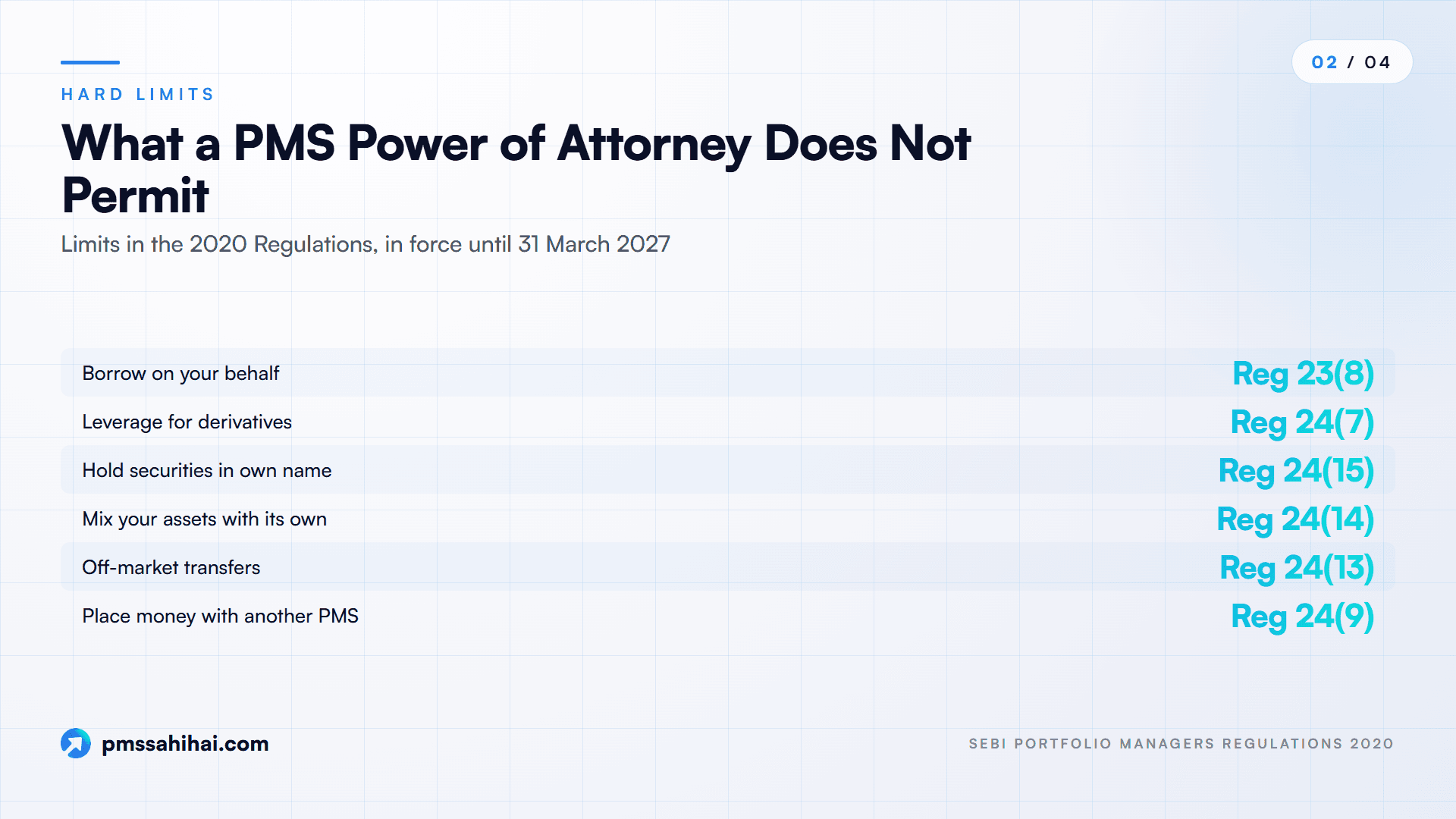
Here is the part that matters most. These limits come from the Regulations, so a broad power of attorney does not switch them off. Numbers below refer to the 2020 Regulations, in force until 31 March 2027.
| The manager cannot | Rule |
|---|---|
| Borrow funds or securities on your behalf | Regulation 23(8) |
| Leverage your portfolio for derivatives | Regulation 24(7) |
| Derive any direct or indirect benefit from your funds or securities | Regulation 23(7) |
| Hold your portfolio's securities in its own name | Regulation 24(15) |
| Mix your funds and securities with its own | Regulation 24(14) |
| Lend your securities without your written authority | Regulations 23(9) and 24(16), Schedule IV |
| Do off-market transfers, except for listed reasons | Regulation 24(13) |
| Use your money for bill discounting, badla, or lending to companies | Regulation 24(8) |
| Place your money in another manager's portfolio | Regulation 24(9) |
| Invest in its related parties without your prior consent | Regulation 22(1A) |
| Change agreement terms without your prior consent | Schedule IV, item 9 |
| Impose a lock-in on your investment | SEBI FAQ, 2024 |
Three of these deserve a closer look.
Off-Market Transfers Are the Real Danger Zone
Moving shares out of your account without a market trade is the classic fear. Regulation 24(13) allows off-market transfers only for settling your own trades, providing margin or collateral for your own positions, dealing in unlisted securities under the rules, with your specific consent for each transaction, or for a reason SEBI specifies. A general POA is not "specific consent for each transaction". If you ever see an off-market debit you cannot explain, ask at once.
Your Liability Has a Ceiling
For a discretionary mandate, Regulation 22(2)(m) requires a condition that your liability does not exceed your investment with the manager. Schedule IV repeats the idea for the agreement. This is one reason the borrowing bar matters.
The Fiduciary Duty Survives the Signature
Regulation 23(3) requires the manager to act in a fiduciary capacity on your funds, and Schedule IV says it acts "as a trustee and agent". Signing a power of attorney does not waive this. And thanks to the 2006 circular, a clause cannot make the manager's decisions immune from challenge for fraud, mala fide action, conflict of interest or gross negligence.
A power of attorney in PMS also does not protect you from an honest bad call. The manager can lawfully buy a stock that then falls. Authority and investment judgment are separate questions.
Everyday Scenarios: Can the Manager Do This?
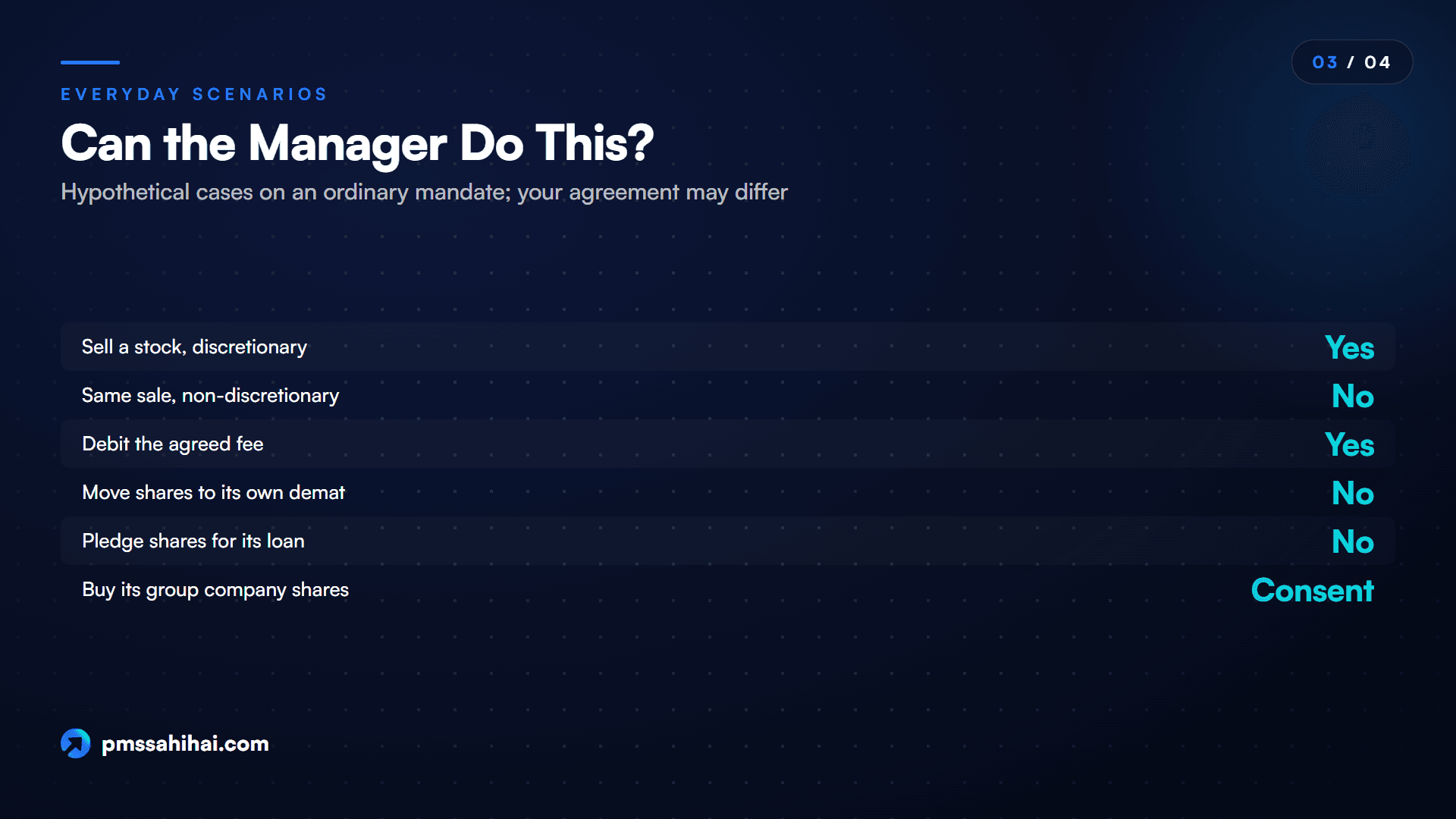
These hypothetical cases show how the pieces fit. They assume an ordinary discretionary mandate and no unusual terms. Your agreement could change the answer on some.
| Scenario | Likely answer | Why |
|---|---|---|
| Sell a stock you like without calling you | Yes, on a discretionary mandate | Final decision rests with the manager |
| Same sale on a non-discretionary mandate, without your direction | No | Regulation 23(1) requires following your directions |
| Debit its agreed management fee | Yes, as the agreement states | Schedule IV billing terms |
| Move your shares to its own demat account | No | Regulations 24(13) and 24(15) |
| Pledge your shares to take a loan for your portfolio | No | Regulation 23(8) |
| You pledge your own shares for a personal loan | Yes in principle | SEBI informal letters, 2026 |
| Buy shares of its group company | Only with your prior consent | Regulation 22(1A) |
| Lend your shares to earn income | Only with your written authority | Regulation 24(16) |
| Send your exit proceeds to a friend's account | Should not happen | Charter: verified bank or demat account |
The pledge line surprises people. In letters dated 18 May 2026 (non-discretionary) and 17 August 2026 (discretionary), SEBI's department said the borrowing bar does not stop a client from initiating a pledge of their own holdings, solely at the client's discretion. These letters give a departmental view on specific facts and are not a Board decision. SEBI declined to answer the question on risk warnings, and your manager's agreement may still have a view.
How the POA Works With Today's Custody and Trading Systems
A power of attorney reads like a Victorian document, but it plugs into modern plumbing.
Custody. Regulation 26 requires a custodian, except for advisory-only managers. Your demat account gets mapped to that custodian during onboarding, which separates the person making decisions from the entity holding the assets.
Order flow. SEBI requires managers to set out when orders are placed for each client individually and when they are pooled from the manager's trading account. Regulation 24(12) says aggregated trades must be allocated pro rata at the weighted average price. A per-trade client signature could not work in this system, which is a practical reason the power of attorney exists.
Regulatory data. SEBI's inspection data format for portfolio managers carries a true-or-false field for this document. So the power of attorney is a tracked data point, not just a paper in a cabinet.
Client visibility. Regulation 31 requires reports at least every three months, plus whenever you ask, and they can sit on a restricted website. The report must show holdings, transactions, benefits received and expenses. Read it as your check on how the authority gets used.
Digital direction. The September 2026 Board decision also promotes digital disclosure documents.
Why Investors Benefit From a Well-Drawn POA
A power of attorney in PMS has real benefits, and none of them requires blind trust.
- Speed. Markets do not wait for couriered signatures. Authority up front lets the manager act when the decision is made.
- A workable discretionary mandate. You hire a manager to decide. A POA lets that decision reach the market without you in the chain.
- Less admin. Settlements, corporate actions and agreed fee debits can run without constant paperwork from you.
- Useful for busy or travelling clients. You do not need to be reachable for each trade.
- A written boundary. Unlike a verbal arrangement, a POA is a document you can read, copy and challenge. You can ask for a copy, and SEBI's timeline is 3 days.
- Ownership stays with you. The manager gets the ability to act while the holdings remain in your name.
How PMS Sahi Hai Helps You Read the Fine Print of Your POA
A power of attorney is a document problem, and PMS Sahi Hai is a research platform rather than a law firm, so be clear about what it can and cannot do. The site has no dedicated page or tool on POA wording, and we would rather say so than stretch the fit. It will not review your document. Its value lies in the questions around that document.
Start with who you would be handing the keys to. The compare page lets you line up to four PMS, AIF or GIFT City strategies side by side. Knowing the strategy first makes it easier to judge whether the authority a manager asks for fits what it actually does.
Use Nyra to prepare your questions. Nyra, the platform's AI research tool, answers plain-English questions with cited sources. Before a meeting with a manager, you could ask how a termination clause usually operates, what a custodian does in the settlement chain, or what to look for in a disclosure document. The site describes Nyra as an analytical tool, not a SEBI-registered investment adviser, so treat its answers as research and take legal questions to a lawyer.
Read the related guides in order. Four published PMS Sahi Hai insights fill in the surrounding picture:
- The PMS onboarding process shows where the POA falls among KYC and account opening.
- Discretionary vs non-discretionary PMS explains the difference in control behind the same signature.
- What a custodian does covers the entity that sits between your manager and your holdings.
- How to read a PMS disclosure document helps you test what the manager says about itself before you sign anything.
Talk to a person when the question is about fit. The team can be reached through a 15-minute conversation. Bring your shortlist and your questions about the mandate, and keep the legal reading of the POA itself with your lawyer.
Red Flags to Check Before You Sign
These are our own checks, built from the rules above. None means a manager is doing anything wrong, but each is worth a question.
- The power of attorney is broader than the PMS agreement. Look for "all acts", "any account" or "any other thing" with no link back to the PMS. Ask for a sentence limiting it to the agreement and the Regulations.
- It is called irrevocable. See the revocation section. Ask why it is needed.
- It names an individual rather than the registered entity. SEBI required this for brokers in 2010. That rule does not bind portfolio managers, but it is a useful yardstick.
- It allows transfers to "any account". The Charter sends exit proceeds to your verified accounts. Ask for the same limit on everything else.
- It mentions borrowing, pledging or lending. Borrowing on your behalf is barred. Lending requires written authority, so make sure that is a deliberate choice.
- It allows free sub-delegation. Find out who else can use the authority and on what terms.
- It lets the manager open new accounts in your name. SEBI barred this in broker POAs. Ask what is planned and why.
- It has no end point. Check that the power of attorney ends with the PMS agreement, rather than outliving it.
- It contains an "absolute and final" clause without the carve-out. SEBI's required wording keeps challenges open for mala fide action, fraud, conflict of interest and gross negligence.
- Nobody explains it. SEBI requires the manager to tell you, at signing, what transactions it can do using the power of attorney. If nobody does, ask in writing.
How to Revoke Power of Attorney Given to a Portfolio Manager
SEBI's PMS documents we read set no special procedure for this. General agency law and your agreement govern. These are the working rules, and a lawyer should review your particular case.
The right. Section 201 of the Indian Contract Act lists revocation by the principal among the ways an agency ends. It also lists the principal's death, unsound mind or insolvency, which is why Schedule IV requires the agreement to deal with death or disability.
The exception. Section 202 says that where the agent has its own interest in the property that is the subject of the agency, the agency cannot, without an express contract, be ended to the prejudice of that interest. Whether a manager's fee entitlement counts is a question for your lawyer. A label such as "irrevocable" deserves a question, not automatic acceptance.
The notice. Section 206 requires reasonable notice, failing which the party at fault must compensate for the damage. Section 208 is the practical trap: termination does not take effect for the agent until it knows, or for third parties until they know. Until your custodian or bank hears from you, they may be entitled to rely on the old authority.
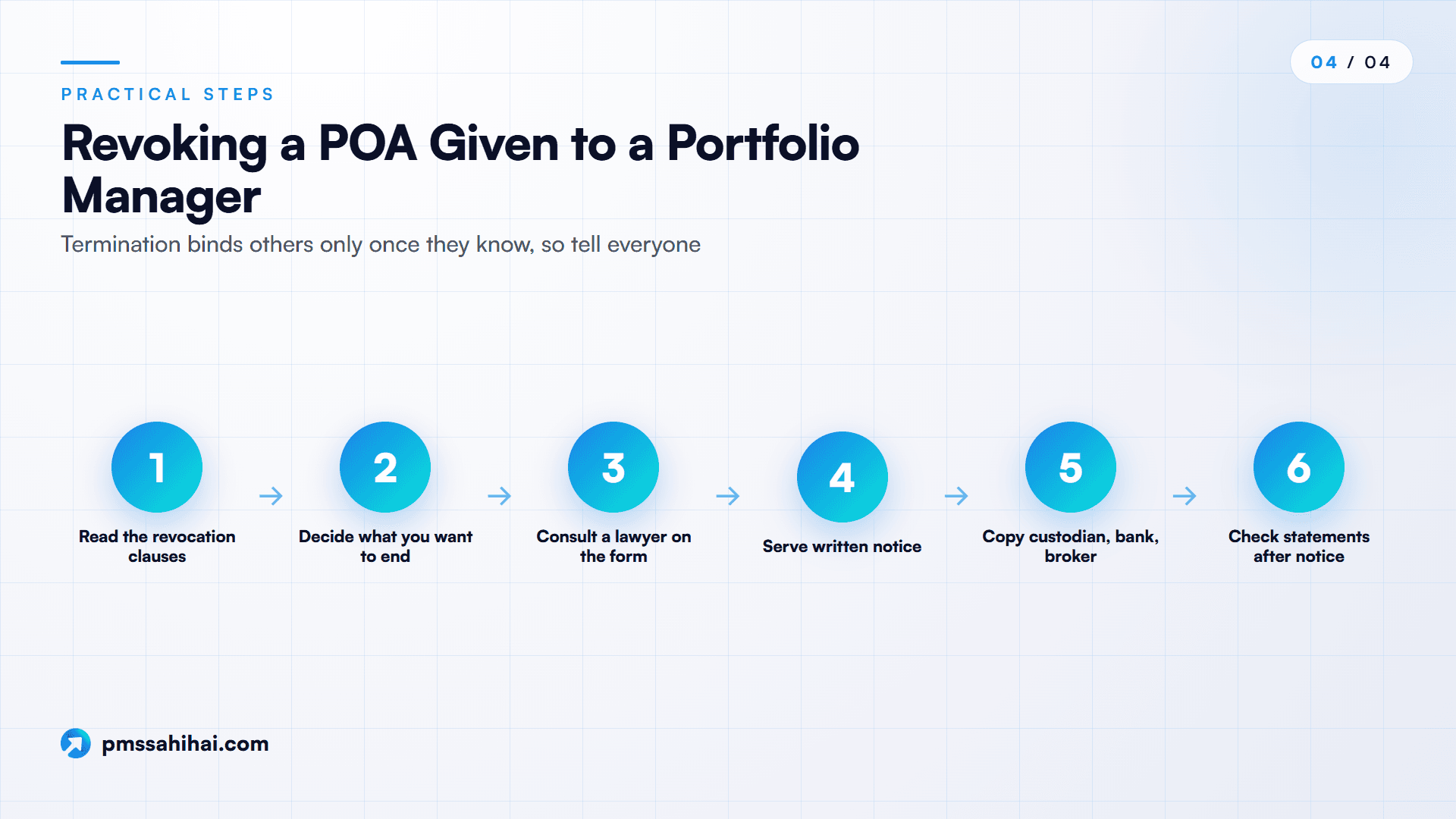
Practical steps:
- Read the power of attorney and PMS agreement for the revocation, notice and termination clauses.
- Decide what you want. Ending the power of attorney without ending the PMS would leave the manager unable to run the mandate. Your agreement decides how a stand-alone revocation is treated.
- Consult a lawyer on the form of revocation, especially if your power of attorney was notarised, registered or signed abroad.
- Serve written notice on the manager and keep proof of delivery.
- Send a copy to the custodian, the bank, and any broker you know holds the power of attorney, and get acknowledgements.
- Ask for confirmation of open trades, and how they will be completed or closed.
- Check your bank and demat statements for activity after notice.
The exit itself. Regulation 24(2) lets you withdraw funds or securities before maturity on voluntary termination, notwithstanding the agreement. Managers cannot impose a lock-in, but they can charge an exit load within SEBI's caps of 3%, 2% and 1% in the first three years. On termination the manager must give a detailed statement of accounts, and securities and funds go to your verified accounts. Our guide to the PMS exit process has the steps.
If something has already gone wrong, raise it with the manager's investor relations officer in writing, then use SEBI's SCORES complaints system, on which PMS providers must register. Suspected fraud needs a lawyer straight away.
Honest Limits of a POA in Portfolio Management
A power of attorney in PMS has drawbacks, and some are structural.
- No standard wording today. You are comparing different documents across managers, and the plain-English gap is real. No public specimen turned up in our research.
- Paperwork can duplicate the agreement. SEBI recorded an industry representation that the POA creates an administrative barrier and complicates moving assets between managers.
- Stamp duty and formalities vary. POA stamp duty differs by state, and SEBI's charter refers to franking.
- Revocation does not work instantly. Section 208 means a gap can exist between your decision and everyone knowing about it.
- Death or incapacity ends it at an awkward moment. The agency ends under Section 201, but the portfolio still needs a decision. Plan ahead with your lawyer.
- It is not a safeguard against loss. Rules cap misuse, not poor returns.
- Rules only help if you check. Reports, statements and a chartered accountant's audit right under Schedule IV work only if someone uses them.
What the 2027 Rule Change Means for Your Mandate
SEBI has already decided where this is heading, so do not read older articles without checking the date.
Today, until 31 March 2027: The 2020 Regulations and the 16 July 2025 Master Circular apply. The power of attorney continues as the working practice.
24 September 2026: SEBI's Board approved a standardised Investment Management Agreement. The press release says authority to operate demat and trading accounts will be embedded in it, and that the POA requirement for bank accounts, as mandated by RBI, continues.
From 1 April 2027: The SEBI (Portfolio Managers) Regulations, 2026 take effect. The new definition of "investment agreement" covers "mutual rights, liabilities, obligations and authority". The schedule of contents adds "Requisite Authorization(s) for management and administration of the client's portfolio". The phrase "power of attorney" does not appear. The key limits carry over: the fiduciary duty in Regulation 16(7), and off-market restrictions in the same five categories.
- Fewer separate documents, not fewer powers. The authority moves to where you read it alongside the mandate.
- Same checks, new location. Our red flags list applies to that clause of the agreement too.
- The bank POA stays. Keep your revocation checklist handy.
- Some open questions remain. As of 30 October 2026, we have not seen SEBI's standard format, and the notified text does not address already-signed POAs by name. Ask your manager in writing how existing clients will move across.
Large value accredited investors should note that the prescribed agreement contents do not apply to them under either set of Regulations. They should negotiate and read this clause especially carefully.
Reading Your POA With Open Eyes
A power of attorney in PMS is a set of keys, and the regulations decide which doors stay locked regardless. The manager can trade, settle and operate within your mandate. It cannot borrow for you, take your shares into its own name or profit from your money beyond its agreed fee. You can ask for a copy, question its use, and end it by a notice that must reach everyone who relies on it.
The April 2027 change alters the paperwork more than the principle. Before you sign either version, read the authority clause as carefully as the fee table, and consult a lawyer if the wording goes beyond the mandate. PMS Sahi Hai and Nyra can help you prepare the questions, and your lawyer can answer the ones about the document itself.
Review Your Mandate Before You Sign
Before your next signature, ask for the power of attorney and the PMS agreement together, and go through the red flags list side by side. If you already hold a PMS, ask for your copy this week. SEBI's clock is 3 days. When you are ready to weigh the strategy itself, compare PMS strategies side by side on PMS Sahi Hai, ask Nyra to explain the terms you do not follow, or book a 15-minute conversation with the team. This article is general information as of 30 October 2026, not legal or investment advice, so please consult a lawyer about your own documents.
PMS Sahi Hai is a distributor of Portfolio Management Services and Alternative Investment Funds, APMI-registered (Registration No. APRN08358). This article is for education only and is not investment advice, a recommendation, or an offer to buy or sell any security. Investments in securities markets are subject to market risks; read all scheme-related documents carefully. Past performance is not indicative of future results. Consult your advisor before investing.
Ishaan founded PMS Sahi Hai to make India's PMS, AIF and GIFT City markets legible to serious investors, comparing every SEBI-registered manager on the same comparative basis, with no shelf products and no commission bias.
Frequently asked
What is a power of attorney in PMS?
It is a written authority that lets a portfolio manager act in a client's name, mainly to carry out transactions and operate linked accounts for the agreed mandate. The client still owns the securities, which stay in a demat account in the client's name. SEBI describes the POA as an operating model adopted by the industry, used in addition to the client agreement that the Regulations require.
Is a power of attorney mandatory for PMS in India?
The 2020 Regulations require a written agreement but do not use the phrase power of attorney. In practice the Investor Charter lists signing one as an onboarding step, so you should expect to sign. From 1 April 2027, the Board has said demat and trading authority sits inside a standard agreement, while the POA for bank accounts continues.
Can a portfolio manager withdraw my money using a POA?
The POA is meant for running the mandate, not for taking money. A manager cannot benefit from client funds, cannot mix them with its own, and must send closing balances to your verified account. Wording differs across managers, so check transfer language in your POA. Report any debit you cannot explain to the manager, then escalate through SEBI SCORES.
Can I get a copy of my PMS power of attorney?
Yes. SEBI's Investor Charter timeline requires the manager to provide a copy of the POA within 3 days of your request. Managers must also tell you, when you sign the agreement, what transactions they can carry out using the POA, as part of the account opening form. Keep your copy with the agreement and review both together.
How do I revoke power of attorney given to a portfolio manager?
Read your POA and agreement, then take a lawyer's advice on form. Serve written notice on the manager, custodian, bank and any broker holding it, and keep proof of delivery. Section 208 of the Contract Act means authority continues for each party until it knows. Reasonable notice is required, and your agreement decides what happens next.
What happens to the POA if the client dies?
Under Section 201 of the Indian Contract Act, an agency ends on the principal's death or unsound mind. The authority should not continue, although Section 208 protects those who have not yet heard. Schedule IV requires the agreement to cover death, disability, succession and nomination, so inform the manager and custodian promptly, and take legal advice on the transfer.
Can I pledge shares held in my PMS account?
SEBI's department said in 2026 letters that the borrowing bar does not stop a client from initiating a pledge of their own holdings, at their own discretion and for their own benefit. These letters cover specific facts and are not a Board decision. Check your agreement and ask your manager how a pledge affects the mandate and your portfolio.
Does a PMS power of attorney need stamp duty?
SEBI's Investor Charter describes franking and signing the POA during onboarding, and POA stamp duty is set under state-level law, so the amount differs by location. Your manager will usually tell you what its process requires. If you sign abroad or have an unusual holding structure, ask a lawyer which formalities apply.
Keep reading
All articles
Information Ratio in PMS: Separating Manager Skill From Luck
What the information ratio in PMS tells you: the formula, a worked example, what counts as good, and how many years it takes to rule out luck.

Upside Capture Ratio: How Much of a Bull Market Did Your Fund Catch?
What upside capture ratio means, how to calculate it from monthly returns, why one fund can show 119 or 149, and how to read it in a bull market.

What Are Point-to-Point Returns? Meaning, Formula and Uses
Point-to-point returns explained: formula, CAGR and Rs 10,000 forms, SEBI's disclosure rule, and real Nifty figures showing how end dates change results.
Read it. Now pressure-test it.
Ask Nyra how this applies to your portfolio, or talk to our team, no pitch, no pressure.